In this study, fasting blood glucose (FBG) and HbA1C level of type 2 diabetes mellitus (T2DM) patients, together with reduced glutathione (GSH), oxidized glutathione (GSSG) and malondialdehyde (MDA) in their serum. In addition, the activities of glutathione peroxidase (GSH-Px) and glutathione reductase (GSH-Rd) enzymes in erythrocytes were determined and compared with the health group. Blood samples were taken from a total of 81 individuals, of which 60 T2DM and 21 were healthy controls. FBG and HbA1C values were determined by using a commercial kit. GSH, GSSG and MDA amounts were determined by HPLC. Activities of GSH-Px and GSH-Rd enzymes were determined using UV-spectrophotometer. It was found that, FBG, HbA1C, GSSG and MDA levels of patients with T2DM were higher than the control group, on the other hand level of GSH was found to be significantly lower than the control group (p<0.001). While the GSH-Px activity in the erythrocytes of the patients with T2DM increased, the GSH-Rd activity decreased significantly when it was compared to the control group (p<0.001). The decrease in the amount of GSH and the GSH/GSSG ratio, and the increase in the amount of GSSG and MDA in patients with T2DM could be the related with the oxidative stress caused by higher glucose level in T2DM patients.
Diabetes is a disease in which the level of sugar in the blood is too high. T2DM is a metabolic defect which is characterize by a decrease in response of peripheral tissue to insulin and failure of insulin secretion by pancreatic B-cells[1]. Glycosed hemoglobin A1C (HbA1C) is the hemoglobin form showing the mean concentration of plasma glucose over the last 3 months[2]. The values of glycosylated hemoglobin (HbA1C) levels in the blood is an indicator and also provide additional prognostic information[3]. Some studies have reported that diabetic vascular complications and lipid peroxidation are the result of high blood sugar levels[4,5]. Free radicals that cause lipid peroxidation have an important role in the pathogenesis of diabetes mellitus[6,7]. It is known that free radicals and lipid peroxidation cause damage to organs and tissues. It has also been reported that oxidative stress caused by diabetes may play a role in the initiation and progression of many diseases[8,9]. Free radicals cause lipid peroxidation by affecting unsaturated fatty acids in cell membranes. Lipid peroxides decompose rapidly to form reactive carbon compounds. MDA is the one of these compounds, which is also used as an indicator of lipid peroxidation and oxidative stress[10]. It is reported that glutathione protects cells against the toxic effects of reactive oxygen species (ROS)[11]. It is stated that the GSH and GSSG act together with other redox active compounds to regulate and maintain the cellular redox state[12]. The glutathione peroxidase (GSH-Px) enzyme converts reduced glutathione to oxidized glutathione, while the glutathione reductase (GSH-Rd) enzyme converts oxidized glutathione to reduced glutathione [13,14].In this study we determine the FBG level, HbA1C %, GSH, GSSG and MDA GSH-Px and GSH-Rd activities in patients with T2DM and compare them with the healthy control group.
Material
People whose blood samples were taken at Firat University Faculty of Medicine, Department of Endocrinology. Type 2 diabetes mellitus (T2DM) patient group consisted of 23 males and 37 females with an average age of 49.85 ± 9.24 years, and the control group consisted of 13 male and 8 female volunteers with a mean age of 45.43 ± 9.09 years. Blood samples were taken from person do not smoke, use alcohol and have no chronic diseases. Blood samples (3.0 mL) were taken into tubes with and without EDTA and centrifuged at 3500 rpm at 4 °C for 5 minutes, and serum and erythrocyte were separated.
Ethics
The study was carried out by the approval of the ethics committee of Firat University, with the date and number of 06.01.2010 – 07.
Determination of FBG and percentage HbA1C
FBG and HbA1C levels were determined with auto analyzers using commercial kits.
Determination of MDA, GSH and GSSG levels in serum
In order to determine the MDA, GSH and GSSG parameters, 0.5 mL of 0.5 M perchloric acid was added to 1.0 mL of serum sample and total volume was made up to 4.0 mL by adding distilled water. After the mixture was centrifuged at 3500 rpm for 10 minutes at 4 °C, the supernatant was separated. The amount of MDA in the supernatant was determined by HPLC at 254 nm using a Tecopak C18 column with a mobile phase consisting of CH3OH and 30 mM KH2PO4 buffer solution in water (pH=4) (65:35, v/v)[15].
GSH and GSSG determined in the supernatant of the samples, by HPLC at 215 nm on the SGE Walkosil II 5Cl8 RS column with a mobile phase 0.1% H3PO4 solution containing 50 mM NaClO4 (pH=4)[16].
Preparation of enzyme source
The separated erythrocyte samples were washed 3 times with 0.9 % NaCl. Lysate was obtained as a result of complete disintegration of erythrocytes in a deep freeze for 15 minutes. 0.2 mL of erythrocytes samples taken and volume of the sample completed to 1.0 mL by distilled water. An equal amount of drapkin solution was mixed with the lysate to prevent inhibition of peroxidases. 2.58 mL of 0.05 M phosphate buffer (pH=7.0) containing 0.005 M EDTA was added to 0.1 mL of this mixture and stored −20 °C until GSH-Px and GSH-Rd measurement.
Determination of erythrocyte GSH-Px and GSH-Rd activities
GSH-Px activity was measured using the method of [17]in which the NADPH is combined with oxidation by GSH-Rd. In addition, GSH-Rd activities were measured using methods modified[18,19]. The hemoglobin content of erythrocytes was determined according to[20].
Statistical Analysis
The data were evaluated using SPSS program compatible with Windows. Comparison of variables between the groups were performed with the One-Way ANOVA test. Results were expressed as mean ± standard deviation p 0<0.05 and 0<0.001 with considered to be statistically significant and highly significant respectively.
T2DM is characterized by varying degrees of insulin resistance and progressive β-cell dysfunction[21].The amounts of FBG, HbA1C, MDA, GSH and GSSG with GSH-Px, GSH-Rd activity values of the T2DM patients and the control group obtained in the study are given in Table 1.
Table 1 The experimental results of the T2DM patients and control group.
Parameters | Control Group (n=21) | Type 2 Diabetes Mellitus Group (n=60) | P (Values) |
Age (year) | 45.43 ± 9.09 | 49.85 ± 9.24 | >0.05 |
FBG (mg/dL) | 93.67 ± 6.32 | 221.32 ± 75.92 | <0.001 |
HbA1C% | 4.99 ± 0.31 | 10.42 ± 2.41 | <0.001 |
MDA (nmol/mL) | 0.51 ± 0.07 | 2.33 ± 0.74 | <0.001 |
GSH (µg/mL) | 17.47 ± 2.15 | 10.49± 1.74 | <0.001 |
GSSG (µg/mL) | 0.94 ± 0.21 | 10.18 ± 0.97 | <0.001 |
GSH / GSSG | 19.26 ± 4.02 | 1.04± 0.24 | <0.001 |
GSH-Px (U/g Hb) | 3.17 ± 0.56 | 14.72± 2.58 | <0.001 |
GSH-Rd (U/g Hb) | 4.85 ± 1.28 | 1.98 ± 0.41 | <0.001 |
|
|
|
|
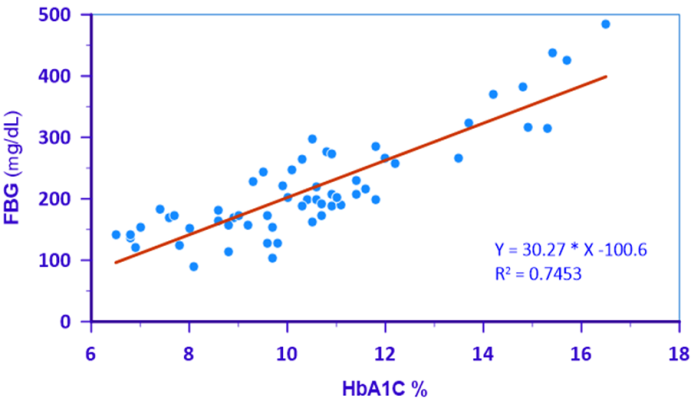
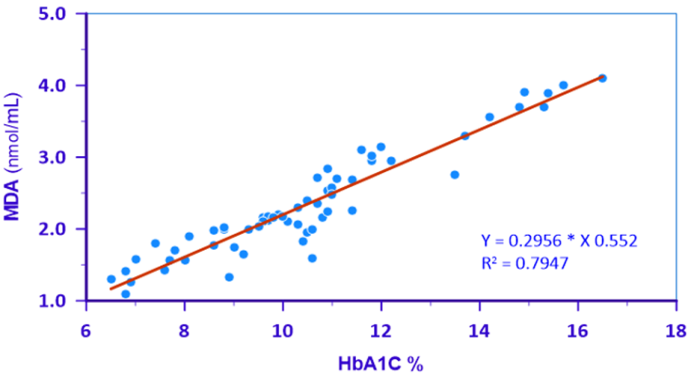
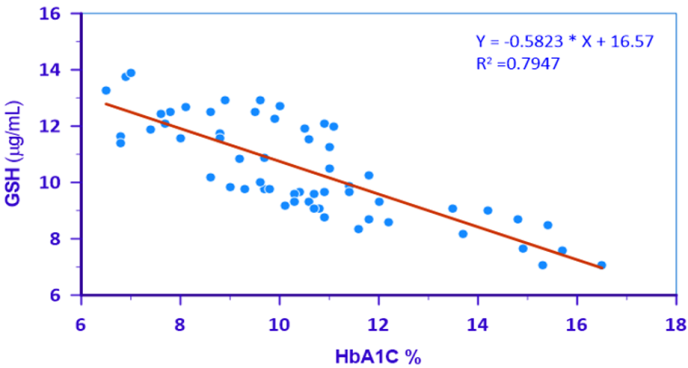
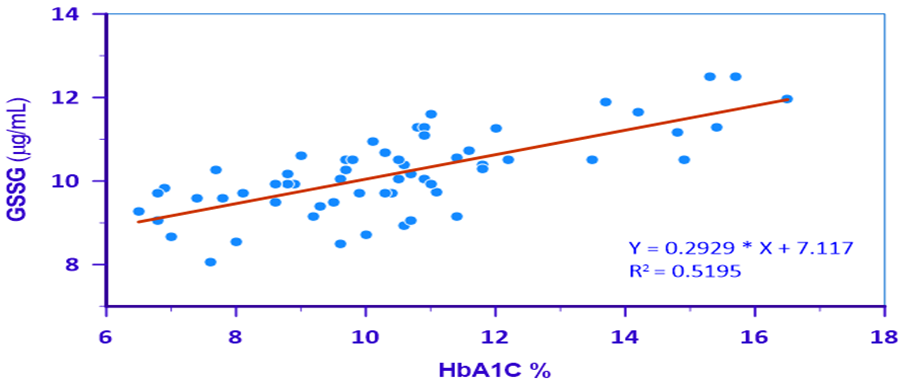
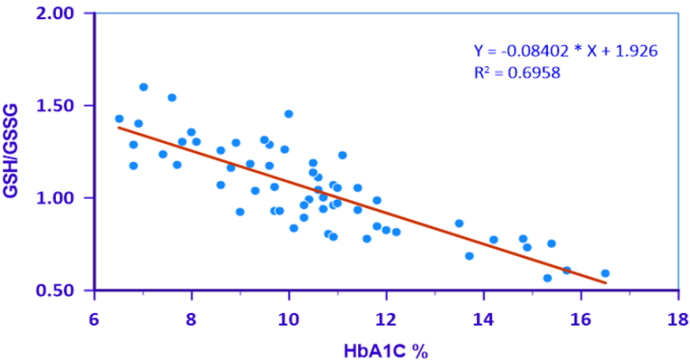
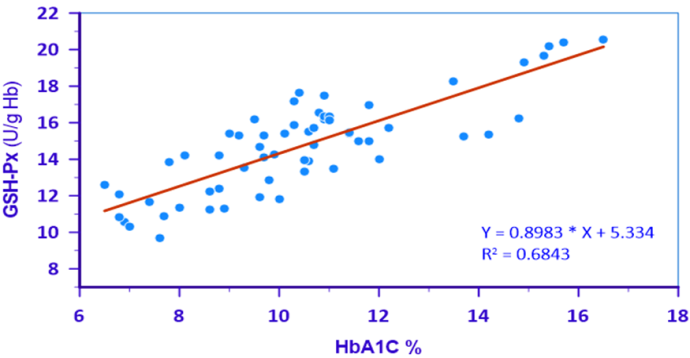
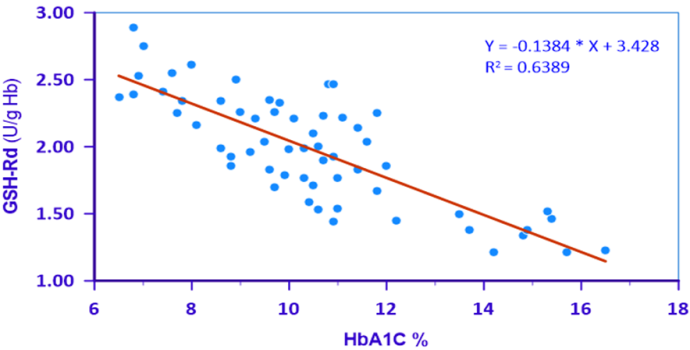
Relationship between HbA1C and FBG level, MDA, GSH, GSSG, GSH/GSSG, GSH-Px and GSH-Rd activity values of the T2DM patients are given in Figures 1-7

Figure 1. Variation of fasting blood sugar with HbA1C

Figure 2. Variation of MDA with HbA1C

Figure 3. Variation of GSH with HbA1C

Figure 4. Variation of GSSG with HbA1C

Figure 5. Variation of GSH/GSSG ratio with HbA1C

Figure 6. Variation of GSH-Px activity with HbA1C

Figure 7. Variation of GSH-Rd activity with HbA1C
It is stated that T2DM occurs after the age of 40 and the probability of its occurrence increases with age. Although nutrition, inactivity, excess weight and natural aging have a role in the association of T2DM with age, the most important factor is genetic[22]. [2]reported that HbA1C values increased with age in Chinese populations. Since parameters such as glucose and HbA1C are age-related, the mean ages of the patient and control groups were chosen close to each other in the study (p>0.05) (Table 1). The HbA1C level have been suggested to be used as a marker for diagnosing diabetes [2,23].
The experimental result showed that, FBG and HbA1C of controls group and diabetic patients were found to be 93.67 ± 6.32 mg/dL and % 4.99 ± 0.31 and 221.32± 75.92 mg/dL and % 10.42 ± 2.41 respectively. FBG and HbA1C of diabetic patients showed a significant increase (p<0.001). The results are compatible with the literature[24,1]. It has been observed that as the HbA1C value increase the FBG level also increases in patients with T2DM. The correlation between these two variables is given in Figure 1.MDA, which is formed as a result of oxidative stress, is a toxic by-product and reacts reversibly and irreversibly with proteins and phospholipids. Particularly, the collagen in the cardiovascular system hardens with the cross-links effected by MDA and becomes resistant to restructuring. Modification of collagen by sugar additives in diabetes mellitus constitutes a series of glycation products. These glycation products then stimulate the breakdown of lipids into MDA, thus causing the previously modified collagen to form more crosslinks with MDA[25,26]. It was observed that MDA levels of patients with T2DM increased significantly (p<0.001) (Table 1). The increase in MDA levels of diabetic patients is consistent with the literature[1,26]. In patients with T2DM, an increase in the amount of MDA was observed as the HbA1C value increased. The correlation between these two variables is given in Figure 2.Due to the increase in the amount of HbA1C, an increase in the amount of MDA indicates an increase in lipid peroxidation in diabetes mellitus patients.GSH is a non-enzymatic antioxidant that acts as a redox regulator in cells[27]. It was observed that while the amount of GSH decreased in T2DM, the amount of GSSG increased (p<0.001) (Table 1). The results obtained are compatible with the literature [13,24,28]. GSH/GSSG ratio, which is another indicator of oxidative stress like MDA, decreased significantly in diabetic patients (p<0.001) (Table 1). While the ratio of GSH/GSSG at the base level is high, this ratio decrease in many oxidative stress models and diabetes[29]. In their study, [30]reported that diabetic patients had decreased GSH levels. The changes of GSH, GSSG, GSH/GSSG with HbA1C in T2DM patients are given in Figure 3-5.As it can be seen in Figure 3-5, as the HbA1C value increased, the amount of GSSG and the GSH/GSSG increased and the amount of GSH decreased. Depending on the increase in HbA1C value, GSH, GSH/GSSG decrease, MDA and GSSG levels increase, which indicates the oxidative stress increase in T2DM patients, which is supported by the literature [24,29,31]
It has been reported that there is a significant increase in lipid peroxidation products as a result of decreased antioxidant defense system in T2DM[32]. Reactive oxygen species (ROS) formation, which increases as a result of oxidative stress, causes damage to the cell. Detoxification of ROS occurs with the conversion of GSH to GSSG. GSSG, which is formed as a result of this reaction catalyzed by glutathione peroxidase (GSH-Px), is converted back to GSH by the enzyme glutathione reductase (GSH-Rd)[33]. While the GSH-Px activity of T2DM patients showed a significant increase compared to the control group, a significant decrease was observed in the GSH-Rd activity (p<0.001) (Table 1).
The study conducted[34], reported that the GSH-Px activities in the erythrocytes of diabetic patients increased compared to the control group. [35]reported that the erythrocyte GSH-Px enzyme activity of patients with T2DM increased compared to the control group. [36]reported that diabetic patients had lower GSH-Rd activities compared to the control group.As seen in Figures 6 and 7, a positive correlation was observed between HbA1C and GSH-Px activity, and a negative correlation was observed between GSH-Rd activity.
Diabetes is a chronic inflammatory disease and when glucose levels are not controlled, the oxidative stress that occurs plays an important role in the pathogenesis of some complications. Depending on the increase in lipid peroxidation as a result of metabolic stress in patients with T2DM, an increase in the amount of MDA and GSSG, and a decrease in the amount of GSH and GSH/GSSG' ratio was observed. In the glutathione cycle, the GSH-Px enzyme converts GSH to GSSG, while the GSH-Rd enzyme converts GSSG to GSH. The decrease in the amount of GSH and the increase in the amount of GSSG in diabetics can be explained by the increase in the GSH-Px activity and the decrease in the GSH-Rd activity. The reason low GSH-Rd enzyme activity can be explained by the inability of GSSG to be converted to GSH and the not enough NADPH produced in the pentose phosphate pathway in T2DM patients.
Acknowledgements The financial support of Firat University, Scientific Research Projects Unit is gratefully acknowledged (Project Number FUBAP 12675). We would like to thank Prof. Dr. Yusuf Ozkan for supplying the blood samples.
The authors declare that they have no conflict of interest
No funding sources
The study was approved by the Fırat University, 23200, Elazığ, Turkey.
Morsi, H. K., et al. "Macrophage Migration Inhibitory Factor and Malondialdehyde as Potential Predictors of Vascular Risk Complications in Type 2 Diabetes Mellitus: Cross-Sectional Case Control Study in Saudi Arabia." Mediators of Inflammation, (2016), doi: 10.1155/2016/5797930.
Ma, Q., et al. "Association between Glycated Hemoglobin A1c Levels with Age and Gender in Chinese Adults with No Prior Diagnosis of Diabetes Mellitus." Biomedical Reports 4.6 (2016), pp. 737-740.
Reddigan, J. I., et al. "Differences in the Association between Clinically Relevant Classifications of Glycemia Measures and All-Cause and Cardiovascular Disease Mortality Risk." Journal of Diabetes & Metabolism, 1, (2010), p. 106.
Suryawanshi, N. P., et al. "Study of Lipid Peroxide and Lipid Profile in Diabetes Mellitus." Indian Journal of Clinical Biochemistry 21.1 (2006), pp. 126-130.
Ahmed, F. N., et al. "Lipid Peroxidation and Serum Antioxidant Enzymes in Patients with Type 2 Diabetes Mellitus." Annals of the New York Academy of Sciences, 1084, (2006), pp. 481-489.
Murotomi, K., et al. "Switching from Singlet-Oxygen-Mediated Oxidation to Free-Radical-Mediated Oxidation in the Pathogenesis of Type 2 Diabetes in Model Mouse." Free Radical Research 49.2 (2015), pp. 133-138.
Memisogullari, R., et al. "Antioxidant Status and Lipid Peroxidation in Type II Diabetes Mellitus." Cell Biochemistry and Function, 21, (2003), pp. 291-296.
Giugliano, D., et al. "Oxidative Stress and Diabetic Vascular Complications." Diabetes Care, 19, (1996), pp. 257–267.
Ceriello, A. "Oxidative Stress and Glycemic Regulation." Metabolism, 49, (2000), pp. 27–29.
Gaweł, S., et al. "Malondialdehyde as Lipid Peroxidation Marker." Wiadomości Lekarskie, 57(9-10), (2004), pp. 453-455.
American Diabetes Association. "Diagnosis and Classification of Diabetes Mellitus." Diabetes Care, 34(Supplement 1), (2011), pp. 62–69.
Lushchak, V. I. "Glutathione Homeostasis and Functions: Potential Targets for Medical Interventions." Journal of Amino Acids, (2012), pp. 1-26.
Seghieri, G., et al. "Relationship between Metabolic Glycaemic Control and Platelet Content of Glutathione and Its Related Enzymes, in Insulin-Dependent Diabetes Mellitus." Clinica Chimica Acta, 299, (2000), pp. 109–117.
Pastore, A., et al. "Analysis of Glutathione: Implication in Redox and Detoxification." Clinica Chimica Acta, 333, (2003), pp. 19-39.
Karatas, F., et al. "Determination of Free Malondialdehyde in Human Serum by High-Performance Liquid Chromatography." Analytical Biochemistry 311, (2002), pp. 76-79.
Dawes, P., and E. Dawes. SGE Chromatography Products Catalog, (2000), pp. 182.
Paglia, D. E., and W. N. Valentine. "Studies on Quantitative and Qualitative Characteristics of Erythrocyte Glutathione Peroxidase." Journal of Laboratory and Clinical Medicine, 70, (1967), pp. 158–169.
Beutler, E. Red Cell Metabolism: A Manual of Biochemical Methods, 3rd ed., Grune & Stratton, (1984), pp. 72-75, 105-106.
Carlberg, I., and B. Mannervik. "Purification and Characterization of the Flavoenzyme Glutathione Reductase from Rat Liver." Journal of Biological Chemistry, 250, (1975), pp. 55475–55480.
Fairbanks, V. F., and G. G. Klee. Biochemical Aspects of Hematology. Burtis CA, Ashwood ER, editors, Tietz Textbook of Clinical Chemistry, 3rd ed., WB Saunders, (1999), pp. 72-73.
Polonsky, K. S. "The Past 200 Years in Diabetes." New England Journal of Medicine 367.14 (2012), pp. 1332–1340.
Akyol Güner, T., et al. "Yaşlı Tip 2 Diyabetli Bireylerde Diyabet Yükünün İncelenmesi: Zonguldak İli Örneği." Türk Diyab Obez, 2, (2020), pp. 108-118.
Lippi, G., et al. "Glycated Hemoglobin, Diabetes, and Cardiovascular Risk in Nondiabetic Adults." New England Journal of Medicine 362, (2010), pp. 2030-2031, author reply 2031.
Bravi, M. C., et al. "Insulin Decreases Intracellular Oxidative Stress in Patients with Type 2 Diabetes Mellitus." Metabolism, 55, (2006), pp. 691–695.
Slatter, D., et al. "The Importance of Lipid-Derived Malondialdehyde in Diabetes Mellitus." Diabetologia 43.5 (2000), pp. 550-557.
Hacıoğlu, Y., and N. Bahtiyar. "Komplikasyonlu ve Komplikasyonsuz Tip 2 Diyabetik Hastalarda Antioksidanlar ve Lipid Peroksidasyon Durumu." Sakarya Tıp Dergisi 9.4 (2019), pp. 602-611.
Hayes, J. D., and L. I. McLellan. "Glutathione and Glutathione-Dependent Enzymes Represent a Coordinately Regulated Defence against Oxidative Stress." Free Radical Research 31.4 (1999), pp. 273-300.
Kalkan, H., and M. Suher. "The Relationship Between the Level of Glutathione, Impairment of Glucose Metabolism and Complications of Diabetes Mellitus." Pakistan Journal of Medical Sciences 29 (2013), pp. 938-942.
Calabrese, V., et al. "Oxidative Stress, Glutathione Status, Sirtuin and Cellular Stress Response in Type 2 Diabetes." Biochimica et Biophysica Acta 1822.5 (2012), pp. 729-736.
El Boghdady, N. A., and G. A. Badr. "Evaluation of Oxidative Stress Markers and Vascular Risk Factors in Patients with Diabetic Peripheral Neuropathy." Cell Biochemistry and Function 30.4 (2012), pp. 328-334.
Hamamcioğlu, A. C. "Diyabette Oksidatif Stres ve Antioksidanların Rolü." Türkiye Diyabet ve Obezite Dergisi 1 (2017), pp. 7-13.
Parthiban, A., et al. "Oxidative Stress and the Development of Diabetic Complications—Antioxidants and Lipid Peroxidation in Erythrocytes and Cell Membrane." Cell Biology International 19 (1995), pp. 987–993.
Goldin, E., et al. "Gastric Mucosal Damage in Experimental Diabetes in Rats: Role of Endogenous Glutathione." Gastroenterology, 112, (1997), pp. 855-863.
Likidlilid, A., et al. "Lipid Peroxidation and Antioxidant Enzyme Activities in Erythrocytes of Type 2 Diabetic Patients." Journal of the Medical Association of Thailand 93.6 (2010), pp. 682-693.
Kostic, N., et al. "Clinical Evaluation of Oxidative Stress in Patients with Diabetes Mellitus Type II: Impact of Acute Exercise." Vojnosanitetski Pregled 459, (2009), pp. 66-76.
Muchová, J., et al. "Antioxidant Systems in Polymorphonuclear Leucocytes of Type 2 Diabetes Mellitus." Diabetic Medicine 16.1 (1999), pp. 74–78.