Contents
Download PDF
pdf Download XML
2083 Views
220 Downloads
Share this article
Research Article | Volume 2 Issue 1 (Jan-June, 2021) | Pages 1 - 5
Effect of Different Level of Potassium on Early Growth of Maize (Zea mays L) Genotypes
 ,
1
Institute of Agriculture and Animal Science, Lamjung Campus, Sundar Bazar, Tribhuwan University, 33603 Nepal
Under a Creative Commons license
Open Access
Received
May 15, 2021
Revised
June 25, 2021
Accepted
July 15, 2021
Published
Aug. 10, 2021
Abstract

Nitrogen, phosphorus and potassium are the major nutrients required for the proper growth and development of the maize crop. Among N P K, Potassium (K) is an essential nutrient for plant growth which cannot be replaced by other nutrients. An experiment was carried out at Sundarbazar, Lamjung during May-June 2015 in diffused light condition to find the effect of K on two varieties of maize viz. RatoMakai and QPM. Maize genotypes were grown under four treatment combinations of K (control, 17kgha-1, 22 kgha-1 and 27 kgha-1). Four replication of treatment were arranged in Randomized Complete Block Design. QPM showed 13% and 9% more plant height than RatoMakai under control and 27 kgha-1 treatment respectively. Similarly, 16% more height was observed in QPM at 27 kgha-1 over control and 19% more height in RatoMakai in same case. The biomass accumulation (root and shoot) in both maize genotype were found greater in case of 27 kgha-1 than control. But, in comparison between these two genotype QPM variety showed higher biomass accumulation than RatoMakai variety in all level of treatments. QPM seemed to be suitable genotype over RatoMakai in this environmental condition, that showed good results towards all parameters at various level of treatment.

Keywords
Important Note

Key findings:

This study investigates the effect of potassium (K) on two maize varieties, RatoMakai and QPM, in diffused light conditions. It found that QPM generally outperformed RatoMakai, showing greater plant height and biomass accumulation across different K levels. This suggests that QPM is more suitable for this environment, demonstrating better growth characteristics.


What is known and what is new?

This study delves into the essential role of potassium (K) in maize growth, focusing on the comparison between two varieties, RatoMakai and QPM, under diffused light conditions. While nitrogen and phosphorus are also critical, potassium stands out as indispensable for plant development. The research, conducted in Sundarbazar, Lamjung, during May-June 2015, examines four K treatment levels (control, 17 kgha-1, 22 kgha-1, and 27 kgha-1) on the two maize genotypes. Results reveal that QPM exhibits greater plant height and biomass accumulation than RatoMakai across all K levels, with the highest differences seen at 27 kgha-1. 


What is the implication, and what should change now?

The implication of this study is the importance of potassium in maize cultivation, particularly in diffused light conditions. Farmers and agricultural policymakers should consider the potassium requirements of maize varieties when planning fertilizer applications. Additionally, the superior performance of QPM over RatoMakai suggests that farmers in similar environments should consider switching to QPM for better yields. Agricultural practices should focus on optimizing potassium use to maximize maize productivity and resilience in varying light conditions.

Introduction

Maize (Zea mays, L.) is a monocot plant and it can be grown from Terai to Hilly areas and almost all maize growing areas of Nepal [1]. In Nepal, maize is the principle food crop in hilly region and the second most staple food crop of the country after rice in terms of production and productivity. In fiscal year 2012/2013 (AICC, 2071B.S) the total production of maize was 19,99,010 MT, which occupies about 8,49,635 ha of land. More than 69% of mid hills area is occupied by maize. It can be used as food, feed, fodder and raw materials for industrial purpose.Maize plant shows good response towards fertilizer application. Among N P K, Potassium (K) is an essential nutrient for plant growth which cannot be replaced by other nutrients.The function of K is associated with increased root growth and tolerance to drought, cellulose formation, enzyme activity, photosynthesis, transportation of sugar and starch, increase protein content of plants, maintain turgor, reduce water loss, and to protect plants against diseases and nematodes.


Plants absorb potassium in its ionic form, K+. The high mobility of K results in its loss through leaching due to heavy rainfall. According to study conducted by Brady (1992), most potassium added to the soil will be fixed in the spaces between clay lattice and plants can utilize only 1-2%.The amount of slowly available potassium varies according to the type of clay that dominates the soil. Later, on the next growing season the slowly available K acts as readily available K for the plant. Potassium uptake by plant is affected by several factors thus those factors should be taken in consideration for the optimum utilization of potassium. Some of the factors associated with K uptake are soil moisture, soil aeration and oxygen level, soil temperature, tillage system.


Area under hybrid genotypes is increasing in Nepal. The hybrid genotypes replacing local and other various indigenous genotypes of maize. Hybrid varieties show good response towards fertilizer application and gives good yield than the local genotypes. Local genotypes of Nepal can also give good production in various environmental conditions.  For the better production of maize, effective fertilizer management i.e. effective dose of fertilizer should be applied.


Potassium deficiency in most soil in Nepal has been reported. Recently, depleting K pool has been reported in Nepal. Managing K, therefore, is emerging as key concern. And the required fertilizers for cultivation is not timely available. Thus, for managing the appropriate dose of potassium for the early growth and development of plant, the research has been conducted. So that which appropriate level of k could be determined for the efficient growth and development of maize plant in early phase. 

Materials & Methods

A pot experiment was conducted under diffused light condition under a roof of under construction library of Lamjung Campus, Sundarbazar, and Lamjung (800masl) during May-June 2015. The experimental area lies in mid hills region of Nepal with subtropical climate. Our experiment was carried under a roof so precipitation and direct sunlight had very less effect Randomized complete block design (RCBD) with four replication, four treatments (potassium dose of 0, 17, 22, 27 kgha-1), where Nitrogen (N) and Phosphorous (P) were kept constant which were obtained through urea (187 mg/l stock solution and 6.98g/l working solution) and KH2PO4 (35mg/l stock solution and 1.75g/l working solution) respectively for two varieties of maize (one local and one hybrid). Red maize (RatoMakai) and Quality protein maize (QPM) are local and hybrid variety of maize respectively. All the required nutrients solution (micro and macro) were prepared in the soil science laboratory. At first stock solution of definite strength was prepared and working solution prepared at the time of sowing by diluting with required amount of water. Soil required for this experiment was collected from the farm land near the experimental area. The top soil was dug out and left it for two days to dry up. Then the polypots (4L) were filled with 3kg soil in each pot after making it smooth. Each pot was applied with nutrient solution. All the required seeds for this experiment were pre-germinated in the petri dishes in the laboratory by soaking in water for 24 hours. Then the pre-germinated seedlings were sown in the pot by using forceps without damaging the radicle and plumule. Three seeds were sown in each pot and depth of sowing is 3cm. Thinning was done after seven days of sowing and one plant was removed from each pot. Plant heights were taken after 7 DAS at two days interval till 30th days and plant biomass (root and shoot) were taken after 42 DAS. Weeding was done 20 days after sowing and staking was provided for the plant. Insecticide (Nuvan) was applied @1ml L-1 of water to prevent from insect.

Results and Discussion

In the treatments of potassium in QPM variety of maize, the treatment with 27 kgha-1 showed 16% more plant height than 0 kgha-1 treatment fig.1.
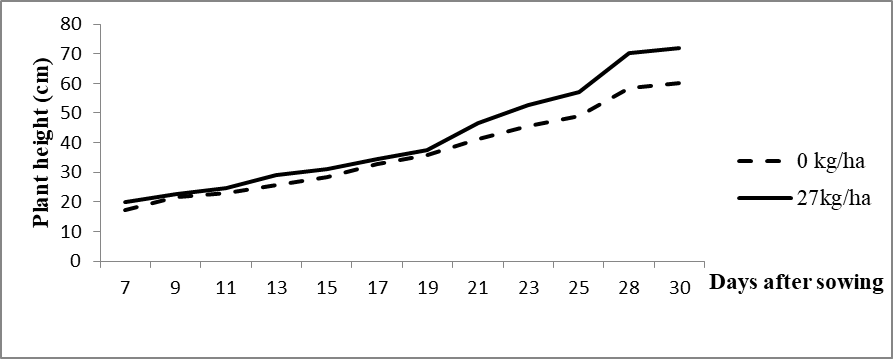
Fig 1: Comparison of different level of potassium on plant height of QPM variety


Hybrid maize shows good response towards fertilizer application. Potassium helps in the closing and opening of leaf stomata which considerably increases the leaf area index and also positively increases the plant height as well [2]. Chemma et al., (1999) has also found similar result on the application of 150 kgKha-1 over control. Findings of this study are also in line with [3,4] who also found improvement in growth parameters in different cultivars with the application of Potassium.


Plant height of RatoMakai variety in the treatment of potassium, the treatment with 27 kgha-1 showed 19% more plant height than 0 kgha-1 fig.2.
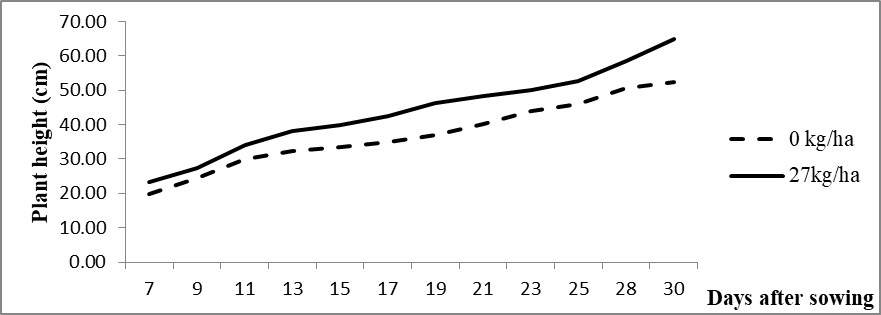
 

Fig 2: comparison of different level of potassium on plant height of RatoMakai variety

Potassium helps plant in the uptake of nutrient from the soil and thus, that might be the reason for the increment of plant height of RatoMakai variety over control treatment. The previous observed result on QPM showed the increase in height of plant on the application of higher level of potassium. Thus, the significant result has been obtained in the case of RatoMakai as well.


Shoot dry weight of both QPM and RatoMakai variety showed difference among the various level of treatment. The increasing dose of potassium caused the shoot dry matter to increase both in QPM and RatoMakai variety fig.3.
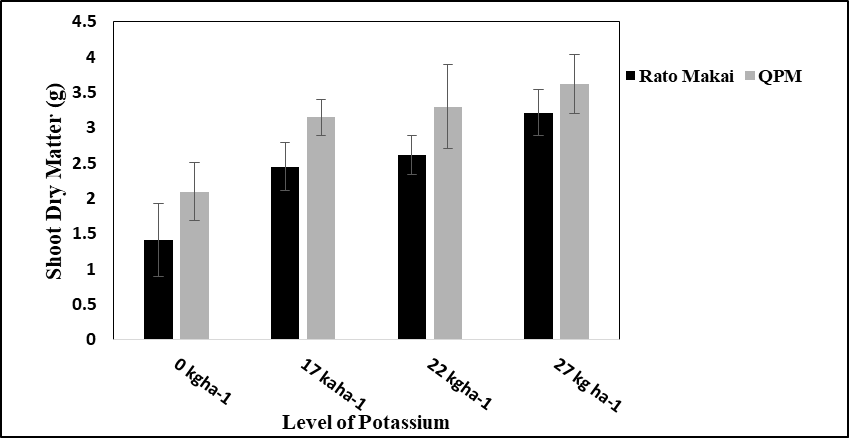
Fig3: Effect of Application of Different Level of K on Shoot Dry Weight of Both Genotypes


Application of potassium fertilizer significantly increased the dry matter and the increase on dose increased the dry matter in maize [5]. A study in maize by Adnan (2020) [6], observed similar results where fresh biomass of shoot and dry biomass of shoot, no. of leaves of plant were improved by the potassium application @ 60.0 kg ha-1 [6]. Whereas, comparing the effect of same level of potassium between two varieties, QPM was found to be superior in terms of shoot dry matter in all potassium level. Hybrid variety of maize has good response on potassium application for dry matter accumulation.Further, Jiaet. al., (2008) [7], reported increased root dry matter due to potassium uptake in early growth of rice which correlated positively with the increase in shoot dry weight in early growth caused by the upward translocation of k absorbed by root.


On comparison on the different level of treatment of potassium, on increment on the dose of potassium the root dry matter was found to be increased fig.4. Same result was obtained by Aldana, Manuel Estuardo (2005) [8], where higher dose of potassium (3.75 mM) had higher root dry weight than lowest k rate (0.75 mM).
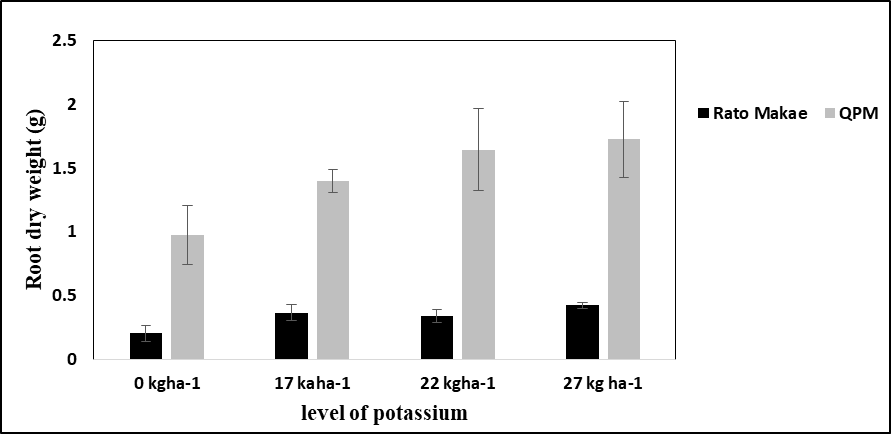


Fig 4: Effect of application of different level of K on root dry weight of both genotypes


Among two varieties QPM variety showed higher accumulation of root dry matter after 42 days compared to RatoMakai. This result is in accordance with results of Ma et al., who observed both shoot and root dry weights maximised at the application of higher doses of Potassium at 49, 63, 77, and 91 DAS in wheat crop [9]. It might be due to high absorption capacity of hybrid maize over locally adapted maize variety and as well good response of hybrid maize towards nutrient application.

Conclusion

QPM was found to be better responsive variety than RatoMakai to the different levels of potassium where the treatments of all level of potassium were superior between and within two varieties in terms of plant height, shoot biomass and root biomass accumulation in the research area. Since, this experiment was conducted just for a month. Thus, for a better result a complete growth season research for maize should be conducted. 


Acknowledgement

Author is grateful to Advisor and friends for their guidance and suggestion during the research period and to Institute of Agriculture and Animal Science, Lamjung, Nepal for infrastructural support.


Funding: No funding sources 


Conflict of interest: None declared


Ethical approval: The study was approved by the Institutional Ethics Committee of Institute of Agriculture and Animal Science

References
  1. NMRP. (2012). Proposal for the Release of Rampur Hybrid-2 Developed from RML-4 and NML-2. www.NMRP.gov.np.

  2. Uchida, Ryusei. "Essential nutrients for plant growth: nutrient functions and deficiency symptoms." Plant nutrient management in Hawaii’s soils 4 (2000): 31-55. https://www.academia.edu/download/50546518/pnm3.pdf

  3. Bukhsh, M. Ahmad Alias Haji A., et al. "Nutritional and physiological significance of potassium application in maize hybrid crop production." Pakistan Journal of Nutrition 11.2 (2012): 187. 

  4. Aslam, Muhammad, et al. "Comparative efficiency of different mungbean genotypes under Agroclimatic conditions of Bhakkar." Pak. J. Life Soc. Sci 2.1 (2004): 51-53. https://pjlss.edu.pk/pdf_files/2004_1/2004_51-53.pdf

  5. Al-Zubaidi, A., Alameddine, A., & Bashour, I. (2009). The Nature and Properties of Soil. New York: Macmillan Pub. Co. Journal of Agricultural Science, 6(2), 2014.

  6. Adnan, Muhammad. "Role of potassium in maize production: A review." Op Acc J Bio Sci Res 3.5 (2020): 1-4. https://biogenericpublishers.com/pdf/JBGSR.MS.ID.00083.pdf

  7. Jia, Yan-bo, et al. "Differential response of root morphology to potassium deficient stress among rice genotypes varying in potassium efficiency." Journal of Zhejiang University Science B 9.5 (2008): 427-434. DOIhttps://doi.org/10.1631/jzus.B0710636
  8. Aldana, Manuel Estuardo. Effect of phosphorus and potassium fertility on fruit quality and growth of Tabasco pepper (Capsicum frutescens) in hydroponic culture. Louisiana State University and Agricultural & Mechanical College, 2005. https://www.proquest.com/openview/05e8170972193925fa98411922554884/1?pq-origsite=gscholar&cbl=18750&diss=y

  9. Ma, Qifu, et al. "Effects of potassium (K) supply on plant growth, potassium uptake and grain yield in wheat grown in grey sand." 2011 WA Agribusiness Crop Updates. 2011. https://researchportal.murdoch.edu.au/esploro/outputs/conferencePaper/Effects-of-potassium-K-supply-on/991005543466107891?skipUsageReporting=true&skipUsageReporting=true&recordUsage=false&recordUsage=false&institution=61MUN_INST

License
CC BY-NC-ND
Creative Commons Attribution-NonCommercial-NoDerivatives 4.0 International License
Effect of Different Level of Potassium on Early Growth of Maize (Zea mays L) Genotypes © 2026 by R. Poudel, R.K. Shrestha licensed under CC BY-NC-ND 4.0
All papers should be submitted electronically. All submitted manuscripts must be original work that is not under submission at another journal or under consideration for publication in another form, such as a monograph or chapter of a book. Authors of submitted papers are obligated not to submit their paper for publication elsewhere until an editorial decision is rendered on their submission. Further, authors of accepted papers are prohibited from publishing the results in other publications that appear before the paper is published in the Journal unless they receive approval for doing so from the Editor-In-Chief.
Himalayan Journal of Agriculture open access articles are licensed under a Creative Commons Attribution-Share A like 4.0 International License. This license lets the audience to give appropriate credit, provide a link to the license, and indicate if changes were made and if they remix, transform, or build upon the material, they must distribute contributions under the same license as the original.
Advertisement
Recommended Articles
Research Article
Mating behaviour of Cavariella aegopodii
Published: 19/07/2024
Download PDF
Research Article
The Role of Indigenous Microbes and Earthworm in the Bioconversion of Dairy Wastewater Solids into Organic Fertilizer
...
Published: 17/01/2024
Download PDF
Research Article
The Effect of Green Marketing Mix on Purchasing Decisions by Greenly Salad Consumers in Surabaya
...
Published: 30/01/2023
Download PDF
Review Article
Registration of Gute-19 (Late Set) Soybean Varieties (Late Maturity Class)
Published: 10/10/2020
Download PDF
Chat on WhatsApp
Flowbite Logo
Najmal Complex,
Opposite Farwaniya,
Kuwait.
Email: kuwait@iarcon.org

Editorial Office:
J.L Bhavan, Near Radison Blu Hotel,
Jalukbari, Guwahati-India
Useful Links
Order Hard Copy
Privacy policy
Terms and Conditions
Refund Policy
Others
About Us
Team Members
Contact Us
Online Payments
Join as Editor
Join as Reviewer
Subscribe to our Newsletter
Follow us
MOST SEARCHED KEYWORDS
scientific journal
 | 
business journal
 | 
medical journals
 | 
Scientific Journals
 | 
Academic Publisher
 | 
Peer-reviewed Journals
 | 
Open Access Journals
 | 
Impact Factor
 | 
Indexing Services
 | 
Journal Citation Reports
 | 
Publication Process
 | 
Impact factor of journals
 | 
Finding reputable journals for publication
 | 
Submitting a manuscript for publication
 | 
Copyright and licensing of published papers
 | 
Writing an abstract for a research paper
 | 
Manuscript formatting guidelines
 | 
Promoting published research
 | 
Publication in high-impact journals
Copyright © Himalayan Journals . All Rights Reserved.