Investigation on the effects of different nitrogen levels on some agronomic traits, yield and turmerone content of turmeric (Curcuma longa) was carried out at the Department of Crop Science and Horticulture Research Farm, Nnamdi Azikiwe University Awka, Anambra State, Nigeria. The treatments were three nitrogen levels; 251 kgNha-1, 214kgNha-1 and 0kgNha-1, replicated three times. The experiment was a simple Randomized Complete Block Design (RCBD). The result showed that there was significant difference at (p≤0.05) on all the parameters; growth, yield, yield components and turmerone content assessed. Results show that yield, yield components, and turmerone concentration were increased with increase in nitrogen level applied to turmeric plants. It was observed that turmeric plants treated with nitrogen level of 251kgNha-1 performed better than plants treated with 214kgNha-1 and 0kgNha-1 being the least, and so it could be recommended that nitrogen level of 251 kgha-1 and fertilizers containing high nitrogen level should be applied for overall performance of turmeric plant in terms of agronomic traits, yield, yield component, and turmerone content in turmeric plant.
Key findings:
The study examined the impact of different nitrogen levels on the agronomic traits, yield, and turmerone content of turmeric. Results indicated significant differences in growth, yield, yield components, and turmerone content. Higher nitrogen levels, particularly 251 kgNha-1, led to improved performance in terms of yield, yield components, and turmerone concentration. This suggests that applying nitrogen at 251 kgNha-1 or using fertilizers high in nitrogen can enhance turmeric plant performance.
What is known and what is new?
This study contributes new insights into optimizing nitrogen levels for turmeric cultivation, a topic with limited research despite turmeric's economic and medicinal significance. While the importance of nitrogen for plant growth is well-established, this research provides specific guidance for turmeric farmers by demonstrating the impact of different nitrogen levels on various aspects of turmeric growth, yield, and quality. The findings suggest that applying nitrogen at 251 kgNha-1 or using fertilizers high in nitrogen can significantly improve turmeric performance. This information is valuable for farmers seeking to enhance their turmeric cultivation practices and improve crop yields.
What is the implication, and what should change now?
The implication of this study is that optimizing nitrogen levels in turmeric cultivation can lead to improved growth, yield, and quality of the crop. Farmers should consider applying nitrogen at a rate of 251 kgNha-1 or using fertilizers with high nitrogen content to enhance turmeric performance. This finding emphasizes the importance of proper nutrient management in maximizing turmeric production and highlights the need for farmers to adopt effective fertilization practices to achieve optimal yields and quality.
Turmeric (Curcuma longa L) is a flowering plant, of the ginger family, Zingiberaceae, the roots of which are used in cooking. The plant is a perennial, rhizomatous, herbaceous plant native to the Indian subcontinent and Southeast Asia, that requires temperatures between 20 and 30 °C (68 and 86 °F) and a considerable amount of annual rainfall to thrive [1].Turmeric has been used in Asia for thousands of years and is a major part of Ayurveda, Siddha medicine, traditional Chinese medicine, and Unani. According to Chattopadhyay et al., (2004) [2] it was also used in the animistic rituals of Austronesian peoples [3]. It was first used as a dye, and then later for its supposed properties in folk medicine [4]. The greatest diversity of Curcuma species by one country alone is in India, where 40 to 45 species exist. Thailand has a comparable 30 to 40 species for example, but is much smaller than India [4]. Other countries in tropical Asia also have numerous wild species of Curcuma (NCCIH, 2012) [4].
Turmeric (Curcuma longa L.) is from the family Zingiberaceae, as said earlier. Which includes more than 80 species of rhizomatous perennial? It is a herbaceous plant that has widespread existence in the tropics of Asia, Africa, and Australia. This perennial herbaceous plant, reaches a stature of up to 1 m. The turmeric plant has highly branched, yellow-to-orange, cylindrical, aromatic rhizomes. C. longa, commonly known as turmeric, is a well-known plant which is used as a drug in Ayurvedic and Unani system of medicine [5]. In turmeric plant at the top of the inflorescence, stem bracts are present on which no flowers occur; these are white to green and sometimes tinged reddish-purple, and the upper ends are tapered according to South China Botanical Garden. The hermaphrodite flowers are zygomorphic and threefold. The three sepals are 0.8 to 1.2 cm (0.3 to 0.5 in) long, fused, and white, and have fluffy hairs; the three calyxteeth are unequal. The three bright-yellow petals are fused into a corolla tube up to 3 cm (1.2 in) long. India is the largest producer, consumer and exporter of turmeric in the world. Other major producers are Thailand, other Southeast Asian countries, Central and Latin America and Taiwan (FAO, 2012). The global production of turmeric is around 1100000 tons per annum. India dominates the world production scenario contributing 78 % followed by China (8%), Myanmar (4%) and Nigeria and Bangladesh together contributing to 6% of the global production. India is the global leader in value added products of turmeric and exports [6].
The turmeric production we have in Nigeria is majorly accounted for by the north central state of the federation and about the remaining being accounted for by the other parts of the country [6]. Turmeric (Curcuma longa Linn) is an important spice both locally and globally. Its main active ingredients oleoresin and turmeric oil are used for a wide range of culinary, confectionary, and pharmaceutical purposes [7]. It is traded globally in various forms such as fresh, preserved, dried, and powdered turmeric. Turmeric also enters the global market as processed products like turmeric oil, turmeric oleoresin, turmeric candy, turmeric soft drinks, turmeric shreds, turmeric prickles, ginger chutney etc. [8]. Turmeric contains 69.4% carbohydrates, 6.3% protein, 5.1% fat, 3.5% minerals, and 13.1% moisture. The essential oil (5.8%) obtained by steam distillation possesses Sesquiterpenes (53%), zingiberene (25%), a-phellandrene (1%), sabinene (0.6%), cineol (1%), and borneol (0.5%). Curcumin (3–4%) is responsible for the yellow colour, and comprises curcumin1 (94%), turmerone (6%) and curcumin III (0.3%) [9]. Over the years the production of turmeric in Nigeria has not been in a very large scale. Nigeria turmeric production has not been up to 6% of the world output [6]. The low output in turmeric production is due primarily to inadequate information on nutrient requirements for the growth of the plant among low resource farmers as well as improper production techniques. This research is focused on solving this major problem by investigating the effects of different levels of Nitrogen in turmeric production as well as its effect on yield and turmerone content in Awka agroecology This research is very imperative based on the importance of turmerone due to its benefits as it has anti-venom activity, anti-platelet property, anticancer agent, antioxidant activity and culinary properties [10].
Experimental Site: the experimental site was in Crop Science and Horticulture research farm of Nnamdi Azikiwe University. Awka (060151211N, 070615911, and 51m above the sea level). The experiment was done from March to August, 2019. The area has average rainfall of 1810.3mm per annum and a mean minimum and maximum temperature of 270C and 27.30C respectively and a relative humidity of 72.3% [11]. Laboratory work was conducted at biotechnology research Center of Nnamdi Azikiwe University.
Materials used in the field: The experimental materials used in the field were; veneer caliper, cutlass, hoe, electronic weighing balance, pegs, rope, meter rule, safety boot, raffia hat, hand gloves, turmeric rhizome, NPK 15:15:15, and watering can.
Materials used in the laboratory: The experimental materials used in the laboratory were; measuring cylinder, different sizes of test tubes, test tube racks, Soxhlet apparatus, separating funnel, electronic weighing balance, maker, beakers, conical flask, grinding machine, hand gloves, nose mask, oven, and turmeric powder.
Reagents used in the laboratory: Reagents used in carrying out the experiment were; petroleum ether, methanol, and distilled water.
Treatments, Experimental design and Plot size: The experimental design used in the experimental site was a simple Randomized Complete Block Design (RCBD) replicated three times, which had a total land area of 100m2, and plant spacing of 50cm x 50cm. The distance from one block to the next block was 1m and each block measured 2m by 2m, with the total of 9 plots. The treatment was a fertilizer type NPK- 15:15:15 which was applied at the rate of 251kg of N per hectare and 214 kg of N per hectare respectively.
Seed Source and Description of Variety: The source of rhizomes was from National Root Crop Research Institute Umudike (NRCRI). The rhizome was the pink Indian turmeric. This variety when cut is usually pinkish in color or light red in color.
Media preparation and Nursery Practices: The media was prepared in the high tunnel at Crop Science and Horticulture Departmental nursery, using river sand, top soil, and poultry manure at the ratio of 1:3:2 respectively. The poultry manure was cured for two weeks before it was used in compounding the media. The media was then potted in nursery bags of 20cm in diameter, these nursery bags were perforated with nails to prevent submerging the rhizomes with water. The plants stayed in the nursery for two months where proper agronomic practices were carried out.
Transplanting: Transplanting was done with the aid of a hand trowel; this was done in the evening with a ball of earth on the root of the plant, this was done two months after the plant had stayed in the nursery. Plants could also be sow directly into the field but for better yield it is advised to make provisions for nursery care.
Weed Control: Weed control was done both in the field and in the nursery with hand and hoe. This was done at two weeks interval.
Land Preparation and Fertilizer Application: The land was first mapped out with measuring tape, rope, pegs and cutlass for digging hole, before the land was cleared with a cutlass; an area of 10m by10m was mapped out, and each plot had an area of 2m by 2m. Land was prepared using hoe and a furrow of 1m apart. Fertilizer was applied three weeks after transplanting into the field and the rate of nitrogen applied was 251kg of N per hectares, 214kg of N per hectare and 0kg of N per hectare.
Irrigation: The field was solely irrigated by rainfall, except in the nursery where artificial irrigation was done using a watering can with the rose on.
Harvesting: Harvesting was done seven months after planting following the yellowing of the plant leaves which is one of the maturity indices of turmeric plans. Harvesting was done with the aid of a hoe and cutlass for digging up turmeric rhizomes.
Data Collection: Data were taken uninterruptedly at two weeks interval; this was done after fertilizer application. Data were carefully taken down with a note book, and a biro. This was taken by measuring both the growth parameter and yield parameter using a pair of meter rule, a weighing balance and a veneer caliper. The parameters measured include:
Plant height: Plant heights of four randomly selected plants from each plot were taken using a pair of meter rule. This was done by measuring the plant from the tip of the shoot to the root region.
Leaf Length: Plant leaf length of four randomly selected plants from each plot were taken using a pair of meter rule. This was done by measuring from the furthest tip of a leaf to the point of attachment to the stem.
Leaf Width: Plant leaf width of four randomly selected plants from each plot were taken using a pair of meter rule. This was done by measuring from the broadest parts of the leaves using a pair of meter rule.
Leaf Area: Leaf area was gotten by simply multiplying the length and width of a leaf and standardized with the appropriate correction factor.
Rhizome Length: It is worthy of note that the rhizome length was among the yield parameters. This was gotten by measuring the length of the harvested rhizome using a meter rule.
Number of Rhizomes: The average number of rhizomes of each harvested plant per plot was counted and recorded.
Fresh Rhizome Yield (kg/ ha): The weight of fresh rhizomes was obtained per plot by weighing using a weighing balance. This could be properly expressed with the formula below:
Rhizome yield= plot yield (kg) /plot area (m2) x10000(m2)
Extraction and isolation of turmerone: Harvested turmeric rhizomes of the different levels of nitrogen were taken to the lab, in the lab these turmeric rhizomes were washed and after they were washed, the clean rhizomes placed in a sieve to allow water to drain.
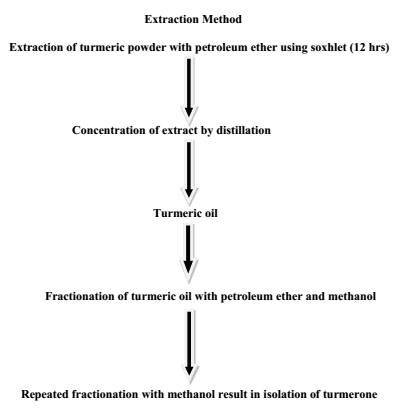
Oven drying: The rhizome samples were separately oven dried under a temperature of 3000 C for 72 hours and were ground with hand grinding machine. Twenty grams of turmeric powder was weighed out from the two different samples, 251kg/ha of nitrogen, 214kg/ha of nitrogen and 0kg/kg and extraction was carried out with 4litres of petroleum ether (b.p. 60-800C) using Soxhlet assembly for 12 hours for each of the samples. The extract obtained was then concentrated by using distillation. The solid material from the Soxhlet assembly was extracted twice more with petroleum and the concentrated filtrates or extracts were combined. This extract was nothing but turmeric oil. Turmeric oil was then fractionated between petroleum ether and methanol using separating funnel. Repeated fractionation was carried out with methanol which gave turmerone.
The result in Table 1 shows effect of different levels of nitrogen on leaf area of turmeric plant at different weeks after fertilizer application, where nitrogen level of 251kgN/ha had a higher leaf area (16.70cm2) than nitrogen level of 214kgN/ha which had leaf area of (8.53cm2). This trend was observed at 4th, 6th, and 8th weeks after application (Table 1).
Table 1 also shows that the highest leaf area (166.40cm2) was obtained in nitrogen level of 251kgN/ha which was significantly higher than leaf area of (135.10cm2) obtained in fertilizer level of 214kgN/ha. Generally, this effect of the two different nitrogen levels gave better leaf area than the control (Table 1).
Table 1: Effects of three different Nitrogen levels on leaf area of turmeric plants. leaf area (cm2)
Treatment. | 2WAA | 4WAA | 6WAA | 8WAA |
251kg of N | 16.37 | 43.60 | 93.56 | 166.40 |
214kg of N | 8.53 | 33.28 | 74.93 | 135.10 |
0 kg of N | 4.70 | 20.67 | 49.50 | 97.97 |
LSD (0.05) | 1.70 | 4.69 | 6.63 | 18.20 |
WAA-Weeks After Application
Table 2 shows effect of different levels of nitrogen on stem girth of turmeric plant at different weeks after application, where at 2 WAA nitrogen level of 251kgN/ha had a higher stem girth (10.27mm) than nitrogen level of 214kg/ha with stem girth of (8.17mm). This trend was observed in 4th, 6th, and 8th weeks after application. (Table 2)
The table also shows that the highest stem girth 22.60mm was obtained in nitrogen level of 251 kg/ha which was also significantly higher than stem girth 20.77mm obtained in nitrogen level of 214 kg/ha. Generally, the effect of the two different nitrogen levels gave better stem girth than nitrogen level of 0 kg/ha (Table 2).
Table 2: Effects of three different Nitrogen levels on Stem girth of turmeric plants. Stem girth (mm)
Treatments | 2WAA | 4WAA | 6WAA | 8WAA |
251kg of N | 10.27 | 14.03 | 18.27 | 22.60 |
214kg of N | 8.17 | 12.10 | 16.10 | 20.77 |
0 kg of N | 5.10 | 9.30 | 13.10 | 17.67 |
LSD (0.05) | 0.29 | 0.37 | 0.53 | 1.53 |
WAA-Weeks After Application
Table 3 shows that there was significant effect of different nitrogen levels on plant height of turmeric plants, where the highest plant height of turmeric was 84.20cm obtained at nitrogen level of 251kgN/ha at the 8th week after application followed by 70.80cm obtained at nitrogen level of 214kg/ha, while the least 62.10cm was obtained at 0 kg of N/ha (Table 3).
It was also observed that the higher the nitrogen level applied to turmeric plants the higher the height of plants.
Table 3: Effects of three different Nitrogen levels on turmeric plant height. plant heights (cm)
Treatments | 2WAA | 4WAA | 6WAA | 8WAA |
251kg of N | 18.83 | 44.00 | 67.80 | 84.20 |
214kg of N | 15.10 | 34.00 | 52.00 | 70.80 |
0 kg of N | 10.37 | 25.33 | 42.20 | 62.10 |
LSD (0.05) | 3.92 | 4.69 | 15.01 | 7.26 |
WAA-Weeks After Application
Table 4 Shows that there was significant effect of the different levels of nitrogen, on yield of rhizome in Kg/ha at the 10th week during harvest, it was observed that although the yield of 251KgN/ha (5220kg/ha) was higher than that of 214KgN/ha (2604kg/ha) the mean of their different yields per hectare were not significantly different, this trend was also observed between 0 Kg of N/ha (1018.7kg/ha) and the one of 214KgN/ha (2604kg/ha). The yield of 251kgN/ha (5220 kg/ha) is significantly higher than that of 0kgN/ha (1018.7kg/ha).
Table 4 shows that there was significant effect of different nitrogen levels on length of rhizomes of turmeric plant, where the highest nitrogen level of 251kgN/ha produced rhizome length of 7cm which was significantly higher than 4.33cm obtained at nitrogen level of 214kgN/ha, while the least 2.30cm was obtained at 0kgN/ha. It is fundamental to note that length of rhizomes of turmeric plant obtained at nitrogen levels of 251kgN/ha and nitrogen level 214kgN/ha were significantly higher (p<0.05) than that obtained at 0kg of N/ha (Table 4).
Table 4 also shows that there was significant effect of three different levels of nitrogen on the concentration of turmerone in turmeric plants, where the highest (36.30ml/20g) level of turmerone was obtained from nitrogen level of 251kgN/ha. This was not significantly higher than that (26.50ml/20g) obtained at nitrogen level of 214kg/ha) at (p<0.05). It could be noted that the turmerone quantity (26.50ml/20g) obtained at nitrogen level of 214kgN/ha was not significantly higher than the turmerone quantity of 20.80ml/20g obtained at 0kgN/ha. Table 4 also shows that turmerone quantity of 36.30ml/20g is significantly higher than 20.80ml/20g obtained at 214kgN/ha and 0kgN/ha respectively (Table 4). It was also observed that the higher the nitrogen level applied to turmeric plants the higher the concentration of turmerone.
Table 4 Effect of three different levels of nitrogen on turmeric yield, yield component and turmerone content.
Yield and turmerone content
Treatments | rhizome yield (kg/ha) | rhizome length (cm) | turmerone content (ml/20g) |
251 Kg of N/ha | 5220.00 | 7.00 | 36.30 |
214 kg of N/ha | 2604.00 | 4.33 | 26.50 |
0 kg of N/ha | 1018.70 | 2.30 | 20.80 |
LSD (0.05) | 3999.90 | 1.89 | 14.12 |
WAA-Weeks After Application
Effect of three different levels of nitrogen, on growth characteristics in turmeric plants in Awka Anambra state
The result showed that increase in nitrogen level led to increase in growth characteristics of turmeric plants such as leaf area, plant height, and stem girth. This is in agreement with Mohan et al., (2004) [11], who reported that, the average leaf area of turmeric plant was increased with an increase in nitrogen levels applied to turmeric plant. The result is also in agreement with the findings of Medda et al., (2003) [12], who reported that stem girth of a plant increases with an increase in nitrogen level. The result is also agreement with the findings of Govind et al., (1993) [13], who reported that plant height of turmeric plants increases with increase in nitrogen level.
Effecst of three different levels of nitrogen on yield, and yield components of turmeric plants, in Awka, Anambra state.
The result showed that increase in nitrogen level had significant effect on yield, and yield components in turmeric plants. This is in line with the findings of Ahmed and Methuswany (1981) [14], who reported that turmeric plant yield increased with increase in nitrogen level applied to turmeric plant. This result is also in line with the findings of Umate et al., (1984) [15], who reported that plant yield increased with increase in nitrogen level.
Effects of three different levels of nitrogen on turmerone concentration in turmeric plants, in Awka, Anambra state.
The result showed that increase in nitrogen level gave increased turmerone concentration in turmeric plants. This is in agreement with the findings of Hikaru et al., (2007) [16] who reported that turmerone concentration in turmeric increases with increase in nitrogen level.
From this investigation, it was observed that growth characteristics, yield, yield components, and turmerone concentration were increased with increase in nitrogen level applied to turmeric plants.
Recommendations
Nitrogen level up to 251kg/ha is recommended for the production of turmeric plant, because it gave higher yield, better yield components, and higher turmerone concentration. Fertilizers with high nitrogen content should be used in the cultivation of turmeric plant as this will lead to increase in turmerone content which is one of the important active ingredients in turmeric plant both for health benefits and its pesticidal effects.It is recommended that more work should be conducted on effects of Nitrogen levels on growth, yield and turmerone concentration in turmeric plants
Conflict of Interest
The authors declare that they have no conflict of interest.
Funding: No funding sources
Ethical approval: The study was approved by the Institutional Ethics Committee of Nnamdi Azikiwe University
Pranuthi, G., et al. "Trend and change point detection of precipitation in urbanizing Districts of Uttarakhand in India." Indian Journal of Science and Technology (2014): 1573-1582. DOI: https://doi.org/10.17485/ijst/2014/v7i10/59375
Chattopadhyay, Ishita, et al. "Turmeric and curcumin: Biological actions and medicinal applications." Current science (2004): 44-53. https://www.jstor.org/stable/24107978
Kikusawa, Ritsuko, and Lawrence A. Reid. "Proto who utilized turmeric, and how?." (2007).
NCCIH. (2012). National Center for Complementary and Integrative Health. https://www.nccih.nih.gov/ or Turmeric | NCCIH (nih.gov)
Purseglove, J. W., et al. "Spices. Volumes 1 and 2." Purseglove, JW; Brown, EG; Green, CL; Robbins, SRJ: Spices. Volumes 1 and 2. (1981).
Turmeric Outlook. (2020). Agricultural Market Intelligence Centre, PJTSAU.p1-3 https://www.pjtsau.edu.in/files/AgriMkt/2020/june/...
Amadi, C., A. O. Olojede, and M. Obasi. "Growth and yield of turmeric in a derived savanna agro-ecology of Nigeria." (2015): 388-395. Available online at http://www.journalissues.org/IJAPR/ http://dx.doi.org/10.15739/IJAPR.065
Mohan, E., et al. "Effects of graded levels of nitrogen and biofertilizers on growth, yield and quality in turmeric (Curcuma domestica Val.) cv. DK Local." (2004): 715-719. https://www.cabidigitallibrary.org/doi/full/10.5555/20043157665
Medda, P. S., and J. K. Hore. "Effect of N and K on growth and yield of turmeric in alluvial plains of West Bengal." Indian Journal of Horticulture 60.1 (2003): 84-88. https://www.indianjournals.com/ijor.aspx?target=ijor:ijh&volume=60&issue=1&article=016
Govind, S., P. N. Gupta, and B. Singh. "Effect of spacings, types and weight of rhizomes on growth and yield of turmeric." Indian Agric 37 (1993): 249-54.
Shah, H. AHMED, and S. Muthuswami. "Studies on the influence of nitrogen on the yield and yield components of turmeric (Curcuma longa L.)." (1981): 9-10. https://www.cabidigitallibrary.org/doi/full/10.5555/19820306082
Umate, M. G., & Latchanna, A. (1984). Growth and yield of turmeric varieties CIS influenced by varying levels of nitrogen. Indian Cocoa, Arecanut and Spices Journal, 8(2), 23-57.
Hikaru, Akamine, et al. "Effects of application of N, P and K alone or in combination on growth, yield and curcumin content of turmeric (Curcuma longa L.)." Plant production science 10.1 (2007): 151-154. https://cir.nii.ac.jp/crid/1390001204466557056