Background: Pre-marital screening is a series of examine that new couples undergo to screen for frequent inherited genetic blood disorders (primarily hemoglobinopathies, for instance thalassemia and sickle cell anemia) in addition to viral infections (such as hepatitis B, hepatitis C, and HIV/AIDS), sexually transmitted diseases (such as syphilis and gonorrhea), blood grouping, and resuscitation factor. Objective: The goal is to minimize the risk of a partner or child contracting a disease and to give partners choices to assist them plan for a family that is healthy. Result: This study was performed on 1380 individuals (690 couples) in Al-Furat Al-Awsat Teaching Hospital for premarital screening was performed over five months from January to the end of May of 2023. The age was ranging from 15 years to 50 years of either sex, and regarding the result for HIV was two cases only in May, VDRL was one case in January and March, two cases in April, HBV was seven cases, one case in January and February, two cases in April, and three cases in March, as regards HCV there was one case in January and two cases in February. Blood group O had the largest prevalence of blood groupings (31.5%), followed by A (25%), B (23.2%), and AB (8.9%). Rh-negative individuals made up (11.4%) of the study sample; of them, 81 (5.9%) were female and 76 (5.5) were male. Conclusions: Premarital screening programs are a crucial strategy for identifying non-symptomatic carriers of thalassemia and hepatitis virus infection.
Pre-marital screening, or PMS, is a series of investigators that new couples undergo to screen for frequent inherited genetic blood disorders (primarily hemoglobinopathies, for instance thalassemia and sickle cell anemia) in addition to viral infections (such as hepatitis B, hepatitis C, and HIV/AIDS), sexually transmitted diseases (such as syphilis and gonorrhea), blood grouping, and resuscitation factor. The goal is to minimize the risk of a partner or child contracting a disease and to give partners choices to assist them plan for a family that is healthy [4].
Premarital blood testing assists partners in identifying dangers and possible health issues for both the couple and their future children. According to [1], an individual who appears healthy may actually be an undetectable carrier of transmissible illnesses or may have undiagnosed medical conditions. Premarital screening is regarded as a principal preventative strategy for couples' preparation a pregnancy and a significant phase for maintaining the community and enabling individuals to enjoy life, especially in relation to the avoiding the dissemination of illnesses as well as it is important for the avoidance of genetic disorders of blood like hemoglobinopathy [2].
In couples suspected with thalassemia, red cell should be examined by two criteria: mean corpuscular hemoglobin (MCH) <27 pg and mean corpuscular volume (MCV) <80 fl (cut off values) before marriage to discover carriers of these illness to determine whether couples are possibly having impacted offspring [3].
Hepatitis B virus (HBV) is a type of virus that infects the liver and can lead to cirrhosis, hepatocellular carcinoma (HCC), acute and chronic hepatitis, and other illnesses. This virus can stay alive outside the human body for about 7 days, and be capable of spreading infection if it gets into the body of someone who isn't immunized [5]. One to ten weeks following an acute HBV exposure, the serum can be used to detect HBs Ag, the serological marker for HBV infection. When HBs Ag is elevated for longer than six months, chronic HBV infection results [8]. Another viral infection that affects the liver and can cause both
acute and can cause both acute and chronic illness is hepatitis C (HCV). Acute HCV infection seldom results in life-threatening conditions and is typically asymptomatic. Antiviral drugscan cure more than 95% of hepatitis C patients; unfortunately, diagnosis and therapy are not commonly accessible. In Iraq, the common population regard as low frequency and endemicity [6]. Anti-HCV, the serological marker for HCV, often manifests after 2 months, though in certain circumstances, it may take up to 6 months [9].
The human immunodeficiency virus (HIV) infect immune system cells and loss their ability for function. The phrase Acquired immunodeficiency syndrome (AIDS) is referred to the most severe of HIV infection. HIV/AIDS is a sexually transmitted infection that can spread through blood transfusions and can also be passed from mother to child through pregnancy, childbirth and breast feeding (UNAIDS, 2006).
Syphilis is a sexually transmitted infection caused by the bacteria Treponema pallidum, it can remain latent in the body for years before causing deformity, harm, and possibly even death. If left untreated, syphilis progresses through four stages. Syphilis takes 21 days to incubate, although symptoms might start to show anytime from 10 to 90 days after the infectious agent is acquired. Sexual contact is the main way that syphilis is spread and vertical transmission from mother to child is also possible. The nontreponemal "Venereal Disease Research Laboratory” (VDRL) test is used to screen for syphilis because of its low cost, sensitivity, and simplicity of use [12].
The majority common blood group incompatibility in the medical field is Rh-incompatibility, which can result in fetal anemia, hydrops, and eventually death [10].
Patients and Methods
A cross-sectional was performed at Al-Furat Al-Awsat Teaching Hospital in Al-najaf City of Iraq, was performed over five months from January to the end of May of 2023, entire individual of 1380 (690 couples) with age range from 15-50 years.
Laboratory investigations for blood grouping, Hb, RBC indices (MCV and MCH), tests for Treponema pallidum antibody (VDRL and TPHA), HCV, HBsAg, and HIV. Venous blood samples are drawn from both couples in purpose screening of hemoglobinopathies and infectious diseases. The blood sample is placed into blood tubes included EDTA after let to clot and centrifuged at 1000 rpm for 5 min, the serum was separated and utilized for the testing of HIV, HBV and HCV viruses by enzyme-linked immunosorbant assay (ELISA) technique to discover antibodies in plasma against HCV (by indirect ELISA), HIV (by sandwich ELISA), and to discover hepatitis B surface antigen (HBsAg) by (sandwich ELISA). The public health department approved permission for carrying out this study. If a couple's MCV was less than 80 fl and their MCH was less than 27 pg, they were suspected of being thalassemia carriers.
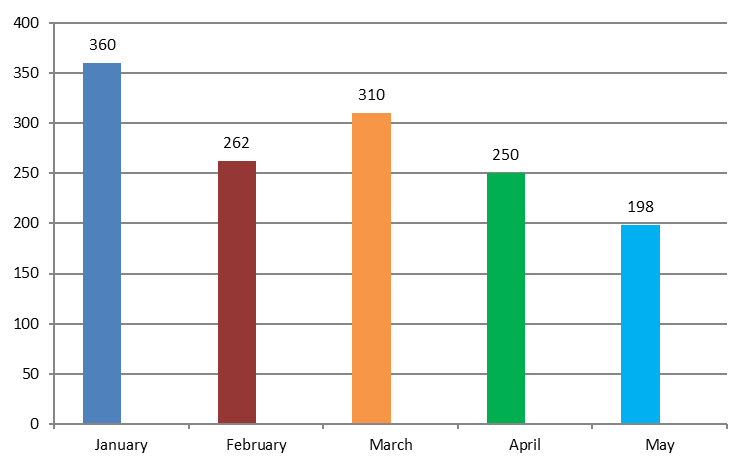
This study was performed on 1380 individuals (690 couples) in Al-Furat Al-Awsat Teaching Hospital for premarital screening. The age was ranging from 15 years to 50 years of either sex, and regarding the result for HIV was two cases only in May, VDRL was one case in January and March, two cases in April, HBV was seven cases, one case in January and February, two cases in April, and three cases in March, regarding HCV there was one case in January and two cases in February, (Table 1, 2 & Figure 1).Blood group O had the largest prevalence of blood groupings (31.5%), followed by A (25%), B (23.2%), and AB (8.9%). Rh-negative individuals made up (11.4%) of the study sample; of them, 81 (5.9%) were female and 76 (5.5) were male, as shown in Table 3.

Figure 1: The total number of participants each month
Table 1: The proportion and prevalence of VDRL and virology screens
| Months | No. | VDRL (%) | HBsV (%) | HCV (%) | HIV (%) |
| January | 360 | 1 0.07 | 1 0.07 | 1 0.07 | 0 0.00 |
| February | 262 | 0 0.00 | 1 0.07 | 2 0.14 | 0 0.00 |
| March | 310 | 1 0.07 | 3 0.21 | 0 0.00 | 0 0.00 |
| April | 250 | 2 0.14 | 2 0.14 | 0 | 0 0.00 |
| May | 198 | 0 0.00 | 0 0.00 | 0 0.00 | 2 0.14 |
| Total | 1380 | 4 0.28 | 7 0.49 | 3 0.21 | 2 0.14 |
Table 2: The screening test's positive results
| Test result | No. |
| VDRL | 4 |
| HBV | 7 |
| HCV | 3 |
| HIV | 2 |
| MCV<80 | 190 |
| MCH<27 | 248 |
| Hb Male | 82 |
| Hb Female | 187 |
Table 3: The individuals' blood type prevalence
| B.GP | Rh +ve | Rh –ve | Total | ||||
| No. | (%) | No. | (%) | No. | (%) | ||
| A | 345 | 25 | 43 | 3.1 | 388 | 28.1 | |
| B | 319 | 23.2 | 25 | 1.8 | 344 | 25 | |
| AB | 124 | 8.9 | 29 | 2.1 | 153 | 11 | |
| O | 435 | 31.5 | 60 | 4.3 | 495 | 35.9 | |
| Total | 1223 | 88.5 | 157 | 11.3 | 1380 | 100 | |
| Total | Male Female Total | 614 609 1223 | 44.5 44.1 88.6 | 76 81 157 | 5.5 5.9 11.4 | 690 690 1380 | 100 100 100 |
One of the nations where various heamoglobinopathies are endemic is Iraq. On their frequency, various epidemiological investigations have been conducted. Haemoglobinopathies affect about 7% of people worldwide as carriers. Hemoglobin (Hb) abnormalities are now considered endemic disorders in many parts of the world [13].
According to the study, couples that met the two criteria of MCV<80 and MCH<27 had respective values of 190 and 248 for thalassemia. It is comparable to others studies reported in Iraq, including Duhok, Baghdad and Basra [14].
Additional findings from our investigation of infectious diseases show that two individuals had been diagnosed with HIV, three had been tested for HCV, seven had been tested for HBV, and four had been tested for syphilis (VDRL). Few articles in Iraq have reported on the prevalence of HCV or hepatitis B carriers for premarital health screening. According to a Duhok study, the predominance of HBV infection was 1.1% and that of HCV infection was 0.2% [16]. Other countries, like Saudi Arabia, have HBV predominance rates of 1.95 and HCV predominance rates of 0.45 [15]. According to Flichman et al. (2014), study which included blood donors and was conducted in Argentina between 2004 and 2011, the prevalence of HBsAg was declined. According to the current study, the HIV rate was 0.14%, which is higher than the HIV rate of 0.03% reported by Alswaidi and O'Brien (2010) and inconsistent with the findings of the study by Ismail et al. (2016). Additionally, the percentage of HCV infection was 0.21%, greater than in the Aljarbou study [20].
Blood group O had the largest prevalence of blood groupings (31.5%) in current study, this agreement with other nations where group O is greatest frequency such as Kuwait (47.3%) [21], Bangladesh (33.8%) [22], Greece (43.7%) [23], Saudia Arabia (53.2%) [24], Egypt (36.4%) [25], Algeria (60%) [27], India (37.9%) [27]. Rh negative occurrence among females was 5.9%, which was higher than the 9.5% recorded in a 2010 study amongst Nigerian [29].
Iraq is generally regarded as having moderate levels of viral infection when compared to other countries, and the low incidence of premarital screening may be because the country's population had viral infections while they were younger than marriageable. In order to lower the number of affected children born in the area, the results of the existing study as well as the entire previously mentioned facts support the idea of developing a preventive program for hemoglobinopathies rely on ideas of premarital screening, counseling, and prenatal testing. Premarital screening is a preventative health program which implemented in numerous nations across the globe. Its objectives include identifying and treating undiagnosed diseases as well as preventing the spread of disease to partners and offspring. It also includes promoting a woman's and her partner's health before becoming pregnant, and it's a crucial stage in preserving society and enabling individuals to take pleasure in life.
Kalar, N., et al. "To Assess the Level of Awareness of Pre-Marital Sexually Transmitted Diseases (STDs) Screening Between Medical and Nonmedical Students in Karachi, Pakistan." International Journal of Collaborative Research on Internal Medicine and Public Health, vol. 4, no. 12, 2012, pp. 1959–70.
Tawfik, S., et al. "Promotion of Knowledge and Attitude towards Premarital Care: An Interventional Study Among Medical Students in Fayoum University." Journal of Public Health Epidemiology, vol. 3, 2011, pp. 121–28.
Tosun, F., et al. "Five-Year Evaluation of Premarital Screening Program for Hemoglobinopathies in the Province of Mersin, Turkey." Turkish Journal of Haematology, vol. 23, no. 2, 2006, pp. 84–89.
Alhosain, Ammar. "Premarital Screening Programs in the Middle East, from a Human Rights Perspective." Diversity and Equality in Health and Care, vol. 15, no. 2, 2018, pp. 41–45.
Haber, B. A., et al. "Recommendations for Screening, Monitoring, and Referral of Pediatric Chronic Hepatitis B." Pediatrics, vol. 124, no. 5, 2009, pp. 1007–13.
Khattab, O. S. "Prevalence and Risk Factors for Hepatitis C Virus Infection in Hemodialysis Patients in an Iraqi Renal Transplant Center." Saudi Journal of Kidney Diseases and Transplantation, vol. 19, no. 1, 2008, pp. 110–15.
Joint United Nations Programme on HIV/AIDS and World Health Organization. AIDS Epidemic Update 2006. UNAIDS, 2006.
Ogba, O. M., et al. "Hepatitis B, Human Immunodeficiency Virus and Hepatitis C Virus Infections Among Marriage Intending Couples in Calabar, Nigeria." International Journal of Biomedical Laboratory Science, vol. 4, no. 2, 2015, pp. 33–38.
Franciscus, A. HCV Antibody Tests. HCSP Fact Sheet, version 5.1, 2013, pp. 1–4.
Lazer, L., et al. "Non-Invasive Detection of Fetal Rh Using Real-Time PCR Method." OruHetil, vol. 148, no. 11, 2011, pp. 497–500.
Cohen, S. E., et al. "Syphilis in the Modern Era: An Update for Physicians." Infectious Disease Clinics of North America, vol. 27, no. 4, 2013, pp. 705–22.
Kadhim, Kamal A., et al. "Epidemiological Profile of Thalassemia in Iraq." International Conference on Preventive Medicine & Public Health, 2018, London, UK.
Al-Allawi, N. A., and Al-Dousky, A. A. "Frequency of Hemoglobinopathies at Premarital Health Screening in Dohuk, Iraq: Implications for a Regional Prevention Program." Eastern Mediterranean Health Journal, vol. 16, no. 4, 2010.
Abdullah, S. M. "Prevalence of Hepatitis B and C Virus Infection and Their Co-Relation with Hematological and Hepatic Parameters in Subjects Undergoing Premarital Screening in the Jazan Region, Kingdom of Saudi Arabia." Pakistan Journal of Medical Sciences, vol. 34, no. 2, 2018, pp. 316–321.
Warsy, A., et al. "Is Consanguinity Prevalence Decreasing in Saudis? A Study in Two Generations." African Health Sciences, vol. 14, 2014, pp. 314.
Flichman, D. M., et al. "Prevalence and Trends of Markers of Hepatitis B Virus, Hepatitis C Virus, and Human Immunodeficiency Virus in Argentine Blood Donors." BMC Infectious Diseases, vol. 14, 2014, pp. 218.
Alswaidi, F. M., and S. J. O'Brien. "Is There a Need to Include HIV, HBV, and HCV Viruses in the Saudi Premarital Screening Program?" Journal of Epidemiology & Community Health, vol. 64, no. 11, 2010, pp. 989–97.
Ismail, F., et al. "Occurrence of Hepatitis B, Hepatitis C, and HIV Infections Among Individuals Undergoing Preemployment and Premarital Medical Examination in Mediterranean Port City Tobruk, Libya." International Blood Research Review, vol. 6, no. 4, 2016.
Aljarbou, A. N. "Current Prevalence of HBV and HCV Seropositivity." Journal of Antiviral & Antiretroviral, vol. 4, no. 4, 2012.
Boyd, W. C., and Boyd, Lyle G. "The Blood Groups and Types of the Ramath Navaho." American Journal of Physical Anthropology, vol. 3, no. 7, 2010, pp. 569–74.
Zervopoulos, G., et al. "Relation of Mental Disease to Blood Groups (in Greek)." Neuropsychiat Chron, vol. 12, no. 6, 2009, pp. 12–14.
Beinab, M. A., et al. "Blood Groups in Saudi Obstetric Patients." Saudi Medical Journal, vol. 19, no. 3, 2008, p. 66–68.
Awny, A. Y., et al. "ABO Blood Groups and Haemoglobin Variants Among Nubian Egyptians." American Journal of Physical Anthropology, vol. 2, no. 3, 2005, pp. 81–82.
Benabadji, M., et al. "Erythrocytaires." Bulletin de la Société d'Anthropologie de Paris, SII, vol. 7, 1965, pp. 171–80. Cited in Lato, J. A., et al. "The ABO and Rh Blood Groups in Kihmiri Population." Indian Journal for Practicing Doctor, vol. 3, no. 2, 2006, p. 111–13.
Bhat, N. A., et al. "Frequency of Blood Groups in Donors and Recipients." The Indian Practitioner, vol. 52, no. 3, 2009, pp. 160–64.
Lato, J. A., et al. "The ABO and Rh Blood Groups in Kihmiri Population." Indian Journal for Practicing Doctor, vol. 3, no. 2, 2006, pp. 54–55.