Contents
Download PDF
pdf Download XML
2926 Views
140 Downloads
Share this article
Research Article | Volume 3 Issue 1 (Jan-June, 2022) | Pages 1 - 4
Learning Style Preferences of First-Year Undergraduate Medical College Students; Assessment using VARK Strategy
 ,
1
Department of Physiology, Government Medical College Srinagar J&K, India
2
Department of Community Medicine Government Medical College Baramulla-KanthBagh, 193101, J&K, India
Under a Creative Commons license
Open Access
Received
Jan. 13, 2022
Revised
Feb. 22, 2022
Accepted
March 30, 2022
Published
April 20, 2022
Abstract

Learning styles and approaches for gaining knowledge vary considerably among individual undergraduate medical students. Students differ in their preferred methods of acquiring, processing and recalling new information. This study aimed to investigate the learning style preferences among undergraduate medical students by using the standardized VARK questionnaire and determining the relationships of learning preferences with their gender and academic performances. The study was conducted among 108 undergraduate (1st year) medical students of Government Medical College Srinagar. The Visual, Auditory, Read/Write and Kinesthetic (VARK) methods of learning was assessed among the students. Association of learning style preferences with gender and academic performance was determined by chi-square test, student independent t-test and one-way ANOVA. In this study 35.2, 47.2, 15.7 and 1.9% of students preferred unimodal, bimodal, trimodal and tetramodal learning styles respectively. Among students with unimodal learning style, kinaesthetic modality (20.4%) was the most preferred learning style whereas read/write (1.9%) was the least preferred style. No significant difference was observed in the preferred modality according to gender (p = 0.404) and academic performance (p = 0.643). To conclude, students have varied learning styles for acquiring knowledge. Assessment of their preferred learning styles early in the course and subsequent planning of suitable teaching-learning methods will lead to the optimal success of students.

Keywords
INTRODUCTION

Students come from different backgrounds and possess different educational experiences during the years of attainment of knowledge. Students and learners possess distinctive styles of acquiring knowledge and differ in their preferences [1]. Many students may not be satisfied with the traditional curriculum and teaching-learning methods as they are passive methods of teaching with a unidirectional transfer of information [2]. Hence knowledge of preferential learning methods of each student is important for their optimal perception of, interaction with and response to the learning environment.


In recent years, as the trend of education has shifted towards student-specific learning, the instructors and educators need to understand, recognize and value the divergent styles of learning styles of the students. Once the teachers are aware of the learning method preferred by their students they can adjust the teaching methods to make teaching-learning more satisfactory and successful [3-5].


Many methods and models have been recently developed to assess the learning style preferences of learners in the teaching-learning process [6,7]. Currently the most popular and widely used model for assessment of the preferred learning style of students is the VARK model developed by Neil Fleming in 1992 [8]. This model classifies the learning preferences based on four sensory modalities; Visual (V), aural/Auditory (A), read/Write (R) and Kinaesthetic (K) [9].


Visual learners prefer to acquire knowledge through visual stimuli like charts, diagrams, graphs and maps. Aural individuals grasp knowledge through auditory stimuli by listening to audio or lectures. Individuals with read/write learning style gain knowledge by reading text material whereas, kinaesthetic learners prefer direct participation in simulation or reality and use experiences to grab concepts [9].


The study was conducted for the assessment of learning style preferences of medical students using the VARK strategy and also to determine its association with gender and course performance. 

MATERIALS AND METHODS

This study was conducted among 108 1st year undergraduate MBBS students of Government Medical College Srinagar for a period of 2 months from Nov to Dec 2021. Out of 180 students of the first-year MBBS batch, only 108 students participated in the study. Participation and submission of the questionnaire by the students was considered as their informed consent. 


The English version of VARK questionnaire version 8.01 was administered to the students to assess their preferred learning style [10]. This questionnaire contains 16 multiple choice questions with 4 options designed in a manner that the student will provide his preferred method of learning in a particular situation. Students were allowed to select more than one option for a particular question so that a minimum score of 16 and a maximum score of 64 could be obtained from each of the respondents.


If the student preferred only one of the 4 VARK learning styles, then he/she was categorised to have a ‘unimodal’ learning style and if more than one style was preferred, then it was labelled as ‘multimodal’. The multimodal category was further subdivided into bimodal, trimodal and tetramodal learning styles if the respondent preferred two, three and all the four VARK learning styles, respectively.


Statistical analysis was done in SPSS version 21. The academic performance during their first-year MBBS curriculum was obtained for determination of any relationship with their preferred learning style. The presence of any association of gender with learning style preference was determined by the Chi-square test. Student’s independent t-test and one-way ANOVA were used to find the association of academic scores with gender and VARK learning preferences. 

RESULTS

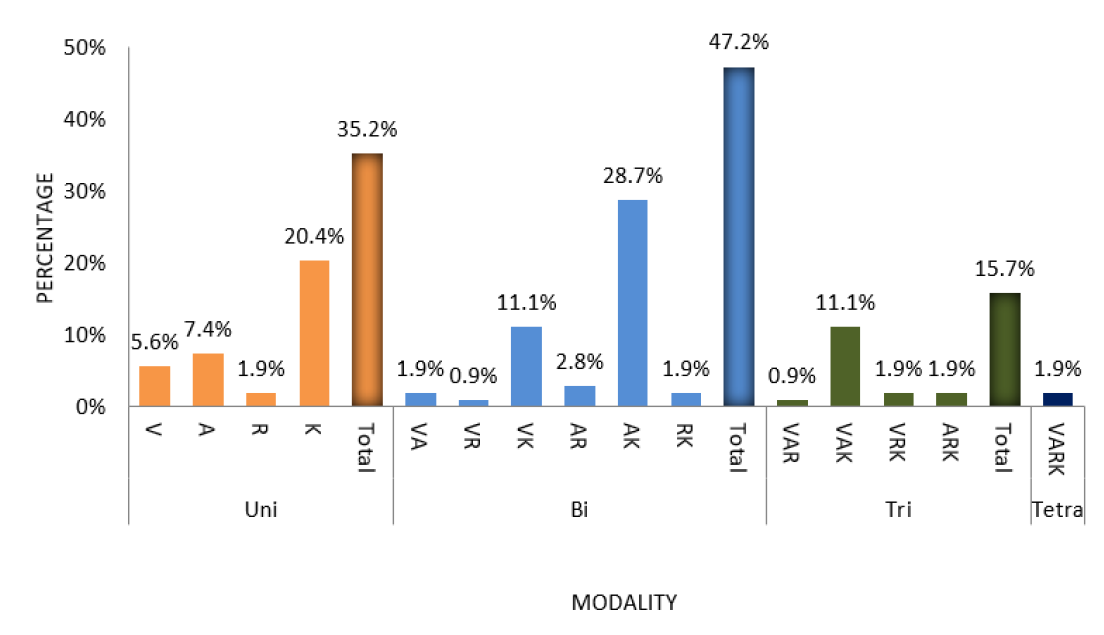
Of the 108 students who participated in the study, 50 (46.3%) were males and 58 (53.7%) were females. Figure 1 shows that around half of students (47.2%) and one-third of the students (35.2%) preferred bimodal and unimodal learning styles respectively and only 1.9% of students preferred tetramodal learning style. Among students depicting unimodal learning style, kinaesthetic modality was the most preferred learning style whereas read/write was the least preferred style.


Table 1 shows that no significant difference (p = 0.404) was observed in the preferred modality according to gender. Also in the unimodal style, the preferences for visual, auditory, read/write and kinaesthetic learning styles were similarly distributed (p = 0.707) among males and females.


The mean academic scores of the students during their course did not reveal any significant difference according to preferred modality (p=0.643). Also in the unimodal category, students who preferred the kinaesthetic type of learning style had the highest mean academic scores (59.3±6.4) whereas those preferring the visual method of learning achieved the lowest mean scores (55.8±10.8). However, this difference in mean academic scores was statistically not significant (p = 0.755 (Table 2).


Figure 1: Learning Style Preferences of Medical Students


Table 1: Learning Style Preference of Students According to Gender

 MalesFemalesp-value
Preferred Modality
Unimodal1632.0%2237.9%0.404
Bimodal2346.0%2848.3%
Trimodal918.0%813.8%
Tetramodal24.0%00.0%
Unimodal Preference
Visual313.6%318.8%0.707
Auditory418.2%425.0%
Read/Write14.5%16.3%
Kinaesthetic1463.6%850.0%


Table 2: Mean academic course score according to gender and preferred modality

GenderNMean ± SDp-value
Male5056.8±9.30.161
Female5859.5±10.0
Preferred Modality
Unimodal3858.5±7.20.643
Bimodal5157.2±11.0
Trimodal1760.6±11.1
Tetramodal260.0±9.9
Unimodal Preference
Visual655.8±10.80.755
Auditory858.9±7.5
Read/Write256.5±3.5
Kinaesthetic2259.3±6.4


DISCUSSION

VARK assessment helps to recognize the preferred learning modality of students. Awareness of their learning style preferences is essential for planning their teaching and will improve the quality of teaching, satisfaction of students and success rates of the teaching-learning process. This study helped us to understand the diversity of learning processes among our undergraduate medical students as they come from different cultural, social and intellectual backgrounds.


In our study around one third (35.2%) of the students preferred unimodal and the rest preferred multimodal learning style that comprised 47.2% bimodal, 15.7% trimodal and only 1.9% tetramodal learning styles. In support of our findings, one study from the United States also reported that 36.1% of students preferred unimodal learning style, however, on the contrary, 43.45% preferred tetramodal style [11]. Peyman et al. [12] also reported unimodal preference among 41.8% of students similar to our findings. Varied results in the preferred learning style among students have been reported in the literature [13-16].


Among students depicting unimodal learning style, kinaesthetic modality was the most preferred learning style depicted by 20.4% of students and read/write was preferred by only 1.9% of students. Kinaesthetic modality has also been reported to be the most preferred learning style in studies conducted by Khanal et al. [16] and Liew et al. [17] However some studies have reported the kinaesthetic modality as a less preferred learning style among students [12,18,19].


We did not find any significant difference in the preferred learning modality according to gender. Similarly, no significant gender differences in the preferred learning styles have been reported in many studies conducted by Dobson [14] James et al. [20] and Alkhasawneh et al. [21] However, Wehrwein et al. reported significant differences in the preferred learning styles of male and female students [22].


We also compared mean course performance scores of students with gender and preferred learning style and found no significant differences in both the comparisons. However, students with kinaesthetic learning style preference achieved higher mean academic scores whereas those with visual preference had obtained the lowest mean performance scores. Dobson, also reported no significant association of course performance with gender and preferred learning style, although students preferring kinaesthetic modality depicted the lowest course scores in contrast to our findings [14].


It is not clear why there are conflicting results reported in the literature regarding VARK preferences or their association with gender and course performance. The only logical reasoning that could explain these discrepancies can be either disproportionate gender differences among the students or variations in the teaching-learning methods during their years of schooling. Variations may also be attributed to social, cultural and intellectual differences among students of different backgrounds.


A significant limitation of this study was the number of students who participated in the study. Only 2 students preferred the tetramodal style of which none was female. Further among students preferring unimodal style only 1 each of male and female students preferred read/write learning style. This may be the reason that the study could not provide significant results regarding the association of learning style preferences with gender and course performance. Hence a large level study, preferably a multicentric one can help in providing better insight into the learning style preferences of the medical students and its impact on their academic performance.

CONCLUSION

Students depict variations in their preferred learning styles which may be attributed to discrepancies in the mode of attaining knowledge in their school life. However, VARK assessment should be done early in the course for understanding students’ learning style preferences and present information to them accordingly for a successful teaching-learning process.

REFERENCES
  1. Zhao, B. and D.D. Potter. "comparison of lecture-based learning vs discussion-based learning in undergraduate medical students." Journal of Surgical Education, vol. 73, no. 2, 2016, pp. 250–257.

  2. Felder, R.M. and R. Brent. "Understanding student differences." Journal of Engineering Education, vol. 94, no. 1, 2005, pp. 57–72.

  3. Romanelli, F. et al. "Learning styles: A review of theory, application and best practices." American Journal of Pharmaceutical Education, vol. 73, no. 1, 2009, p. 9.

  4. Vaughn, L.M. and R.C. Baker. "Do different pairings of teaching styles and learning styles make a difference? preceptor and resident perceptions." Teaching and Learning in Medicine, vol. 20, no. 3, 2008, pp. 239–247.

  5. Divaris, K. et al. "The academic environment: The students’ perspective." European Journal of Dental Education, vol. 12, suppl. 1, 2008, pp. 120–130.

  6. Coffield, F. et al. Learning Styles and Pedagogy in Post-16 Learning: A Systematic and Critical Review. Learning & Skills Research Centre, 2004.

  7. Hosford, C.C. and W.A. Siders. "Felder-Soloman’s index of learning styles: Internal consistency, temporal stability and factor structure." Teaching and Learning in Medicine, vol. 22, no. 4, 2010, pp. 298–303.

  8. Fleming, N.D. and C. Mills. "Not another inventory, rather a catalyst for invention." To Improve the Academy, 1992, pp. 137–147.

  9. Introduction to VARK/The VARK Modalitieshttps://vark-learn.com/introduction-to-vark/the-vark-modalities/. Accessed January 2022.

  10. The VARK Questionnaire, Version 8.01https://vark-learn.com/the-vark-questionnaire/. Accessed January 2022.

  11. Lujan, H.L. and S.E. DiCarlo. "First-year medical students prefer multiple learning styles." Advances in Physiology Education, vol. 30, no. 1, 2006, pp. 13–16.

  12. Peyman, H. et al. "VARK approach for assessing preferred learning styles of first year medical sciences students: A survey from Iran." Journal of Clinical and Diagnostic Research, vol. 8, no. 8, 2014, pp. 1089–1092.

  13. Meehan-Andrews, T.A. "Teaching mode efficiency and learning preferences of first year nursing students." Nurse Education Today, vol. 29, no. 1, 2009, pp. 24–32.

  14. Dobson, J.L. "A Comparison between learning style preferences and sex, status and course performance." Advances in Physiology Education, vol. 34, 2010, pp. 197–204.

  15. Panambur, S. et al. "Learning style preferences of preclinical medical students in Oman." Oman Medical Journal, vol. 29, no. 6, 2014, pp. 461–463.

  16. Khanal, L. et al. "Influence of learning-style preferences in performance in the subject of human anatomy: An institution-based study among preclinical medical students." Advances in Medical Education and Practice, vol. 10, 2019, pp. 343–355.

  17. Liew, S. et al. "The relationship between learning preferences (styles and approaches) and learning outcomes among pre-clinical undergraduate medical students." BMC Medical Education, vol. 15, no. 44, 2015, pp. 1–7.

  18. Murphy, R. et al. "Student learning preferences and teaching implications." Journal of Dental Education, vol. 68, 2004, pp. 859–866.

  19. Rezigalla, A.A. and O.Y. Ahmed. "Learning style preferences among medical students in the college of medicine, University of Bisha, Saudi Arabia (2018)." Advances in Medical Education and Practice, vol. 10, 2019, pp. 795–801.

  20. James, S. et al.  "Learning preferences of first year nursing and midwifery students: Utilising VARK." Nurse Education Today, vol. 31, no. 4, 2011, pp. 417–423.

  21. Alkhasawneh, I.M. et al. "Problem-Based Learning (PBL): Assessing students' learning preferences using VARK." Nurse Education Today, vol. 28, no. 5, 2008, pp. 572–579.

  22. Wehrwein, E.A. et al.  "Gender differences in learning style preferences among undergraduate physiology students." Advances in Physiology Education, vol. 31, no. 2, 2007, pp. 153–157.

License
CC BY-NC-ND
Creative Commons Attribution-NonCommercial-NoDerivatives 4.0 International License
Learning Style Preferences of First-Year Undergraduate Medical College Students; Assessment using VARK Strategy © 2026 by Tazeen Khan, Zahid Ali Khan licensed under CC BY-NC-ND 4.0
All papers should be submitted electronically. All submitted manuscripts must be original work that is not under submission at another journal or under consideration for publication in another form, such as a monograph or chapter of a book. Authors of submitted papers are obligated not to submit their paper for publication elsewhere until an editorial decision is rendered on their submission. Further, authors of accepted papers are prohibited from publishing the results in other publications that appear before the paper is published in the Journal unless they receive approval for doing so from the Editor-In-Chief.
Himalayan Journal of Applied Medical Sciences and Research open access articles are licensed under a Creative Commons Attribution-Share A like 4.0 International License. This license lets the audience to give appropriate credit, provide a link to the license, and indicate if changes were made and if they remix, transform, or build upon the material, they must distribute contributions under the same license as the original.
Advertisement
Recommended Articles
Research Article
Study of the Role of Serum Interleukin-6 in Inflammation among Pregnant Women with COVID-19
Published: 27/07/2021
Download PDF
Research Article
Evaluation of Serum Heat Shock Protein 70 as a Diagnostic Biomarker for Ectopic Pregnancy: A Comparative Case-Control Study
Published: 28/02/2026
Download PDF
Research Article
Bones in Balance: Awareness of Rickets and Nutritional Deficiencies Among the Hamirpur Community
Published: 10/12/2024
Download PDF
Research Article
Assessing First Trimester Maternal Serum Pentraxin-3 Levels in Primary Unexplained Recurrent Pregnancy Loss: A Case-Control Study
Published: 28/02/2026
Download PDF
Chat on WhatsApp
Flowbite Logo
Najmal Complex,
Opposite Farwaniya,
Kuwait.
Email: kuwait@iarcon.org

Editorial Office:
J.L Bhavan, Near Radison Blu Hotel,
Jalukbari, Guwahati-India
Useful Links
Order Hard Copy
Privacy policy
Terms and Conditions
Refund Policy
Others
About Us
Team Members
Contact Us
Online Payments
Join as Editor
Join as Reviewer
Subscribe to our Newsletter
Follow us
MOST SEARCHED KEYWORDS
scientific journal
 | 
business journal
 | 
medical journals
 | 
Scientific Journals
 | 
Academic Publisher
 | 
Peer-reviewed Journals
 | 
Open Access Journals
 | 
Impact Factor
 | 
Indexing Services
 | 
Journal Citation Reports
 | 
Publication Process
 | 
Impact factor of journals
 | 
Finding reputable journals for publication
 | 
Submitting a manuscript for publication
 | 
Copyright and licensing of published papers
 | 
Writing an abstract for a research paper
 | 
Manuscript formatting guidelines
 | 
Promoting published research
 | 
Publication in high-impact journals
Copyright © Himalayan Journals . All Rights Reserved.