This article investigates the influence of e-marketing on social and economic development, focusing specifically on Asia Cell Communications Company as a case study. The descriptive analysis indicates that perceptions of e-marketing practices ranged from moderate to high, with an overall mean score of 3.62 (SD = 0.35). Among the assessed sub-variables, quality digital content was rated highest (mean = 3.80), followed by the use of digital tools (mean = 3.67), technical support (mean = 3.58), promotion strategies (mean = 3.55) and targeting the appropriate audience (mean = 3.51). Regarding development outcomes, both social and economic development were positively perceived, with mean scores of (3.63 and 3.62), respectively. Regression analysis demonstrated that e-marketing exerted a statistically significant and positive effect on development outcomes, accounting for (65.8%) of the variance (R² = 0.658, p<0.001). Within the dimensions of e-marketing, promotion strategies (β = 0.757) emerged as the strongest predictor, followed by targeting the right audience, quality digital content, digital tools and technical support; all were statistically significant predictors. The findings confirm all primary and subsidiary hypotheses, leading to the conclusion that effective e-marketing strategies are pivotal in fostering social and economic development, particularly when implemented through comprehensive and targeted approaches.
In the contemporary context a confinement of expectations and new perceptions faced by individuals, organizations, as well as nations, revolving the integration of the digital environments is rapidly altering the methods in which business, institutions and individuals communicate, restore, market and interact. While traditionally engaged with commercial purpose, e-marketing is increasingly a driver of social development and economic ingenuity necessary to support development in many countries including Iraq after the conflict, with a focus on modernization. Considering the impact of the digital means of social interaction, e-marketing has enabled revitalization of youth, business and societal models of engagement to move development forward. Iraq’s rich cultural legacy and youthful population provides an opportunity for critical change. University students, who are one of the most vibrant and dynamic groups in society, are critically important if not critical actors in both the future workforce and as influencers in regard to moving towards the adoption and dissemination of digital technologies. Given this, there is a very relevant case to study how e-marketing contributes to uses fundamentally associated with development in students from Tikrit University. This research aims to examine the capability e-marketing to foster social and economic development within Iraqi society through an applied investigation sample of Tikrit University students. The goal is to investigate awareness, use and engagement with e-marketing tools and the potential for digital strategies to better local entrepreneurship, include social investments and build economic sustainability. Furthermore, the research expected to show how youth identity as digitally literate marketing individuals could inform local realities in an inclusive development context amidst challenges posed by the evolving digital space in Iraq. Finally, the study will identify the fact-finding attempts to understand what improvements can be made to improve the connectivity between the two elements of a service and digital marketing strategies to effectively meet the expectations of a digitally-savvy consumer market in Iraq.
Literature Review
E-Marketing: Marketing can be defined as identifying and describing the needs, wants and interests of target markets to provide the desired level of satisfaction effectively and efficiently than competitors provide, which results in the preservation or consolidation of all aspects that would contribute to the greater good of society [1]. There are many studies considered as the activities that enable organizations to manage their businesses using digital technologies and information technologies to take actions they would have taken in traditional marketing applications. Hence, e-marketing consists of technologies enables an organization to manage customer relationships, organize their resources, manage their supply chains, send text messages and more [2,3]. The evolution of traditional marketing to E-Marketing presents new complexities for organizations in the digital environment, can result in competition, which requires firms to innovate continuously so that they can continue to get the attention of consumers who are even more single-mindedly engaged on line [4]. E-marketing, also referred to as "online" or "internet" advertising, is a form of advertising that uses the internet to communicate with customers. This type of advertising includes email and social media advertising, web banners and mobile advertising [5]. Electronic Marketing (E-Marketing) is still a new variable, especially for food and beverage industries in developing countries that have limited resources, poor infrastructure and strong competition cannot afford to make unenlightened investments or bad decisions [6].
Digital Marketing Tools
Digital marketing tools are generally inexpensive [7]. Digital marketing tools have become universal and popular marketing channels of communication directed directly towards the target group of consumers, in a fast and continuous manner [8]. The following is a compilation of various digital marketing tools and [9].
Quality Digital Content
Digital Content is content that is delivered electronically. It can be text, images, audio or video. Digital content can come on websites, social media or apps. Digital content is vital for all types of engagement as it allows you to achieve reach in ways traditional media can't. There is so much information available on the Internet today that it’s more important than ever that your digital content is of high quality so it captures people’s attention!! Otherwise, they aren’t going to return.Businesses need quality digital content to attract new customers and establish a sustainable business. Bloggers need quality digital content to attract new readers and create long-term reading relationships. And regular people like you and I need quality digital content to share our thoughts and ideas with the world [10].
Targeting The Right Audience
The right audience in e-marketing refers to the specific subset of interested individuals in a product or service based on demographics, interests, behaviors and needs. When targeting the right audience, marketing efforts are more effective, more efficient and have greater potential to lead to stronger levels of engagement, conversions and customer satisfaction. Audience targeting allows you to be more precise when selecting the viewers of your ads. Using an audience targeting lets you reach users all over the web based on their online behavior and then the implications of those behaviors, their preferences and their consumption patterns.
Supporting and Social Development
Quick responses are indispensable to longevity or sustained success [11]. Rapid response systems are typically used in healthcare settings like hospitals to identify and respond to a patient whose condition is escalating or deteriorating while outside of the intensive care unit. The value of rapid response systems is debated [12]. Therefore, social marketers must create substantial incentives through the promotion of how and why, the benefits of their offer exceed the respective costs [13,14]. The exchange component of social marketing is an important aspect of social marketing interventions and is one of [15] benchmarks. Social marketing interventions think about how to get target individuals engaged voluntarily in behaviour change and offer something good in return. Social exchange uses actions that are dependent on getting rewarding responses from others. Social exchange can be utilitarian, with the content being tangible, network or informational types of social support, symbolic, with the content being emotional and esteem social support or mixed use, with some combination of utilitarian and symbolic. Historically, the focus of exchange within a social marketing framework has had a utilitarian nature, with social marketing largely concerned with marketing tangible offers, such as food and medicine [15] and restricted types of exchanges, which involved two party direct relationships, where the intervention promoter offered tangible assistance to the targeted audience. As the discipline has developed, the nature of the exchange has become more symbolic in nature as its use has become more widespread to include more social causes [16] and restricted exchanges were criticized for failing to examine the holistic structural, behavior and exchange contexts Social development is a process that attempts to create social harmony among the various components of satisfaction, whether they are physiological, social or even psychological. It, therefore, attempts to guarantee the life necessities which the individual cannot renounce [17].
Economic Development
Economic development only became a mainstream concern after World War II. As European colonialism came to an end, many former colonies and other countries with low living standards came to be categorized underdeveloped countries to contrast their economies with those of the developed countries, which were understood to be, Canada, the United States, Western Europe, most of Eastern Europe, the then Soviet Union, Japan, South Africa, Australia and New Zealand. While living standards in most poor countries began to rise in the following decades, they came to be known as the developing countries [18].
In emerging countries, informal firms (firms that are not listed with the government) account for approximately 50 percent of economic activities. We outline three broad views regarding the roles of formal firms in economic development [19]. It is significant to supply banking and financial services at an affordable cost, especially in areas where there is minimal interaction between formal economic systems and individual people (i.e. homes or businesses). Promoting digital finance as a pro-development financing instrument for poverty reduction has two implications regarding risk: firstly, the wealthy can transfer or mitigate the risk of using digital finance platforms by acquiring insurance, whereas the poor typically do not have the means to do so [20].
Research Hypotheses
The study includes two main hypotheses; The third main hypothesis included four sub-hypotheses as follows:
First Main Hypothesis: There are adequate e-marketing in in Iraqi society from the point of view of Tikrit University students
Second Main Hypothesis: There are adequate social and economic development in Iraqi society from the point of view of Tikrit University students
Third Main Hypothesis: E-marketing positively effect in social and economic development in Iraqi society the point of view of Tikrit University students
Sub-Main Hypothesis
Using Digital tools positively effect in social and economic development in Iraqi society the point of view of Tikrit University students

Quality digital content positively effect in social and economic development in Iraqi society the point of view of Tikrit University students.
Targeting the right audience positively effect in social and economic development in Iraqi society the point of view of Tikrit University students

Technical and technical support positively effect in social and economic development in Iraqi society the point of view of Tikrit University students

Electronic advertising and promotion strategies positively effect in social and economic development in Iraqi society the point of view of Tikrit University students
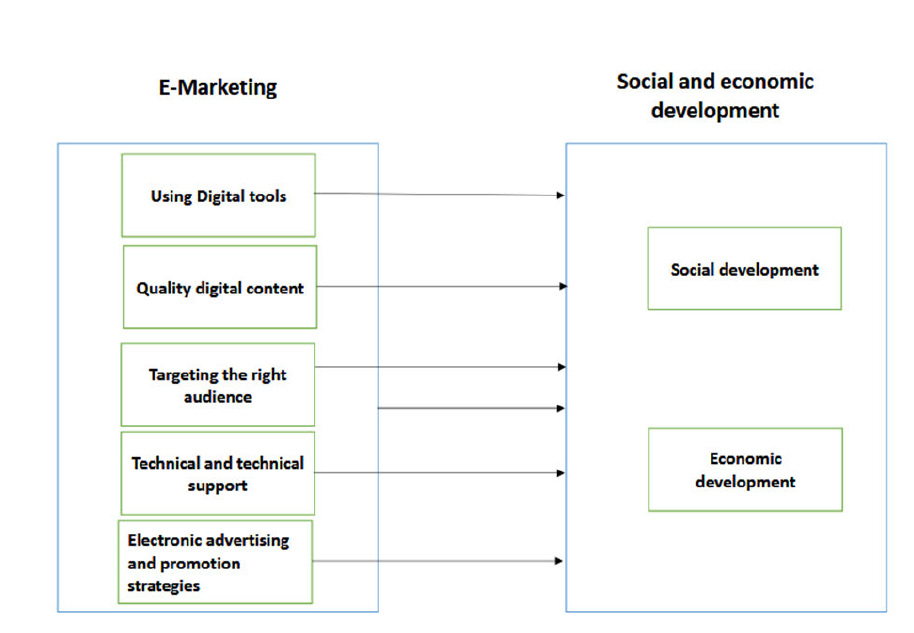
This study utilized a quantitatively deductive investigation method within the survey structure. The primary function of the literature review in the research process was to produce research hypotheses. After these were developed, numerical data has been utilized in the research process to test the hypotheses, with minimal difference on a new sample population (Figure 1).
Population Description
The population of this study consists of the student in Tikrit University for 2025-2026-year academic in Iraq.
Sample Selection and Methodology
Participants were drawn from the population: University of Tikrit in Tikrit city. Participants were under the simple random sampling strategy, in order to make an arbitrary selection of participants from different colleges and faculties at the university, depending on the investigation descriptors. The sample comprised a total of 118 students at the university: collage named: male and female undergraduate students and students at different academic standing (first year), second year, third year and fourth year students). In terms of data collection, the questionnaire was administered both electronically as well as a paper copy, while keeping in mind diversity with male and female participants and with the different fields of study and academic years, in order to provide more detailed and objective results (Table 1).
Table 1: Characteristics of Sample (n = 118)
| % | n | Level | Factor |
| 45.8 | 54 | Male | Sex |
| 54.2 | 64 | Female | |
| Age in years | |||
| 22 | 26 | Less than 25 | |
| 36.4 | 43 | 25-35 | |
| 20.3 | 24 | 35-45 | |
| 21.2 | 25 | More 45 | |
| Academic year level | |||
| 4.2 | 5 | First year | |
| 22.9 | 27 | Second year | |
| 21.2 | 25 | Third year | |
| 51.7 | 61 | Fourth year | |
| Level of Internet use | |||
| 5.1 | 6 | Never | |
| 30.5 | 36 | Sometimes | |
| 34.7 | 41 | Often | |
| 29.7 | 35 | Always | |
| Hours using of Internet per Day in hour | |||
| 11.9 | 14 | Less than 3 | |
| 63.6 | 75 | 3-6 | |
| 24.6 | 29 | More than 6 | |

Figure 1: The Planned Conceptual Model
Data Collection and Analysis
Using structured questionnaires data were collected in terms of gender, age, qualification, years of experience and job title.
Reliability Analysis
The reliability of the questionnaire items was assessed via Cronbach’s Alpha, a standard approach for evaluating internal consistency. Within the E-Marketing dimension, the sub-variables yielded the following coefficients: Using Digital Tools (α = 0.705), Quality Digital Content (α = 0.731), Targeting the Right Audience (α = 0.806), Technical and Technical Support (α = 0.711) and Electronic Advertising and Promotion Strategies (α = 0.726). Each of these surpassed the commonly accepted threshold of 0.70, signifying satisfactory reliability.
Aggregating these sub-variables produced an overall Cronbach’s Alpha of 0.865 for the main E-Marketing construct, demonstrating high internal consistency. In the Social and Economic Development dimension, Social Development (α = 0.716) and Economic Development (α = 0.726) also met acceptable reliability standards.
Combined, these sub-variables exhibited a strong reliability coefficient of 0.844. Overall, the full scale, consisting of 37 items, achieved a Cronbach’s Alpha of 0.917. This result indicates excellent internal consistency and supports the instrument’s suitability for further statistical analysis (Table 2).
Table 2: Reliability Analysis of Questionnaire Variables
| Main variable | Sub-main variable | Number of item | Alpha Cronbach's |
| Using Digital tools | 5 | 0.705 | |
| Quality digital content | 5 | 0.731 | |
| Targeting the right audience | 5 | 0.806 | |
| Technical and technical support | 5 | 0.711 | |
| Electronic advertising and promotion strategies | 5 | 0.726 | |
| E-Marketing | 25 | 0.865 | |
| Social development | 6 | 0.716 | |
| Economic development | 6 | 0.726 | |
| Social and economic development | 12 | 0.844 | |
| Total | 37 | 0.917 | |
Table 3 offers a snapshot of participants’ perceptions regarding key aspects of E-Marketing and its relation to Social and Economic Development, as measured through mean scores and standard deviations. Within the E-Marketing sub-variables, Quality Digital Content achieved the highest mean score (3.795, SD = 0.483), underlining its perceived importance among respondents. This was followed by Using Digital Tools (mean = 3.673, SD = 0.499), highlighting the recognized value of technology adoption in digital marketing strategies. Technical and Technical Support (mean = 3.586) and Electronic Advertising and Promotion Strategies (mean = 3.554) received moderate evaluations, suggesting steady, albeit improvable, performance in these areas. Targeting the Right Audience showed the lowest mean (3.512, SD = 0.525), indicating a potential area for strategic refinement. The overall E-Marketing construct recorded a mean score of 3.624 (SD = 0.350), placing it second among the two main constructs. This reflects generally positive attitudes towards digital marketing practices, while also suggesting that targeted improvements may further enhance effectiveness. Regarding Social and Economic Development, both sub-variables received similar assessments. Social Development held a slightly higher mean (3.623, SD = 0.421), closely followed by Economic Development (3.619, SD = 0.460). Together, the combined construct registered a mean of 3.627 (SD = 0.435), ranking as the highest among the main variables. This outcome demonstrates strong consensus among respondents concerning the positive impact of digital marketing on broader social and economic outcomes.
Table 3: Descriptive Statistics of Variables in Research
| Main variable | Sub-main variable | Mean | SD | Rank |
| Using Digital tools | 3.673 | 0.499 | 2 | |
| Quality digital content | 3.795 | 0.483 | 1 | |
| Targeting the right audience | 3.512 | 0.525 | 5 | |
| Technical and technical support | 3.586 | 0.505 | 3 | |
| Electronic advertising and promotion strategies | 3.554 | 0.497 | 4 | |
| E-Marketing | 3.624 | 0.35 | 2 | |
| Social development | 3.623 | 0.421 | 1 | |
| Economic development | 3.619 | 0.46 | 2 | |
| Social and economic development | 3.627 | 0.435 | 1 | |
The findings summarized in Table (4) provide clear empirical support for the central hypothesis namely, that e-marketing exerts a significant positive influence on social and economic development. The standardized beta coefficient (β = 0.811) is notably high, accompanied by a substantial T-value (14.954) and a p-value well below conventional thresholds for significance (p = 0.000). The R-square statistic (0.658) suggests that e-marketing accounts for approximately 65.8% of the observed variance in social and economic development, which strongly substantiates the main hypothesis. Turning to the sub-hypotheses, the data present a nuanced picture. First, the hypothesis that digital tools contribute positively to development is supported (β = 0.468, T = 5.709, p = 0.000), with an R-square of 0.219. While this effect is moderate, it is nonetheless statistically significant. The quality of digital content, addressed in the second sub-hypothesis, also demonstrates a meaningful impact (β = 0.543, T = 6.959, p = 0.000; R-square = 0.295), indicating that content quality accounts for nearly 30% of the variance in development outcomes. Audience targeting, the third sub-hypothesis, emerges as a particularly robust predictor. The beta coefficient (0.672) and T-value (9.778) underscore the strength of this relationship, with the model explaining 45.2% of the variance. This finding highlights the importance of reaching the appropriate audience in maximizing e-marketing’s developmental impact. The fourth sub-hypothesis, which concerns technical support, reveals a more modest though still significant effect (β = 0.383, T = 4.464, R-square = 0.147). While technical support is not the dominant factor, its role should not be overlooked in the broader context. Finally, electronic advertising and promotion strategies stand out as the most influential component among those examined. With a beta of 0.757, a T-value of 12.492 and an R-square of 0.574, the evidence indicates these strategies alone explain over half of the variance in development outcomes.
Table 4: Regression Results of E-Marketing and Its Domain in Social and Economic Development
| variable | B | β | Se | T | p-value |
| E-Marketing | 0.976 | 0.811 | 0.065 | 14.954 | 0.000 |
| R | 0.811 | - | - | - | - |
| R square | 0.658 | - | - | - | - |
| Adjusted R square | 0.656 | - | - | - | - |
| F-statistics | 223.627 | 0.000 | |||
| Using Digital tools | 0.395 | 0.468 | 0.069 | 5.709 | 0.000 |
| R | 0.468 | - | - | - | - |
| R square | 0.219 | - | - | - | - |
| Adjusted R square | 0.213 | - | - | - | - |
| F-statistics | 32.590 | 0.000 | |||
| Quality digital content | 0.472 | 0.543 | 0.068 | 6.959 | 0.000 |
| R | 0.543 | - | - | - | - |
| R square | 0.295 | - | - | - | - |
| Adjusted R square | 0.288 | - | - | - | - |
| F-statistics | 48.434 | - | - | - | 0.000 |
| Targeting the right audience | 0.538 | 0.672 | 0.055 | 9.778 | 0.000 |
| R | 0.672 | - | - | - | - |
| R square | 0.452 | - | - | - | - |
| Adjusted R square | 0.447 | - | - | - | - |
| F-statistics | 95.606 | - | - | - | 0.000 |
| Technical and technical support | 0.319 | 0.383 | 0.071 | 4.464 | 0.000 |
| R | 0.383 | - | - | - | - |
| R square | 0.147 | - | - | - | - |
| Adjusted R square | 0.139 | - | - | - | - |
| F-statistics | 19.926 | - | - | - | 0.000 |
| Electronic advertising and promotion strategies | 0.641 | 0.757 | 0.051 | 12.492 | 0.000 |
| R | 0.757 | - | - | - | - |
| R square | 0.574 | - | - | - | - |
| Adjusted R square | 0.57 | - | - | - | - |
| F-statistics | 156.045 | - | - | - | - |
This research underscores the substantial impact of e-marketing on both social and economic development. The data speaks for itself: e-marketing accounts for nearly 66% of the variance in developmental outcomes, which is nothing short of significant. Within the various elements of e-marketing, electronic advertising and promotional strategies stand out as the most influential, with audience targeting, high-quality digital content and utilization of digital tools also making noteworthy contributions. Technical support, although statistically significant, demonstrated the least influence compared to the other factors. Survey results reinforce these findings, showing that respondents place high value on quality digital content and the effective use of digital tools these aspects received the strongest ratings. Interestingly, even though targeting the appropriate audience and promotional strategies showed strong statistical effects, they were rated less highly in practice, indicating a potential disconnect between theoretical effectiveness and Real-World application. In conclusion, the evidence confirms both the main and subsidiary hypotheses: comprehensive, well-designed e-marketing strategies can drive meaningful social and economic progress. Prioritizing investment in superior digital content, targeted outreach and robust promotional approaches while not neglecting technical support can maximize the developmental benefits of e-marketing, particularly in dynamic sectors such as telecommunications.
Al-Suwaidan, H. Basics of Marketing. Dar Al-Hamid, 2003, pp. 13–14.
Strauss, J. and R. Frost. E-Marketing. Prentice-Hall, 2005.
Chaffey, D. and F. Ellis-Chadwick. Digital Marketing. 6th ed., Pearson Education Limited, 2016.
Oktavenus, R. “Analisis Pengaruh Transformasi Digital dan Pola Perilaku Konsumen Terhadap Perubahan Bisnis Model Perusahaan di Indonesia.” Jurnal Manajemen Bisnis dan Kewirausahaan, vol. 3, no. 5, 2019, pp. 44–48.
Strauss, J. and R. Frost. E-Marketing. Prentice-Hall, 2009.
Salem, I.E.B.et al. “Determinants and Effects of Applying Electronic Marketing in Alexandria Hotels: Current Status and Future Trends.” Journal of Tourism and Hospitality, vol. 2, no. 2, 2013, p. 112.
Alrousan, M.K.et al. “Factors Affecting the Adoption of E-Marketing by Decision-Makers in SMEs: Evidence from Jordan.” Research Anthology on Small Business Strategies for Success and Survival, IGI Global, 2021, pp. 887–915.
Piranda, D.R.et al. “Online Marketing Strategy in Facebook Marketplace as a Digital Marketing Tool.” Journal of Humanities, Social Sciences and Business (JHSSB), vol. 1, no. 3, 2022, pp. 1–8.
Setkute, J. and S. Dibb. “‘Old Boys’ Club’: Barriers to Digital Marketing in Small B2B Firms.” Industrial Marketing Management, vol. 102, 2022, pp. 266–279.
Jayachandran, S., K. Hewett and P. Kaufman. “Customer Response Capability in a Sense-and-Respond Era: The Role of Customer Knowledge Process.” Journal of the Academy of Marketing Science, vol. 32, no. 3, 2004, pp. 219–233.
“The Importance of Digital Content.” Horde Marketing. https://hordemarketing.com/articles/the-importance-of-digital-content/
Lyons, A. “Social Support and the Mental Health of Older Gay Men: Findings from a National Community-Based Survey.” Research on Aging, vol. 38, no. 2, 2016, pp. 234–253.
Luca, N.R. and L.S. Suggs. “Theory and Model Use in Social Marketing Health Interventions.” Journal of Health Communication, vol. 18, no. 1, 2013, pp. 20–40.
Baptista, N., H. Alves and J. Pinho. “The Case for Social Support in Social Marketing.” RAUSP Management Journal, vol. 56, 2021, pp. 295–313.
Andreasen, A.R. “Marketing Social Marketing in the Social Change Marketplace.” Journal of Public Policy and Marketing, vol. 21, no. 1, Spring 2002, pp. 3–13.
Glenane-Antoniadis, A.et al. “Extending the Vision of Social Marketing through Social Capital Theory: Marketing in the Context of Intricate Exchange and Market Failure.” Marketing Theory, vol. 3, no. 3, 2003, pp. 323–343.
Khazzaz, R. and M. Rahmani. “The Role of Social Marketing in Promoting Social Development as an Introduction to the Social and Solidarity Economy.” Journal of Studies in Economics and Business Administration, vol. 4, no. 2, 2021, pp. 318–332.
Myint, H. and A.O. Krueger. “Economic Development.” Encyclopedia Britannica, June 2025, https://www.britannica.com/money/economic-development
La Porta, R. and A. Shleifer. The Unofficial Economy and Economic Development. National Bureau of Economic Research, 2008. NBER Working Paper no. w14520.
Koh, F., Kok Fai Phoon and Cao Duy Ha. “Digital Financial Inclusion in South East Asia.” Handbook of Blockchain, Digital Finance and Inclusion. 1st ed., Elsevier, 2018.
In the contemporary context a confinement of expectations and new perceptions faced by individuals, organizations, as well as nations, revolving the integration of the digital environments is rapidly altering the methods in which business, institutions and individuals communicate, restore, market and interact. While traditionally engaged with commercial purpose, e-marketing is increasingly a driver of social development and economic ingenuity necessary to support development in many countries including Iraq after the conflict, with a focus on modernization. Considering the impact of the digital means of social interaction, e-marketing has enabled revitalization of youth, business and societal models of engagement to move development forward. Iraq’s rich cultural legacy and youthful population provides an opportunity for critical change. University students, who are one of the most vibrant and dynamic groups in society, are critically important if not critical actors in both the future workforce and as influencers in regard to moving towards the adoption and dissemination of digital technologies. Given this, there is a very relevant case to study how e-marketing contributes to uses fundamentally associated with development in students from Tikrit University. This research aims to examine the capability e-marketing to foster social and economic development within Iraqi society through an applied investigation sample of Tikrit University students. The goal is to investigate awareness, use and engagement with e-marketing tools and the potential for digital strategies to better local entrepreneurship, include social investments and build economic sustainability. Furthermore, the research expected to show how youth identity as digitally literate marketing individuals could inform local realities in an inclusive development context amidst challenges posed by the evolving digital space in Iraq. Finally, the study will identify the fact-finding attempts to understand what improvements can be made to improve the connectivity between the two elements of a service and digital marketing strategies to effectively meet the expectations of a digitally-savvy consumer market in Iraq.
Literature Review
E-Marketing: Marketing can be defined as identifying and describing the needs, wants and interests of target markets to provide the desired level of satisfaction effectively and efficiently than competitors provide, which results in the preservation or consolidation of all aspects that would contribute to the greater good of society [1]. There are many studies considered as the activities that enable organizations to manage their businesses using digital technologies and information technologies to take actions they would have taken in traditional marketing applications. Hence, e-marketing consists of technologies enables an organization to manage customer relationships, organize their resources, manage their supply chains, send text messages and more [2,3]. The evolution of traditional marketing to E-Marketing presents new complexities for organizations in the digital environment, can result in competition, which requires firms to innovate continuously so that they can continue to get the attention of consumers who are even more single-mindedly engaged on line [4]. E-marketing, also referred to as "online" or "internet" advertising, is a form of advertising that uses the internet to communicate with customers. This type of advertising includes email and social media advertising, web banners and mobile advertising [5]. Electronic Marketing (E-Marketing) is still a new variable, especially for food and beverage industries in developing countries that have limited resources, poor infrastructure and strong competition cannot afford to make unenlightened investments or bad decisions [6].
Digital Marketing Tools
Digital marketing tools are generally inexpensive [7]. Digital marketing tools have become universal and popular marketing channels of communication directed directly towards the target group of consumers, in a fast and continuous manner [8]. The following is a compilation of various digital marketing tools and [9].
Quality Digital Content
Digital Content is content that is delivered electronically. It can be text, images, audio or video. Digital content can come on websites, social media or apps. Digital content is vital for all types of engagement as it allows you to achieve reach in ways traditional media can't. There is so much information available on the Internet today that it’s more important than ever that your digital content is of high quality so it captures people’s attention!! Otherwise, they aren’t going to return.Businesses need quality digital content to attract new customers and establish a sustainable business. Bloggers need quality digital content to attract new readers and create long-term reading relationships. And regular people like you and I need quality digital content to share our thoughts and ideas with the world [10].
Targeting The Right Audience
The right audience in e-marketing refers to the specific subset of interested individuals in a product or service based on demographics, interests, behaviors and needs. When targeting the right audience, marketing efforts are more effective, more efficient and have greater potential to lead to stronger levels of engagement, conversions and customer satisfaction. Audience targeting allows you to be more precise when selecting the viewers of your ads. Using an audience targeting lets you reach users all over the web based on their online behavior and then the implications of those behaviors, their preferences and their consumption patterns.
Supporting and Social Development
Quick responses are indispensable to longevity or sustained success [11]. Rapid response systems are typically used in healthcare settings like hospitals to identify and respond to a patient whose condition is escalating or deteriorating while outside of the intensive care unit. The value of rapid response systems is debated [12]. Therefore, social marketers must create substantial incentives through the promotion of how and why, the benefits of their offer exceed the respective costs [13,14]. The exchange component of social marketing is an important aspect of social marketing interventions and is one of [15] benchmarks. Social marketing interventions think about how to get target individuals engaged voluntarily in behaviour change and offer something good in return. Social exchange uses actions that are dependent on getting rewarding responses from others. Social exchange can be utilitarian, with the content being tangible, network or informational types of social support, symbolic, with the content being emotional and esteem social support or mixed use, with some combination of utilitarian and symbolic. Historically, the focus of exchange within a social marketing framework has had a utilitarian nature, with social marketing largely concerned with marketing tangible offers, such as food and medicine [15] and restricted types of exchanges, which involved two party direct relationships, where the intervention promoter offered tangible assistance to the targeted audience. As the discipline has developed, the nature of the exchange has become more symbolic in nature as its use has become more widespread to include more social causes [16] and restricted exchanges were criticized for failing to examine the holistic structural, behavior and exchange contexts Social development is a process that attempts to create social harmony among the various components of satisfaction, whether they are physiological, social or even psychological. It, therefore, attempts to guarantee the life necessities which the individual cannot renounce [17].
Economic Development
Economic development only became a mainstream concern after World War II. As European colonialism came to an end, many former colonies and other countries with low living standards came to be categorized underdeveloped countries to contrast their economies with those of the developed countries, which were understood to be, Canada, the United States, Western Europe, most of Eastern Europe, the then Soviet Union, Japan, South Africa, Australia and New Zealand. While living standards in most poor countries began to rise in the following decades, they came to be known as the developing countries [18].
In emerging countries, informal firms (firms that are not listed with the government) account for approximately 50 percent of economic activities. We outline three broad views regarding the roles of formal firms in economic development [19]. It is significant to supply banking and financial services at an affordable cost, especially in areas where there is minimal interaction between formal economic systems and individual people (i.e. homes or businesses). Promoting digital finance as a pro-development financing instrument for poverty reduction has two implications regarding risk: firstly, the wealthy can transfer or mitigate the risk of using digital finance platforms by acquiring insurance, whereas the poor typically do not have the means to do so [20].
Research Hypotheses
The study includes two main hypotheses; The third main hypothesis included four sub-hypotheses as follows:
First Main Hypothesis: There are adequate e-marketing in in Iraqi society from the point of view of Tikrit University students
Second Main Hypothesis: There are adequate social and economic development in Iraqi society from the point of view of Tikrit University students
Third Main Hypothesis: E-marketing positively effect in social and economic development in Iraqi society the point of view of Tikrit University students
Sub-Main Hypothesis
Using Digital tools positively effect in social and economic development in Iraqi society the point of view of Tikrit University students
Quality digital content positively effect in social and economic development in Iraqi society the point of view of Tikrit University students.
Targeting the right audience positively effect in social and economic development in Iraqi society the point of view of Tikrit University students
Technical and technical support positively effect in social and economic development in Iraqi society the point of view of Tikrit University students
Electronic advertising and promotion strategies positively effect in social and economic development in Iraqi society the point of view of Tikrit University students
This study utilized a quantitatively deductive investigation method within the survey structure. The primary function of the literature review in the research process was to produce research hypotheses. After these were developed, numerical data has been utilized in the research process to test the hypotheses, with minimal difference on a new sample population (Figure 1).
Population Description
The population of this study consists of the student in Tikrit University for 2025-2026-year academic in Iraq.
Sample Selection and Methodology
Participants were drawn from the population: University of Tikrit in Tikrit city. Participants were under the simple random sampling strategy, in order to make an arbitrary selection of participants from different colleges and faculties at the university, depending on the investigation descriptors. The sample comprised a total of 118 students at the university: collage named: male and female undergraduate students and students at different academic standing (first year), second year, third year and fourth year students). In terms of data collection, the questionnaire was administered both electronically as well as a paper copy, while keeping in mind diversity with male and female participants and with the different fields of study and academic years, in order to provide more detailed and objective results (Table 1).
Table 1: Characteristics of Sample (n = 118)
| % | n | Level | Factor |
| 45.8 | 54 | Male | Sex |
| 54.2 | 64 | Female | |
| Age in years | |||
| 22 | 26 | Less than 25 | |
| 36.4 | 43 | 25-35 | |
| 20.3 | 24 | 35-45 | |
| 21.2 | 25 | More 45 | |
| Academic year level | |||
| 4.2 | 5 | First year | |
| 22.9 | 27 | Second year | |
| 21.2 | 25 | Third year | |
| 51.7 | 61 | Fourth year | |
| Level of Internet use | |||
| 5.1 | 6 | Never | |
| 30.5 | 36 | Sometimes | |
| 34.7 | 41 | Often | |
| 29.7 | 35 | Always | |
| Hours using of Internet per Day in hour | |||
| 11.9 | 14 | Less than 3 | |
| 63.6 | 75 | 3-6 | |
| 24.6 | 29 | More than 6 | |

Figure 1: The Planned Conceptual Model
Data Collection and Analysis
Using structured questionnaires data were collected in terms of gender, age, qualification, years of experience and job title.
Reliability Analysis
The reliability of the questionnaire items was assessed via Cronbach’s Alpha, a standard approach for evaluating internal consistency. Within the E-Marketing dimension, the sub-variables yielded the following coefficients: Using Digital Tools (α = 0.705), Quality Digital Content (α = 0.731), Targeting the Right Audience (α = 0.806), Technical and Technical Support (α = 0.711) and Electronic Advertising and Promotion Strategies (α = 0.726). Each of these surpassed the commonly accepted threshold of 0.70, signifying satisfactory reliability.
Aggregating these sub-variables produced an overall Cronbach’s Alpha of 0.865 for the main E-Marketing construct, demonstrating high internal consistency. In the Social and Economic Development dimension, Social Development (α = 0.716) and Economic Development (α = 0.726) also met acceptable reliability standards.
Combined, these sub-variables exhibited a strong reliability coefficient of 0.844. Overall, the full scale, consisting of 37 items, achieved a Cronbach’s Alpha of 0.917. This result indicates excellent internal consistency and supports the instrument’s suitability for further statistical analysis (Table 2).
Table 2: Reliability Analysis of Questionnaire Variables
| Main variable | Sub-main variable | Number of item | Alpha Cronbach's |
| Using Digital tools | 5 | 0.705 | |
| Quality digital content | 5 | 0.731 | |
| Targeting the right audience | 5 | 0.806 | |
| Technical and technical support | 5 | 0.711 | |
| Electronic advertising and promotion strategies | 5 | 0.726 | |
| E-Marketing | 25 | 0.865 | |
| Social development | 6 | 0.716 | |
| Economic development | 6 | 0.726 | |
| Social and economic development | 12 | 0.844 | |
| Total | 37 | 0.917 | |
Table 3 offers a snapshot of participants’ perceptions regarding key aspects of E-Marketing and its relation to Social and Economic Development, as measured through mean scores and standard deviations. Within the E-Marketing sub-variables, Quality Digital Content achieved the highest mean score (3.795, SD = 0.483), underlining its perceived importance among respondents. This was followed by Using Digital Tools (mean = 3.673, SD = 0.499), highlighting the recognized value of technology adoption in digital marketing strategies. Technical and Technical Support (mean = 3.586) and Electronic Advertising and Promotion Strategies (mean = 3.554) received moderate evaluations, suggesting steady, albeit improvable, performance in these areas. Targeting the Right Audience showed the lowest mean (3.512, SD = 0.525), indicating a potential area for strategic refinement. The overall E-Marketing construct recorded a mean score of 3.624 (SD = 0.350), placing it second among the two main constructs. This reflects generally positive attitudes towards digital marketing practices, while also suggesting that targeted improvements may further enhance effectiveness. Regarding Social and Economic Development, both sub-variables received similar assessments. Social Development held a slightly higher mean (3.623, SD = 0.421), closely followed by Economic Development (3.619, SD = 0.460). Together, the combined construct registered a mean of 3.627 (SD = 0.435), ranking as the highest among the main variables. This outcome demonstrates strong consensus among respondents concerning the positive impact of digital marketing on broader social and economic outcomes.
Table 3: Descriptive Statistics of Variables in Research
| Main variable | Sub-main variable | Mean | SD | Rank |
| Using Digital tools | 3.673 | 0.499 | 2 | |
| Quality digital content | 3.795 | 0.483 | 1 | |
| Targeting the right audience | 3.512 | 0.525 | 5 | |
| Technical and technical support | 3.586 | 0.505 | 3 | |
| Electronic advertising and promotion strategies | 3.554 | 0.497 | 4 | |
| E-Marketing | 3.624 | 0.35 | 2 | |
| Social development | 3.623 | 0.421 | 1 | |
| Economic development | 3.619 | 0.46 | 2 | |
| Social and economic development | 3.627 | 0.435 | 1 | |
The findings summarized in Table (4) provide clear empirical support for the central hypothesis namely, that e-marketing exerts a significant positive influence on social and economic development. The standardized beta coefficient (β = 0.811) is notably high, accompanied by a substantial T-value (14.954) and a p-value well below conventional thresholds for significance (p = 0.000). The R-square statistic (0.658) suggests that e-marketing accounts for approximately 65.8% of the observed variance in social and economic development, which strongly substantiates the main hypothesis. Turning to the sub-hypotheses, the data present a nuanced picture. First, the hypothesis that digital tools contribute positively to development is supported (β = 0.468, T = 5.709, p = 0.000), with an R-square of 0.219. While this effect is moderate, it is nonetheless statistically significant. The quality of digital content, addressed in the second sub-hypothesis, also demonstrates a meaningful impact (β = 0.543, T = 6.959, p = 0.000; R-square = 0.295), indicating that content quality accounts for nearly 30% of the variance in development outcomes. Audience targeting, the third sub-hypothesis, emerges as a particularly robust predictor. The beta coefficient (0.672) and T-value (9.778) underscore the strength of this relationship, with the model explaining 45.2% of the variance. This finding highlights the importance of reaching the appropriate audience in maximizing e-marketing’s developmental impact. The fourth sub-hypothesis, which concerns technical support, reveals a more modest though still significant effect (β = 0.383, T = 4.464, R-square = 0.147). While technical support is not the dominant factor, its role should not be overlooked in the broader context. Finally, electronic advertising and promotion strategies stand out as the most influential component among those examined. With a beta of 0.757, a T-value of 12.492 and an R-square of 0.574, the evidence indicates these strategies alone explain over half of the variance in development outcomes.
Table 4: Regression Results of E-Marketing and Its Domain in Social and Economic Development
| variable | B | β | Se | T | p-value |
| E-Marketing | 0.976 | 0.811 | 0.065 | 14.954 | 0.000 |
| R | 0.811 | - | - | - | - |
| R square | 0.658 | - | - | - | - |
| Adjusted R square | 0.656 | - | - | - | - |
| F-statistics | 223.627 | 0.000 | |||
| Using Digital tools | 0.395 | 0.468 | 0.069 | 5.709 | 0.000 |
| R | 0.468 | - | - | - | - |
| R square | 0.219 | - | - | - | - |
| Adjusted R square | 0.213 | - | - | - | - |
| F-statistics | 32.590 | 0.000 | |||
| Quality digital content | 0.472 | 0.543 | 0.068 | 6.959 | 0.000 |
| R | 0.543 | - | - | - | - |
| R square | 0.295 | - | - | - | - |
| Adjusted R square | 0.288 | - | - | - | - |
| F-statistics | 48.434 | - | - | - | 0.000 |
| Targeting the right audience | 0.538 | 0.672 | 0.055 | 9.778 | 0.000 |
| R | 0.672 | - | - | - | - |
| R square | 0.452 | - | - | - | - |
| Adjusted R square | 0.447 | - | - | - | - |
| F-statistics | 95.606 | - | - | - | 0.000 |
| Technical and technical support | 0.319 | 0.383 | 0.071 | 4.464 | 0.000 |
| R | 0.383 | - | - | - | - |
| R square | 0.147 | - | - | - | - |
| Adjusted R square | 0.139 | - | - | - | - |
| F-statistics | 19.926 | - | - | - | 0.000 |
| Electronic advertising and promotion strategies | 0.641 | 0.757 | 0.051 | 12.492 | 0.000 |
| R | 0.757 | - | - | - | - |
| R square | 0.574 | - | - | - | - |
| Adjusted R square | 0.57 | - | - | - | - |
| F-statistics | 156.045 | - | - | - | - |
This research underscores the substantial impact of e-marketing on both social and economic development. The data speaks for itself: e-marketing accounts for nearly 66% of the variance in developmental outcomes, which is nothing short of significant. Within the various elements of e-marketing, electronic advertising and promotional strategies stand out as the most influential, with audience targeting, high-quality digital content and utilization of digital tools also making noteworthy contributions. Technical support, although statistically significant, demonstrated the least influence compared to the other factors. Survey results reinforce these findings, showing that respondents place high value on quality digital content and the effective use of digital tools these aspects received the strongest ratings. Interestingly, even though targeting the appropriate audience and promotional strategies showed strong statistical effects, they were rated less highly in practice, indicating a potential disconnect between theoretical effectiveness and Real-World application. In conclusion, the evidence confirms both the main and subsidiary hypotheses: comprehensive, well-designed e-marketing strategies can drive meaningful social and economic progress. Prioritizing investment in superior digital content, targeted outreach and robust promotional approaches while not neglecting technical support can maximize the developmental benefits of e-marketing, particularly in dynamic sectors such as telecommunications.
Al-Suwaidan, H. Basics of Marketing. Dar Al-Hamid, 2003, pp. 13–14.
Strauss, J. and R. Frost. E-Marketing. Prentice-Hall, 2005.
Chaffey, D. and F. Ellis-Chadwick. Digital Marketing. 6th ed., Pearson Education Limited, 2016.
Oktavenus, R. “Analisis Pengaruh Transformasi Digital dan Pola Perilaku Konsumen Terhadap Perubahan Bisnis Model Perusahaan di Indonesia.” Jurnal Manajemen Bisnis dan Kewirausahaan, vol. 3, no. 5, 2019, pp. 44–48.
Strauss, J. and R. Frost. E-Marketing. Prentice-Hall, 2009.
Salem, I.E.B.et al. “Determinants and Effects of Applying Electronic Marketing in Alexandria Hotels: Current Status and Future Trends.” Journal of Tourism and Hospitality, vol. 2, no. 2, 2013, p. 112.
Alrousan, M.K.et al. “Factors Affecting the Adoption of E-Marketing by Decision-Makers in SMEs: Evidence from Jordan.” Research Anthology on Small Business Strategies for Success and Survival, IGI Global, 2021, pp. 887–915.
Piranda, D.R.et al. “Online Marketing Strategy in Facebook Marketplace as a Digital Marketing Tool.” Journal of Humanities, Social Sciences and Business (JHSSB), vol. 1, no. 3, 2022, pp. 1–8.
Setkute, J. and S. Dibb. “‘Old Boys’ Club’: Barriers to Digital Marketing in Small B2B Firms.” Industrial Marketing Management, vol. 102, 2022, pp. 266–279.
Jayachandran, S., K. Hewett and P. Kaufman. “Customer Response Capability in a Sense-and-Respond Era: The Role of Customer Knowledge Process.” Journal of the Academy of Marketing Science, vol. 32, no. 3, 2004, pp. 219–233.
“The Importance of Digital Content.” Horde Marketing. https://hordemarketing.com/articles/the-importance-of-digital-content/
Lyons, A. “Social Support and the Mental Health of Older Gay Men: Findings from a National Community-Based Survey.” Research on Aging, vol. 38, no. 2, 2016, pp. 234–253.
Luca, N.R. and L.S. Suggs. “Theory and Model Use in Social Marketing Health Interventions.” Journal of Health Communication, vol. 18, no. 1, 2013, pp. 20–40.
Baptista, N., H. Alves and J. Pinho. “The Case for Social Support in Social Marketing.” RAUSP Management Journal, vol. 56, 2021, pp. 295–313.
Andreasen, A.R. “Marketing Social Marketing in the Social Change Marketplace.” Journal of Public Policy and Marketing, vol. 21, no. 1, Spring 2002, pp. 3–13.
Glenane-Antoniadis, A.et al. “Extending the Vision of Social Marketing through Social Capital Theory: Marketing in the Context of Intricate Exchange and Market Failure.” Marketing Theory, vol. 3, no. 3, 2003, pp. 323–343.
Khazzaz, R. and M. Rahmani. “The Role of Social Marketing in Promoting Social Development as an Introduction to the Social and Solidarity Economy.” Journal of Studies in Economics and Business Administration, vol. 4, no. 2, 2021, pp. 318–332.
Myint, H. and A.O. Krueger. “Economic Development.” Encyclopedia Britannica, June 2025, https://www.britannica.com/money/economic-development
La Porta, R. and A. Shleifer. The Unofficial Economy and Economic Development. National Bureau of Economic Research, 2008. NBER Working Paper no. w14520.
Koh, F., Kok Fai Phoon and Cao Duy Ha. “Digital Financial Inclusion in South East Asia.” Handbook of Blockchain, Digital Finance and Inclusion. 1st ed., Elsevier, 2018.