The purpose of the study is to determine the level of interaction of Zain Telecom employees with viral marketing campaigns that they receive via email, on the one hand. On the other hand, its relationship with the electronic spread of brands, the researcher relied on a descriptive approach based on theoretical information from many sources and references available in libraries. The survey form was designed as the primary tool in data collection, where 150 were distributed Number of forms valid for analysis was 120. Forms Relied on the SPSS statistical program the study confirmed that viral marketing has a positive effect on brands based on the study conducted. With this, the researcher recommended further promotion of the use of viral marketing campaigns to promote brands.
Keywords
Viral Marketing
Email
Online Advertising
Social Media
Branding
INTRODUCTION
Due to the high expenditure on promotional campaigns, a new type of marketing has emerged called (viral marketing) as it is used to promote the products of an organization through the internet through various websites, especially social media, which have a large circulation among individuals, as viral marketing is one of the modern concepts in the fields of marketing that organizations rely on to attract and attract customers and influence their purchasing decisions [1].
Viral marketing has recently generated much excitement as a new technology in the marketing world, where viral marketing is based on the basic idea that a company prepares attractive and enjoyable content for its marketing message that includes information about its products on its website in several ways: text, image, audioand video, to influence customers and encourage them to spread the viral message to their families, friendsand family, which increases the spread of this message and thus increases the promotion of its products quickly, completely Just like the speed of the virus spread.
Viral marketing is one of the most potent and effective marketing tools as it is considered as one of the new and innovative methods of online product marketing, which involves convincing consumers to redirect advertising to others through emails and social media sites to achieve goals at the lowest possible cost [2].
Study Problem
Due to the growing interest of enterprises in technology, increasing competition among enterprisesand the changing needs and desires of customers (who are also becoming more patient when making purchasing decisions), enterprises tend to seek and apply various innovations in the business world to achieve their goals at the lowest possible cost. With the emergence of the concept of viral marketing as a modern marketing method that delivers advertising information to the broadest possible audience through the Internet and conveys its content credibly and reliably, it is necessary to study further and investigate this concept. Therefore, this study attempts to answer the following questions:
To what extent do Zain Telecom employees interact with viral marketing campaigns?
How does this relate to online purchasing decisions?
This central question stems from the following sub-questions:
To what extent do Zain Telecom employees interact with viral marketing campaigns they receive through email?
To what extent do Zain Telecom employees interact with viral marketing campaigns they receive through email? 2. How much interaction do Zain Telecom employees have with viral marketing campaigns received through electronic advertising?
How much interaction do Zain Telecom employees have with viral marketing campaigns received through social media?
How much interaction do Zain Telecom employees receive from viral marketing campaigns through opinion leaders and influencers?
Objectives of the Study
This study aims to:
Determine the extent of interaction of Zain Telecom employees with viral marketing campaigns received through emails and their relationship with electronic brand communication
Determine the extent of interaction of Zain Telecom employees with viral marketing campaigns received through electronic advertisements and their relationship with brands
Determine the extent of interaction of Zain Telecom employees with viral marketing campaigns received through social media and their relationship with brands
Determine the extent of interaction of Zain Telecom employees with viral marketing campaigns exposed through opinion leaders and influencersand their relationship with brands
Determine the extent to which electronic advertising campaigns provide data and information that helps Zain Telecom employees understand their actual needs and desires
Determine the extent to which electronic advertising campaigns provide data and information that helps Zain Telecom employees compare different brand options
Determine the actual interaction of Zain Telecom employees with viral marketing in electronic brand communication
Determine the actual post-purchase behavior of employees when interacting with Zain Telecom after exposure to viral marketing campaigns
To determine the level of engagement among Zain Telecom employees on popular social media platforms
Importance of the Study
This study explores the relationship between Zain Telecom employees’ interaction with viral marketing campaigns received through email, e-advertising, social mediaand opinion leaders and influencersand the brand’s e-communication
This study is one of the few that explores the relationship between viral marketing and the online communication of e-tags
It can inspire researchers to conduct further studies on similar topics, thereby enriching the literature in the field in university libraries
This study aims to increase institutional awareness of the importance of viral marketing, which is essential for quickly and cost-effectively promoting products locally and globally through the Internet
The results of this study will be provided to companies and marketers to help them implement online marketing strategies to improve performance
Research Hypothesis
To achieve the objectives of the study, hypotheses were formulated as follows.
Primary Hypothesis
Viral marketing has a statistically significant positive impact on brands (significance level 0.05). This hypothesis can be divided into:
First Sub-Hypothesis: Email has a statistically significant positive impact on brands (significance level 0.05)
Second Sub-Hypothesis: Electronic advertising has a statistically significant positive impact on brands (significance level 0.05)
Third Sub-Hypothesis: Social networks have a statistically significant positive impact on brands (significance level 0.05)
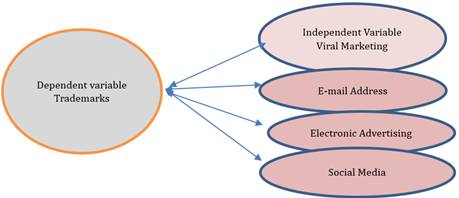
Figure 1: Hypothetical Study Outline
Research Form
The research model is designed as a diagram that reflects the nature of the relationship between the research variables and expresses the results of the research questions. It contains two main variables: the first variable represents viral marketing as the independent variable of its dimension. The second variable represents brand as the dependent variable of its dimension. As shown in Figure 1.
MATERIALS AND METHODS
The researcher relied on a descriptive approach based on theoretical information from numerous sources and references in the library and developed a questionnaire as the primary tool for data collection, in which all the research variables were considered and covered to achieve the research objectives and its hypotheses based on theoretical aspects and previous studies.
The Concept of Viral Marketing
Marketing encompasses all processes and activities aimed at identifying customer needs.
Products or service lines are developed to meet these needs on the one hand and to achieve profitability for the company within a specific period on the other. The concept of marketing has gone through several stages from traditional to modern. This coincides with the rapid development of media and communicationsand is now adopted by modern organizations as marketers are encouraged to use it to reach the target audience [3].
Fraser, believes that viral marketing is a marketing technique that uses existing social networks to promote brands or achieve other advertising goals. It uses a viral replication process, similar to the reproduction of viruses in the medical field and on the Internet, where the recipients of the advertisement actively share it with acquaintances on websites and electronic networks due to the perceived advantages or uniqueness of the advertisement.
The concept of viral marketing is based on the creativity and innovation of products and services. Each message sent to ten people is passed on to a hundred people, a hundred people to a thousand peopleand so on through free websites to attract the company's customers and build brand awareness [4].
Viral Marketing Goals
The goals of viral marketing include:
Reach existing or new customers quickly and cost-effectively by using verbal communication in interpersonal communication. This method is often considered the most credible among friends because it integrates experience and expertise in a familiar environment [5]
Maximize sales: Viral marketing can affect the sales of a company's products. One of the main reasons for this is that customers can get free product data and informationand the cost of product distribution can be saved through viral marketing activities [6]
Increase brand awareness and economic benefits [7]
Reach the target audience faster and more accurately by using the Internet, especially social networks. [8]
Elements (Dimensions of Viral Marketing)
Email: Email, as the latest communication method, is an electronic interface between letters, phone calls, faxes, or other electronic forms. In addition, email is an important tool for promoting companies and their products and conducting online business [9]
The uses of email are as follows [10]:
Acquire new customers and sell various products to existing customers
It is a very effective way of communication
Solicit orders for services and products
Announce new products, prices, servicesand other policies
Companies can understand customer reactions, inquiriesand opinions about products
They can send electronic catalogs and pictures to customers
Email is one of the viral communication tools commonly used by marketing companies. When a company sends a message to a customer's email address to promote its products and services and then forwards it to other contacts, the message spreads quickly between individuals, just like a virus infectionand the company does not incur any cost [11].
Electronic Advertisements
Electronic advertising is defined as a form of product information promotion. It uses the Internet to bring traffic to websites, highlight marketing informationand present it to consumers to attract them [12].
Online advertising has many advantages, including the ability to easily attract and retain a large number of consumers who see the advertisement and target a large customer base in the global market [13].
Online advertising has advantages that traditional advertising does not have. The most important advantages are as follows [14]:
Ability to accurately target a wide range of consumer groups in the global market
Consumers can obtain detailed information about the product. If they are satisfied with the product, they can visit the company's website, open the shopping cart, complete the order directly on the websiteand receive the product according to the delivery method agreed during the purchase process
Shorten the advertising cycle, enhance consumers' awareness and influence on the product, thereby encouraging consumers to shop on the website and ultimately purchase the product. Thanks to the integrated nature of the Internet, the cycle from influence to purchase is very shortand in many cases, it can be completed in a few minutes or even seconds.
Ability to quickly modify and supplement advertising copy and information
Quraish and Younesi, add the Following Advantages
Electronic advertising contains numerous symbols, signsand gestures, which give advertising a complex scientific and technological dimension
The persuasive power of billboards lies in encouraging visitors to click, which works through two channels that can be used separately or simultaneously. The first channel, the central channel, is based on logic, through which people can expand the information contained in the advertisement
Social Networking Sites
The Concept of Social Networking Sites: There are many definitions of social networksand different researchers have defined them differently. For example, Abu Shaaban, defines it as: "An electronic service that allows users to create and manage personal profiles, communicate with othersand express their opinions in different languages."
He [15] defines it as: Websites that provide users with opportunities for dialogue, information exchangeand exchange of opinions through personal profiles, photo albums, chat rooms, etc. They represent a series of social identities established by individuals or organizations through social interactions. They are represented by the structure or dynamic form of social groups and help develop and activate professional or friendly relationships.
Social networks are also defined as "a set of electronic networks distributed globally through the Internet that allow users to create their websites while ensuring that they can connect with other websites and members with similar interests, tendenciesand hobbies" [16].
Trademark
The Concept of Brand: The concept of brand is not new; it has existed since ancient times. About 300 years ago, Indian craftsmen would engrave seals on their innovative products before sending them to Iran; the Badiya tribe engraved seals and tattoos on camels to distinguish themselves from other tribes. However, as a modern and important concept that emerged in the 1990s, brand is closely related to the image and identity of a company [17] and the reputation and responsibility of a company [18]. Brand can also affect consumers' evaluation of branded products, which is reflected in consumer satisfaction. Therefore, brand is crucial to winning loyalty and improving corporate financial performance [19]. Horwitz defines it as a name or identifying symbol (such as a logo, trade name, or cover design) that is intended to distinguish the goods and services provided by the seller from those of a specific sample or groupand to distinguish it from the products of competitors [20]. A brand can be a famous person, business, service goods rather than an organization or an idea. It is more complex than just a name or logoand therefore consists of tangible and intangible physical components that interact with the product. Over time, a brand becomes more firmly rooted in the minds of consumers [21]. In the same context, a brand is a set of assets and liabilities associated with a logo or name that increase or decrease the value of the goods or services to the organization and its consumers, or both, thereby affecting the evaluation of the product [22]. He believes that a brand is a reliable perception of a specific product by consumers and is part of the organization's marketing strategy. Trademarks are not only a legal means to protect products from imitation, but also a means for consumers to identify products to reduce imitation. Trademarks are not only a means of quality assurance, but also a means to gain a competitive advantage (for example, the perceived risk of using a non-branded product or a product whose distinctive features are not widely used). The role of a trademark is not only limited to defining a product or its owner, but also goes far beyond that. Among other aspects, a trademark can provide a company with new sources of financing and allow third parties to use it in various forms of licensing (especially franchise agreements). McDonald's, Coca-Cola, Hiltonand Sheraton are all famous examples of licensing agreements. This is shown by the fact that when the commercial value of a brand is high, its importance increases. The concept of a brand revolves around six elements:
Characteristics: It means that the consumer's mind is associated with specific characteristics. For example, Mercedes is a car that symbolizes solidity, high price, superior designand durability
Customer Benefits: The brand is associated with the functional and psychological benefits brought by the product's characteristics
Values: The symbol represents the culture of the production facility, excellent performance, prestigeand ancient traditions
Culture: The symbol also indicates a specific cultural affiliation
Personality: The symbol can reflect a specific personality as it can be associated with businessmen, officialsand wealthy people
Users: It can indicate the type of customers who use the product
The Second Topic: The Practical Side
This study aims to explore the impact of viral marketing on the brand of Zain Telecom Company in Iraq. This section presents the results of the research instrument based on the responses of the sample membersand the arithmetic mean and standard deviation of each segment are calculated based on the rating of the five-point Likert scale, as shown in Table 1.
Table 1: Likert Pentameter
Answer
Grade
Scale
Strongly agree
5
5-4.21
I agree
4
4.20-3.41
Neutral
3
3.40-2.61
Disagree
2
2.60-1.81
Strongly disagree
1
0.80-1
Source: Researcher Preparation
Study Sample
The sample for this study was randomly selected from the employees of Zain Telecom Company in Iraqand the sample size of the questionnaire was 150, of which 120 valid questionnaires were collected.
Data Collection Tool
The researchers reviewed the literature and previous related studies. They designed the form as a research tool that includes personal information and other dimensions, as the questionnaire contains three principal axes, the first central axis is personal information, the second principal axis is viral marketing and its dimensions and brand, covering the expected topics on the respective principal axes and dimensions, including 25 paragraphs, as shown in Table 2.
Table 2: Questionnaire Axes and Dimensions
Variables
No. of paragraphs
Viral Marketing
E-mail Address
5
Electronic Advertising
5
Social Media
5
Trademarks
10
Total
25
Source: Researcher Preparation
Demographic Characteristics of the Research Sample
They are illustrated through Table 3.
Table 3: Demographic Characteristics of the Research Sample
Figure
Variable
Category
No. of sample members
%
1
Sex
Male
62
52%
Female
58
48%
Total
120
100
2
lifetime
From 20-30 years
40
33%
30-40 years old
23
19%
40-50 years
29
24%
50 years and above
28
23%
Total
120
100
3
Qualification
Doctor
22
18%
Master
41
34%
Bachelor
57
48%
Total
120
100
Consistency and Honesty
Constancy: To ensure the stability of the research tool, the α-Cronbach equation was used to compile each axis of the questionnaireand the overall stability of the questionnaire was measured. The results showed that the stability coefficient exceeded 0.70 and reached a high value of 0.872, indicating that the questionnaire has a high reliability. In addition, the stability coefficients of each axis of the questionnaire reached the allowable limit, which improved the stability of the tool. As shown in Table 4.
Table 4: Values of Cronbach Stability Coefficients
Variables
No. of paragraphs
Coefficient of stability
Viral Marketing
E-mail Address
5
0.836
Electronic Advertising
5
0.736
Social Media
5
0.823
Total
15
0.846
Trademarks
10
0.776
Total
25
0.872
Source: Prepared by the researcher based on the statistical program SPSS
Honesty
The internal honesty of the research tool was calculatedand it can be seen that the internal honesty coefficient reached 0.855. The internal honesty coefficients of each axis of the questionnaire were greater than 0.70, proving that the research tool has a high degree of honesty, as shown in Table 5.
Table 5: Values of Honesty Transactions
Variables
No. of paragraphs
Honesty coefficient
Viral Marketing
E-mail Address
5
0.812
Electronic Advertising
5
0.742
Social Media
5
0.755
Total
15
0.783
Trademarks
10
0.791
Total
25
0.855
Source: Prepared by the researcher based on the statistical program SPSS
Descriptive Analysis
Axis (Viral Marketing: Email Dimension): In Table 6, the average arithmetic mean of the email dimension is 3.46, with a standard deviation of 0.68. The paragraph “email-based marketing strategies have a positive impact on purchase decisions” has the highest arithmetic mean of 3.63 and a standard deviation of 0.62. In contrast, the paragraph “promotional emails reduce online experience” has the lowest arithmetic mean of 3.38 and a standard deviation of 0.62. This shows that awareness of email marketing as a tool that can positively influence consumer purchase decisions can achieve significant results. Zain Telecom can focus on creating attractive and personalized email campaigns to present to customers instead of relying on spam advertising messages.
Table 6: Arithmetic mean and Standard Deviation of E-mail
Figure
Paragraphs
Arithmetic mean
Standard deviation
Order
1
Marketing emails are useful
3.39
0.70
4
2
Respond positively to offers and discounts sent via email
Email containing viral content may be effective in capturing consumers' interest
3.50
1.00
2
Total
3.46
0.68
Source: Prepared by the researcher based on the statistical program SPSS
Axis (Viral Marketing: After Electronic Advertising)
Table 7 shows that the dimension (electronic advertising) has an arithmetic mean of 3.44 and a standard deviation of 0.68. The paragraph "Using social interaction strategies in electronic advertising can significantly increase its penetration rate" has a higher arithmetic mean of 3.55 and a standard deviation of 0.67. The paragraph "Electronic advertising containing interactive elements can be more attractive to consumers" has the lowest arithmetic mean of 3.30 and a standard deviation of 0.73. Although consumers may respond positively to social interaction strategies, interactive elements are not necessarily the most attractive factor. Companies should balance various factors when designing online advertising to ensure effective precision delivery.
Table 7: Arithmetic Mean and Standard Deviation of Electronic Advertising
Figure
Paragraphs
Arithmetic mean
Standard deviation
Order
1
Viral online advertising can be effective in increasing interaction with consumers.
3.44
0.68
3
2
Using interesting images or videos in online advertising can increase consumer engagement
3.49
0.65
2
3
Online ads with interactive elements can be more attractive to consumers
3.30
0.78
5
4
Online advertising that excites consumers and encourages them to participate can be a great success.
3.43
0.55
4
5
Using social interaction strategies in electronic advertising can significantly increase its penetration rate
3.55
0.67
1
Total
3.44
0.68
Source: Prepared by the researcher based on the statistical program SPSS
Axis (Viral Marketing: After Social Networking Sites)
Table 8 shows that the dimension (social network) has an arithmetic mean of 3.28 and a standard deviation of 0.68. The paragraph “The positive response and interaction of users on social media platforms reflects the success of viral marketing” has a higher arithmetic mean of 3.49 and a standard deviation of 0.52. The paragraph “Sharing marketing content on social media platforms promotes audience participation” has a lower arithmetic mean of 3.06 and a standard deviation of 0.73. Most of the arithmetic means of the indicators of engagement and response on social media platforms indicate the success of viral marketing and the importance of sharing marketing content. This can be used as a positive indicator to measure the effectiveness of social media marketing strategies and their impact on the target audience. The data provided shows that the target audience responds positively to content that promotes interaction and participation. This reflects the importance of communicating and actively interacting with the target audience in marketing strategies targeting social media.
Table 8: Arithmetic Mean and Standard Deviation of Social Networking Sites
Figure
Paragraphs
Arithmetic Mean
Standard Deviation
Order
1
Viral marketing is an effective strategy to increase the spread of social media.
3.14
0.72
4
2
Sharing marketing content on social media platforms promotes audience participation
3.06
0.73
5
3
Viral stories on social media contribute to brand awareness
3.26
0.66
3
4
Viral marketing can lead to increased sales and revenue.
3.48
0.56
2
5
The positive response and interaction of users on social media platforms reflect the success of viral marketing
3.49
0.52
1
Total
3.28
0.68
Source: Researcher counter based on the statistical program SPSS
Axis (Branding)
Table 9 shows that the average arithmetic mean of the “social media” dimension is 3.26 with a standard deviation of 0.69. The paragraphs “comfort when interacting with the brand’s services” have a higher arithmetic mean of 3.61 with a standard deviation of 0.56. In contrast, the paragraphs “the brand provides high-quality products or services” have a lower arithmetic mean of 3.02 with a standard deviation of 0.68. The difference in paragraph evaluation can be attributed to consumers’ experience and interaction with the brand on social media. Consumers value the comfort when interacting with the brand’s services, with an arithmetic mean higher than the overall mean. On the other hand, due to the low evaluation in this regard, there may be room for improvement in the quality of the products or services provided by the brand. Based on the data provided, companies can work on improving consumer experience and product quality to win consumer trust and increase consumer satisfaction.
Table 9: Arithmetic Mean and Standard Deviation of Trademarks
Figure
Paragraphs
Arithmetic mean
Standard deviation
Order
1
Brands play an important role in attracting customer interest.
3.23
0.68
6
2
Strong brands contribute to building trust and loyalty among customers
3.30
0.65
5
3
A brand's association with values and principles can positively affect a brand's reputation
3.14
0.75
8
4
The customer's experience with the brand has an important role in their evaluation of the brand
3.23
0.69
7
5
Continuous innovation and development of products and services can enhance a brand's reputation
3.19
0.81
9
6
Brands provide high-quality products or services
3.02
0.68
10
7
Brands have a good reputation in the market
3.30
0.61
3
8
Brands align with personal values and principles
3.29
0.82
4
9
Enjoy the experience of using the products of this brand
3.38
0.69
2
10
comfort when interacting with the brand’s services
3.61
0.56
1
Total
3.26
0.69
Source: Researcher counter based on the statistical program SPSS
Hypothesis Analysis
Main Hypothesis: Viral marketing has a statistically significant positive impact on brand at a significance level of (0.05).
Table 10 shows that the correlation coefficient between viral marketing and brand is 0.630, which is a positive value because there is a positive correlation between the two. Table 10 also shows that the coefficient of determination is 0.572 and the adjusted coefficient of determination is 0.571. This shows that viral marketing explains 57.1% of the variation in the brandand 43.9% of the variation is caused by other factors. The value of the F test is 22.525. In addition, the statistical significance level of 0.000 is lower than the pre-set significance level (0.05)and viral marketing has a significant impact on the brand (0.621). The calculated t-value (5.730) is less than the pre-set significance level (0.05) at the significance level of 0.000.
Table 10: Results of the Impact of Viral Marketing on Brands
Variable
Trademarks
Viral Marketing
Beta value
Correlation coefficient
Coefficient of determination
Adjusted coefficient of determination
F test
T Test
0.621
0.630
0.572
0.571
22.525
5.730
Statistical function
0.000
0.000
Source: Researcher counter based on the statistical program SPSS
The First Sub-Hypothesis
Email has a statistically significant positive impact on brand at the (0.05) level.
Table 11 shows that the correlation coefficient between email and branding is 0.619, which is a strong positive correlation because there is a positive correlation between the two. Table 11 also shows that the coefficient of determination (0.648) and the adjusted coefficient of determination (0.649) are both 0.648. This shows that email explains 64.9% of the variation in brandingand 36.1% of the variation comes from other factors. The F test also shows that viral marketing has a significant effect, with a value of 0.621. The calculated t-value (5.730) is lower than the preset significance level (0.05) at a significance level of (0.000).
Table 11: Results of the Impact of E-mail on Trademarks
Variable
Trademarks
E-mail Address
Beta value
Correlation coefficient
Coefficient of determination
Adjusted coefficient of determination
F test
T Test
0.619
0.623
0.648
0.649
23.618
4.285
Statistical function
0.02
0.01
Source: Researcher counter based on the statistical program SPSS
Second Sub-Hypothesis
Electronic advertising has a statistically significant positive impact on brand, reaching a significant level (0.05).
Table 12 shows that the correlation coefficient between electronic advertising and brand is 0.621, which is a strong positive correlation because there is a positive correlation between the two. Table 12 also shows that the coefficient of determination is 0.633 and the adjusted coefficient of determination is 0.634. This shows that electronic advertising explains 63.4% of the variation of the brandand 36.6% of the variation comes from other factors. The F test also reached 20.432. In addition, the statistical significance level of 0.00 is lower than the preset significance level (0.05)and viral marketing has a significant impact on the brand (0.645). The calculated t value (3.548) is lower than the preset significance level (0.05) at the significance level of (0.000).
Table 12: Results of the Impact of Electronic Advertisements on Trademarks
Variable
Trademarks
Electronic Advertising
Beta value
Correlation coefficient
Coefficient of determination
Adjusted coefficient of determination
F test
T Test
0.645
0.621
0.633
0.634
20.432
3.548
Statistical function
0.00
0.00
Source: Researcher counter based on the statistical program SPSS
The Third Sub-Hypothesis
Communication sites. A statistically significant positive effect at a significant level (0.05) on the brand.
Table 13 shows that the correlation coefficient between e-newsletter sites and brands is 0.597, which is a strong positive correlation because there is a positive correlation between them. Table 13 also shows that the coefficient of determination is 0.589, while the adjusted coefficient of determination is 0.590. This shows that e-advertising explains 59% of the variance in brandsand 41% of the variance comes from other factors. The F test is 18.756. In addition, the statistical significance level (0.00) is lower than the preset significance level (0.05)and viral marketing has a significant impact on brands (0.534). The calculated t-value (2.534) and significance level (0.000) are less than the preset significance level (0.05).
Table 13: Results of the Impact of Social Media Sites on Brands
Variable
Trademarks
Social Media
Beta value
Correlation coefficient
Coefficient of determination
Adjusted coefficient of determination
F test
T Test
0.534
0.597
0.589
0.590
18.756
2.534
Statistical function
0.00
0.00
Source: Researcher counter based on the statistical program SPSS
CONCLUSION
Based on the stated objectives and hypotheses, the researchers came to the following conclusions after conducting the study:
Based on the findings, the positive impact of viral marketing on brands was confirmed
The extent of employee interaction with viral marketing campaigns through email, electronic advertisingand social media was analyzed
The relationship between employee interaction with viral marketing campaigns and online purchase decisions was determined
The extent to which opinion leaders and influential figures influence employee interaction with viral marketing campaigns was determined
The effectiveness of electronic advertising campaigns in meeting employee needs and desires was analyzed
Limitations of the Study
Spatial Boundaries: Done on Zain Telecom in Iraq
Human Limits: Included Zain Telecom employees in Iraq
Recommendations
Increase the use of viral marketing campaigns to promote the brand
Strengthen viral marketing strategies through email, e-advertisingand social media
Support and strengthen communication with opinion leaders and influencers to spread e-marketing campaigns
Take measures to improve customer post-purchase experience and enhance brand loyalty
Increase the use of popular social media to improve employee interaction and communication.
REFERENCES
Eagles, Hala A. et al. “The Impact of social media marketing on purchase intention in Jordan.” Jordanian Journal of Business Administration, vol. 12, no. 3, 2016, pp. 519–530.
Muhammad, A.A.N. “The impact of viral marketing on the Egyptian Consumer’s perception of the dimensions of brand value: An Applied Study.” The Egyptian Journal of Commercial Studies, no. 2, 2018, pp. 1–46.
Angel, Q. “The importance of viral marketing in promoting enterprise products: Presenting the experience of the British Company Cadbury Schweppes.” Al-Aseel Journal for Economic and Administrative Research, no. 3, 2018, pp. 232–241.
Mahmoud, N.A. et al. “The contribution of viral marketing to enhancing the mental status of customers: An exploratory study in mobile phone companies in Iraq.” Journal of Educational and Social Sciences, vol. 6, no. 8, 2019, pp. 117–145.
Al-Ghamdi, A.R.A.J. “The mediating effect of brand value on the relationship between viral marketing and buyback intentions: A case study on Pepsico customers.” Scientific Journal of Business and Environmental Studies, vol. 7, no. 1, 2016, pp. 1–59.
Abbas, Aliand Raja, M. “Viral marketing and how to make a viral bomb in the digital space to exploit the COVID-19 pandemic.” International Journal of Multicultural and Interreligious Understanding, vol. 7, no. 4, 2020, pp. 323–336.
Falaq, Mohammed. “The role of social media in contemporary marketing: An analytical perspective.” Academic Journal for Social Studies and Humanities, no. 18, 2017, pp. 16–25.
Thabet, Tariq. “Opinion and thought leaders and their role in influencing, changingand introducing the values of the Muhammadan message through new media (The Internet as a Model).” Dean’s Magazine, Oum El Bouaghi University, Algeria, no. 2, 2013, pp. 203–225.
Zaalan, A.F.J. “The role of viral marketing in enhancing customer confidence: An analytical study of the opinions of a sample of managers of mobile phone companies in Iraq (Zain, Asia Cell, Korek).” Iraqi Journal of Administrative Sciences, vol. 12, no. 49, 2015, pp. 40–64.
Zaalan, A.F.J. “The role of viral marketing in the brand of mobile device products: An exploratory study of a sample of students of the University of Karbala.” Iraqi Journal of Administrative Sciences, vol. 9, 2012, pp. 166–193.
Sadiq, D.S. “Viral marketing technology in the market of business organizations.” Journal of the University of Karbala, vol. 4, no. 21, 2008, pp. 85–109.
Al-Bala, Abdullah A.-S.Z. et al. “The impact of viral marketing technologies on consumer behavior: An exploratory study of a sample of students of the college of administration and economics.” Journal of Economics and Administrative Sciences, University of Mosul, vol. 25, no. 113, 2019, pp. 279–293.
Bu Amer, Aisha. “The role of viral marketing in purchasing decision making: A case study of the orifilm foundation.” Journal of Contemporary Economic Research, no. 2, 2019, pp. 81–101.
Al-Zoubi, Mohammedand Mohammed Al-Batayneh. “The influence of reference groups on the decision to buy cars: A field study on the Jordanian consumer in the city of Irbid.” Journal of the Islamic University for Economic and Administrative Studies, vol. 21, no. 1, 2013, pp. 293–321.
Al-Debisi, A.K.A.and Z.Y. Al-Tahat. “The role of social media in shaping public opinion among Jordanian University Students.” Journal of Humanities and Social Sciences, vol. 40, no. 1, 2013, pp. 66–81.
Argenti, P.A.and B. Druckenmiller. “Reputation and the corporate brand.” Corporate Reputation Review, vol. 6, no. 4, 2004, pp. 368–374.
Azizi, S. et al. “Impact of brand orientation, internal marketingand job satisfaction on the internal brand equity: The case of Iranian food and pharmaceutical companies.” International Review of Management and Marketing, vol. 2, no. 2, 2012, pp. 122–129.
Abratt, R.and N. Kleyn. “Corporate identity, corporate branding and corporate reputations: Reconciliation and integration.” European Journal of Marketing, vol. 46, no. 7, 2012, pp. 1048–1063.
Forbes, Thayne. Brands on the Balance Sheet: The Strategic Implications of IFRS for IP. Intangible Business Ltd., 2005.
Keller, Kevin L. Strategic Brand Management: Building, Measuring and Managing. Prentice Hall, 2005.
Ofori, D. Rebuilding the Catholic Brand in America: An Isocratean Perspective. Doctoral dissertation, Duquesne University, 2016. https://dsc.duq.edu/etd/992.
Thompson, Stephanie. “Perry Ellis Banks on brand resurrections.” Advertising Age, vol. 75, no. 11, March 2004, p. 14.
License
Creative Commons Attribution-NonCommercial-NoDerivatives 4.0 International License
All papers should be submitted electronically. All submitted manuscripts must be original work that is not under submission at another journal or under consideration for publication in another form, such as a monograph or chapter of a book. Authors of submitted papers are obligated not to submit their paper for publication elsewhere until an editorial decision is rendered on their submission. Further, authors of accepted papers are prohibited from publishing the results in other publications that appear before the paper is published in the Journal unless they receive approval for doing so from the Editor-In-Chief.
Himalayan Journal of Economics and Business Management open access articles are licensed under a Creative Commons Attribution-Share A like 4.0 International License. This license lets the audience to give appropriate credit, provide a link to the license, and indicate if changes were made and if they remix, transform, or build upon the material, they must distribute contributions under the same license as the original.
Recommended Articles
Research Article
Influence of Leadership on Poverty Reduction in the Devolved Government in Trans-Nzoia County, Kenya
Kinisu Sifuna,
...
Peter Simotwo
Published: 30/06/2021
Download PDF
Cite
x
APA
Sifuna, K., Lwangale, D. W., Simotwo, P., Sifuna, K., Lwangale, D. W. & Simotwo, P. (2021). Influence of Leadership on Poverty Reduction in the Devolved Government in Trans-Nzoia County, Kenya. Himalayan Journal of Economics and Business Management, 2(1), None-None.
MLA
Sifuna, Kinisu, et al. "Influence of Leadership on Poverty Reduction in the Devolved Government in Trans-Nzoia County, Kenya." Himalayan Journal of Economics and Business Management 2.1 (2021): None-None.
Chicago
Sifuna, Kinisu, David W. Lwangale, Peter Simotwo, Kinisu Sifuna, David W. Lwangale and Peter Simotwo. "Influence of Leadership on Poverty Reduction in the Devolved Government in Trans-Nzoia County, Kenya." Himalayan Journal of Economics and Business Management 2, no. 1 (2021): None-None.
Harvard
Sifuna, K., Lwangale, D. W., Simotwo, P., Sifuna, K., Lwangale, D. W. and Simotwo, P. (2021) 'Influence of Leadership on Poverty Reduction in the Devolved Government in Trans-Nzoia County, Kenya' Himalayan Journal of Economics and Business Management 2(1), pp. None-None.
Vancouver
Sifuna K, Lwangale DW, Simotwo P, Sifuna K, Lwangale DW, Simotwo P. Influence of Leadership on Poverty Reduction in the Devolved Government in Trans-Nzoia County, Kenya. Himalayan Journal of Economics and Business Management. 2021 Jan;2(1):None-None.
Download PDF
Research Article
Modelling Structure Job Quality, Job Design and Job Satisfaction
Moch Nurhadi,
...
Avi Sunani
Published: 30/08/2022
Download PDF
Cite
x
APA
Nurhadi, M., Bisyri Effendi, M., Saiful Ulum, A. & Sunani, A. (2022). Modelling Structure Job Quality, Job Design and Job Satisfaction. Himalayan Journal of Economics and Business Management, 3(2), 1-4.
MLA
Nurhadi, Moch, et al. "Modelling Structure Job Quality, Job Design and Job Satisfaction." Himalayan Journal of Economics and Business Management 3.2 (2022): 1-4.
Chicago
Nurhadi, Moch, Moch Bisyri Effendi, Achmad Saiful Ulum and Avi Sunani. "Modelling Structure Job Quality, Job Design and Job Satisfaction." Himalayan Journal of Economics and Business Management 3, no. 2 (2022): 1-4.
Harvard
Nurhadi, M., Bisyri Effendi, M., Saiful Ulum, A. and Sunani, A. (2022) 'Modelling Structure Job Quality, Job Design and Job Satisfaction' Himalayan Journal of Economics and Business Management 3(2), pp. 1-4.
Vancouver
Nurhadi M, Bisyri Effendi M, Saiful Ulum A, Sunani A. Modelling Structure Job Quality, Job Design and Job Satisfaction. Himalayan Journal of Economics and Business Management. 2022 Jul;3(2):1-4.
Download PDF
Research Article
Accountability and Transparency of Village Fund Management in Lumajang District
Nurina Ayuningtiyas,
...
Muhammad Miqdad
Published: 28/12/2023
Download PDF
Cite
x
APA
Ayuningtiyas, N., Santosa Putra, H. & Miqdad, M. (2023). Accountability and Transparency of Village Fund Management in Lumajang District. Himalayan Journal of Economics and Business Management, 4(2), 1-4.
MLA
Ayuningtiyas, Nurina, Hendrawan Santosa Putra and Muhammad Miqdad. "Accountability and Transparency of Village Fund Management in Lumajang District." Himalayan Journal of Economics and Business Management 4.2 (2023): 1-4.
Chicago
Ayuningtiyas, Nurina, Hendrawan Santosa Putra and Muhammad Miqdad. "Accountability and Transparency of Village Fund Management in Lumajang District." Himalayan Journal of Economics and Business Management 4, no. 2 (2023): 1-4.
Harvard
Ayuningtiyas, N., Santosa Putra, H. and Miqdad, M. (2023) 'Accountability and Transparency of Village Fund Management in Lumajang District' Himalayan Journal of Economics and Business Management 4(2), pp. 1-4.
Vancouver
Ayuningtiyas N, Santosa Putra H, Miqdad M. Accountability and Transparency of Village Fund Management in Lumajang District. Himalayan Journal of Economics and Business Management. 2023 Jul;4(2):1-4.
Download PDF
Research Article
Proposed Digital Marketing Strategy to Enhance Engineering Consultancy Company Revenue
Alfarisy, K. A.,
Wandebori, H.
Published: 30/04/2024
Download PDF
Cite
x
APA
K. A., A. & H., W. (2024). Proposed Digital Marketing Strategy to Enhance Engineering Consultancy Company Revenue. Himalayan Journal of Economics and Business Management, 5(1), 1-18.
MLA
K. A., Alfarisy, and Wandebori, H.. "Proposed Digital Marketing Strategy to Enhance Engineering Consultancy Company Revenue." Himalayan Journal of Economics and Business Management 5.1 (2024): 1-18.
Chicago
K. A., Alfarisy, and Wandebori, H.. "Proposed Digital Marketing Strategy to Enhance Engineering Consultancy Company Revenue." Himalayan Journal of Economics and Business Management 5, no. 1 (2024): 1-18.
Harvard
K. A., A. and H., W. (2024) 'Proposed Digital Marketing Strategy to Enhance Engineering Consultancy Company Revenue' Himalayan Journal of Economics and Business Management 5(1), pp. 1-18.
Vancouver
K. A. A, H. W. Proposed Digital Marketing Strategy to Enhance Engineering Consultancy Company Revenue. Himalayan Journal of Economics and Business Management. 2024 Jan;5(1):1-18.
Jadaan Hammad, M. (2025). The Role of Viral Marketing in Increasing the Electronic Spread of Brands. Himalayan Journal of Economics and Business Management, 6(2), 1-9.
MLA
Jadaan Hammad, Mohammed. "The Role of Viral Marketing in Increasing the Electronic Spread of Brands." Himalayan Journal of Economics and Business Management 6.2 (2025): 1-9.
Chicago
Jadaan Hammad, Mohammed. "The Role of Viral Marketing in Increasing the Electronic Spread of Brands." Himalayan Journal of Economics and Business Management 6, no. 2 (2025): 1-9.
Harvard
Jadaan Hammad, M. (2025) 'The Role of Viral Marketing in Increasing the Electronic Spread of Brands' Himalayan Journal of Economics and Business Management 6(2), pp. 1-9.
Vancouver
Jadaan Hammad M. The Role of Viral Marketing in Increasing the Electronic Spread of Brands. Himalayan Journal of Economics and Business Management. 2025 Jul;6(2):1-9.


 Download PDF
 Download XML