Contents
Download PDF
pdf Download XML
819 Views
321 Downloads
Share this article
Research Article | Volume 3 Issue 1 (Jan-June, 2022) | Pages 1 - 5
Analysis of Repurchase Intention: The Case Study of Tepat Financing Bank Daya Sharia Mms Lab, 2021
1
School of Business and Management, Institute Teknologi Bandung, Indonesia
Under a Creative Commons license
Open Access
Received
Nov. 4, 2021
Revised
Dec. 1, 2021
Accepted
Jan. 5, 2022
Published
Jan. 31, 2022
Abstract

Relationship marketing is something that is needed in the context of Grameen's microfinance business model because people can be accepted as customers only if they follow the financing cycle. The first financing cycle starts with below 3 million IDR and goes bigger up until 50 million IDR. As the financing cycle increases, the acquisition cost tends to be static but the margin gets bigger. Therefore, one of the problems faced by the Bank is how to ensure customers can continue the financing into the next cycle. To follow up this problem, research is carried out to identify what factors influence repurchase intention of customers to go to the next cycle of financing, analyze its magnitude, and set them on priority scale so that Bank’s management is able to reduce dropout rate of customers of Tepat Financing. The research uses quantitative methods. The questionnaire uses a survey Typeform which is distributed to customers through Bank Daya Sharia field officers after the routine center meetings are held. The customer fills out an independent survey from the link shared by the officer. The research sample is 190 active customers in the MMS Lab Bank Daya Syariah. From the respondents data obtained and then processed with the PLS-SEM method, it is found that the factor of customer satisfaction has the biggest influence on the repurchase intention then followed by the factor of switching cost. The venture’s performance and the perceived CSR can not be shown to have an influence on the repurchase intention of customers.

Keywords
INTRODUCTION

Relationship marketing refers to all marketing activities directed toward establishing, developing, and maintaining successful relational exchanges [1]. Marketing orientation is shifting away from creating exchanges (sales) to creating value (satisfaction) and relationship (co-creating value). It is undeniable that having loyal customers is preferable to having many customers but the purchase rate cannot be ascertained. Therefore, it is important to be able to retain customers who have used the products and services.


Repurchase intention is the extent to which customers are willing to purchase the same product or service from the same provider and it is a vital indicator of future purchases and anticipated business performance [2-4]. The MFI depends upon repurchase by their bottom pyramid customers, as the incremental loans amount are small and the transaction cost associated with validating and initiating new clients is comparatively high. 


Similar to the Grameen Guideline above, Bank Daya Sharia also implements a specific business model that has a funnel market characteristic that it can only be started from an early stage. It cannot be accommodated that the customer immediately gets financing in the middle or even upper stages and gets big financing limit, except that the customer was previously a customer of Bank Daya Sharia. Average dropout rate of Bank Daya Sharia is quite high (39%) so that knowing the variables that impact on the dropout rate and repurchase intention of the customers is important. 


To follow up this problem, research is carried out to identify what factors influence repurchase intention of customers to go to the next cycle of financing, analyze its magnitude, and set them on priority scale so that Bank’s management is able to reduce dropout rate of customers of Tepat Financing.

LITERATURE REVIEW

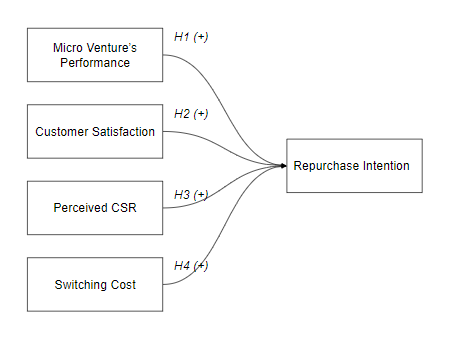
This research model was adopted from several previous studies. The first journal as the main reference is entitled “Serving the Poor: Captive Market CSR and Repurchase Intention” in 2015 which was published by The Internal Journal of Bank Marketing. The second journal is entitled “Switching Barriers in the Four-Stage Loyalty Model” in 2007 which was published by Advances in Consumer Research.  By  observing  those  two  sources  this  research has adapted several changes and combinations then finally created this research's conceptual model shown in the figure below.


Micro-Venture’s Performance

Financing from Bank Daya Sharia is disbursed via a small group at neighborhood level. It is called center or in Bahasa as Sentra. Each center consists of approximately 5-15 members. There is no collateral in this financing. The Bank guarantee is only the customer’s face itself. As long as customers continue to meet the field officer, they are eligible to be Bank Daya Sharia’s customers. [5]                . 


On the first cycle everyone is eligible to have a maximum 1.5 mio IDR to initiate their ventures. Continued financing to support continuation or further growth of the micro-venture is usually available only when the venture proves successful and gains the approval of the majority of the center’s members. In the absence of any standardized formal record of micro-ventures’ business history, the mechanism involves social approval.


In contrast, failure of a proposed venture is more likely to burden micro-entrepreneurs with additional debt burden and reduce interest in continued borrowing. Therefore, this study proposes the following hypothesis.


H1: In the context of repurchase intention, micro-venture’s performance has a positive influence.


Customer Satisfaction

The definition of satisfaction contained in various literatures is quite diverse. Kotler [6] defined customer satisfaction as a person's liking or disliking a product after he compares the product's performance with his expectations. Wilkie [7] defined customer satisfaction as a positive emotional response to the evaluation of the experience of using a product or service. Engel [8] defined customer satisfaction as an evaluation after purchase where the selected product is at least equal to or exceeds customer expectations, while dissatisfaction arises when the outcome does not meet expectations. From the various definitions above, it can be concluded that basically the notion of customer satisfaction includes the difference between expectations and perceived achievements or results. 


Customer satisfaction will basically affect customer repurchase intention. The higher the customer satisfaction will impact on the higher their repurchase intention. but it will stop at some point [9].


In the case of poor buyers, it has been shown that they pay more than affluent buyers for ordinary goods and services due to exploitation [10]. It suggests that although dissatisfied, constraints often push vulnerable borrowers to repeat borrowings and debt overburden. In emerging markets characterized by poor regulatory monitoring, stronger constraints, it is plausible that poor and captive borrowers may choose to ignore their dissatisfaction and prefer to appreciate relatively vital and low-cost access to funds via microfinance service providers. Therefore, this study proposes the following hypothesis.


H2: In the context of repurchase intention, customer   satisfaction   has     a    positive   influence.


Perceived CSR

By deploying CSR, the company can lead profit. This could be achieved through an improved brand image involving CSR-driven product or market development [11]. One highly desirable effect is increased customer repurchase [12]. Lichtenstein et al. found consumers to be more emotionally attached and more loyal toward companies that engaged in CSR activities. However, studies have also revealed that CSR initiatives do not always generate positive effects. Hence the findings relating to the effects of CSR on customer responses so far are overall inconclusive.


In the context of Bank Daya Sharia, CSR is not only concerned with the environment and society in general, it is even integrated as a product service, namely the Daya program. It is already become unique value proposition (UVP) of Bank Daya Sharia. Therefore, this study proposes the following hypothesis [14-29]


H3: In the context of repurchase intention, perceived CSR has a positive influence.


Switching Cost

Another factor that influences customer to continue consume the same product or service is the size of the switching barrier [13]. The barriers to moving consist of; financial costs, transaction costs, discounts for loyal customers (loyal customer discounts), social costs, and emotional costs. The greater the barriers to switching will make customers loyal, but their loyalty contains an element of compulsion. Therefore, this study proposes the following hypothesis.[30-37]


H4: In the context of repurchase intention, switching cost has a positive influence.

Research model in this study depicted on the Figure 1 below.


Figure 1. Research Model

METHODOLOGY

This study uses quantitative methods. It utilizes a questionnaire using a 6-point Likert scale. Clarity of questionnaire will be validated by having a focus discussion group with the Business Support unit of Bank Daya Sharia. After that, there will be a direct visit to customers to ensure their understanding.


The questionnaire uses an online survey Typeform which is distributed to customers through Bank Daya Sharia field officers after the routine center meetings are held. The customer fills out an independent survey from the link shared by the officer. Minimum of 200 respondents is required for test marketing studies to determine the number of samples in this study with convenience sampling technique chosen. 


To test the relationship between repurchase intention on micro-venture’s performance, satisfaction with the service level, perceived CSR activities of MFI, and switching cost, this study will test the model using Partial Least Square (PLS) - Structural Equation Model (SEM).

FINDINGS AND ARGUMENT

The questionnaire was collected from 1-10 December 2021. A total of 205 respondents managed to collect online responses. After that we validated with the data input as customer profile that was customer name and sentra meeting name as the key references with the customer data from core banking system. We managed that only 190 data were valid. 15 respondents or 7.3% categorized as unsatisfactory data due to not able to fulfill data requirements that are active customer and active financing. Based on the table above, the R square value in this study was 0.404 or 40.4%. This means that this study was categorized as moderate.


The following are the results of the path coefficient test in this study.


Based on the table above, customer satisfaction on repurchase intention has the most significant effect followed by switching cost on repurchase intention. Meanwhile, perceived CSR on repurchase intention and venture’s performance on repurchase intention does not significantly affect.


As the result of this study's Q square value has a value of 0.373 or greater than 0. This means that this study has a good observation value. As the result of the study, the SRMR value in this study was 0.083 or less than 0.01. That is, the model in this study is considered suitable. Meanwhile, the NFI value is 0.741 or 74.1%. This means that this research has a percentage of 74.1% fit.

CONCLUSION

The research objective is to identify what factors influence repurchase intention of customers to go to the next cycle of financing, analyze its magnitude, and set them on priority scale so that Bank’s management is able to reduce dropout rate of customers of Tepat Financing.


From the respondent’s data obtained and then processed with the PLS-SEM method, it is found that the factor of customer satisfaction has the biggest influence on the repurchase intention then followed by the factor of switching cost. The venture’s performance and the perceived CSR cannot be shown to have an influence on the repurchase intention of customers.


In the context of customer satisfaction, at the tactical level Bank Daya Sharia needs to establish serious metrics to measure customer satisfaction index. At the moment, there is a simple survey conducted by Branch Manager (BM). Yet, the surveys need to be enriched or moreover Bank can create another survey that is specific to address customer satisfaction level. At the strategic level, Bank Daya Sharia can exercise on the concept of new wave marketing on Marketing 4.0. For now, The Bank already have a baseline for Communization, Confirming, Clarification, Codification, and Communal Activation. The Bank can take steps further strategically to assess Co-creation, Currency, Commercialization, Character, Caring, and Collaboration. On the switching cost perspective, if we compare with the similar business model of a bank or financial institution, Bank Daya Sharia actually has an advantage by using the concept financing cycle. Because it is offered as non-collateral, customers need to follow the financing cycle to get bigger facilities. If they switch to another bank which has a similar business model, they will need to rebuild the financing portfolio from scratch. But this does not mean without threat from competitors. If they can have another solution to mitigate credit risk without following the financing cycle, credit facility as switching cost become a low barrier. Therefore, customers can switch to another financing/loan company.


Table 1: Path coefficient results in this study

Parameters

Customer Satisfaction

Perceived CSR

Repurchase Intention

Switching Cost

Venture's Performance

Customer Satisfaction

 Nill

 Nill

0.398

 Nill

Nill 

Perceived CSR

 Nill

 Nill

-0.058

 Nill

 Nill

Repurchase Intention

 Nill

 Nill

 Nill

 Nill

 Nill

Switching Cost

 Nill

 Nill

0.227

 Nill

 Nill

Venture's Performance

 Nill

 Nill

0.172

 Nill

 Nill


Table 2: T-statistic result in this study

 ParametersOriginal Sample (O)Sample Mean (M)Standard Deviation (STDEV)T Statistics (|O/STDEV|)P Values
Customer Satisfaction à Repurchase Intention0.3980.3980.1153.4640.001
Perceived CSR àRepurchase Intention-0.058-0.0390.1090.5300.596
Switching Cost à Repurchase Intention0.2270.2240.0892.5500.011
Venture’s Performance à Repurchase Intention0.1720.1610.0951.8200.069


Table 3. Hypothesis analysis

HypothesisStatementT-statisticConclusion
H1In the context of repurchase intention, the micro-venture’s performance has a positive influence1.820The hypothesis is not accepted, the data do not support the hypothesis
H2In the context of repurchase intention, the customer satisfaction has a positive influence.3.464The hypothesis is accepted, the data support the hypothesis
H3In the context of repurchase intention, perceived CSR has positive influence.0.530The hypothesis is not accepted, the data do not support the hypothesis
H4In the context of repurchase intention, switching cost has positive influence.2.550The hypothesis is accepted, the data supports the hypothesis


Social connection, both among fellow members and to officers also, is also seen as a switching cost that benefits the Bank. It should be noted that customers are well connected with the officers, so it becomes a concern for Human Capital to ensure that employee’s turnover is also low.


Meanwhile as part of big investment on the CSR, Bank Daya Sharia needs to overlook how financing customers perceive the CSR values that is Daya program. Ideally, as well as stated in many literature, CSR-driven product programs will become unique value propositions that differentiate Bank Daya Sharia with other competitors. But in this study, it presents that perceived CSR does not affect the customers repurchase intention. Perceived CSR as the lowest factor that influences repurchase intention.


Similar to the customer satisfaction perspective, The Bank needs to establish a matrix to determine perceived CSR. The Bank must think critically to develop Daya programs that resonate benefit for customers which finally influence their repurchase intention and eliminate other programs that might be seen beneficial on the headquarter perspective but less significant for customers.


On the last perspective about micro-venture’s performance, based on the study the result does not affect customer’s repurchase intention. From this point of view, management can see that micro-venture are resilient even in a pandemic era. This is also proven by Bank Daya Sharia financial performance which still records positive performance during 2020-2021 compared with other banks or any other industries. 


Despite the result, there is a challenge when doing sampling methods with convenience sampling remotely due to limitation of time and cost. The recommendation is to have sampling method probability sampling with stratified sampling.

REFERENCE
  1.  

  2. Malhotra, N. K., Can Uslay, and Bayraktar, A. "Relationship marketing re-imagined: Marketing’s inevitable shift from exchanges to value co-creating relationships." Business Expert Press, 2016.

  3. Jones, T. O., and Sasser, W. E. Jr. "Why satisfied customers defect." Harvard Business Review, vol. 73, no. 6, 1995, pp. 88–99.

  4. Lin, J. S. C., and Liang, H. Y. "The influence of service environments on customer emotion and service outcomes." Managing Service Quality, vol. 21, no. 4, 2011, pp. 350–372.

  5. Seiders, K., Voss, G. B., Grewal, D., and Godfrey, A. L. "Do satisfied customers buy more? Examining moderating influences in a retailing context." Journal of Marketing, vol. 69, no. 4, 2005, pp. 26–43.

  6. Trimulato, Darussalam, A. Z., Syarifuddin, and Wahyuni, S. "The empowerment for women’s economic with productive financing at BTPN Syariah." Jurnal Ilmu Ekonomi dan Bisnis Islam – JIEBI, vol. 3, no. 1, 2021.

  7. Kotler, P. Marketing Management. The Millennium Edition, New Jersey: Prentice Hall International, Inc., 2000.

  8. Wilkie, Williem L. Consumer Behavior. 3rd ed., John Wiley & Sons, Inc., 1994.

  9. Engel, J. F. Consumer Behavior. 6th ed., Chicago: The Dryden Press, 1990.

  10. Yi, Y., and La, S. "What influences the relationship between customer satisfaction and repurchase intention? Investigating the effects of adjusted expectations and customer loyalty." Psychology & Marketing, vol. 21, no. 5, 2004, pp. 351–373

  11. Viswanathan, M., Sridharan, S., Ritchie, R., Venugopal, S., and Jung, K. "Marketing interactions in subsistence marketplaces: A bottom-up approach to designing public policy." Journal of Public Policy & Marketing, vol. 31, no. 2, 2012, pp. 159–177.

  12. Torres, A., Bijmolt, T. H. A., Tribo, J. A., and Verhoef, P. "Generating global brand equity through corporate social responsibility to key stakeholders." International Journal of Research in Marketing, vol. 29, no. 1, 2012, pp. 13–24.

  13. Schaltegger, S., and Wagner, M. Managing the Business Case for Sustainability: The Integration of Social, Environmental and Economic Performance. Greenleaf, Sheffield, 2006.

  14. Fornell. "A national customer satisfaction barometer: The Swedish experience." Journal of Marketing, vol. 56, no. 1, 1992, pp. 6–21.

  15. Amarsy, N. "Switching costs: 6 ways to lock customers intoyour ecosystem." Strategyzer.Com, 2015, https://www .strategyzer.com/blog/posts/2015/7/27/ switching-costs-6-strategies-to-lock-customers-in-your-ecosystem.

  16. Carlson, K. D., and Herdman, A. O. "Understanding the impact of convergent validity on research results." Organizational Research Methods, vol. 15, no. 1, 2012, pp. 17–32, https://doi.org/10.1177/10944281 10392383.

  17. Chandler, C. R. "MBA students find microfinance program makes difference in borrowers’ lives." Archive.Org, 2009, https://web.archive.org/web/20100609150812/http://blogs.csun.edu/news/2009/09/microfinance/.

  18. Chin, Wynne, and Marcoulides, G. "The partial least squares approach to structural equation modeling." Modern Methods for Business Research, vol. 8, 1998.

  19. Freischlad, N. "7 crowdlending sites in Indonesia." Techinasia.Com, 2016, https://www.techinasia.com/7-crowdlending-sites-in-indonesia.

  20. Fornell, C., and Larcker, D. F. "Structural equation models with unobservable variables and measurement error: Algebra and statistics." JMR, Journal of Marketing Research, vol. 18, no. 3, 1981, pp. 382, https://doi.org/10.2307/ 3150980.

  21. Global Business Guide. "Indonesia’s microfinance sector outlook." Gbgindonesia.Com, 2013, http://www.gbgindo nesia.com/en/finance/article/2013/an_outlook_on_indonesia_s_microfinance_sector.php.

  22. Hair, J. F., Black, W. C., Babin, B. J., Anderson, R. E., and Tatham, R. L. Multivariate Data Analysis: Global Edition. 7th ed., Pearson Education, 2008.

  23. "History of PPI." PPI, n.d., Retrieved December 21, 2021, from https://www.povertyindex.org/about-us.

  24. Jose, S., Khare, N., and Buchanan, F. R. "Serving the poor: Captive market CSR and repurchase intention." The International Journal of Bank Marketing, vol. 33, no. 3, 2015, pp. 316–329, http://dx.doi.org/10.1108/IJBM-07-2014-0102.

  25. Kotler, P., Kartajaya, H., and Setiawan, I. Marketing 4.0: Moving from Traditional to Digital. 1st ed., John Wiley & Sons, 2017.

  26. Liputan6.com. "PNM resmi menanggalkan status perseroan." Liputan6, 2021, https://www.liputan6.com/news/read/4701523/pnm-resmi-menanggalkan-status-perseroan.

  27. Lohmoller, J.-B. Latent Variable Path Modeling with Partial Least Squares. Physica-Verlag, 1989.

  28. Malhotra, N. K., Nunan, D., and Birks, D. F. Marketing Research: An Applied Approach. 5th ed., Pearson Education, 2017.

  29. Mardalis, Ahmad. "Meraih loyalitas pelanggan." Benefit, Jurnal Manajemen dan Bisnis, vol. 9, no. 2, 2005.

  30. Blut, M., Evanschitzky, E., Vogel, V., and Ahlert, D. "Switching barriers in the four-stage loyalty model." NA - Advances in Consumer Research, vol. 34, 2007, pp. 726–73.

  31. MBK. "MBK-Ventura home." Mbk-Ventura.Com, 2021, https://www.mbk-ventura.com/index.php.

  32. Nurul Alam, M., D. M. G. "Guidelines for establishing and operating Grameen-style microcredit programs." Grameenfoundation.Org, 2010, https://grameenfou ndation.org/documents/GrameenGuidelines.pdf.

  33. OJK. "IKNB." Ojk.Go.Id, n.d., Retrieved November 4, 2021, from https://www.ojk.go.id/id/kanal/iknb/Pages/lembaga-keuangan-Micro.aspx.

  34. Prahalad, C. K. Fortune at the Bottom of the Pyramid: Eradicating Poverty Through Profits. Wharton School Publishing, Upper Saddle River, NJ, 2005.

  35. "Profile BTPN Syariah." Btpnsyariah.Com, n.d., Retrieved December 21, 2021, from https://www.btpnsyariah.com/web/guest/profil

  36. Sekaran, U., and Bougie, R. J. Research Methods for Business: A Skill-Building Approach. 7th ed., John Wiley & Sons, 2016.

  37. "Shareholders composition." Btpnsyariah.Com, n.d., Retrieved December 21, 2021, from https://www.btpnsyariah.com/web/guest/pemegang-saham.

  38. Sujarweni, V. W. Metodologi Penelitian Bisnis Ekonomi. Pustaka Baru, 2015.
License
CC BY-NC-ND
Creative Commons Attribution-NonCommercial-NoDerivatives 4.0 International License
Analysis of Repurchase Intention: The Case Study of Tepat Financing Bank Daya Sharia Mms Lab, 2021 © 2026 by Ahmad Romdhon Asror licensed under CC BY-NC-ND 4.0
All papers should be submitted electronically. All submitted manuscripts must be original work that is not under submission at another journal or under consideration for publication in another form, such as a monograph or chapter of a book. Authors of submitted papers are obligated not to submit their paper for publication elsewhere until an editorial decision is rendered on their submission. Further, authors of accepted papers are prohibited from publishing the results in other publications that appear before the paper is published in the Journal unless they receive approval for doing so from the Editor-In-Chief.
Himalayan Journal of Economics and Business Management open access articles are licensed under a Creative Commons Attribution-Share A like 4.0 International License. This license lets the audience to give appropriate credit, provide a link to the license, and indicate if changes were made and if they remix, transform, or build upon the material, they must distribute contributions under the same license as the original.
Advertisement
Recommended Articles
Research Article
Influence of Leadership on Poverty Reduction in the Devolved Government in Trans-Nzoia County, Kenya
...
Published: 30/06/2021
Download PDF
Research Article
The impact of organizational flexibility on improving institutional performance in Iraqi business organizations
Published: 22/01/2026
Download PDF
Research Article
Modelling Structure Job Quality, Job Design and Job Satisfaction
...
Published: 30/08/2022
Download PDF
Research Article
Accountability and Transparency of Village Fund Management in Lumajang District
...
Published: 28/12/2023
Download PDF
Chat on WhatsApp
Flowbite Logo
Najmal Complex,
Opposite Farwaniya,
Kuwait.
Email: kuwait@iarcon.org

Editorial Office:
J.L Bhavan, Near Radison Blu Hotel,
Jalukbari, Guwahati-India
Useful Links
Order Hard Copy
Privacy policy
Terms and Conditions
Refund Policy
Others
About Us
Team Members
Contact Us
Online Payments
Join as Editor
Join as Reviewer
Subscribe to our Newsletter
Follow us
MOST SEARCHED KEYWORDS
scientific journal
 | 
business journal
 | 
medical journals
 | 
Scientific Journals
 | 
Academic Publisher
 | 
Peer-reviewed Journals
 | 
Open Access Journals
 | 
Impact Factor
 | 
Indexing Services
 | 
Journal Citation Reports
 | 
Publication Process
 | 
Impact factor of journals
 | 
Finding reputable journals for publication
 | 
Submitting a manuscript for publication
 | 
Copyright and licensing of published papers
 | 
Writing an abstract for a research paper
 | 
Manuscript formatting guidelines
 | 
Promoting published research
 | 
Publication in high-impact journals
Copyright © iARCON Internaltional LLP . All Rights Reserved.