This study was conducted to examine the effect of the basic macroeconomic variable, namely aggregate expenditure, which consists of consumption (C), investment (I), government expenditure (G) and net exports (X & M) on economic growth (Y) and public welfare (HDI) in 10 provinces with the largest GRDP in Indonesia throughout 2015-2019. Using panel data regression, it is found that consumption, investment and net exports have a significant effect on HDI. It is also through path analysis, that all dependent variables have a direct effect on HDI, without going through the mediating variable, economic growth.
Keywords
Consumption
Investment
Government Expenditure
Net Exports
Economic Growth and HDI
INTRODUCTION
Economic development is a multidimensional process that includes various fundamental changes to social structures, attitudes of society and national institutions, in addition to pursuing economic growth acceleration, handling income inequality and poverty alleviation [1]. Economic growth is indeed the goal of a development but it is not the ultimate goal of development itself, because growth that is not accompanied by the ability to overcome inequality, including in alleviating poverty, is all economic growth and is in vain. Currently, quite a number of developing countries have succeeded in achieving and recording their country's economic growth at a fairly high rate compared to developed countries. But, the developing country group is still faced with inequality and poverty problems that have not improved. Amartya Sen in Todaro and Smith [1] states that there is a clear emphasis on health and education, countries with high income levels but low health and education standards as a case of “growth without development”.
Based on the explanation previously stated, apart from economic growth as one of the parameters to measure the level of welfare, the proxy uses the Human Development Index (HDI) using 3 composite parameters, namely economy, education and health. Economic growth focuses on the cumulative increase in output produced in an economy, while HDI is a parameter to measure the level of community welfare using those 3 composite indicators. Thus, it becomes very important for all stakeholders to know the determinants of these two variables in order to determine the right policy direction for policy makers.
The Central Statistics Agency of Indonesia (BPS) generally publishes GDP and GRDP publications based on the production/sectoral approach and based on expenditure approach. In this study, we will focus more on the income function or GDP/GRDP based on the expenditure approach.
Ginting [2] found that government spending, consumption and net exports have a positive and significant impact on economic growth in Indonesia. Ernita and Amar [3] found that all consumption, investment, government spending and net exports have a positive and significant impact on economic growth in Indonesia. Ichvani and Sasana [4] found that consumption and government spending had a positive and significant impact on economic growth in 5 ASEAN countries. Herdiana [5] found that consumption has a positive and significant effect on economic growth but investment has a negative and significant effect on economic growth in Indonesia.
Shandra et al. [6] found that consumption, investment and government spending have a positive and significant impact on economic growth in West Sumatra Province, Indonesia. Mustika et al. [7] found that net exports had no significant effect on economic growth in Indonesia. Purwanggono and Sasana [8] found that net exports and investment have a positive and significant impact on economic growth in Indonesia.
Noviansyah and Yacoub [9] found that consumption and government spending had a positive and significant effect on HDI in West Kalimantan Province, Indonesia, while investment had no significant effect. Bhakti et al. [10] found that government spending and GDP have a positive effect on HDI but consumption has a negative effect on HDI in Indonesia. Nuryadin [11] found that consumption and government spending in the education sector had a significant effect on HDI but government spending on the health sector had a negative effect on HDI in East Nusa Tenggara, Indonesia.
This study aims to determine the effect of consumption, investment, government spending and net exports in explaining economic growth and public welfare as measured by HDI in 10 (ten) provinces with the largest GRDP in Indonesia. The use of the 10 largest GRDP provinces in Indonesia is to find out the above variables in provinces with great economic power and contribute a high contribution to Indonesia's GDP as a whole.
Brief Review of Literature
Classical and Neoclassical Theory: According to the classical theory of economic growth, according to David Ricardo and Adam Smith in Deliarnov, there are 4 factors that can influence it in increasing economic growth, namely:
Population
Availability of capital goods
Natural wealth and land area
Technology application
From these several factors, it can be explained that firstly, growth can be said to be high if the population is said to be small, then the availability of capital is quite large and also a large area of land is available. Second, economic growth can be classified as not increasing if the productivity of the population decreases because it can affect the decrease in production in which the frequency of the economy and people's welfare decreases.
According to Harrod-Domar Theory in Deliarnov there are 4 assumptions of economic growth factors. First, make full use of capital goods. Second, the amount of savings with fluctuations in national income. Third, there is a comparison of production results with fixed capital. Fourth, in the economy there are only 2 sectors. According to Harrod-Domar in the neoclassical economic growth theory, it is revealed that the need for capital formation (investment) is a condition for increasing economic growth that is steadfast in stable growth. If you have done capital formation, then the economy will be able to produce goods in larger quantities.
As stated by Solow in Deliarnov high economic growth depends on the development of production factors. There are 3 factors that influence economic growth, namely:
Technological growth
Capital growth
Population growth.
Keynesian Theory
In Keynes's theory explains that GDP is the sum of all the production of goods and services that have been produced from a country during a certain period of time. In the expenditure approach, national income is the sum of expenditures that have been obtained from various sectors in a country. Those sectors are household sector expenditure which is represented by public consumption (C), business sector expenditure which is represented by investment from companies (I), government sector which is represented by government expenditure (G) and for trade expenditure carried out abroad is illustrated by the difference between exports and imports with the country concerned (XM).
Analysis in national income which has three model approaches in the economy, as follows:
An economy with 2 sectors (households and business entities):
Y = C + I (1)
An economy with 3 sectors (households, business entities, and government):
Y = C + I + G (2)
An economy with 4 sectors (households, business entities, government, and international trade):
Y = C + I + G + (X-M) (3)
Colander [12] suggests that aggregate income or GDP/GDP with an expenditure approach consists of 3 main categories, namely:
Consumption (C)
Investment (I)
Government Expenditures (G) Net Exports (X-M). A function is also formed from these components that make up aggregate income, which can be seen as follows:
GDP/GDP = C+I+G+(X-M) (4)
New Growth Theory: The new growth theory is basically an endogenous growth theory which has given it a theoretical framework in analyzing new growth. Because, the theory of Gross National Product (GNP) suggests that what is able to influence economic growth is not from the outside of the system but from the system in the production process. And in contrast to the neoclassical theory which assumes that the growth of Gross National Product occurs from a balance in the long term.
Economic growth is a very important indicator to analyze the economic development that has occurred in a country. Regional economic growth will be faster if it has an absolute advantage, namely the number of natural resources and by measuring the quality of human life, so that with the high value of economic growth, the standard of living of humans will also be higher [13]. Economic growth is defined as an increase in the output of the community due to the increasing number of total production used in the community. Economic growth is a process of increasing the Gross Domestic Product (GDP) in a country [1].
Economic growth is one of the conditions that are useful in improving the prosperity of the community and to fulfill the objectives of development, such as: on the wealth of the community and increasing income/social facilities and the provision of facilities. From every activity in the economy, actual economic growth means the fiscal development of goods and services in a country, such as: infrastructure development, increased production from the growth sector in capital goods and services production, services, increased production of industrial goods and an increase in the number of schools [14]. However, by using various types of production data, we will get a picture of the economic growth we want to achieve. Therefore, to give a picture of what you want to achieve in a country, it is necessary to use the growth rate of real national income to be achieved.
Welfare Theory
In general, theories regarding welfare can be classified into three types, namely classical utilitarian, neoclassical welfare theory and new contractarian approach [15]. The classical utilitarian approach emphasizes that a person's pleasure or satisfaction can be measured and increased. The principle for individuals is to increase their level of welfare as much as possible, while for the community, increasing the welfare of their groups is a principle that is held in their lives. The neoclassical welfare theory approach explains that the welfare function is a function of all individual satisfaction. Another development in social welfare theory is the emergence of a new contractarian approach which promotes maximum freedom in the life of an individual or a person.
The thing that is most emphasized in this new contractarian approach is that individuals will maximize their freedom to pursue their concepts of goods and services without any interference. There are various developments in measuring the level of welfare from the physical side, such as the Human Development Index, Quality of Life Index, Basic Needs and Percapita Income. This measure of economic welfare can be seen from two sides, namely consumption and production (scale of business). In terms of consumption, welfare can be measured by calculating how much a person or family spends for clothing, food, shelter, and other needs within a certain time or period.
Greve states that welfare is a word derived from the word "wel and fare". Spencer in Greve states that welfare is "well-being". Meanwhile, according to the Oxford Dictionary's in Greve states that welfare consists of:
"well-being', happiness, health and prosperity (of person, community, etc.)
Welfare financial support from the state”. Regarding welfare, Pigou in Greve (2008) says:
`
“…welfare can be brought under the category of greates and less. …… he stressed that the only obvious way of measuring welfare is in terms of money. That does not lead to any furthers clarification of the concept, but still, when looking at a macro-level understanding of the welfare, money can be, and is, used as indicator (for example, as GDP per capita)”
Welfare is closely related to individual perceptions and utility of income use, so it is very difficult to measure it. Welfare measurement at the macro level is often used as an indicator of GDP/GDP per capita.
Greve (2008) explains: the concept of welfare must be understood in a deep historical and cultural context, because it can influence the understanding of the long historical analysis of the concept of welfare.
The concept of human development in the above sense is much broader than conventional economic development theories, including models of economic growth, human resource development (HR), welfare approaches and approaches to basic human needs. Human resource development places humans primarily as inputs to the production process (as a means not an end). The welfare approach sees humans as beneficiaries, not as objects of change. The basic needs approach focuses on providing goods and services for the necessities of life.
Egger et al. in his research found that citizenship knowledge, capital mobility and multinational activities have a significant effect on the welfare of the Organization for Economic Co-operation and Development (OECD) countries with multilateral investment agreements. This condition can then allow a convergence of per capita income among OECD member countries. Molana and Montagna in their research suggest that increasing economic capacity, government spending policies and international trade affect economic performance and people's welfare. Research states that basically the mobility of production factors between countries are factors that have a significant effect on improving regional economic welfare, if there is no asymmetric information.
MARTIAL AND METHOD
The approach used in this research is a quantitative approach. Quantitative research is a method for testing certain theories by examining the relationship between variables. Furthermore, the analytical method used in this research is path analysis. Path analysis is an extension of multiple linear regression analysis, or path analysis is the use of regression analysis to estimate causality between variables (casual models) that have been determined previously based on theory. Causality relationships between variables have been established with models based on theoretical foundations.
To determine the effect of consumption, investment, government spending and net exports on economic growth and HDI, panel regression was used with secondary data obtained from the publication of the Central Statistics Agency of Indonesia (BPS) (2021) on 10 provinces with the largest GRDP in Indonesia, with a span of years 2015-2019. Furthermore, the regression model formed is as follows.
(5)
(6)
where,
i = Individual Unit (cross-section)
t = Time period
1- 3 = Regression coefficient
PE = Regional Economic Growth
C = Consumption
I = Investment
G = Government Expenditure
X = Net Export
HDI = Human Development Index
E = Error term
After finding the best model from the panel data regression equation, a path analysis will be carried out to find out how much influence the components of aggregate expenditure (consumption, investment, government spending and net exports) have on economic growth and HDI. The use of path analysis in this study is due to the very limited and lack of previous empirical studies related to the model being studied at this time.
RESULT AND ANALYSIS
According to Kuncoro (2011) the coefficient of determination (R2) is used to measure how far the model's ability to explain the variation of the dependent variable. The results of the calculation of the coefficient of determination can be seen in Table 1.
Based on the results of the coefficient of determination test in Table 1. above, the R-squared value of each model is 0.8291 and 0.6412. Because the value of R-squared tends to increase or get bigger when the number of independent variables and observation data are used more and more, the R-squared that will be used is the Adjusted R-squared which can eliminate bias due to the addition of the number of independent variables and the amount of data observed.
The value of Adjusted R-square model I with Economic Growth as the dependent variable is 0.7674. This value shows that all independent variables in this study, namely Consumption, Investment, Government Expenditure and Net Exports can explain the increase or decrease in Economic Growth in 10 Provinces with the largest GRDP in Indonesia of 76.74%. While the rest, which is 23.26%, is another variable outside of the variables used in this study which can explain the increase or decrease in Economic Growth.
The value of Adjusted R-square model II with HDI as the dependent variable is 0.6005. This value shows that all independent variables in this study, namely Economic Growth, Consumption, Investment, Government Expenditure and Net Exports can explain the increase or decrease in HDI in 10 provinces with the largest GRDP in Indonesia of 60.05%. While the rest, which is 39.95%, is another variable outside the variables used in this study which can explain the increase or decrease in HDI.
Table 1: Coefficient of determination test results
Determination Coefficient
R-squared
Adjusted R-squared
Model I (EG)
0,8291
0,7674
Model II (HDI)
0,6412
0,6005
Source: Research Result
Table 2: T-Test Result
Variable
Model I (EG)
Model II (HDI)
T-Statistic
Prob.
T-Statistic
Prob.
Economic Growth (Y1)
3,593
0,0008
Consumption (X1)
0,469
0,6415
-7,792
0,0000
Investment (X2)
-0,021
0,9829
9,546
0,0000
Government Expenditure (X3)
-0,599
0,5523
1,099
0,2776
Net Exports (X4)
-2,229
0,0321
3,817
0,0004
Source: Research Result
The interpretation of the results of the T test is in Table 2. are as follows:
Consumption
The P value of the consumption variable in model I is 0.641 or greater than = 0.05, then H0 is accepted, which means that consumption partially has no significant effect on economic growth in 10 provinces with the largest GRDP in Indonesia (0.641>0.05)
The P value of the consumption variable in model II is 0.982 or greater than = 0.05, then H0 is rejected, which means that consumption partially has a significant effect on HDI in 10 provinces with the largest GRDP in Indonesia (0.000 < 0.05).
Investment
The P value of the Investment variable in model I is 0.982 or greater than = 0.05, then H0 is accepted, which means that investment partially has no significant effect on economic growth in 10 provinces with the largest GRDP in Indonesia (0.982 >0.05).
The P value of the Investment variable in model II is 0.0000 or less than = 0.05, then H0 is rejected, which means that investment partially has a significant effect on HDI in 10 provinces with the largest GRDP in Indonesia (0.000<0.05).
Government Expenditure
The p-value of the Government Expenditure variable in model I is 0.552 or greater than = 0.05, then H0 is accepted, which means Government Expenditure partially has no significant effect on Economic Growth in 10 Provinces with the largest GRDP in Indonesia (0.552 > 0.05).
The P value of the Government Expenditure variable in model II is 0.277 or greater than = 0.05, then H0 is accepted, which means Government Expenditure partially has no significant effect on HDI in 10 provinces with the largest GRDP in Indonesia (0.277 > 0.05).
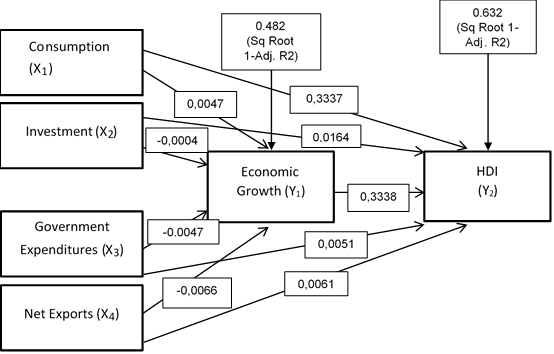
Figure 1: Path analysis result
Table 3: F-Test result
F-Statistic
Prob.
Model I (EG)
13,4396
0.000000
Model II (HDI)
15,7323
0.000000
Source: Research Result
Net Export
The P value of the Net Export variable in model I is 0.032 or smaller than = 0.05, then H0 is rejected, which means that Net Exports partially have a significant
effect on Economic Growth in 10 Provinces with the largest GRDP in Indonesia (0.032 <0.05).
The P value of the Net Export variable in model II is 0.0004 or smaller than = 0.05, then H0 is rejected, which means that Net Exports partially have a significant effect on HDI in 10 provinces with the largest GRDP in Indonesia (0.0004 > 0.05).
Economic Growth
The P value of the Economic Growth variable in model II is 0.0008 or smaller than = 0.05, then H0 is rejected, which means that Economic Growth partially has a significant effect on HDI in 10 provinces with the largest GRDP in Indonesia (0.0008 <0.05).
Based on Table 3 the P value of the F test of the two model is the same, which is 0.00000 or smaller than = 0.05 (0.00000 <0.05), so H1 is accepted. This means that all independent variables namely Consumption, Investment, Government Expenditure, Net Exports and Economic Growth simultaneously or jointly have a significant effect on Economic Growth and HDI in 10 Provinces with the largest GRDP in Indonesia.
The indirect effect using path analysis is calculated based on the coefficient of direct influence on Y2 and the effect of Y1 on Y2. The results of the calculation of the direct effect, indirect effect and total effect in this study can be seen in Figure 1.
Based on Figure 1. above, the results of the calculation of the effect of path coefficient analysis, indirectly the influence of the four independent variables on HDI through the mediation of economic growth.
Analysis of the influence of Consumption (X1) on HDI (Y2) through Economic Growth (Y1)
It is known that the direct influence given by consumption (X1) on HDI (Y2) is -0.3337. While the indirect effect of Consumption (X1) through Economic Growth (Y1) on HDI (Y2) is the multiplication between the alpha value (α1X1) on Economic Growth (Y1) with the beta value (β5Y1) on HDI (Y2), namely: 0.0047 x 0.3338 = -0.0015. Then the total effect given by consumption (X1) on HDI (Y2) is a direct effect plus an indirect effect, namely: 0.3337 + (-0.0015) = 0.3322. Based on the calculation results above, it is known that the direct influence value is 0.3337 and the indirect effect is 0.3322, which means that the indirect effect value is smaller than the direct influence value, this result indicates that indirectly Consumption (X1) through growth Economy (Y1) does not have a significant effect on HDI (Y2) in 10 provinces with the largest GRDP in Indonesia can be accepted.
Analysis of the influence of Investment (X2) on HDI (Y2) through Economic Growth (Y1)
It is known that the direct effect given by Investment (X2) on HDI (Y2) is 0.0164. Meanwhile, the indirect effect of Investment (X2) through Economic Growth (Y1) on HDI (Y2) is the multiplication between alpha value (α1X1) on Economic Growth (Y1) and beta value (β5Y1) on HDI (Y2), namely: -0.0004 x 0.3338 = -0.0001. Then the total effect given by Investment (X2) on HDI (Y2) is a direct effect plus an indirect effect, namely: 0.0164 + (-0.0001) = 0.0163. Based on the results of the above calculation, it is known that the direct influence value is 0.0164 and the indirect effect is 0.0163 which means that the indirect effect value is smaller than the direct influence value, these results indicate that indirectly Investment (X2) through Growth Economy (Y1) does not have a significant effect on HDI (Y2) in 10 provinces with the largest GRDP in Indonesia can be accepted.
Analysis of the effect of Government Expenditure (X3) on HDI (Y2) through Economic Growth (Y1)
It is known that the direct effect of Government Expenditure (X3) on HDI (Y2) is 0.0051. Meanwhile, the indirect effect of Government Expenditure (X3) through Economic Growth (Y1) on HDI (Y2) is the multiplication between alpha value (α1X3) on Economic Growth (Y1) and beta value (β5Y1) on HDI (Y2), namely: -0, 0047 x 0.3338 = -0.0015. Then the total effect given by Government Expenditures (X3) on HDI (Y2) is the direct effect plus the indirect effect, namely: 0.0051 + (-0.0015) = 0.0036. Based on the results of the above calculation, it is known that the direct influence value is 0.0051 and the indirect effect is 0.0036, which means that the indirect influence value is smaller than the direct influence value, these results indicate that indirectly Government Expenditures (X3) through Economic growth (Y1) does not have a significant effect on HDI (Y2) in 10 Provinces with the largest GRDP in Indonesia, which is acceptable.
Analysis of the influence of Net Exports (X4) on HDI (Y2) through Economic Growth (Y1)
It is known that the direct effect of Net Exports (X4) on HDI (Y2) is 0.0061. While the indirect effect of Net Exports (X4) through Economic Growth (Y1) on HDI (Y2) is the multiplication between the alpha value (α1X4) on Economic Growth (Y1) with the beta value (β5Y1) on HDI (Y2), namely: -0, 0066 x 0.3338 = -0.0022. Then the total effect given by Net Exports (X4) on HDI (Y2) is a direct effect plus an indirect effect, namely: 0.0061 + (-0.0022) = 0.0039. Based on the calculation results above, it is known that the direct influence value is 0.0061 and the indirect effect is 0.0039 which means that the indirect effect value is smaller than the direct influence value, this result indicates that indirectly Net Exports (X4) through Economic growth (Y1) does not have a significant effect on HDI (Y2) in 10 provinces with the largest GRDP in Indonesia is acceptable.
Analysis
The Effect of Consumption on Economic Growth and HDI in 10 Provinces with the largest GRDP in Indonesia: Based on the results of calculations that have been carried out, partially Consumption has a positive and insignificant effect on Economic Growth but positive and significant on HDI in 10 Provinces with the largest GRDP in Indonesia. This can be interpreted that with a confidence level of 95%, consumption has a small and almost non-significant effect on economic growth, but has a large and significant effect on HDI. The results of this study are in accordance with the research hypothesis that has been built previously about the direction of the relationship between variables, namely consumption has a positive effect on Economic Growth and HDI.
The direction of the positive relationship that occurs between consumption and economic growth and HDI in 10 provinces with the largest GRDP in Indonesia can be interpreted that the higher consumption carried out by households and non-government institutions serving households, the more economic growth will increase, and with HDI, vice versa. However, when viewed from the significance value, the effect of consumption on economic growth is relatively small, but quite large and significant to the HDI. Based on path analysis, it is also found that consumption is better in influencing HDI without going through economic growth as a mediating variable.
Positive, significant and has a more direct effect on consumption on the HDI, meaning that the higher the level of consumption by households, the higher the quality of life or community welfare in the economic, education and health sectors as measured by the HDI. According to Sukirno [14], a person's consumption will be directly proportional to his income. So, it can be said that the higher a person's income, the greater the consumption expenditure that will be issued by that person. High income will be followed by high expenses.
So it can be concluded that the increase in consumption indicates the goodness of income which in aggregate or as a whole will create economic growth. So, in the end it can also affect welfare or HDI. Household consumption expenditure is one of the important indicators in looking at the level of community welfare. This result accordance with Keynes' theory (Mankiw, 2006) which states that the higher the expenditure for the consumption of goods and services issued, it will lead to an increase in income and people's welfare.
The results of this study are in line with research conducted by Ginting [2], Ernita et al. [3], Ichvani and Sasana [4], Herdiana [5], Shandra [6], Noviansyah et al. [9] and Nuryadin [11] who found a positive relationship between consumption and economic growth and HDI.
The Effect of Investment on Economic Growth and HDI in 10 Provinces with the largest GRDP in Indonesia
Based on the results of calculations that have been carried out, partially investment has a negative and insignificant effect on economic growth but positive and significant on HDI in 10 provinces with the largest GRDP in Indonesia. This can be interpreted that with a confidence level of 95%, investment has not shown a significant and relatively small effect on economic growth, but has a large and significant effect on HDI. The results of this study are in accordance with the research hypothesis that has been built previously about the direction of the relationship between variables, namely investment has a positive effect on HDI but not with its effect on Economic Growth.
The direction of the positive relationship that occurs between investment and HDI in 10 provinces with the largest GRDP in Indonesia can be interpreted that the higher foreign and domestic investment and the formation of inventories, the higher the HDI and vice versa. However, the effect of investment on economic growth is relatively small and even almost non-existent, but quite large and significant for HDI. Based on path analysis, it is also found that investment is better in influencing HDI directly without going through economic growth as a mediating variable.
Positive, significant and more direct effect of investment on the HDI, meaning that the higher the level of investment, both domestic and foreign, will further improve the quality of life or community welfare in the economic, education and health sectors as measured by the HDI. Government support in promoting capital accumulation, adding buildings or other equipment, increasing the potential output of each region and stimulating inclusive economic growth in the long term. This is in accordance with Harrod-Domar’ theory which states that economic growth will really need investment, where economic growth is part of economic development, so that in the end economic development will also have an impact on human development as measured by HDI.
The presence of investments that enter each province in Indonesia, will help create jobs. Especially if foreign investment is large and mega-project, which if using local workers will greatly help improve the local economy and increase the standard of living of the people as indicated by the increase in HDI. This is supported by research conducted by Gohou and Soumaré [16] which found that the more foreign investment that is poured into African countries, the lower poverty, increase income and ultimately increase the welfare shown by the HDI.
The results of this study are in line with research conducted by Herdiana [5], and Noviansyah et al. [9] which found a negative relationship between investment and economic growth and was significant on HDI. The results of the study show new findings which indicate that investment can have a negative effect on economic growth, but has a positive and significant effect on increasing people's welfare or HDI.
The Effect of Government Spending on Economic Growth and HDI in 10 Provinces with the largest GRDP in Indonesia
Based on the results of calculations that have been carried out, partially Government Expenditure has a negative and insignificant effect on Economic Growth but positive and insignificant on HDI in 10 Provinces with the largest GRDP in Indonesia. This can be interpreted that with a confidence level of 95%, government spending has not shown a real and relatively small effect on economic growth and HDI. The results of this study are not in accordance with the research hypothesis that has been built previously about the direction of the relationship between variables, namely Government Expenditures have a positive and significant effect on economic growth and HDI.
The direction of the positive relationship that occurs between Government Expenditures and HDI in 10 Provinces with the largest GRDP in Indonesia can be interpreted that the higher Government Expenditures in the form of direct spending, indirect spending and financing, the higher the HDI, and vice versa. However, the effect of Government Expenditure on economic growth and HDI is relatively small and even almost non-existent. Based on path analysis, it is also found that government spending is better in influencing HDI directly without going through economic growth as a mediating variable.
Positive, significant and has a more direct effect on Government Expenditures on the HDI, meaning that the higher the level of Government Expenditures, the higher the quality of life or community welfare in the economic, education and health sectors as measured by the HDI. Gupta et al. [17] found that government spending, especially in the education and health sectors, had a positive impact on human capital, which in turn would increase economic growth and alleviate poverty. This is reinforced by research conducted by Razmi et al. [18] which found that an increase in government spending on the health sector will increase labor productivity and increase the supply of labor, which in turn will increase productivity and economic growth.
The results of this study are in line with research conducted by Noviansyah et al., Bhakti et al. [10] and Nuryadin [11] which found a positive relationship between government spending on HDI. The results of the study show new findings which show that government spending can have a negative effect on economic growth, but has a positive and significant effect on increasing people's welfare or HDI [19].
Effect of Economic Growth on HDI in 10 Provinces with the largest GRDP in Indonesia
Based on the results of calculations that have been carried out, partially Economic Growth has a positive and significant influence on HDI in 10 provinces with the largest GRDP in Indonesia. This can be interpreted that with a confidence level of 95%, economic growth can be stated to have a significant and significant effect on the HDI. The results of this study are in accordance with the research hypothesis that has been built previously, the significance of the variables, namely Economic Growth, has a significant effect on HDI [20].
The direction of the positive relationship that occurs between growth and HDI in 10 provinces with the largest GRDP in Indonesia can be interpreted that the higher the economic growth, the higher the HDI, and vice versa [21-22].
The positive and significant influence of Economic Growth on the HDI means that the higher the level of Economic Growth, the higher the quality of life or the welfare of the community in the economic, education and health sectors as measured by the HDI. In the theory of economic growth, it is explained that there is an era link between human development and economic growth that can be seen from two directions, namely the influence of economic growth on human development and the influence of human development on economic growth. The relationship between economic growth and human development cannot be considered linear or direct, but can be determined by the extent to which the factors that link the two concepts play a role. Good economic growth will encourage the creation of infrastructure that triggers many industries, public facilities such as education and hospitals that can encourage increased welfare through the HDI.
The results of this study are in line with research conducted by Bhakti et al. [10] which found that economic growth has a positive and significant relationship to HDI.
CONCLUSION
Based on the results of the research that has been described above, several conclusions were obtained, namely as follows:
Consumption has a positive and insignificant effect on economic growth
Investment has a negative and insignificant effect on economic growth
Government spending has a negative and insignificant effect on economic growth
Net Exports have a negative and significant effect on economic growth
Consumption has a positive and significant impact on HDI
Investment has a positive and significant impact on HDI
Government Expenditures have a positive and insignificant effect on HDI
Net Exports have a positive and significant impact on HDI
Economic growth has a positive and significant impact on HDI.
Based on the research that has been done, the authors provide suggestions to the parties concerned to be taken into consideration and input, among others, as follows:
The government should implement policies that can attract more foreign investors, such as improving infrastructure and facilitating bureaucracy. Expenditures in the field of health and education must also continue to be considered and increased in order to improve community welfare (HDI). Furthermore, the government should always maintain the balance of exports and imports so that there is no trade balance deficit which ultimately has an impact on economic growth and HDI.
For future researchers, it is hoped that they can increase the period of research observation and research locations so that more complete results are obtained.
ACKNOWLEDGMENT
This research was funded by Budget Execution List (DIPA) funds from the Faculty of Economics and Business, Tanjungpura University in 2021 with Contract Number 4377/UN22.2/PL/2021 dated 27 May 2021.
REFERENCE
Todaro, Michael P., and Stephen C. Smith. Pembangunan Ekonomi, vol. 1, 9th ed., Erlangga, Jakarta, 200.
Ginting, A. M. “Prospek pertumbuhan ekonomi Indonesia 2013: Suatu analisis pengaruh pengeluaran pemerintah, konsumsi, dan ekspor Indonesia terhadap pertumbuhan ekonomi Indonesia.” In Semnas Fekon: Optimisme Ekonomi Indonesia 2013, Antara Peluang dan Tantangan.
Ernita, D., et al. “Analisis pertumbuhan ekonomi, investasi, dan konsumsi di Indonesia.” Jurnal Kajian Ekonomi, vol. 1, no. 2, 2013.
Ichvani, L. F., and H. Sasana. “Pengaruh korupsi, konsumsi, pengeluaran pemerintah dan keterbukaan perdagangan terhadap pertumbuhan ekonomi di ASEAN 5.” Jurnal REP (Riset Ekonomi Pembangunan), vol. 4, no. 1, 2019, pp. 61–72.
Herdiana, Dian. Pengaruh kosumsi, investasi dan kridit perbankan terhadap pertumbuhan ekonomi Indonesia periode 1980–2010. Skripsi, UIN Syarif Hidayatullah Jakarta, 2011.
Shandra, Yosef, Syafri Amar, and Harry Aimon. “Konsumsi dan investasi serta pertumbuhan ekonomi Sumatera Barat.” Jurnal Kajian Ekonomi, vol. 1, no. 1, 2012.
Mustika, Cut, Enny Umiyati, and Etty Achmad. “Analisis pengaruh ekspor neto terhadap nilai tukar rupiah terhadap dolar Amerika Serikat dan pertumbuhan ekonomi di Indonesia.” Jurnal Paradigma Ekonomika, vol. 10, no. 2, 2015.
Purwanggono, Chandra H., and Haryo Sasana. Pengaruh Ekspor Neto, Tenaga Kerja Dan Investasi Terhadap Pertumbuhan Ekonomi Indonesia. Doctoral dissertation, Fakultas Ekonomika dan Bisnis, 2015.
Noviansyah, Hadi. “Kemampuan konsumsi rumah tangga, investasi dan pengeluaran pemerintah dalam menjelaskan indeks pembangunan manusia (IPM) di Kalimantan Barat.” Jurnal Ekonomi Daerah (JEDA), vol. 7, no. 1, 2019.
Bhakti, N. A., et al. “Analisis faktor-faktor yang mempengaruhi indeks pembangunan manusia di indonesia periode 2008–2012.” Jurnal Ekonomi dan Keuangan, vol. 80, 2012, pp. 452–469.
Nuryadin, Anis. Pengaruh Penduduk Miskin, Konsumsi Rumah Tangga dan Belanja Pemerintah Terhadap Indeks Pembangunan Manusia di Nusa Tenggara Timur. Doctoral dissertation, Universitas Airlangga, 2015.
Colander, David C. Macroeconomics. 6th ed., The McGraw-Hill Companies Inc., New York, 2006.
Sirojuzilam, Syamsul. “Analisis pusat pertumbuhan ekonomi Kab. Singkil.” Jurnal Ekonomi dan Keuangan, vol. 2, no. 2, 2015, pp. 147–181.
, Sadono. Pengantar Teori Makro Ekonomi, Rajagrafindo Persada, Jakarta, 2003.
Albert, Michael and Robin Hahnel. Traditional Welfare Theory. In Quiet Revolution in Welfare Economics, Princeton University Press, 2017, pp. 13–32.
Gohou, Georges and Issouf Soumaré. “Does foreign direct investment reduce poverty in Africa and are there regional differences?” World Development, vol. 40, no. 1, 2012, pp. 75–95.
Gupta, Sanjeev, Marijn Verhoeven, and Erwin Tiongson. “The effectiveness of government spending on education and health care in developing and transition economies.” European Journal of Political Economy, vol. 18, 2002, pp. 717–737.
Razmi, M. J., Esmail Abbasian, and Saeed Mohammadi. “Investigating the effect of government health expenditure on HDI in Iran.” Journal of Knowledge Management, Economics and Information Technology, vol. 5, 2012.
Badan Pusat Statistik (BPS). Produk Domestik Regional Bruto, BPS, Jakarta, 2021.
Kuncoro, Mudrajad. Metode Kuantitatif: Teori dan Aplikasi Untuk Bisnis dan Ekonomi, 4th ed., UPP STIM YKPN, Yogyakarta, 2011.
Mankiw, N. Gregory. Teori Makro Ekonomi, 4th ed., Erlangga, Jakarta, 2006.
Primandari, Niken R. “Pengaruh nilai ekspor terhadap pertumbuhan ekonomi di Indonesia periode tahun 2000–2015.” Jurnal KOLEGIAL, vol. 5, no. 2, Dec. 2017.
Advertisement
Recommended Articles
Research Article
Influence of Leadership on Poverty Reduction in the Devolved Government in Trans-Nzoia County, Kenya
Kinisu Sifuna,
...
Peter Simotwo
Published: 30/06/2021
Download PDF
Cite
x
APA
Sifuna, K., Lwangale, D. W., Simotwo, P., Sifuna, K., Lwangale, D. W. & Simotwo, P. (2021). Influence of Leadership on Poverty Reduction in the Devolved Government in Trans-Nzoia County, Kenya. Himalayan Journal of Economics and Business Management, 2(1), None-None.
MLA
Sifuna, Kinisu, et al. "Influence of Leadership on Poverty Reduction in the Devolved Government in Trans-Nzoia County, Kenya." Himalayan Journal of Economics and Business Management 2.1 (2021): None-None.
Chicago
Sifuna, Kinisu, David W. Lwangale, Peter Simotwo, Kinisu Sifuna, David W. Lwangale and Peter Simotwo. "Influence of Leadership on Poverty Reduction in the Devolved Government in Trans-Nzoia County, Kenya." Himalayan Journal of Economics and Business Management 2, no. 1 (2021): None-None.
Harvard
Sifuna, K., Lwangale, D. W., Simotwo, P., Sifuna, K., Lwangale, D. W. and Simotwo, P. (2021) 'Influence of Leadership on Poverty Reduction in the Devolved Government in Trans-Nzoia County, Kenya' Himalayan Journal of Economics and Business Management 2(1), pp. None-None.
Vancouver
Sifuna K, Lwangale DW, Simotwo P, Sifuna K, Lwangale DW, Simotwo P. Influence of Leadership on Poverty Reduction in the Devolved Government in Trans-Nzoia County, Kenya. Himalayan Journal of Economics and Business Management. 2021 Jan;2(1):None-None.
Download PDF
Research Article
Modelling Structure Job Quality, Job Design and Job Satisfaction
Moch Nurhadi,
...
Avi Sunani
Published: 30/08/2022
Download PDF
Cite
x
APA
Nurhadi, M., Bisyri Effendi, M., Saiful Ulum, A. & Sunani, A. (2022). Modelling Structure Job Quality, Job Design and Job Satisfaction. Himalayan Journal of Economics and Business Management, 3(2), 1-4.
MLA
Nurhadi, Moch, et al. "Modelling Structure Job Quality, Job Design and Job Satisfaction." Himalayan Journal of Economics and Business Management 3.2 (2022): 1-4.
Chicago
Nurhadi, Moch, Moch Bisyri Effendi, Achmad Saiful Ulum and Avi Sunani. "Modelling Structure Job Quality, Job Design and Job Satisfaction." Himalayan Journal of Economics and Business Management 3, no. 2 (2022): 1-4.
Harvard
Nurhadi, M., Bisyri Effendi, M., Saiful Ulum, A. and Sunani, A. (2022) 'Modelling Structure Job Quality, Job Design and Job Satisfaction' Himalayan Journal of Economics and Business Management 3(2), pp. 1-4.
Vancouver
Nurhadi M, Bisyri Effendi M, Saiful Ulum A, Sunani A. Modelling Structure Job Quality, Job Design and Job Satisfaction. Himalayan Journal of Economics and Business Management. 2022 Jul;3(2):1-4.
Download PDF
Research Article
Accountability and Transparency of Village Fund Management in Lumajang District
Nurina Ayuningtiyas,
...
Muhammad Miqdad
Published: 28/12/2023
Download PDF
Cite
x
APA
Ayuningtiyas, N., Santosa Putra, H. & Miqdad, M. (2023). Accountability and Transparency of Village Fund Management in Lumajang District. Himalayan Journal of Economics and Business Management, 4(2), 1-4.
MLA
Ayuningtiyas, Nurina, Hendrawan Santosa Putra and Muhammad Miqdad. "Accountability and Transparency of Village Fund Management in Lumajang District." Himalayan Journal of Economics and Business Management 4.2 (2023): 1-4.
Chicago
Ayuningtiyas, Nurina, Hendrawan Santosa Putra and Muhammad Miqdad. "Accountability and Transparency of Village Fund Management in Lumajang District." Himalayan Journal of Economics and Business Management 4, no. 2 (2023): 1-4.
Harvard
Ayuningtiyas, N., Santosa Putra, H. and Miqdad, M. (2023) 'Accountability and Transparency of Village Fund Management in Lumajang District' Himalayan Journal of Economics and Business Management 4(2), pp. 1-4.
Vancouver
Ayuningtiyas N, Santosa Putra H, Miqdad M. Accountability and Transparency of Village Fund Management in Lumajang District. Himalayan Journal of Economics and Business Management. 2023 Jul;4(2):1-4.
Download PDF
Research Article
The Quality of Information Systems and their Impact on Improving Digital Management: An Exploratory Study of the Opinions of a Sample of Administrative Staff at Tikrit University
Anwar Ghazi Noaman
Published: 10/10/2025
Download PDF
Cite
x
APA
Ghazi Noaman, A. (2025). The Quality of Information Systems and their Impact on Improving Digital Management: An Exploratory Study of the Opinions of a Sample of Administrative Staff at Tikrit University. Himalayan Journal of Economics and Business Management, 6(2), 1-8.
MLA
Ghazi Noaman, Anwar. "The Quality of Information Systems and their Impact on Improving Digital Management: An Exploratory Study of the Opinions of a Sample of Administrative Staff at Tikrit University." Himalayan Journal of Economics and Business Management 6.2 (2025): 1-8.
Chicago
Ghazi Noaman, Anwar. "The Quality of Information Systems and their Impact on Improving Digital Management: An Exploratory Study of the Opinions of a Sample of Administrative Staff at Tikrit University." Himalayan Journal of Economics and Business Management 6, no. 2 (2025): 1-8.
Harvard
Ghazi Noaman, A. (2025) 'The Quality of Information Systems and their Impact on Improving Digital Management: An Exploratory Study of the Opinions of a Sample of Administrative Staff at Tikrit University' Himalayan Journal of Economics and Business Management 6(2), pp. 1-8.
Vancouver
Ghazi Noaman A. The Quality of Information Systems and their Impact on Improving Digital Management: An Exploratory Study of the Opinions of a Sample of Administrative Staff at Tikrit University. Himalayan Journal of Economics and Business Management. 2025 Jul;6(2):1-8.
None, R. (2022). Aggregate Expenditure and Public Welfare: Case of Ten Biggest Economy Provinces in Indonesia. Himalayan Journal of Economics and Business Management, 3(1), 1-8.
MLA
None, Rosyadi. "Aggregate Expenditure and Public Welfare: Case of Ten Biggest Economy Provinces in Indonesia." Himalayan Journal of Economics and Business Management 3.1 (2022): 1-8.
Chicago
None, Rosyadi. "Aggregate Expenditure and Public Welfare: Case of Ten Biggest Economy Provinces in Indonesia." Himalayan Journal of Economics and Business Management 3, no. 1 (2022): 1-8.
Harvard
None, R. (2022) 'Aggregate Expenditure and Public Welfare: Case of Ten Biggest Economy Provinces in Indonesia' Himalayan Journal of Economics and Business Management 3(1), pp. 1-8.
Vancouver
Rosyadi R. Aggregate Expenditure and Public Welfare: Case of Ten Biggest Economy Provinces in Indonesia. Himalayan Journal of Economics and Business Management. 2022 Jan;3(1):1-8.


 Download PDF
 Download XML