This study investigated the link between investments of Multinational Corporations (MNCs) and telecommunication output in Nigeria using yearly time series data from 2003 to 2020. A model representing the functional relationship between the indicators was designed to include Investment of MTN and the contributions of Telecommunication to GDP. This study carried out unit root, cointegration and Granger Causality tests. The results from the analysis disclosed the existence of long-run relationship and convergence to common equilibrium of Multinational Corporations and telecommunication output in Nigeria, and concluded that the following are evident from the study's findings and recommendations :Policy formulation and implementation that will monitor and enforce total compliance of telecommunication industry to increase their percentage contribution to GDP should be developed and implemented in order for telecommunication to have positive impact on the economy . This is achievable by ensuring that the telecommunication industry has transparent and accessible record available to both the supervisory and regulatory authorities and government for the purpose of accountability.
Keywords
MNCs
Telecommunications Output
ICT
Nigeria
INTRODUCTION
The economy of Nigeria has been characterized by low productivity, high unemployment rates and high business expenses despite her continued preference for telecommunications services and growing teledensity. Nigeria has a high unemployment rate, which was about 23.1% in the third quarter of 2019 compared to 18.1% in the same period last year (National Bureau of Statistics (NBS). Moreover, they assert that the expansion of telecommunication services has had a negligible effect on employment and has only marginally enhanced welfare; as a result, economic growth in Nigeria cannot be primarily attributed to the development of telecommunication and tele-density. Osuagwu [1] estimates that there are more than 90 million internet connections, over 150 million active users and a teledensity of more than 100 percent access. While Nigeria offers an average of 3 megabytes per second, Egypt offers 8 megabytes per second and South Africa offers 5 megabytes per second in terms of mobile broadband speed, the United Kingdom, for example, offers speeds of up to 23.7 megabytes per second. It is clear that. He calculated that the sector had received $80 billion in investments, with FDI making up more than 70% of the total. The analysis also indicated that urban regions had a disproportionately high concentration of broadband network capacity. Because of the sluggish speed, robust internet exploration will be discouraged for consumers in the hinterlands. This may be the cause of the small contribution to economic growth that has resulted from macroeconomic factors, indices including the unemployment rate, the inflation rate, the currency exchange rate and the payment balance deficit. On the other hand, Atsu et al. [2]; Mamoun and Talib [3]; Awoleye et al. [4] posited that telecommunications revenue does not contribute significantly to economic growth; rather its impact is negative. Similarly, Haider and Sharif [5]; Sridhar and Sridhar [6]; Sulaiman [7] and Wainaina [8] find that teledensity benefits economic growth. While other researchers, like Kuofie et al. [9], hypothesized that the existence of the telecom business generates a large number of jobs that eventually lower the unemployment rate and increase the GDP per capita As a result, purposeful additional research was required Given the uncertainty and disparate results of the research, it is important to pinpoint the specific impact of telecommunication on economic growth in Nigeria and to examine the relationship between telecommunication economic growth between 2003 and 2020.
The Concept of Telecommunication in Nigeria
Nigeria is Africa's largest mobile telecommunications market, based on the Telecommunications Concept. Because of the shortcomings of the fixed-line network, mobile device usage has rapidly expanded in Nigeria. MTN Nigeria aspires to lead the wireless industry in the nation. To benefit from these trends, a strong telecoms business needs to have best-in-class distribution capabilities. Because of this, the mobile sector currently controls the telecommunications business and as the market transitions to smart-phones, the mobile handset segment is quickly growing. Adoption of smart-phones increased from 19% in 2015 to 37% in 2018. Due to competition from data and OTT (over-the-top) services, voice growth is slowing, which is a major component in the evolution of mobile technology. The information and telecommunications service industry (which is a part of the information and communication sector) increased by 16.67% in Q4 2018 from 14.97% in Q3 2018 to -3.28% in Q4 2017. The sector's share of Nigeria's GDP climbed from 9.2% in the first quarter to 9.5% in the second. According to the NCC, the sector contributed 9.85% of Nigeria's 2018 fourth- quarter GDP. From N887 billion in 2017, MTN Nigeria's income increased to over N1.039 billion in 2018. Additionally, voice revenue increased from N660 billion to about N784 billion for the fiscal year that concluded on December 31, 2018, from N660 billion. This shows a growth in voice revenue of 18.8% throughout the time frame. Even though voice revenue is maturing, MTN Nigeria anticipates unstoppable growth over the coming few years. By 2022, it's expected that 50% of Nigerians will have smart-phones, up from about 37% today, while data revenue (3G/4G) contribution is anticipated to increase from about 12% in 2018 to 49% by that time. Operators are expected to push bundle offerings to boost value and flexibility, according to MTN Nigeria. Data usage and income are anticipated to increase due to the increasing number of OTT providers, the expansion of data networks (3G/4G) and the adoption of smart-phones. The data space is anticipated to remain competitive, with data margins continuing a surge.
New entrants and smaller firms in the telecommunications business are expected to continue to campaign for a data pricing floor to be imposed on the bigger players to win greater market share. Additionally, MTN Nigeria anticipates that strategic alliances between operators will drive the telecommunications market.
The first communications infrastructure was set up in Nigeria by the colonial government in 1886. When the nation attained independence in 1960 had a population of roughly 40 million, there were only about 18,724 active phone lines. The Department of Post and Telecommunications (P and T), a limited liability business that oversaw the internal network and the Nigeria External Telecommunications Company made up the telecommunications industry between 1960 and 1985. The company in charge of the external telecommunications service that served as the entry point to the outside world was Telecommunications (NET) Limited.
When compared to the intended aim of around 460,000 lines, the installed switching capacity at the end of 1985 was roughly 200,000 lines. All switching exchanges used analog technology. One phone line for 440 people is still only a small fraction of the International Telecommunications Union's (ITU) goal of one phone line per 100 people for developing nations. Telephone penetration is still low. The government communication institution's monopoly was broken when the Nigeria Communication Commission (NCC) was established in 1992. By 2002, three GSM operators (MTEL Limited, ECONET Nigeria Ltd and MTN Communications Nigeria Ltd.) had received licenses. The teledensity increased as a result of this significant development in the telecommunications infrastructure, going from 0.71 in 2001 to 63.11 in December 2010. (2011) Nigerian Communication Commission.
MTN Nigeria’s Telecommunication Business
Mobile communications services in Nigeria were first made available by MTN Nigeria about 20 (twenty) years ago. Since then, it has expanded its product, service and technological offerings by utilizing its connection to the MTN Group. With the 2G, 3G and 4G LTE technologies that are accessible in Nigeria, the company offers its clients an integrated suite of communications services, including mobile voice, data and digital services, finance and business solutions. With its brand tagline "Everywhere you go," MTN Nigeria is ideally positioned as the network with the greatest voice and data coverage. Due to a variety of factors, including low fixed-line coverage and penetration, a growing youth population, the relatively high mobile usage widespread devices and other considerations, MTN Nigeria expects that the mobile communications services market in Nigeria will continue to grow. High cost of fixed-line infrastructure deployment and currently low mobile (data) penetration had set the stage for increased mobile penetration in the future. As of the end of December 2018, more than 99.2% of the company's clients were on pre-paid contracts, indicating that the company largely operates a pre-paid business.
MTN Nigeria intends to invest in boosting its 3G and 4G LTE capacity and coverage in order to provide data solutions to its users and handle increasing data traffic, with a growing focus on high-value clients and youth. Due to its possession of spectrum licenses, MTN Nigeria has access to 4G services and is thus well-positioned to provide 5G services in the future. MTN Nigeria continues to gain from the company's large network investment in Nigeria, which include better data network speeds in major cities and have recently resulted in higher network quality for its subscribers.
The Neoclassical Growth Theory: Solow Swan Growth Model
Robert Solow and Trevor Swan introduced the neo-classical growth theory for the first time in 1956. The Solow Growth Model, which stressed the value of capital accumulation, saving and investment, was an advancement to the Harrod-Domar Model [10]. The Solow-Swan Model (henceforth SSM) basically enlarged and codified the Harrod Model by incorporating labor, capital and technology [11].
It was believed that the "residual" element, which technology tried to explain, was determined exogenously. The economy eventually reaches a point where any increase in capital will no longer lead to economic growth. A "steady state" is what is being described here. The idea also discusses how nations might leave this steady position and continue to grow by creating new technologies. Production per capita is ultimately calculated using the rate of saving, but regardless of the rate of saving, output growth should continue at a steady rate. In this paradigm, the "exogenous" mechanism which corresponds to the evolution of new technology that enables output while consuming less resource is considered as the means by which countries continue to develop despite diminishing returns. The SSM had significant consequences for policy development, including the finding that a rise in labor supply and quality, an increase in capital (through saving and investing) and a rise in technology are the three (3) main drivers of Growth in Production (GDP).
Delaying free trade and foreign investment will thus generally limit economic progress. Closed economies experience slower growth than open economies.
Review Of Related Literature
Madden and Savage [12] analyzed data from the 27 European Commission to determine the connection between telecoms investment and economic growth in Central and Eastern Europe. countries between 1990 and 1995. The authors use ordinary least squares regressions to estimate static cross-country growth equations at the sectorial and Aggregate Levels (OLS). According to the research, increasing the GDP share of telecommunications investment significantly boosts real GDP growth per person. A sample of 8 countries showed a significant positive increase in GDP growth per capita in the industrial sector when real telecommunications investment, as measured by the growth rate of mainlines per 100 inhabitants, was taken into account. Granger-causality test also demonstrate a mutual precedent between telecommunications investment and real economic growth at the overall level.
Using state-level data from 1970 to 1997 in the United States, Yilmaz et al. [13] investigated the impact of spill-over effects of telecommunications infrastructure investment on regional economic growth. The authors use weighted two-stage least squares regressions and first-difference generalized least squares to estimate a production-function model with network and spatial spillover variables. According to the findings, while an increase in a state's telecommunications capital stock has a big positive impact on state's output growth, it also has a significant negative impact on other states. Geographic proximity to a state increasing its telecommunications investment between 1984 and 1997 significantly increases these harmful spillover effects.
Roller and Waverman [14] applied data for 21 OECD nations from 1970 to 1990, to analyze the effect of wire line telephones on GDP growth. The authors employed a structural model. that endogenizes telecoms investment to address potential reverse causality. Following that, the non-linear Generalized Method of Moments was used to estimate all equations. The results show that an increase in mainlines per capita has a positive effect on economic growth. Between 1970 and 1990, it was estimated that telecommunications infrastructure contributed around one-third of annual GDP growth. Furthermore, countries with penetration rates above 40% (close to universal service given 2 to 2.5 people per family) are found to have nonlinear effects of telecommunications infrastructure, compare favorably to nations with low or medium penetration rates in terms of growth. These findings support the critical mass phenomena and network externalities and they indicate that developing nations with low adoption rates would require significant development to achieve growth effects comparable to those of high penetration countries [15].
Using panel data for 93 developing nations from 1985 to 2007, Chakraborty and Nandi [16] use unit root tests, panel cointegration and Granger causality tests to examine the relationships between mainline access per 100 persons and GDP per capita. The authors discover evidence supporting a short-term, unidirectional causal effect of GDP per capita on the uptake of telecoms and a long-term, bidirectional causal relationship between the two variables for the entire nation. A more thorough investigation reveals a bidirectional there is both a short-term and long-term causal association between less developed countries and those with strong economic growth. Although the more developed countries in the sample exhibit the same pattern of causality as the full sample of countries, mainline telecommunications and economic development show a particularly strong link over the long run in high-growth countries. Based on these findings, the authors draw the conclusion that investments in telecommunications infrastructure could be a key tool in helping nations with less developed infrastructure and economies catch up.
Lee et al. [17] investigate the impact of the introduction of landline and mobile telephony on the rise of GDP per capita in 44 Sub-Saharan African countries between 1975 and 2006. The authors estimate a dynamic panel data growth model with a two-step difference approach to account for reverse causality. The estimators of the Generalized Method of Moments as Agarwal and Datta [18] did. It was found that the increase in GDP per capita between 1975 and 2006 was significantly influenced by the number of main telephone lines per 100 persons. The impact of the low number of mobile phone users per 100 people may be explained in part by the relatively recent introduction of mobile phones. Mobile telecommunications, however, has the greatest impact on GDP growth if the study just takes the years 2000 to 2006 into account. The interaction term between landline and mobile telecommunications in this specification has a negative coefficient, which indicates that mobile phones have a higher effect on GDP growth in countries with low landline penetration. The authors discover that telecoms have no appreciable impact on GDP growth when they combine landline and mobile telecommunications. In 192 nations between 1990 and 2007, Gruber and Koutroumpis [19] look at the connection between the uptake of mobile telecommunications and economic growth.
Table 1: Summary of Relevant Literature
8
Study
Region
Technique
Findings
1
Sridhar and Sridhar [6]
63 countries;
1990-2001; country-level
Simultaneous equations model estimated by three-stage least squares regressions
• Wire line telephone adoption has a significant positive impact on GDP growth
2
Lam and Shiu [29]
105 countries; 1980-2006; country-level
Dynamic panel data model in first-differenced form estimated by Generalized Method of Moments, Granger causality test
• Bidirectional causal links between telecommunications adoption* and economic growth in European and high income countries
• Causal impact of GDP on telecommunications adoption in lower income countries
3
Lam and Shiu [29]
22 Chinese provinces; 1978-2004; province-level
Dynamic panel data model estimated in first-differenced form by Arellano-Bond estimators; Granger causality tests
• Wireline telecommunications adoption causally impacts GDP only in provinces with high income/adoption rates
4
Chakraborty and Nandi (16)
93 developing countries; 1985-2007; country-level
Unit root tests, panel cointegration and Granger causality tests
• Bidirectional causal relationship between wire line
telecommunications adoption and economic growth in less developed or fast growing countries
• The effect is weaker in more developed countries
Dynamic panel data growth model estimated by two step difference Generalized Method of Moments
• Significant positive impact of wire line telecommunications adoption on GDP per capita
6
Gruber and Koutroumpis [19]
192 selected countries (1990-2007) country-level
Simultaneous equations model estimated by three-stage least squares; static fixed-effect ordinary least squares and instrumental variable regressions
• Significant positive impact of mobile telecommunications infrastructure on economic growth
• Critical mass at a penetration rate of around 30 percent
7
Ward and Zheng [30]
31 Chinese provinces; 1991-2010; industry- and province-level
Static two-way fixed-effect ordinary least squares and dynamic system Generalized Method of Moments regressions (with and without instruments for possible endogeneity of the telecommunications variable)
• Between 1991 and 2000, fixed-line subscriptions had a positive impact on growth of GDP per capita in the well-developed eastern provinces of China
• In contrast, fixed-line subscriptions had a negative effect from 2001 to 2010
Source: Author’s Compilation, Other studies relating telecommunications and growth include Tella et al. [31,32]; Kootanaee et al. [33]; Erumban and Das [34]; Lam and Shiu [29]; Kallel et al. [35]; Sun and Kim [36]; Dahmani et al. [37,38] and Shobande and Ogbeifun [39]
MATERIALS AND METHODS
This research investigates the link between Multinational firms and Telecommunication output in Nigeria represented as Investments in MTN and Telecommunication to GDP. In this study, time series data were used. They were sourced from secondary sources such as: National Bureau of Statistics (NBS), Central Bank of Nigerian Statistical Bulletin (CBN), Nigerian Communication Commission (NCC), MTN Nigeria Annual Reports and World Bank development indicator (for various years).
The essential characteristics of the variables are further described in Table 2.
Specification of Models
The simple functional form of our model is stated as:
INVM = Investment in MTN multinational corporation
Our functional connotes that telecommunication Gross Domestic Product depends on or is function of investment in MTN multinational corporation.
Estimation Technique
This study applied the unit root test, Johansen Co-integration test and Granger causality test, etc.
Unit Root Test
The unit root test is used to determine whether the data can be utilized for forecasting or whether they contain any components that would make it difficult to do so. i.e. whether or not the data are stationary. To do this, we applied the Augmented Dickey-Fuller [20] test to determine whether the process is stationary or not and whether there is a unit root.
Johansen Cointegration Test
The cointegration test is used to determine if there is a long-term association between the selected time series [10,21,22]. A number of non-stationary time series data are tested for co-integrating relationships using the Johansen test. We utilized the trace and maximum Eigen value statistics.
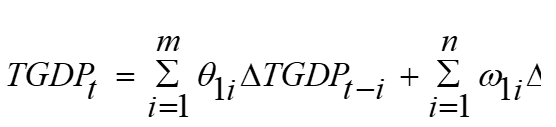
Granger Causality Test: Following Granger et al. [23] and [10,21,22,24,25] this test is conducted to ascertain the nature and type of causality between the two variables in our bilateral models:
(2)
Table 2: Definition of variables and source
Variables
Symbols
Definition of Variables
Sources
Telecommunication Gross Domestic Product
TGDP
Telecommunication simply means communication over a distance by designated devices at a very fast speed. However, in this study telecommunication percentage contribution to GDP in Nigeria is of interest to this study. This is the share of telecommunications in total GDP Magaji and Eke.
Central Bank of Nigerian Statistical Bulletin (CBN), 2021
MTN Investment
INVM
This is the total sum of capital formation in terms of asset that is created, with the intention of accumulation of profit.
Nigeria Communication Commission (NCC), 2021
Source: Author’s Compilation
Table 3: The Results of Unit Root Test
Variable
T-statistics
1% Critical value
5% Critical value
10% Critical value
Prob
Order
INVM
-3.954798
-3.920350
-3.065585
-2.673460
0.0094
1(1)
TGDP
-4.319171
-3.959148
-3.081002
-2.681330
0.0051
1(1)
Source: Authors computation
Table 4A: Unrestricted Cointegration Rank Test (Trace)
Hypothesized
No of CE
Eigen value
Trace statistics
0.05
Critical value
Prob
Decision
None
0.143042
3.254669
12.32090
0.8149
There is no cointegration between INVM and TGDP.
At Most 1
0.047867
0.784807
4.129906
0.4325
Table 4B: Unrestricted Cointegration Rank Test (Maximum Eigen value)
None
0.143042
2.469863
11.22480
0.8651
There is no cointegration between INVM and TGDP
At Most 1
0.047867
0.784807
4.129906
0.4325
Source: Authors computation
Table 5: The Result of Granger Causality Test
Null Hypothesis
OBS
F-Statistics
Prob.
Decision
TGDP does not Granger cause INVM
INVM does not Granger cause TGDP
16
2.64236
0.41465
0.1156
0.6705
There is no causality between INVM and TGDP.
Source: Authors computation
(3)
All the series are as previously defined except their lagged values and the error terms.
RESULTS AND DISCUSSION
The stationarity test in Table 3 indicates that Investment of MTN and Telecommunication GDP are stationary at first difference, that is, integrated of order one, I(1). This infers that the series were not stationary at levels and as a result, we reject the null hypothesis of stationarity at levels.
The Results of Cointegration
Results of two versions of the Johansen cointegration tests (Trace and Maximal Eigen Statistics) are displayed in Table 4. Both the trace statistic and maximum Eigen statistic confirmed the non-existence of any cointegrating vector or equation between INVM and TGDP. This implies that there is no long-run relationship between Investment of MTN Multinational Corporation (INVM) and Telecommunication GDP (TGDP). This means there won't be any form of causality between TGDP and INVM.
From the results presented in Table 5, there is no Granger causality between INVM and TGDP. This means that both INVM and TGDP do not Granger cause each other. It further implies that, we fail to reject the null hypothesis in both bilateral econometric conditions; and the results suggest that any policy that affectas INVM adversely won't affect TGDP and any policy either reducing or advancing TGDP will not reduce or advance INVM in Nigeria. Finally, both INVM and TGDP are not the determinants of each other.
CONCLUSION
This study critically investigated the link between the investment of Multinational Corporations and Telecommunication output in Nigeria for the period, 2003-2020. Reviewed current and existing literature revealed quite a few empirical studies on the subject matters in developed, emerging and developing economies. There have been a number of studies, but a few have been performed on the relationship between Multination Corporations and Telecommunication output in Nigeria has been conducted [26,27, 28] and a limited number of others focused on telecommunication-led growth. Seeing the gap and void in existing studies, the study explored a new dimension in Telecommunication development along with information communication technology.
Investment of MTN Multinational Corporation has been adjudged to be a major determinant of the Telecommunication GDP contribution to the Nigerian Economy. In recent times, less developed but small open economies have tried to boost the level of their Telecommunication and investment in the communication sector and integrate it into global competitiveness with a view to achieving sustainable and higher economic performance. The unit root and cointegration tests were applied as the estimation techniques for evaluating if our variables were statistically significant in explaining the Investment of MTN Multinational Corporation has been adjudged to be a major determinant of the Telecommunication GDP contribution to the Nigerian Economy. Policy should be designed and implemented using country-specific and home-grown reform programs that will increase access, quality and quantum of telecommunication with a view to reducing cost in making calls and other telecommunication accessories.
Atsu, F. et al. "The impact of telecommunication revenue on economic growth: Evidence from Ghana." European Journal of Marketing, vol. 5, no. 2, 2014, pp. 10–76.
Mamoun, M.M. and Talib, M.W. "The impact of telecom infrastructure on the economic growth: The case of oil producing and non-oil producing Arab countries." International Journal of Economics and Financial Issues, vol. 7, no. 3, 2017, pp. 423–428, http://www.econjournals.com.
Awoleye, O.M. et al. "Socio-economic effects of telecommunications growth in Nigeria: An exploratory study." Interdisciplinary Journal of Contemporary Research in Business, vol. 4, no. 2, 2012, pp. 256–262.
Haider, H. and Sharif, A.A. "Impact of teledensity on economic growth: A comparative analysis of South Asian countries." International Journal of Economics and Empirical Research, vol. 4, no. 11, 2016, pp. 571–581.
Sridhar, K.S. and Sridhar, V. "Telecommunications infrastructure and economic growth: Evidence from developing countries." Applied Econometrics and International Development, vol. 7, no. 2, 2004, pp. 91–116.
Sulaiman, C. "Assessing the impact of GSM sub-telecommunication sector on the teledensity rate and economic growth in Nigeria: Time series analysis." International Journal of Business and Social Science, vol. 4, no. 3, 2013, pp. 156–165.
Wainaina, M.C. Telecommunication infrastructure and economic growth: A case of Sub-Saharan Africa (1988–2010). Thesis, Kenyatta University, 2012.
Kuofie, M. et al. "Mobile phone providers and economic development in Ghana." Journal of Information Technology & Economic Development, vol. 2, no. 2, 2011, pp. 17–29, http://www.gsmi-ijgb.com.
Ishioro, B.O. "Energy consumption and economic growth in Nigeria: An augmented neoclassical growth model perspective." Journal of Environmental Management and Tourism, vol. X, no. 7, 2019, pp. 1637–1657.
Kimberly, D. Fundamentals of national income. McGraw-Hill Inc., 2018.
Madden, G.G. and Savage, S. "Telecommunications and economic growth." International Journal of Social Economics, vol. 27, 2000, pp. 893–906.
Yilmaz, S. et al. "The impact of infrastructural investment on sectoral growth." Australasian Journal of Regional Studies, vol. 7, no. 3, 2012, pp. 383–391.
Roller, L.H. and Waverman, L. "Telecommunications infrastructures and economic development: A simultaneous approach." American Economic Review, vol. 91, no. 4, 2001, pp. 909–923.
Bekere, B. and Bersisa, M. "Impact of foreign direct investment on economic growth in Eastern Africa." Determinants of Economic Growth in Africa, edited by Heshmati, A., Palgrave Macmillan, 2018, https://doi.org/10.1007/978-3-319-76493-1_4.
Chakraborty, C. and Nandi, B. "‘Mainline’ telecommunications infrastructure, levels of development and economic growth: Evidence from a panel of developing countries." Telecommunications Policy, vol. 35, no. 5, 2011, pp. 441–449.
Lee, S., Levendis, J. and Gutierrez, L. "Telecommunications and economic growth: An empirical analysis of Sub-Saharan Africa." Applied Economics, vol. 44, no. 4, 2011.
Agarwal, S. and Datta, A. "Telecommunications and economic growth: A panel data approach." Applied Economics, vol. 35, no. 15, 2004, pp. 1649–1654.
Gruber, H. and Koutroumpis, P. "Mobile telecommunications and the impact on economic development." Economic Policy, vol. 26, no. 67, 2011, pp. 387–426.
Dickey, D.A. and Fuller, W.A. "Distribution of the estimators for autoregressive time series with a unit root." Journal of the American Statistical Association, vol. 74, no. 366, 1979, pp. 427–431.
Ishioro, B.O. "Banking sector reforms and economic growth: Recent evidence from a reform-bound economy." Binus Business Review, vol. 8, no. 1, 2017, pp. 46–60.
Ishioro, B.O. "Energy consumption and performance of sectoral outputs: Evidence from an energy-impoverished economy." Journal of Environmental Management and Tourism, vol. IX, no. 7, 2018, pp. 1539–1558.
Granger, C.W.J., Huang, B.N. and Yang, C.W. "A bivariate causality between stock prices and exchange rates: Evidence from recent Asian flu." The Quarterly Review of Economics and Finance, vol. 40, 2000, pp. 337–354.
Ishioro, B.O. "Crude oil and economic growth in Nigeria: A simplified pair-wise causality test." Journal of Academic Research in Economics, vol. 12, no. 2, 2020, pp. 224–246.
Ishioro, B.O. "Financial market inclusion, shadow economy and economic growth paradigm: A less developed country perspective." Scientific Papers of the University of Pardubice, Series D, vol. XXVIII, no. 1, 2020, pp. 67–78.
Lee, C. "The causal relationship between telecommunications investment and economic development." Paper presented at the International Telecommunications Society Meeting, Sydney, Australia, 2013, pp. 6–9.
Keil, M. and Johnson, A. "Why software projects escalate: An empirical analysis and test of four theoretical models." MIS Quarterly, vol. 24, no. 4, 2015, pp. 631–664.
Ndukwe, E.C. "An overview of the Nigerian telecommunication environment." Paper presented at the Nigerian Telecommunication Summit, June 2017, Abuja, Nigeria.
Lam, P.L. and Shiu, A. "Economic growth, telecommunications development and productivity growth of the telecommunications sector: Evidence around the world." Telecommunications Policy, vol. 34, no. 4, 2010, pp. 185–199.
Ward, M.R. and Zheng, S. "Mobile telecommunications service and economic growth: Evidence from China." Telecommunications Policy, vol. 40, no. 2–3, 2016, pp. 89–101.
Tella, A. et al. "Global system for mobile communication: Implications for an emerging communication industry." The Journal of Community Informatics, vol. 3, no. 4, 2007, pp. 15–22.
Tella, S.A. et al. "Telecommunications infrastructure and economic growth: Evidence from Nigeria." Paper presented at the UN-IDEP and AFEA Joint Conference on Sector-Led Growth in Africa, Dakar, Senegal, Nov. 2017.
Kootanaee, A.J. et al. "Just-in-time manufacturing system: From introduction to implement." International Journal of Economics, Business and Finance, vol. 1, no. 2, 2013, pp. 7–25.
Erumban, A.A. and Das, D.K. "Information and communication technology and economic growth in India." Telecommunications Policy, vol. 40, no. 5, 2016, pp. 412–431.
Kallel, R. et al. "ICT diffusion and economic growth: Evidence from the sectoral analysis of the periphery country." Technological Forecasting and Social Change, vol. 162, 2021, p. 120403.
Sun, H. and Kim, G. "The composite impact of ICT industry on lowering carbon intensity: From the perspective of regional heterogeneity." Technology in Society, vol. 66, 2021, p. C.
Dahmani, M. et al. "The information and communication technology-growth nexus in Tunisia: A cross-section dynamic panel approach." Montenegrin Journal of Economics, vol. 18, no. 2, 2022, pp. 161–174.
Dahmani, M. et al. "ICT, trade openness and economic growth in Tunisia: What is going wrong?" Economic Change and Restructuring, vol. 55, 2022, pp. 2317–2336.
Shobande, O.A. and Ogbeifun, A. "Has information and communication technology improved environmental quality in the OECD? A dynamic panel analysis." International Journal of Sustainable Development and World Ecology, vol. 29, no. 1, 2022, pp. 39–49.Top of Form
License
Creative Commons Attribution-NonCommercial-NoDerivatives 4.0 International License
All papers should be submitted electronically. All submitted manuscripts must be original work that is not under submission at another journal or under consideration for publication in another form, such as a monograph or chapter of a book. Authors of submitted papers are obligated not to submit their paper for publication elsewhere until an editorial decision is rendered on their submission. Further, authors of accepted papers are prohibited from publishing the results in other publications that appear before the paper is published in the Journal unless they receive approval for doing so from the Editor-In-Chief.
Himalayan Journal of Economics and Business Management open access articles are licensed under a Creative Commons Attribution-Share A like 4.0 International License. This license lets the audience to give appropriate credit, provide a link to the license, and indicate if changes were made and if they remix, transform, or build upon the material, they must distribute contributions under the same license as the original.
Advertisement
Recommended Articles
Research Article
Influence of Leadership on Poverty Reduction in the Devolved Government in Trans-Nzoia County, Kenya
Kinisu Sifuna,
...
Peter Simotwo
Published: 30/06/2021
Download PDF
Cite
x
APA
Sifuna, K., Lwangale, D. W., Simotwo, P., Sifuna, K., Lwangale, D. W. & Simotwo, P. (2021). Influence of Leadership on Poverty Reduction in the Devolved Government in Trans-Nzoia County, Kenya. Himalayan Journal of Economics and Business Management, 2(1), None-None.
MLA
Sifuna, Kinisu, et al. "Influence of Leadership on Poverty Reduction in the Devolved Government in Trans-Nzoia County, Kenya." Himalayan Journal of Economics and Business Management 2.1 (2021): None-None.
Chicago
Sifuna, Kinisu, David W. Lwangale, Peter Simotwo, Kinisu Sifuna, David W. Lwangale and Peter Simotwo. "Influence of Leadership on Poverty Reduction in the Devolved Government in Trans-Nzoia County, Kenya." Himalayan Journal of Economics and Business Management 2, no. 1 (2021): None-None.
Harvard
Sifuna, K., Lwangale, D. W., Simotwo, P., Sifuna, K., Lwangale, D. W. and Simotwo, P. (2021) 'Influence of Leadership on Poverty Reduction in the Devolved Government in Trans-Nzoia County, Kenya' Himalayan Journal of Economics and Business Management 2(1), pp. None-None.
Vancouver
Sifuna K, Lwangale DW, Simotwo P, Sifuna K, Lwangale DW, Simotwo P. Influence of Leadership on Poverty Reduction in the Devolved Government in Trans-Nzoia County, Kenya. Himalayan Journal of Economics and Business Management. 2021 Jan;2(1):None-None.
Download PDF
Research Article
Modelling Structure Job Quality, Job Design and Job Satisfaction
Moch Nurhadi,
...
Avi Sunani
Published: 30/08/2022
Download PDF
Cite
x
APA
Nurhadi, M., Bisyri Effendi, M., Saiful Ulum, A. & Sunani, A. (2022). Modelling Structure Job Quality, Job Design and Job Satisfaction. Himalayan Journal of Economics and Business Management, 3(2), 1-4.
MLA
Nurhadi, Moch, et al. "Modelling Structure Job Quality, Job Design and Job Satisfaction." Himalayan Journal of Economics and Business Management 3.2 (2022): 1-4.
Chicago
Nurhadi, Moch, Moch Bisyri Effendi, Achmad Saiful Ulum and Avi Sunani. "Modelling Structure Job Quality, Job Design and Job Satisfaction." Himalayan Journal of Economics and Business Management 3, no. 2 (2022): 1-4.
Harvard
Nurhadi, M., Bisyri Effendi, M., Saiful Ulum, A. and Sunani, A. (2022) 'Modelling Structure Job Quality, Job Design and Job Satisfaction' Himalayan Journal of Economics and Business Management 3(2), pp. 1-4.
Vancouver
Nurhadi M, Bisyri Effendi M, Saiful Ulum A, Sunani A. Modelling Structure Job Quality, Job Design and Job Satisfaction. Himalayan Journal of Economics and Business Management. 2022 Jul;3(2):1-4.
Download PDF
Research Article
Accountability and Transparency of Village Fund Management in Lumajang District
Nurina Ayuningtiyas,
...
Muhammad Miqdad
Published: 28/12/2023
Download PDF
Cite
x
APA
Ayuningtiyas, N., Santosa Putra, H. & Miqdad, M. (2023). Accountability and Transparency of Village Fund Management in Lumajang District. Himalayan Journal of Economics and Business Management, 4(2), 1-4.
MLA
Ayuningtiyas, Nurina, Hendrawan Santosa Putra and Muhammad Miqdad. "Accountability and Transparency of Village Fund Management in Lumajang District." Himalayan Journal of Economics and Business Management 4.2 (2023): 1-4.
Chicago
Ayuningtiyas, Nurina, Hendrawan Santosa Putra and Muhammad Miqdad. "Accountability and Transparency of Village Fund Management in Lumajang District." Himalayan Journal of Economics and Business Management 4, no. 2 (2023): 1-4.
Harvard
Ayuningtiyas, N., Santosa Putra, H. and Miqdad, M. (2023) 'Accountability and Transparency of Village Fund Management in Lumajang District' Himalayan Journal of Economics and Business Management 4(2), pp. 1-4.
Vancouver
Ayuningtiyas N, Santosa Putra H, Miqdad M. Accountability and Transparency of Village Fund Management in Lumajang District. Himalayan Journal of Economics and Business Management. 2023 Jul;4(2):1-4.
Download PDF
Research Article
Proposed Digital Marketing Strategy to Enhance Engineering Consultancy Company Revenue
Alfarisy, K. A.,
Wandebori, H.
Published: 30/04/2024
Download PDF
Cite
x
APA
K. A., A. & H., W. (2024). Proposed Digital Marketing Strategy to Enhance Engineering Consultancy Company Revenue. Himalayan Journal of Economics and Business Management, 5(1), 1-18.
MLA
K. A., Alfarisy, and Wandebori, H.. "Proposed Digital Marketing Strategy to Enhance Engineering Consultancy Company Revenue." Himalayan Journal of Economics and Business Management 5.1 (2024): 1-18.
Chicago
K. A., Alfarisy, and Wandebori, H.. "Proposed Digital Marketing Strategy to Enhance Engineering Consultancy Company Revenue." Himalayan Journal of Economics and Business Management 5, no. 1 (2024): 1-18.
Harvard
K. A., A. and H., W. (2024) 'Proposed Digital Marketing Strategy to Enhance Engineering Consultancy Company Revenue' Himalayan Journal of Economics and Business Management 5(1), pp. 1-18.
Vancouver
K. A. A, H. W. Proposed Digital Marketing Strategy to Enhance Engineering Consultancy Company Revenue. Himalayan Journal of Economics and Business Management. 2024 Jan;5(1):1-18.
None, A., Ajiroghene, R. & ISHIORO, B. (2022). Investments of Multinational Corporations and Telecommunication Output in Nigeria: A Leapfrogging Experience?. Himalayan Journal of Economics and Business Management, 3(2), 1-7.
MLA
None, Akpobasa, Richard Ajiroghene and Bernhard ISHIORO. "Investments of Multinational Corporations and Telecommunication Output in Nigeria: A Leapfrogging Experience?." Himalayan Journal of Economics and Business Management 3.2 (2022): 1-7.
Chicago
None, Akpobasa, Richard Ajiroghene and Bernhard ISHIORO. "Investments of Multinational Corporations and Telecommunication Output in Nigeria: A Leapfrogging Experience?." Himalayan Journal of Economics and Business Management 3, no. 2 (2022): 1-7.
Harvard
None, A., Ajiroghene, R. and ISHIORO, B. (2022) 'Investments of Multinational Corporations and Telecommunication Output in Nigeria: A Leapfrogging Experience?' Himalayan Journal of Economics and Business Management 3(2), pp. 1-7.
Vancouver
Akpobasa A, Ajiroghene R, ISHIORO B. Investments of Multinational Corporations and Telecommunication Output in Nigeria: A Leapfrogging Experience?. Himalayan Journal of Economics and Business Management. 2022 Jul;3(2):1-7.



 Download PDF
 Download XML