Employee engagement is an emotional and intellectual commitment to the organization. Employee engagement can create success for a company, one of which is through improving employee performance. The purpose of this study is to determine the significance of the problem between Competence and Self-Efficacy on Employee Engagement through Intervening Variable of Organizational Commitment in ASN Semarang City. The number of respondents used in this study was 100 people using the judgment sampling method. Respondents are ASN employees in Semarang City. This type of research is quantitative by means of data collection by filling out questionnaires using the IBM SPSS test with the Multiple Linear Regression analysis method, namely the validity test and the reliability test descriptively. The reason for choosing this method is that this research can be conducted to dissect in detail the influence and relationship between competency, self-efficacy and organizational commitment variables on employee engagement in ASN Semarang City. The results showed that each variable had a significant effect, namely competence had a positive effect on employee engagement, self-efficacy had a positive effect on employee engagement and organizational commitment variable which was an intervening variable had an effect on employee engagement. So it can be concluded that all variables influence the occurrence of employee engagement in ASN Semarang City. This research provides a better understanding of the factors that influence employee engagement.
Keywords
Employee Engagement
Competence
Self-Efficacy
Organizational Commitment
INTRODUCTION
The company is an organization consisting of a group of people, working in carrying out various activities to achieve company goals. Human resources are very important for a company to achieve its goals. The success of an organization or company depends on the existence of its human resources. Quality human resources will produce good performance for individuals and make a positive contribution to the progress of the company. Human resources are employees and leaders who are in the company's organization, because the company's success in achieving its goals depends on its employees and leaders. Processing of human resources must be a thought and determinant of the success of organizational goals. Employees and organizations need each other, performance produced by an organization as a result of the performance of employees in the organization. To realize the desired goal, then one of the ways that must be taken is to improve employee performance that is by paying attention to competence, self-efficacy and organizational commitment.
Currently, classic problems often occur in an organization in various sectors in facing increasingly complex and competitive challenges to carry out its operations. In a dynamic business environment, employee performance is one of the key factors that influence the success of a company. One of the factors believed to influence employee performance is their competence and self-efficacy. Competence refers to knowledge, skills, and attitudes that are relevant to the tasks that must be carried out, while self- efficacy is an individual's belief in his ability to succeed in achieving the desired goals. Previous research has linked competency and self-efficacy with employee performance. For example, the study conducted by Johnson et al [1] found that employees who have a high level of competence tend to have better performance compared to those who have a low level of competence. Likewise, research conducted by Smith et al [2] showed that high self- efficacy is positively correlated with employee performance.
Although the relationship between competence, self-efficacy, and employee performance has been widely studied, there are still unresolved issues. One of the issues that is still being questioned is the role of organizational commitment as an intervening variable between competency and self-efficacy and employee performance. Organizational commitment refers to the level of loyalty, identification, and involvement of employees towards the organization where they work. In this context, organizational commitment is considered to be a mediating factor that strengthens the relationship between competency, self-efficacy, and employee performance.
Competence refers to knowledge, skills, and attitudes that are relevant to the tasks that must be carried out by an employee. High competence indicates that a person has the qualifications and skills needed to carry out the task properly. Previous research has shown a positive relationship between competency and employee performance. When employees have high competence, they tend to feel more engaged and involved in the organization they work for. High organizational commitment can increase employee motivation and dedication to achieve better performance. In addition, organizational commitment can also affect employees' perceptions of their duties and responsibilities, as well as affect the quality of the relationship between employees and superiors or co-workers.
Relevant studies exploring the relationship between self-efficacy, employee performance, and organizational commitment as intervening variables between self- efficacy and employee performance are research conducted by Lee et al [3]. This study focuses on the role of organizational commitment in explaining the relationship between self-efficacy and employee performance. In that study, self- efficacy was measured as an individual's belief in his abilities to carry out the tasks required in their job. High self-efficacy indicates that individuals feel confident and confident in overcoming work challenges and achieving good results.
Based on research conducted by Lee et al [3], self-efficacy has a direct influence on employee performance. Employees with high self-efficacy tend to perform better than those with low self-efficacy. High self-efficacy provides motivation and confidence in individuals to face tasks confidently, overcome obstacles, and try to achieve good results.
Employee performance is measured as the result of work tasks performed by individuals, such as productivity, quality of work, initiative or target achievement. High performance shows that individuals are able to achieve the expected results and make a significant contribution to the organization. In this context, when employees feel emotionally and psychologically attached to the organization, they tend to have higher motivation to do well. Strong organizational commitment can also influence employees' perceptions of their duties and responsibilities, as well as influence their relationships with superiors, co-workers, and the organization as a whole.
Organizational commitment is an important factor in the sustainabilitgyuoafrtdhe organization. Organizational commitment is loyalty or individual loyalty to the organization where they work. The higher the level of commitment, the more likely the individual will stay in the organization and perform well. Therefore, increasing organizational commitment is the main focus of management in achieving organizational goals.
In addition, organizational commitment also has an important role in explaining the relationship between self-efficacy and employee performance. Organizational commitment mediates this relationship by influencing employees' attitudes and behavior toward their jobs. Individuals with high organizational commitment tend to have strong motivation to perform well and strive to achieve organizational goals. High organizational commitment can also strengthen the positive effect of self-efficacy on employee performance by providing support and a sense of attachment to the organization.
Several previous studies have also provided preliminary evidence about the role of organizational commitment as an intervening variable. For example, research conducted by Brown et al [5] show that organizational commitment mediates the relationship between competence and employee performance. Another study conducted by Lee et al [4] show that organizational commitment also mediates the relationship between self-efficacy and employee performance.
Based on this background, the purpose of this study was to investigate the effect of competence and self-efficacy on employee performance, taking into account the role of organizational commitment as an intervening variable. In particular, this study will examine whether competence and self-efficacy directly affects employee performance, as well as whether organizational commitment mediates the relationship.
This research is expected to contribute to the understanding of the factors that influence employee performance. The results of this study can also provide practical guidance for companies in developing human resources, especially in improving employee competence and self-efficacy, as well as strengthening organizational commitment. In this regard, this research will also serve as a basis for developing more effective management strategies in improving organizational performance.
LITERATURE REVIEW AND DEVELOPMENT OF THE COMPETENCE
Competence
Competence, which refers to a collection of knowledge, skills and attitudes owned by an employee that allows him to carry out job duties properly. Competence can cover various aspects, such as technical knowledge, interpersonal skills, understanding of the work context, and the ability to solve problems. According to Kustiany states that competence needs attention from the leadership, especially those dealing with human resources and the work environment in the form of security, welfare, comfort and welfare of Human Resources employees who need to get the attention of the leadership so that the tasks assigned can run well. Meanwhile, according to Hendriani et al. [6], argues that competence is the ability to carry out activities in a job or function in accordance with expected work standards. From the above understanding, it can be concluded that competence is a characteristic that underlies a person who influences himself in thinking and acting while working to carry out activities in work or functions in accordance with expected work standards.
Meanwhile, according to Moeheriono [7] competency can also be defined as the underlying characteristics of a person related to the effectiveness of individual performance in his work or the basic characteristics of individuals who have a causal relationship or as a cause and effect with the criteria used as a reference, effective or excellent or superior performance at work or in certain situations. However, according to [8] the importance of competence is a combination of job maturity (ability) psychological maturation (willingness) and work experience that can direct one's own behavior. In the above understanding, it can be concluded that competence shows a combination of knowledge, skills, attitudes and characteristics possessed by individuals who carry out their duties and responsibilities effectively.
Factors that influence it are:
Education and Training: Formal education and professional training can assist in acquiring the necessary knowledge and skills to develop competency in a particular field
Work Experience: Relevant and diverse work experience can provide opportunities to develop practical competencies and broaden understanding in real work contexts
Organizational Support: Support from organizations, such as employee development programs, mentoring, or access to relevant resources, can play a role in enhancing individual competencies
Independent Learning: Willingness and motivation to learn independently, such as reading books, taking online courses, or seeking relevant learning opportunities, can assist in developing competencies.
Performance Feedback and Evaluation: Constructive feedback and regular performance evaluations can help individuals identify their strengths and weaknesses in terms of competence, so that they can direct their efforts towards further development
Supportive Work Environment: A supportive work environment, where collaboration, open communication, and a learning culture are practiced, can provide better opportunities for individuals to develop competencies
Personal Motivation and Initiative: Intrinsic motivation and personal initiative to continuously learn and develop oneself can be a key factor in competence development
Self-Efficacy
Self-efficacy is an individual's belief in their ability to succeed in achieving goals and overcoming the challenges they face. Self-efficacy has a strong influence on a person's motivation, performance, and success in various areas of life. Self-efficacy according to Bandura in Kartika and Prihatsanti, is a vital self-dimension. This self-efficacy refers to self-confidence in one's own capabilities in doing something, especially in a task or job. Judge et al in Kartika and Prihatsanti also consider that self-efficacy this is a positive aspect of self-evaluation when doing self- understanding. In addition, according to Corsun and Enz in Subagyo [9] explaining self-efficacy is personal belief to explore potential abilities so that they can develop, so that it has a positive impact on job performance. Then Kreitner and Kinicki in Subagyo [9] define self-efficacy asconfidentindividual regarding the chance to complete something taskforces.
Based on this statement it can be implied that self-efficacy is the individual's confidence in the opportunity (opportunity) and the potential to complete a task or problem. Good self-efficacy in a person's persona will create motivation within him to complete a task painstakingly and achieve predetermined goals according to his abilities and capacities. A person's self-efficacy can be developed through a process that involves several influencing factors.
The following are several factors that can influence the development of a person's self- efficacy:
Experience of success: Experience of success in dealing with a particular task or challenge can build self-confidence and increase self-efficacy. When a person achieves a set goal or overcomes a difficult obstacle, they will tend to feel more confident in their ability to deal with similar situations in the future
Role models and observations: Observing other people who are successful in the same field or have the desired skills can influence the development of self- efficacy. Seeing how others overcome challenges, manage failure, and achieve success can provide inspiration and guidance for individuals to develop their own self-confidence
Positive feedback: Positive feedback from others about individual abilities and achievements can increase self-efficacy. When people receive feedback that reinforces their abilities and accomplishments, they tend to feel more confident and confident in their abilities to achieve their desired goals
Learning and knowledge: Development of knowledge and skills in the desired field can increase self-efficacy. With increased relevant knowledge and skills, individuals will feel more prepared and confident in facing the related tasks and challenges
Social support: Social support from people around, such as friends, family, or mentors, can affect the development of self-efficacy. Emotional support, encouragement, and positive feedback from others can help individuals feel supported and confident in facing difficult tasks or challenges
Realistic goal setting: Setting realistic and achievable goals can help individuals develop self-efficacy. By planning clear steps and achieving realistic goals incrementally, individuals can build self confidence and increase their self- efficacy over time
Reflection and self-monitoring: Regularly reflecting on one's achievements, strengths, and progress can help in developing self- efficacy. By monitoring and recognizing their own progress, individuals can build self-confidence and motivate themselves to continuously improve self-efficacy
Employee Performance
Performanceis the result of an employee's action or ordinary performance of the employee's skills on duty. Employee Performanceis a measure of the extent to which an employee achieves or exceeds the goals, tasks, or standards set by the organization.Employee Performanceis the result of the activities carried out by employees over a period of time based on the professional performance of each that has been adapted to the industry or company. Performancecan be assumed to be the result of a method or profession in its achievements.
Therefore, every employee is required to have competence, namely expertise or ability to carry out duties or professions that are his responsibility or that which he is entrusted with. Performance is basically every application of an obligation or profession where there is an activity doing or changing the input (input) into something valuable output (output) for the product or the results of the activities in the activity. The employee performance indicators are the quality of work, quantity of work, timeliness, productivity.
The following are some general factors that can affect employee performance:
Competence: Employee competency, namely the knowledge, skills, and attitudes possessed, can significantly influence their performance. The higher the competency level of employees in the relevant field, the more likely they are to achieve good performance
Motivation: Employee motivation is an important factor in determining performance. High motivation can encourage employees to work diligently, dedicatedly, and try to achieve the set goals. Motivating factors such as recognition, fair rewards, and career development opportunities can positively influence employee performance
Leadership: Leadership style and the ability of a boss to manage and provide direction to employees can have a significant impact on performance. Good leadership, such as providing support, providing constructive feedback, and providing clear guidelines, can motivate and improve employee performance
Work Environment: A good work environment, including positive organizational culture, effective communication, and teamwork, can affect employee performance. An enabling environment and providing social support can increase job satisfaction and motivation, which in turn can have a positive impact on performance
Reward and Recognition System: A fair and clear reward and recognition system can provide incentives for employees to achieve good performance. Rewards, such as verbal recognition, promotions, bonuses, or other rewards, can increase employee motivation and improve performance
Work and Personal Life Balance: A healthy balance between work and personal life can affect employee performance. When employees have a good balance between work responsibilities and time for personal life, they tend to be more focused, productive and perform well
Training and Development Support: Organizational support in the form of training, skills development, and opportunities for career growth can improve employee performance. Through training and development, employees can increase their competence and feel more competent in carrying out work tasks
Organizational Commitment
Organizational Commitment is an important key in achieving organizational success. When organizational members are actively involved and highly dedicated to the company's goals and values, they are more likely to work hard, collaborate, and innovate to achieve better results. This paper aims to describe good and true organizational commitment and explain why it is important for organizational success. The concept of organizational commitment relates to the degree of involvement people have with the organization in which they work and are interested in remaining in that organization.
The Importance of Organizational Commitment with higher performance: Members of an organization who have a strong commitment tend to be more dedicated, motivated, and contribute optimally, which in turn increases individual and organizational performance as a whole [10]. Therefore the way to build strong Organizational Commitment is like having an inspiring leader: Organizational leaders must be a good example and inspire employees through vision, clear communication, and fair leadership [11].
The following are several factors that are generally considered to have an influence on organizational commitment:
Leadership: Good and effective leadership can influence organizational commitment. Leadership that provides support, provides clear direction, and pays attention to the needs of employees can increase their sense of attachment and involvement with the organization
Organizational Culture: A positive and inclusive organizational culture can affect employee commitment. When an organization has values that are in line with those of its employees and provides a supportive environment, employees will tend to be more attached to and involved in the organization
Career Development Opportunities: Opportunities for career development and advancement in the organization can affect employee commitment. Employees who feel there is an opportunity to develop, advance, and achieve their career goals within the organization tend to have higher commitment
Organizational Justice: Employees' perceptions of fairness in the organization, including fairness in decision making, distribution of resources, and fair treatment, can affect organizational commitment. Employees who feel they are treated fairly tend to be more engaged and have a higher commitment to the organization
Work-Life Balance: Organizational support for work-life balance can affect employee commitment. Organizations that pay attention to and support a balance between the demands of work and personal lives of employees can increase their commitment to the organization
Relationships among colleagues: Good relations between colleagues can influence organizational commitment. A positive work climate, strong teamwork, and social support among colleagues can increase employee commitment to the organization
Job Satisfaction: A high level of job satisfaction can influence organizational commitment. Employees who are satisfied with their jobs, including pay, working conditions, recognition, and development opportunities, tend to have higher commitment to the organization
Framework
A framework is a concept or conceptual structure that is used to guide understanding, analysis, and research on a topic or phenomenon. The framework of thought provides a systematic framework for compiling arguments, identifying relevant variables, and connecting concepts logically Sugiyono.
In the process of forming a framework, researchers can conduct a literature review to identify theories, models, or concepts that are relevant to their research topic. The bibliography and citations collected from previous research are used to support and strengthen arguments and provide an understanding of previous research related to the topic being studied.
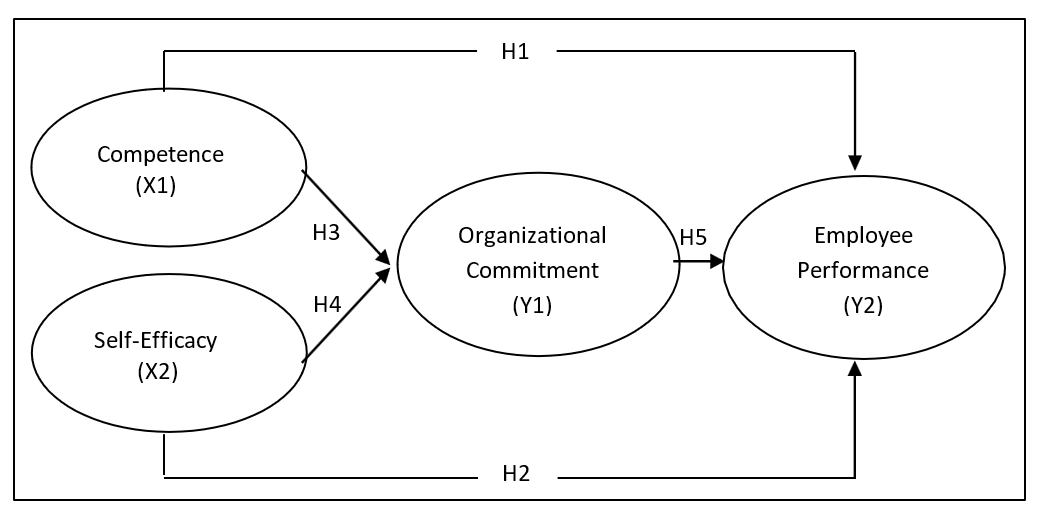
This study was made using independent variables, namely Competence (X1) and Self-Efficacy (X2) on the dependent variable, namelyEmployee Performance (Y2) with the intervening variable, namely Organizational Commitment (Y1). The following is a picture of the research model from the framework in this study:
H1: Competence has a positive effect on employee performance
H2: Self-efficacy has a positive effect on employee performance
H3: competence has a significant positive influence on organizational commitment
H4: Self-efficacy has a positive influence on organizational commitment
H5: Organizational commitment has a positive effect on employee performance
This study uses the Multiple Linear Regression Analysis method with the IMB SPSS program. Where to find out how much influence Competence, Self- Efficacy, and Work Motivation have on Organizational Commitment.
HYPOTHESIS DEVELOPMENT
The Effect of Competence on Employee Performance
Competence is something that must be owned by a civil servant (ASN), by having the right competence, you will be able to understand what you have to do and what your function is in that job. A good understanding of the adequate functions and competencies of ASN will increase a high commitment to the organization. Research on the effect of competence on organizational commitment is shown by Bram Afrilyan's research which states that competence has a positive and significant effect on organizational commitment.
According to Radiyah Hasan Jan and Faradila Hasan [12] who stated that competency has a positive and significant effect on organizational commitment. And research conducted by Fakhrul Rozi Yamali [13] states that competency has a positive and significant effect on organizational commitment, meaning that ASNs with high competence can increase their commitment to the organization.
H1: There is a significant impact on competence Employee Performance
Effect of Self-Efficacy on Employee Performance
Employee performance is the result of work in quality and quantity achieved by an employee in carrying out his duties in accordance with the responsibilities given to him [2]. Zainal et al stated that performance is a real behavior that is displayed by everyone as work performance produced by employees according to their role in the company. Employee performance is a very important thing in the company's efforts to achieve its goals.
The performance of the State Civil Apparatus (ASN) as a result of the work achieved by ready civil servants in the organization is in accordance with employee performance targets and work behavior. It was further explained that employee performance targets are performance plans and targets to be achieved by civil servants that must be achieved annually. Performance indicators are a measure of work success achieved by every civil servant.
H2: There is a significant impact on Self-Efficacy Employee Performance
The Effect of Competence on Organizational Commitment
Competence is the work ability of each individual which includes aspects of knowledge, skills and work attitudes that are in accordance with the expected standardization.
Competence can be seen from the attributes of knowledge, experience and knowledge possessed by the employee concerned and his ability can be improved through training and development. The level of competency possessed by ASN will affect commitment in carrying out their duties. ASN who have competence and are supported by strong self-efficacy tend to be committed to their organization.
H3: There is a significant impact of Competence on Organizational Commitment
The Effect of Self-Efficacy on Organizational Commitment
Self-efficacy plays a very important role in everyday life, someone will be able to use their potential optimally if their self-efficacy can support it. For self-efficacy is an individual's belief about his ability to perform tasks or actions needed to achieve certain results. Research on the relationship between self-efficacy and organizational commitment has been demonstrated by Marwan Adnan Rajak and Anjas Mukti Yallo which states that self-efficacy has a positive and significant effect on organizational commitment.
According to Amir Subagyo [9] argued that self-efficacy has a positive and significant effect on organizational commitment. And research conducted by Nira Avie Dyah Puspita Dewi states that self-efficacy has a positive effect on organizational commitment.
H4: There is a significant impact of Self-Efficacy on Organizational Commitment
The Effect of Organizational Commitment on Employee Performance
The results of research conducted by Murty and Hudiwinarsih and Anto Triyono revealed that organizational commitment partially has no significant effect on employee performance. Khan, found a positive relationship between performance and organizational commitment including its three aspects. Therefore, from the description above, the hypothesis can be formulated as follows
H5: Organizational Commitment Has a Positive Effect on Employee Performance
RESEARCH METHODOLOGY
In this research, it includes quantitative types that act as independent variables, dependent variables and intervening variables, namely the Effect of Competence and Self-Efficacy on Employee Performance through Organizational Commitment as Intervening Variables.
According to Sugiono population is defined as a generalized area consisting of objects/subjects with certain qualities and characteristics, determined by researchers to be studied and then drawn conclusions. In this case the population determined is the Semarang City ASN employees, totaling 100 people. Samples were taken using the judgment sampling method. In this study, the data collection method was carried out by distributing questionnaires. The data analysis method used is the Multiple Linear Regression analysis method, namely the validity test and the reliability test descriptively.
Validity and Reliability Test
Validity test is used to measure the validity of the research instrument. The research instrument is said to be valid if it is able to measure the variables studied. Ghozali said that a variable is said to be valid if the value of Corrected item total correlation>r table.
Reliability test to determine the consistency of a measuring instrument used in research. Ghozali states that a variable is reliable if the value of Cronbach's alpha>0.60.
Hypothesis Test
According to Ghozali states that the t statistical test basically shows how far the influence of one independent variable individually explains the variation of the dependent variable.
RESULTS AND DISCUSSION
Competency Variable (X1)
Based on the distribution of the research questionnaire, there are competency variables from the number of respondents, so a descriptive analysis of the question items using the SPSS version 22 program is as follows: the results show that the average answer from respondents on the competency variable shows an average score (mean) of 4.18. It can be concluded that most of the respondents tend to perceive that they have high work competence.
Self-Efficacy Variable (X2)
Based on the distribution of research questionnaires, there is a self-efficacy variable indicating that the average answer from respondents on the self-efficacy variable shows an average score (mean) of 3.96. It can be concluded that most respondents tend to perceive themselves as having high self-efficacy.
Organizational Commitment Variable (Y1)
It is known that the organizational commitment variable shows that the average response of respondents to the organizational commitment variable shows an average score (mean) of 4.12. It can be concluded that most respondents perceive that they have high organizational commitment.
Validity and Reality Test
The results of the KMO test show that the number of KMO in the competency variable is 0.669 which exceeds 0.5 so that the research sample is sufficient for factor analysis. All competency indicators (X1) above are valid because it is known that 8 indicators have a loading factor exceeding 0.4. All of the self-efficacy indicators (X2) above are valid because it is known that 9 indicators have a loading factor exceeding 0.4. All indicators of work motivation (X3) above are valid because it is known that 6 indicators have a loading factor of more than 0.4. All indicators of organizational commitment (Y) above are valid because of the 12 indicators known to have a loading factor of more than 0.4.
Reliability Test
Reliability Test is a tool for measuring questionnaires which are indicators of variables. A questionnaire can be said to be reliable or reliable if the answers from the respondents to the statement items are consistent or stable. It can be seen that the variables in this study have met the requirements with the competency variable (X1) which has a cronsbach's alpha value of 0.780, self- efficacy variable (X2) has a cronsbach's alpha value of 0.789, work motivation variable (X3) has a cronsbach's alpha value of 0.767, and the organizational commitment variable (Y) has a cronsbach's alpha value of 0.879. So that it can it was concluded that all the variables in this study were said to be reliable because they had cronsbach's alpha values above 0.7.
Hypothesis Test Results
Hypothesis 1 (H1)
Based on the results of the analysis of hypothesis testing, it can be explained that competence has a positive effect on organizational commitment (significance value
0.018<0.05 and β = 0.260). Thus hypothesis 1 states that competence has a positive effect on organizational commitment is accepted.
Hypothesis 2 (H2)
Based on the results of the analysis of hypothesis testing, it can be explained that self- efficacy has a positive effect on organizational commitment (significance value of 0.000<0.05 and β = 0.450). Thus hypothesis 2 states that self-efficacy has a positive effect on organizational commitment is accepted.
Hypothesis 3 (H3)
Based on the results of the analysis of hypothesis testing, it can be explained that work motivation has a negative effect on organizational commitment (significance value of 0.474>0.05 and β = -0.071). Thus hypothesis 3 states that work motivation has a positive effect on organizational commitment is rejected.
DISCUSSION
The Effect of Competence on Organizational Commitment
Based on hypothesis testing shows that competence has a positive effect on organizational commitment. This means that the higher the competence, the higher the organizational commitment, those who have competence in character can develop their expertise and skills and are responsible for their work, so that those concerned feel happy to do their best, full of challenges and have a career with enjoyable feelings. The findings of this study support the finding that competency has a positive effect on organizational commitment.
The Effect of Self-Efficacy on Organizational Commitment
Based on hypothesis testing shows that self-efficacy has a positive effect on organizational commitment. This means that the higher the level of self-efficacy, the higher the organizational commitment. This shows that those who have high self- efficacy and have a character where they feel able to work with colleagues and superiors, work methodically, and are always able to achieve goals in carrying out their duties, so that those concerned feel happy working with the best and full of challenges, and happy career. The findings of this study are in line with the findings of research by Marwan [15], Rajak, A and Yallo, AM, Subagyo, A [9], which states that self-efficacy has a positive effect on organizational commitment.
The Effect of Competence on Employee Performance
The effect of competency on employee performance has been widely studied in the human resource management literature. Several studies show a positive relationship between competence and employee performance. Following are some of the main findings from the related literature:
A study conducted by Obeidat, Al Bakri, and Tarhini [16] found that interpersonal competencies, such as communication skills and the ability to work in teams, are related to employee performance. Employees who have good interpersonal competence tend to have better relationships with co- workers and are able to collaborate effectively, which contributes to an increase in their performance.
Research by Hafeez, Javed, and Rizwan [17] shows that competencies related to understanding and implementing organizational values have a positive influence on employee performance. Employees who have a strong understanding of organizational values and are able to apply them in their daily work tend to achieve better performance.
In general, the positive influence of competence on employee performance. Job-relevant competencies, whether technical or interpersonal, provide employees with the skills necessary to achieve the desired results. It is important for organizations to identify competencies that are critical in the context of their work and implement appropriate competency development strategies to improve employee performance.
The Effect of Organizational Commitment on Employee Performance
Organizational commitment refers to the level of attachment, identification, and involvement of employees in the organization where they work. According to a study conducted by Rhoades and Eisenberger [18] found that organizational commitment can moderate the relationship between job stress and employee performance. Employees who have high commitment tend to be better able to cope with work stress and maintain good performance even in challenging situations.
Organizational commitment has a positive influence on employee performance. Highly committed employees tend to be more motivated, perform better, and have higher retention rates. Therefore, it is important for organizations to pay attention to and facilitate the development of employee organizational commitment in order to improve the overall performance and success of the organization.
Effect of Self-Efficacy on Employee Performance
Self-efficacy relates to employee performance through mechanisms of self- influence and self-regulation. Employees with high self-efficacy tend to organize themselves better, set more ambitious goals, and use effective strategies to achieve those goals, which in turn improves their performance.
The effect of self-efficacy on employee performance based on the findings:
Research by Rigotti, Schyns, and Mohr [19] shows that self-efficacy is related to employee performance in stressful situations. Employee with high self-efficacy tends to have a better ability to cope with pressure and stress at work, which has a positive impact on their performance
The study conducted by Wang and Liao [20] found that employee self- efficacy influences organizational commitment. Employees who have high self- efficacy tend to be more engaged and committed to their organizations, which in turn can improve their performance
High self-efficacy has a positive influence on employee performance.
High self-efficacy can increase motivation, resistance to pressure, problem- solving skills, and commitment to the organization, which in turn contributes to better performance. It is important for organizations to pay attention to and support the development of employee self-efficacy in order to improve their performance.
CONCLUSION
Competence has a positive and significant effect on Employee Performanceto ASN employees in Semarang City
Self-efficacy has a positive and significant effect onEmployee Performanceto ASN employees in Semarang City
Competence has a positive and significant effect on Organizational Commitment to ASN employees in Semarang City
Self-efficacy has a positive and significant effect on Organizational Commitment to ASN employees in Semarang City
Organizational commitment has a positive and significant effect on Employee Performanceto ASN employees in Semarang City
Managerial Implications
This research was conducted to determine how much the factors that influenceEmployee Performance. The implication of the results of this study is that if the ASN organization in Semarang City intends to improve employee performance, then it should be able to increase self-efficacy, namely increasing individuals and organizations to be attracted to each other which will materialize when there is compatibility between one another, this is very influential. towards the organization in recruiting employees and also the attitude of employees to choose the job.
Five personality factors in outline are able to link personality with performance. The urge to work better, work according to procedures, be able to work permanently, and be responsible for work plays an important role in the process of realizing organizational goals.
The involvement of employees in the organization both emotionally and work as a form of implementing organizational commitment will be able to make a major contribution to the organization, so this must be implemented by employees in the dynamics of work in an organization.
Research Limitations
Some of the limitations and weaknesses in this study include:
This study only uses the variables competence, self-efficacy, Employee Performance, and organizational commitment, there are many other potential variables but have not been included in this research model, so they can be added to future research.
This research was only conducted at a limited research location, namely the manager of health information management at the Semarang City Health Office, so the results of this study cannot be generalized to other research locations. It is necessary to conduct research with a wider object or different objects, for example in private companies which have different staffing characteristics from government agencies
In addition to the limited research scope, the research variables are also limited to individual aspects of organizational behavior
There were inaccuracies in filling out the questionnaire. This can be due to the different understanding of respondents and the many questions concerning individual opinions that cannot be separated from the element of subjectivity
Suggestion
Based on the conclusions above, there are several things that can be used as suggestions to improve employee performance for ASN Semarang City, including:
The Health Service needs to continue to maintain and improve Competency values such as knowledge of organizational goals, similarities in organizational values, equality of organizational norms with employees, so that the Employees can work optimally so as to improve their performance
Employee personality values, especially in the application of clear procedures, a sense of responsibility for their work, giving encouragement to work better, as well as a permanent work situation, need to be maintained to encourage increased employee performance at the Health Service. The way leaders/superiors pay attention to employees needs to be addressed by taking a more prudent approach
The Semarang City Health Office must increase the application of values which include organizational commitment variables because employees do not fully understand the importance of applying organizational commitment values to improving employee performance
Future research recommendations
Recommendations that the author can convey for the implementation of future research are:
Based on the research findings, the policy suggestion is that it is necessary to create a more conducive work environment by placing employees who are relatively young in age and supported by providing job training and developing competence and self-efficacy in order to build better organizational commitment so that they can achieve the targets that have been set
In future research it is necessary to deepen the research method by completing a questionnaire with open questions, so as to enrich and sharpen the analysis of this research data
REFERENCE
Johnson, R et al. "The impact of competency on employee performance: A meta-analysis." Journal of Management, vol. 42, no. 2, 2018, pp. 567–589.
Smith, K et al. "Self-efficacy and employee performance: A meta-analysis." Journal of Applied Psychology, vol. 122, no. 2, 2017, pp. 437–456.
Kaswan. Manajemen sumber daya manusia strategis. Cimahi: CV AndiOffset, 2019. Lee, H., Kim, J. and Park, S. "The role of organizational commitment in the relationship between self-efficacy and employee performance." Journal of Organizational Behavior, vol. 41, no. 4, 2020, pp. 431–448.
Afriliyan, Bram. Pengaruh servant leadership dan kompetensi terhadap komitmen organisasional pada universitas swasta, 2017.
Brown, A et al. "The mediating role of organizational commitment in the relationship between competency and employee performance." Journal of Applied Psychology, vol. 124, no. 3, 2019, pp. 365–378.
Hendriani, S et al. "Pengaruh pendidikan dan pelatihan, kompetensi terhadap kinerja karyawan PT. Bank Riau Kepri Kantor Pusat Pekanbaru." Jurnal Pekbis, vol. 5, no. 2, 2013, pp. 133–144.
Moeheriono. Pengukuran kinerja berbasis kompetensi. Edisi Revisi, Jakarta, 2012.
Ariyanto, D. and Jati, A. M. "Pengaruh independensi, kompetensi, dan sensitivitas etika profesi terhadap produktivitas kerja auditor eksternal (studi kasus pada auditor perwakilan BPK RI Provinsi Bali)." Jurnal Ilmiah Akuntansi dan Bisnis, vol. 2, no. 1, 2010, pp. 1–21.
Subagyo, Amir. Pengaruh lingkungan kerja dan efikasi diri terhadap komitmen organisasional dosen Politeknik Negeri Semarang, 2014.
Meyer, J. P et al. "Affective, continuance, and normative commitment to the organization: A meta-analysis of antecedents, correlates, and consequences." Journal of Vocational Behavior, vol. 61, no. 1, 2002, pp. 20–52.
Zhu, W et al. "Transformational leadership and organizational commitment: Mediating role of psychological empowerment and moderating role of structural distance." Journal of Organizational Behavior, vol. 25, no. 8, 2004, pp. 951–968.
Jan, Radliyah Hasan and Faradila Hasan. Pengaruh kompetensi terhadap komitmen organisasi pada perguruan tinggi keagamaan Islam negeri di Indonesia Timur, 2020.
Yamali, Fakhrul Rozi. Pengaruh kompensasi dan kompetensi terhadap komitmen organisasional serta implikasinya pada kinerja tenaga ahli perusahaan jasa konstruksi di Provinsi Jambi, 2017.
Dewi, Nira Avie Dyah Puspita. Pengaruh efikasi diri terhadap komitmen organisasional pada karyawan The Rich Jogja Hotel, 2020.
Marwan et al.Pengaruh locus of control dan efikasi diri terhadap komitmen organisasional pegawai pada Balai Latihan Kerja (BLK) di Kota Ternate, 2018.
Obeidat, B et al. "The impact of knowledge management on job performance in higher education: The case of faculty members at Middle East University." Journal of Enterprise Information Management, vol. 30, no. 2, 2017, pp. 244–262.
Hafeez, S et al. "Impact of organizational values on employee performance: Mediating role of employee engagement." Journal of Management Development, vol. 39, no. 9, 2020, pp. 1231–1244.
Rhoades, L. and Eisenberger, R. "Perceived organizational support: A review of the literature." Journal of Applied Psychology, vol. 87, no. 4, 2002, pp. 698–714.
Rigotti, T et al. "A short version of the occupational self-efficacy scale: Structural and construct validity across five countries." Journal of Career Assessment, vol. 16, no. 2, 2008, pp. 238–255.
Wang, H. and Liao, J. "Do different types of employee commitment matter for different types of employee performance?" Journal of Applied Psychology, vol. 93, no. 2, 2008, pp. 474–486.
Hatna, Arif Firmanda et al.Pengaruh kompetensi dan karakteristik individu terhadap kinerja, 2016.
Bontis, N et al. "Intellectual capital and business performance in Malaysian industries." Journal of Intellectual Capital, vol. 1, no. 1, 2000, pp. 85–100.
Campion, M. A et al. "Doing competencies well: Best practices in competency modeling." Personnel Psychology, vol. 64, no. 1, 2011, pp. 225–262.
Gagne, M. and Deci, E. L. "Self-determination theory and work motivation." Journal of Organizational Behavior, vol. 26, no. 4, 2005, pp. 331–362.
Gomez-Mejia et al Managing human resources. 8th ed., Pearson, 2016.
Greenhaus, J. H. and Allen, T. D. "Work-family balance: A review and extension of the literature." Handbook of occupational health psychology, edited by J. C. Quick and L. E. Tetrick, 2nd ed., American Psychological Association, 2011, pp. 165–183.
Pegawai dengan mediasi komitmen organisasional pada Badan Pemberdayaan Masyarakat Perempuan dan Keluarga Berencana Kabupaten Rembang.
Hutchings, K. and Michailova, S. "Competence-based management education and sustainable development goals: A conceptual framework." Journal of Management Development, vol. 38, no. 2, 2019, pp. 135–154.
Meyer, J. P et al. "Employee commitment and motivation: A conceptual analysis and integrative model." Journal of Applied Psychology, vol. 89, no. 6, 2004, pp. 991–1007.
PT Rajagrafindo Persada.
Noe, R. A. Employee training and development. 6th ed., McGraw-Hill, 2013.
Ployhart, R. E. and Moliterno, T. P. "Emergence of the human capital resource: A multilevel model." Academy of Management Review, vol. 36, no. 1, 2011, pp. 127–150.
Putri, Rizka Yunita. Pengaruh iklim organisasi, efikasi diri dan kepuasan kerja terhadap komitmen organisasi (Studi pada Pegawai PNS DISPERMADES P3A Kabupaten Kebumen), 2020.
Schunk, D. H. and Pajares, F. "Competence perceptions and academic functioning." Handbook of competence and motivation, edited by A. J. Elliot and C. S. Dweck, Guilford Press, 2005, pp. 85–104.
Sudarmanto. Kinerja dan pengembangan kompetensi SDM. Yogyakarta: Pustaka Pelajar, 2009.
Sutrisno, Edy. Manajemen sumber daya manusia. Jakarta: Prenadamedia Group, 2009.
Zimmerman, B. J. "Self-efficacy: An essential motive to learn." Contemporary Educational Psychology, vol. 25, no. 1, 2000, pp. 82–96.
License
Creative Commons Attribution-NonCommercial-NoDerivatives 4.0 International License
All papers should be submitted electronically. All submitted manuscripts must be original work that is not under submission at another journal or under consideration for publication in another form, such as a monograph or chapter of a book. Authors of submitted papers are obligated not to submit their paper for publication elsewhere until an editorial decision is rendered on their submission. Further, authors of accepted papers are prohibited from publishing the results in other publications that appear before the paper is published in the Journal unless they receive approval for doing so from the Editor-In-Chief.
Himalayan Journal of Economics and Business Management open access articles are licensed under a Creative Commons Attribution-Share A like 4.0 International License. This license lets the audience to give appropriate credit, provide a link to the license, and indicate if changes were made and if they remix, transform, or build upon the material, they must distribute contributions under the same license as the original.
Advertisement
Recommended Articles
Research Article
The impact of organizational flexibility on improving institutional performance in Iraqi business organizations
Muntaha Abdul Hassan Salih
Published: 22/01/2026
Download PDF
Cite
x
APA
Salih, M. A. H. (2026). The impact of organizational flexibility on improving institutional performance in Iraqi business organizations. Himalayan Journal of Economics and Business Management, 7(1), 1-9.
MLA
Salih, Muntaha A. H.. "The impact of organizational flexibility on improving institutional performance in Iraqi business organizations." Himalayan Journal of Economics and Business Management 7.1 (2026): 1-9.
Chicago
Salih, Muntaha A. H.. "The impact of organizational flexibility on improving institutional performance in Iraqi business organizations." Himalayan Journal of Economics and Business Management 7, no. 1 (2026): 1-9.
Harvard
Salih, M. A. H. (2026) 'The impact of organizational flexibility on improving institutional performance in Iraqi business organizations' Himalayan Journal of Economics and Business Management 7(1), pp. 1-9.
Vancouver
Salih MAH. The impact of organizational flexibility on improving institutional performance in Iraqi business organizations. Himalayan Journal of Economics and Business Management. 2026 Jan;7(1):1-9.
Download PDF
Research Article
Influence of Leadership on Poverty Reduction in the Devolved Government in Trans-Nzoia County, Kenya
Kinisu Sifuna,
...
Peter Simotwo
Published: 30/06/2021
Download PDF
Cite
x
APA
Sifuna, K., Lwangale, D. W., Simotwo, P., Sifuna, K., Lwangale, D. W. & Simotwo, P. (2021). Influence of Leadership on Poverty Reduction in the Devolved Government in Trans-Nzoia County, Kenya. Himalayan Journal of Economics and Business Management, 2(1), None-None.
MLA
Sifuna, Kinisu, et al. "Influence of Leadership on Poverty Reduction in the Devolved Government in Trans-Nzoia County, Kenya." Himalayan Journal of Economics and Business Management 2.1 (2021): None-None.
Chicago
Sifuna, Kinisu, David W. Lwangale, Peter Simotwo, Kinisu Sifuna, David W. Lwangale and Peter Simotwo. "Influence of Leadership on Poverty Reduction in the Devolved Government in Trans-Nzoia County, Kenya." Himalayan Journal of Economics and Business Management 2, no. 1 (2021): None-None.
Harvard
Sifuna, K., Lwangale, D. W., Simotwo, P., Sifuna, K., Lwangale, D. W. and Simotwo, P. (2021) 'Influence of Leadership on Poverty Reduction in the Devolved Government in Trans-Nzoia County, Kenya' Himalayan Journal of Economics and Business Management 2(1), pp. None-None.
Vancouver
Sifuna K, Lwangale DW, Simotwo P, Sifuna K, Lwangale DW, Simotwo P. Influence of Leadership on Poverty Reduction in the Devolved Government in Trans-Nzoia County, Kenya. Himalayan Journal of Economics and Business Management. 2021 Jan;2(1):None-None.
Download PDF
Research Article
Modelling Structure Job Quality, Job Design and Job Satisfaction
Moch Nurhadi,
...
Avi Sunani
Published: 30/08/2022
Download PDF
Cite
x
APA
Nurhadi, M., Bisyri Effendi, M., Saiful Ulum, A. & Sunani, A. (2022). Modelling Structure Job Quality, Job Design and Job Satisfaction. Himalayan Journal of Economics and Business Management, 3(2), 1-4.
MLA
Nurhadi, Moch, et al. "Modelling Structure Job Quality, Job Design and Job Satisfaction." Himalayan Journal of Economics and Business Management 3.2 (2022): 1-4.
Chicago
Nurhadi, Moch, Moch Bisyri Effendi, Achmad Saiful Ulum and Avi Sunani. "Modelling Structure Job Quality, Job Design and Job Satisfaction." Himalayan Journal of Economics and Business Management 3, no. 2 (2022): 1-4.
Harvard
Nurhadi, M., Bisyri Effendi, M., Saiful Ulum, A. and Sunani, A. (2022) 'Modelling Structure Job Quality, Job Design and Job Satisfaction' Himalayan Journal of Economics and Business Management 3(2), pp. 1-4.
Vancouver
Nurhadi M, Bisyri Effendi M, Saiful Ulum A, Sunani A. Modelling Structure Job Quality, Job Design and Job Satisfaction. Himalayan Journal of Economics and Business Management. 2022 Jul;3(2):1-4.
Download PDF
Research Article
Accountability and Transparency of Village Fund Management in Lumajang District
Nurina Ayuningtiyas,
...
Muhammad Miqdad
Published: 28/12/2023
Download PDF
Cite
x
APA
Ayuningtiyas, N., Santosa Putra, H. & Miqdad, M. (2023). Accountability and Transparency of Village Fund Management in Lumajang District. Himalayan Journal of Economics and Business Management, 4(2), 1-4.
MLA
Ayuningtiyas, Nurina, Hendrawan Santosa Putra and Muhammad Miqdad. "Accountability and Transparency of Village Fund Management in Lumajang District." Himalayan Journal of Economics and Business Management 4.2 (2023): 1-4.
Chicago
Ayuningtiyas, Nurina, Hendrawan Santosa Putra and Muhammad Miqdad. "Accountability and Transparency of Village Fund Management in Lumajang District." Himalayan Journal of Economics and Business Management 4, no. 2 (2023): 1-4.
Harvard
Ayuningtiyas, N., Santosa Putra, H. and Miqdad, M. (2023) 'Accountability and Transparency of Village Fund Management in Lumajang District' Himalayan Journal of Economics and Business Management 4(2), pp. 1-4.
Vancouver
Ayuningtiyas N, Santosa Putra H, Miqdad M. Accountability and Transparency of Village Fund Management in Lumajang District. Himalayan Journal of Economics and Business Management. 2023 Jul;4(2):1-4.
Febrian Riyandi, D. & Sukawijaya, A. (2023). The Influence of Competence and Self-Efficiency On Employee Performance Through Organizational Commitment as Intervening Variables. Himalayan Journal of Economics and Business Management, 4(2), 1-10.
MLA
Febrian Riyandi, Dewa and A.S. Sukawijaya. "The Influence of Competence and Self-Efficiency On Employee Performance Through Organizational Commitment as Intervening Variables." Himalayan Journal of Economics and Business Management 4.2 (2023): 1-10.
Chicago
Febrian Riyandi, Dewa and A.S. Sukawijaya. "The Influence of Competence and Self-Efficiency On Employee Performance Through Organizational Commitment as Intervening Variables." Himalayan Journal of Economics and Business Management 4, no. 2 (2023): 1-10.
Harvard
Febrian Riyandi, D. and Sukawijaya, A. (2023) 'The Influence of Competence and Self-Efficiency On Employee Performance Through Organizational Commitment as Intervening Variables' Himalayan Journal of Economics and Business Management 4(2), pp. 1-10.
Vancouver
Febrian Riyandi D, Sukawijaya A. The Influence of Competence and Self-Efficiency On Employee Performance Through Organizational Commitment as Intervening Variables. Himalayan Journal of Economics and Business Management. 2023 Jul;4(2):1-10.


 Download PDF
 Download XML