In today’s evolving knowledge-based environment, Knowledge Management (KM) has been recognized as a critical factor for both organizational performance and project success. Effective project knowledge management enables organizations to utilize their collective knowledge and experience in planning, executing and completing projects, leading to improved project outcomes and stimulates innovation. Successful innovation in product, process, or business model allows a company to achieve the competitive advantage. This study aims to implement the integration of knowledge management in project management. To achieve an effective integration of KM in project management, an assessment about KM Maturity is performed to all project managers in Project Management and Delivery Division of PT Aplikanusa Lintasarta by utilizing Asian Pacific Organization (APO) KM Assessment Tools. While project knowledge mapping on each project cycle is also performed to discover the current condition, identify the challenges and plan the strategy for the implementation to enhance project success. Result of the research suggests that KM Maturity assessment is classified at the initiation level, which implies that knowledge management has been implemented in certain areas but is not yet fully governed to support existing business processes. By integrating knowledge management into project management, the success rate of projects can improve; organizations can make advantage of project knowledge management on each of the project cycle which is pre-project, project implementation and post-project phases. This integration can improve project quality, increase efficiency and promote learning and innovation which ultimately leading to greater project success and become source of competitive advantage.
Keywords
Knowledge Management
Project Management
Integration KM
KM Initiatives
INTRODUCTION
Knowledge Management is about a knowledge economy that entails growth, value and improving living standards through knowledge creation, storage and dissemination. KM plays an essential role by facilitating the survival of businesses through incorporating expertise, search, data, communication and technology that deliver information to organizational employees and customers.
The Government of Indonesia through the Ministry of Communication and Informatics (KOMINFO) announced the digital roadmap for 2021-2024 which intended to accelerate Indonesia’s digital transformation agenda. In the current knowledge society, knowledge is the important source of innovation and a potential element for creating sustainable competitive advantage.
Knowledge management is a process that enables organizations, specifically in ICT industry to learn, create, develop and apply necessary knowledge which makes organizations more profitable and innovative. While project is a temporary endeavor undertaken to create a unique product, service, or result. Managing Project Knowledge is the process of using existing knowledge and creating new knowledge to achieve the project’s objectives and contribute to organizational learning [1,2].
PT Aplikanusa Lintasarta (“Lintasarta”) is a provider of data communication, internet and IT services for various industry sectors. Lintasarta was founded in April 1988 and has become part of the business dynamics in Indonesia by delivering reliable data communication, business information and internet services even to the most remote areas in the Indonesian Archipelago. Since its establishment in 1988, Lintasarta has dominated application service provider in telecommunication industry and the long-term performance is deeply tied to people practices and sustainability. Currently, the challenge for project management and delivery division on delivering strategic projects are on [3,4]:
People, where nature of the project team is temporary, team has been formed to work on a specific project or task for a limited period of time
Process, when knowledge was created in each process of the project cycle but not yet identified as the valuable knowledge
Governance to regulate project management knowledge
Technology where repetitive projects were done without proper documentation or utilized available technology which currently Lintasarta possessed
Based on the given business challenge, some research questions that author would like to explore are:
What is the maturity level of knowledge management in Project Management and Delivery Division in Lintasarta
How to set up integration of knowledge management in project management given the maturity level of the company
How knowledge management and project management can be integrated to contribute to efficient delivery, stimulate innovation while improving the effectiveness in the implementation and sustainability in ICT industry
This research is focusing on the integration of knowledge management on project management in Project Management and Delivery Department under Delivery and Operation Directorate of Lintasarta. The integration will be using Asian Productivity Organization (APO) Knowledge Management Framework combined with project knowledge mapping on each of project cycle which are in pre project, project implementation and post project phase.
Literature Review
Knowledge Management: Knowledge Management is one set of approaches to add value to the organization by enhancing innovation and innovativeness. Furthermore, Tjakraatmadja and Kristinawati, stated that the main objective of knowledge management is to create value through:
Discover new potential knowledge in order to elevate knowledge-based innovation
Improve the current business process to be more effective, which eventually lead to the improvement of working capacity of the organization
Create market and/or social value through innovation
Categories of Knowledge
Tacit knowledge is conceptual or theoretical knowledge that has not documented or codified. The knowledge is attached to the person through experience and intuition of a person which make it difficult to share, socialize and duplicate. While explicit knowledge defined as knowledge that has been documented in the work guidelines or codified into a database and can be standardized and shared. Knowledge management is concerned with managing both tacit and explicit knowledge for two purposes: reusing existing knowledge and creating new knowledge [5].
Project Management Knowledge
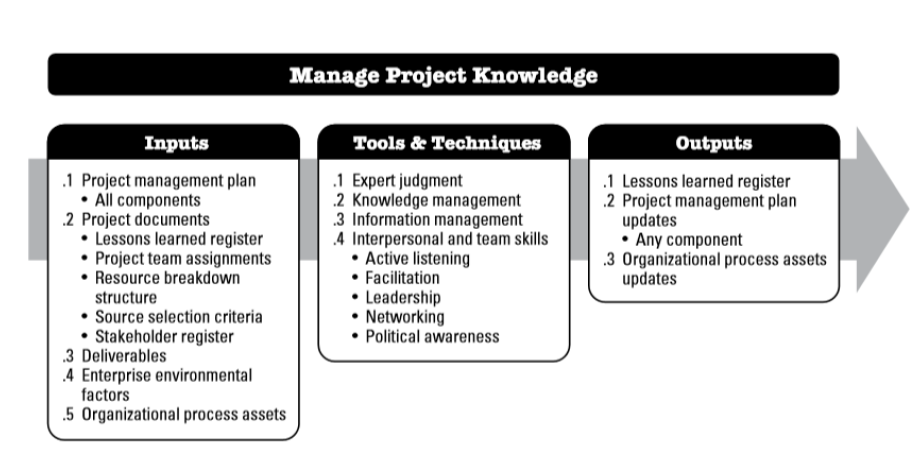
The project life cycle is managed by executing a series of project management activities known as project management processes. Project management process requires input, appropriate project management tools and techniques and out as a deliverable or an outcome. Project data are collected as a result of various processes and are shared within the project team [6].
The collected data are analyzed in context, aggregated and transformed to become project information during various processes. Managing Project Knowledge requires utilising existing and new knowledge for organizational learning as and achieve project objectives.
Conceptual Framework
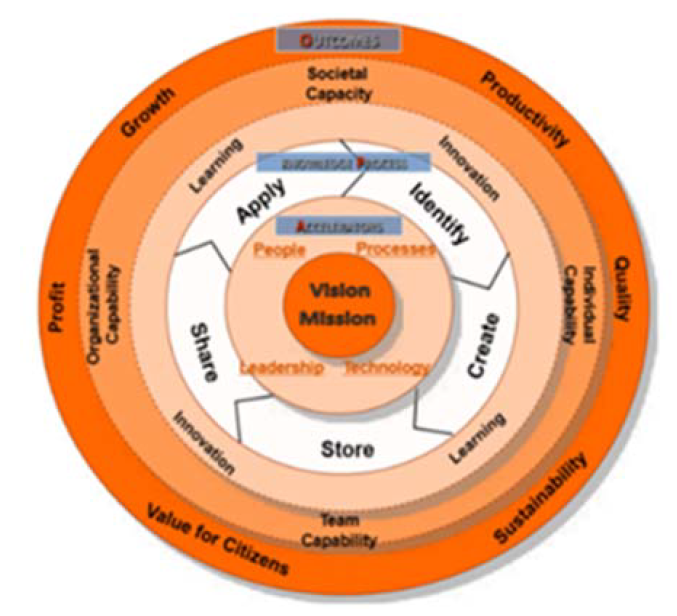
According to APO KM definition, KM is an integrated approach for creating, sharing and applying knowledge to enhance organizational productivity, profitability, value for citizens, sustainability and growth. The starting point of KM framework is vision and mission which play an important role in guiding the organization's efforts to create, share and use knowledge effectively [7,8].
There are three levels in the framework, accelerators consist of leadership, people, processes and technology which are important to propel and speed up the KM initiative in the organization. Knowledge process represent the major steps in the knowledge creation and development process which are identify, create, store, share and apply to manage knowledge within an organization. The outcomes of the framework are essential for enhancing individual, team, organizational and societal capacity, ultimately resulting in improved productivity, quality of products and services, profitability and growth.
Table 1: APO KM Assessment Tool
Audit Category
Description
KM Leadership
To evaluates leadership capability to respond to the challenges of a knowledge-based economy
Process
To assess how knowledge is used in managing, implementing and improving the key work process and also the extent to which the organization continually evaluates and improves its work processes to achieve better performance
People
To assess the ability to create and sustain the learning culture, knowledge sharing, collaboration and knowledge worker.
Technology
To review the ability to develop and deliver knowledge-based solution, collaborative tools and content management systems.
Knowledge Process
To assess the ability to identify, create, store, share and apply knowledge systematically.
Learning and Innovation
To determine the ability to encourage, support and strengthen learning and innovation process, as well as the incentives that follow.
KM Outcome
To measure the ability to enhance value to customers through new and improved products and services, increase of productivity, quality, profitability and sustain growth through the effective use of resources and as a result of learning and innovation.
Table 2: Likert Scale for KM Assessment
Level Description
Scale Rating
Doing very poorly, or none at all
1
Doing poorly
2
Adequate
3
Doing well
4
Doing very well
5
Fully Embedded in the organization
6
Figure1: Manage Project Knowledge
Figure2: APO KM Framework
MATERIALS AND METHODS
Research Design
In this research, a quantitative approach will be utilized to evaluate the level of maturity of knowledge management. The goal is to examine the underlying causes, obstacles and key factors for the successful integration of Knowledge Management in Project Management at Lintasarta [9].
Data Collection Method
Survey will be conducted to Senior Managers, Junior Managers, Project Managers and supporting team of Project Management and Delivery Division. There are a total of 35 questions covering the seven audit categories. By utilizing likert scale, each of the questions can be rated from 1 to 6 with a minimum score of 35 points and maximum score of 210 point.
Data Analysis Method
KM Maturity Level Assessment: Aligned with the APO KM Framework, there are seven parameters for assessing KM readiness. There are a total of 35 questions covering the seven audit categories. By utilizing likert scale, each of the questions can be rated from 1 (doing poorly or none at all) to 6 (doing very well) with a minimum score of 35 points and maximum score of 210 point.
Fishbone/Ishikawa Diagram
A fishbone diagram is a visualization tool for categorizing the potential causes of a problem by identifying the root cause of a problem, doing further investigation, generating ideas for solutions and planning for actions to create desired results.
Project Knowledge Mapping on Project Lifecycle
According to the PMBOK Guide, a project management life cycle consists of 5 distinct phases including initiation, planning, execution, monitoring and closure that combine to turn a project idea into a working product.
To facilitate this research, the project lifecycle will be divided into three distinct phases. The first phase, pre-project, will combine initiation and planning activities. The second phase, project implementation, will combine execution and monitoring activities. Finally, the third phase, post-project, will be the closure phase. For each of these phases, project knowledge will be defined, which will later serve as an input for integrating Knowledge Management into Project Management.
RESULTS
Analysis
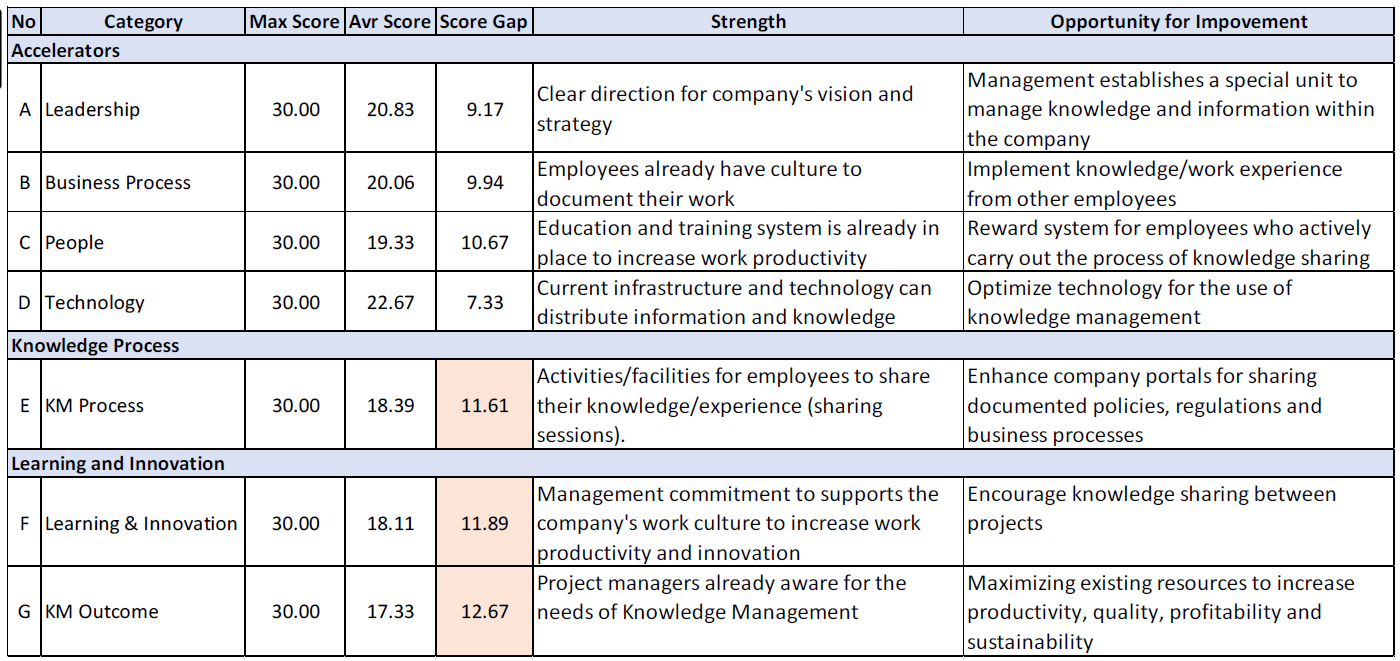
KM Maturity Analysis: From the assessment results of APO KM maturity assessment given in Appendix A, the author summarizes each category and identifies the gap between the maximum and average scores, as well as strengths and opportunities for improvement:
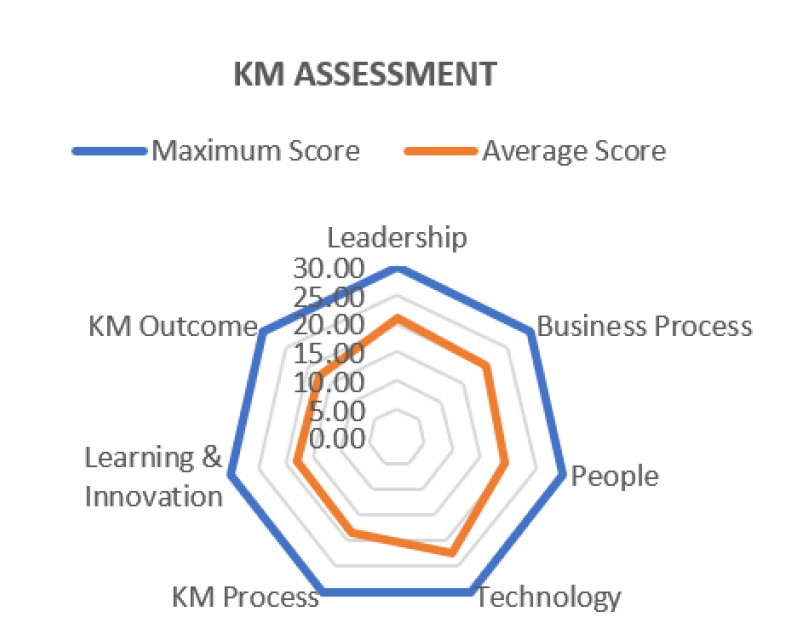
Among the seven categories of KM assessment, the KM Outcome category has the widest gap, followed by learning and innovation and the KM process. Therefore, the role of accelerators is very crucial in Lintasarta to facilitate the successful implementation of KM practices within the organization [10].
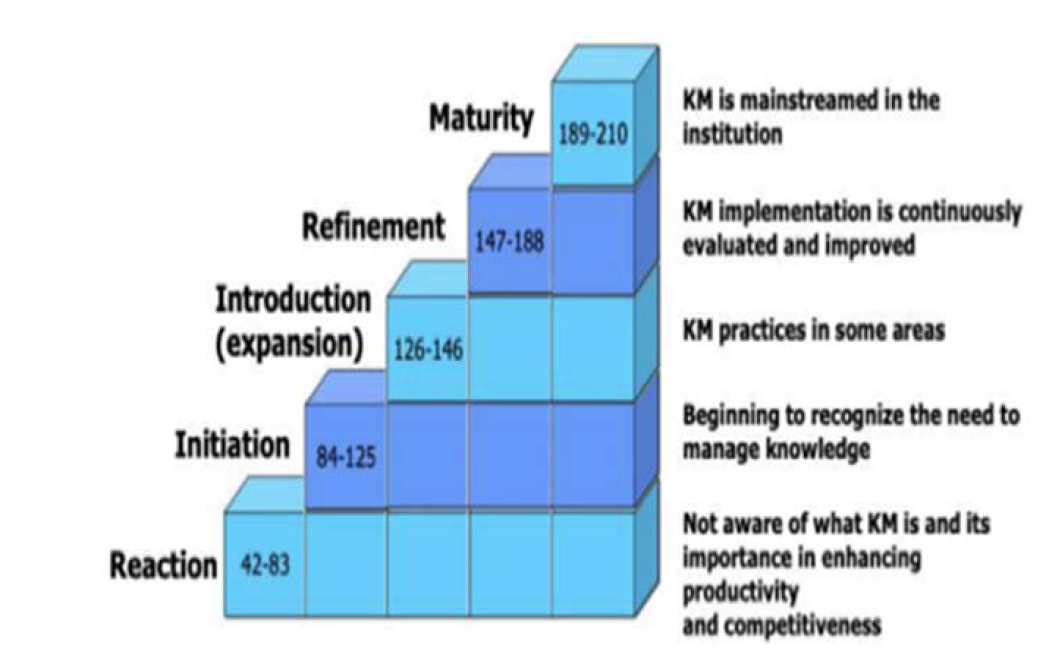
According to Figure 4, the KM maturity level falls within the introduction/expansion range, indicating that KM practices have been implemented in certain areas, but management has not yet established regulation over them.
Fishbone Analysis
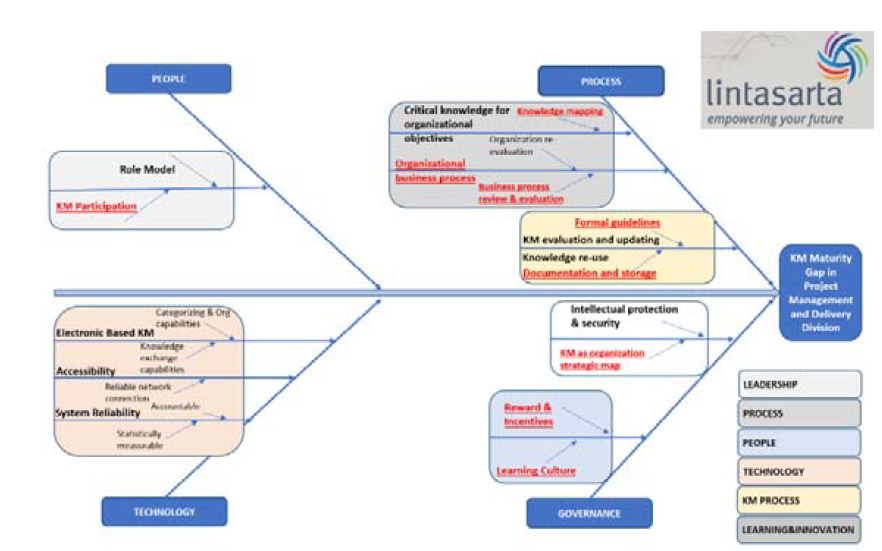
To further analyze the results, a fishbone analysis was conducted to break down the root causes of the gap for each category. The analysis was divided into four main categories: People, Process, Governance and Technology.
The analysis and explanation of the fishbone analysis aims to identify the root causes of the current situation of the project management department.
Project Knowledge Mapping on Project Cycle
Knowledge mapping on each of the project cycle will be identified as an input or the source of data, relevant information and knowledge which are available in the form of tacit or explicit knowledge on each of project cycle. Below is the project knowledge which has been identified by the author on each of the project cycle [11].
Table 3: KM Maturity Assessment
Table 4: Root cause and Explanation
Components
Root Cause and Explanation
Governance
Despite vision and mission of the company is already clear, it is important to acknowledge KM as an organization strategic map through establishing special unit to manage knowledge information within the company.
Lintasarta needs to reinforce the participation of KM activities through collaboration team and include this as a Key Performance Indicators (KPI) to stimulate learning and innovation
Process
Current business process is not prioritizing on documenting the critical knowledge. Lintasarta needs to have guidelines on how documenting knowledge, evaluation of an organizational business process must be done regularly to ensure the implementation of KM
People
Current training and development need to include the importance of KM. Knowledge sharing needs to be encouraged and given incentives in order to become more adaptable, innovative in achieving organization’s objectives
Technology
Current technology should facilitate knowledge exchange capabilities which possess reliable connection and accountability.
Figure 3: KM Maturity Radar Chart
Figure 4: KM Maturity Level
Figure 5: KM Maturity Radar Chart
Table 5: Project Knowledge Mapping on Each Project Cycle
INPUT
Pre Project
Evaluation on previous projects
Enterprise Environmental Factors
Evaluation on Customers profile
Evaluation on technical references
Lesson learned from previous projects
Project Implementation
Project Management Plan
History of previous project which include:
Scope, Schedule, Cost, Quality, Resource, Communication, Risk, Procurement and Stakeholder
Enterprise Environmental Factors
Organizational Process Access
Reference of Project Management tools from best practice
Post Project
Project Management Plan
Progress Report
Change Request Documents
Project Deliverables
Lesson learned
Business Solution
After understanding the importance of knowledge economy, KM framework and the project knowledge, the integration of Knowledge Management in Project Management is formulated as an action plan for the implementation of KM in Lintasarta. From discover, design, develop and deploy, the step of integration below will be further explaining on each of the process [12].
Table 6: Project Knowledge Mapping on Each Project Cycle
Type Of Project
PARAMETERS OF PROJECT
Total Value of Project
Product Complexity
Document Diversity
Operation Capability
Corporate Project
Large
Yes
Yes
Yes
Government Project
Large
No
No
Yes
Table 7: Project Knowledge Mapping on Each Project Cycle
Project Knowledge Domain
Project Stakeholder Category
Strategy
Project Board, Sponsor
Roles
Project Sponsor, Project Management and Delivery Division
Processes
Project Management and Delivery Division
Technologies
Project Management and Delivery Division, Project Team
Attitudes
Project Team
Enablers
All
Table 8: KM Integration in Pre Project
PRE PROJECT
Activities
Definition
Input
Knowledge Areas
10 knowledge areas which contribute to Project Management Plan. The knowledge are scope, time, cost, quality, resources, communication, risk, procurement, stakeholder and integration management
Enterprise Environmental Factors
The Enterprise Environmental Factors are organizational culture, structure and governance, market conditions, government or industry standards, regulations and laws, physical environment, political climate, technological environment and stakeholder expectations which are critical to be assessed and create mitigate plan to any potential risk or negative effects
Process
Brainstorming
Generating new ideas which involves a group of people to leverage their collective knowledge, expertise and experiences and share their thoughts and ideas in a structured and creative manner in order to tap into creativity of an organization and to drive innovation and improvement
Learning and Ideas Capture
A process of capturing, storing and sharing from various sources, such as employees, projects and training programs within an organization. It involves identifying and capturing information and insights that are generated through learning and innovation and making this knowledge accessible to others in order to support decision-making, problem-solving and innovation.
Peer Assist
A process or method of collaboration and knowledge sharing of a team of peers from different departments or areas of expertise to identify best practices, share experiences and knowledge and address challenges and opportunities to promote creativity and cross-functional collaboration within organization.
Collaborative Physical Workspace
A shared space that encourages interaction and communication among team members to incorporate technology and tools that facilitate collaboration, such as large screens for video conferencing, whiteboards for brainstorming and shared software for document creation and collaboration.
Output
Project Management Plan
The Project Management Plan is a living document that is updated throughout the project to reflect changes in the project’s requirements, schedule, budget and other factors which are important tool for project managers to manage the project effectively
Discover
The Readiness of the Organization for KM is assessed through KM Maturity Assessment. Based on the analysis of KM Maturity assessment and fishbone diagram mentioned earlier, the maturity falls under initiation/expansion level where the knowledge management practice is already implemented in some areas, however there is still need improvement in some key processess in order to have a maximum impact of KM.
Knowledge mapping on each of the project cycle will be identified as an input or the source of data, relevant information and knowledge which are available in the form of tacit or explicit knowledge on each of project cycle.
Design
Approach: Since the research is focused on the Project Management Delivery Division in Delivery and Operations Directorate and aims to formulate an integration strategy for implementation, a bottom-up approach will be employed. In this approach, Project Managers will be designated as Communities of Practice (CoPs) in the pilot project. Appendix B illustrates the bottom-up approach.
Project Selection
In order to implement the integration strategy in the Project Management Delivery division, the pilot project will be selected based on certain parameters, such as the total value of the project, product complexity, document diversity and operational capability.
Project Knowledge Domain and Stakeholder
Defining the key stakeholders for the project knowledge domain is essential to support the bottom-up approach. Referring to the Project Knowledge Management Maturity Model in Appendix C, it is necessary to define the project knowledge domain along with the stakeholder category:
Develop
In PMBOK (Project Management Body of Knowledge), "inputs" refer to the resources, information and other assets that are required to perform a specific project management process. It is used as the starting point for each process and are necessary to create the desired output. While “outputs” refer to the results, deliverables, or products that are produced by a specific project management process. It is the end products of the process and are used as inputs for the next process in the project.
Deploy
This stage is about deployment the implementation of integration of knowledge management in Project Management under Project Management and Delivery of Lintasarta.
Referring to the KM implementation in project management model in figure 6, below is the description for the implementation in Project Management and Delivery Division of Delivery and Operation Division of Lintasarta:
Role of Accelerators
Accelerators have an important role in knowledge management by helping organizations to identify, capture, share and apply knowledge more effectively and efficiently.
Leadership
Promote a culture of knowledge sharing and learning within the organization to capture and share knowledge across teams and departments
People
By investing in people, organizations can build a knowledgeable workforce that is better equipped to adapt to changing business needs and drive innovation
Integration Process
Business Process: By optimizing knowledge management processes, organizations can reduce duplication of effort and improve the quality and consistency of knowledge process improvement methodologies and automation tools, making them easier to capture, store and share knowledge across the organization.
Technology
Technology will support management processes, such as content tagging and search and provide insights and recommendations based on patterns and trends. By leveraging these technologies, organizations can more easily identify and capture valuable knowledge, making it more accessible and usable to those who need it. By having support from accelerators, organizations can improve the efficiency and effectiveness of their knowledge management processes, enabling them to make better decisions, innovate more quickly and deliver greater value to their customers.
Outcome
Project Success: A project is considered successful when it delivers the desired outcome on time, within budget and with the expected level of quality, while satisfying the needs and requirements of its stakeholders.
Learning and Innovation
A successful learning and innovation project is one that enables the participants to acquire new knowledge, skills and perspectives and to apply them in innovative ways to solve problems and improve performance. By utilizing all integration output given on each project cycle which are Project Management Plan, Progress Report and Organizational Process Asset, Lintasarta can capture and manage knowledge, including lessons learned from previous projects, customer feedback, market research and industry trends. This information is used to identify opportunities for innovation and to create new products, services, or processes.
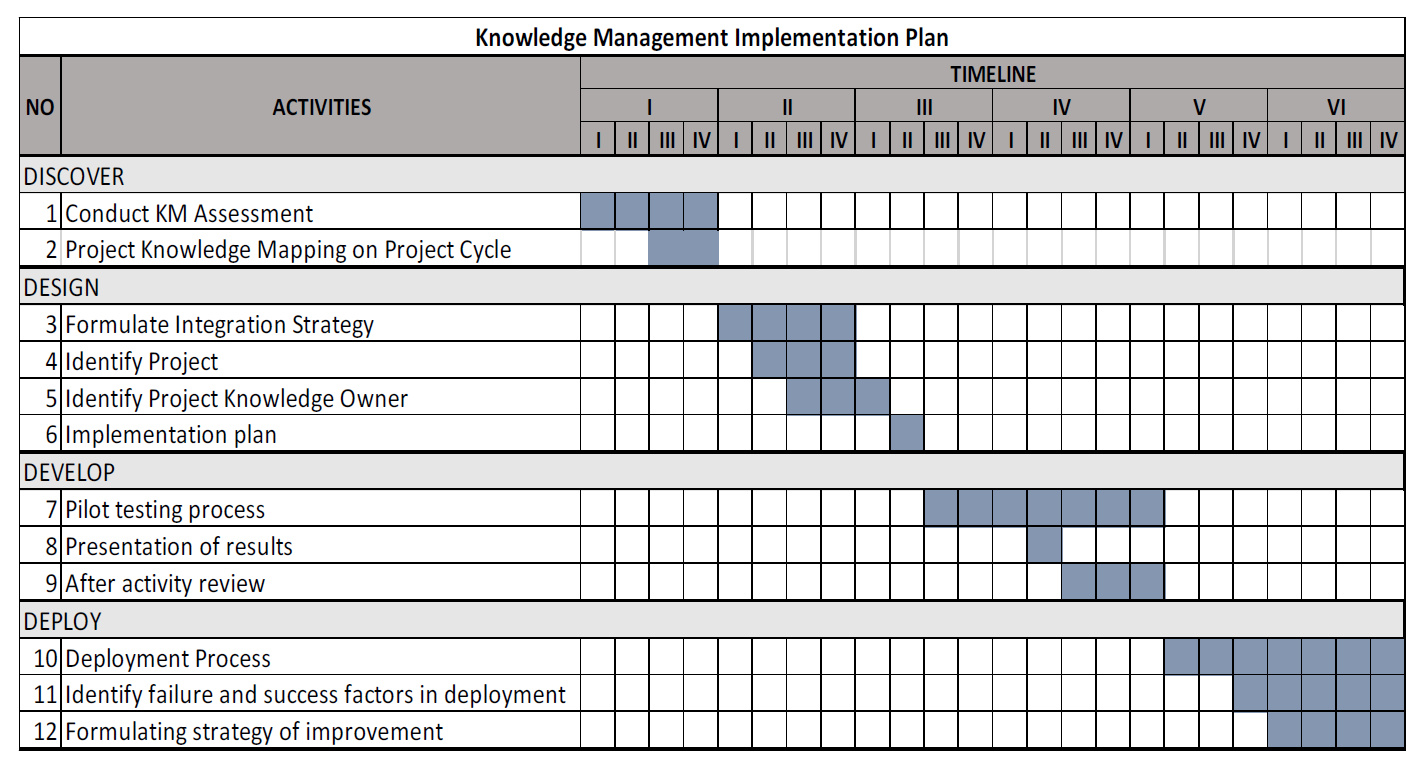
Implementation Plan and Justification
The implementation plan is expected to require approximately 6 months completing including tracking progress and monitoring after activity review, identifying and addressing potential challenges and formulating strategy of improvement along the way.
Table 9: KM Integration in Project Implementation
PROJECT IMPLEMENTATION
Input
Project Management Plan
The output from previous process and a living document that is updated throughout the project to reflect changes in the project’s requirements, schedule, budget and other factors which are important tool for project managers to manage the project effectively
References from Best Practice
Best practices refer to methods and techniques that have been proven to be effective in managing projects and achieving project objectives. By referring to best practices, project managers can benefit from the collective experience and knowledge of others, improve the efficiency and effectiveness of the projects
Enterprise Environmental Factors
Reviewed and updated Enterprise Environmental Factors to ensure that the project plan remains aligned with the latest external and internal conditions that may impact the project to minimize the risks associated with changes to the environment enables project managers to proactively respond to any potential challenges that may arise
Process
Learning Review
An evaluation process used to assess the effectiveness of a learning program to identify areas for improvement in the content, delivery and overall design of the learning experience. The results of a learning review include revising and updating content, methods, technology and resources used, highlight areas of success, which can be reinforced and replicated in future learning programs.
Knowledge Café
A group discussion with participants seated in a circle or around tables facilitated by a moderator, who encourages participants to share their thoughts, experiences, exchange ideas, asks questions and build connections with each other in order to generate new insights, foster collaboration and promote learning and growth for strategic planning.
Communities of Practice
A group discussion with participants seated in a circle or around tables facilitated by a moderator, who encourages participants to share their thoughts, experiences, exchange ideas, asks questions and builds connections with each other in order to generate new insights, foster collaboration and promote learning and growth for strategic planning.
Output
Progress report
Progress Report is a document that provides information about the status of a project, including its progress, achievements and challenges in order to communicate project's status and progress to stakeholders
Table 10: KM Integration in Post Project
POST PROJECT
Activities
Definition
Input
Project Management Plan
Output from Project Management Plan in Project Implementation
Progress Report and Deliverable
Output from Progress Report in Project Implementation
Process
Learning Review
An evaluation process used to assess the effectiveness of a learning program to identify areas for improvement in the content, delivery and overall design of the learning experience. The results of a learning review include revising and updating content, methods, technology and resources used, highlight areas of success, which can be reinforced and replicated in future learning programs.
After Action Review
A process used to reflect on and evaluate the effectiveness of a project in order to identify what worked well, what could be improved and what lessons can be learned for future reference
Story Telling
Storytelling can be used to capture and share tacit knowledge and lessons learned and providing tools and resources that make it easy to capture and share these knowledge
Knowledge Café
A group discussion with participants seated in a circle or around tables facilitated by a moderator, who encourages participants to share their thoughts, experiences, exchange ideas, asks questions and builds connections with each other in order to generate new insights, foster collaboration and promote learning and growth for strategic planning.
Output
Organizational Process Asset
Organization Process Assets are the internal and external resources and information that an organization has available to support the management and execution of its projects which include policies and procedures to manage projects, processes during project implementation, The collective experience and knowledge of the organization, resources and facilities that an organization has available to support its projects including historical information which contain data and information from previous projects, including project schedules, budgets and status reports
Figure 7: Implementation Plan
CONCLUSION
According to the assessment of Lintasarta's KM Maturity level, it appears that the Project Management and Delivery Division is currently at the Initiation level. This indicates that knowledge management practices have been implemented within the department, but they are not yet fully integrated into the project management process. Therefore, it is necessary to establish governance over the business processes within the Project Management and Delivery division to effectively embed KM practices and enable Lintasarta to reap the benefits of Knowledge Management. With regards to setting up the integration of Knowledge Management into project management, the following steps can be described:
Discovery
Based on knowledge Management Maturity Assessment, a fishbone root cause diagram has been developed to identify the underlying causes of problems. This diagram is then analyzed and categorized using a KM Framework. Additionally, project knowledge is identified for each phase of the project cycle. From this knowledge, one output is selected for the pre-project, project implementation and post-project processes.
Design
A bottom-up approach has been selected, which aims to promote knowledge creation starts by Community of Practices which are project managers. The next step is to select a project based on certain criteria and identify stakeholders based on their project knowledge domain.
Develop
The process of developing knowledge management integration within project management begins with identifying inputs, tools and techniques for each phase of the project cycle - pre-project, project implementation and post-project. The chosen tools and techniques are those that align with the objective of capturing, storing, sharing and utilizing knowledge and expertise within Lintasarta which are categorized as KM tools and techniques.
The next step is to identify the role of accelerators to ensure learning, innovation and project success. These accelerators are crucial in facilitating the integration of knowledge management practices into project management and must be effectively managed to maximize the benefits of knowledge management.
Deploy
On this process, it involves the deployment of knowledge management integration within project management processes. By integrating knowledge management practices into project management, the role of Knowledge Management in project management can be described as follows:
Improve project quality by providing collaborative platform to capture and share best practices which can help project teams to avoid repeating mistakes, leverage successful strategies and decision making
Efficient delivery through the use of knowledge management to deliver desired outcome on time, within budget and with the expected level of quality, while satisfying the needs and requirements of its stakeholders which lead to project success
A successful learning and innovation project which enables the stakeholder to acquire new knowledge, skills and perspectives and apply them in innovative ways to solve problems and improve performance
Recommendation
In order to strengthen KM implementation in project management Knowledge Management in Project Management should be able to:
Facilitate continuous sharing and learning by collaboration and teamwork from all entities within Lintasarta
Discuss lessons learned at key milestone to optimize processes, reduce inefficiencies, avoid repeating past mistakes and promote continuous learning and improvement within the company
Curate information to elevate crucial knowledge by identifying what is most important, presenting and utilizing the knowledge to achieve goals
Sharing success stories to establish collaboration in order to create a culture of continuous learning, improvement and innovation
Support from management in order to obtain the approval, participation and resources from top-level management to ensure the success of the initiative
Institutionalize the integration in the organization, which may require some organizational restructuring, such as the establishment of a knowledge management office
REFERENCES
APQC.Managing Project Knowledge. APQC, 2017.
APQC.Developing a Knowledge Sharing Culture at Consolidated Contractors Company. APQC Journal, 2018.
Dekkers, C.A. and P. Forselius. “Increase ICT project success with concrete scope management.” PMI Global Congress 2007—North America, Atlanta, GA. Newtown Square, PA: Project Management Institute, 2007.
Dülgerler, M. and M. Negri. “Lessons (Really) learned? How to retain project knowledge and avoid recurring nightmares: Knowledge management and lessons learned.” PMI Global Congress 2016—EMEA, Barcelona, Spain. Newtown Square, PA: Project Management Institute, 2016.
Eick, S. “A history of Indonesian Telecommunication reform 1999–2006.” 2007 40th Annual Hawaii International Conference on System Sciences (HICSS’07), IEEE, 2007, pp. 67–67. https://doi.org/10.1109/HICSS.2007.16
Hanisch, B. et al. “Project knowledge management: Status quo, organizational design and success factors.” PMI Research Conference: Defining the Future of Project Management, Warsaw, Poland. Newtown Square, PA: Project Management Institute, 2008.
Levin, G. and P.F. Rad. “Moving forward with project management: A knowledge management methodology.” PMI Global Congress 2007—North America, Atlanta, GA. Newtown Square, PA: Project Management Institute, 2007.
Park, M. et al. “A Bottom-Up approach based knowledge management system for construction organizations.” Korean Journal of Construction Engineering and Management, vol. 10, 2009, pp. 3–13.
Takenaka, Shigeo. “Opening remarks.” International Productivity Conference 2007: Knowledge Management – From Brain to Business, 18–19 January 2007, Bangkok, Thailand, 2007.
Wenger, E. et al. Cultivating Communities of Practice. Harvard Business Review Press, 2002.
Wu, Z. and Q. Peng. “Project management and knowledge-based economy – several issues on China’s Situation.” Project Management Institute Annual Seminars and Symposium, Nashville, TN. Newtown Square, PA: Project Management Institute, 2001.
License
Creative Commons Attribution-NonCommercial-NoDerivatives 4.0 International License
All papers should be submitted electronically. All submitted manuscripts must be original work that is not under submission at another journal or under consideration for publication in another form, such as a monograph or chapter of a book. Authors of submitted papers are obligated not to submit their paper for publication elsewhere until an editorial decision is rendered on their submission. Further, authors of accepted papers are prohibited from publishing the results in other publications that appear before the paper is published in the Journal unless they receive approval for doing so from the Editor-In-Chief.
Himalayan Journal of Economics and Business Management open access articles are licensed under a Creative Commons Attribution-Share A like 4.0 International License. This license lets the audience to give appropriate credit, provide a link to the license, and indicate if changes were made and if they remix, transform, or build upon the material, they must distribute contributions under the same license as the original.
Advertisement
Recommended Articles
Research Article
Influence of Leadership on Poverty Reduction in the Devolved Government in Trans-Nzoia County, Kenya
Kinisu Sifuna,
...
Peter Simotwo
Published: 30/06/2021
Download PDF
Cite
x
APA
Sifuna, K., Lwangale, D. W., Simotwo, P., Sifuna, K., Lwangale, D. W. & Simotwo, P. (2021). Influence of Leadership on Poverty Reduction in the Devolved Government in Trans-Nzoia County, Kenya. Himalayan Journal of Economics and Business Management, 2(1), None-None.
MLA
Sifuna, Kinisu, et al. "Influence of Leadership on Poverty Reduction in the Devolved Government in Trans-Nzoia County, Kenya." Himalayan Journal of Economics and Business Management 2.1 (2021): None-None.
Chicago
Sifuna, Kinisu, David W. Lwangale, Peter Simotwo, Kinisu Sifuna, David W. Lwangale and Peter Simotwo. "Influence of Leadership on Poverty Reduction in the Devolved Government in Trans-Nzoia County, Kenya." Himalayan Journal of Economics and Business Management 2, no. 1 (2021): None-None.
Harvard
Sifuna, K., Lwangale, D. W., Simotwo, P., Sifuna, K., Lwangale, D. W. and Simotwo, P. (2021) 'Influence of Leadership on Poverty Reduction in the Devolved Government in Trans-Nzoia County, Kenya' Himalayan Journal of Economics and Business Management 2(1), pp. None-None.
Vancouver
Sifuna K, Lwangale DW, Simotwo P, Sifuna K, Lwangale DW, Simotwo P. Influence of Leadership on Poverty Reduction in the Devolved Government in Trans-Nzoia County, Kenya. Himalayan Journal of Economics and Business Management. 2021 Jan;2(1):None-None.
Download PDF
Research Article
Modelling Structure Job Quality, Job Design and Job Satisfaction
Moch Nurhadi,
...
Avi Sunani
Published: 30/08/2022
Download PDF
Cite
x
APA
Nurhadi, M., Bisyri Effendi, M., Saiful Ulum, A. & Sunani, A. (2022). Modelling Structure Job Quality, Job Design and Job Satisfaction. Himalayan Journal of Economics and Business Management, 3(2), 1-4.
MLA
Nurhadi, Moch, et al. "Modelling Structure Job Quality, Job Design and Job Satisfaction." Himalayan Journal of Economics and Business Management 3.2 (2022): 1-4.
Chicago
Nurhadi, Moch, Moch Bisyri Effendi, Achmad Saiful Ulum and Avi Sunani. "Modelling Structure Job Quality, Job Design and Job Satisfaction." Himalayan Journal of Economics and Business Management 3, no. 2 (2022): 1-4.
Harvard
Nurhadi, M., Bisyri Effendi, M., Saiful Ulum, A. and Sunani, A. (2022) 'Modelling Structure Job Quality, Job Design and Job Satisfaction' Himalayan Journal of Economics and Business Management 3(2), pp. 1-4.
Vancouver
Nurhadi M, Bisyri Effendi M, Saiful Ulum A, Sunani A. Modelling Structure Job Quality, Job Design and Job Satisfaction. Himalayan Journal of Economics and Business Management. 2022 Jul;3(2):1-4.
Download PDF
Research Article
Accountability and Transparency of Village Fund Management in Lumajang District
Nurina Ayuningtiyas,
...
Muhammad Miqdad
Published: 28/12/2023
Download PDF
Cite
x
APA
Ayuningtiyas, N., Santosa Putra, H. & Miqdad, M. (2023). Accountability and Transparency of Village Fund Management in Lumajang District. Himalayan Journal of Economics and Business Management, 4(2), 1-4.
MLA
Ayuningtiyas, Nurina, Hendrawan Santosa Putra and Muhammad Miqdad. "Accountability and Transparency of Village Fund Management in Lumajang District." Himalayan Journal of Economics and Business Management 4.2 (2023): 1-4.
Chicago
Ayuningtiyas, Nurina, Hendrawan Santosa Putra and Muhammad Miqdad. "Accountability and Transparency of Village Fund Management in Lumajang District." Himalayan Journal of Economics and Business Management 4, no. 2 (2023): 1-4.
Harvard
Ayuningtiyas, N., Santosa Putra, H. and Miqdad, M. (2023) 'Accountability and Transparency of Village Fund Management in Lumajang District' Himalayan Journal of Economics and Business Management 4(2), pp. 1-4.
Vancouver
Ayuningtiyas N, Santosa Putra H, Miqdad M. Accountability and Transparency of Village Fund Management in Lumajang District. Himalayan Journal of Economics and Business Management. 2023 Jul;4(2):1-4.
Download PDF
Research Article
Proposed Digital Marketing Strategy to Enhance Engineering Consultancy Company Revenue
Alfarisy, K. A.,
Wandebori, H.
Published: 30/04/2024
Download PDF
Cite
x
APA
K. A., A. & H., W. (2024). Proposed Digital Marketing Strategy to Enhance Engineering Consultancy Company Revenue. Himalayan Journal of Economics and Business Management, 5(1), 1-18.
MLA
K. A., Alfarisy, and Wandebori, H.. "Proposed Digital Marketing Strategy to Enhance Engineering Consultancy Company Revenue." Himalayan Journal of Economics and Business Management 5.1 (2024): 1-18.
Chicago
K. A., Alfarisy, and Wandebori, H.. "Proposed Digital Marketing Strategy to Enhance Engineering Consultancy Company Revenue." Himalayan Journal of Economics and Business Management 5, no. 1 (2024): 1-18.
Harvard
K. A., A. and H., W. (2024) 'Proposed Digital Marketing Strategy to Enhance Engineering Consultancy Company Revenue' Himalayan Journal of Economics and Business Management 5(1), pp. 1-18.
Vancouver
K. A. A, H. W. Proposed Digital Marketing Strategy to Enhance Engineering Consultancy Company Revenue. Himalayan Journal of Economics and Business Management. 2024 Jan;5(1):1-18.
Suprihatini, S. S. (2023). Integration of Knowledge Management in Project Management: A Case Study in Project Management and Delivery Division at Pt. Aplikanusa Lintasarta. Himalayan Journal of Economics and Business Management, 4(1), 1-9.
MLA
Suprihatini, Suryane S.. "Integration of Knowledge Management in Project Management: A Case Study in Project Management and Delivery Division at Pt. Aplikanusa Lintasarta." Himalayan Journal of Economics and Business Management 4.1 (2023): 1-9.
Chicago
Suprihatini, Suryane S.. "Integration of Knowledge Management in Project Management: A Case Study in Project Management and Delivery Division at Pt. Aplikanusa Lintasarta." Himalayan Journal of Economics and Business Management 4, no. 1 (2023): 1-9.
Harvard
Suprihatini, S. S. (2023) 'Integration of Knowledge Management in Project Management: A Case Study in Project Management and Delivery Division at Pt. Aplikanusa Lintasarta' Himalayan Journal of Economics and Business Management 4(1), pp. 1-9.
Vancouver
Suprihatini SS. Integration of Knowledge Management in Project Management: A Case Study in Project Management and Delivery Division at Pt. Aplikanusa Lintasarta. Himalayan Journal of Economics and Business Management. 2023 Jan;4(1):1-9.


 Download PDF
 Download XML