The Role of Management Information Technology in The fuzzy of Banking Institutions and Its Implications for The Efficiency and Performance of Employees, A Field Study in Commercial Banks in Basra
Arafat Naser Jasim Al-Yousef
1
,
Jawad Al-frijawy
1
,
Hayder Jerri Mohsin
2
1
Department of Management Information Systems College of Administration and Economics / University of Basra
2
Accounting Technologies Department College of Administrative Technology, Basra/Southern Technical University
This study examines the field of employee performance in light of the ambiguity in information and the lack of clarity and the extent of its impact on performance and how information technology can improve performance the two researchers conducted a field survey on the employees of the Commercial Bank in Basra, and took the opinions of a sample of them about the antiquities, and their number reached (130) A questionnaire was distributed to them and retrieved valid for statistical analysis using the arithmetic mean, standard deviation, and coefficient of variation using (SMART PLS) program And then testing the hypothesis of the study and reached the most important results that the use of technology in improving the performance of employees, which helps reduce the burden of human efforts that were taking our time and allocating money and cost. recommended by the researchers on the importance of the information that the institution needs in its daily procedures and be a result of improving The performance of the staff, due to the use of modern technology in the delivery of information.
Keywords
Administrative Information Technology
Fuzzy of Institutions
Improving Employee Performance
INTRODUCTION
Information technology is a new situation that has invaded the world and has become an important and required phenomenon that cannot be escaped from, and from it in the banks that were imposed on them to improve the performance of their employees and services [1]. Many service organizations use information technology in response to the external environment, with a lot of volatility and change, and to provide sophisticated and advanced services that satisfy customers who deal with them [2]. Information technology improves banking performance, provides the best banking services, reduces costs, and increases profitability, with diversified services, greater flexibility in use, and greater value [3]. Application of electronic payment (concepts, technologies, policies) and implementation of electronic devices in the banking industry the access of information technology to every aspect of human life and business has become so remarkable that it does not need to be highlighted more. Information technology has been of abundant importance in the banking system [4]. Information technology and its applications are considered as valuable assets for the banking sector to meet the challenges of the new economy. Information technology has been the cornerstone of recent developments in the financial sector aimed at enhancing the speed and reliability of financial operations and initiatives to enhance banking services [5], and information technology represents the dominant force in today's global society. And improvements in it that enable banks to meet these higher expectations of more demanding customers who are also more tech-savvy than their counterparts in years past [6]. They demand immediate banking facilities, anytime and anywhere [7]. There is a significant and clear effect of the blurring of organizations, represented by the lack of information for the employee for the purpose of decision-making, weak communication networks, lack of focus on work, internal conflicts increase, and work supervision and coordination of work or clarity of procedures and the availability of information causes him exhaustion and psychological pressure, and then move away from efficiency and lack of productivity and failure to achieve the desired goal. Since the early nineties, measuring employee performance has become an important and necessary matter for any production or service institution and an essential part of achieving organizational goals and effectiveness, especially banking systems that have been strongly affected by the global system of customer service operations [8], technology has contributed to shorteninginternal processes to make the service quickly, accurately and in a short time, and these technologies are an urgent necessity to provide the required information necessary for managers to make decisions [9]. Information technology also facilitates the introduction of new delivery channels - in the form of automated teller machines, net banking, mobile banking and the like [10]. Information technology is very important in organizations and has taken up a large space because it reduced work costs, reduced time, improved job performance, work efficiency, and achieved customer satisfaction and made them permanent because there is a rapid response to customer requests and high productivity for the largest possible number of them. In a short time [7], banks are increasingly linking their computer systems not only across branches in the city but also with others and preventing blurring and lack of clarity with information that causes confusion at work [3], as well The information clarifies the role required by the institution to perform and its procedures, as well as the role of each employee and his most important duties. Thus, there is a work and a goal that must be achieved and supported by good performance [11]. In this research, we will work on explaining the importance of information technology in reducing the vagueness of institutions in information and improving the performance of employees and the institution in commercial banks in Basra Governorate, and we will explain the most important reasons for vagueness and lack of information.
First - Research Methodology
The Study Problem
Many international banks similar to the Commercial Bank of Iraq in Basra have proven the changes that have taken place in the field of banking services and their introduction in a large way, such as Qi Card, electronic withdrawal and electronic payment [3], and worked to increase profitability and investments, improve services through employee performance, and gain acceptance from customers through their satisfaction with the service provided. The effects of technology throughout human history are well documented [8], and contributed in the process of monitoring the environment, if databases are available about it, it is appropriate to understand its movements in light of environmental changes. There is a significant impact on the organization of what is happening due to the blurring of information and the lack of clarity of roles and information that is uncertain, in addition to the weakness of internal communication channels between departments and senior leadership and between the organization and the environment external, since there are direct influences [12] there is a significant impact of ambiguity in information and the blurring of organizations represented in the lack of communication, internal networks, and unconnected internal relationships. This causes a lot of conflicts and bad relations between employees, and this requires the institution to focus on the external environment and understand it [13]. Especially the Commercial Banks in Basra Governorate, it is considered one of the most important service institutions that deal with all currencies and with clear automated policies in form, but there is great uncertainty as a result of the difference in the price of foreign currencies between what is imposed by the Commercial Banks in Basra Governorate and between foreign offices in the markets, and this greatly affected the transactions Regular customers are citizens, merchants, and company owners. There are commercial transactions in addition to other banking services to the customer, and this assumes that information technology is widely available in order to contribute to creating a correct relationship, eliminating ambiguity, and improving job performance [14]. In a manner commensurate with the bank’s reputation, history, history, and the advancement of the services it provides to the customers with whom it deals, communication channels must be organized through up and down internal networks, establishing strong relationships with the transfer of information, clarity of the employee’s role regarding his work, what the duty must be done, and avoiding uncertain information [7]. And to study the environment properly, and there are no cognitive problems, lack of work experience, and other reasons that affect the efficiency, effectiveness, and productivity of employees, and the lack of information reduces good performance and causes lack of cooperation among employees [15]. And from it we extract the study question as follows. ((Does information technology affect the improvement of employee performance and reduce the impact of the blurring of organizations? Exploratory study and analysis in the Commercial Bank, Basra branch)).
Research Importance
The current research is of scientific value as it searches in the field of the turbulent and rapidly changing environment, and the research contributes to defining the concepts and linking the three variables and identifying the most important positive relationships between them and their impact on improving performance, there are circumstances and reasons for uncertainty that we are trying to identify and ways to address with information technology. It is a warning to organizations, especially banks that need to use modern technologies in light of the current intense competition. Understand the impact of information technology on improving employee performance and the growth of service organizations in developing countries.
Research Aims
Introducing the concept of information technology and its dimensions in service institutions, which is the commercial bank in Basra
Defining the concept of blurring service institutions in light of the rapidly changing environment and how to deal with it
Clarify the important role in improving the performance of employees because of its positive aspect in customer satisfaction in banking transactions
Statistical Aspect
The field statistical aspect was used as an analytical survey of the opinions of a sample of the employees of the commercial Banks in Basra, which was their number (130), and then relying on the Likert scale in identifying the questions that depended on the study’s three variables (independent: information technology, mediator: blurry institutions, dependent : improving employee performance), and the five-point scale was strongly agree (5), agree (4), neutral (3), strongly disagree (2), disagree (1). And the use of descriptive statistics by extracting the arithmetic mean, standard deviation, and coefficient of variation, and then testing the research hypothesis.
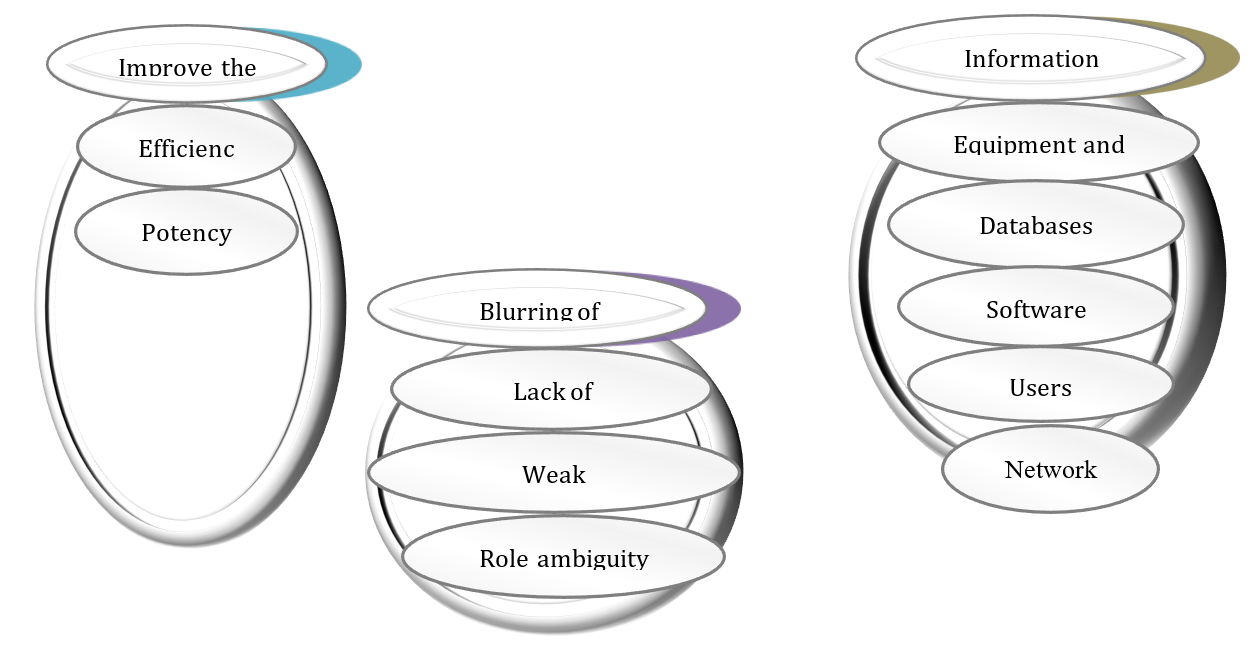
The concept of technology is not new, but updated according to time and time. It is a new approach and transformed into a modern organizational work. It is a process of changing from the old approach to the new. It is creating a new value for business. It is a new work and communication process and a process of organizing the daily work of banks. [16] It is defined as ((It is the study, development and implementation of computer-based technical information systems that contribute to solving organizational problems, developing business and improving organizational performance)) [17]. Since the introduction of Information Technology (IT) with its new related technologies such as computers and the Internet, a large number of organizations are making significant investments in it. Like banks and working to continue to pursue any available opportunity such as to improve their competitive advantage, to live in a global world where information technology is changing the way companies create and capture value, and how and where are we? Technology continues to change the world of work, and how do we interact and communicate [18], organizations need to develop ways to enhance optimal employee performance and well-being in the era of automation, and deal effectively with the opportunities and challenges associated with the implementation of technology, as information technology has contributed to improving performance For many institutions working in the service sector, because it has demonstrated the quality and speed of service [11]. Its importance has emerged in increasing productivity, investment, research and development, and increasing efficiency and effectiveness, reducing costs and increasing competitiveness in the workplace [15]. Technique Information such as Internet Banking, Mobile Banking, ATM, Cash Deposit Machine, Check Deposit Machine, E-Transfer and SMS Banking [17], through this we expect to provide attractive services to customers and reduce the cost of the administrator, they expect to provide a paperless work environment in banks, through this information technology they expect to increase the performance of employees [3]. Due to the introduction of IT staff they are able to study further and need the new training to get familiar with the system. Information technology has become very important because it is required as a result of the increase in the number of customers dealing with it and the large number of requests for service and the traditional methods are unrewarding, and we do not forget that the world has become a small village and there are contacts and financial transfers that need to deepen contacts between international banks and expand cooperation and agreements [6]. It helps to reduce the use of papers, as well as helps to save customer parameters and store the speed of access to them, not to lose information, reduce time, quality of service and customer satisfaction [19]. Consider four technologies that are changing the foundations of global business and the organizations that lead them: hardware, equipment, software, databases, and networks. In the current economic environment, organizations have shifted towards increasing reliance on digital technologies [8], as follows:
Devices and equipment
The spread of the use of information technology at work represents a controversial issue, especially modern devices of all kinds, including laptops, iPads, phones of various sizes, in addition to photocopiers and documentation devices. [20], in fact, by exploiting the spread of technologies, companies achieve great benefits in terms of employee productivity and efficiency and the development of business operations. By following up and monitoring business through huge cameras and modern devices for storing and documenting business and taking electronic photos Through imaging devices for books, photos, and storage, inside or outside the computer, using modern hard devices or cloud computing, automatic exchange devices, dealing and identifying customer’s Qi Cards [15], and the devices and equipment include all the important means that help to process data and become Very important information that is used in the decision-making process, and the important components are threatened through the availability of data entry devices and then processing them and using external storage devices to protect the information [5]. Many organizations have found that the use of smart phones is necessary for the workflow and has become very important in the work and its availability [13].
Software
Software is one of the intangible components and an essential element in the success of using the system, so it is better to choose computers with high-quality and safer operating systems, and the program is defined as (it is a set of commands and instructions that guide the computer and how to do the work). These programs are frequently changed and updated from time to time, and there are two types of programs, including operational ones that operate the general system of the computer, and the most famous is the system windows and the other application that downloads from the App Store or the Play Market, which is the largest application store and its updates, a group of helping the user to complete tasks on the computer such as creating documents, developing databases, conducting a lot of research on the Internet, designing graphics, and Microsoft Word is the most famous and used, and comes after it the Excel program (record specialist) [1]. The operating systems used and responsible for managing the computers must have high efficiency and ability to detect the sequence to the network through the design of systems protected by complex locks or by means of encryption and linking them to communication lines, which are mathematical algorithms or information transmission devices and equipment. [15]. 3D printers create solid objects by adding or merging layers from a range such as the design of bank card cards and the art of card handling with an automatic teller machine. The software contributes to quick access to information and enables employee access to databases, as well as contributing to facilitating daily operations and providing ideas New, more creative, in order to provide better services [19], and social networking programs have a major role in work through preserving and recording information, transferring electronic files and records from one place to another, and they have a major role in facilitating daily dealings, reducing work pressure, and greater flexibility, faster, and more. High productivity and quality [13].
Figure1: First Information Technology
Databases
Databases refer to a regular collection of information stored in the form of rules linked to each other [17], and these databases constitute the information and storage of the company that is returned to at the time of need, and is an important and strategic resource for the company to rely on [5]. Databases contribute to the speed of access to customer information, storage process Information is necessary because it helps speed up the completion of work [13]. It is an important proactive process by the bank’s management and its information and increases the value of the customer by executing his requests and achieving satisfaction [6], and the rules are characterized by efficiency in managing and organizing large numbers of information And tabulate it very quickly and be prepared in a timely manner for decision-making by sending through the transfer of files in the internal networks of the organization, and it should not be hidden from us that the data should enjoy security by establishing a security key for the data to protect it from penetration and theft.
Networks
Computer networks are represented as a group of computers that are linked to each other, and this network contributes to the transfer of information within the organization [17], and the networks expanded and diversified, including internal networks that connect one building called the intranet and contribute to protecting information and increasing its reliability [5]. The extranet connects two buildings with each other when the institution is expanding its work [19], and there are local networks that connect a geographical area (LAN), and wide networks that connect a wide area, such as the World Wide Web and cover entire countries (WAN), What we care about is the networks that help the organization in the transfer of information. The local or international information transfer network is considered one of the fruits of developments in the field of communications. It also facilitated the process of messaging between computers and exchanging the use of files.
Second the Blurring of Institutions
The blurring of institutions is the lack of clarity of the role and the information and the lack of weakness in organizational communications that represent the transfer of information between the administrative departments, and also represents the weakness of clarity in the role and ambiguity in the information that reaches the employee for the purpose of completing his daily work [21], and one of the reasons for the ambiguity in information is the lack of clarity in work policies and administrative leaders at work, when resources are limited and there is resistance to work, or lack of skills [14]. Conflict of interests, lack of information resources, weak decision-making and increased competition / may be due to turmoil in the external environment and political changes, which are strong and influencing factors [1]. It is necessary to clarify the causes of ambiguity in institutions and the most important dimensions that clarify them as a concept and useful in our current research will look at the following three dimensions.
Lack of information
And "Annie" points out that people often make wrong decisions because of their prior biases, in the event that the complete picture is not complete from the available information, and the person constantly seeks to complete it using his prior backgrounds on the matter he is dealing with [14].
This makes the decision-maker vulnerable to his personal biases, which may not make him take the best possible decision. One of the most important reasons for the vagueness of institutions in their internal procedures is the lack of information that the institution needs in its daily procedures and procedures, and it is a result of the lack of transfer of knowledge from one person to another [22]. Or from another department, or due to other reasons resulting from the rapidly changing environment and the lack of monitoring by the institution, or its inability to understand the reasons for the rapid change, [10]. The lack of information can contribute to something positive, which is the tendency towards producing distinguished services of high quality to confront competitors, and the lack of Having a clear vision can reduce cycle time. Information is often available but of poor quality and is insufficient for the process of carrying out work procedures [23] Or improving the service, as well as affecting the speed of completion of the business because the information is little and does not meet the purpose of the service that must be provided to the customer, and this is a major problem that causes anxiety to the employee, psychological pressure and role conflict due to ambiguity and ambiguity and contributes to the loss of customers and poor work relations and then the emergence of conflicts within the work [24]. The lack of information often interferes as a result of negligence in listening to the owners of the information, negligence of the employee in conveying the information in full, failure to check the validity of information coming from the external environment that affects the organization from people directly related to it, and many What we see is that rumors and lack of confirmation of information take a larger space due to the weakness of the source of information to confirm information. We note that banking information, whether from inside or outside, in particular from customers, is an important resource for bank management [7]. As it is considered the basis on which the bank’s plans, policies and decisions are built, and in order for the information to be in its correct place, it is necessary to establish units specialized in information that collect, process and display it in an acceptable manner and then transfer it through the internal networks in the form of reports to serve the bank’s departments and be in the form of clear bulletins by the decision-makers and managers Their names and work locations are stamped to be credible, reliable, sufficient and timely [25]. In order to prevent the intensity of information production and be according to the need for it, the problem and the specific information must be identified, because the information costs affect the profitability of the bank, and therefore they are considered floating costs that end with a period And we do not forget the time when the information is delayed because it is often about customers who deal with it, and it is important and necessary information that must be kept confidential, Others belong to competitors and are collected and kept in electronic and paper records. The more accurate the information, the higher quality, costly, but useful information.
Weak Communication Channels
The nature of organizational communications has changed recently, in an unprecedented way as a result of the tremendous developments in information technology, and the increased use of computers, laser printers, and cameras, these tools enabled the manager to distribute a printed report at specific times, and contribute to his communications with his employees periodically [23], Thus, the channels of communication continue to play a major role in the transfer of information, as each institution consists of a group of administrative levels. There is senior management, which is responsible for strategic decisions and has huge information within secure and clear databases that is obtained from employees specialized in work, according to the decision and its quality. [24]. And the information is transferred within the communication forces, which must be correct, and the information is transmitted without deficiency from the base level, which is always at the lowest (operational) level, i.e. the role and problems between the leaderships cause poor communication, and not only at the leadership level [26]. Also, the conflict between the administrative departments in their greed causes weak communication, delay in transferring information or blurry in transferring it, failure in speed and confidence in transferring it among themselves, and among the other reasons that cause poor communication is not taking responsibility for work, lack of trust between individuals, and failure to update information, and many managers neglect communication and transfer of information, Role Clarity: The degree to which required information about how the employee performs his or her job is provided. One of the keys to measurable indicators of job performance [22]. There is a top-down and bottom-up communication structure within the organization, and there is a transfer of information within the internal administrative levels, how to obtain information from the external side, the changing environment, and ways to obtain and benefit from it [4]. We often notice that communication channels are still traditional and have not developed and there is a kind of distortion as a result of the presence of employees who protect their personal interests by withholding information from decision-makers, it is far from using modern technologies in the field of systems and software and not extending internal networks, which is a very important element in facilitating the transfer of information between Administrative divisions operating at the same functional level, or those that constitute communications ascending to senior management or descending to the lower operational level [26]. It is necessary to clarify the role of the executive middle management and the extent of its significant role and effective contribution in facilitating and supporting the channels of communication and clarifying its correct role in transferring information from one level to another with speed and accuracy, but if it is shocked by internal conflicts, there will be blocking of important information and therefore there will be a weakness in the channel as a result of these reasons. Concentrated here within the structure of the institution is the statement of the database center and its great position in the speed of transferring the required information from the authorities located in the different administrative levels [24]. And the supervisors at the lower level will have great weight in the communication channels, being the closest to the employee and knowing his needs for information that helps him clarify his role at work and avoid lack of clarity and ambiguity [27]. But they need to be listened to by their subordinates, otherwise their transmission of information through communication channels will be neglected if they find a good listener who appreciates this information, otherwise they will end up transmitting through the channel and fade away [26].
Role Ambiguity
Since the late 1950s and early 1960s, the emergence of the role ambiguity theory, which is one of the concerns of organizational behavior [12]. The ambiguity of the role formed a large area in many studies, as it was formed in the role of the manager who has insufficient information to choose the most effective job behavior or when the duties, authority and responsibilities are unclear, and not only at the level of the individual but also at the level of the team when the objectives of the project are vague [12]. It promotes conflict and doubt in the team as to what to produce, can be inferred from adjustments and discussions and takes a long time [28]. It can be described as “a lack of clarity in the responsibilities, tasks, and expectations specified in a particular role.” Thus, there is a major problem in the decision-making process by managers in the organization and the quality and follow-up of the decision due to the lack of required information and the consequences of the information that results. Of which [10], role ambiguity occurs when “the employee does not feel that he has the information necessary to perform his role adequately, and that the individual’s ability to understand how to perform the formal functions required by his role helped the employee perform better at work.” Gaining an understanding an individual’s responsibilities and responsibilities help one gain more effectiveness in a particular role. Although past studies have examined feedback-seeking behavior, in relation to role ambiguity [22], ambiguity also arises from complexities beyond the individual’s degree of understanding and from the results of changes associated with increased demands. Therefore, it is quite understandable that individuals have to confront ambiguity in the role to get rid of it and facilitate clear work success [26]. He indicates that role ambiguity is detrimental to employee performance, and causes increased anxiety and dissatisfaction with the role of work and its result: Declining performance, lack of efficiency and effectiveness, and increasing the productivity cost of the service [14]. The ambiguity of the role has negative effects on the employee, including exposure to fear of work and psychological pressure, and also ambiguity indicates a lack of job-related information such as work goals, performance, expectations, and job responsibilities that individuals can perceive. If people do not know their responsibilities and what others expect, they will hesitate to take the necessary actions to fulfill their duties, and feel that they cannot make a difference [25]. The high level of role ambiguity can cause employees to have a great deal of misunderstanding and difficulty adapting to job roles according to their capabilities. When role ambiguity is high, employees' performance expectations and goals may not be clear. In this situation, employees have to speculate and/or set their own goals [23] The ambiguity of the role has negative effects on the employee because it reduces work efficiency, stops job creativity, and prevents employees from providing more productivity due to the lack of clarity of the tasks assigned to them, failure to provide assistance by their supervisors because they are often incompetent for the position, or the causes of ambiguity are internal conflict between Individuals for positions and jobs [29] Problems, non-cooperation, and lack of positive functional relationships are an important reason for the emergence of ambiguity at work they are gray and incomprehensible, the role assigned to the employee interferes with knowledge there are no written work procedures and there are no educational training courses for the employee [27]. The opposite of ambiguity is role clarity, which defines role clarity as the degree to which required information is provided about how an employee is expected to perform his or her job. Role clarity adds positivity to job satisfaction and job satisfaction in turn produces a positive impact towards roles and responsibilities [24].
Third Improving Employee Performance
It clearly affected the fundamental modifications of the twentieth century. Similar to other developing countries, it is essential for organizations management to measure and evaluate organization performance to use the organizations resources in a superior manner and to earn a good organizational reputation. Managers measure and monitor an organization's performance as it leads to better asset management and an increased ability to deliver value to customers [17], to increase organizational knowledge and the extent of the organization's performance has an impact on the reputation of the institution organizational performance can be measured using organization efficiency (productivity), organizational effectiveness, and industry ranking Job performance constitutes measurable activities of employees in performing certain tasks and responsibilities Adaptive performance is included because the environment is changing or the ability of employees to adapt to a changing environment in the performance of their tasks must be considered when evaluating job performance, it can be briefly defined as the performance of a task or role at the employee level [4]. The requirements of a particular task or a specific role are defined by management, the definition of task performance as the expected behaviors “that are directly involved in producing Goods, services, or activities that provide indirect support to the organization's core technical operations [30], individuals realize that by improving their performance they will be seen as competent and as an asset of the organization, and in this way they can persuade others, including their line managers. However, this possibility has not yet been given enough attention” [21]. Employees see that improving their performance helps them create value for them, and distinguishes them from the best performance by having distinctive skills. Employees who are highly motivated to enhance their self-image may make more effort to improve the performance of their tasks. On the other hand, employees who are not motivated and do not feel the need to persuade their managers may limit their work effort and thus only produce an acceptable level of task performance [9].
Efficiency at Work
It is not hidden from us what information technology does in terms of reducing the burden of costly work. It is the speed of work, the exploitation of available resources, the achievement of product or service productivity with the lowest waste, the possession of skills to deal with the customer, the speed of order completion and gaining customer satisfaction. [1] Every year, the digitization of processes leads to lower costs and better use of resources, and thus to higher revenues. Key areas of job quality likely to be affected by digitization are skills, work intensity, (discretionary) autonomy, and physical environment. [31], therefore, job performance is an indicator of the extent to which employees succeed in fulfilling the job requirements for a specific position, task performance represents the employee's effort to accomplish the expected tasks and responsibilities through the use of information technology, the business efficiency of individuals increases by increasing the speed of response to customer requests [16]. Modern technologies affect the improvement of daily business and increase efficiency.
Daily Productivity
Each employee has a task, which is the role that he plays in order to complete his assigned duty, and on the basis of that, the number of units produced during the hour is determined, and then it is calculated during one day, and the number of units produced determines the efficiency of the employee, [28] and the presence of high-speed technologies contribute to the utilization of time and contribute to the production of quick decisions and the solution of daily problems by providing clear information [9]. It was found that vaguely defined tasks with inconsistent directions from supervisors lead to anxiety and lower productivity. Many studies indicate that improving productivity does not stem only from ICT investments but by using ICT “information” and telecommunications infrastructure to re-engineer business processes [17]. Technologies help increase the productivity of one unit for individuals and make it more quality of services provided and customer satisfaction.
Effectiveness in the Outputs
Reducing the cost in the quantity of production, reducing the price, and distinguishing the product or service from other competitors. It is the output of the performance system within the institution. [6], which determines the strength of daily activity in meeting the customer’s desires, speed, and reducing the time of one cycle of the product or service and presenting it to its requesters, and the technologies contribute to the delivery of services through networks to the most remote countries of the world, and what the customer is [20], The effectiveness of role performance refers to the extent to which individuals perform effectively in a particular role, because the individual's belief in his own abilities to perform effectively in a role affects the effectiveness of performance [4]. The individual tends to seek feedback decreases, found that role ambiguity had an impact on supervisor rating performance and that those employees with high levels of role ambiguity were associated with lower levels of performance effectiveness [14].
Third the Practical Side
After the necessary tests were conducted to ensure the quality of the collected data, so the amount of influence will be identified between the study variables, as the study aimed to reduce the possibility of employee performance through its influence on the technical information of the vague management of banking institutions. In order to test the impact hypotheses, the applied program will be used (SMART PLS). In the beginning, for each hypothesis, the correlation relationship with the variables of the study will be tested, then the extent explained by the independent variable and the mediator of the variation in the dependent variable will be identified, then the effect coefficient will be estimated between the variables of the study, as three main hypotheses have been assumed, which are as follows.
The First Main Hypothesis
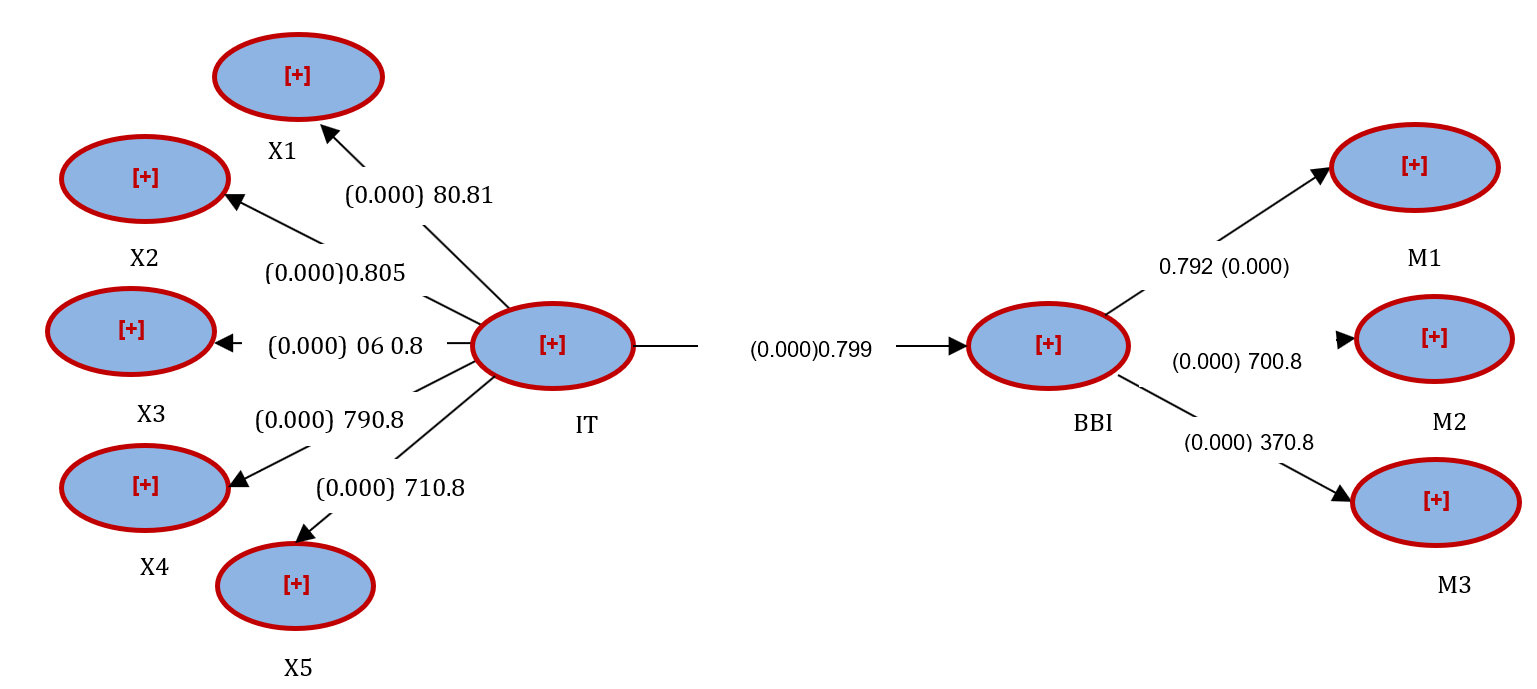
The researchers hypothesized that there is a significant and positive effect relationship of administrative information technology on the ambiguity of banking institutions. This assumes that the blurring of banking institutions is a real function of management information technology and that any increase in the (independent variable) will lead to a similar increase in the (mediating variable), and the structural equation will be tested (SEM-PLS), and the results are extracted through the statistical program (SMART PLS) according to the (simple regression method) as it estimates the effect coefficient (Beta) and the level of significance that appear on the arrow connected between the intermediate variable to the dependent variable as shown in Figure (2) and table (1), They are as follows.
According to the results of Table (1), it became clear that there is a correlation between administrative information technology and ambiguity of banking institutions it amounted to (0.810), which is positive and acceptable at a significant level (0.05). As it turns out from Table (1), the coefficient of determination (R2) amounted to (0.62), which indicates that management information technology explains the amount of (0.62) of the variance in the intermediate variable, the ambiguity of banking institutions. As for the amount of the effect, it amounted to (0.796), meaning that any increase in the independent variable, management information technology, will lead to an increase by (0.796) in the ambiguity of banking institutions, which is significant at the level of significance (0.05). According to these results, this hypothesis is accepted at the level of this study.
Figure 2: The Results of the Simple Regression Analysis Test of Management Information Technology in the Ambiguity of Banking Institutions
Table 1: Statistics of the Impact Coefficient Test of Administrative Information Technology on the Blurring of Banking Institutions
Original Sample (O)
impact coefficient
R
Standard Deviation (STDEV)
R2
T Statistics (|O/STDEV|)
P-Values
Moral level
IT -> BBI
0.796
0.810
0.091
0.62
8,980
0.000
The Second Main Hypothesis
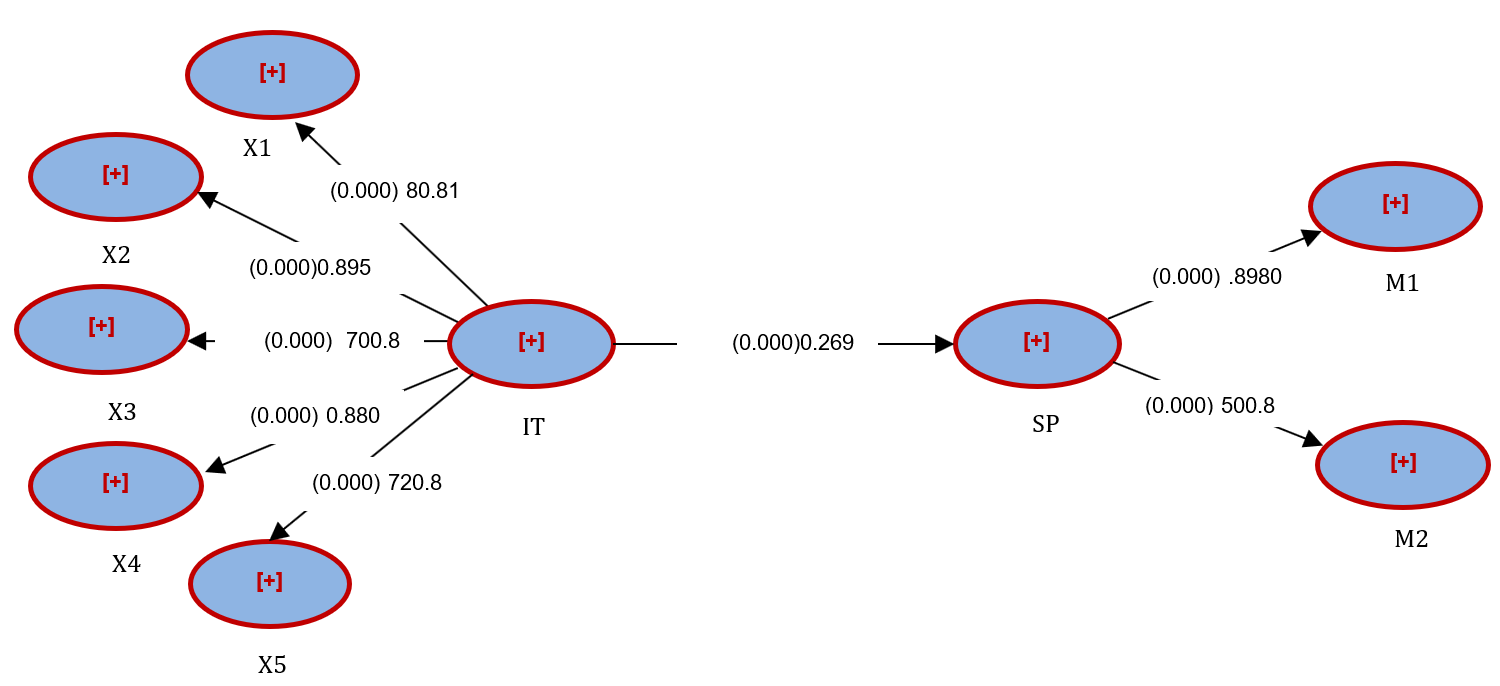
The researchers hypothesized that there is a significant and negative effect of management information technology on employee performance. This assumes that employee performance is a real function of management information technology and that any increase in (the independent variable) will lead to a corresponding decrease in (the dependent variable), and the structural equation will be tested (SEM-PLS), and the results are extracted through the statistical program (SMART PLS) according to the (simple regression method) as it estimates the effect coefficient (Beta) and the level of significance that appear on the arrow connected between the intermediate variable to the dependent variable as shown in Figure (3) and table (2). They are as follows.
According to the results of Table (2), it became clear that there is a correlation between management information technology and employee performance. It amounted to (-0.304), which is negative and acceptable at a significant level (0.05). As it turns out from Table (2), the coefficient of determination (R2) has reached (0.12), which indicates that management information technology explains the amount of (0.12) of the variation in the employee performance variable. As for the amount of effect, Figure (2) showed that the effect coefficient was (0.298), meaning that any increase in the variable management information technology will lead to a decrease by (0.298) in the performance of the employees, which is significant at the level of significance (0.05). According to these results, this hypothesis is accepted at the level of this study.
The Third Main Hypothesis
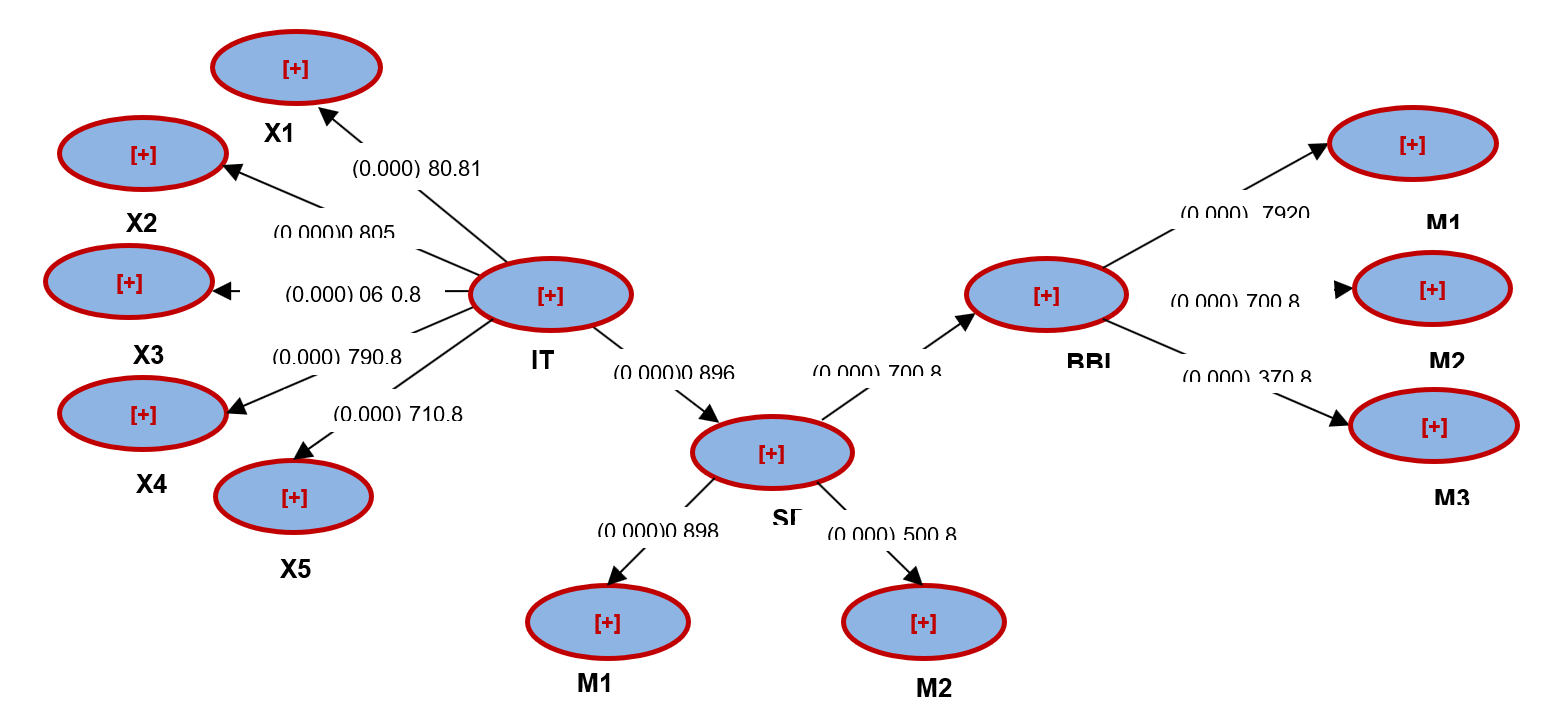
The researchers hypothesized that there is a significant and negative effect of administrative information technology and the ambiguity of banking institutions on employee performance. This assumes that employee performance is a real function of management information technology and that any increase in (the independent variable and the mediator) will lead to a similar increase in (the dependent variable), Structural equation will be tested (SEM-PLS), and the results are extracted through the statistical program (SMART PLS) according to the (simple regression method) as it estimates the effect coefficient (Beta) and the level of significance that appear on the arrow connected between the intermediate variable to the dependent variable as shown in Figure (4) and Table (3). They are as follows.
According to the results of Table (3), it became clear that there is a correlation between the administrative information technology and the ambiguity of banking institutions and the performance of employees it amounted to (0.638), which is positive and acceptable at a significant level (0.05). As it turns out from Table (3), the coefficient of determination (R2) amounted to (0.34), which indicates that administrative information technology and the ambiguity of banking institutions explain the amount of (0.34) of the variation in the employee performance variable. As for the amount of the effect, Figure (3) showed that the effect coefficient was (0.603), meaning that any increase in the variable of management information technology and the ambiguity of banking institutions will lead to an increase of (0.603) in the performance of employees, which is significant at a moral level of (0.05). According to these results, this hypothesis is accepted at the level of this study.
Figure 3: The results of the simple regression analysis test for administrative information technology in the performance of employees
Table 2: Statistics of the impact coefficient test of administrative information technology in and staff performance
Original Sample (O) impact coefficient
R
Standard Deviation (STDEV)
R2
T Statistics (|O/STDEV|)
P Values
Moral level
IT -> SP
-0.298
-0.304
0.072
0.12
-5,000
0.000
Figure 4: The results of the simple regression analysis of administrative information technology and the uncertainty of banking institutions in the performance of employees
Table 3: Statistics of testing the coefficient of influence of administrative information technology and the ambiguity of banking institutions on employee performance
Original Sample (O)
impact coefficient
R
Standard Deviation (STDEV)
R2
T Statistics (|O/STDEV|)
P Values
Moral level
BBI -> SP
-0.603
-0.638
0.079
0.34
-7.802
0.000
CONCLUSION
The results showed that management information technology, with all its components, played an important role in the performance of employees in commercial banks
The use of technology to improve the performance of employees, which helps reduce the burden of human efforts that used to take our time and allocate money and cost
The employees in commercial banks rely on their skills and experience gained by using different technologies and software that help improve their performance
The results prove that the mediating variable the vagueness of banking institutions has a major role in the lack of communication or cohesion between employees due to the lack of clarity of the role and information and the lack of weakness in the performance of employees
Analysis and testing of the second main hypothesis: There is a significant effect of the dimensions of the independent variable management information technology with the dependent variable and the dimensions of the employees' performance in the surveyed banks
Recommendations
Banks operating in the Iraqi banking system must give great importance to the development of human resources and put them in training courses that increase the efficiency of the performance of the banking system
Banks should focus their attention on the acquisition of modern devices and equipment for their important role in banking performance and in line with the tremendous developments in the global banking sector
The researchers recommended the importance of the information that the organization needs in its daily procedures and be a result of improving the performance of employees, due to the use of modern technology in the delivery of information
REFERENCE
Ayyagari, R et al. “Technostress: Technological anticedents and implications.” Journal Article, vol. 35, no. 4, 2011, pp. 831–858.
Venkatesh, V et al. “Impacts of information and communication technology implementations on employees' jobs in service organizations in India: A multi-method longitudinal field study.” Production and Operations Management, vol. 19, no. 5, 2010, pp. 591–613. https://doi.org/10.1111/j.193 7-595 6.2010.01148. x.
Aliyu, A. A. and Tasmin, R. B. H. “The impact of information and communication technology on banks’ performance and customer service delivery in the banking industry.” International Journal of Latest Trends in Finance and Economic Sciences, vol. 2, no. 2, 2012, pp. 81–90.
Olanrewaju, B. E. “Effects of information technology on organizational performance in Nigerian banking industries.” Research Journal of Finance and Accounting, vol. 7, no. 3, 2016, pp. 52–64.
Nuskiya, A. F. “The effect of information technology on employees' performance in the banking industry in Sri Lanka. Empirical study based on the banks in Ampara District.” European Journal of Business and Management, vol. 10, no. 16, 2018, pp. 47–52.
Abbas, J. et al. “Impact of technology on performance of employees (A case study on Allied Bank Ltd, Pakistan).” World Applied Sciences Journal, vol. 29, no. 2, 2014, pp. 271–276.
Dangolania, S. K. “The impact of information technology in banking system (A case study in Bank Keshavarzi IRAN).” Procedia - Social and Behavioral Sciences, vol. 30, 2011, pp. 13–16.Cascio, W. F. and Montealegre, R. “How technology is changing work and organizations.” Annual Review of Organizational Psychology and Organizational Behavior, vol. 3, 2016, pp. 349–375.
Ostrom, A. L. et al. “Service research priorities: Managing and delivering service in turbulent times.” Journal of Service Research, vol. 24, no. 3, 2021, pp. 329–353.
Paulin, D. and Suneson, K. “Knowledge transfer, knowledge sharing and knowledge barriers – Three blurry terms in KM.” The Electronic Journal of Knowledge Management, vol. 10, no. 1, 2012, pp. 81–91. www.ejkm.com.
Rasita, Z. A. and Isab, S. R. “The influence of comprehensive performance measurement system (CPMS) towards managers' role ambiguity.” Procedia - Social and Behavioral Sciences, vol. 164, 2014, pp. 548–561.
Unguren, E. and Arslan, S. “The effect of role ambiguity and role conflict on job performance in the hotel industry: The mediating effect of job satisfaction.” Tourism & Management Studies, vol. 17, no. 1, 2021, pp. 45–58.
Köffer, S et al. “The intensified blurring of boundaries between work and private life through IT consumerisation.” Completed Research Papers, paper 108, 2015. http://aisel.aisnet.org /ecis 2015_cr/108.
Hassan, S. “The importance of role clarification in workgroups: Effects on perceived role clarity, work satisfaction, and turnover rates.” Public Administration Review, vol. 73, no. 5, 2013, pp. 716–725.
Hye, Y. E. “Analysis of the impact of ICT utilization on employee and customer: Focusing on employee satisfaction, organizational performance, customer satisfaction, and purchase decision making.” KDI School of Public Policy and Management, Master’s thesis, 2021.
Diener, F. and Špacek, M. “Digital transformation in banking: A managerial perspective on barriers to change.” Sustainability, vol. 13, 2021, pp. 2032. https://doi.org/10.33 90/su13042032.
Appiahene, P et al. “Evaluation of information technology impact on bank's performance: The Ghanaian experience.” International Journal of Engineering Business Management, vol. 11, 2019, pp. 1–10.
Verhoef, P. C et al.
Karim, A. J. “The significance of management information systems for enhancing strategic and tactical planning.” Journal of Information Systems and Technology Management, vol. 8, no. 2, 2011, pp. 459–470.
Pansini, M et al. “Positioning technostress in the JD-R model perspective: A systematic literature review.” Healthcare, vol. 11, 2023, pp. 446. https://doi.org/10.3390/healthcare 11030446.
Abun, D et al. “The effect of organizational politics on the individual work performance.” International Journal of Research in Business & Social Science, vol. 11, no. 2, 2022, pp. 157–171. https://www.ssbfnet.com/ojs/index.php/ijrbs.
Kichura, M. “The impact organizational factors have on role ambiguity amongst school social workers.” Abilene Christian University, Master’s thesis, 2019.
Pillet, J. C et al. “Learning about ambiguous technologies: Conceptualization and research agenda.” Proceedings of the 25th European Conference on Information Systems (ECIS), 2017, pp. 674–690. http://aisel.aisnet.org/ ecis2017_rp/44.
Thangavelu, A. and Sudhahar, C. “Role clarity and job performance among the employees in small and medium IT industries.” Research on Humanities and Social Sciences, vol. 7, no. 17, 2017, pp. 6–12.
Zhang, J et al. “The relationship between role ambiguity and workers' creativity during the COVID-19 pandemic in China.” International Journal of Environmental Research and Public Health, vol. 19, 2022, pp. 15977. https://doi.org/10.3 390/ijerph192315977.
Srikanth, P. B. and Jomon, M. G. “Role ambiguity and role performance effectiveness: Modifying the effect of feedback seeking behavior.” Asian Academy of Management Journal, vol. 18, no. 2, 2013, pp. 105–127.
Celik, K. “The effect of role ambiguity and role conflict on performance of vice principals: The mediating role of burnout.” Eurasian Journal of Education Research, no. 51, 2013, pp. 195–214.
Lynn, G. S. and Kalay, F. “The effect of vision and role clarity on team performance.” International Journal of Economic and Administrative Studies, no. 17, 2016, pp. 175–196.
Kundu, S. C et al. “Effects of perceived role clarity on innovative work behavior: A multiple mediation model.” RAUSP Management Journal, vol. 54, 2019, pp. [missing pages]. DOI: 10.1108/RAUSP-04-2019-0056.
Yun, S et al. “Employee self-enhancement motives and job performance behaviors: Investigating the modifying effects of employee role ambiguity and managerial perceptions of employee commitment.” Journal of Applied Psychology, vol. 92, no. 3, 2007, pp. 745–756.
Chun, Y. H. and Rainey, H. J. “Goal ambiguity in US federal agencies.” Journal of Public Administration Research and Theory, vol. 15, no. 1, 2005, pp. 1–30.
Fabiana, N. and Haenlein, M. “Digital transformation: A multidisciplinary reflection and research agenda.” Journal of Business Research, vol. 122, 2021, pp. 889–901.
License
Creative Commons Attribution-NonCommercial-NoDerivatives 4.0 International License
All papers should be submitted electronically. All submitted manuscripts must be original work that is not under submission at another journal or under consideration for publication in another form, such as a monograph or chapter of a book. Authors of submitted papers are obligated not to submit their paper for publication elsewhere until an editorial decision is rendered on their submission. Further, authors of accepted papers are prohibited from publishing the results in other publications that appear before the paper is published in the Journal unless they receive approval for doing so from the Editor-In-Chief.
Himalayan Journal of Economics and Business Management open access articles are licensed under a Creative Commons Attribution-Share A like 4.0 International License. This license lets the audience to give appropriate credit, provide a link to the license, and indicate if changes were made and if they remix, transform, or build upon the material, they must distribute contributions under the same license as the original.
Advertisement
Recommended Articles
Research Article
Influence of Leadership on Poverty Reduction in the Devolved Government in Trans-Nzoia County, Kenya
Kinisu Sifuna,
...
Peter Simotwo
Published: 30/06/2021
Download PDF
Cite
x
APA
Sifuna, K., Lwangale, D. W., Simotwo, P., Sifuna, K., Lwangale, D. W. & Simotwo, P. (2021). Influence of Leadership on Poverty Reduction in the Devolved Government in Trans-Nzoia County, Kenya. Himalayan Journal of Economics and Business Management, 2(1), None-None.
MLA
Sifuna, Kinisu, et al. "Influence of Leadership on Poverty Reduction in the Devolved Government in Trans-Nzoia County, Kenya." Himalayan Journal of Economics and Business Management 2.1 (2021): None-None.
Chicago
Sifuna, Kinisu, David W. Lwangale, Peter Simotwo, Kinisu Sifuna, David W. Lwangale and Peter Simotwo. "Influence of Leadership on Poverty Reduction in the Devolved Government in Trans-Nzoia County, Kenya." Himalayan Journal of Economics and Business Management 2, no. 1 (2021): None-None.
Harvard
Sifuna, K., Lwangale, D. W., Simotwo, P., Sifuna, K., Lwangale, D. W. and Simotwo, P. (2021) 'Influence of Leadership on Poverty Reduction in the Devolved Government in Trans-Nzoia County, Kenya' Himalayan Journal of Economics and Business Management 2(1), pp. None-None.
Vancouver
Sifuna K, Lwangale DW, Simotwo P, Sifuna K, Lwangale DW, Simotwo P. Influence of Leadership on Poverty Reduction in the Devolved Government in Trans-Nzoia County, Kenya. Himalayan Journal of Economics and Business Management. 2021 Jan;2(1):None-None.
Download PDF
Research Article
Modelling Structure Job Quality, Job Design and Job Satisfaction
Moch Nurhadi,
...
Avi Sunani
Published: 30/08/2022
Download PDF
Cite
x
APA
Nurhadi, M., Bisyri Effendi, M., Saiful Ulum, A. & Sunani, A. (2022). Modelling Structure Job Quality, Job Design and Job Satisfaction. Himalayan Journal of Economics and Business Management, 3(2), 1-4.
MLA
Nurhadi, Moch, et al. "Modelling Structure Job Quality, Job Design and Job Satisfaction." Himalayan Journal of Economics and Business Management 3.2 (2022): 1-4.
Chicago
Nurhadi, Moch, Moch Bisyri Effendi, Achmad Saiful Ulum and Avi Sunani. "Modelling Structure Job Quality, Job Design and Job Satisfaction." Himalayan Journal of Economics and Business Management 3, no. 2 (2022): 1-4.
Harvard
Nurhadi, M., Bisyri Effendi, M., Saiful Ulum, A. and Sunani, A. (2022) 'Modelling Structure Job Quality, Job Design and Job Satisfaction' Himalayan Journal of Economics and Business Management 3(2), pp. 1-4.
Vancouver
Nurhadi M, Bisyri Effendi M, Saiful Ulum A, Sunani A. Modelling Structure Job Quality, Job Design and Job Satisfaction. Himalayan Journal of Economics and Business Management. 2022 Jul;3(2):1-4.
Download PDF
Research Article
Accountability and Transparency of Village Fund Management in Lumajang District
Nurina Ayuningtiyas,
...
Muhammad Miqdad
Published: 28/12/2023
Download PDF
Cite
x
APA
Ayuningtiyas, N., Santosa Putra, H. & Miqdad, M. (2023). Accountability and Transparency of Village Fund Management in Lumajang District. Himalayan Journal of Economics and Business Management, 4(2), 1-4.
MLA
Ayuningtiyas, Nurina, Hendrawan Santosa Putra and Muhammad Miqdad. "Accountability and Transparency of Village Fund Management in Lumajang District." Himalayan Journal of Economics and Business Management 4.2 (2023): 1-4.
Chicago
Ayuningtiyas, Nurina, Hendrawan Santosa Putra and Muhammad Miqdad. "Accountability and Transparency of Village Fund Management in Lumajang District." Himalayan Journal of Economics and Business Management 4, no. 2 (2023): 1-4.
Harvard
Ayuningtiyas, N., Santosa Putra, H. and Miqdad, M. (2023) 'Accountability and Transparency of Village Fund Management in Lumajang District' Himalayan Journal of Economics and Business Management 4(2), pp. 1-4.
Vancouver
Ayuningtiyas N, Santosa Putra H, Miqdad M. Accountability and Transparency of Village Fund Management in Lumajang District. Himalayan Journal of Economics and Business Management. 2023 Jul;4(2):1-4.
Download PDF
Research Article
Proposed Digital Marketing Strategy to Enhance Engineering Consultancy Company Revenue
Alfarisy, K. A.,
Wandebori, H.
Published: 30/04/2024
Download PDF
Cite
x
APA
K. A., A. & H., W. (2024). Proposed Digital Marketing Strategy to Enhance Engineering Consultancy Company Revenue. Himalayan Journal of Economics and Business Management, 5(1), 1-18.
MLA
K. A., Alfarisy, and Wandebori, H.. "Proposed Digital Marketing Strategy to Enhance Engineering Consultancy Company Revenue." Himalayan Journal of Economics and Business Management 5.1 (2024): 1-18.
Chicago
K. A., Alfarisy, and Wandebori, H.. "Proposed Digital Marketing Strategy to Enhance Engineering Consultancy Company Revenue." Himalayan Journal of Economics and Business Management 5, no. 1 (2024): 1-18.
Harvard
K. A., A. and H., W. (2024) 'Proposed Digital Marketing Strategy to Enhance Engineering Consultancy Company Revenue' Himalayan Journal of Economics and Business Management 5(1), pp. 1-18.
Vancouver
K. A. A, H. W. Proposed Digital Marketing Strategy to Enhance Engineering Consultancy Company Revenue. Himalayan Journal of Economics and Business Management. 2024 Jan;5(1):1-18.
Naser Jasim Al-Yousef, A., Al-frijawy, J. & Jerri Mohsin, H. (2023). The Role of Management Information Technology in The fuzzy of Banking Institutions and Its Implications for The Efficiency and Performance of Employees, A Field Study in Commercial Banks in Basra. Himalayan Journal of Economics and Business Management, 4(2), 1-11.
MLA
Naser Jasim Al-Yousef, Arafat, Jawad Al-frijawy and Hayder Jerri Mohsin. "The Role of Management Information Technology in The fuzzy of Banking Institutions and Its Implications for The Efficiency and Performance of Employees, A Field Study in Commercial Banks in Basra." Himalayan Journal of Economics and Business Management 4.2 (2023): 1-11.
Chicago
Naser Jasim Al-Yousef, Arafat, Jawad Al-frijawy and Hayder Jerri Mohsin. "The Role of Management Information Technology in The fuzzy of Banking Institutions and Its Implications for The Efficiency and Performance of Employees, A Field Study in Commercial Banks in Basra." Himalayan Journal of Economics and Business Management 4, no. 2 (2023): 1-11.
Harvard
Naser Jasim Al-Yousef, A., Al-frijawy, J. and Jerri Mohsin, H. (2023) 'The Role of Management Information Technology in The fuzzy of Banking Institutions and Its Implications for The Efficiency and Performance of Employees, A Field Study in Commercial Banks in Basra' Himalayan Journal of Economics and Business Management 4(2), pp. 1-11.
Vancouver
Naser Jasim Al-Yousef A, Al-frijawy J, Jerri Mohsin H. The Role of Management Information Technology in The fuzzy of Banking Institutions and Its Implications for The Efficiency and Performance of Employees, A Field Study in Commercial Banks in Basra. Himalayan Journal of Economics and Business Management. 2023 Jul;4(2):1-11.



 Download PDF
 Download XML