Real estate typically relies on their experience to price property products. Pricing is subjective and controlled only by property developers, creating an imbalance for property consumers. This study aims to get the optimal price for actual Estate-based estate-based behaviour. This study reaches the data using mix method approach, qualitative by collecting data using interviewing Real Estate developers and sales marketing. Quantitative data approach using questionnaires distributed to Real Estate residents. Data analysis and hypothesis will define by content analysis method for data obtained by interviewing and using regression from questionnaires. Questionnaires and Interview questions are among physical condition, design concept, marketing concept, location city, uniqueness and livability. The previous study found that customer behaviour has a significant leading impact on estate developers deciding the price, but most developers determine price only from previous experience. It would be unfair because the developer can increase the price. Furthermore, based on the literature review, we propose a conceptual framework where we conduct price modelling for real estate based on consumer behaviour.
Keywords
Real Estate
Optimizing
Questionnaires
Livability
Conceptual Framework
INTRODUCTION
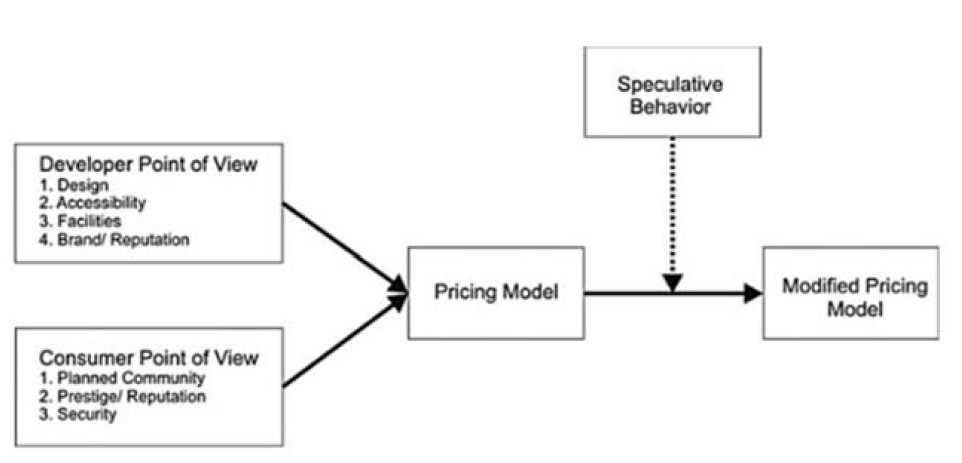
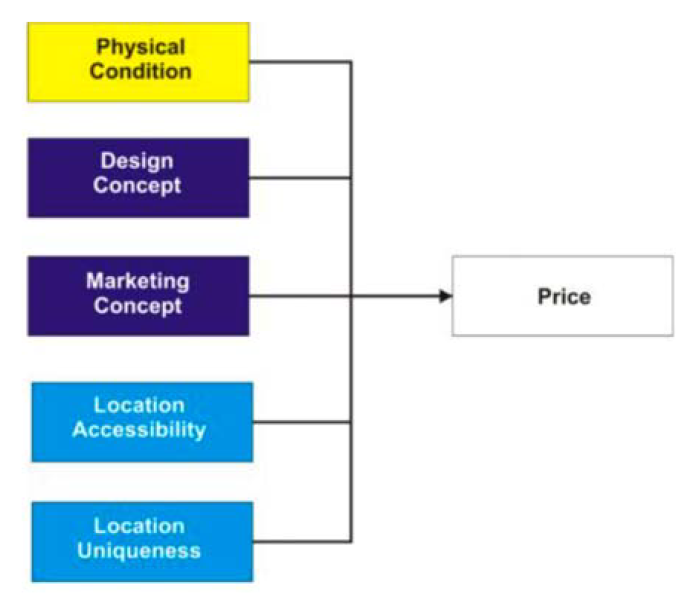
Real Estate developers typically rely on their experience to price property products. Pricing is subjective and controlled only by property developers, creating an imbalance for property consumers [1]. From the previous research, they have found that the most influential factors that affect price us customers from customers' perspective. Customers reflect most of the attributes that influence the price. From this, it can be concluded that to optimize the pricing of residential products, property developers should pay more attention to what their customers prefer rather than just looking at their experience in pricing new products [2]. Factors influencing customers when looking for Real Estate are physical condition, design concept, marketing concept, location accessibility and uniqueness. The other thing that has contributed to customer preferences is Real Estate Prices. From the developer's perspective, design, accessibility, facility and brand have the most influential factors for the developer to make the price. The interception factors that will influence the cost from customer and developer are planned community, prestige and security. The factors above are from literature research and their relationship to Indonesia's situation [3].
Bias in the real estate investment market. Investing wisely was the most popular choice during the real estate boom. In contrast, unsuccessful investments in times of crisis are due to bad luck, other people or circumstances such as the presence of the market or bearish investors, lowering investment sentiment. The same bias affects future expectations. People generally look for logic to explain and reinforce their beliefs, so they tend not to adjust their expectations easily [4].
Most homebuyers are unaware of the importance of psychological processes in the real estate market. A survey of homebuyers has asked whether recent trends in home prices can be better explained in terms of psychology and economic and demographic conditions. Only 13% of respondents [5]. This is despite the real estate prices being accurate. People make life decisions based on vague expectations. These expectations and the perception of owning a unique property make them believe their property will be of great value. This foresight will lead to more consumption today and an implicit price increase tomorrow [6].
A considerable population creates a housing problem in the area, opening up opportunities for property developers to build real estate and making property prices more valuable. Over time prices have risen significantly. So every people competes to get the most helpful house in the town. The macro-perspectives influencing customers are green, healthy, suitable for raising family and cluster housing. Housing and real price correlate with macroeconomic perspectives, such as interest rates, GDP per capita and credit growth, which have been found to explain real estate and housing prices. Financial supervisors have been trying to develop tools to monitor the evolution of real estate and housing prices [7]. Besides that, there are speculated factors that influence housing prices.
However, no research has focused on housing price modelling solutions. A general model for all the participants in the market is generated to find the marginal production costs and demand [8]. These models are used for short-term price estimation using all consumer behavioural information. These models are used to analyze the strategic decisions of market participants. On the other hand, developers try to optimize the price to get equilibrium.
MATERIALS AND METHODS
This paper aims to identify significant works on price modelling in real estate using deep learning and its impacts on real estate prices and the market to optimise them to identify consumer and developer perspectives and opportunities for further study and research. In this context, a literature search is an essential step in building a research field but also assists in identifying the field's conceptual content and provides direction for theory formation. It seems to be a sensible approach. Therefore, this article followed the three-step methodology [9]. Collection and selection of articles, analysis of selected literature, identification of research gaps and potential areas for further investigation.
Searching Methodology for Literature
For data collection, we focused on Scopus, one of the largest bibliographic databases containing only journals with an Impact Factor. Since this research focuses on real estate price modelling using deep learning, we focused on particular original estate-related articles. That's why we initially included the keywords real estate and price modelling. I used the Boolean AND operator to generate a combination of these terms and his two searches for "real estate prices". Additionally, these combinations could be coupled with Impact impact, including more papers on real estate consumer behaviour in physical condition, design concept, marketing concept, location accessibility, location uniqueness and machine learning using AND operators. We searched the literature that was published in 2022.
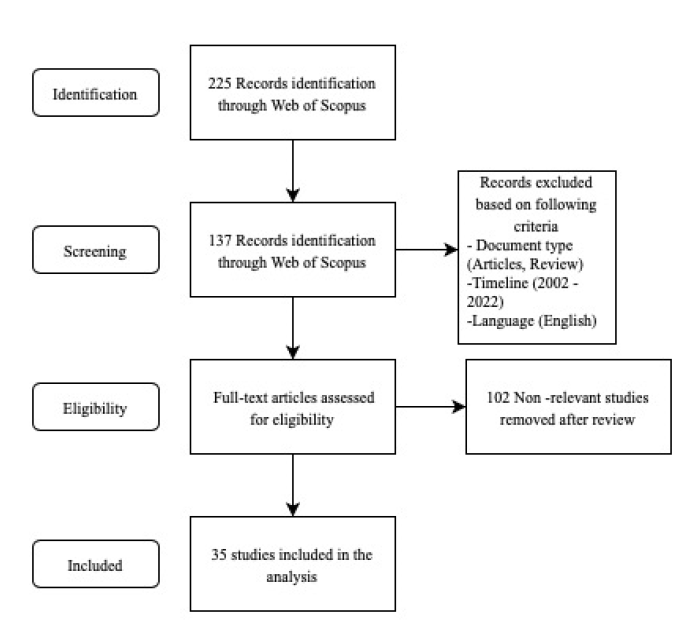
In the Scopus database, we searched for these keyword combinations by title, abstract and keyword of papers and conference papers. The initial search yielded 225 publications. We've narrowed them down to 35 based on article length. We excluded publications not written in English and those unrelated to real estate price modelling and artificial intelligence about consumer behaviour in real estate price modelling. Several interesting publications indirectly allude to some of these influences, but they focus on consumer behaviour, price modelling, consumer willingness to pay, real estate prices and machine learning. I understand. Figure 1 shows how publications were selected.
Figure 1: Publication Selection Methodology
Descriptive Statistics
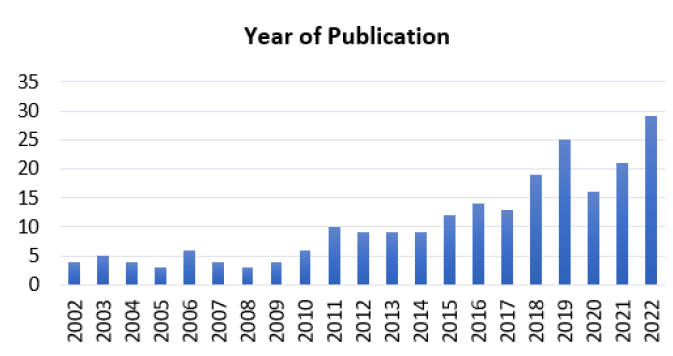
This section presents some descriptive statistics of the reviewed literature. Figure 2 shows the distribution of publications by year from 2002 to 2022. We can see that the number of publications has increased significantly in recent years, reflecting the growing interest in this topic. This trend is probably the result of investing in real estate. This trend is expected to continue over the next few years, given the real estate investments' impact.
Figure 2: Year of Publication
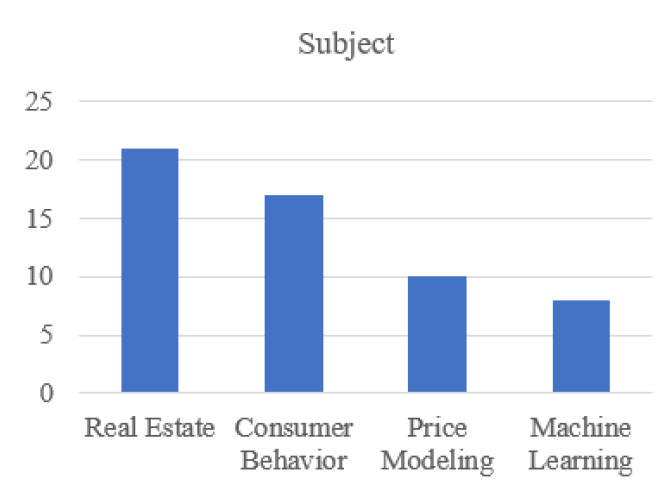
Figure 3 shows the most common themes in the reviewed literature. We categorised our literature into WoS research categories based on publication topics and grouped some cases into appropriate broader categories.
The real estate includes publications that address real estate development, property development, the housing market, residential property and real estate theory development.
In machine learning, studies examine digital transformation issues such as price forecasting, big data, artificial neural networks, deep learning and linear regression. There is a focus on price modellings, such as price forecasting, price prediction, house price, the housing market, property valuation and housing price. In consumer behaviour sectors, some preferences make the consumer buy real estate, such as consumer preferences, location accessibility, design concept, physical qualities, marketing concept, location uniqueness, livability and residential property.
Figure 3: Publication by Subject
Analysis of The Literature
Real estate is the land and any permanent structures, like a home or improvements attached to the ground, whether natural or artificial [10]. Land and buildings have played an essential role in the ancient and modern world as a source of wealth, power and economic strength. Real estate typically relies on their experience to price property products. Pricing is subjective and controlled only by property developers, creating an imbalance for property consumers [1]. Most influencing factors that affect prices usually come from the customer's perspective. Customers reflect most of the attributes that influence the price. From this, it can be concluded that to optimise the pricing of residential products, property developers should pay more attention to what their customers prefer rather than just looking at their experience in pricing new products [2]. Key factors contributing to developer perceptions and consumer preferences for consumer product pricing. Regarding developer perceptions, based on the results of our interviews, four factors influence pricing design, accessibility, facility and brand [3]. Most homebuyers are unaware of the importance of psychological processes in the real estate market. A survey of homebuyers has asked whether recent trends in home prices can be better explained in terms of psychology and economic and demographic conditions. Only 13% of respondents [5]. This is despite the real estate prices being accurate. People make life decisions based on vague expectations.
These expectations and the perception of owning a unique property make them believe their property will be of great value. This foresight will lead to more consumption today and an implicit price increase tomorrow [6].
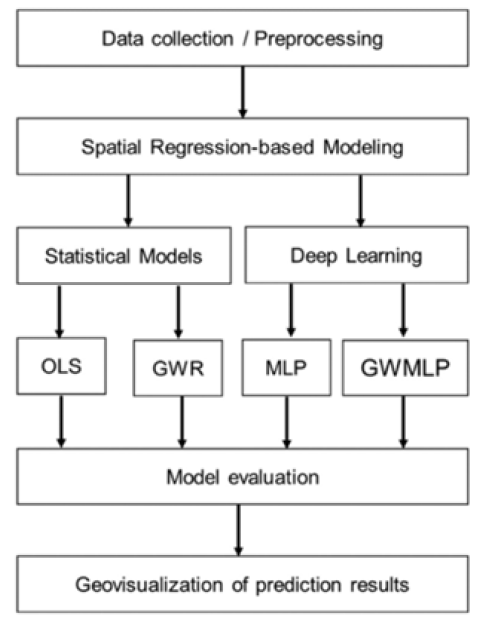
Factors that will be used to decide the price model is a physical condition, design concept, marketing concept, location accessibility, dan location uniqueness. The researcher will count the mean and weight point models mathematics review of various research papers is pending. Still, several regression models have focused on the relationships between property prices, transportation systems, land distribution, environmental quality, industrial centres and accessibility. Spatial regression models enable the study of spatial data and spatial processes. Nevertheless, many model specifications can be applied, assuming different spatial dependencies. In the spatial lag and error models, the dependence of residuals or yield results in spatial regression models [11]. This work uses spatial regression modelling using statistical methods such as OSL and GWR and supervised deep learning algorithms using Multilayer Perceptrons (MLP) and geographically weighted shapes. This research uses the Python programming language on Google's collaborative platform for cloud computing. Python has many libraries that can be used to run deep-learning algorithms. The process can be seen in the diagram below.
They use the content analysis method as a classifier, selecting meaning units, to begin with, handling original data and refraining from abstracting the text. A common concern is the length of a meaning unit on the phenomenon study and the kind of data. The text is usually broken down into short semantic units if the study aims to describe general and concrete things close to the participant's experience the advantages and disadvantages of different types of devices for people with disabilities [12]. Regarding revealing complex phenomena, texts are more likely to be divided into more extended semantic units with more content.
Spatial regression models enable the study of spatial data and spatial processes. Nevertheless, many model specifications can be applied that assume different spatial dependencies. The spatial lag model and the spatial error model the dependence of residuals and outcomes, respectively, in spatial regression models [11]. This work uses spatial regression modelling using statistical methods such as OSL and GWR and supervised deep learning algorithms using multilayer perceptrons (MLP) and geographically weighted conditions. A flow chart of the selected methodology is presented. This research uses the Python programming language on Google's collaborative platform for cloud computing. Python has many libraries that can be used to run deep-learning algorithms. The process can be found in the Figure 4.
A neural network can be used to predict the selling price of a house. From this perspective, this work's core relies on applying artificial neural networks to property valuation. The advantage of the proposed approach is that when using ANNs, we do not need to assume explicit functions between the inputs and outputs of the study because the ANN learns directly from the observed data [13]. Based on the variables reported in the residential real estate database, ANNs were trained to associate environment and other local attributes with the considered real estate price. The ANN thought is a feed-forward-back propagation network with a training function that updates weight and bias values according to Leven Berg-Marquardt optimization. The ANN consists of 3 hidden layers with 24 neurons in the first and second and one neuron at the end. The input data for training the ANN consists of matrices containing the environmental and land-use attributes of the collected plots. Output is expressed in real estate prices.
Table 1: Classification of The Literature On Real Estate, Consumer Behaviour, Price Modelling, Machine Learning
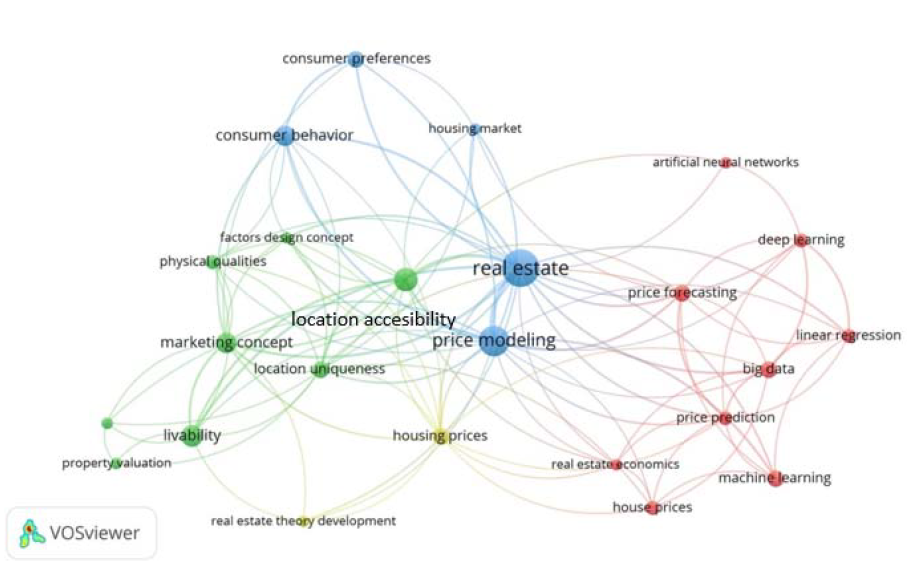
The downloaded literature journal was input into the medley and converted into.RIS file. Input.RIS file to VOS viewer to make a graphical network analysis. Data clustering is a technique for grouping similar items into a cluster to distinguish them from objects in other collections. Therefore, the connection density of nodes within a cluster is higher than that of another group.
Applying VOSviewer in this research found 24 nodes and four significant clusters. This high density between nodes also reflects the grouping of papers with similar research topics. Therefore, a thorough analysis of these papers reveals research areas for this cluster. For simplicity, we focused only on each group's top 10 articles (based on co-citation page rank), as shown in Figure 5.
Figure 5: VOSviewer Relation
Understanding Research Cluster
Real Estate: Real estate is defined to include only investments in Private Real Estate Equity and Private Real Estate Debt. While pension funds and wealthy families bought and held direct investments in single buildings and mutual funds, insurance companies traditionally built large portfolios of individual residential real estate mortgages. Both approaches required significant investments and then holdings because there was no market for circulated and securitised bonds or stocks [14]. Private commercial real estate capital is held as individual assets or in hybrid vehicles. Personal, commercial real estate debt is stored either as a directly issued aggregate loan or as a commercial mortgage held in a fund and a hybrid car. Public real estate stocks are structured as REITs or Real Estate Operating Companies (REOCs). Commercial real estate debt is structured as Commercial Mortgage-Backed Securities (CMBS) [15]. Real estate markets are relatively illiquid and most scientists assume that these markets are efficient and that participants act according to rationality [16]
Land and buildings have played an essential role in the ancient and modern world as a source of wealth, power and economic strength. Real estate includes investments in private equity, public equity, private debt and public debt markets. Real estate provides risk mitigation in low to medium-risk portfolios but plays no role in risk-tolerant portfolios. Real estate is not the best absolute return trust, but equities are better [17].
Housing serves a variety of functions. It emphasises that buying real estate is an investment and consumption decision. This diversity makes it difficult to compare real estate investments with other financial assets that cannot be consumed directly [18]. Decisions involve both rational and irrational actions. That is, behaviour deviates from the optimal strategy for determining the accurate valuation. Particular attention is paid to irrational behaviour when investing in real estate.
Real estate is the most common asset in a highly diversified investment portfolio management. Residential investment is volatile in GDP and positively correlated with business cycles. Housing is very different from other investments because it is illiquid due to the low frequency of transactions and the significant heterogeneity of the assets. De-risk a household's entire portfolio when short-term liquidity is not required. Exposure to real estate reduces relative holdings of risky assets such as stocks [19]. Real estate is the best long-term investment. For the business cycle, the long run time series of Real Estate price is the momentum effect related.
Consumer Behavior
Most influencing factors that affect prices usually come from the customer's perspective. Customers reflect most of the attributes that influence the price. From this, it can be concluded that to optimise the pricing of residential products, property developers should pay more attention to what their customers prefer rather than just looking at their experience in pricing new products [2].
Key factors contributing to developer perceptions and consumer preferences for consumer product pricing. Regarding developer perceptions, based on our interviews' results, four factors influence pricing design, accessibility, facility and brand [3]. Regarding consumer preferences, three factors influence prices based on literature research and their relationship to the Indonesian situation. Concept of planned community, prestige and security. These factors are generated based on the assumption that the authors are the most likely factors with an Indonesian context based on their work experience. There are several pricing model options available, each with advantages and disadvantages. Modified or combined approaches are used in this study to obtain more accurate results.
Bias in the real estate investment market. Investing wisely was the most popular choice during the real estate boom. In contrast, unsuccessful investments in times of crisis are due to bad luck, other people or circumstances such as the presence of the market or bearish investors, lowering investment sentiment. The same bias affects future expectations. People generally look for logic to explain and reinforce their beliefs, so they tend not to adjust their expectations easily [4].
Herd behaviour plays an essential role in human decision-making. Due to social pressure, people do not always judge independently. The idea that no one is wrong helps rationalise the behaviour of the herd, which has turned out to be the cause of mispricing and speculation bubbles. Problems with psychological adjustment mean that people cannot change their expectations of the future. Boom forecasts are based on recent price movements in the same region and elsewhere. Because of the widespread belief that prices are rising worldwide, people are unaware of the change [6]. Herd behaviour has also been shown to be a factor in strategic error. People are easily persuaded to follow the herd and fall behind, especially when thought leaders are involved [20].
Most homebuyers are unaware of the importance of psychological processes in the real estate market. A survey of homebuyers has asked whether recent trends in home prices can be better explained in terms of psychology and economic and demographic conditions. Only 13% of respondents [5]. This is despite the real estate prices being accurate. People make life decisions based on vague expectations. These expectations, combined with the perception of owning a unique property, make them believe their property will be of great value. This foresight will lead to more consumption today and an implicit price increase tomorrow [6].
Price Modeling
A systematic review of various research papers is pending, but several regression models have focused on the relationships between property prices, transportation systems, land distribution, environmental quality, industrial centres and accessibility.
The first focuses on estimating cap rates as a function of macroeconomic and capital market variables. Cap rates for residential/commercial real estate, concluding that real estate investors are slower to adjust their expectations than stock market investors in response to changes in the macroeconomy, isolating the real estate market from the capital markets [21]. Model the average cap rate as a panel model with fixed effects. This simple two-level hierarchical model derives functions of location and market factors and liability and equity components, as defined by the investment scope approach, to account for sector-based capitalisation rates. They conclude that it is a cross-section/time series. Most of the variability is explained by property type captured by the intercept term, arguing that income variability should be defined by accounting for property-specific characteristics.
The reasons for disparities in cap quotes may be masked via several actual properties and transaction-particular elements that perform throughout numerous spatial levels and deliver upward thrust to spatial autocorrelation [21].
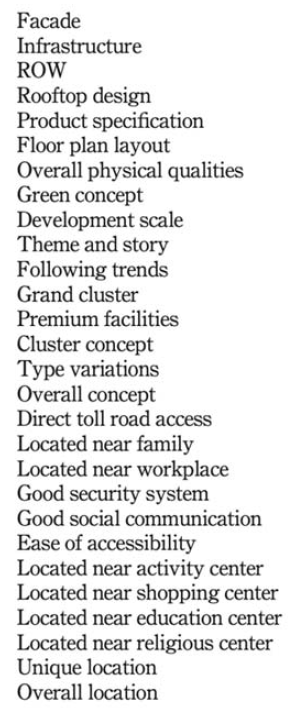
Figure 6: Real Estate Pricing Attributes [2]
Figure 7. Real Estate Price Concept Factors [2]
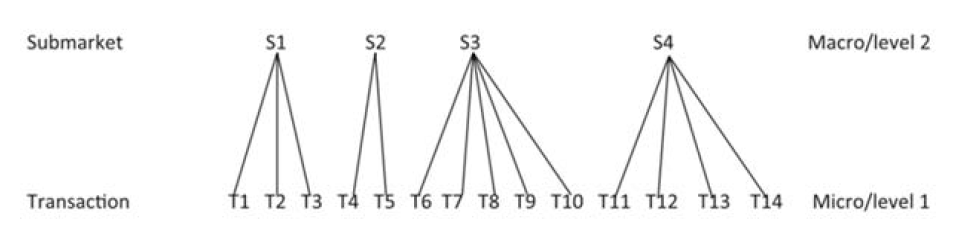
Figure 8: Unit Diagram for a Two-Level Nested Hierarchy (Crosby, 2016)
Figure 9: Factors That Influence Price Modeling [1]
Multi-degree analyses, while analyzing nearby residence costs to explicitly permit homes to be embedded inside submarkets inspired by nearby and better spatial degree elements, a comparable nested hierarchy exists in the industrial actual property market. Investment transactions can conceptually be represented as an easy two-degree nested shape, where transactions are clustered inside submarkets. There can be shared impacts from specific submarkets on transactions inside one's submarkets. Exploration of the spatial versions in cap quotes which are pushed via way of means of submarket effects, whilst additionally measuring the performance generated via the form of means of the traits of the actual property, its tenants, its client and the way more comprehensive macro-financial elements impact the expectancies of customers concerning man or woman investments [22]. This modelling framework is appropriate because it explicitly captures the hierarchical shape of funding transaction effects while transactions are clustered inside submarkets.
The elements used to make the price model are physical condition, design concept, marketing concept, location accessibility and uniqueness. The researcher will count the mean and weight points of every model.
Machine Learning
Spatial regression models enable the study of spatial data and spatial processes. Nevertheless, many model specifications can be applied, assuming different spatial dependencies. In the spatial lag and error models, the dependence of residuals or yield results in spatial regression models [11]. This work uses spatial regression modelling using statistical methods such as OSL and GWR and supervised deep learning algorithms using multilayer perceptrons (MLP) and geographically weighted shapes. This research uses the Python programming language on Google's collaborative platform for cloud computing. Python has many libraries that can be used to run deep-learning algorithms. The process can be seen in the Figure 10.
A neural network can be used to predict the selling price of a house. From this perspective, the core of this work is A neural network that can be used to predict the selling price of a home. From this point of view, this work's nature rests on applying artificial neural networks to real estate valuation. The advantage of the proposed approach is that when using ANNs, we do not need to assume an explicit function between survey inputs and outputs, as ANNs learn directly from observed data [13]. Based on the variables reported in the residential real estate database, ANNs were trained to relate environmental and other local attributes to property prices under consideration.
The ANN considered is a feed-forward-back propagation network with a training function that updates weight and bias values according to Levenberg-Marquardt optimisation. The ANN consists of 3 hidden layers with 24 neurons in the first and second and one neuron at the end. The input data for training the ANN consists of matrices containing the environmental and land-use attributes of the collected plots. Production is expressed in house prices.
Conceptual Framework
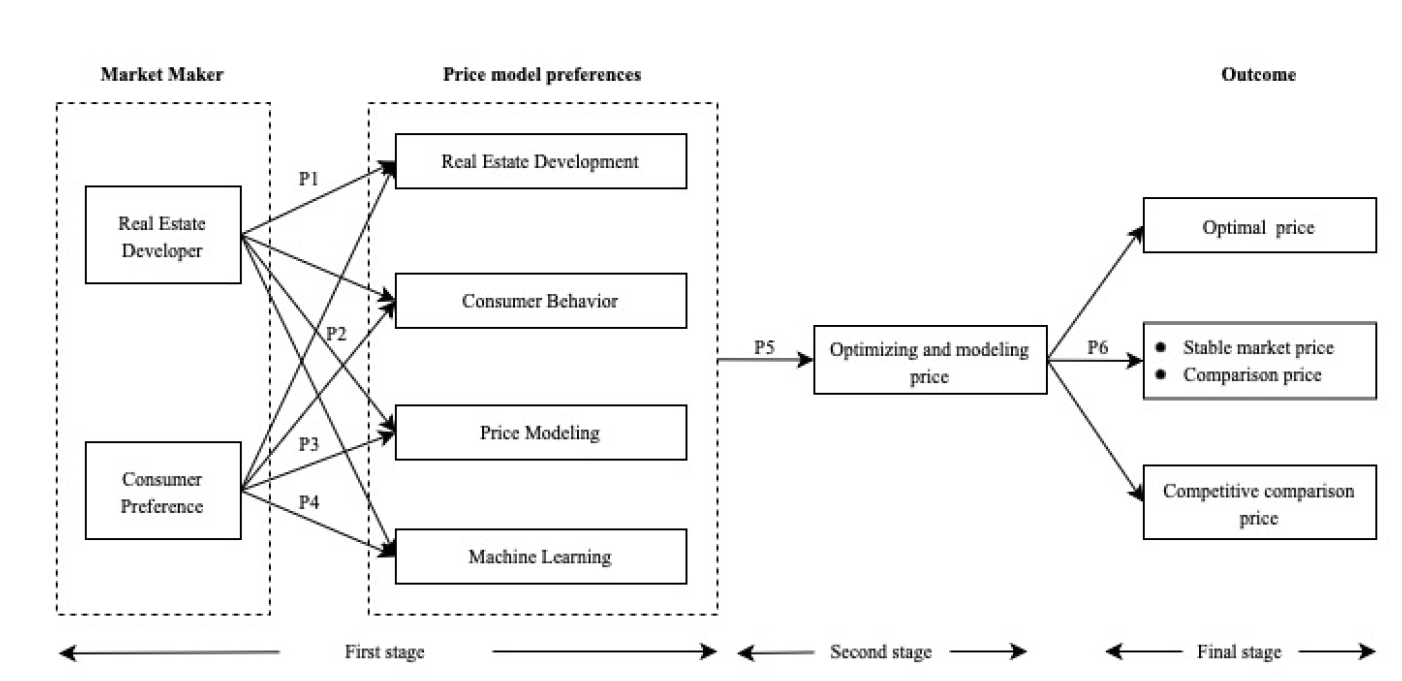
This section provides a conceptual framework that connects the three stages of transformational change in organisations: the first stage, the second stage and the final stage, to optimise real estate prices with consumer behaviour using deep learning analytics. Real estate, consumer behaviour, price modelling, machine learning, property development, physical condition, design concept, marketing concept, location accessibility and location uniqueness are the ten primary parts of the suggested conceptual model, as depicted in Figure 10. The primary goal of the study model is to optimise accurate price based on consumer behaviour using deep learning analytics. We also examine the overall influence of real estate development, consumer behaviour, price modelling and machine learning. As can be observed, the suggested framework is consistent with Figure 10.
Figure 10: Conceptual Framework
DISCUSSION
Real estate is defined to include only investments in Private Real Estate Equity and Private Real Estate Debt. While pension funds and wealthy families bought and held direct investments in single buildings and mutual funds, insurance companies traditionally built large portfolios of individual residential real estate mortgages. Although, real estate typically relies on their experience to price property products. Pricing is subjective and controlled only by property developers, creating an imbalance for property consumers. This framework aims to optimise real estate prices using consumer behaviour. Mix method will use in this research qualitative content analysis used for interviewing real estate developers and comparing the result. Quantitative using questionnaires will be distributed to the respondent who is able or willing to buy real estate. Questionaire and interviews made from factors that influence real estate prices. Data will process using a regression method. Spatial regression models enable the study of spatial data and spatial processes.
Nevertheless, many model specifications can be applied, assuming different spatial dependencies. In the spatial lag and error models, the dependence of residuals or yield results in spatial regression models [11]. This work uses spatial regression modelling using statistical methods such as OSL and GWR and supervised deep learning algorithms using multilayer perceptrons (MLP) and geographically weighted shapes.
Further Studies
This section provides four further research opportunities for scholars working in real estate price modelling.
Modelling real estate price using qualitative content analysis
Previous research found a gap in analysing real estate price preferences using content analysis. Using content analysis methods as classifiers, the selection of semantic units begins by processing the original data rather than abstracting the text. A common concern is the length of the meaningful units and the nature of the data in phenomenological studies. Suppose the purpose of the research is to describe general and concrete things that are close to the participants' experience. In that case, the text is usually broken down into short semantic units’ pros and cons of different types of devices for people with disabilities [12]. Regarding revealing complex phenomena, texts are more likely to be divided into more extended semantic units with more content. Content obtained by interviewing real estate developers and marketing.
Relationship between attributes that affect the value and price of real estate products and consumer preferences
From the factors obtained [1], we can interview potential real estate conconsumersue. The questioned 35 factors that influence real estate prices. Rating scale with a balance rating scale. Data will process with regression to find the relationship between affecting the value and cost of real estate products and consumer preferences.
Deep learning analytics for optimising real estate prices with consumer behaviour
After completing the first and second research, there's a method to optimise price using previous data found using deep learing. Neural networking can be used to predict the selling price of a house. From this perspective, the gist of this work is that neural networks can be used to predict the selling price of a home. From this point of view, this research's core lies in applying artificial neural networks to property valuation. The advantage of the proposed approach is that when using ANNs, we do not need to assume an explicit function between survey inputs and outputs, as ANNs learn directly from observed data. Based on variables reported in the residential real estate database, ANNs were trained to associate environmental and other local attributes with property prices under consideration. The ANN considered is a feed-forward-back propagation network with a training function that updates weight and bias values according to Levenberg-Marquardt optimisation. The ANN consists of 3 hidden layers with 26 neurons in the first and second and one neuron at the end. The input data for training the ANN consists of matrices containing the environmental and land-use attributes of the collected plots. Production is expressed in house prices.
Investing strategies in real estate depends on consumer behaviour and a macroeconomic perspective
When the optimal price has been defined, the last exciting thing we can do is make investment strategies. From previous research, we found that real estate price is influenced by the macroeconomic perspective [10]. Real estate price growth aligns with GDP, inflation and interest rate cumulative growth [23]. Make a strategy by looking at gaps in some real estate factors and development processes such as [24] and trying to gain capital from development in the facility around the real Estate cluster area and looking at growth density from macro-economic factors.
REFERENCES
Rahadi, R.A. “Factors influencing the price of housing in Indonesia.” International Journal of Housing Markets and Analysis, 2015, pp. 169–188.
Rahadi, R.A. “Attributes influencing housing product value and price in Jakarta metropolitan region.” AMER International Conference on Quality of Life, 2013, pp. 368–378.
Rahadi, R.A. “Relationship between consumer preferences and value propositions: A study of residential product.” AcE-Bs 2012 Bangkok ASEAN Conference on Environment-Behaviour Studies, 2012, pp. 865–874.
Farlow. Crash and Beyond: Causes and Consequences of the Global Financial Crisis. Oxford University Press, 2013.
Salzman, D. and R. Zwinkels. “Behavioral real estate.” Journal of Real Estate Literature, 2017, pp. 77–106.
Cunha, A. “The determinants of real estate prices in the european context: A four-level analysis.” Real Estate Price, 2021, pp. 331–348.
Çanakoglu, E. and E. Adiyeke. “Comparison of electricity spot price modelling and risk management applications.” Energies, 2020, pp. 1–22.
Mangiaracina, R. “A Review of the environmental implications of B2C E-commerce: A logistics perspective.” International Journal of Physical Distribution and Logistics Management, 2015, pp. 565–591.
Wilhelmsson, M. “Spatial models in real estate economics.” Housing, Theory and Society, 2002, pp. 92–101.
Ansari, O.B. “A deep learning approach for estimation of price determinants.” International Journal of Information Management Data Insights, 2022.
Lindgren, B.-M. “Abstraction and interpretation during the qualitative content analysis process.” International Journal of Nursing Studies, 2020.
Chiarazzo, V. et al. “A neural network based model for real estate price estimation considering environmental quality of property location.” Transportation Research Procedia, vol. 3, 2014, pp. 810–817.
Hudson-Wilson, S. “The four quadrants: diversification benefits for investors in real estate—A second look.” Real Estate Finance, 1995, pp. 82–99.
Gordon, J. “The real estate capital markets matrix: A paradigm approach.” Real Estate Finance, 1994, pp. 85–95.
Farlow, A. “The U.K. housing market: Bubbles and buyers.” Credit Suisse First Boston Housing Market Conference, 2004.
Wilson, S.H. et al. “Why real estate?” The Journal of Portfolio Management, 2003.
Seiler, M.J. “Mimetic herding behavior and the decision to strategically default.” Journal of Real Estate Finance and Economics, 2014, pp. 3–53.
Kullmann, C. and S. Siegel. “Real estate and its role in household portfolio choice.” EFA 2003 Annual Conference Paper No. 918, 2003.
Shiller, R. The Subprime Solution: How Today’s Global Financial Crisis Happened and What to Do about It. 2008.
Oxford, S. “Modelling spatial structures in local housing market dynamics: A multilevel perspective.” Urban Studies, vol. 37, 2000, pp. 1643–1671.
Leishman, C. “Spatial change and the structure of urban housing sub-markets.” Housing Studies, 2009, pp. 563–585.
Li, S. “Spatiotemporal Analysis of Housing Prices in China: A Big Data Perspective.” Springer Science+Business Media Dordrecht, 2016.
Chen, H. “Analysis on the spatial effect of infrastructure development on the real estate price in the yangtze river delta.” 2022.
Ravikumar, A.S. “Understanding real estate price prediction using machine learning.” International Journal for Research in Applied Science and Engineering Technology, 2021, pp. 811–816.
Zhang, X. “Green real estate development in china: state of art and prospect agenda—A Review.” Renewable and Sustainable Energy Reviews, 2015, pp. 1–13.
Ansah, A. “Construction of real estate price indices for developing housing markets.” International Journal of Housing Markets and Analysis, 2017, pp. 371–382.
Pinter, G. “Artificial intelligence for modeling real estate price using call detail records and hybrid machine learning approach.” 2020, pp. 1–14.
Singh, A. “Big data analytics predicting real estate prices.” International Journal of System Assurance Engineering and Management, 2020, pp. 208–219.
Berawi, M. “Impact of rail transit station proximity to commercial property prices: Utilising big data in urban real estate.” Journal of Big Data, 2020.
Zondag, B. “Influence of accessibility on residential location choice.” Transportation Research Record, 2005, pp. 63–70.
Rymarzak, M. “Factors affecting the location of real estate.” Journal of Corporate Real Estate, 2012, pp. 214–225.
Wang, W.-K. “House age and housing prices: A viewpoint of the optimal time for land redevelopment.” International Journal of Strategic Property Management, 2022, pp. 172–187.
Cajias, M. “Green agenda and green performance: Empirical evidence for real estate companies.” Journal of European Real Estate Research, 2004, pp. 135–155.
Rahadi, R.A. “Factors affecting housing products price in jakarta metropolitan region.” International Journal of Property Sciences, 2016, pp. 1–21.
Jim, C.Y. “Value of scenic views: Hedonic assessment of private housing in Hong Kong.” Landscape and Urban Planning, 2009, pp. 226–234.
Tordai, D. “The benefit of rail: Estimating the impact of station accessibility on residential property prices.” 2022.
Spetic, W. “Willingness to Pay and Preferences for Healthy Home Attributes in Canada.” Forest Products Journal, 2005, pp. 19–24.
Hofman, E. “Variation in housing design: identifying customer preferences.” Housing Studies, 2006, pp. 929–943.
Mulder, C. “The family context and residential choice: A challenge for new research.” Wiley InterScience, 2007, pp. 265–278.
Alkalin, A. “Architecture and engineering students' evaluations of house façades: preference, complexity and impressiveness.” Journal of Environmental Psychology, 2009, pp. 124–132.
Riccardo, F. “Redesign of affordable housing façades: preparation of a visual experiment.” ERES Conference, Milano, 2010, pp. 1–15.
Cetintahra, G. “The influence of environmental aesthetics on economic value of housing: An empirical research on virtual environments.” Journal of Housing and the Built Environment, 2015, pp. 331–340.
Aluko, B. “Examining valuer's judgement in residential property valuations in metropolitan lagos, Nigeria.” Property Management, 2007, pp. 98–107.
Minne, A. “Forecasting US commercial property price indexes using dynamic factor models.” Journal of Real Estate Research, 2022, pp. 29–55.
Kang, Y. “Understanding house price appreciation using multi-source big geo-data and machine learning.” Land Use Policy, 2020.
Ghosalkae, N. “Real estate value prediction using linear regression.” Proceedings of the 2018 4th International Conference on Computing, Communication Control and Automation (ICCUBEA), 2018.
Assarroudi, A. “Directed qualitative content analysis: The description and elaboration of its underpinning methods and data analysis process.” Journal of Research in Nursing, 2018, pp. 1–14.
Elo, S. “Qualitative content analysis: A focus on trustworthiness.” SAGE Open, 2014, pp. 1–10.
Wamboldt, B. “Content analysis: Method, applications and issues.” Health Care for Women International, 2009, pp. 37–41.
Cho, J.Y. and E.H. Lee. “Reducing confusion about grounded theory and qualitative content analysis: Similarities and differences.” The Qualitative Report, vol. 19, 2014, pp. 1–29.
Elo, S. and H. Kyngas. “The qualitative content analysis process.” Journal of Advanced Nursing, 2007, pp. 107–115.
White, M. and E. Marsh. “Content analysis: A flexible methodology.” The Johns Hopkins University Press, 2006, pp. 22–45.
Forman, J. and L. Damschroder. “Qualitative content analysis.” Empirical Methods for Bioethics: A Primer, 2015, pp. 39–62.
Pagourtzi, E. and V. Assimakopoulos. “Real estate appraisal: A review of valuation methods.” Journal of Property Investment and Finance, 2003, pp. 383–401.
Araya, A. “Blockchain technology and regression methods: a case of conceptual framework.” International Journal of Business Society, 2021, pp. 450–463.
Bourassa, S. “Measuring house price bubbles.” Real state Economics, 2016, pp. 1–30.
License
Creative Commons Attribution-NonCommercial-NoDerivatives 4.0 International License
All papers should be submitted electronically. All submitted manuscripts must be original work that is not under submission at another journal or under consideration for publication in another form, such as a monograph or chapter of a book. Authors of submitted papers are obligated not to submit their paper for publication elsewhere until an editorial decision is rendered on their submission. Further, authors of accepted papers are prohibited from publishing the results in other publications that appear before the paper is published in the Journal unless they receive approval for doing so from the Editor-In-Chief.
Himalayan Journal of Economics and Business Management open access articles are licensed under a Creative Commons Attribution-Share A like 4.0 International License. This license lets the audience to give appropriate credit, provide a link to the license, and indicate if changes were made and if they remix, transform, or build upon the material, they must distribute contributions under the same license as the original.
Advertisement
Recommended Articles
Research Article
Influence of Leadership on Poverty Reduction in the Devolved Government in Trans-Nzoia County, Kenya
Kinisu Sifuna,
...
Peter Simotwo
Published: 30/06/2021
Download PDF
Cite
x
APA
Sifuna, K., Lwangale, D. W., Simotwo, P., Sifuna, K., Lwangale, D. W. & Simotwo, P. (2021). Influence of Leadership on Poverty Reduction in the Devolved Government in Trans-Nzoia County, Kenya. Himalayan Journal of Economics and Business Management, 2(1), None-None.
MLA
Sifuna, Kinisu, et al. "Influence of Leadership on Poverty Reduction in the Devolved Government in Trans-Nzoia County, Kenya." Himalayan Journal of Economics and Business Management 2.1 (2021): None-None.
Chicago
Sifuna, Kinisu, David W. Lwangale, Peter Simotwo, Kinisu Sifuna, David W. Lwangale and Peter Simotwo. "Influence of Leadership on Poverty Reduction in the Devolved Government in Trans-Nzoia County, Kenya." Himalayan Journal of Economics and Business Management 2, no. 1 (2021): None-None.
Harvard
Sifuna, K., Lwangale, D. W., Simotwo, P., Sifuna, K., Lwangale, D. W. and Simotwo, P. (2021) 'Influence of Leadership on Poverty Reduction in the Devolved Government in Trans-Nzoia County, Kenya' Himalayan Journal of Economics and Business Management 2(1), pp. None-None.
Vancouver
Sifuna K, Lwangale DW, Simotwo P, Sifuna K, Lwangale DW, Simotwo P. Influence of Leadership on Poverty Reduction in the Devolved Government in Trans-Nzoia County, Kenya. Himalayan Journal of Economics and Business Management. 2021 Jan;2(1):None-None.
Download PDF
Research Article
The impact of organizational flexibility on improving institutional performance in Iraqi business organizations
Muntaha Abdul Hassan Salih
Published: 22/01/2026
Download PDF
Cite
x
APA
Salih, M. A. H. (2026). The impact of organizational flexibility on improving institutional performance in Iraqi business organizations. Himalayan Journal of Economics and Business Management, 7(1), 1-9.
MLA
Salih, Muntaha A. H.. "The impact of organizational flexibility on improving institutional performance in Iraqi business organizations." Himalayan Journal of Economics and Business Management 7.1 (2026): 1-9.
Chicago
Salih, Muntaha A. H.. "The impact of organizational flexibility on improving institutional performance in Iraqi business organizations." Himalayan Journal of Economics and Business Management 7, no. 1 (2026): 1-9.
Harvard
Salih, M. A. H. (2026) 'The impact of organizational flexibility on improving institutional performance in Iraqi business organizations' Himalayan Journal of Economics and Business Management 7(1), pp. 1-9.
Vancouver
Salih MAH. The impact of organizational flexibility on improving institutional performance in Iraqi business organizations. Himalayan Journal of Economics and Business Management. 2026 Jan;7(1):1-9.
Download PDF
Research Article
Modelling Structure Job Quality, Job Design and Job Satisfaction
Moch Nurhadi,
...
Avi Sunani
Published: 30/08/2022
Download PDF
Cite
x
APA
Nurhadi, M., Bisyri Effendi, M., Saiful Ulum, A. & Sunani, A. (2022). Modelling Structure Job Quality, Job Design and Job Satisfaction. Himalayan Journal of Economics and Business Management, 3(2), 1-4.
MLA
Nurhadi, Moch, et al. "Modelling Structure Job Quality, Job Design and Job Satisfaction." Himalayan Journal of Economics and Business Management 3.2 (2022): 1-4.
Chicago
Nurhadi, Moch, Moch Bisyri Effendi, Achmad Saiful Ulum and Avi Sunani. "Modelling Structure Job Quality, Job Design and Job Satisfaction." Himalayan Journal of Economics and Business Management 3, no. 2 (2022): 1-4.
Harvard
Nurhadi, M., Bisyri Effendi, M., Saiful Ulum, A. and Sunani, A. (2022) 'Modelling Structure Job Quality, Job Design and Job Satisfaction' Himalayan Journal of Economics and Business Management 3(2), pp. 1-4.
Vancouver
Nurhadi M, Bisyri Effendi M, Saiful Ulum A, Sunani A. Modelling Structure Job Quality, Job Design and Job Satisfaction. Himalayan Journal of Economics and Business Management. 2022 Jul;3(2):1-4.
Download PDF
Research Article
Accountability and Transparency of Village Fund Management in Lumajang District
Nurina Ayuningtiyas,
...
Muhammad Miqdad
Published: 28/12/2023
Download PDF
Cite
x
APA
Ayuningtiyas, N., Santosa Putra, H. & Miqdad, M. (2023). Accountability and Transparency of Village Fund Management in Lumajang District. Himalayan Journal of Economics and Business Management, 4(2), 1-4.
MLA
Ayuningtiyas, Nurina, Hendrawan Santosa Putra and Muhammad Miqdad. "Accountability and Transparency of Village Fund Management in Lumajang District." Himalayan Journal of Economics and Business Management 4.2 (2023): 1-4.
Chicago
Ayuningtiyas, Nurina, Hendrawan Santosa Putra and Muhammad Miqdad. "Accountability and Transparency of Village Fund Management in Lumajang District." Himalayan Journal of Economics and Business Management 4, no. 2 (2023): 1-4.
Harvard
Ayuningtiyas, N., Santosa Putra, H. and Miqdad, M. (2023) 'Accountability and Transparency of Village Fund Management in Lumajang District' Himalayan Journal of Economics and Business Management 4(2), pp. 1-4.
Vancouver
Ayuningtiyas N, Santosa Putra H, Miqdad M. Accountability and Transparency of Village Fund Management in Lumajang District. Himalayan Journal of Economics and Business Management. 2023 Jul;4(2):1-4.
Pangestu, D., Bagaskara, G., Aswin Rahadi, R. & Widyarini Hapsariniaty, A. (2023). Real estate price optimising with customer behaviour using deep learning: Literature review and a conceptual framework. Himalayan Journal of Economics and Business Management, 4(1), 1-10.
MLA
Pangestu, Danang, et al. "Real estate price optimising with customer behaviour using deep learning: Literature review and a conceptual framework." Himalayan Journal of Economics and Business Management 4.1 (2023): 1-10.
Chicago
Pangestu, Danang, Gusti Bagaskara, Raden Aswin Rahadi and Alia Widyarini Hapsariniaty. "Real estate price optimising with customer behaviour using deep learning: Literature review and a conceptual framework." Himalayan Journal of Economics and Business Management 4, no. 1 (2023): 1-10.
Harvard
Pangestu, D., Bagaskara, G., Aswin Rahadi, R. and Widyarini Hapsariniaty, A. (2023) 'Real estate price optimising with customer behaviour using deep learning: Literature review and a conceptual framework' Himalayan Journal of Economics and Business Management 4(1), pp. 1-10.
Vancouver
Pangestu D, Bagaskara G, Aswin Rahadi R, Widyarini Hapsariniaty A. Real estate price optimising with customer behaviour using deep learning: Literature review and a conceptual framework. Himalayan Journal of Economics and Business Management. 2023 Jan;4(1):1-10.



 Download PDF
 Download XML