In Indonesia, MSMEs have contributed significantly to the country's GDP, employment rate, and investment. With the growing IT industry in Indonesia, MSMEs in this industry have a vast potential for growth. However, both internal and external factors can impact their growth and success. In this study, we aimed to provide recommendations for the business strategy of PTIDM, a small IT enterprise in Indonesia, using qualitative methods and internal and external analysis. Our analysis using the Business Model Canvas (BMC) and PEST analysis identified several factors that affect PTIDM's performance. We found that the declining revenue of PTIDM could be attributed to a lack of clear roles and standard operating procedures for employees, limited marketing efforts, and low emphasis on service offerings. The political stability, growing economy, increasing demand for IT products and services, and emerging technologies in Indonesia offer opportunities for PTIDM to expand its business and attract new customers. The proposed BMC emphasizes the importance of personalized services, social media optimization, and external funding to maintain a skilled workforce, attract new customers, and generate revenue. Our study provides insights into the development of effective business strategies for MSMEs in the IT industry in Indonesia.
Keywords
MSMEs
IT industry
Business Model Canvas
PEST analysis
INTRODUCTION
Micro, Small, and Medium Enterprises (MSMEs) play a crucial role in a country's economic growth, as they can absorb a large portion of the workforce and attract a significant amount of investment. The Ministry of Cooperatives and Small and Medium-Size Enterprises [1] reported that MSMEs in Indonesia have the potential to employ up to 97% of the total workforce and collect up to 60.42% of the total investment in the country. Furthermore, MSMEs contributed to 61.07% or IDR 8,573.89 trillion of the gross domestic product (GDP) in 2019, with the number of MSMEs in Indonesia reaching 65.4 million. The significance of MSMEs is evident in their potential to contribute to the country's efforts to reduce the number of unemployed individuals, making them one of the most important elements of the economy in generating new jobs for the local population [2].
The Indonesian economy's potential for growth in 2023 presents an opportunity for MSMEs in the IT industry. The government has implemented several MSME support programs, including financing, to support economic growth [3]. The IT industry has been growing rapidly, supported by the increasing adoption of digital technologies in various sectors. According to Statista, the market size of Indonesia's IT industry is expected to reach US$33.6 billion by 2025, with a compound annual growth rate (CAGR) of 7.1% from 2021 to 2025. With the increasing number of internet users and e-commerce market growth, the IT industry in Indonesia has a significant potential for growth. Additionally, the Indonesian government has launched various initiatives to support the growth of the IT industry, creating a favorable environment for companies in the IT industry to expand their operations and achieve long-term success [4].
Previous study documented that there are influences of internal and external factors. Internal factors play a crucial role in the growth and success of both the IT industry MSMEs. A highly skilled workforce is essential for developing and implementing innovative technologies that meet customers' evolving needs in the IT industry [5]. Studies have shown that skilled workforces are linked to higher customer satisfaction and retention rates, which are critical for long-term business success. For MSMEs, human resources can significantly affect their growth and survival [6]. By providing ongoing training to employees, companies can ensure they have the necessary skills and knowledge to provide high-quality products and services, and adapt to changes in the industry [7]. Business owners can also improve their competencies, intelligence, and skills through education and training, both formal and informal, and gain more experience related to managerial aspects [8,6]. A company with adequate access to finance is more likely to grow than a company lacking financial resources [9]. Moreover, operational and marketing management are crucial because they manage all matters relating to the company's operations, communication, or good customer relations [10]. Therefore, the selection in the use of promotional media is an essential consideration [10].
External factors play a critical role in the growth and success of MSMEs. Government policy is a significant external factor impacting the entrepreneurship environment. The government is responsible for supporting the expansion of regional MSMEs through policies promoting entrepreneurship and economic growth. Regulations, trade policy, labor market policy, and social policy are factors that affect entrepreneurship, and they all need to be coordinated to support the growth of MSMEs. The Indonesian government has been implementing policies such as the Job Creation Law, Pemulihan Ekonomi Nasional (PEN), and Kredit Usaha Rakyat (KUR) to support the growth of MSMEs. These policies aim to improve access to financing and strengthen MSME capital. Competition is another significant external factor affecting MSME growth. Market competition creates growth opportunities for MSMEs, but high competition can also inhibit growth. MSMEs must differentiate themselves from competitors through quality and service to compete and continuously improve towards growth. Benchmarking themselves with the best in the industry can help MSMEs identify areas for improvement and growth [11].
Hence, to achieve improved performance, it is essential for a company to analyze both its internal and external environment to develop a strategic plan that maximizes its strengths, addresses its weaknesses, and takes advantage of opportunities while mitigating potential threats. This strategic planning process plays a vital role in guiding decision-making in a company or business actor [12]. It helps ensure that the business has a clear direction in supervising, controlling, and evaluating the implementation of strategies and business achievements in line with the existing vision and mission. Analyzing internal factors such as the company's resources, human capital, and operational activities can help identify strengths and weaknesses, while analyzing external factors such as market competition and government policies can help identify opportunities and threats [13]. By conducting a thorough analysis, a company can develop a strategic plan that aligns with its goals and objectives, and enables it to achieve improved performance.
MATERIALS AND METHODS
This study aimed to provide recommendations for the business strategy of PTIDM, a small enterprise in the IT industry in Indonesia, using qualitative methods and internal and external analysis. Primary data was obtained through interviews with PTIDM owners and employees from January to March 2023, and secondary data was collected through library, digital, and online sources. The study used the Business Model Canvas (BMC) and PEST analysis as tools for analysis and developed a proposed BMC. Semi-structured interview guidelines were used to gather information. The use of qualitative methods allowed for a close analysis of real-life situations, and the results provide insights into the development of effective business strategies.
RESULTS AND DISCUSSION
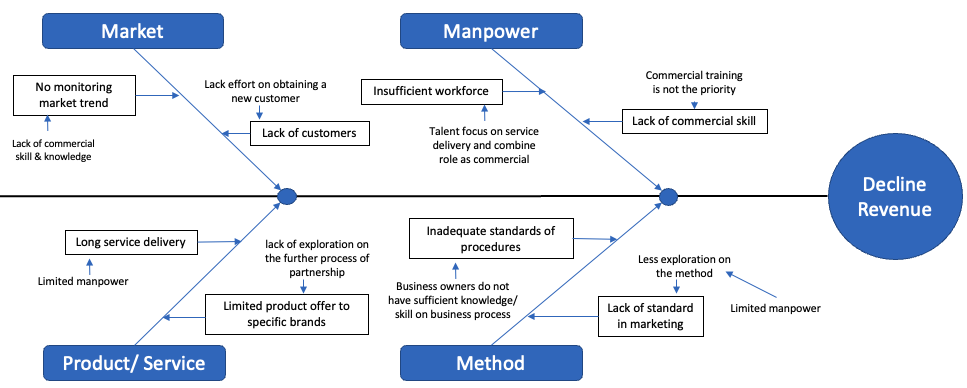
In the interview with business owners, there are possible causes of the declining revenue, including manpower, method, product and service, and the market (Figure 1). Manpower and standard operating procedures (SOPs) are crucial to running day-to-day business operations. PTIDM has five employees, including business owners, but their roles are not clear enough, and there are no standard procedures for business processes. Lack of commercial experience and knowledge among employees is one of the primary reasons for the inadequacy of SOPs. There is also a need for continuity in content posts or promotion, limiting the company's ability to remain competitive in the fast-paced market. The focus is still on selling products; the service only accounts for 20% of total revenue. However, the employees demonstrate a strong willingness to learn and support each other. The business owners want to recover revenue, grow the business by selling products and increase the capability of service offers. They recognize the need for more commercial knowledge and experience to achieve these goals.
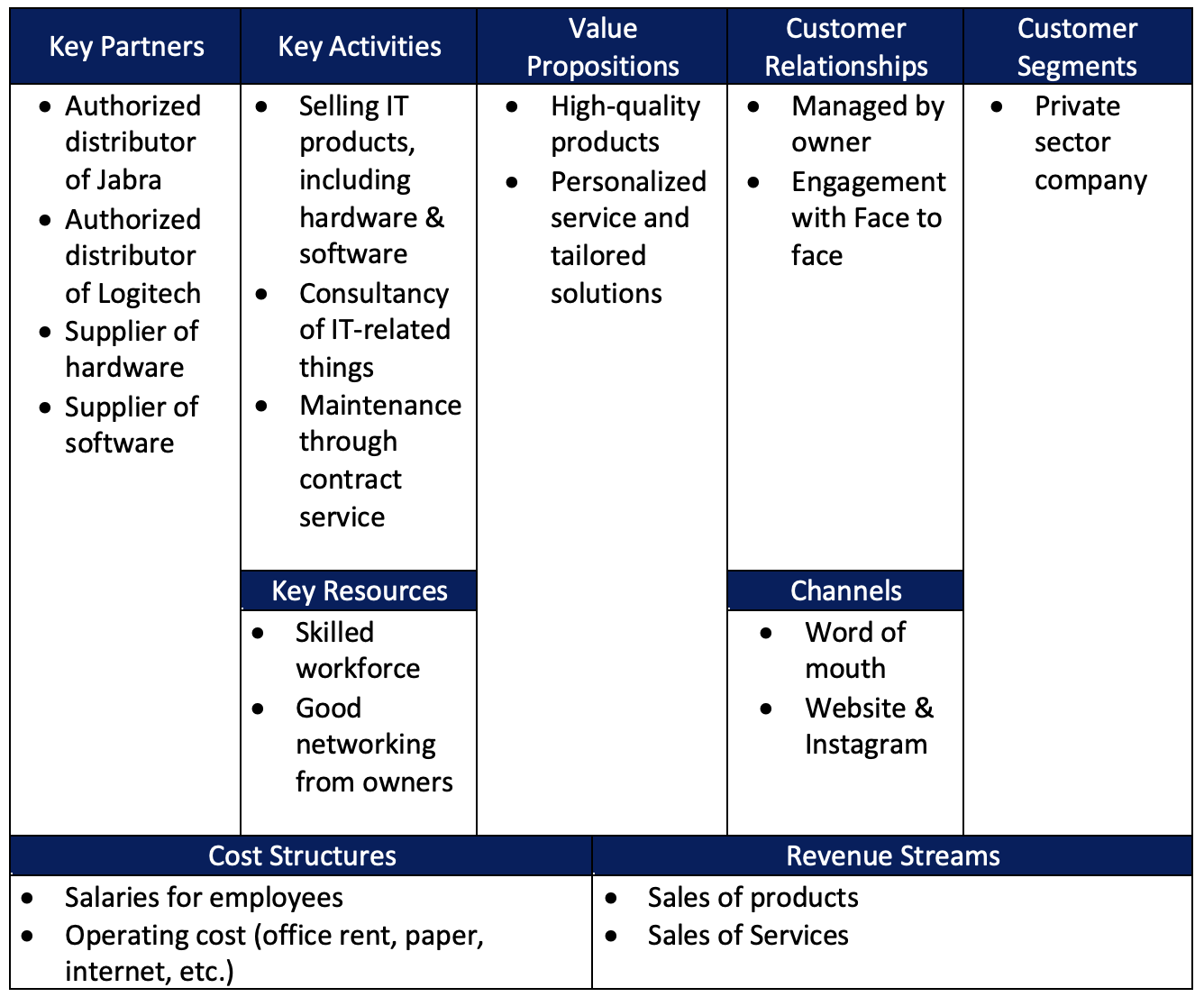
PTIDM operates as a sub-distributor of the main distributor for big IT hardware or software manufacturers and offers a range of products and services, including installation, maintenance, and repair, with a focus on high-quality products from reputable brands such as Apple, Dell, Jabra, and Logitech, while placing a strong emphasis on building strong relationships with customers and providing exceptional customer service. The existing BMC is captured in the Figure 2.
PTIDM's value proposition centers around providing high-quality products from reputable brands and personalized services tailored to meet each customer's unique needs. The company ensures product quality through careful selection and testing before sale and offers personalized consultations and post-sale support.
The customer segment is primarily private sector companies, but the owners express interest in exploring new segments. Word-of-mouth and digital marketing are used to reach potential customers, and the company places a high value on building strong customer relationships. Key resources include a skilled workforce and good networking, while key activities include selling IT products and offering expert consultancy and contract services. Key partnerships include Jabra and Logitech as authorized distributors, and the cost structure includes salaries and operating costs. The owner prioritizes keeping costs low, but the lack of marketing investment may limit the company's ability to attract new customers and keep up with competitors.
Figure 1: The fishbone analysis
Figure 2: The existing Business Model Canvas of PTIDM
The PEST analysys resulted that the business environment in Indonesia is shaped by various political factors, including government regulations and policies that impact the technology industry (Table 1). For PTIDM, compliance with data privacy and security regulations is crucial. The government's plan to develop Indonesia's information and communication technology infrastructure is expected to lead to potential opportunities for PTIDM to expand its business and attract new customers. Political stability in Indonesia has been improving, leading to an increase in foreign investment and a growing IT industry. Indonesia's economy has been growing steadily, presenting opportunities for companies in various sectors, including the IT industry, as businesses seek to improve their efficiency and productivity. The increasing trend of remote work and digital transformation presents an opportunity for PTIDM to provide IT solutions and services, such as cloud-based services and remote collaboration tools. Additionally, increasing awareness of cybersecurity's importance in Indonesia creates opportunities for PTIDM to offer security-related products and services. Rapid technological advancements pose a challenge for PTIDM to keep up with the latest products and services. Still, emerging technologies such as cloud computing and artificial intelligence present opportunities for PTIDM to offer innovative solutions to its customers.
Table 1: Regulations and policies that impact the technology industry
Factor
Description
Political
Political factors shape business environment in Indonesia
Government regulations affecting technology industry operations in Indonesia include: Peraturan Menteri Komunikasi dan Informatika No. 1 Tahun 2021; Peraturan Presiden No. 32 Tahun 2011 tentang Masterplan Percepatan dan Perluasan Pembangunan Ekonomi Indonesia (MP3EI); Undang-Undang No. 11 Tahun 2008 tentang Informasi dan Transaksi Elektronik (ITE Law)
Political stability essential for IT industry growth in Indonesia
Indonesia's ranking improved in Global Innovation Index report 2021 (WIPO 2021).
Economic
Indonesia's growing economy presents opportunities for the IT industry.
GDP growth rate projected to reach 5.5% in 2021 and 5.7% in 2022 (World Bank, 2021).
ICT sector's contribution to GDP increased from 4.0% in 2019 to 4.3% in 2020 (KOMINFO, 2021).
The number of internet users in Indonesia reached 196.7 million in 2020 (Mordor Intelligence, 2023).
E-commerce market in Indonesia valued at US$40 billion in 2020 with a growth rate of 21% expected from 2020 to 2025.
Social
COVID-19 pandemic has increased the demand for IT products and services (KOMINFO, 2021).
Remote work and digitalization trend has accelerated due to the pandemic
Cybersecurity is becoming a critical concern for companies in various sectors in Indonesia Gartner (2021).
The cybersecurity market in Indonesia is expected to grow significantly
The government has implemented initiatives and regulations to improve cybersecurity posture
Technological
IT development influences company development
Technology has changed the work system from typewriters to computers
Computers and internet have become necessities in doing business
There were 196 million internet users in Indonesia in 2020
Global IT spending expected to reach $4.2 trillion in 2021, with a 6.2% increase from previous year (KOMINFO, 2021)
Emerging technologies such as AI, cloud computing, and IoT can disrupt traditional business models and create new opportunities
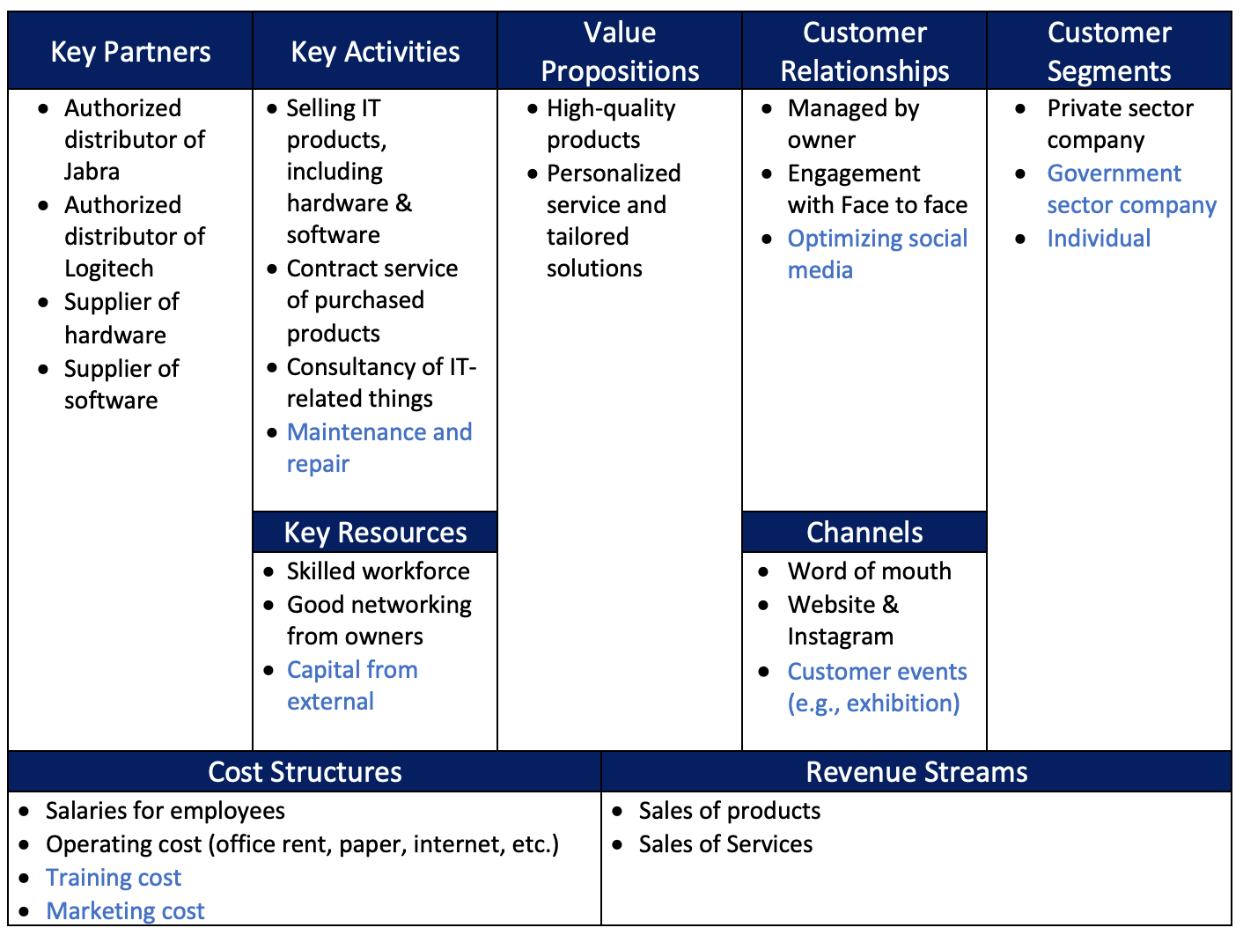
Figure 3: Proposed Business Model Canvas of PTIDM
After conducting a thorough analysis of PTIDM's internal and external environments, the author proposes a new business model canvas that leverages the company's capabilities and addresses its challenges to drive growth and success in the competitive the industry. The proposed BMC of PTIDM is presented as follows:
This study proposes additional elements to the existing business model canvas for PTIDM, including customer segments, customer relationships, channels, key resources, and cost structure. Two customer segments have been identified: government sector companies and individuals (Figure 3). The study highlights the importance of social media optimization to enhance customer relationships, while physical stores, e-commerce platforms, and social media are identified as the channels to reach out to customers. Additionally, external funding is deemed necessary for the company's growth and operations, and the company needs to invest in training and marketing efforts to maintain a skilled workforce, attract new customers, and generate revenue.
CONCLUSION
PTIDM's declining revenue may be attributed to its employees' need for clear roles and SOPs, limited marketing efforts, and a low emphasis on service offerings. However, the company strongly focuses on providing high-quality products and exceptional customer service, with key partnerships with reputable brands. The business environment in Indonesia is influenced by various political factors, including government regulations and policies that impact the technology industry. Nevertheless, the growing economy, increasing demand for IT products and services due to the COVID-19 pandemic, and emerging technologies such as AI and cloud computing present potential opportunities for PTIDM to expand its business and attract new customers. PTIDM must also consider the importance of cybersecurity and the need to keep up with rapid technological advancements to remain competitive in the IT industry. The proposed BMC emphasizes the importance of personalized services, social media optimization, and external funding to maintain a skilled workforce, attract new customers, and generate revenue. Also, the proposed BMC provides a comprehensive framework for PTIDM to achieve its goals and compete effectively in the dynamic IT industry. This study will provide insights and recommendations for other SMEs in the IT industry in Indonesia and other emerging markets facing similar challenges and opportunities.
REFERENCE
Ministry of Cooperatives and Small and Medium-Size Enterprises. Sandingan Data UMKM 2018–2019. 2019, https://kemenkopukm.go.id/uploads/laporan/1650868533_SANDINGAN_DATA_UMKM_2018-2019%20=.pdf.
Nursini, N. “Micro, Small, and Medium Enterprises (MSMEs) and Poverty Reduction: Empirical Evidence from Indonesia.” Development Studies Research, vol. 7, no. 1, 2020, pp. 153–166.
Coordinating Ministry for Economic Affairs. The Government Supports the Empowerment of MSMEs through Increasing the Portion of MSME Loans to Contribute Greater to the National Economy. February 2021, https://ekon.go.id/publikasi/detail/3680/the-government-supports-the-empowerment-of-msmes-through-increasing-the-portion-of-msme-loans-to-contribute-greater-to-the-national-economy.
Deloitte. Tech Trends 2021: The Edge of Transformation. 2021, https://www2.deloitte.com/content/dam/insights/articles/6730_TT-Landing-page/DI_2021-Tech-Trends.pdf.
Lazzaroni, P., and B. Pate. “The Skills Companies Need Most in 2020 – And How to Learn Them.” LinkedIn Learning Blog, 2020, https://www.linkedin.com/pulse/skills-companies-need-most-2020and-how-learn-them-lazzaroni-pate/.
Suroso, A., and A.I. Anggraeni. “Optimizing SMEs’ Business Performance through Human Capital Management.” 2017.
Ganesh, S., et al. “Impact of Training and Development on Employee Productivity and Profitability: A Case Study of Private Sector Banks in India.” Journal of Human Resources Management and Labor Studies, vol. 6, no. 1, 2018, pp. 11–26.
Prijadi, R., and P.M. Desiana. “Factors Affecting the Profitability and Growth of Small & Medium Enterprises (SMEs) in Indonesia.” International Journal of Economics & Management, vol. 11, 2017.
Tambunan, T.T. UMKM di Indonesia: Perkembangan, Kendala, dan Tantangan. Prenada Media, 2021. Wijaya, D. “The Dynamics of Indonesia's Economic Growth.” Journal of Applied Accounting and Taxation, vol. 1, no. 1, 2020, pp. 1–10.
Sarwoko, E., et al. “Entrepreneurial Characteristics and Competency as Determinants of Business Performance in SMEs.” IOSR Journal of Business and Management (IOSR-JBM), vol. 7, no. 3, 2013, pp. 31–38. https://doi.org/10.9790/487X-0733138.
Burger, N., et al. Reforming Policies for Small and Medium-Sized Enterprises in Indonesia. RAND Corporation, 2015.
Wheelen, T.L., et al. Strategic Management and Business Policy. 15th ed., Pearson, 2018.
Barney. Global Innovation Index 2021: Tracking Innovation through the COVID-19 Crisis. World Intellectual Property Organization, 2021.
License
Creative Commons Attribution-NonCommercial-NoDerivatives 4.0 International License
All papers should be submitted electronically. All submitted manuscripts must be original work that is not under submission at another journal or under consideration for publication in another form, such as a monograph or chapter of a book. Authors of submitted papers are obligated not to submit their paper for publication elsewhere until an editorial decision is rendered on their submission. Further, authors of accepted papers are prohibited from publishing the results in other publications that appear before the paper is published in the Journal unless they receive approval for doing so from the Editor-In-Chief.
Himalayan Journal of Economics and Business Management open access articles are licensed under a Creative Commons Attribution-Share A like 4.0 International License. This license lets the audience to give appropriate credit, provide a link to the license, and indicate if changes were made and if they remix, transform, or build upon the material, they must distribute contributions under the same license as the original.
Advertisement
Recommended Articles
Research Article
Influence of Leadership on Poverty Reduction in the Devolved Government in Trans-Nzoia County, Kenya
Kinisu Sifuna,
...
Peter Simotwo
Published: 30/06/2021
Download PDF
Cite
x
APA
Sifuna, K., Lwangale, D. W., Simotwo, P., Sifuna, K., Lwangale, D. W. & Simotwo, P. (2021). Influence of Leadership on Poverty Reduction in the Devolved Government in Trans-Nzoia County, Kenya. Himalayan Journal of Economics and Business Management, 2(1), None-None.
MLA
Sifuna, Kinisu, et al. "Influence of Leadership on Poverty Reduction in the Devolved Government in Trans-Nzoia County, Kenya." Himalayan Journal of Economics and Business Management 2.1 (2021): None-None.
Chicago
Sifuna, Kinisu, David W. Lwangale, Peter Simotwo, Kinisu Sifuna, David W. Lwangale and Peter Simotwo. "Influence of Leadership on Poverty Reduction in the Devolved Government in Trans-Nzoia County, Kenya." Himalayan Journal of Economics and Business Management 2, no. 1 (2021): None-None.
Harvard
Sifuna, K., Lwangale, D. W., Simotwo, P., Sifuna, K., Lwangale, D. W. and Simotwo, P. (2021) 'Influence of Leadership on Poverty Reduction in the Devolved Government in Trans-Nzoia County, Kenya' Himalayan Journal of Economics and Business Management 2(1), pp. None-None.
Vancouver
Sifuna K, Lwangale DW, Simotwo P, Sifuna K, Lwangale DW, Simotwo P. Influence of Leadership on Poverty Reduction in the Devolved Government in Trans-Nzoia County, Kenya. Himalayan Journal of Economics and Business Management. 2021 Jan;2(1):None-None.
Download PDF
Research Article
Modelling Structure Job Quality, Job Design and Job Satisfaction
Moch Nurhadi,
...
Avi Sunani
Published: 30/08/2022
Download PDF
Cite
x
APA
Nurhadi, M., Bisyri Effendi, M., Saiful Ulum, A. & Sunani, A. (2022). Modelling Structure Job Quality, Job Design and Job Satisfaction. Himalayan Journal of Economics and Business Management, 3(2), 1-4.
MLA
Nurhadi, Moch, et al. "Modelling Structure Job Quality, Job Design and Job Satisfaction." Himalayan Journal of Economics and Business Management 3.2 (2022): 1-4.
Chicago
Nurhadi, Moch, Moch Bisyri Effendi, Achmad Saiful Ulum and Avi Sunani. "Modelling Structure Job Quality, Job Design and Job Satisfaction." Himalayan Journal of Economics and Business Management 3, no. 2 (2022): 1-4.
Harvard
Nurhadi, M., Bisyri Effendi, M., Saiful Ulum, A. and Sunani, A. (2022) 'Modelling Structure Job Quality, Job Design and Job Satisfaction' Himalayan Journal of Economics and Business Management 3(2), pp. 1-4.
Vancouver
Nurhadi M, Bisyri Effendi M, Saiful Ulum A, Sunani A. Modelling Structure Job Quality, Job Design and Job Satisfaction. Himalayan Journal of Economics and Business Management. 2022 Jul;3(2):1-4.
Download PDF
Research Article
Accountability and Transparency of Village Fund Management in Lumajang District
Nurina Ayuningtiyas,
...
Muhammad Miqdad
Published: 28/12/2023
Download PDF
Cite
x
APA
Ayuningtiyas, N., Santosa Putra, H. & Miqdad, M. (2023). Accountability and Transparency of Village Fund Management in Lumajang District. Himalayan Journal of Economics and Business Management, 4(2), 1-4.
MLA
Ayuningtiyas, Nurina, Hendrawan Santosa Putra and Muhammad Miqdad. "Accountability and Transparency of Village Fund Management in Lumajang District." Himalayan Journal of Economics and Business Management 4.2 (2023): 1-4.
Chicago
Ayuningtiyas, Nurina, Hendrawan Santosa Putra and Muhammad Miqdad. "Accountability and Transparency of Village Fund Management in Lumajang District." Himalayan Journal of Economics and Business Management 4, no. 2 (2023): 1-4.
Harvard
Ayuningtiyas, N., Santosa Putra, H. and Miqdad, M. (2023) 'Accountability and Transparency of Village Fund Management in Lumajang District' Himalayan Journal of Economics and Business Management 4(2), pp. 1-4.
Vancouver
Ayuningtiyas N, Santosa Putra H, Miqdad M. Accountability and Transparency of Village Fund Management in Lumajang District. Himalayan Journal of Economics and Business Management. 2023 Jul;4(2):1-4.
Download PDF
Research Article
Proposed Digital Marketing Strategy to Enhance Engineering Consultancy Company Revenue
Alfarisy, K. A.,
Wandebori, H.
Published: 30/04/2024
Download PDF
Cite
x
APA
K. A., A. & H., W. (2024). Proposed Digital Marketing Strategy to Enhance Engineering Consultancy Company Revenue. Himalayan Journal of Economics and Business Management, 5(1), 1-18.
MLA
K. A., Alfarisy, and Wandebori, H.. "Proposed Digital Marketing Strategy to Enhance Engineering Consultancy Company Revenue." Himalayan Journal of Economics and Business Management 5.1 (2024): 1-18.
Chicago
K. A., Alfarisy, and Wandebori, H.. "Proposed Digital Marketing Strategy to Enhance Engineering Consultancy Company Revenue." Himalayan Journal of Economics and Business Management 5, no. 1 (2024): 1-18.
Harvard
K. A., A. and H., W. (2024) 'Proposed Digital Marketing Strategy to Enhance Engineering Consultancy Company Revenue' Himalayan Journal of Economics and Business Management 5(1), pp. 1-18.
Vancouver
K. A. A, H. W. Proposed Digital Marketing Strategy to Enhance Engineering Consultancy Company Revenue. Himalayan Journal of Economics and Business Management. 2024 Jan;5(1):1-18.
Prastika MNS., D. & Fachira, I. (2023). Business Strategy for Small IT Enterprises in Indonesia: A Case Study of PTIDM Using Business Model Canvas and PEST Analysis. Himalayan Journal of Economics and Business Management, 4(1), 1-5.
MLA
Prastika MNS., Deya and Ira Fachira. "Business Strategy for Small IT Enterprises in Indonesia: A Case Study of PTIDM Using Business Model Canvas and PEST Analysis." Himalayan Journal of Economics and Business Management 4.1 (2023): 1-5.
Chicago
Prastika MNS., Deya and Ira Fachira. "Business Strategy for Small IT Enterprises in Indonesia: A Case Study of PTIDM Using Business Model Canvas and PEST Analysis." Himalayan Journal of Economics and Business Management 4, no. 1 (2023): 1-5.
Harvard
Prastika MNS., D. and Fachira, I. (2023) 'Business Strategy for Small IT Enterprises in Indonesia: A Case Study of PTIDM Using Business Model Canvas and PEST Analysis' Himalayan Journal of Economics and Business Management 4(1), pp. 1-5.
Vancouver
Prastika MNS. D, Fachira I. Business Strategy for Small IT Enterprises in Indonesia: A Case Study of PTIDM Using Business Model Canvas and PEST Analysis. Himalayan Journal of Economics and Business Management. 2023 Jan;4(1):1-5.


 Download PDF
 Download XML