Contents
Download PDF
pdf Download XML
1303 Views
129 Downloads
Share this article
Research Article | Volume 4 Issue 1 (Jan-June, 2023) | Pages 1 - 6
The Effect of Job Stress and Rewards on Freelance Content Creators Job Satisfaction with Motivation as Mediating Factor
 ,
 ,
 ,
 ,
1
Faculty of Economics and Business, UniversitasTanjungpura, Pontianak, Indonesia
Under a Creative Commons license
Open Access
Received
Nov. 3, 2022
Revised
Dec. 9, 2022
Accepted
Jan. 19, 2023
Published
Jan. 29, 2023
Abstract

Due to society's demands and technological advancement, there has been a shift of changes in the world of work. This trend indicates the increased number of people selecting to become freelancers by leveraging social media and become to freelance content creator. On the other hand, freelancers may not be aware that they experience the same work-related emotions as regular employees, such as job stress, reward, motivation, and job satisfaction. This study aims to build and explore novel items seldom discovered in research, specifically freelance content creators. Since the professional trend of becoming a freelancer is in high demand, this study can serve as a benchmark for freelancers carrying out their work. Data were collected using a questionnaire from 227 respondents, and the results were analyzed using the Structural Equation Modeling (SEM) method with the assistance of AMOS 26 application software.

Keywords
INTRODUCTION

In this era of globalization, we are inseparable from the digital world, and Indonesia's digital economy is also proliferating. We cannot dispute that digital brings many changes so that it can facilitate all matters, including in the field of work. Digitalization transforms human management with various stages, i.e., the first stage is adapting the system to the physical input process into the digital strategy, and the next is the value-meaning system for internal and external customers [1]. Humans use their abilities and experiences to adapt to technology to make it easier to do their jobs. With these changes and developments, there are also many shifts in interpreting work. With rapidly advancing technology and the increasing effectiveness of business, understanding how creativity in employees must also develop in an increasingly digital setting is highly important for organizations [2]. Work can provide possibilities for self-realization and development, which can both contribute to a person's life experiences and help them satisfy the necessities of their day-to-day lives and their hopes and goals for the future.


Workplace stress is unavoidable in the working world and is experienced by workers regularly. People under much pressure at work may struggle with various issues, including the inability to relax or concentrate, making mistakes in thinking and decision-making, and feeling upset and irritated. According to Jawed, the factors contributing to work-related stress for employees include excessive work, pressure from seniors, ineffective communication, lack of recognition, an unbalanced grading system, a hostile working environment, and the failure to mark payments and other rewards properly. An essential driver of security in the workplace is the fulfillment of the needs of workers [3]


One of the techniques that a great number of businesses implement is the practice of giving recognition. Employee recognition is important in creating and managing effective and better human resource management [4]. Employees' contributions to company culture should be recognized as crucial to fostering open lines of communication [5].


According to the Central Statistics Agency, the number of Indonesians working part-time or as freelancers increased by 4.32 million, or 26 percent, in August 2020. Unlike full-time employees, freelancers do not have to shell out much money to move platforms so they can take advantage of more flexible scheduling options [6]. There's a good chance that freelancing will continue to gain popularity.


A Freelancer is different from a bound employee of a company; therefore, freelancers are free to complete additional work simultaneously for various individuals or companies unless contractually committed to working exclusively until a particular project is completed. The utilization of freelancers for the company can also provide many benefits, including maximizing employees' productivity and the company, streamlining hiring costs, and time flexibility for new and creative ideas. Freelance work deals on a project-by-project basis and neither the employer nor the employee is obligated to make any commitments beyond the scope of the project contract [7]. In addition, this digital world also provides many opportunities to create and create on available online platforms such as Youtube, Instagram, Tiktok, and other social media. This opportunity is very promising and has potential for the future, such as freelancers who take advantage of social media platforms, namely Influencers and Content Creators.


The choice of young people to become Freelance in the current era is related to the use of technology in the digital age, especially utilizing the available social media platforms. The decision among young people to become freelancers is undoubtedly connected to the utilization of technology in the digital era, especially the use of various social media platforms. The term "content creator" has been popular in recent years to represent technically inclined cultural producers who publish their work on different social media platforms, these individuals are typically motivated by an entrepreneurial spirit and a desire to establish their own "media brands"[8].


The term "Content Creator" refers to an individual who gathers information to create media like movies and images that will be shared extensively across social media platforms per the intended usage and terms of the agreement. Authenticity and an entrepreneurial spirit are necessities that can inspire content creators and provide them with a competitive edge in their business endeavors [9].


While freelancers should experience the same levels of stress, rewards, motivation, and pleasure in the workplace as their permanent counterparts, a paucity of studies specifically examines them. Most studies examine workers or permanent employees in a bound agency or organization. Furthermore, with the development of increasingly complex technologies, many people select social media to earn a living. Therefore, this research is intended to study the phenomenon of freelancers, and more specifically, freelance content creators.


Literature Review

Job Stress and Motivation: People who work independently are more likely to experience stress if their working environment is depressing, their work rhythm is inappropriate, if they have an abundance of problems, and if they are close to the deadline but have not been able to find inspiration. According to Vanchapo, job stress is an emotional state that arises due to a mismatch between the workload and the ability of a person to face all the pressures he receives. Stress at the workplace can diminish motivation, although that's a crucial element in getting things done, especially if there are specific outcomes to accomplish. Perceived job stress can cause a person to lose motivation. The following factors contribute to low motivation as a content creator or entrepreneur, namely, lack of strategy, a content plan, a to-do list, vibrant goals, and fear of failure.


  • H1: There is a significant effect of that job stress on motivation


Job Stress and Job Satisfaction 

Factors like if the work or content isn't to one's liking might add stress to the workplace and lower job satisfaction. Meanwhile, freelancers who feel satisfied with their work are more likely to adapt to their work and find themselves easily and comfortably doing content creation work. Riaz et al. [10] reported that job stress is a serious problem related to job satisfaction; this is evidenced by research that job stress negatively affects job satisfaction [11]. It implied that job stress negatively and significantly affects job satisfaction. According to Li, L [12], there is a negative correlation between job stress and work performance due to increased career stress and imbalances: 


  • H2: There is a negative effect of that job stress on job satisfaction


Rewards and Motivation

According to Pitts, a reward is a benefit from carrying out a duty, service or taking over all responsibilities. Chin-Ju [13] states that rewards can be money, attention, praise, or a combination of the two. Meanwhile, motivation is related to all efforts made by workers in pursuing an achievement, such as the success of creating content that will have an impact on getting rewards and recognition:


  • H3: There is a significant effect of that rewards on motivation


Rewards and Job Satisfaction

Job satisfaction is essential to create a comfortable work environment. [14] suggests that job satisfaction is when the workers' attitudes regarding their work result from their perception. The more people receive results, the more satisfied they will be. It is in accordance with what will be attained when success at work acquires results in the form of rewards since the less they receive in the way of outcomes, the less content they will be: 


  • H4: There is a significant effect of rewards on job satisfaction


Motivation and Job Satisfaction 

job motivation is indeed very influential on job satisfaction. job motivation is achieved by aligning one's needs, enthusiasm, and goals with the work that needs to be done in order to produce a good and appropriate outcome [15]. A person is said to have a sense of satisfaction when they feel pleasure while working due to work that has been going on in the past few days. Highly motivated workers also have a high level of passion for achieving their goals, which currently appears to translate into a sense of satisfaction in the content they generate. Herzberg's Theory of Motivation is based on the principle that job satisfaction and dissatisfaction have an independent relationship: 


  • H5: There is a significant effect of motivation on job satisfaction


Motivation Mediates Job Stress and Job Satisfaction

Freelancers may beat job stress, which, in turn, affects how satisfied they are with their work if they remain motivated. According to Sowmya and Panchanatham [16], employees who report higher levels of job satisfaction tend to be more productive, have higher levels of involvement and are less likely to resign from their positions than those who report lower levels of job satisfaction. Some factors that cause this relationship are career development, wage stress, and rewards [17].


  • H6: Relationship between job stress and the job satisfaction of employment is mediated by motivation


Motivation Mediates Rewards and Job Satisfaction

Offering equitable and practical rewards can motivate workers to perform better. Not only from the presence of motivation, companies also need to pay attention to employee job satisfaction. Every employee has a different quality of job satisfaction, in line with the goals and assessments he adheres to [18]:

 

  • H7: Relationship between reward and job satisfaction is mediated by motivation

MATERIALS AND METHODS

Measurement

Researchers employed non-probability sampling techniques, namely purposive sampling. The purpose of using purposive sampling is to determine the sample of a study that does require certain criteria so that the sample taken is by the purpose of the study. The data collected from the questionnaire were analyzed by Structural Equation Modeling (SEM) with the help of AMOS 26 software.


Sampling and Data Collection

The term "population" is used to refer to the sum of all subjects of research. Meanwhile, the sample is a subset of the population assigned as a research subject since it is thought to represent the whole accurately. This research was conducted in West Kalimantan, and the population was freelance content creators working in various fields according to their expertise.


Data Analysis

This research uses Structural Equation Modeling (SEM) in conjunction with AMOS 26. The fit test model assessed based on goodness of fit index parameters such as chi-square (χ2), CMIN/DF, Root Mean Square Error of Approximation (RMSEA), root mean squared residual (RMR), goodness of fit index (GFI), Tucker Lewis Index (TLI), Incremental Fit Index (IFI), Comparative Fit Index (CFI), and Normed Fit Index (NFI). The validity evaluation relied on the value of the standardized loading factor (SLF) whose value must be ≥0.50, and the construct reliability relied on the results of tabulation of construct reliability (CR) and average variance extracted (AVE) values. Furthermore, the SEM analysis carried out is the analysis of structural models to assess the research hypotheses that have been built and whether they are accepted or rejected.

RESULTS

Respondent Characteristics

In the study results (Table 1), respondents' characteristics were based from content creator.


Measurement and Structural Models

The results of goodness of fit, validity, and reliability tests can be described as follow:


Table 2 shows that the entire model has loading factors greater than 0.50 on all elements. It indicates that all items comprising variable values (job stress, reward, motivation, and job satisfaction) are thought to be valid and are alleged to be appropriate in measuring the construct validity. In addition to this, reliability tests produce outcomes that are suitable and consistent. All items in the value of job stress, reward, motivation, and job satisfaction are also considered reliable and consistently measure the whole construct model. This is evident from the variance extract (VE) value, which has a value greater than 0.50, and the construct reliability (CR) value, which has a value greater than 0.70.


Table 1: Characteristics of Respondents

Category

Items

F

%

Gender

Man

106

46.2

Woman

121

53.8


Total

227

100

Age

20-24 years old

171

74

25–29 years old

More than 30 years old

37

19

16.6

9.4


Total

227

100

Creator content field

Video

92

40.5

Photograph

105

46.2

Writing  

12

5.3

Others

18

8


Total

227

100

Income

<IDR 2,000,000

137

60.3

IDR 2,000,000–4,000,000

57

25.2

IDR 4,000,0008,000,000

25

11

>IDR 8,000,000

8

3.5


Total

227

100


Table 2: Measurement Model Results

ParametersItemsFactorLoadingCRVE
Job StressThere was not enough time for me to do everything properly0.840.970.84
Non-settled salary depending on the availability of the job taken0.84
I sometimes can't finish the work according to the specified deadline0.85
 Clients use enough pressure to make the assignment unpleasant to complete0.85
Taking care of multiple obligations at once due to overlap in due dates0.84
I experience burnout, lack of skill, and lack of concentration when creating too much content0.86
Communication between me and the client about the work is well established0.84
My client doesn't provide instructions clearly so there are a lot of revisions in the content creation0.82
I feel that the plans and objectives of my work direction are sometimes unclear and unstructured0.82

Reward


The results of my content are used as agreed upon0.840.980.86
The reward for maintaining the copyright terms that were agreed upon is the content that I generated0.89
My career is on the rise and is renowned for its good and inspiring content0.86
Clients appreciate the content I produce0.86
The content I created received a positive response when it was disseminated0.90
My clients have a positive reaction to my ideals and skills because of the talent I possess.0.84
I get paid according to the agreement0.85
I get equipment for work needs as a bonus0.84
I get extra money0.87
MotivationI enjoy the satisfaction of a difficult content creation solution0.870.980.87
I'm motivated when creating content that's different from others0.88
I create great content so that more clients want to work together0.88
I enjoy the responsibility of creating content0.88
Clients are satisfied when the content created is good and appropriate0.87
I am motivated when clients notice creative ideas that I initiate0.88
I build good relationships with clients0.87
I'm more excited when I have positive ideas from other creator friends0.88
I collaborate with other content creators.0.84
Job SatisfactionSatisfaction with an appreciation for work or content that has been created0.870.970.84
The amount of salary and employment as expected0.87
The praise I receive whenever my work is well received0.85
creating content according to my creativity 0.86
Freedom to vary in doing content creation work0.88
Utilizing trends in creativity in content creation0.86
A feeling of satisfaction when the work is done well0.87
Comfortable conditions for working anywhere0.68
The mood at work supports the work situation0.78


Table 3: Goodness of Fit Index

Goodness of Fit Index

Cut off Value

Results

χ2-Significance Probability

≥0.05

0.000

CMIN/DF

≤3.00 pm

2.438

RMSEA

≤0.08

0.080

RMR

<0.05

0.021

IFI

≥0.90

0.943

TLI

≥0.90

0.939

CFI

≥0.90

0.943

NFI

≥0.90

0.908


Table 4:  Hypothesis Testing

ItemsStd Estimate

S.E.

C.R.

p-valuesDescription

Job Stress

--->

Motivation

0.476

0.072

6.588

***

Accepted

Reward

--->

Motivation

0.560

0.062

9.064

***

Accepted

Motivation

--->

Job Satisfaction

0.209

0.099

2.107

0.035

Accepted

Job Stress

--->

Job Satisfaction

-0.206

0.073

-2.824

0.005

Accepted

Reward

--->

Job Satisfaction

0.949

0.083

11.460

***

Accepted


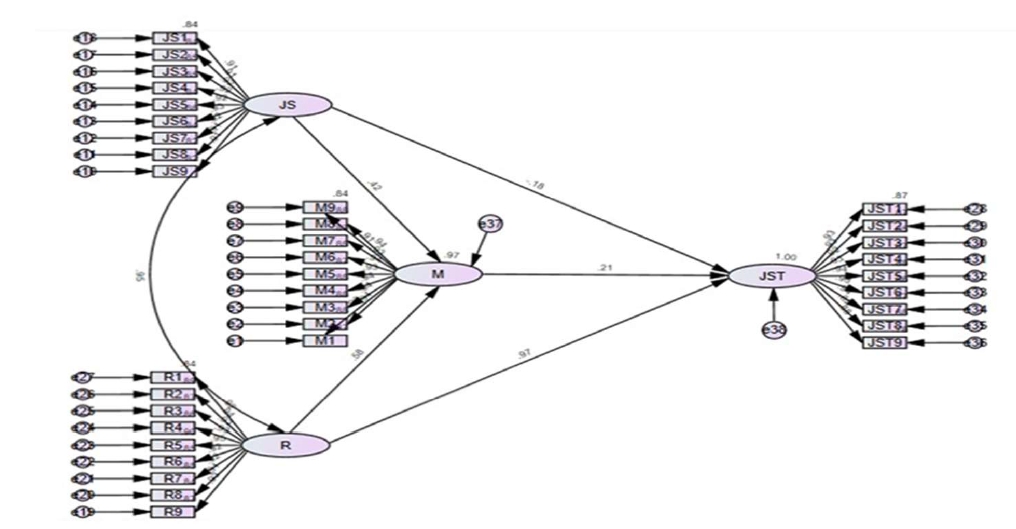
Table 3 presents the result Measurement of the goodness of fit (GOF). It showed that the result from the Conformity requirement is accepted. Six measurements demonstrate an index Match that is satisfactory and adequate. These Data Results exist. The degree of fit can be obtained by setting CMIN/DF = 2.438 (3.00) and RMSEA = 0.080 (0.08). In addition. The results indicated appropriate obtain value above 0.90. So that get stated the model, fit is accepted.


Hypotheses Testing

The test results of the causal relationship between variables in the present research construct are as follows.


Figure 1 and Table 4 showed that the t-test value for the variable job stress and motivation obtained a number that was greater than 6.588, which indicated it was greater than the t-table value of 1.96. Likewise, the p-value received a number less than 0.001, indicating a value  less than 0.05 (α = 0.05). It implied that the hypothesis is accepted and that job stress has a significant effect on motivation. In addition, the result of the t-test value for the reward and motivation was 9.064, and the p-value was less than 0.001. It indicated that there is a positive effect of reward on motivation. Moreover, the t-test value for the motivation and job satisfaction variable is 2.107, and the corresponding p-value is 0.035, indicating a statistically significant positive effect of motivation and job satisfaction. Lastly, for the impact of job stress on job satisfaction, the t-score was -2.824, and the p-value was 0.005


Furthermore, the indirect impacts of the mediating variables are presented in Table 5, which contains the Sobel test results.


The results show that the t-Sobel value obtains a good and fit value for it to mediate between these variables. It implied that the motivation variable is acting as a mediating variable in facilitating the influence of the job stress and job satisfaction variable. Similarly, motivation variables operate as a mediating factor between reward and job satisfaction.


Table 5: Sobel Test-Significance of Mediation

ItemsSobel test statisticsTwo-tailed probabilityDescription
Job Stress         --->Motivation ---> Job Satisfaction2.0110.04431856Accepted
Reward             --->Motivation ---> Job Satisfaction2.0550.03981083Accepted


Figure 1: Full Model Structural Test

DISCUSSION

Referring to the statistical result of the first hypothesis, it revealed that there is positive and significant effect of job stress on the motivation of freelancers in West Kalimantan. It contradicts the findings of research conducted by Fong and Mahfar [19] and Qureshi [20], who found that stress at work has a detrimental effect on motivation, which generates a gap in this research. The researchers believed that freelancers are different from permanent workers. Even though they are dealing with job stress because professionalism needs to be prioritized, freelancers still need to increase their motivation because they have goals and agreements related to their work. 


The second hypothesis can be summarized as follows: job stress has a negative impact on job satisfaction. When freelancers have a high level of stress, they will report lower levels of work satisfaction; this finding is consistent with previous research [10]. 


The third hypothesis demonstrates a significant effect of rewards on motivation. One of the motivations that a freelancer can be increased when the outcomes of his content are favorably responded to. This result is in line with the previous research [21-23]. 


The fourth hypothesis shows the result that rewards have a significant effect on job satisfaction. It is because a freelancer will feel satisfied when he gets an award and feel more valued. The findings supported the previous research [13]. 


The fifth hypothesis showed a significant effect of motivation on job satisfaction. When a freelance content creator is highly motivated, it will impact with enthusiasm in developing good content. Furthermore, content that is responded to favorably by clients will increase job satisfaction. This hypothesis is also in accordance with preceding research. 


The sixth hypothesis revealed that there is a relationship between job stress and job satisfaction of; employment is mediated by motivation. It follows research conducted by Basalamah, M. S. A. and As'ad, A. [24]. 


The seventh hypothesis revealed that a relationship between reward and job satisfaction is mediated by motivation. It is in line with the previous research [25].

CONCLUSION

Numerous factors in the world of work have the potential to impact a worker, such as the variables that have been researched. These factors include job stress, rewards, motivation, and job satisfaction. Freelancers who have high job satisfaction will have a good impact on their professionalism. 


Having innovative ideas is also beneficial for clients who use the services of freelancers to contribute to the development of the business world. Occasionally, businesses require a workforce with specialized skills or skills that permanent workers cannot meet. Therefore, freelancers can provide this type of workforce for these companies.


Obviously, a reward is necessary for workers as it impacts job satisfaction, which affects the worker's motivation level. This study revealed that job stress negatively impacts job satisfaction; therefore, to overcome this obstacle, a good strategy response is required. Some ideas can be selecting content according to time or self-creativity, consistently communicating well with clients, and making appropriate targets when creating the content.


All of the data, beginning with the goodness-of-fit index, yielded results suggesting that all variables were measured using an appropriate index. In addition, the outcomes of the hypothesis testing and the Sobel testing both are fit, and the relationships between the variables affect one another, with a particularly detrimental impact on the relationships between job stress and job satisfaction. The effects of job stress on workplace motivation differ from those of previous studies, and it was found to be a research gap. It implied that freelancers can learn to disregard the negative effects of stress at work and instead use that pressure to propel them forward in order to fulfill their prescribed obligations and produce high-quality material despite their precarious situation.


The scope of this study is restricted to West Kalimantan, Indonesia, and its focus is on independent content creators. It is expected that future research will be conducted regarding other variables linked to freelancers and content creators to obtain different research results. The findings of this study have important implications for acquiring additional information in the process of becoming a freelancer or working with freelancers. In addition, the findings of this study can serve as a reference for future research that can be used to apply and develop new knowledge in the field of freelance content creators


Acknowledgement

I would like to express our gratitude to the Management study program, and the Faculty of Economics and Business at Universitas Tanjungpura for their assistance in the publication of this journal

REFERENCE
  1. Blštáková, J. et al. “Reflection of digitalization on business values: The results of examining values of people management in a digital age.” Sustainability, vol. 12, no. 12, 2020, p. 5202.

  2. Arthur, W.B. Complexity and the economy. Oxford University Press, 2014.

  3. Wheatley, D. “Employee satisfaction and use of flexible working arrangements.” Work, Employment and Society, vol. 31, no. 4, 2017, pp. 567–585.

  4. Cannon, M. Employee recognition: Understanding the construct, its measurement and its relationship to employee outcomes. 2015.

  5. Saunderson, R. “Survey findings of the effectiveness of employee recognition in the public sector.” Public Personnel Management, vol. 33, no. 3, 2004, pp. 255–275.

  6. Kuhn, K.M. “The rise of the ‘gig economy’ and implications for understanding work and workers.” Industrial and Organizational Psychology, vol. 9, no. 1, 2016, pp. 157–162.

  7. Wood, A. and V. Lehdonvirta. “Platform labour and structured antagonism: Understanding the origins of protest in the gig economy.” SSRN, 2019, paper no. 3357804.

  8. Cunningham, S. and D. Craig. “Creator governance in social media entertainment.” Social Media + Society, vol. 5, no. 4, 2019, pp. 2056305119883428.

  9. Duffy, B.E., and E. Hund. “‘Having it all’ on social media: Entrepreneurial femininity and self-branding among fashion bloggers.” Social Media + Society, vol. 1, no. 2, 2015, p. 2056305115604337.

  10. Riaz et al. “The impact of job stress on employee job satisfaction.” International Review of Management and Business Research, 2016.

  11. Trivellas, P. et al. “The effect of job-related stress on employees’ satisfaction: A survey in health care.” Procedia – Social and Behavioral Sciences, vol. 73, 2013, pp. 718–726.

  12. Li, L. et al. “Work stress, work motivation and their effects on job satisfaction in community health workers: A cross-sectional survey in China.” BMJ Open, vol. 4, no. 6, 2014, pp. e004897.

  13. Sajuyigbe, A.S. et al. “Impact of reward on employees’ performance in selected manufacturing companies in Ibadan, Oyo State, Nigeria.” 2013.

  14. Ivancevich, J.M. and M.T. Matteson. Organizational behavior and management. 2nd ed., 1990.

  15. Stoyanov, S. An analysis of Abraham Maslow’s “A theory of human motivation”. Macat Library, 2017.

  16. Sowmya, K.R. and N. Panchanatham. “Factors influencing job satisfaction of banking sector employees in Chennai, India.” Journal of Law and Conflict Resolution, vol. 3, no. 5, 2011, pp. 76–79.

  17. Khan, M. and H.T. Mansoor. “Factors influencing motivation level of academic staff in the education sector of Pakistan.” Global Journal of Human Resource Management, vol. 1, no. 1, 2013, pp. 41–48.

  18. Kanfer, R. “Work motivation: Theory, practice, and future directions.” 2012.

  19. Fong, Y.L. and M. Mahfar. “Relationship between occupational stress and turnover intention among employees in a furniture manufacturing company in Selangor.” Journal of Technology (Sciences and Engineering), 2013.

  20. Qureshi, S. “The relationship between work motivation, burnout and intention to leave for top-level managers of the garment industry: A case study of the Indian garment industry.” International Journal of Human Resource Studies, vol. 3, no. 4, 2013, pp. 128.

  21. Robbins, S.P. Organizational behaviour. Prentice Hall International, 2001.

  22. Richter, G. et al. “Studying gamification: The effect of rewards and incentives on motivation.” Gamification in Education and Business, Springer, 2015, pp. 21–46.

  23. Loke, S.P. et al. “The impact of rewards and motivation on job satisfaction in the water utility industry.” International Conference on Financial Management and Economics, IPEDR, vol. 11, 2011, pp. 35–41.

  24. Basalamah, M.S.A., and A. As’ad. “The role of work motivation and work environment in improving job satisfaction.” Golden Ratio of Human Resource Management, vol. 1, no. 2, 2021, pp. 94–103.

  25. Jehanzeb, K. et al. “Impact of rewards and motivation on job satisfaction in the banking sector of Saudi Arabia.” International Journal of Business and Social Science, 2012

License
CC BY-NC-ND
Creative Commons Attribution-NonCommercial-NoDerivatives 4.0 International License
The Effect of Job Stress and Rewards on Freelance Content Creators Job Satisfaction with Motivation as Mediating Factor © 2026 by Tasya Rabiatu Alviah, Heriyadi, Ilzar Daud, Nurul Komari, Endah Mayasari licensed under CC BY-NC-ND 4.0
All papers should be submitted electronically. All submitted manuscripts must be original work that is not under submission at another journal or under consideration for publication in another form, such as a monograph or chapter of a book. Authors of submitted papers are obligated not to submit their paper for publication elsewhere until an editorial decision is rendered on their submission. Further, authors of accepted papers are prohibited from publishing the results in other publications that appear before the paper is published in the Journal unless they receive approval for doing so from the Editor-In-Chief.
Himalayan Journal of Economics and Business Management open access articles are licensed under a Creative Commons Attribution-Share A like 4.0 International License. This license lets the audience to give appropriate credit, provide a link to the license, and indicate if changes were made and if they remix, transform, or build upon the material, they must distribute contributions under the same license as the original.
Advertisement
Recommended Articles
Research Article
Influence of Leadership on Poverty Reduction in the Devolved Government in Trans-Nzoia County, Kenya
...
Published: 30/06/2021
Download PDF
Research Article
The impact of organizational flexibility on improving institutional performance in Iraqi business organizations
Published: 22/01/2026
Download PDF
Research Article
Modelling Structure Job Quality, Job Design and Job Satisfaction
...
Published: 30/08/2022
Download PDF
Research Article
Accountability and Transparency of Village Fund Management in Lumajang District
...
Published: 28/12/2023
Download PDF
Chat on WhatsApp
Flowbite Logo
Najmal Complex,
Opposite Farwaniya,
Kuwait.
Email: kuwait@iarcon.org

Editorial Office:
J.L Bhavan, Near Radison Blu Hotel,
Jalukbari, Guwahati-India
Useful Links
Order Hard Copy
Privacy policy
Terms and Conditions
Refund Policy
Others
About Us
Team Members
Contact Us
Online Payments
Join as Editor
Join as Reviewer
Subscribe to our Newsletter
Follow us
MOST SEARCHED KEYWORDS
scientific journal
 | 
business journal
 | 
medical journals
 | 
Scientific Journals
 | 
Academic Publisher
 | 
Peer-reviewed Journals
 | 
Open Access Journals
 | 
Impact Factor
 | 
Indexing Services
 | 
Journal Citation Reports
 | 
Publication Process
 | 
Impact factor of journals
 | 
Finding reputable journals for publication
 | 
Submitting a manuscript for publication
 | 
Copyright and licensing of published papers
 | 
Writing an abstract for a research paper
 | 
Manuscript formatting guidelines
 | 
Promoting published research
 | 
Publication in high-impact journals
Copyright © iARCON Internaltional LLP . All Rights Reserved.