Fire, if controlled, is a very important object in school community, it is used in many areas in school organization; kitchen e.g. cooking food for students, labs e.g. Bunsen burner, and in instructions` workshops e.g. Fire baths for forging, soldering and welding and burning of rubbish; generally controlled fire help in the learning of students while uncontrolled fire is very dangerous and has its effects. The study surveyed the effects of fire in schools that lead to solutions. Survey of causes of school arsons will help community, the school management and the Ministry of Education get solution to schools` burning. The purpose of the study was to find out the causes of fires and remedies. The study Sought to establish the following objective: to make known probable causes of fires, and to open way for opportunity to study fires in related academic discipline. The study was conducted in four, randomly selected; public secondary schools in Homa Bay County, that were affected by fire and four secondary schools that never had fire problem. The study used Survey Research Design. The study population were principals, teachers, students and watchmen in those secondary schools. Interview was given at random, selection for a principal, 23 teachers, 47 selected students and 2 watchmen in each of the 8 secondary schools randomly selected in Homa Bay County. Questionnaires were given to the rest respondents. Survey research was used to analyze data. Findings and recommendations will assist educational stakeholders in Kenya such as the Ministry of Education, the Kenya Institute of Curriculum Development, Curriculum developers and teachers. The study discovered ways of controlling fires, show importance of fires and open way forward to study fire as one of the safety regulations especially in Sciences and Engineering. The knowledge will differentiate and categorize the kind of status of school fires.
Keywords
: Jobs
Company
Sells
Online Sales
INTRODUCTION
Fires in schools, which are the concern, are of two types, namely controlled fires and uncontrolled fires. Controlled fires in schools may have its benefits and advantages that can promote academic excellence and development in technology education hence Development in Education unlike uncontrolled fires that may exist whose sources and causes are not known. Controlled fires have benefits and are budgeted for, while uncontrolled fires are not budgeted for; that even as they occur in schools; they accidentally come out with a lot of brainstorming, and confusions.
According to National Research Crime Centre, the Education sector in Kenya is an important pillar in the realization of the objectives of Vision 2030 with regard to the attainment of socio-economic and political development of the country. The Education sector has in the recent years been witnessing unusual student unrest and violence at the secondary school level. This often has caused interrupted school learning programs, loss of human life in some cases and massive destruction of school properties as well as students ‘belongings.
According to NRCC, incidences of student protest actions and violence in Kenyan secondary schools have been perennial and could be traced as far back as the beginning of the 20th Century when the first case was reported at Maseno school in 1908. The 1960s- 1970s periods recorded few student protests actions that were less violent and which took the form of boycott of classes, mass walk -outs and simple protests. The period from 1980s through to 2000s saw an increase in both the frequency and intensity of students’ protests. Student protest became acts of deadly violence targeting other students rather than more generalized protests against school conditions. The late 1990s and early 2000s were marked by violent protest by students that often resulted in catastrophic school fires, rape, and loss of student lives and destruction of school property. The most unfortunate of these incidents were, The July 1991 in which male students at St. Kizito Mixed Secondary School violently attacked their female students and set their dormitory on fire where over seventy girls were raped and nineteen killed. In May 1997, twenty- six female students at Bomb lulu Girls secondary school died in a dormitory fire suspected to be an act of arson by fellow students. In March 1999, students from Nyeri Boys High School locked up four prefects in their cubicle and burnt them up with petrol. In May 2001, a fire set by students at Kyan Guli secondary school in Machakos killed sixty seven students (Two more schools hit Kenya as crisis talks expected, tuko.co.ke.). These schools’ unrests have received national attention and condemnation. There has also been concerted efforts and discussions among different stakeholders in the education sector in trying to find lasting solutions to this problem. The Ministry of Education officials have often condemned student violence, indiscipline and juvenile hooliganism cases stating that the wanton destruction of school property will not be tolerated.
The government‘s response through the Ministry of Education has been the appointment of committees of Inquiry /Task Forces whenever student unrests and violence occur in unprecedented scale. These committees of inquiry and task forces often are mandated to look into the issues of student unrests and other educational matters in Kenya. They include: National Committee on Educational Objectives and Policies of 1976, Report on Education and Manpower Training for the Next Decade and Beyond, Dr. Lawrence Sagini Committee/Task Force, Nicodemus Kirima, and David Koech Committee/Task Force. It has been also a national disaster on the whole as well towards burning of schools and learning institutions in the nation at points. Schools and other learning institutions are manufacturing industries of better performance Termly/semester evaluation and summative evaluation of curriculum. Better performance is possible when the objectives of the content of curriculum are achieved through syllabus coverage in time without accidental barriers like uncontrolled fires. Questions arise to be answered, whose solutions are to be searched, if they are not to be taken for granted in as pertains the fields of opportunity of the need to advance, study, do research and come up with developing solutions in discoveries. Arson attacks in secondary schools with reference to commissions of education recommendations, KICD duties and Dr. Julius Nyerere declaration of 1985, is a problem to be defined (is something in question) from sources. The above are key founder of education system that streamlined recommended actions of conduct of leaning theories and objectives used in education to an extent to date. According to Shiundu and Omulando [1], Ominde commission report of 1965 stated that Education system should be organized, promote National Development and its role is manpower development. The duties of KICD briefly is to design, try, test and approve Education curriculum and ensure correct methods are applied in syllabus coverage while the duties of Chief Inspector of Schools and Quality Assurance briefly are to inspect schools by finding out whether correct guiding principles are followed in learning and direct ways of bringing down arsonist to an end, it is in question that no effective action towards arson has been noticed by the authorities. Dr. Julius Nyerere declaration stated what Education system should do and its purpose, He launched in 1967 Education for Self-Reliance. The key concepts of the declaration are: -preparation of young people, their participation in societies ‘maintenance and development, but not arsonists, joining terrorist groups nor represent any of them in learning institutions. And the Mackay Commission Report received present Education system for National development. Mackay a Canadian, Prof. at chairmanship of commission of presidential working party proved second university in Kenya. The Mackay commission recommended ILO mission, and The Gachathi Report also recommended restructuring of Education system; p.265, to new structure of Education 8-4-4- system, 8 years primary, 4 years secondary, and 4 years university, thus improving curriculum content for national development and participation of the youths in development. Mackay report also in 1982, recommended 8-4-4 system of education to meet challenges of national development and promote participation of youths in national development.
The Problem
According to National Crime Research Centre, 2016, nearly every year, in second term, there have been problems of burning of schools. There have been reports from the Daily Nation News Papers, Teachers ‘Association and religious leaders about the burning of schools that needs investigations. Students’ unrest and strikes have been perennial occurrences in Kenya, resulting in wanton destruction of school property and loss of life. There have been various efforts to address this phenomenon. In another incident, according to Muchui D. et al. dormitories and labs of the following secondary schools:
Atela secondary school
Homa Bay Boys Secondary school
Bishop Mogendi secondary school
Sindo Girls Moi Suba secondary school
Jonyo Mixed Secondary school
Wangapala secondary school
Adega secondary school
Nyamanga Mixed secondary school
Samanga Mixed Secondary school
Kandiege secondary school
Oriwo Secondary school
Gendia secondary school
In Homa Bay County were brought down by fire. According to Mabel W. over 120 Secondary schools in the Nation have been brought down by fire between June and July 2016. According to Karanja F., of Nation News, actions by the government to arrest, and take the arsonist to custody and prosecute them lead to custodial orders with probe teams formed to follow up links that could lead to the revelation of more information of arson and their age. The students, who take part in arson cases, setting school dormitory or any other building on fire, leave other students with / without injuries; usually majority are minors below eighteen years. This makes prosecutor to apply for custodial orders to allow probe team to follow links of arson.
Investigations to arsons are complex, incomplete, and involve young ones who are both victims and suspects hence take long time. In the custody, the lives of the students are subjected to poor, dirty and discomforting environment that makes the students` lives sink down from classroom environment. The cell life makes the students cohabit with people of different offences of street children with no hope. Complications always arise in the court for the arson case involving secondary students- (Adult law court/children law court) before investigations of the age is done.
According to Okwany R. of Nation News, at the Kessha-Kenya secondary school heads Association annual general meeting attended by education officials, teachers enquired and sought ways on how to control arson in schools. Teachers complain that dealing with unruly students is increasingly difficult and proposed return to corporal punishment on students as they are heavily protected by the law. The basic Education act, section 30 out-laws physical punishment and mental harassment and prescribes a fine not exceeding sh.1 000 000 or six months ‘imprisonment for offenders. Most students are below 18 years and when presented in courts of law, they are categorized under minors. This ``below age, slows down punishment. According to news media in 2016 about 114 schools were burnt in one of the worst outbreaks of arson in the shortest time, therefore this calls for need to still investigate further arson in learning institutions in Homa Bay County Kenya as this seems to approach National disaster. This study therefore proposes to investigate the causes and effects of arson to secondary schools in Homa Bay County.
Purpose of the Study
The main purpose of the study was to investigate the causes of arson to secondary schools in Homa Bay County, Kenya.
Objectives of the Study
To find out causes of burning of secondary schools in Homa Bay County.
Theoretical Framework
This study was guided by Problem Analysis Triangle; the theory, The Crime Triangle which was postulated by Lawrence Cohen and Marcus Fuson. The theory put in place the directive of thoughts about recurring problems of crime and disorder, and as according to this, in second term, many school fires in secondary schools in Homa Bay County; Kenya, took place. The problem solution Triangle, assumes that crime or disorder results when:
Likely Offenders
Suitable Target come together in
Time and Space at the absence of the capable guardians for the target
It further states that, offenders can be controlled by other people; and such people are known as Handlers. Targets and victims can be protected by other people, and such people are Guardians. Places are usually controlled by someone and that person is called the Manager. As a result, solutions to problems efficiently call for understanding on how offenders and their targets/victims come together in places and understanding how the offenders, targets/victims, and places are or are not effectively controlled.
MATERIALS AND METHODS
Research Design
Descriptive survey research design was used in this research. Descriptive survey design was used in collecting information by interviewing to sample of individuals. It involved measurement, classification, analysis, comparison, and interpretation of data. The design was chosen because it provided information on attitudes, opinions, tragedies, suggestions for burning of secondary schools in Homa Bay County.
Study Population
The population used in this study were principals of secondary schools, teachers, and students of secondary schools in Homa Bay county. This comprised of 8 secondary schools randomly selected giving eight principals purposively selected, 16 watchmen purposively selected, 348 teachers and 6100 students. The population of teachers and students were got from school records . Homa Bay county has 318 secondary schools, 2, 963 teachers, 41,678 girls’ secondary schools and 48,728 boys’ secondary schools giving a total of 90 406 secondary students in Homa Bay county. Four schools affected by fire and four schools not affected by fire were randomly selected.
Sampling Procedure and Sample Size
Sample size consisting of total of eight secondary schools were randomly selected for the study. Sample size of teachers and students were taken due to their large numbers using Fisher et al. Yamane formula giving 47 students and 23 teachers from each of the eight schools. The final sample size of eight secondary schools consisted of 8 principals, purposively selected, 16 watchmen, purposively selected, 186 teachers and 375 students.
Data Collection Instruments
The research instruments that were used to collect information were questionnaire and an interview schedule. The research instruments were administered to the respondents by the researcher himself. A covering letter introducing the study was attached to the research instruments. Questionnaires were preferred because they could gather data quickly from geographically dispersed sample.
Validity and Reliability of Research Instruments
Validity: Validity refers to the correctness, true and soundness of the results of conclusion reached in the study, the content selected and included in the research tools must be relevant to the variable being investigated for it to pass the validity test [2]. The researcher discussed the items in the instruments with the lecturers from the department. Content validity was determined through questionnaire for different groups in which responses of the participants in piloting were checked against research objectives to ensure questionnaires were clear to respondents.
Reliability
Reliability is the ability of the tools to return the same responses after administration. This is concerned with the degree to which a particular measuring procedure gives similar results over a number of repeated trials. According to Best and Kahn, reliability of an instrument is the degree of consistency that an instrument demonstrates; that is the accuracy of the test scores which are free of choice errors. As Orodho [3] says, the researcher uses test-retest strategy which involves administering the instruments in one of the schools which are not to be used in the final study. The test -retest was done by using study instruments in different study setting area, similar (two secondary schools, Nyarach mixed secondary school and Kodero [4]’ secondary school; in Migori County) to the actual study area earlier; to the starting of the real study that confirmed the similarity or non-similarity of the results. The researcher re- administered the instruments after three weeks. Reliability of research instruments was determined by, Cronbach Alpha correlation to estimate whether the research instruments were reliable or not. The scale of reliability ranges from 0-1. R- Values of less than 0.5 were considered not reliable while those above 0.5 were considered to be reliable. The study used Kothari marking scale for determining the reliability of research instruments, Kothari advocates that a reliability values of 0.6 and above is considered better.
Data Analysis Procedures
The collected data employed use of quantitative and qualitative methods. The qualitative data involved questionnaires while interview guide employed quantitative information. Quantitative data from questionnaires was used to check properly, remove errors and to properly arrange data. After that, coding and entry was done with the use of Statistical Package for Social Sciences (SPSS) Computer software for data analysis. Quantitative data was analyzed using descriptive and inferential methods. Inferential method included Karl Pearson Product Correlation and Descriptive ones that are frequencies, percentages, means, and standard deviation. Quantitative data was considered using categorization of data according to related responses from various respondents. The related responses were counted and quantified. Unquantifiable qualitative data was grouped mathematically and generally narratively written to describe the results. Analyzed data was presented using tables, graphical illustrations and narrations.
RESULTS
Socio-Demographic Characteristics of Respondents
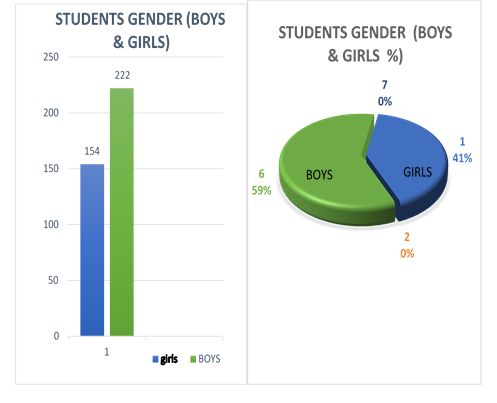
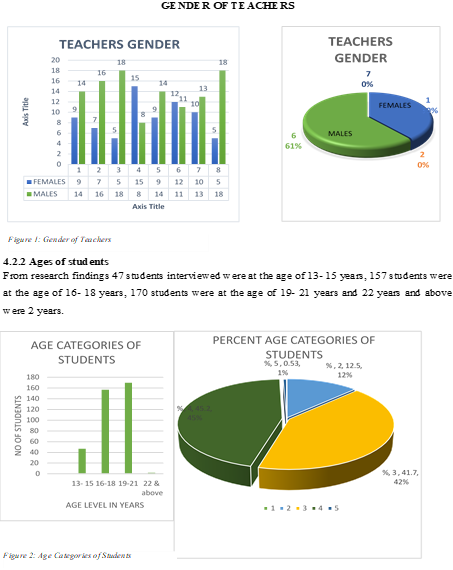
Gender of Respondents: From a total of 276 students interviewed, 59% were males while 41% were females. For the 184 teachers interviewed, 61% were males and 39% females.
Table 1: Gender of Students
Figure 1: Gender of Students
Table 2: Gender of Teachers
Figure 3: Gender of Teachers and Age of Students
Table 3: Results from Class Representatives and Masters
Causes of Burning of Secondary Schools in Homa Bay County
Results from the respondents, 70% of Teachers and 80% of the Students pointed out that burning of secondary schools take place in second term when there is a lot of work loads of completing the syllabus by teachers, approaching mock examinations for KCSE candidates in secondary schools and completion of KCSE Projects for collection for National Exam Assessment. The following were the views from teachers, students and volunteers (teachers , subordinate staff and watchmen ) in Homa Bay County, as in the Table 3.
Effects of the Ministry of Educations’ Reforms methods in stopping secondary schools’ Arsons
Results from students and teachers respondents through questionnaires and interviews stated that proposed planned changes by the Ministry of Education in Secondary schools’ programme brought reactions from students that resulted criminal arsons that occurred in secondary schools. On contribution by both teachers and students on Ministry of Education reform measures ;88 % of the students and 90 % of the teachers agreed that extension of term dates influenced school burning ;70 % of the students and 40 % of teachers considered abolition of half- term holiday breaks; 76% of the students and 50 % of the teachers agreed that abolition of visitation in third term as cause of arsons ;71 % of the students suggested that penalties imposed on students and teachers for exam cheating as the main cause ;and 70 % of students suggested abolition of exam prayer days in term three as the cause of burning of secondary schools.
Effects of Proposed ministry of Education Programme
Ministry of Education’s policy changes for schools were implemented in second term school calendar. Second term had been prolonged by a week, shortening holidays to two weeks from the previous four while third term last nine weeks from previous twelve weeks. The term dates at times varies, not fixed in terms of reforms the Ministry of Education reformed policies. This has been varied according to national activities in regard to students mobility with their families to schools open days. The second term Holiday 2019 was extended from 26th August, 2019 that effected opening of third term to 2nd September to 25th October, 2019,due to The National Population and Housing Census exercises.
Ministry of Education policy changes may be received by worrying students, teachers, and stakeholders in the education sector for many reasons. The students felt that they were not informed earlier as is the routine by their school heads. Teachers interviewed thought that Ministry of Education was dictating and too strict in its proposed policy changes without consultative meetings with top educators leaders. Students interviewed were unhappy and discouraged with the new policies. Students said they burnt schools to protest the extension of second term that that kept them long time in schools instead of breaking for holiday to ease from a lot of a lot of assignments and exams. Half-terms and school holidays help to ease students’ fatigue in brain workloads. Psychologists recommend that prayers have positive effects on students and the visits from family members and friends give relief, appreciation and adjustment to family belonging. Due to all the above the Ministry of Education may have accelerated burnings of schools, the students reacted against the policy changes by burning of school structures.
Peer Pressure
Peer pressure was considered by respondent as most contributing factor in burning of secondary schools, an average of 48% of teachers and 47% of students contributed; students added that during the high level of school burning there was a lot of passing of massages through phones between schools, some students interviewed by news media could say that they would prefer to be at home like their student mates in other schools who had been sent home due to arsons.
According to NCRC [5] findings, peer pressure was also the main cause of burning of Secondary schools between June and August, 2016. This is explained as students; as a group bound together by common interests and experiences in a way that the ‘unfavourable situation’ affecting one school is also likely to affect the next school. In such circumstances, the next school may definitely go on rampage not due to copying their colleagues but as a means of expressing their views concerning their colleagues as well as protesting against unfavourable situation taking place in their school. The spread of student violence is expression of solidarity. Student respondent agreed to being in constant communication with peers in other schools and the outside world through various channels, including smuggled mobile phones and other social media networks. This is the reason copycat pattern of burning quickly spread across many schools.
Exam Fatigue in Second Term
Exam fatigue which is due to giving many tests and quizzes in preparation of the coming KCSE in November was pointed out by 31.8% of Students and 24% of Teachers as the other panic that caused burning of secondary schools, mainly in second term. Form four students and teachers pointed out that many exams given in term two increased the burning culture in students mentality. For many citizens success in academic and professional examinations is regarded as success in life as a result rigorous testing of the level preparedness for KCSE candidates. The loads of internal trial examinations and joint zonal exams strains students mentally eventually may encourage students arsons in some learners. Similarly, result from NCRC, 2016, regarding second term overload, one teacher in one of the affected school in Eastern Kenya said that; ‘ second term has always been a tough term for candidates, however, collective outrage has marked a watershed for a country that had shut eyes to the teen violence in secondary schools in second term.
In further investigation, through questionnaire, on fear to term two exams and many class exercises, as cause of burning of secondary schools 70% of the students and 56% of teachers agreed that it was ;21% of the students and 41% of teachers pointed out that it was not ;while 9% of students and 3% of teachers were undecided of the contributing factor, see figure 10.It was discovered by the study that even if the Ministry of Education is banning mock nationwide they are still widely done in schools through different names as ‘ joint trial exams’. The only difference is that they are done at the Sub-County level. In the minds of students, they are the same straining mock exams despite the change in the name and context of administration. From the causes of burning of schools pointed out by different classes/forms, from the Figure 4 and Table 4 it is evident that fear of exams ranked highest.
Absence of Principals from schools
Many of the student’s respondents that were interviewed agreed that heads of school’s absence from schools, leaving their deputies and senior masters due some natural personal problems and commission duties for weeks are the cause of majority of student unrest and arsons. This is because their deputies are not yet experienced in school administration.
Result from National Crime Research Council, 2016 on the same revealed that absence of school heads from schools for some times (a week and above) presents opportunities and challenges in the management of secondary schools in Kenya. These times, that exists cases and complications when important, critical and timely administrative decisions have to be made, Principals being the Chairman of administration meetings, failure to which may lead to dangerous situations in schools.
Principal’s absence in second term for a long time results in administrative and management problems, especially those principals who take all the power of administrations into their hands (authoritative and autocratic principals ).Principals in some affected schools learned that their time in school in second term suffered in finishing school assignments in finances, related to school supplies, rate of fee payment levels by students’ parents and Government funding to schools. The assignments include Sub-County, County, Regional, and National meetings, in respective month, taking at least ten working days. This is almost 50% absenteeism per month outside time taken off for personal engagements.
Boards of Management officials, who was interviewed likewise had to say that prolonged absenteeism of school heads is likelihood of student unrests in many secondary schools. A study of the same by NCRC, came across a case in Meru County where County Director of Education dealt with a case of absentee school Principal whose school had serious management problems.
Importance of period of Principals absence from schools’ findings, the gap of prolonged absence of administrative authority results in lack of decision making on important issues creating pilled agendas for discussions, suspicions, and abandonment of responsibility among students and other teachers. During these times, with the recent increased enrolment (Ministry of Education 2019, Form one Admission Directive in action for Universal Education for All), also according to NCRC,2016, this has influenced insufficient school infrastructure in many schools, it is evident that a small tension could lead to abnormal congestion in infrastructure resulting in student unrests.
Proliferation of Indiscipline Across Schools
Students indiscipline, an average of 8% of the students and 40 % of teachers respondents were able to view that indiscipline was a contributing factor to students unrest and arson to an extent, the other percentages of students and teachers did not know and did not respond. NCRC 2016, findings also showed that there is a major policy gap and weak processes of profiling indiscipline cases of student transfers between schools in Kenya. In NCRC study indiscipline ranked sixth in causes of burning of secondary schools by (11%) teachers respondents and (9.3%)students respondents, thus reflecting the relevance as a cause. Expelled students on the same get admissions in other schools, enabling inability to protect the rest students from unwanted influence of such students.
The current law regarding student’s juvenile justice in Kenya make disciplining of students difficult for the schools’ administrations, though it prohibits corporal punishment in learning institutions, it also protects many rights of a child. Students below eighteen years enjoy minors’ rights provided by constitutional’s statutory regulations and other supporting legislations. Many schools have to persevere the challenges of restricted disciplinary processes protected by the law for fear of being prosecuted in a Law Court.
According more findings, from NCRC and Periodical, Sagini Task Force Report of 1961 recommended that indiscipline students should be expelled from schools and where necessary be prosecuted according to the laws of the land. In addition, Sagini had recommended that the Ministry of Education should ensure that expelled undisciplined students never be re-admitted in other public schools in the republic. In effect, Ministry of Education in Kenya is to necessarily implement policy measures to the solutions of the ever-recurring student unrest and violence for discipline is a requirement for better citizens of productive school community.
Figure 4: TSC Fire Marshals Under Training
Limited Guidance and Counselling
Guidance and counselling were also cited as being insufficient in secondary schools, a factor that could generate burning of schools due to ignorance of students. Many respondents could say that many schools depend on consultant way of guiding students by inviting guest speakers to school while forget to fully maintain Guidance and counselling Department to actively guide students for morality. The guest speakers guide and give massage of self-worth strength, share personal feelings with students so that they make decisions, such meetings are done once a year in mind to motivate KCSE students and rest of school at a cost for Guest speakers. Many schools were found to have no professional councillor, the trend is that a teacher is appointed by administration to head the department while he has not been taken for seminar and skill improvement workshops. During questionnaires, 34.5% of the students and 12.5% of teacher’s respondents admitted insufficient counselling as being contributing factor of students’ unrest and violence. Guidance and counselling is provided for policy maintenance, rules and regulations to instil character education in promoting core ethical and performance values in students that support academic achievement. Guidance and counselling is poorly maintained in schools as it is not financed that result in negligence, increased indiscipline and students unrest at reality therapy modelling. Teachers assigned as counsellors have no time considering usual class work. Professional guidance and counselling should be encouraged in schools even workshops organized by educators at all levels to enable teachers control students’ feelings and problems.
Other Causes of Students’ Unrests Given by Other Political Leaders, Teachers Union Heads, Educators and Students’ Responses Through Newspapers (Media)
The teacher’s union (KNUT) Chairman, was of the opinion that ‘students’ unrest’ is resulted by the abrupt changes in school calendar, extending August Holiday and leaving term three with only nine weeks. But Cabinet Secretary of Education in address through news reporters said that more students unrests and burning of schools is contributed by poor school management and weak parenting by teachers.The government need to appoint a taskforce to look into the matter and close schools to allow students to rest in giving way to solve the issue.
According to Mr. Nyakeyo, Principal of Itierio Boys, Stakeholders should curb school fires by ensuring regular meetings and mentoring session should be held in schools by teachers and administration; friendly learning environment and counselling should be introduced; school security services and new counselling process should be improved thus making use of Security Firm Services.
According to Deputy County Commissioner Mbooni East Sub-location, dialogue between teachers and students is the way to avert arson attacks, also the CS of Education added that cartels behind exams leaks were the ones burning the schools, though the teachers denied this. According to Lancet Psychiatry journal, a lot of behaviors are modelled. This reflect copycat acts dramatically as in American High School where one shooting incident follows another in contagion. Spread of behavior pattern through suggestion or imitation is real. It is truly the same with Kenyan teenage in the methods of torching dormitories.
Students finally were able to respond to media newsmen in stating that they were rioting because, schools are poorly run, Head Teachers are frequently away from schools, discipline has collapsed and their attentions are neglected, they have peer pressure from neighbour schools towards arson crime in order that they can be the same as other schools doing it. Students also added that they are copying politicians who also defy the government authority in order that they get what they want.
CONCLUSIONS
Results emerging out from findings of this study gave the following recommendations that may enforce further check -ups in the Education Sector.
Relieve Overloaded Term Two
Education administrators and policy makers should relieve overloaded term two, to ensure that some extra -curricular activities in the term are divided to other term citing first term that is relaxed.
Stepping Joint Trial Exams that Displaced Mock Exams
Mock exams are still being done in all Counties in the nation with the name of Joint Trial exams. Students feared mock exams because it was set very difficult than KCSE with strict marking. This resulted to higher stress, fears and instability in students giving way for school unrests and rioting towards burning of school as short cuts to relieve them from these exams. The mock exam has made the students to go against the school rules and regulations and Education policy as well. The Education Policy makers, and other Government concerned Departments should find way of abolishing straining exams (Mock) done at Sub -County levels.
Reestablishment Active Guidance and Counselling Departments in Schools
Psychological, behavioral factors, drug abuse, family and society problems play greater contribution on student unrests and rioting. Guidance and counselling, with professional experts need to be done in schools actively to address psychotic and psycho-social problems in students. The government through the Ministry of Education should provide financial support to schools to allow school Heads manage the department in Secondary schools in Kenya , financial provision should be a policy for guidance and counselling activity in schools. Professional counsellors should be deployed full time to all schools. The Headmasters of schools should make it clear to students to ensure they contact guidance and counselling department to help them solve any burning issues or problems so that they don’t make mistakes. Heads of schools should encourage staff to guide students who need help and support teachers to attend professional workshops organized at relevant colleges.
Moderate Multiple Exams Administered to students
The image of the result from NCRC 2016, on Recommendations to the solutions of students unrest states that schools should avoid giving excessive exams to students, with reference to KCSE candidates. They NCRC, adds that different methods for students’ abilities evaluation should be discovered. That it is reasonably required students to be encouraged to do school -based testing and be excluded from non-academic activities ( sports, music, drama and other talents) to lessen the fatigue in work load in schools. Other recommendations of NCRC 2016 are:
Addressing policy gap in profiling indiscipline cases across schools
To consult and strategically review and implement
Ministry of Education policies in secondary schools
Do extensive deep forensic investigations
Address Policy Gaps in Profiling Indiscipline Cases across Schools
A deer need is required in place to revise a method of profiling, tracking and sharing information on cases of student indiscipline in all secondary schools in the Nation. A national system of ‘student -offender ’will assist in inter-school transfers of students with delinquent and criminal characters. This is intended taking in consideration dealing with the transfer of such criminal acts and anarchy across schools.
Consultative Strategic Review and Implementation of Ministry of Education Policies in Secondary Schools
The biggest reason pointed out that effective policy formulations, review and changes in any sector of the society may at times meet stiff opposition from target stakeholders irrespective of their importance. Ministry of Education should run consultative decision -making methods on policy changes in secondary schools. This reduces expected negative reactions by different stakeholders, students inclusive.
Recommendations for Further Forensic Investigation
Forensic investigations of arson crisis in the Nation in Secondary schools by Directorate of Criminal Investigations should form the extensive of planning, the level of organization and the pattern of coordination involved in arson acts. This is to make it clear that the burning took place with no human life and serious injuries not as like the past student strikes and arson attacks that resulted massive loss of human life, serious injuries and destruction of property.
REFERENCES
Shiundu, J. O., and S. J. Omulando. Curriculum: Theory and Practice in Kenya. Oxford University Press, 1992.
Kothari Commission. Education and National Development: Report of the Education Commission, 1964–66. Government of India, 2009.
Orodho, John Aluko. Techniques of Writing Research Proposals and Reports in Education and Social Sciences. Kanezja Publishers, 2003.
Kodero, H. M. N. “An Evaluation of Discipline Practices in Public Secondary Schools: A Case Study of Bara Boys’ High School.” Educational Journal, vol. 15, no. 2, 2010, pp. 120–135.
National Crime Research Centre (NCRC). Rapid Assessment of School Violence in Kenya. NCRC, 2016.
License
Creative Commons Attribution-NonCommercial-NoDerivatives 4.0 International License
All papers should be submitted electronically. All submitted manuscripts must be original work that is not under submission at another journal or under consideration for publication in another form, such as a monograph or chapter of a book. Authors of submitted papers are obligated not to submit their paper for publication elsewhere until an editorial decision is rendered on their submission. Further, authors of accepted papers are prohibited from publishing the results in other publications that appear before the paper is published in the Journal unless they receive approval for doing so from the Editor-In-Chief.
Himalayan Journal of Education and Literature open access articles are licensed under a Creative Commons Attribution-Share A like 4.0 International License. This license lets the audience to give appropriate credit, provide a link to the license, and indicate if changes were made and if they remix, transform, or build upon the material, they must distribute contributions under the same license as the original.
Recommended Articles
Research Article
Understanding Regional Spaces vis-à-vis “the” Indian Space: A Study of Récits
Himanshu Parmar
Published: 10/02/2026
Download PDF
Cite
x
APA
Parmar, H. (2026). Understanding Regional Spaces vis-à-vis “the” Indian Space: A Study of Récits. Himalayan Journal of Education and Literature, 7(1), 1-5.
MLA
Parmar, Himanshu. "Understanding Regional Spaces vis-à-vis “the” Indian Space: A Study of Récits." Himalayan Journal of Education and Literature 7.1 (2026): 1-5.
Chicago
Parmar, Himanshu. "Understanding Regional Spaces vis-à-vis “the” Indian Space: A Study of Récits." Himalayan Journal of Education and Literature 7, no. 1 (2026): 1-5.
Harvard
Parmar, H. (2026) 'Understanding Regional Spaces vis-à-vis “the” Indian Space: A Study of Récits' Himalayan Journal of Education and Literature 7(1), pp. 1-5.
Vancouver
Parmar H. Understanding Regional Spaces vis-à-vis “the” Indian Space: A Study of Récits. Himalayan Journal of Education and Literature. 2026 Jan;7(1):1-5.
Download PDF
Research Article
Perceptions of Adolescent Pregnancy and Early Motherhood
Lucy Fonjong Udikoh,
Tamfuchia Ferdinard Baba
Published: 30/12/2020
Download PDF
Cite
x
APA
Fonjong Udikoh, L. & Ferdinard Baba, T. (2020). Perceptions of Adolescent Pregnancy and Early Motherhood. Himalayan Journal of Education and Literature, 1(1), 1-7.
MLA
Fonjong Udikoh, Lucy and Tamfuchia Ferdinard Baba. "Perceptions of Adolescent Pregnancy and Early Motherhood." Himalayan Journal of Education and Literature 1.1 (2020): 1-7.
Chicago
Fonjong Udikoh, Lucy and Tamfuchia Ferdinard Baba. "Perceptions of Adolescent Pregnancy and Early Motherhood." Himalayan Journal of Education and Literature 1, no. 1 (2020): 1-7.
Harvard
Fonjong Udikoh, L. and Ferdinard Baba, T. (2020) 'Perceptions of Adolescent Pregnancy and Early Motherhood' Himalayan Journal of Education and Literature 1(1), pp. 1-7.
Vancouver
Fonjong Udikoh L, Ferdinard Baba T. Perceptions of Adolescent Pregnancy and Early Motherhood. Himalayan Journal of Education and Literature. 2020 Jul;1(1):1-7.
Download PDF
Research Article
Pragmatic Formatting of Poetic Discourse According to Al-A’sha: An Analytical Study
التنسيق التداولي للخطاب شعري عند الأعشى: دراسة تحليلية
Neamah Dahash Farhan,
...
Rafid Sabah Al-Tamimi
Published: 28/02/2026
Download PDF
Cite
x
APA
Farhan, N. D., Sadiq, N. Q. & Al-Tamimi, R. S. (2026). Pragmatic Formatting of Poetic Discourse According to Al-A’sha: An Analytical Study
التنسيق التداولي للخطاب شعري عند الأعشى: دراسة تحليلية. Himalayan Journal of Education and Literature, 7(1), 1-10.
MLA
Farhan, Neamah D., Niyazik Q. Sadiq and Rafid S. Al-Tamimi. "Pragmatic Formatting of Poetic Discourse According to Al-A’sha: An Analytical Study
التنسيق التداولي للخطاب شعري عند الأعشى: دراسة تحليلية." Himalayan Journal of Education and Literature 7.1 (2026): 1-10.
Chicago
Farhan, Neamah D., Niyazik Q. Sadiq and Rafid S. Al-Tamimi. "Pragmatic Formatting of Poetic Discourse According to Al-A’sha: An Analytical Study
التنسيق التداولي للخطاب شعري عند الأعشى: دراسة تحليلية." Himalayan Journal of Education and Literature 7, no. 1 (2026): 1-10.
Harvard
Farhan, N. D., Sadiq, N. Q. and Al-Tamimi, R. S. (2026) 'Pragmatic Formatting of Poetic Discourse According to Al-A’sha: An Analytical Study
التنسيق التداولي للخطاب شعري عند الأعشى: دراسة تحليلية' Himalayan Journal of Education and Literature 7(1), pp. 1-10.
Vancouver
Farhan ND, Sadiq NQ, Al-Tamimi RS. Pragmatic Formatting of Poetic Discourse According to Al-A’sha: An Analytical Study
التنسيق التداولي للخطاب شعري عند الأعشى: دراسة تحليلية. Himalayan Journal of Education and Literature. 2026 Jan;7(1):1-10.
Download PDF
Research Article
Interaction of Modern Literature-Paintings and Poetry, Storytelling, Literature
Jackline Njeri Murimi
Published: 27/01/2025
Download PDF
Cite
x
APA
Njeri Murimi, J. (2021). Interaction of Modern Literature-Paintings and Poetry, Storytelling, Literature. Himalayan Journal of Education and Literature, 2(1), 1-5.
MLA
Njeri Murimi, Jackline. "Interaction of Modern Literature-Paintings and Poetry, Storytelling, Literature." Himalayan Journal of Education and Literature 2.1 (2021): 1-5.
Chicago
Njeri Murimi, Jackline. "Interaction of Modern Literature-Paintings and Poetry, Storytelling, Literature." Himalayan Journal of Education and Literature 2, no. 1 (2021): 1-5.
Harvard
Njeri Murimi, J. (2021) 'Interaction of Modern Literature-Paintings and Poetry, Storytelling, Literature' Himalayan Journal of Education and Literature 2(1), pp. 1-5.
Vancouver
Njeri Murimi J. Interaction of Modern Literature-Paintings and Poetry, Storytelling, Literature. Himalayan Journal of Education and Literature. 2021 Jan;2(1):1-5.
Joseph O., M., Dimo O., H. & Peter, O. (2020). An Investigation into Arson in Secondary Schools in Kenya: A Case of Homa Bay County. Himalayan Journal of Education and Literature, 1(1), 1-9.
MLA
Joseph O., Modi, Herbet Dimo O. and Okemwa Peter. "An Investigation into Arson in Secondary Schools in Kenya: A Case of Homa Bay County." Himalayan Journal of Education and Literature 1.1 (2020): 1-9.
Chicago
Joseph O., Modi, Herbet Dimo O. and Okemwa Peter. "An Investigation into Arson in Secondary Schools in Kenya: A Case of Homa Bay County." Himalayan Journal of Education and Literature 1, no. 1 (2020): 1-9.
Harvard
Joseph O., M., Dimo O., H. and Peter, O. (2020) 'An Investigation into Arson in Secondary Schools in Kenya: A Case of Homa Bay County' Himalayan Journal of Education and Literature 1(1), pp. 1-9.
Vancouver
Joseph O. M, Dimo O. H, Peter O. An Investigation into Arson in Secondary Schools in Kenya: A Case of Homa Bay County. Himalayan Journal of Education and Literature. 2020 Jul;1(1):1-9.


 Download PDF
 Download XML