Contents
Download PDF
pdf Download XML
1903 Views
346 Downloads
Share this article
Research Article | Volume 2 Issue 2 (July-Dec, 2021) | Pages 1 - 3
Socio-Demographic and Etiological Profile of Interstitial Lung Diseases (ILDS) Patients at a Tertiary Center in Northern India: A Cross Sectional Study
1
Junior Resident, Department of Pulmonary Medicine, IGMC, Shimla (HP), India
Under a Creative Commons license
Open Access
Received
July 29, 2021
Revised
Aug. 17, 2021
Accepted
Sept. 14, 2021
Published
Oct. 31, 2021
Abstract

Background: Interstitial Lung Disease (ILD) defines any disease that affects the interstitium and the distal alveoli of the lungs, leading to impaired lung diffusion. The present study was done to evaluate the Socio-demographic and etiological profile of Interstitial Lung Diseases (ILDs) patients. Material and Methods: This cross-sectional study was conducted at Indira Gandhi Medical College, Shimla from July 2018 to June 2019. All consecutive patients of all types of ILDs, attending the outpatient services of the Department of Pulmonary Medicine, IGMC Shimla were enrolment and subjected to focused socio-demographic history. Data was analyzed using Epi info V7 software by applying appropriate statistical tests. Results: The present study includes 50 patients of different types of ILD. Among these, 27 (54%) were female and 23 (46%) were male. The mean age of the study population was 57.821+5.03years. 44(88%) were of rural background and majority were from the lower class of socioeconomic status. The prevalence of active smoking was reported in small percentage of the patients 2(4%). The majority of the study population was either ex-smokers 17(34%) or non-smoker 31(62%). The mean duration of symptoms of ILD was 3.034+2.62 years. Among the study population, a total of 8 (16%) had a history of ATT intake and 10 (20%) patients were on domiciliary oxygen therapy. Among all these ILD patients, 24 (48%) had Idiopathic Pulmonary Fibrosis (IPF), 11(22%) had sarcoidosis, 8(16%) had systemic sclerosis-associated Interstitial Lung Diseases (PSSc-ILD), 3(6%) had Systemic Lupus Erythematous associated Interstitial Lung Diseases (SLE-ILD), 1(2%) patient had Combined Pulmonary Fibrosis and Emphysema (CPFE) and 3(12%) patients had suffered from Hypersensitive Pneumonitis (HP). Conclusion: Most of ILD patients were females, were of rural background, from the lower class of socioeconomic status and either ex-smokers or non-smoker. IPF, Sarcoidosis and CTD-ILDs were the most common ILDs seen at a tertiary center of hilly state in northern India.

Keywords
INTRODUCTION

Interstitial Lung Disease (ILD) defines any disease that affects the interstitium and the distal alveoli of the lungs, leading to impaired lung diffusion. It is a heterogeneous group of different diseases of unknown and known cause with common functional characteristics (restrictive physiology and impaired gas exchange) and a common final pathway, eventually leading to irreversible fibrosis [1,2,3].


Although well over 100 distinct entities of ILDs are recognized, a limited number of disorders, including idiopathic pulmonary fibrosis, sarcoidosis and connective tissue disease-related ILDs, account for most ILDs encountered clinically [4].


Some factors have been identified to be associated with poorer prognosis and shorter survival time among ILDs patients are older age, smoking status (smokers and ex-smokers), lower body mass index, more impaired pulmonary function (mainly on forced vital capacity, FVC, total lung capacity, TLC and diffusing capacity for carbon monoxide, DLCO), radiological findings (usual interstitial pneumonia, UIP), a pattern or greater extent of fibrosis and the development of acute exacerbations or comorbidities, especially pulmonary hypertension and emphysema [5].


Little is known on the characteristics of patients diagnosed with idiopathic pulmonary fibrosis (IPF) in this hilly area of northern India. The present study was done to evaluate the Socio-demographic and etiological profile of Interstitial Lung Diseases (ILDs) patients.


Aims and Objectives

To study the Socio-demographic and etiological profile of Interstitial Lung Diseases (ILDs) patients.


MATERIALS AND METHODS

The present study was conducted at Indira Gandhi Medical College, Shimla which is a tertiary care center of Himachal Pradesh, located in North India in Asian Continent and covers the majority of the population of this state. All consecutive patients of Interstitial Lung Diseases (ILDs), attending the outpatient services of the Department of Pulmonary Medicine, IGMC Shimla from July 2018 to June 2019 were screened for enrolment in the study. All types of ILDs were enrolled in the study.


Inclusion Criteria

Stable ILD Patients: Diagnosis of ILD according to ATS/ERS guidelines based on an overall assessment of High-Resolution Computed Tomography (HRCT) scan, lung function tests, (bronchoscopy and biopsy, if available) Age >18 years, written consent.


Exclusion Criteria:


  • Subjects with evidence of left heart disease, Chronic kidney disease, Liver disease

  • Chronic lung diseases other than ILDs

  • Patients with HIV

  • Pregnant


Patients presenting with respiratory symptoms such as cough, shortness of breath and diagnosed cases of ILD were evaluated. 


All consecutive ILD patients were subjected to focused history and physical examination as structured questionnaire record information related to; Demographics, Duration of ILD symptoms etc.


The data was collected, entered in the MS Excel sheet and analyzed using Epi info V7 software. Continuous variables were reported as mean ± SD or median and interquartile range depending on the distribution of the variables. Categorical variables were recorded as counts and percentages. Differences between means of continuous variables were compared using the unpaired student’s’ test. A p-value of <0.05 was considered as statistically significant.

RESULTS

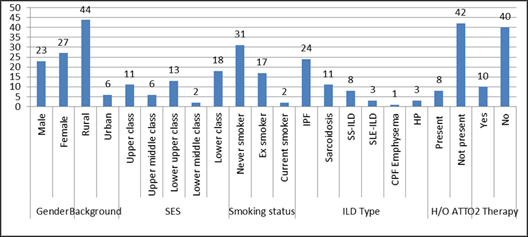
Among the study population, 50 patients 27 (54%) were female and 23 (46%) were male. The mean age of the study population was 57.821+5.03years. The mean age of males and females was 62.561+3.84 years and 53.771+5.07 years respectively. 44(88%) were of rural background and majority were from the lower class of socioeconomic status. The prevalence of active smoking was reported in small percentage of the patients 2(4%). The majority of the study population was either ex-smokers 17(34%) or non-smoker 31(62%). The mean duration of symptoms of ILD was 3.034+2.62 years. There was no significant difference between males and females regarding the duration of illness (2.76+2.46 years versus 3.39+2.77 years, p = 0.40). Among the study population, a total of 8 (16%) had a history of ATT intake among these 5 (18.52%) were female 3(13.04%) were male. A total of 10 (20%) patients were on domiciliary oxygen therapy, among these 6 (26.09%) were male.


Table 1: Socio-Demographic and Etiological Profile of the Study Population (n = 50)

CharacteristicTotal (n = 50)Male (n = 23)Female (n = 27)p-value
Age(years)57.821+5.0362.561+3.8453.771+5.070.03
Background

Rural

Urban

44 (88%)

6(22%)

17 (73.91%)

6(26.09%)

27 (100%)

0 (0%)

0.006
Socioeconomic status

Upper class

Upper middle class

Lower upper class

Lower middle class

Lower class

11(22%)

06(12%)

13(26%)

2(4%)

18(36%)

9(39.82%)

02(8.70%)

6(26.09%)

0(0.00%)

6(26.09%)

2(7.41%)

4(14.)81%

7(25.93%)

2(7.41%)

12(44.44%)

0.062
Smoking status    

Never smoker

Ex smoker

Current smoker

31(62%)

17(34%)

2(4%)

11(47.83%)

11(47.83%)

1(4.35%)

20(74.0%)

6(22.22%)

1(3.70%)

0.15
Duration of ILD (years)3.034±2.622.76±2.463.39+2.770.40
ILD categories:   0.09

IPF

Sarcoidosis

Systemic sclerosis-associated ILD

SLE-ILD

Combined pulmonary fibrosis emphysema

Hypersensitivity pneumonitis

24(48%)

11(22%)

8(16%)

3(6%)

1(2%)

3(6%)

12(52.17%)

7(30.70%)

1(4.35%)

0(0%)

1(4.35%)

2(8.70%)

12(44.44%)

4(14.81%)

7(45.93%)

3(11.11%)

0(0%)

1(3.70%)

 
History of anti tu bercular treatment

Present

Not present

8(16%)

42(84%)

3(13.04%)

20(86.96%)

5(18.52%)

22(81.48%)

0.44
Oxygen Therapy (long term)    

Yes

No

10(20%)

40(80%)

6(26.09%)

17(73.9)1

4(14.81%)

23(85.19%)

0.26


Figure 1: Socio-Demographic and Etiological Profile of the Study Population (n = 50)


All (n = 50) patients of Interstitial Lung Diseases (ILD) were screened for PAH by echocardiography, among these 24 (48%) had  Idiopathic Pulmonary Fibrosis (IPF), 11(22%) had sarcoidosis, 8(16%) had systemic sclerosis-associated Interstitial Lung Diseases (PSSc-ILD), 3(6%) had Systemic Lupus Erythematous associated Interstitial Lung Diseases (SLE-ILD), 1(2%) patient had Combined Pulmonary Fibrosis and Emphysema (CPFE ) and 3(12%) patients had suffered from Hypersensitive Pneumonitis (HP) (Table 1 ).

DISCUSSION

The mean age of the study population was 57.821+5.03 with male and female mean age 62.561+3.84 and 53.77+15.07 respectively (Figure 1). Females were more than male and younger with a mean duration of ILD of 3.034±2.62 years. A similar finding was also reported in the study conducted by Agarwal et al. [6] In the ILD registry of Indian data, it was reported that ILDs occur at a younger age compared to the western countries and females are affected more [7].

CONCLUSION

Most of ILD patients were females, were of rural background, from the lower class of socioeconomic status and either ex-smokers or non-smoker. IPF, Sarcoidosis and CTD-ILDs were the most common ILDs seen at a tertiary center of hilly state in northern India.


Limitations of the Study

The small number of the population were included in this study represents a methodological limitation and study over a larger population is recommended.

REFERENCES
  1. Society, A.T. Forn et al. "American Thoracic Society/European Respiratory Society International Multidisciplinary Consensus Classification of the Idiopathic Interstitial Pneumonia, June 2001." American Journal of Respiratory and Critical Care Medicine, vol. 165, no. 2, 2002, pp. 277-304.

  2. Wells, A.U. and N. Hirani. "Interstitial Lung Disease Guideline: The British Thoracic Society of Australia and New Zealand Thoracic Society in Collaboration with Irish Thoracic Society." Thorax, vol. 63, 2008, pp. 1-58.

  3. Ishak, S.R. Forn et al. "Environmental Hazards and Demographic and Clinical Data of Childhood Interstitial Lung Diseases in a Tertiary Institute in Egypt." The Egyptian Journal of Bronchology, vol. 15, no. 1, 2021, pp. 1-8.

  4. Ryu, J.H. Forn et al. "Diagnosis of Interstitial Lung Diseases." Mayo Clinic Proceedings, vol. 82, no. 8, 2007, pp. 976-86.

  5. Fernández-Fabrellas, E. Forn et al. "Demographic and Clinical Profile of Idiopathic Pulmonary Fibrosis Patients in Spain: The SEPAR National Registry." Respiratory Research, vol. 20, no. 1, 2019, p. 127.

  6. Agarwal, R. Forn et al. "Noninvasive Estimation of Clinically Asymptomatic Pulmonary Hypertension in Idiopathic Pulmonary Fibrosis." The Indian Journal of Chest Diseases & Allied Sciences, vol. 47, no. 4, 2005, pp. 267-71.

  7. Indian ILD Registry. "Lung India." Lung India, vol. 31, no. 4, 2014, pp. 320-22.

  8. Sahni, S. Forn et al. "Socioeconomic Status and Its Relationship to Chronic Respiratory Disease." Advances in Respiratory Medicine, vol. 85, no. 2, 2017, pp. 97-108.

  9. Keusch, S. Forn et al. "Tobacco Smoke Exposure in Pulmonary Arterial and Thromboembolic Pulmonary Hypertension." Respiration, vol. 88, no. 1, 2014, pp. 38-45.

License
CC BY-NC-ND
Creative Commons Attribution-NonCommercial-NoDerivatives 4.0 International License
Socio-Demographic and Etiological Profile of Interstitial Lung Diseases (ILDS) Patients at a Tertiary Center in Northern India: A Cross Sectional Study © 2026 by Vir Singh licensed under CC BY-NC-ND 4.0
All papers should be submitted electronically. All submitted manuscripts must be original work that is not under submission at another journal or under consideration for publication in another form, such as a monograph or chapter of a book. Authors of submitted papers are obligated not to submit their paper for publication elsewhere until an editorial decision is rendered on their submission. Further, authors of accepted papers are prohibited from publishing the results in other publications that appear before the paper is published in the Journal unless they receive approval for doing so from the Editor-In-Chief.
Himalayan Journal of Medicine and Surgery open access articles are licensed under a Creative Commons Attribution-Share A like 4.0 International License. This license lets the audience to give appropriate credit, provide a link to the license, and indicate if changes were made and if they remix, transform, or build upon the material, they must distribute contributions under the same license as the original.
Advertisement
Recommended Articles
Research Article
Impact of Gut-Liver Axis: Hepatic Biochemical and Metabolic Changes Associated with Chronic Gastritis in Iraqi Patients with Helicobacter Pylori
Published: 20/02/2026
Download PDF
Research Article
Effect of Land Degradation on Livelihood
Published: 04/01/2024
Download PDF
Research Article
Gastric Cancer: A Comprehensive Review
...
Published: 20/01/2026
Download PDF
Research Article
Mean Platelet Volume, Systemic Immune-Inflammation Index and Procalcitonin as Biomarkers in Streptococcal Acute Tonsillitis and Peritonsillar Abscess
...
Published: 31/12/2025
Download PDF
Chat on WhatsApp
Flowbite Logo
Najmal Complex,
Opposite Farwaniya,
Kuwait.
Email: kuwait@iarcon.org

Editorial Office:
J.L Bhavan, Near Radison Blu Hotel,
Jalukbari, Guwahati-India
Useful Links
Order Hard Copy
Privacy policy
Terms and Conditions
Refund Policy
Others
About Us
Team Members
Contact Us
Online Payments
Join as Editor
Join as Reviewer
Subscribe to our Newsletter
Follow us
MOST SEARCHED KEYWORDS
scientific journal
 | 
business journal
 | 
medical journals
 | 
Scientific Journals
 | 
Academic Publisher
 | 
Peer-reviewed Journals
 | 
Open Access Journals
 | 
Impact Factor
 | 
Indexing Services
 | 
Journal Citation Reports
 | 
Publication Process
 | 
Impact factor of journals
 | 
Finding reputable journals for publication
 | 
Submitting a manuscript for publication
 | 
Copyright and licensing of published papers
 | 
Writing an abstract for a research paper
 | 
Manuscript formatting guidelines
 | 
Promoting published research
 | 
Publication in high-impact journals
Copyright © Himalayan Journals . All Rights Reserved.