Approximately 20% of patients with newly diagnosed colorectal cancer present with distant metastatic disease. Ca rectum with brain metastasis is relatively rare in oncological practice. We describe a rare case of a 73-year-old patient presenting with persistent severe headaches and weakness right upper limb found to have a solitary brain metastasis from primary rectal cancer.
Colorectal cancer is the fifth most common cancer in India [1]. Common presenting symptoms include a change in bowel habits, rectal bleeding, or a rectal or abdominal mass [2]. Moreover, approximately 20% of patients with newly diagnosed colorectal cancer present with distant metastatic disease [3]. The most common sites of metastasis are liver, lung, peritoneum and lymph nodes [4]. Brain metastasis from colorectal cancer is uncommon. We describe a rare case of a 73-year-old patient presenting with severe headaches found to have a solitary brain metastasis from primary rectal cancer.
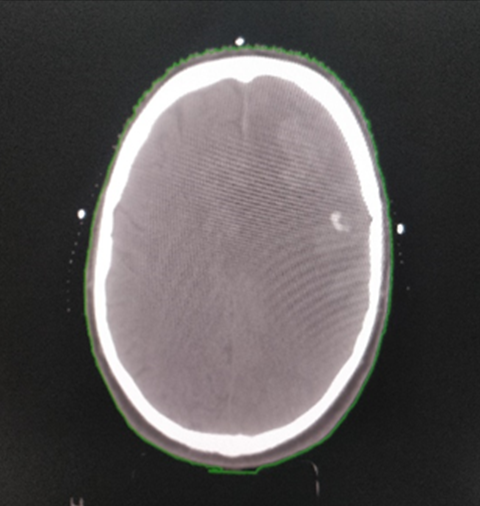
A 73-year-old male, diagnosed with ca rectum in 2018 presented with complaint of persistent worsening headaches, nausea, vomiting and weakness right upper limb. On neurological examination, power right upper limb was 3/5. Rest of physical and systemic examination was normal. CECT head showed heterogeneously enhancing lobulated mass lesion in left frontal cortex measuring 3.2x2.7x3.0 cm in maximum dimension (Figure 1).

Figure 1: CECT head showing a heterogeneously enhancing lobulated mass lesion in the left frontal cortex

Figure 2: CECT Image of the Head Demonstrating a Heterogeneously Enhancing Lobulated Mass Lesion in The Left Frontal Cortex
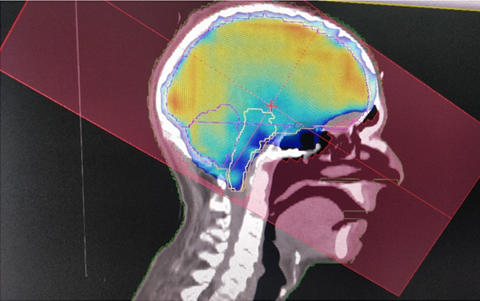
Patient then underwent low anterior resection and received 4 cycles of CAPOX based adjuvant chemotherapy. Patient was then lost to follow up and presented with brain metastasis in June 2021. Patient was then started on decongestive therapy and subjected to whole brain radiotherapy for palliative relief of symptoms.
The median age of diagnosis of rectal cancer is 63 years for both men and women [5]. Moreover, only 3% of rectal cancer presents with single metastasis to the nervous system as compared to single metastasis to the liver (62%) or thorax (19%) [6]. Incidence of a brain metastasis from colorectal cancer is relatively rare with an incidence of approximately 0.6 to 3.2% [6]. Brain metastasis is much more common with ca lung, ca breast, testicular cancer and melanoma with an incidence ranging from 10-50% depending on the type of cancer [6].
MRI imaging of the brain in patients with colorectal cancer having any neurological symptoms or risk factors for brain metastases such as the presence of lung metastases, KRAS mutation, high Carcinoembryonic Antigen (CEA) level, or rectal cancer is highly recommended [7].
A recent metanalyses expresses the concern of microsatellite instability leading to proximal colon cancer with RAS and BRAF mutations found in approximately 52% [8] and 10% [9] of colorectal cancer, respectively. However, our patient did not have any evidence of microsatellite instability or a proximal colon cancer, still RAS and BRAF mutation testing has been shown to have prognostic and predictive value in metastatic colorectal cancer. Treatment with Anti-Epidermal Growth Factor Receptor (EGFR) antibodies has been shown to be less effective in patients with KRAS mutations [10] and patients with metastatic colorectal cancer. Patients with KRAS or BRAF mutations have been shown to have worsened outcomes [11].

Brain metastases are the most common intracranial neoplasm and usually arise from melanoma, ca lung and ca breast. Brain metastases from gastrointestinal cancers are quite rare and occur in less than 3.2% of patients with colorectal cancer. Common risk factors for brain metastases in patients with colorectal cancer includes primary rectal cancer, young age, lung and liver metastases and KRAS mutation. Those at high risk of brain metastases, should be considered for Intracranial imaging as a part of the workup in the staging of colorectal cancer.
R.L. Siegel et al."Cancer statistics, 2020."CA Cancer J. Clin., vol. 70, no, 2020, pp. 7–30. https://doi.org/10. 3322/caac.21590
M.R. Thompson et al."Clinical assessment to determine the risk of bowel cancer using symptoms, age, mass and iron deficiency anaemia (SAMI)." Br. J. Surg., vol. 104, no, 2017, pp. 1393–1404. https://doi.org/10.1002/bjs.10573
R.L. Siegel et al."Cancer statistics, 2016."CA Cancer J. Clin., vol. 66, no, 2016, pp. 7–30. https://doi.org/10.3322/ caac.21332
M.Riihimäki et al. "Patterns of metastasis in colon and rectal cancer." Sci. Rep., vol. 6, no, 2016, 29765. https://doi.org/10.1038/srep29765
R.L. Siegel et al."Colorectal cancer statistics, 2020."CA Cancer J. Clin., vol. 70, no, 2020, pp. 145–164. https://doi.org/10.3322/caac.21601
T.D. Christensen et al. "Systematic review brain metastases from colorectal cancer—incidence and patient characteristics." BMC Cancer, vol. 16, no. 2016, 260. https://doi.org/10.1186/s12885-016-2290-5
S. Müller et al. "Brain metastases from colorectal cancer a systematic review of the literature and meta-analysis to establish a guideline for daily treatment." Cancers (Basel), vol. 13, no. 2021, 900. https://doi.org/10.3390/cancers13040900
A.D. Cox et al. "Drugging the undruggable RAS mission possible?" Nat. Rev. Drug Discov., vol. 13, no, 2014, pp. 828–851. https://doi.org/10.1038/nrd4389
J.F. Seligmann et al."Investigating the poor outcomes of BRAF-mutant advanced colorectal cancer analysis from 2530 patients in randomised clinical trials." Ann. Oncol., vol. 28, no, 2017, pp. 562–568. https://doi.org/10.1093/annonc/mdw645
I.J. Dahabreh et al."Systematic review anti-epidermal growth factor receptor treatment effect modification by KRAS mutations in advanced colorectal cancer." Ann. Intern. Med., vol. 154, no, 2011, pp. 37–49. https://doi.org/10.7326/0003-4819-154-1-201101040-00006
D.P. Modest et al."Outcome according to KRAS-, NRAS- and BRAF-mutation as well as KRAS mutation variants pooled analysis of five randomized trials in metastatic colorectal cancer by the AIO colorectal cancer study group." Ann. Oncol., vol. 27, no, 2016, pp. 1746–1753. https://doi.org/10.1093/annonc/mdw261