Contents
Download PDF
pdf Download XML
2114 Views
324 Downloads
Share this article
Research Article | Volume 3 Issue 1 (Jan-June, 2022) | Pages 1 - 5
Outcome Of Blunt Liver Injuries in Al-Yarmook Teaching Hospital
 ,
 ,
1
Professor/ Al-Mustansiriyah college of medicine, M.B.Ch.B, F.I.C.M.S, Baghdad, Iraq
2
M.B.CH. B, F.I.C.M.S, AL-Yarmouk Teaching Hospital,Baghdad, Iraq
3
M.B.Ch.B., C.A.B.S., F.I.C.M.S., H.D.L.M, Consultant surgeon, AL-Yarmouk Teaching Hospital, Baghdad, Iraq
Under a Creative Commons license
Open Access
Received
Jan. 3, 2025
Revised
Jan. 9, 2025
Accepted
Jan. 19, 2025
Published
Jan. 27, 2025
Abstract

Background: The liver is the most common solid organ injured in blunt trauma. Mortality from hepatic trauma depends on the degree of injury. Management of liver trauma has changed through the last three decades with a significant improvement in outcomes, especially in blunt trauma, due to improvements in diagnostic and therapeutic tools. Aim of study: To assess the outcome of non-operative management of blunt trauma with liver injury and to compare its outcome with operative management. Materials and Methods: A prospective study that was conducted in Al-Yarmouk Teaching Hospital during the period of two years from 1st of January 2019 till end of December 2020. It included 62 patients who were admitted to the emergency room with blunt thoracoabdominal trauma with evidence of grade I - V liver injury. They were divided into two group: Operative and non-operative group. Results: In this study, 32.3% of study patients were treated conservatively. Prevalence of operative option of management was increasing significantly with increasing grade of liver injury to reach 100% in patients with grade V liver injury. About complication, 80.9% of patients who underwent operations had complications in comparison to 20% of those who were treated conservatively. Mean for duration of hospitalization was significantly higher in patients who managed surgically than that in those who managed conservatively. Conclusion: Non-operative management of blunt hepatic trauma of low grade represents a safe and effective therapeutic approach with high success rate and decreasing morbidity, mortality, complication and hospitalization.

Keywords
INTRODUCTION

Liver injuries make up around 5% of all trauma admissions. The liver is the most common solid organ injured in blunt trauma. Mortality from hepatic trauma depends on the degree of injury. Minor liver injuries make up the majority of hepatic trauma with 80% to 90% being grades I or II. Mortality increases with grade of injury and grade V and VI liver injuries are often fatal. Liver injury is the primary cause of death in severe abdominal trauma and has a 10% to 15% of hepatic trauma [1]. Acceleration injuries can occur by an external force (as in collision) that may suddenly changes the direction of the movement of liver [2].


In deceleration injuries, like injuries by an automobile striking a fixed object, the liver is compressed either against the anterior chest wall, resulting in injury of the anterior segments, or against the posterior chest wall, resulting in injury of the posterior segments [3]. The most common types of traumas include [4]:


  • Blunt injury (acceleration, deceleration and crush injury).

  • Penetrating injury (sharp force trauma and gunshot wounds).


The WSES Classification divides Hepatic Injuries into three classes [5]:


  • Minor (WSES grade I)

  • Moderate (WSES grade II)

  • Severe (WSES grade III and IV)


The majority of patients admitted for liver injuries have grade I, II or III and are successfully treated with non-operative management. In contrast, almost two-thirds of grade IV or V injuries require laparotomy [6]. However, the management of liver trauma has changed through the last three decades with a significant improvement in outcomes, especially in blunt trauma, due to improvements in diagnostic and therapeutic tools [7].


In blunt liver trauma, non-operative management is a standard of care in hemodynamically stable patients. It is not the grade of the injury, but rather the hemodynamic parameters of the patient which divide the conservative versus operative management decision [8].


Complication of blunt hepatic trauma, especially after high-grade injury, are observed in 12–14 % of patients in which most frequent complications associated with non-operative management are: 


  • Bleeding

  • Abdominal compartment syndrome

  • Infections (abscesses and other infections)

  • Biliary complications (bile leak, haemobilia, bilioma

  • biliary fistula) and Liver necrosis [9]


Many factors have been found to have a strong association with the mortality rate, which involve hemodynamic instability, co-existing musculoskeletal and chest injury, high levels of Aspartate Aminotransferase (AST), alanine aminotransferase, lactate dehydrogenase, long activated partial thromboplastin time, prothrombin time, low fibrinogen levels and platelet count on admission. Not surprisingly, mortality is notably decreased when liver trauma is managed by hepatobiliary surgery, if feasible [10].

MATERIALS AND METHODS

A prospective study that was conducted in Al-Yarmouk Teaching Hospital during the period of one year from 1st of January till end of December 2020.

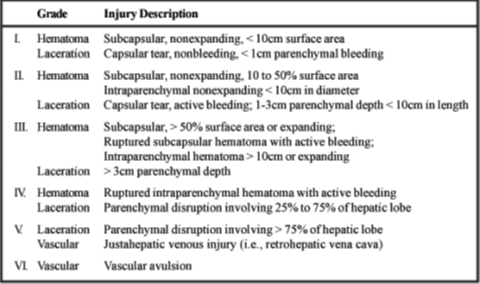
The study included 62 patients who were admitted to the emergency room with blunt abdominal trauma with evidence of AAST (American Association for the Surgery of Trauma) I - VI grade liver injury by CT-scan.

Hemodynamically stable patients (systolic blood pressure ≥90 mmHg, heart rate <100 bpm) and the hemodynamically stabilized patients (returned to normal vital signs after 2000 ml crystalloid infusion) were evaluated by physical examination, laboratory tests (CBC, liver and renal function tests, coagulation profile, cross match and blood preparation and imaging methods (plain x-ray, ultrasonography and computed tomography when available). Patients who were hemodynamically unstable or those with associated injuries that required surgery were operated on as emergency case, after blood preparation.

So, the included study patients were divided into two group:


  • Operative Groups

  • Non-Operative Groups


For those who underwent surgery (Operative group), intravenous (I.V.) fluid, I.V. antibiotics and analgesia were given postoperatively. Monitoring was done with daily vital signs, monitoring urine output, drains and nasogastric tube until discharged home. Duration of time until discharge and observed complications were evaluated.


Trauma and/or operation related complications were defined as morbidity and deaths due to trauma and/or operation were defined as mortality non-operative management was considered successful when the patient was discharged without undergoing any abdominal surgical procedure. 


Figure 1: Grading of liver injury based on American Association of Surgery for Trauma (AAST) by CT-Scan


The data analyzed using Statistical Package for Social Sciences (SPSS) version 25. The data presented as mean, standard deviation and ranges. Categorical data presented by frequencies and percentages. Independent t-test (two tailed) was used to compare the continuous variables accordingly. Chi square test was used to assess the association between outcome and certain information. A level of p–value less than 0.05 was considered significant.

RESULTS

The total number of study patients was 62. All of them were admitted to the emergency room with blunt abdominal trauma with evidence of AAST of I - VI grade liver injury.


Study patients’ age was ranging from 14–62 years with a mean of 33.61 years and a Standard Deviation (SD) of±6.2 years. The highest proportion of study patients was aged between 30–39 years (38.7%).


Regarding gender, proportion of males was higher than females (77.4% versus 22.6%) with a male to female ratio of 3.4:1.


Table 1 shows the distribution of study patients by injury information. In this study, the most common mechanism of injury was Road Traffic Accident (RTA) (62.9%). Regarding associated injury, 56.5% of study patients had associated chest injury and 41.9% of them had associated head injury. Number of associated single injury was 50% and multiple injuries in 37.1% while liver injury alone was 12.9%.


Concerning grade of liver injury, it was graded II in 29.1% of study patients and graded I and III in 25.8% as demonstrated in Table 2.


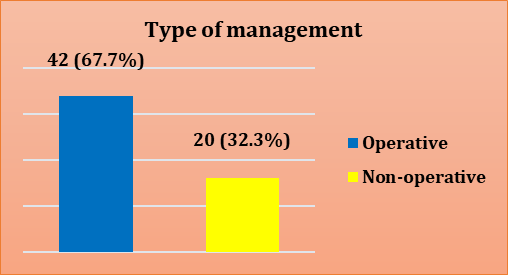
More than two thirds of study patients 42 (67.7%) were managed by surgical intervention; while 20 (32.3%) of them were treated conservatively as in illustrated in Figure 2.


There was no statistically significant association (p = 0.813) between the type of management and mechanism of injury, while the prevalence of operative option of management was increasing with the increasing grade of liver injury to reach 100% in patients with grade V liver injury with a significant association (p = 0.003) between type of management and grade of liver injury, as demonstrated in Table 3.


Table (1): Distribution of Study Patients by Injury Information

Variable

No. (n = 62)

(%)

Mechanism of injury

RTA*

39

62.9

Non-RTA**

23

37.1

Associated injury

Chest

35

56.5

Head

26

41.9

Extremity

24

38.7

Splenic

11

17.7

Pelvic

8

12.9

Renal

4

6.5

Diaphragm

2

3.2

Hollow viscus

0

0

Number of associated injuries

Only Liver

8

12.9

Liver associated with single injury

31

50.0

Liver associated with multiple injury

23

37.1

Type of managementDuration of hospitalization (Day)p-value
Mean±SDRange
Non-operative6.85±0.984 – 15 0.001
Operative9.35±1.13 – 21 

*RTA: Road Traffic Accident, ** FFH: Fall from Height


Table 2: Grades of Liver Injury

Grade of liver injuryNo. (n = 62)(%)
IRTA*914.525.8
FFH**711.3
IIRTA1219.429.1
FFH69.7
IIIRTA1016.125.8
FFH69.7
IVRTA711.314.5
FFH23.2
VRTA11.64.8
FFH23.2

*RTA: Road Traffic Accident, ** FFH: Fall from Height


Table 3: Association Between Type of Management and Injury Information

Injury information Type of management

Total (%) 

n = 62

p-value

Non-operative (%) 

n = 20

Operative (%) 

n = 42

Mechanism of injury
RTA13 (33.3)26 (66.7)39 (62.9)

0.813

FFH7 (30.4)16 (69.6)23 (37.1)
Grade of liver injury
I11 (68.8)5 (31.2)16 (25.8)

0.003


II6 (33.3)12 (66.7)18 (29.0)
III2 (12.5)14 (87.5)16 (25.8)
IV1 (11.1)8 (88.9)9 (14.5)
V0 (0)3 (100.0)3 (4.8)


Table 4: Complications in Study Patients

In Operative group n = 42
No.819.0
Wound infection1433.3
Chest infection614.3
UTI511.9
Atelectasis511.9
DVT511.9
Pleural effusion49.5
RDS37.1
Liver abscess00
Bile leak 00
Biloma00
Liver necrosis00
In non-operative group n= 20
No.1680.0
Ongoing bleeding210.0
Delayed hematoma rupture15.0
Infected hematoma15.0


Table 5: Association Between Type of Management with Complication, Morbidity and Mortality

Complication, morbidity and mortalityType of management

Total (%)

N = 62

p-value

Non-operative (%)

n = 20

Operative (%)

N = 42

Complication
Yes4 (20.0)34 (80.9)38 (61.3)0.001
No16 (80.0)8 (19.1)24 (38.7)
Mortality
Yes0 (0)4 (9.5)4 (6.5)0.153
No20 (100.0)38 (90.5)58 (93.5)


Table 6: Comparison in Duration of Hospitalization by Type of Management


Figure 2: Distribution of study patients by type of management


Table 4 shows the complication and morbidity in study patients. In operative group, 33.3% of study patients complained from wound infection; while in non-operative group, 10% complained from ongoing bleeding.


In this study, 80.9% of patients who underwent operations developed complications in comparison to 20% of those who treated conservatively; and this difference was statistically significant (p = 0.001). Four patients (6.5%) unfortunately died due to liver injury and all of them were from the operative group. No statistically significant difference (p-value = 0.153) in prevalence of death between study groups as shown in table 5.


The comparison in duration of hospitalization by type of management is shown in table (6). Mean of duration of hospitalization was significantly higher in patients who managed surgically than that in those who managed conservatively (9.35 versus 6.85 days, p = 0.001).

DISCUSSION

The liver and the spleen, although they relatively protected by the inferior ribs, represent commonly injured organs during abdominal blunt trauma, accounting for about two-thirds of all visceral injuries [11]. Abdominal CT scan is an essential modality for the accurate diagnosis and grading of liver injuries in hemodynamically stable cases and is considered useful to guiding the management approach [12]. In addition to injury grading, it detects active bleeding (i.e., blush, contrast extravasation and venous phase), pseudoaneurysm which is a common cause of failure to non-surgical management and associated intraperitoneal injuries and also it quantifies the associated haemoperitoneum [13]. This change in the management has many potential benefits, as early hospital discharge, cost-effectiveness and decreasing of nontherapeutic laparotomies, intra-abdominal complications and the need for blood transfusion [14]. 


In this study, the most common mechanism of injury was Road Traffic Accident (RTA) (62.9%). Regarding associated injury, 56.5% had associated chest injury and 41.9% of them had associated head injury. Concerning grade of liver injury, it was graded II in 29% and graded I and III in 25.8% of study patients. Regarding associated injury, 56.5% had associated chest injury and 41.9% of them had associated head injury. 


In Al-Diwaniya/Iraq, Handoz and colleagues in a study conducted in 2017, found that RTA was the commonest cause for blunt liver trauma, as found in 40%, followed by fall from height or stairs in 20% of participants. The grades of liver injury assessed by CT findings were; grade I in 60%, grade II in 30%, grade III in 10%. The associated chest injuries were most common followed by head injury [15]. In comparison to other studies, Brillantino et al. study in Italy 2019, found that commonest cause of blunt liver injury was RTA (56.9%). According to AAST organ injury scale, 34.8% of patients had grade I, while 26.5% had grade II and only 5.5% of them had grade V injuries. About 86.8% of patients showed multiple injuries, the more frequent lesions were rib fractures, observed in 70.1% of cases, followed by long bones fractures in 34.8% and head or maxillofacial injuries in 14.3% of cases [16].


 Another Iraqi study which has been conducted in Baghdad 2017 by Al-Aubaidi and other authors, in which 38.33% of patients presented with grade II liver injury making it the most commonly encountered grade of injury while 31.67% of patients had grade III as second most common grade of injury. Diaphragmatic injury was the most common associated organ injury with liver injury in 50% of patients [17].


In the current study, more than two thirds of study patients (67.7%) were managed by surgical intervention; while 32.3% of them were treated conservatively, in contrast to Brillantino et al. study whereby only (14.6%) OF patients underwent operative management. The indications for surgery were the presence of persisting hemodynamic instability despite fluid therapy, peritonitis and thoraco abdominal injuries [16], another different result reported by Kaptanoglu and colleagues in their study in Turkey 2017, in which 300 injured patients enrolled, of them 192 patients (64%) were observed conservatively, while 108 cases (36%) received abdominal surgery [18], which was lower than present study. This difference could be due to different facilities for diagnosis and management available in our hospital compared to other hospitals in other countries as well as the different sample size, the causative factor and severity of liver injury may also contribute to the different results.


In operative group of this study, 33.3% complained from wound infection; which was the commonest complication, while in non-operative group, 10% complained from ongoing bleeding.


A different finding observed in Afifi et al study in Qatar 2018, they noticed that overall complications were pneumonia (16.7%), sepsis (10.1%) and RDS (3.5%), which frequently associated in-hospital complications. Specific complications of liver injury per say include biloma in 1% and 1.5% developed pseudoaneurysm on the conservative group, massive liver necrosis occurred in 0.5% of patient after angioembolization [19]. The different results could be due to different modalities of treatment that is adopted by them and different sample size which was 257 patients over 3 years.


In Iraq also, Al-Aubaidi et al. study in Iraq 2017 noticed in concern to postoperative complications, that wound infection was the commonest postoperative complication in 13.33% of patients followed by respiratory complications (10%), jaundice (8.33%), bile leak (5%), subphrenic collection (5%), DIC (5%), bleeding (3.33%), hemobilia (1.67%) and liver abscess and necrosis (1.67%) [17].


In the current study, 6.5% of patients died and all of them were from the operative group. This rate was close to that observed in Afifi et al. study in Qatar 2018, as reported that 20 of 257 injured patients died (7.8%) (19). The overall mortality in Fodor et al. study in 2019 study was 4.8%, with 11% in the surgery group and 3.5% in non-operative management group [20], this result was in line with other published data conducted by Ghnnam and other co-authors in Saudi Arabia, in which they noticed that overall mortality rates around 3.5% [21]. A higher result observed in Kaptanoglu et al. study in Turkey 2017, in which 13% of injured participant died and the main determinants of mortality were hemodynamic instability on admission.


This study revealed that prevalence of operative option of management was increasing with increasing grade of liver injury to reach 100% in patients with grade V liver injury with a significant association (p = 0.003) between type of management and grade of liver injury, while no statistically significant association with mechanism of injury and all types of associated injuries (p>0.05) [18]. The same results obtained in Afifi et al study in Qatar 2018, in which the highest grade of injury was treated operatively with significant correlation between type of management and grade of injury exist (p<0.001) [19]. Another agreement noticed in Ghannam et al study in Saudi Arabia 2013, as reported that patients treated operatively, had a higher grade of liver trauma. Grading of injury showed significant difference with the type of management (p<0.001) [21].


In this study, mean of duration of hospitalization was significantly higher in patients who managed surgically than that in those who managed conservatively (p = 0.001). 


In Saleh et al study in Egypt 2016, 27 patients treated with non -operative management (79.42 %) were discharged within 1 week, 7 patients (20.58 %) were discharged within 1–2 weeks of admission but no patient stayed for more than 2 weeks. The mean hospital stay in non-operative management was 7.5 days, while 12 patients treated with operative management (46 %) were discharged within 1 week, 11 patients (42 %) were discharged within 1–2 weeks of admission and no patient stayed for more than 2 weeks [22].


The advantages of non-operative management for blunt liver injury may encourage more surgeons to adopt, whenever possible to decrease the complications of the old strategy that encourage the operative management.

CONCLUSION

Non-operative management of blunt hepatic trauma represents a safe and effective therapeutic approach with high success rate and decreasing morbidity, mortality, complication and hospitalization.

REFERENCES
  1. Taghavi S. "Liver trauma." StatPearls [Internet], StatPearls Publishing, Treasure Island (FL), https://www.ncbi.nlm.nih.gov/books/NBK513236/. Accessed 19 July 2020.

  2. Jin W. et al. "Mechanisms of blunt liver trauma patterns: an analysis of 53 cases." Experimental and Therapeutic Medicine, vol. 5, no. 2, pp. 395–398, 2013.

  3. Slotta J. et al. "Liver injury following blunt abdominal trauma: a new mechanism-driven classification." Surgery Today, vol. 44, no. 2, pp. 241–246, 2014.

  4. Rogers C.B. and Devera R. "The forensic pathology of liver trauma." Academic Forensic Pathology, vol. 8, no. 2, pp. 184–191, 2018.

  5. Coccolini F. et al. "WSES classification and guidelines for liver trauma." World Journal of Emergency Surgery, vol. 11, pp. 50, 2016. https://doi.org/10.1186/s13017-016-0105-2.

  6. Piper G.L. and Peitzman A.B. "Current management of hepatic trauma." Surgical Clinics, vol. 90, no. 4, pp. 775–785, 2010.

  7. Peitzman A.B. and Richardson J.D. "Surgical treatment of injuries to the solid abdominal organs: a 50-year perspective from the Journal of Trauma." Journal of Trauma and Acute Care Surgery, vol. 69, no. 5, pp. 1011–1021, 2010.

  8. Ahmed N. and Vernick J.J. "Management of liver trauma in adults." Journal of Emergencies, Trauma and Shock, vol. 4, no. 1, pp. 114–119, 2011. https://doi.org/10.4103/0974-2700.76846.

  9. Stassen N.A. et al. "Nonoperative management of blunt hepatic injury: an Eastern Association for the Surgery of Trauma practice management guideline." Journal of Trauma and Acute Care Surgery, vol. 73, no. 5, pp. S288–293, 2012.

  10. Bilgiç İ. et al. "Evaluation of liver injury in a tertiary hospital: a retrospective study." Turkish Journal of Trauma and Emergency Surgery, vol. 20, no. 5, pp. 359–65, 2014.

  11. Costa G. et al. "The epidemiology and clinical evaluation of abdominal trauma: an analysis of a multidisciplinary trauma registry." Annali Italiani di Chirurgia, vol. 81, no. 2, pp. 95–102, 2010.

  12. Saltzherr T.P. et al. "Improved outcomes in the non‐operative management of liver injuries." HPB, vol. 13, no. 5, pp. 350–355, 2011.

  13. Buci S. et al. "The rate of success of the conservative management of liver trauma in a developing country." World Journal of Emergency Surgery, vol. 12, pp. 24, 2017.

  14. Ghnnam W.M. et al. "Non-operative management of blunt liver trauma in a level II trauma hospital in Saudi Arabia." International Journal of Critical Illness and Injury Science, vol. 3, no. 2, pp. 118–123, 2013.

  15. Handoz A.A.H. and Majeed ZA. "The role of conservative management in blunt liver trauma." Muthanna Medical Journal, vol. 4, no. 2, pp. 126–34, 2017.

  16.  Brillantino A. et al. "Non-operative management of blunt liver trauma: safety, efficacy and complications of a standardized treaptment protocol." Bulletin of Emergency and Trauma, vol. 7, no. 1, pp. 49–54, 2019.

  17. Al-Aubaidi T, Kamel Al Bermani M and Mohammed A. "Management of liver injury: an experience from Baghdad Teaching Hospital." Iraqi Postgraduate Medical Journal, vol. 16, no. 3, 2017.

  18. Kaptanoglu L., Kurt N. and Sikar HE. "Current approach to liver traumas." International Journal of Surgery (London, England), vol. 39, pp. 255–259, 2017.

  19. Afifi I. et al. "Blunt liver trauma: a descriptive analysis from a level I trauma center." BMC Surgery, vol. 18, no. 1, pp. 42–, 2018.

  20. Fodor M. et al. "Non-operative management of blunt hepatic and splenic injury: a time-trend and outcome analysis over a period of 17 years." World Journal of Emergency Surgery, vol. 14, no. 1, pp. 29, 2019.

  21. Ghnnam W.M. et al. "Non-operative management of blunt liver trauma in a level II trauma hospital in Saudi Arabia." International Journal of Critical Illness and Injury Science, vol. 3, no. 2, pp. 118–123, 2013.

  22. Saleh A.F., Al Sageer E. and Elheny A. "Management of liver trauma in Minia University Hospital, Egypt." Indian Journal of Surgery, vol. 78, no. 6, pp. 442–447, 2016.

License
CC BY-NC-ND
Creative Commons Attribution-NonCommercial-NoDerivatives 4.0 International License
Outcome Of Blunt Liver Injuries in Al-Yarmook Teaching Hospital © 2026 by Dr.Khalid Kareem Rajab, Haider Nahudh Ghalib Shakir, Abulhadi Majed Muhsin licensed under CC BY-NC-ND 4.0
All papers should be submitted electronically. All submitted manuscripts must be original work that is not under submission at another journal or under consideration for publication in another form, such as a monograph or chapter of a book. Authors of submitted papers are obligated not to submit their paper for publication elsewhere until an editorial decision is rendered on their submission. Further, authors of accepted papers are prohibited from publishing the results in other publications that appear before the paper is published in the Journal unless they receive approval for doing so from the Editor-In-Chief.
Himalayan Journal of Medicine and Surgery open access articles are licensed under a Creative Commons Attribution-Share A like 4.0 International License. This license lets the audience to give appropriate credit, provide a link to the license, and indicate if changes were made and if they remix, transform, or build upon the material, they must distribute contributions under the same license as the original.
Advertisement
Recommended Articles
Research Article
Effect of Land Degradation on Livelihood
Published: 04/01/2024
Download PDF
Research Article
Gastric Cancer: A Comprehensive Review
...
Published: 20/01/2026
Download PDF
Research Article
Mean Platelet Volume, Systemic Immune-Inflammation Index and Procalcitonin as Biomarkers in Streptococcal Acute Tonsillitis and Peritonsillar Abscess
...
Published: 31/12/2025
Download PDF
Research Article
Amniotic Fluid and Umbilical Cord Serum Erythropoietin as Biomarkers of Fetal Hypoxia in Term and Prolonged Pregnancies
Published: 15/01/2026
Download PDF
Chat on WhatsApp
Flowbite Logo
Najmal Complex,
Opposite Farwaniya,
Kuwait.
Email: kuwait@iarcon.org

Editorial Office:
J.L Bhavan, Near Radison Blu Hotel,
Jalukbari, Guwahati-India
Useful Links
Order Hard Copy
Privacy policy
Terms and Conditions
Refund Policy
Others
About Us
Team Members
Contact Us
Online Payments
Join as Editor
Join as Reviewer
Subscribe to our Newsletter
Follow us
MOST SEARCHED KEYWORDS
scientific journal
 | 
business journal
 | 
medical journals
 | 
Scientific Journals
 | 
Academic Publisher
 | 
Peer-reviewed Journals
 | 
Open Access Journals
 | 
Impact Factor
 | 
Indexing Services
 | 
Journal Citation Reports
 | 
Publication Process
 | 
Impact factor of journals
 | 
Finding reputable journals for publication
 | 
Submitting a manuscript for publication
 | 
Copyright and licensing of published papers
 | 
Writing an abstract for a research paper
 | 
Manuscript formatting guidelines
 | 
Promoting published research
 | 
Publication in high-impact journals
Copyright © iARCON Internaltional LLP . All Rights Reserved.