Sjögren syndrome is chronic, systemic autoimmune disease characterized by lymphocytic infilteration of the exocrine glands. It is an elaborate involvement of the lacrimal and salivary glands which eventually lead to keratoconjuctivitis sicca and xerostomia. It may occur in two forms- primary and secondary. Secondary is associated with another autoimmune disease, most commonly rheumatoid arthritis. International classification criteria for Sjögrens syndrome include ocular symptoms, oral symptoms, ocular signs, histopathology, salivary gland involvement and sialography. The classification requires four of the six items, one of which must be positive minor salivary gland biopsy or positive antibody test.
Sjögren syndrome is chronic, systemic autoimmune disease characterized by lymphocytic infiltration of the exocrine glands. Thus, an elaborate involvement of the salivary and lacrimal glands leads eventually to keratoconjunctivitis sicca and xerostomia.
Swedish ophthalmologist Henrik Sjögren first described Sjögren syndrome in adults. Sjögren syndrome may occur in two forms: Primary Sjögren syndrome and secondary Sjögren syndrome. The secondary syndrome is associated with another autoimmune disease, usually rheumatoid arthritis [1]. International classification criteria for Sjögrens syndrome include six different criteria:
Ocular symptoms (minimum one of the following points): daily, persistent, troublesome dry eyes for not <3 months.
Oral symptoms (minimum one of the following symptoms): Daily filling of dry mouth for not <3 months, recurrent salivary glands swelling, needs to drink water persistently.
Ocular signs: Schirmer’s test, Rose Bengal dye test.
Positive histopathology. Salivary gland involvement– Whole salivary flow collection when not stimulated (<1.5 ml in 15 min) [2], Sialography Shows the presence of diffuse sialectasia, salivary scintigraphy shows uptake is delayed, reduced concentration of tracer and its delayed excretion. Antibodies to anti-SS-A, anti SS-B antigens are present. The classification requires four of the six criteria, one of which must be positive–biopsy of minor salivary gland or antibody test.
A 56-year-old female patient reported to us complaining of:
Multiple joint pains for 5 years
Along with that patient also complained of dryness of mouth, for 1 year, and dryness of eyes for 4-5 years
Extra oral examination showed bilateral parotid gland enlargement present on the right and left side of the parotid region.
On an inspection swelling on right and left of the parotid gland, measuring about 2.8 cm × 2.4 cm in diameter. On palpation it was diffuse, firm, non-movable, warm, tender on palpation, overlying surface texture was normal, along with that dryness of eyes, fever was also noted. Bilateral submandibular lymph nodes were palpable. Intra-oral examination shows dry tongue.
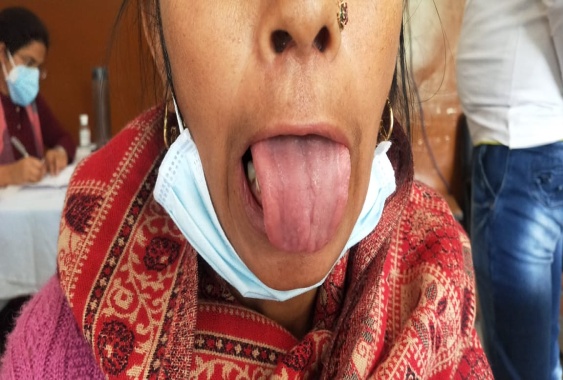
Figure 1: Complete Hemogram
Complete hemogram showed increased erythrocyte sedimentation rate. Schirmer test was less than 5mm (Figure 1). ANA, RA Factor, Anti- ccp, Anti SSa was positive. RA factor was positive for rheumatoid arthritis. Ultrasonography shows bilateral submandibular and parotid gland enlargement with multiple hypoechoic lesions within showing very high vascularity, likely to present systemic disorder like Sjögren’s syndrome. Incisional biopsy of lower lip was not done as patient was not giving consent.
Based on history, clinical presentation of the patient, and above investigatory findings, a confirmatory diagnosis of Secondary Sjögren syndrome was made with underlying disease being rheumatoid arthritis.
Sjögrens syndrome is a defined as a clinical symptom complex. It is an autoimmune destruction of exocrine glands (primary salivary and lacrimal) that produces the clinical manifestations of dry mouth, dry eyes (keratoconjunctivitis sicca), and in more than 50% of cases, parotid gland enlargement. Primary Sjögren syndrome is diagnosed when the syndrome is limited to this pattern of involvement. However, this pattern of involvement may be a manifestation of another -well-defined autoimmune disease such as rheumatoid arthritis, systemic lupus erythematosus, or primary biliary cirrhosis. In this context, it is referred to as secondary Sjögren syndrome [3,4].
Sjögren syndrome primarily affects women older than 40 years. However, newer diagnostic techniques such as parotid biopsies and antibody identifications have shown it in children and teenagers [5]. The parotid penlargements are usually asymmetric and painless. Complete physical examination of our patient at presentation and during the follow-up period of three months failed to reveal evidence of any associated connective tissue disease.
Treatment of Sjögren’s syndrome depends on the extent and severity of the clinical manifestations and is better instituted through a multidisciplinary approach. Symptomatic treatment includes artificial tears, salivary substitutes to relieve the symptoms and prevent local infectious complications like conjunctivitis and corneal inflammation, development of caries and periodontal disease, a thorough dental preventive program should be implemented in all cases. Corticosteroid treatment should be reserved for all the cases showing evidence of organ damage, significant leukopenia or severe clinical symptoms.
Pathogenesis of Sjögren syndrome is complex and uncertain, but thought to be similar to that of the benign lymphoephtlial lesion. 6-10% of cases undergo transformation to lymphoma, because of infiltration of lymphocytic cell [6].
Baldini, C., Talarico, R. et al. “Classification criteria for Sjögren’s syndrome: a critical review”. Journal of Autoimmunity, vol. 39, no. 1–2, pp. 9–14, 2012.
Stewart, C. M. et al. “Labial salivary gland biopsies in Sjögren’s syndrome: still the gold standard?”Oral Surgery, Oral Medicine, Oral Pathology, Oral Radiology, and Endodontology, vol. 106, no. 3, pp. 392–402, 2008.
Schortinghuis, J. et al. “Retention of lipiodol after parotid gland sialography”.International Journal of Oral and Maxillofacial Surgery, vol. 38, no. 4, pp. 346–49, 2009.
Vitali, C. et al. “Parotid sialography and minor salivary gland biopsy in the diagnosis of Sjögren’s syndrome: a comparative study of 84 patients”. Journal of Rheumatology, no. 15, pp. 262–67, 1988.
Gomes, P. D. et al. “Diagnostic approaches to Sjögren’s syndrome: a literature review and own clinical experience”. Journal of Oral and Maxillofacial Research, vol. 3, no. 1, pp. 13, 2012.
Gotoh, S. et al. “Validity of stimulated whole saliva collection as a sialometric evaluation for diagnosing Sjögren’s syndrome”. Oral Surgery, Oral Medicine, Oral Pathology, Oral Radiology, and Endodontology, vol. 99, no. 3, pp. 299–302, 2005.