Introduction: Nurses in hospitals have most of work stress due to workload, leadership style, professional conflict, emotional, lack of appreciation and shift work. It results in absenteeism, high error rates, and decreased work performance lead to patient safety threat. Effectiveness work stress management is needed to minimize the work stress of nurses. The objective is identified nurse work stress management. Method: Design using scoping review, inclusion criteria randomized control trial design, experimental design, and a cross-sectional survey. The process using PRISMA-SR via the Sciencedirect, Scopus and Pubmed databases was published from 2019 to 2023. A total of 810 articles were obtained from Pubmed (53 articles), Scopus (83 articles), Sciencedirect (674 articles). 6 full articles were obtained based on the objectives. Result: Six articles from a scoping review showing that smartphone-based stress management is effective in rectifying depression. Listening music during the afternoon shift shows 432Hz music more effectively than 440Hz and free activities. Restorative yoga for female nurses working night shifts has been shown effective in reducing work stress compared to conventional stress relief methods. The medical material management system app uses the shift check application; the workload of nurses is reduced effectively. Effective delegating behaviour and developing resilience effectively reduce stress. Rose aromatherapy has a positive effect compared to placebo. Conclusion: Stress management is effective in reducing nurses work stress; smartphone-based stress management, listening to 432 hz frequency music, restorative yoga, medical material management system app. effective delegation behaviour, develop resilience and rose aromatherapy.
Keywords
Management
Nurses Work Stress
Hospital
INTRODUCTION
Nurse profession has high risk that lead to work stress [1].Their work is one of the factors can cause stress, workload and the environment become stressor that trigger stress [2].
Work stress is a condition of human interaction with work in the form of tension causing physical and psychological imbalance. Work stress affects the emotions, thought processes, and conditions of an employee. Work stress affects productivity and the work environment and can interfere with individuals [3].
Two hundred Saudi nurses worked at government health centre, majority female (68,0%) thirty percent has severe stress [4]. 199 nurses worked in ICU at one of hospital in Taiwan shows 29,4% suffered acute stress after their patients die [5]. Result of study during pandemic covid 19, one of primary healthcare centre in Semarang with 156 respondent, the nurse suffered work stress around 68.7 % [6].
The impact of work stress results in disruption of physical health, psychological health, decreased work performance, and affects employees in decision making [3]. In nursing practice, work stress causes absenteeism, high error rates, and decreased work performance lead to a deadly threat to patient safety [7]. Lack of stress management skills at work causes difficulties in dealing with stress. [8].
Work stress management is the ability to use resources effectively to deal with mental and emotional disorders that arise. Work stress management’s objective is to prevent stress, accommodate the physiological effects of stress, improve quality of life for the better and prevent the development of short-term stress into long-term stress. [3].
Work as a nurse has a strenuous stressor. It needs effective work stress management to minimize the occurrence of work stress for nurses. Based on the review of work stress management for nurses, the researchers are interested in reviewing work stress management for nurses in hospitals. The objective of this scoping review is to identify work stress management for nurses in hospitals.
MATERIALS AND METHODS
Article review uses the Arksey and O'Malley methods [9] in conducting a scoping review analysis through five stages consisting of identifying research questions according to the topic, identifying research that is relevant to the topic taken, selecting research related to the topic, conducting analysis using a data matrix, and interpreting the findings. The article contains review questions: "What are the types of management to deal with work stress for nurses in hospitals?"
Article collected through online database Sciencedirect, Scopus dan Pubmed. The articles used were published between 2019 and 2023. Searching the article uses Boolean operator method "DAN", the key word is "Management" DAN "Nurse work stress" DAN "Hospital".
The inclusion criteria in this study involved all types of work stress management for nurses in hospitals around the world, using randomized control trial designs, experimental designs, and a cross-sectional survey, nurse respondents, nurse work stress management interventions, stress measuring instruments and research conducted in the hospital.
Chosen data with deleting duplication, article publish before last 5 year, and not complete treks of article. Most important in the selection of this research is the management of overcoming or reducing the work stress of nurses [9].
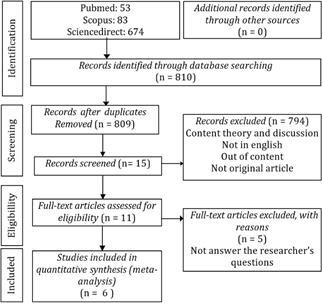
Assessment scoping review, literature search using reliable data based. Articles be analysed to find the necessary data, and analysed for similarities and differences. Titles, abstracts, and articles are reviewed according to inclusion and exclusion criteria. The data used in each of the articles found are full text, year of study, type of intervention, population and results. Figure 1 illustrates the process of searching and selecting articles using the Preferred Reporting Item Systematic Review and Meta-analysis for Scoping Review (PRISMA-SR)[10].
Figure 1: The PRISMA Flow Diagram of the Literature Review
Data Analysis/Synthesis
A total of 810 articles were obtained as literature sources from Pubmed (53 articles), Scopus (83 articles), Sciencedirect (674 articles). There is 1 same article based on excluded data and the remaining 809 articles. Furthermore, out of 809 articles, 794 articles were excluded because they only contained theory and discussion, not in English, the articles were not related to the topic and were not original articles. The results of the article screening obtained 15 articles. Furthermore, from 15 full text articles, 11 articles and 5 articles were excluded because they did not match the research objectives. Completeness of the articles obtained 6 articles analysed discussing the work stress management of nurses in hospitals.
RESULTS
Based on the results of the 6 articles, the analysis of work stress management for nurses in hospitals is shown in Table 1.
DISCUSSION
Scoping review gave benefit in managing effective nurses work stress. Based on analysis from scoping reviewobtained is below discussed.
Smartphone Based Stress Management Programs
iCBT program is effective to reduce depression of nurses in the hospital at Vietnam. Application smartphone stress management program-based includes behavioural activation, cognitive restructuring, problem solving, assertiveness, compassion and crafting. Other function of iCBT program is self-assessment of work-related stress and emotional states. Computerized CBT via the internet (iCBT) is very promising because the method is cost effective, can be accessed directly by workers more effectively for location and time, accessed by larger groups, privacy is maintained.
One randomized controlled trial (RCT) reported that a web-based stress management program, including cognitive behavioural techniques, was effective in reducing work-related stress among nurses in the USA. [8]. Another study showed that stress management program-based smartphones significantly increased the performance of nurses in Vietnam [11].
Listening Music
Listening music on 432 Hz is low-cost intervention and brief, be a source of managing anxiety and stress. Music tempo has direct correlation to changing of heart rate, respiratory rate and blood pressure. The effect depend on music speed then the style or subject music preference [12].
Other study show music intervention to cancer patient compare to standard care, has beneficial effect to anxiety, depression, hope, pain, and fatigue in adults with cancer [13].
Restorative Yoga
There is no significant changing in the vital sign before and after yoga sessions, and no weight changing after 4 weeks practices at home. Questionnaire score “means” for "psychological and physical stress reactions" significantly reduce after yoga sessions. The mean scores were significantly lower after 4 weeks at-home exercise than before or after yoga, or after 4 weeks of regular stress relief methods. These findings indicate that restorative yoga is effective in reducing work stress among female nurses working night shifts.
Yoga is defined in an environment that is predominantly spiritual and meditation. Movement in yoga, exercises of aerobic and anaerobic to improve musculoskeletal structure, insulin circuits, hormone systems, and metabolism. The benefits achieved help relaxation, self-awareness, increase cognitive flexibility, increase attention, acceptance and control of emotional reactions [20].
Other research states that work stress could impact to decreased work satisfaction, poor performance and overall health impacts. Activities based on yoga exercises are effective in reducing stress at work place [21].
Table 1: Summary of Included Article kind of management the nurse works stress in hospital
Author(s), Year of Publication, Origin/ Country of Origin
Aims/purpose, Study Population and size (if applicable)
Methodology/Methods, Intervention Type, Comparator and Details of these (e.g. duration of intervention) (if applicable)
Outcomes and details of these (e.g. how measure) (if applicable)
Key Findings that relate to scoping review question/s
[14] /Vietnam
The universal prevention effect test of two types of smartphone-based iCBT stress management programs (i.e., free choice sequence and fixed sequence) compared to the control group in improving symptoms of depression and anxiety in hospital nurses in Hanoi Vietnam
Method of a three-arm randomized controlled trial. Intervention of two types of programs (free choice and fixed order) from a smartphone-based stress management program. Participants were randomly allocated to Program A (free choice, multimodule stress management), Program B (fixed sequence, internet cognitive behavioral therapy, iCBT), and control group (medication as usual).
Program Module A (Free choice)
1. Behavioral Activation
2. Cognitive Restructuring
3. Troubleshooting
4. Assertive / Firmness
5. Respect yourself
6. Initiative and proactive in work
Program Module B (Sequential)
1. Transactional module and coping mechanism
2. The self-case formula is based on a cognitive behavioral model
3. Behavioral Activation
4. Cognitive Restructuring part 1
5. Cognitive Restructuring part 2 and Relaxation
6. Troubleshooting
Program B showed a significant effect on improving depressive symptoms at month 3 (p = 0.048), but not at month 7 (p = 0.92); D Cohen − 0.18 (95% CI − 0.34 to − 0.02) and 0.03 (95% CI − 1.00 to 1.05), respectively. Program A failed to show a significant effect at either 3 or 7 (months) follow-up (p > 0.05).
Although the effect was small, the iCBT program was effective in reducing nurses' depression.
Instrument:
1. Depression Anxiety and Stress Scales (DASS 21)
2. iCBT software Smartphone
Smartphone based stress management program B iCBT is effective in reducing nurse work stress
[15] / Italy
Knowing the effect of listening to music during breaks compared to regular breaks (without listening to music) on the anxiety level and vital parameters of the nurse on duty in the operating room.
Methods using Randomized, controlled, three-arm, double-blind, single-center clinical study. The intervention group was divided into 3 groups:
Group 1: listening to 440Hz music; Group 2: listening to 432Hz music; Group 3: free activity. The study was conducted during the afternoon shift.
Results: 54 health workers; 32 women (59.3%); mean age 39.64 years (SD ±9.94); the total measurements were 83. The median STAI X1 value decreased in all 3 groups from T0 to T1
Group 1: 34.5 vs 32, p=0.000; Group 2: 34 vs 29, p=0.001; Group 3 : 33 vs. 31, p=0.028).
Group 2 decreased mean respiratory rate and systolic blood pressure at T1 (-2.714/min, p=0.000 and -3.821 mmHg, p=0.031, respectively). Conclusion: Low-cost, brief listening to 432 Hz music effectively manages anxiety and stress.
Instruments: State-Trait Anxiety Inventory – (STAIX1), heart rate (HR), respiratory rate (RR), systolic/diastolic blood pressure, pain and productivity. The Likert scale was measured at the start (T0) and at the end of the exposure (T1).
Listening to music on 432hz frequency is effective in reducing nurse work stress
[16] / Japan
Determine whether restorative yoga methods are effective in relieving nurses' work stress. Participants were 20 female nurses in their 20s to 30s who work night shifts in Japanese hospitals
The method uses a randomized crossover trial. Intervention duration of 1-hour yoga session followed by 4 weeks of home exercises and 4 weeks of regular stress relief methods.
Results: Before to after the yoga session; Vital signs showed no significant change, there was no change in body weight after 4 weeks of practicing at home. The mean questionnaire score for "psychological and physical stress reactions" was significantly reduced after the yoga session. The mean scores were significantly lower after 4 weeks of home exercise than before or after yoga, or after 4 weeks of regular stress relief methods. This shows that restorative yoga is effective in reducing work stress for female nurses working the night shift
Instrument:
The level of stress was assessed by the Brief work Stress Questionnaire of the Ministry of Health
Restorative Yoga is effective in reducing nurse work stress
[17] / Taiwan
Develop clinical medical device management applications for nurses to reduce workload and increase the efficacy of medical device management. The subjects were 57 nurses in ICU of a hospital in Hsinchu
The single-group pre- and post-test experimental design was adopted. The results were analysed using SPSS, APP Inventor, and data mining modelling to determine the effect of the application. Structured questionnaire research tools, including open-ended questions covering aspects of nurses' workload, stress, and intentions to receive information, as well as demographic questionnaires, collect basic personal data, including gender, age, years of service, education level, level of nursing ability, ability to use IT products, and the unit type. Research time starts November 2019 to March 2020
After using the Shift Check Application, the average workload of nurses is effectively reduced, the reduction in the workload of nursing ability level N1 is greater than that of N2. This IT helps manage medical devices in clinical practice to have a significant effect on reducing nurse workload and increasing satisfaction.
Medical material
management system app is effective in reducing nurse work stress
[18] / United Arab Emirates.
Check management stress behaviours of nurses work during pandemic COVID-19 in UEA. 64 nnurses worked at isolation and ICU
a cross-sectional survey
Participants completed Google Form survey from two validated instruments: 10-items scale measuring perceived stress levels and 15-items stress management inventory.
78.1% of respondents reported moderate stress levels (Mean=18.03 and SD=5.33). Four elements stress management behavior (stress relief, developing resilience, using short-term coping, and effective delegation) and mean and SD were 17.62 ± 2.6, 17.42 ± 3.3, 8.88, respectively ± 1.47, and 23.98 ± 3.54. There is a significant positive correlation between the four elements of stress management inventory (p = 0.00).
The findings show a significant inverse correlation between perceived stress scores, effective delegation and developing resilience are effective stress management behaviors among nurses.
Stress Management Behaviors effective delegation and resilience development is effectice to reduce work stress
[19] / Iran
Test and comparations the effect of lavender and rose essential oil aromatherapy on nurses’ work stress. Sample of 118 nurses divided into three groups, lavender(n=39), rose(n=40), and sesame seeds as placebo (n=39)
Method Randomized controlled trial. Descriptive and inferential statistical tests. The level of statistical significance was set at p < 0.05. Nurses received lavender and rose scents for two hours a day for four weeks
There was a statistically significant difference between the groups at the end of the fourth week (p < 0.003). Rose aromatherapy has a positive effect on nurses' work stress at the end of the fourth week compared to placebo (p = 0.002).
Rose aromatherapy is a safe and non-pharmacological method that is effective in increasing self-comfort at work, can reduce dependence on drugs, effectively relieves work stress.
Measurement Tool Nursing Stress Scale (NSS)
Rose scent aromatherapy is effective to reduce work stress
Medical Material Management System App
Application Shift Check is management medical device application for nurses shows that the average workload of nurses is effectively reduced, especially the reduction in the workload of nursing ability level N1 is greater than N2. Utilization of information technology products has a significant effect on reducing nurse workload and increasing satisfaction.
Management medical inventory affects the quality of care. Routine counting of medical devices is an important job in nursing activities. Nurses need to check and register items before the shift starts and ensure the number of tools and the condition of the tools.
Shift check application is smartphone-based as medical device accessories. Model M2M (machine to machine), data uploaded through internet, Bluetooth, radio frequency identification (RFID), and other technology, while medical staff makes judgment according to recorded data. All the job documented, if any property missing during the sift, nurses must pay [17].
Other study shows using technology helps quality management of nursing, it has a significant effect on reducing nurses burden and increase head nurse satisfaction [22].
Stress Management Behaviours
Effective delegation and developing resilience are effective in stress management behaviours among nurses.
Delegation is an activity of one-person responsibility, completed by other, and accepts responsibility for completing appropriate activities. Delegation concept based on authority, responsibility, and good relations between those involved. Personal responsibility and professional of nurses to delegates the activities and ensure that delegates are educated, competent and experienced to be performed ensuring patient safety [23].
Result of other study An Integrative Review of Team Nursing and Delegation: Implications for Nurse Staffing during COVID-19show delegating education is very important for the nursing team, and evidence show improve knowledge, decision making, and nurse competency [24]. Many benefits have been reported from implementing delegation, including service efficiency and improved patient care [25].
Resiliency is rapid recovery of mental health during periods of exposure to a stressor, from potentially traumatic events, challenging life circumstances, critical life transition phases, or physical illness. [26].
Resilience significant to reduce fatigue and prevent mental health disorders. Biologically, uncontrolled stress affects the cognitive function of the brain, leading to compromise logical thinking [27].
How to develop resiliency:feel the works is meaningful and contribute the good, feel supported by family, friends, co-workers, enough sleep and eat, exercise at least 15 minutes a day, foster positive emotions, be grateful, feel sorry for yourself and other people, sharing stories, listening to music, spending time with religious practices or beliefs [28].
Aromatherapy
Aromatherapy with rose scent is one of the safest methods and non-pharmacological that can be use by nurse to increase self-comfort in workplace. This can reduce the dependence of nurses on medicines to relieve symptoms of work stress.
Work stress can stimulate nerve sympatric system and hormones such as adrenalin, cortisol, which results in symptoms of stress. Nursing science identify non-pharmacological therapy Aromatherapy is more effective, cheap, simple and low risk. Aromatherapy as non-pharmacological, complemented therapy and alternative, oil essential from nature for relaxing and mind control and body through aromatic essential oil lead to neurology effect and physiology, have been proven in so many countries and shows the effective of aromatherapy used increase in stress management [29].
Other studies have shown that essential oils are concentrated volatile aromatic liquids, extracted from natural plants with different chemical compositions, obtained by physical and chemical methods such as distillation and pressing. Essential oils exert neuropharmacological effects through the blood circulation or the olfactory system. Clinical studies show that aromatherapy can improve sleep quality, relieve preoperative and postoperative anxiety, relieve gynaecological pain [30].
CONCLUSION
Finding through scoping review there are 6 types of nurse work stress management effective in reducing nurse work stress: stress management smartphone based, listening music, restorative yoga, medical material management system app, stress management behaviours and aromatherapy.
Acknowledgment
Thank you to the education’s staff of Department of Nursing Science, Faculty of Medicine, Diponegoro University, especially to the organizer of manuscript camp event, thereby supporting the completion of this manuscript.
REFERENCE
[1] Herqutanto et al. “Stres kerja pada perawat di rumah sakit dan fasilitas pelayanan kesehatan primer.” eJournal Kedokteran Indonesia. vol. 5, no. 1. 2017. pp. 12–17. https:// doi.org/10.23886/ejki.5.7444.12-7.
[2] Suhaya, Intan and Hasmila Sari. “Tingkat stress perawat dalam merawat pasien dengan penyakit menular di rumah sakit umum daerah dr.Zainoel Abisin Banda Aceh.” Jim Fkep. vol. IV, no. 1. 2019. pp. 102–106.
[3] Asih, Gusti Yuli et al.Stress kerja. 2018.
[4] Abdoh, Duoaa Seddiq et al. “Prevalence and associated factors of stress among primary health care nurses in Saudi Arabia, a multi‑center study.” Journal of Family Medicine and Primary Care. vol. 6, no. 2. 2021. pp. 169–170. https:// doi.org/doi: 10.4103/jfmpc.jfmpc_222_21.
[5] Wang, Chao Ping et al. “Factors associated with critical care nurses’ acute stress disorder after patient death.” Australian Critical Care. vol. 35, no. 4. 2022. pp. 402–407. https://doi.org/10.1016/j.aucc.2021.06.007.
[6] Priyatna, Hendryk et al. “Gambaran tingkat kecemasan dan stress kerja tenaga kesehatan Puskesmas saat pandemi Covid-19.” Journal of Holistic Nursing and Health Science. vol. 4, no. 2. 2021. pp. 74–82.
[7] `Mekonen, Enyew Getaneh et al. “Work-Related Stress among Nurses Working in Northwest Amhara Referral Hospitals; a Burden for Hospitals.” International Journal of Africa Nursing Sciences. 2022. p. 100486. https://doi.org/ 10.1016/j.ijans.2022.100486.
[8] Imamura, Kotaro et al. “Effects of two types of smartphone-based stress management programmes on depressive and anxiety symptoms among hospital nurses in Vietnam: A protocol for three-arm randomised controlled trial.” BMJ Open. vol. 9, no. 4. 2019. pp. 1–10. https://doi.org/10.1136/ bmjopen-2018-025138.
[9] Westphaln, Kristi K. et al. “From Arksey and O’Malley and Beyond: Customizations to enhance a team-based, mixed approach to scoping review methodology.” MethodsX. vol. 8. 2021. p. 101375. https://doi.org/10.1016/j.mex.2021. 101375.
[10] Tricco, Andrea C. et al. “PRISMA extension for scoping reviews (PRISMA-ScR): Checklist and explanation.” Annals of Internal Medicine. vol. 169, no. 7. 2018. pp. 467–473. https://doi.org/10.7326/M18-0850.
[11] Sasaki, Natsu et al. “Effects of smartphone-based stress management on improving work engagement among nurses in Vietnam: Secondary analysis of a three-arm randomized controlled trial.” Journal of Medical Internet Research. vol. 23, no. 2. 2021. pp. 1–12. https://doi.org/10.2196/20445.
[12] Kulinski, Jacquelyn et al. “Effects of music on the cardiovascular system.” Trends in Cardiovascular Medicine. vol. 32, no. 6. 2022. pp. 390–398. https://doi.org/10.1016/j.tcm.2021.06.004.
[13] Bradt, J. et al. “Music interventions for improving psychological and physical outcomes in people with cancer (Review).” 2021. https://doi.org/10.1002/14651858.CD006911.pub4.www.cochranelibrary.com.
[14] Imamura, Kotaro et al. “Effect of smartphone-based stress management programs on depression and anxiety of hospital nurses in Vietnam: a three-arm randomized controlled trial.” Scientific Reports. vol. 11, no. 1. 2021. pp. 1–12. https://doi.org/10.1038/s41598-021-90320-5.
[15] Calamassi, Diletta et al. “Listening to music tuned to 440 hz versus 432 hz to reduce anxiety and stress in emergency nurses during the Covid-19 pandemic: a double-blind, randomized controlled pilot study.” Acta Biomedica. vol. 93, no. 4. 2022. https://doi.org/10.23750/abm.v93iS2.12915.
[16] Miyoshi, Yoko. “Restorative yoga for occupational stress among Japanese female nurses working night shift: Randomized crossover trial.” Journal of Occupational Health. vol. 61, no. 6. 2019. pp. 508–516. https://doi.org/ 10.1002/1348-9585.12080.
[17] Chen, Yi Tsao et al. “The effect of medical material management system app on nursing workload and stress.” BMC Nursing. vol. 21, no. 1. 2022. pp. 1–11. https://doi.org/ 10.1186/s12912-022-00806-4.
[18] Dabou, Eman Abdelaziz Rashad et al. “Work-related Stress Management Behaviors of Nurses During COVID-19 Pandemic in the United Arab Emirates.” SAGE Open Nursing. vol. 8. 2022. https://doi.org/10.1177/23779608221084972.
[19] Emadikhalaf, Mohsen et al. “Effects of rose and lavender scents on nurses’ job stress: A randomized controlled trial.” Explore. no. January. 2023. https://doi.org/10.1016/j.explore.2023.01.002.
[20] Cocchiara, Rosario Andrea et al. “The use of yoga to manage stress and burnout in healthcare workers: A systematic review.” Journal of Clinical Medicine. vol. 8, no. 3. 2019. https://doi.org/10.3390/jcm8030284.
[21] Zhang, Michael et al. “Physical relaxation for occupational stress in healthcare workers: A systematic review and network meta-analysis of randomized controlled trials.” Journal of Occupational Health. vol. 63, no. 1. 2021. pp. 1–16. https://doi.org/10.1002/1348-9585.12243.
[22] Pei-Ying, K. O. et al. “The impact of a multilevel interactive nursing quality control and audit application on nursing quality management.” BMC Nursing. vol. 20, no. 1. 2021. pp. 1–11. https://doi.org/10.1186/s12912-021-00767-0.
[23] Crevacore, Carol et al. “Integrative review: Factors impacting effective delegation practices by registered nurses to assistants in nursing.” Journal of Advanced Nursing. no. August 2021. 2022. pp. 1–11. https://doi.org/ 10.1111/jan.15430.
[24] Beckett, Cynthia D. et al. “An Integrative Review of Team Nursing and Delegation: Implications for Nurse Staffing during COVID-19.” Worldviews on Evidence-Based Nursing. vol. 18, no. 4. 2021. pp. 251–260. https://doi.org/10.1111/ wvn.12523.
[25] Shore, Colin B. et al. “Delegation of medication administration from registered nurses to non-registered support workers in community care settings: A systematic review with critical interpretive synthesis.” International Journal of Nursing Studies. vol. 126. 2022. p. 104121. https://doi.org/10.1016/j.ijnurstu.2021.104121.
[26] Kunzler, Angela M. et al. “Psychological interventions to foster resilience in healthcare professionals.” Cochrane Database of Systematic Reviews. vol. 2020, no. 7. 2020. https://doi.org/10.1002/14651858.CD012527.pub2.
[27] Zenani, Nombulelo E. et al. “Strategies to enhance resilience to cope with workplace adversities post-COVID-19 among ICU nurses.” Curationis. vol. 45, no. 1. 2022. pp. 1–8. https:// doi.org/10.4102/curationis.v45i1.2345.
[28] Albott, Cristina Sophia et al. “Battle Buddies: Rapid Deployment of a Psychological Resilience Intervention for Health Care Workers During the COVID-19 Pandemic.” Anesthesia and Analgesia. vol. 131, no. 1. 2020. pp. 43–54. https://doi.org/10.1213/ANE.0000000000004912.
[29] Tabatabaeichehr, Mahbubeh and Hamed Mortazavi. “The Effectiveness of Aromatherapy in the Management of Labor Pain and Anxiety: A Systematic Review.” Ethiopian journal of health sciences. vol. 30, no. 3. 2020. pp. 449–458. https://doi.org/10.4314/ejhs.v30i3.16.
[30] Liang, Jiahao et al. “Essential oils: Chemical constituents, potential neuropharmacological effects and aromatherapy - A review.” Pharmacological Research - Modern Chinese Medicine. vol. 6, no. November 2022. 2023. https://doi.org/ 10.1016/j.prmcm.2022.100210.
License
Creative Commons Attribution-NonCommercial-NoDerivatives 4.0 International License
All papers should be submitted electronically. All submitted manuscripts must be original work that is not under submission at another journal or under consideration for publication in another form, such as a monograph or chapter of a book. Authors of submitted papers are obligated not to submit their paper for publication elsewhere until an editorial decision is rendered on their submission. Further, authors of accepted papers are prohibited from publishing the results in other publications that appear before the paper is published in the Journal unless they receive approval for doing so from the Editor-In-Chief.
Himalayan Journal of Nursing and Midwifery open access articles are licensed under a Creative Commons Attribution-Share A like 4.0 International License. This license lets the audience to give appropriate credit, provide a link to the license, and indicate if changes were made and if they remix, transform, or build upon the material, they must distribute contributions under the same license as the original.
Recommended Articles
Research Article
Self-Care Practices in Primary Dysmenorrhea among Nursing Students at AL- Diwaniyah Governorate
Fadia Hussein Ali,
Haider Abd AL Ameer Twair Hamad
Published: 30/03/2024
Download PDF
Cite
x
APA
Ali, F. H. & Hamad, H. A. A. A. T. (2024). Self-Care Practices in Primary Dysmenorrhea among Nursing Students at AL- Diwaniyah Governorate. Himalayan Journal of Nursing and Midwifery, 3(1), None-None.
MLA
Ali, Fadia H. and Haider Abd A. A. T. Hamad. "Self-Care Practices in Primary Dysmenorrhea among Nursing Students at AL- Diwaniyah Governorate." Himalayan Journal of Nursing and Midwifery 3.1 (2024): None-None.
Chicago
Ali, Fadia H. and Haider Abd A. A. T. Hamad. "Self-Care Practices in Primary Dysmenorrhea among Nursing Students at AL- Diwaniyah Governorate." Himalayan Journal of Nursing and Midwifery 3, no. 1 (2024): None-None.
Harvard
Ali, F. H. and Hamad, H. A. A. A. T. (2024) 'Self-Care Practices in Primary Dysmenorrhea among Nursing Students at AL- Diwaniyah Governorate' Himalayan Journal of Nursing and Midwifery 3(1), pp. None-None.
Vancouver
Ali FH, Hamad HAAAT. Self-Care Practices in Primary Dysmenorrhea among Nursing Students at AL- Diwaniyah Governorate. Himalayan Journal of Nursing and Midwifery. 2024 Jan;3(1):None-None.
Download PDF
Research Article
General public Knowledge, Attitude and Practices Regarding COVID-19: a Cross-Sectional study in Himachal Pradesh
Hanish Kumar Rana,
...
Badal Katoch
Published: 10/07/2022
Download PDF
Cite
x
APA
Rana, H. K., Katoch, R. & Katoch, B. (2022). General public Knowledge, Attitude and Practices Regarding COVID-19: a Cross-Sectional study in Himachal Pradesh. Himalayan Journal of Nursing and Midwifery, 1(2), 1-4.
MLA
Rana, Hanish K., Riya Katoch and Badal Katoch. "General public Knowledge, Attitude and Practices Regarding COVID-19: a Cross-Sectional study in Himachal Pradesh." Himalayan Journal of Nursing and Midwifery 1.2 (2022): 1-4.
Chicago
Rana, Hanish K., Riya Katoch and Badal Katoch. "General public Knowledge, Attitude and Practices Regarding COVID-19: a Cross-Sectional study in Himachal Pradesh." Himalayan Journal of Nursing and Midwifery 1, no. 2 (2022): 1-4.
Harvard
Rana, H. K., Katoch, R. and Katoch, B. (2022) 'General public Knowledge, Attitude and Practices Regarding COVID-19: a Cross-Sectional study in Himachal Pradesh' Himalayan Journal of Nursing and Midwifery 1(2), pp. 1-4.
Vancouver
Rana HK, Katoch R, Katoch B. General public Knowledge, Attitude and Practices Regarding COVID-19: a Cross-Sectional study in Himachal Pradesh. Himalayan Journal of Nursing and Midwifery. 2022 Jul;1(2):1-4.
Download PDF
Research Article
Knowledge Regarding Cardio Pulmonary Resuscitation in Pregnant Women among Registered Nurses Working in Selected Hospitals of Shimla
Sangeeta Devi,
Pooja Rani Sood
Published: 18/02/2022
Download PDF
Cite
x
APA
Devi, S. & Rani Sood, P. (2022). Knowledge Regarding Cardio Pulmonary Resuscitation in Pregnant Women among Registered Nurses Working in Selected Hospitals of Shimla. Himalayan Journal of Nursing and Midwifery, 1(1), 1-4.
MLA
Devi, Sangeeta and Pooja Rani Sood. "Knowledge Regarding Cardio Pulmonary Resuscitation in Pregnant Women among Registered Nurses Working in Selected Hospitals of Shimla." Himalayan Journal of Nursing and Midwifery 1.1 (2022): 1-4.
Chicago
Devi, Sangeeta and Pooja Rani Sood. "Knowledge Regarding Cardio Pulmonary Resuscitation in Pregnant Women among Registered Nurses Working in Selected Hospitals of Shimla." Himalayan Journal of Nursing and Midwifery 1, no. 1 (2022): 1-4.
Harvard
Devi, S. and Rani Sood, P. (2022) 'Knowledge Regarding Cardio Pulmonary Resuscitation in Pregnant Women among Registered Nurses Working in Selected Hospitals of Shimla' Himalayan Journal of Nursing and Midwifery 1(1), pp. 1-4.
Vancouver
Devi S, Rani Sood P. Knowledge Regarding Cardio Pulmonary Resuscitation in Pregnant Women among Registered Nurses Working in Selected Hospitals of Shimla. Himalayan Journal of Nursing and Midwifery. 2022 Jan;1(1):1-4.
Download PDF
Review Article
Prevention of Extravasation Non-Cytotoxic Agents (Review Study)
Batool Kadham Hussin
Published: 20/10/2022
Download PDF
Cite
x
APA
Hussin, B. K. (2022). Prevention of Extravasation Non-Cytotoxic Agents (Review Study). Himalayan Journal of Nursing and Midwifery, 1(2), None-None.
MLA
Hussin, Batool K.. "Prevention of Extravasation Non-Cytotoxic Agents (Review Study)." Himalayan Journal of Nursing and Midwifery 1.2 (2022): None-None.
Chicago
Hussin, Batool K.. "Prevention of Extravasation Non-Cytotoxic Agents (Review Study)." Himalayan Journal of Nursing and Midwifery 1, no. 2 (2022): None-None.
Harvard
Hussin, B. K. (2022) 'Prevention of Extravasation Non-Cytotoxic Agents (Review Study)' Himalayan Journal of Nursing and Midwifery 1(2), pp. None-None.
Vancouver
Hussin BK. Prevention of Extravasation Non-Cytotoxic Agents (Review Study). Himalayan Journal of Nursing and Midwifery. 2022 Jul;1(2):None-None.
Dyaningsih, M., Dwidiyanti, M. & Dwiantoro, L. (2023). Work Stress Management for Nurses in Hospital. Himalayan Journal of Nursing and Midwifery, 2(2), 1-6.
MLA
Dyaningsih, Murni, Meidiana Dwidiyanti and Luky Dwiantoro. "Work Stress Management for Nurses in Hospital." Himalayan Journal of Nursing and Midwifery 2.2 (2023): 1-6.
Chicago
Dyaningsih, Murni, Meidiana Dwidiyanti and Luky Dwiantoro. "Work Stress Management for Nurses in Hospital." Himalayan Journal of Nursing and Midwifery 2, no. 2 (2023): 1-6.
Harvard
Dyaningsih, M., Dwidiyanti, M. and Dwiantoro, L. (2023) 'Work Stress Management for Nurses in Hospital' Himalayan Journal of Nursing and Midwifery 2(2), pp. 1-6.
Vancouver
Dyaningsih M, Dwidiyanti M, Dwiantoro L. Work Stress Management for Nurses in Hospital. Himalayan Journal of Nursing and Midwifery. 2023 Jul;2(2):1-6.


 Download PDF
 Download XML