Contents
Download PDF
pdf Download XML
2097 Views
168 Downloads
Share this article
Research Article | Volume 4 Issue 1 (Jan-June, 2023) | Pages 1 - 24
The transfer from Standard and Colloquial Arabic While Using Simple English prepositions by Saudi Arabic Speaking Learners of English as a Second Language at The University of Tabuk
1
Ministry of Education, University of Tabuk
Under a Creative Commons license
Open Access
Received
Nov. 22, 2022
Revised
Dec. 4, 2022
Accepted
Jan. 12, 2023
Published
Feb. 3, 2023
Abstract

There are various theories surrounding language transfer from Arabic to English, with theories such as interlanguage (IL) theory, transfer theory and diglossia all surfacing over the last 50 years. Some researchers suggest that Arabic learners of English rely heavily on their mother tongue to ‘transfer’ (that is, translate), either positively or negatively, from their first language (L1) to the target language (L2). Moreover, many researchers and speakers of Arabic claim that there are two varieties of this language: Standard Arabic (used in formal situations such as religious occasions and education) and Colloquial Arabic (used socially or with family members). The level of transfer from either of these varieties to achieve the correct English translation however remains to be seen, especially when it comes to complicated English grammar phenomena, such as prepositions. This study aims to explore the reality of the transfer from both Standard and Colloquial Arabic into English by female Saudi learners who are currently learning English as a second language (L2) at the University of Tabuk in Saudi Arabia. To examine the reality of this phenomenon, a multiple- choice task was given to 24 female undergraduate students studying at the Languages and Translation Department at the University of Tabuk. In addition, an assessment test was used to identify the students’ proficiency in the English language. The multiple-choice task determined the way in which the transfer process from both Standard (H) and Colloquial Arabic (L) to English occurred either positively or negatively. It was clear that the L2 learners in this study relied more heavily on their Standard Arabic (H) rather than Colloquial Arabic (L) in their perception and use of English prepositions. Moreover, when H and L were similar in rule structure to English in terms of prepositional use (SH and SL), students scored higher marks, than when H and L were dissimilar in prepositional structure to English (DH and DL). Thus, it was deemed easier for participants in this study to transfer positively from SH and SL, than DH and DL. Therefore, Standard Arabic can be seen as a source for positive transfer whereas Colloquial Arabic reflects how the student transfers negatively while using some English prepositions. The impact of this research is to produce greater insight to teachers of English to L2 learners in Saudi Arabia and other Arabic-speaking countries, to enable them to focus more heavily on the use of Standard Arabic in the teaching of English, so as to enable learners to translate to English more effectively. Recommendations are provided for teachers of English at the University of Tabuk in Saudi Arabia, although further research in this area is of course required for results to be generalisable to the rest of the Arabic-speaking population. Recommendations for further research are given to this effect.

Keywords
INTRODUCTION

Background to Research

All languages have two main variations: standard and non-standard. The majority of studies that explore L2 language learning have focused on the standard form. Nevertheless, the use of non- standard language becomes more prevalent in the oral and written production and learning of certain languages, depending on the extent to which it is used by L1 individuals for communication; thus,  this  is  an  area  that  requires  greater  research  and understanding if it is to be taught and used effectively for L2 learners of English from L1 Arabic countries. According to Corder [1], L1 (that is, one’s mother tongue or first language) is seen as a source of prior knowledge, a foundation that an L2 learner depends on while learning any second or foreign language. Corder [1] claims that the cross-linguistic influence can either lead to positive transfer in the translation of the L1 language to the L2 language, resulting in the correct forms being used in the target language or it can lead to negative transfer, which results in the incorrect forms being used and thus a lack of fluency and accurateness in the target language.


Sometimes, Arab learners of English as a foreign language find it difficult to determine the accurate mappings between Arabic and English prepositions [2]. Celce-Murcia and Larsen [3] indicate that many English foreign language learners, regardless of their mother tongue, experience difficulty with English prepositions. EFL (English as a Foreign Language) learners usually try to use their mother tongue system as a standard whilst learning the English language [4].


Hence, this would lead EFL learners to commit errors when writing essays or translating tests from Arabic into English and vice versa [2]. Moreover, English prepositions are highly polysemous [5] and the same word can be used in a variety of different ways. Tyler and Evans [6] discuss different English prepositions and explore their spatial and embodied meanings. According to Tyler and Evans [6], the syntactic configuration of lexical items (words) plays a role in the interpretation of a preposition used in any sentence.


Many researchers examine the L1 influence upon the L2 but few of them have explored Arabic learners’ production of English prepositions. More specifically, no studies have yet investigated the positive and the negative transfer from both classical/Standard (high variety -H) and Colloquial (low variety-L) Arabic as a result of the cross-linguistic influence.


Many studies have investigated how L2 learners might be influenced by Standard Arabic as their first language and may have transferred meanings from Standard Arabic when using English prepositions. Nevertheless, the use of non-standard (Colloquial) Arabic has become much more prevalent in the everyday speech of Saudi Arabians; hence, it is relevant that non-standard Arabic and the way that this might be used when transferring to English, especially in terms of English prepositions, is explored.


Hudson [7] pointed to Ferguson [8] contributions to the studies of diglossia in which he examined the diglossic situations among different languages. Diglossia is where two languages or dialects are spoken simultaneously by one community. According to Walters [9], any two varieties of the same language can become increasingly dissimilar, suggesting that the formal written variety remains unchanged, whereas the informal spoken variety, as colloquial dialect, continues to evolve. Although Standard Arabic is stable amongst most Arabic countries, given that it is the language of the Holy Quran, the Arabic dialects differ from one Arabic country to another.


In general, the standard language is used in formal situations such as education and the media; by contrast, colloquial language (or dialect) is used in informal situations such as conversations with friends or families [10]. The Standard Arabic is described as, ‘fusha’ and the Colloquial Arabic as ‘ammiyya’ or ‘dariga’ in North Africa and ‘dialect’ in Western countries and publications [10]. Versteegh [10] described the differences of the African varieties of Arabic compared to other Arabic varieties and highlighted how dissimilar it is to other Arabic dialects, to the extent that it is practically a different language. Gulf Arabic is one of the Arabic dialects used in Gulf countries such as the United Arab Emirates (UAE), Kuwait, Oman, Saudi Arabia, Qatar, Bahrain and Yemen [11]. However, Gulf Arabic differs from other Arabic dialects that are used in North Africa [10].


Aims and Objectives of Current Study

This study aims to explore how the cross-linguistic influence could lead female Arabic L2 learners of English to transfer their L1 into the target language, either positively or negatively. Both Colloquial (Gulf) Arabic (L) and Standard Arabic (H) will be investigated. The goal of such a research study is to provide recommendations to university lecturers and supervisors when teaching Arabic L1 learners of English at the University of Tabuk in Saudi Arabia. Moreover, gaps in the current literature will, it is hoped, be filled, enabling areas of further research to be highlighted.


In order to achieve this aim, various objectives must be met. Thus, this study aimed to:


  • Explore the meaning and use of prepositions in English, Standard Arabic and Colloquial Arabic

  • To identify the nature of Arab learners’ production of English prepositions

  • To ascertain how far Colloquial or Standard Arabic is used by L2 learners of English at the University of Tabuk in Saudi Arabia

  • To explore how far transfer occurs positively or negatively from both Standard and Colloquial Arabic

  • To provide recommendations to teachers of L2 English in Arabic (Gulf) states, to help with their task of teaching English fluency to Arabic speakers

  • To provide recommendations for further research into this area in future


Given the focus of most studies on positive and negative transfer from Standard Arabic only, this study aims to incorporate the investigation of the use of Colloquial Arabic by L1 speakers of Arabic to learn and translate/transfer to English as a second language (ESL) when using prepositions. Recent studies have shown that L2 learners of English do indeed tend to transfer from their colloquial language in addition to their standard language [12,13]; thus, this study will attempt to apply this rule to the use of both Standard and Colloquial Arabic for ESL learners in Saudi Arabia.


Structure of Dissertation

This study begins with Chapter 2, a literature review and the theoretical background to the research, exploring English prepositions, before investigating a range of variables that can impact on language transfer, such as linguistic and cultural distance, proficiency and the characteristics   of   the   L1   and   L2   languages.  Moreover, theories such as IL and transfer theory are explored and the phenomenon of diglossia is investigated. Chapter 3 then presents the methodology that was used to investigate the use of Colloquial and Standard Arabic when transferring to English prepositions by female ESL learners at the University of Tabuk in Saudi Arabia. Chapter 4 presents the results gained from implementing this methodology and Chapter 5 discusses these results, with reference to the findings of the literature review. Chapter 6 then concludes the dissertation and provides recommendations both to ESL teachers at the University of Tabuk, as well as for further research in this area.


Theoretical Background

Introduction: This chapter sets out some of the previous research conducted into the transferring of Colloquial and Standard Arabic into English (and vice versa), as well as transferring to English prepositions from other L1 languages in general. Firstly, prepositions and their meanings are explored, before transference is described and the variables affecting language transfer are given. Issues such as diglossia are also explored, as well as differences between Arabic and English and the role that Colloquial and Standard Arabic play in transference to English. Finally, the hypothesis is given for this study.


What are Prepositions?

Before exploring how L2 learners of English transfer from their L1 language to English, it is important to understand what prepositions are in English. The Cambridge Dictionary [14] defines English prepositions as, ‘in grammar, a word that is used before a noun, a noun phrase or a pronoun, connecting it to another word.’ The example is given of the words ‘in’ and ‘down’ in the sentences, ‘we jumped in the lake’ and ‘she drove down the track.’ Prepositions in English may be a single word, such as ‘a’, ‘after’, ‘concerning’ ‘out’, ‘towards’ or ‘upon,’ a double word, such as ‘regardless of’, ‘thanks to’, ‘up to’, ‘opposite of’ and ‘rather than’ or even three words, such as ‘in place of’, ‘on behalf of’ or ‘with regard to,’ for example Huddleston and Pullum [15].


Prepositions for L2 Learners of English

A study conducted by Alayash [12], presented at an annual conference, aimed to identify the source of difficulties that lead Libyan students to misuse English prepositions. In a discussion of the results, Alayash [12] states, ‘...it seems [that] the students resort more often to Colloquial Arabic than Standard Arabic in choosing English prepositions.’ Furthermore, Asma [13] investigated whether or not Algerian students rely on Standard Arabic when they use English prepositions. Asma [13] discussed the positive and negative transfer from Standard Arabic into English. She designed a multiple-choice task and noticed that Standard Arabic is not the only source of transfer and based on her findings, Asma [13] observed that Algerian students used the equivalent  forms  that  exist  not  only  in  Standard Arabic  but  that  the  participants  also  sometimes  used the   equivalent   forms   present   in   Algerian   Arabic (the dialect), as well as French as a result of the colonialism administrated by France in July 1930 (despite subsequently gaining its independence in July 1962) [16].


For instance, Asma [13] found that the usage of the English preposition ‘since’ is positively influenced by not only its equivalent of the Standard Arabic preposition ‘munthu’ but also its equivalent of the French preposition ‘depuis,’ as well as the equivalent of the Algerian Arabic preposition ‘melli.’ Hence, the students transfer positively from three different variations of languages: two are variations of the Arabic language (Standard Arabic and Algerian Arabic) and the third is a separate language (French). Additionally, Asma [13] noticed that the students in this study transferred positively from Standard Arabic and French more than they transferred from Algerian Arabic and that they also transferred negatively from Standard Arabic more than from both Algerian Arabic and French. Thus, in general, Algerian Arabic students in Asma [13] used Standard Arabic more frequently to transfer from Arabic to English, whether this was correct or not and are relying more heavily on the rules of H (Standard Arabic) than their colloquial forms when transferring to English. Therefore, the researcher of the current study aims to examine such observations by conducting an experiment on Saudi female students in the Language and Translation Department at the University of Tabuk, Saudi Arabia, in order to examine the reality of such observations within this context and to determine if Asma [13] findings of Algerian Arabic students can be applied here.


Language Transference

Language transference has been mentioned several times and it is imperative that a clear understanding of positive and negative transference is gained in order to progress with the study. Learning transfer, according to James [17], is when the rules of the first language (L1) are transferred onto the target language (L2). This transfer may either be a hindrance or a help to accurate language learning and usage. When transfer is harmful or a hindrance, it is dubbed ‘negative transfer’ or interference [18]. When the grammar from one language (L1) clashes with that of L2, the student can use one of the following solutions:


  • Over generalise the rules of L2 and apply them to all circumstances, situations and contexts that appear to be related

  • Ignore the rules of L2 and instead use the rules of L1

  • Apply the rule incompletely or incompetently

  • Create a new, imaginary rule based on their understanding of the rule in the L2 [18]


The type of mistakes that individuals make depends on their mother tongue (L1), their own personality and culture and their familiarity with English (or other L2).


Webster [19] states that the word ‘transfer’ is taken from the Latin word ‘tranferre,’ which means ‘to carry, to bear or to print, impress or otherwise copy from one surface to another.’ It can also be used to refer to the carry-over or generalisation of learned responses from one type of situation to another. Thus, transfer in itself is a neutral word [20].


Within language learning, behaviourists tend to see transfer as a means of habit formation, suggesting that habits from one’s L1 will be carried over to the L2. This is highlighted by Lado [21], who states:


  • Individuals tend to transfer the forms and meanings and the distribution of forms and meanings of their native language and culture to the foreign language and culture both productively when attempting to speak the language and to act in the culture and receptively when attempting to grasp and to understand the language and the culture as practiced by natives


Ellis [22] suggests that transfer can come in various forms, such as negative transfer (errors) and positive transfer (facilitation). Positive transfer is when the rules of L1 can be used to facilitate the learning of L2, given the similarities between the two. Allen and Corder [23] highlight this, stating, ‘positive transfer helps new learning, for instance, it is easy to learn to pronounce aspirated voiceless stops in a second language if the language also has aspirated voiceless stops.’ Thus, similarities between two languages or a prior understanding of the rules of L2, ensure that an ESL learner may be assisted in their learning and experience positive transfer, instead of being hindered and experiencing negative transfer.


Negative transfer is the term often given to the hindrance caused when learning is impeded by differences between the rules of L1 and L2. Weinreich [24] calls negative transfer ‘interference,’ stating that:


  • When a process of second language learning takes place, those linguistic phenomena, which are similar in form, meaning and distribution are regarded as facilitating the process and the transfer is seen as positive. If they are dissimilar, the transfer is considered negative and acquisition is viewed as distorted because the two structures differ. The phenomenon involved in these difficulties is called interference. Thus, this phenomenon is equated with difficulty in learning a L2 as an outcome of differences of the two language structures


Positive and negative transference are used in this study to refer to the facilitation (positive) or hindrance (negative) of Arabic (both colloquial and standard) to the L1 individuals when speaking, writing or reading English as a second language (ESL). Negative transference is often thought to occur when the structure of L1 is different to L2, which means that acquisition of the L2 is more difficult, taking longer, given the ‘newness’ of the L2 structure, which must also be learnt and understood by the learner, however alien it might seem. Naturally, it must be understood that there are those researchers, such as Dulay and Burt [25], that do not believe transfer plays any significant role in an L1’s interlanguage (L2).


Variables Affecting Language Transfer

There are a variety of variables affecting language transfer, which should be addressed if the true nature of positive and negative transference is to be discerned between Arabic and English as a Second Language.


Linguistic Distance & Cultural Distance

Close languages usually share a number of similarities that help the learner to acquire the target language easily; on the other hand, the L2 learner needs to understand the system of the target language if there is a large structural ‘distance’ or dissimilarity between two given languages [26]. Hence, positive transfer can take place if there are similarities between the source language (L1) and the target language (L2), whereas the differences between them can lead to negative transfer, as an individual does not know the structural ‘map’ of the second language and may attempt to apply the structural rules of L1 to L2, creating dissonance between the two and a lack of proficiency in L2 [26].


A cultural distance can also affect (either positively or negatively) the process of L2 learning. Zhang [27] claims that a similar cultural background of two given languages may help a L2 learner find certain similar elements between the two languages; in contrast, an L2 learner may face difficulties if s/he deals with a cultural background that differs from her/his L1. This again is a result of the structural and cultural ‘map’ that a learner must navigate. If it is similar to an L1’s native language [26], then they may be able to transfer their current knowledge more easily and apply this accurately to an L2 language. However, the more distance or difference there is between the cultures, the greater the likelihood that the two language structures (L1 and L2) will clash and negative transfer will occur.


Proficiency

Ringbom [28] argues that the extent of transfer is determined by proficiency in one’s L1. Hence, it can be predicted that negative transfer may lead to low L2 proficiency since the learner has a lower degree of proficiency in his L1. On the other hand, positive transfer may lead to high L2 proficiency since he/she has a higher degree of proficiency in his/her L1 [28]. This is a natural hypothesis to make, since the more one understands their own L1 structural ‘map’, the greater the likelihood that they will understand similarities and differences between their L1 and the L2 structure [26].


General Characteristics of Prepositions in English and Arabic

Kharma and Hajjaj [29] point out that most English sentences are constructed with prepositions, reflecting the vital importance of the use of prepositions when learning a language. At the same time, many Arab learners of English as a second language (ESL) face great difficulties in the usage of some English prepositions. On the other hand, Jordens [30] indicates that problems that occur as a result of language transfer can be eliminated by adopting certain strategies. Saudi students learn most about English in primary, intermediate and secondary schools and those who are not high-achievers during the early stages may face some difficulty in using the grammatical rules of English correctly in their later ESL learning.


School texts, references and dictionaries provide both English and Arabic speakers with definitions of prepositions. Nevertheless, there is no clear explanation to illustrate their functions; therefore, learners are dependent on memorisation of how such prepositions can be used [31]. On the other hand, Ringbom [32] suggests that the cross-linguistic similarity between the source and the target language has a facilitative effect on learning the target language. Therefore, many Arab learners find that some English prepositions are easier to understand. However, not all English prepositions have an equivalent meaning in Arabic. Ringbom [32] focuses on the role of L1 and states that it affects L2 comprehension and production. It is important to emphasise that the transfer in comprehension is as important as it is in production, because comprehension precedes production and it affects the way one understands a text [32].


Zughoul [33] defines prepositions as, ‘function words that link words, phrases or clauses to other words in the sentence. They are not inflected and they express ideas such as location, destination, direction of motion, time and manner’ [33]. In some cases, Arabic learners must learn the English prepositions by rote, as often there is no specific ‘rule’ to their usage in English. This is not helpful for those that prefer to apply rules and structure to the use of language or those that may experience issues in memorisation.


Some Syntactic Properties of Arabic and English Prepositions

Arabic words are classified into three groups: noun, verbs and particles. Prepositions are classified under particles and they are called ‘Huruf Aljar’ [34]. Arab grammarians, such as Hassan and Abdullah [35], divide these prepositions into two types:


  • Separate or independent prepositions such as [an = about], [munthu = since], [ala = on] and [ila = to]

  • Inseparable prepositions that come as prefixes, such as [bi = as], [li = to], [ka = like] [35]


Zughoul [33] illustrates the meaning of some English and Arabic prepositions with the following examples:


  • On = /əlа/

It is on the shelf

( It is )            (on) ( the shelf) (Inahu)     ( ala )     (arraf)

  • In = /fi/ (as a separate preposition), /bi/ = as (inseparable preposition)

I am in the library

( I am) ( in) (the library )

(Ana) (fi) ( almaktaba) (as a separate preposition) (Ana) ( bilmaktaba) (inseparable preposition)

  • To = /ila/

I went to Tripoli

( I ) (went) (to)           (Tripoli). (Ana) ( thahabtu) ( ila) (tarabulus)

  • With = /ma'a/ I ate with the boy

( ate) ( with) (the boy). (Ana) (akaltu) (ma'a) (alwaldu).

  • From = /min/

I took it from him

(took it) (from him) (Ana)                        (akatuhu)              (minhu)

  • Of (this word only exists in English) I am proud of him

(I am) ( proud) (of him).

(Ana) (fakurun) (bihi) (/bi/ is used here in Arabic)

  • At (this word only exists in English)

I am at home

(I am) (at) (home)

Ana fi albeit (/fi/ is used here in Arabic)


The Arabic language, particularly colloquial Arabic, contains compound prepositions such as [/min ala/ = from on] which corresponds to the English preposition ‘from’ [36]. However, this compound preposition is not used in Standard Arabic, which uses [min = from] instead [36]. An example of this, given by Almaloul [36], is shown below:


  • The book dropped from the table

(dropped) (the book ) (from) (the table)

(Tah )            (alkitab)                ( min ala) (atawila) (Colloquial Arabic) (Saqata)       ( alkitab) ( min)  (altawila) (Standard Arabic)


Similarly, the English preposition ‘of’ does not exist in the Arabic language, either Standard or Colloquial. Rather, in Standard Arabic, the possessed and the possessor are formed in a particular sequence (possessed-possessor), as follows:


  • Hujrat almudaressen nadifah (Standard Arabic)

The room the teachers clean (direct translation to English)

The room of the teachers is clean (actual meaning in English) [36]


Sometimes, in Standard Arabic, the possessor is marked by a special ending, which differs depending on the gender of the possessor as well as how many there are. For example:


  • Kitab Ahmed ala arraf (Standard Arabic)


The book Ahmed on the shelf (direct translation in English) Ahmed's book is on the shelf (actual meaning in English). In the above example, the possessor Ahmed is singular


However, this marker is ignored in Colloquial Arabic; for instance, although there is a difference between the male and female, sometimes the possessor can be used for both male and female as in the following example:


  • Hujrat almudaressen nadifah (Colloquial Arabic)

The room the teachers clean (direct translation to English) The room of the teachers is clean (actual meaning in English).

In the above example, ‘almudaressen’ can be used to refer to either male or female [36]


Another characteristic of English prepositions is that they are part of speech, combining with a noun or pronoun to introduce a prepositional phrase [37]. Hamdallah [38] gives the following example:


  • He travelled to (London) (to + noun)

  • In the same way, Arabic prepositions can be followed by nouns or pronouns to form prepositional phrases [35]


Semantic Properties of Arabic and English Prepositions

Tyler and Evans [6] discuss different English prepositions and explore their spatial and embodied meanings. According to Tyler and Evans [6], the syntactic configuration of lexical items plays a role in the interpretation of a preposition used in any sentence. Lakoff [5] examines the English preposition ‘over’ and explains its polysemous meanings; he provides many examples and proves how the preposition ‘over’ can be combined with other lexical items to introduce several meanings, shown in the following examples:


  • You made over a hundred errors

  • Sam lives over the hill

  • Sam turned over [5]


Therefore, given that an English preposition can serve more than one meaning, EFL learners may face difficulties in achieving grammatical fluency and accuracy. They are challenged to make decisions for choosing the suitable preposition, particularly when they realise that the conceptual mapping between the mother tongue (MT or L1) and the English preposition is different. According to Gethin [39], the highly idiomatic usage of English prepositions can make EFL learners and even native English speakers themselves unsure of the suitable prepositional form. As a result of the cross-linguistic differences between languages, EFLs may use inaccurate prepositions in translation from one language to another [40].


Similarly, Arabic prepositions are highly polysemous [35]. They provide more than one meaning depending on the context in which they are used. In a study conducted by Al-Yaari et al. [2] on EFL learners, students’ performance concerning time-related prepositions was found to be significantly worse than their performance in place-related prepositions. Al-Yaari et al. [2] indicate that many Saudi EFL students face problems when translating English prepositions into Arabic for this reason. Abu Humeid [41] finds that most Iraqi EFL university students face difficulties in producing and recognising compound prepositions such as ‘in front of,’ ‘up to’ and ‘because of.’ Abu Humeid [41] mentions in his study that the learners’ errors are attributed to the effect that their mother tongue has on the target language. In addition, many EFL university students do not know the functions as well as the meanings of some English prepositions and as a result, they make mistakes when they employ them [41].


English prepositions are syntactically different to Arabic ones [2]. English and Arabic prepositions differ in both usage and number, although they have some characteristics in common. There are about 20 Arabic prepositions and the most commonly used are:


  • Min = from Ila = to/into Ala = on/over Bi = in

  • Fi = in (Hassan, 1980)


There are some English prepositions that express multiple purposes. For instance, the English preposition ‘in’ expresses time and space depending on the context in which it is used. Like English, Arabic prepositions express spatial and/or temporal meanings. The preposition ‘fii’ for example expresses location or enclosed space (spatial sense) [42], as shown in the following example:


  • He is in the house (English)

  • Hwa fii albeit (Standard Arabic translation)

  • It also refers to time in the following example: He came on time (English)

  • Wha ja, a fii alwaqt (Standard Arabic translation)

  • He came in time (direct English translation of the Arabic)


Differences between Colloquial Arabic Dialects amongst Arabic Countries

Colloquial Arabic can be defined as, ‘the spoken variety of Arabic used by Arabs in their daily lives in informal conversational settings...Colloquial Arabic is subject to regional and geographical variation between countries’ [43]. Alsobh et al. [43] argued that, ‘one characteristic of these colloquial varieties is that they may not be mutually intelligible   to   speakers   of   other   regional   colloquials’. This asserts the distinction between the Gulf dialect, North African dialects and other Arabic dialects in other Arabic countries, such as Syria, Lebanon, Jordan and Palestine.


Aramouni [44] indicated that one of the factors that contribute to the development of Colloquial Arabic is the communication created by marriages that occur between Arabs and people from other places, so that the offspring of these marriages acquire a mix of languages, which can be considered ‘pidgin Arabic.’ Another factor that plays a role in the formation of Colloquial Arabic is the use of simple expressions, sound systems and structure in the language contact between Arabs and other colonial areas [43].


It is known that people in Algeria use 3 languages: the standard language as the official language; Algerian Arabic (which is a dialect) and French (as a result of colonialism). Arbitman and Bomhard [45] refer in their book Essays in Historical Linguistics, to how the Algerian dialect differs from other Arabic dialects. Thus, although Standard Arabic is present in one form amongst all the Arab countries, given that it is the language of the Holy Quran, the colloquial dialects differ from one Arabic country to another.


Versteegh [10] described the differences between the African varieties of the Arabic dialects used in North African countries. For instance, Egyptian Arabic differs from other Arabic dialects in the use of interrogatives and demonstratives [10]. In Egyptian Arabic, the demonstrative [da = this] always occurs in a post-position, that is, after a noun, such as [innaharda = today], whereas in the Gulf dialect, speakers use an equivalent phrase without using demonstratives, such as [ilyoum = today]. Furthermore, the post-position of interrogatives is marked in Egyptian Arabic, as in the following example:


  • (Alullak)       (e)? (Egyptian Arabic)

  • (Tell you) ( what)? (direct English translation)

  • What did they tell you? (actual English meaning) [10]

  • On the other hand, Versteegah (1997) indicated that in most Arabic dialects, interrogatives occur in 13 preposition; for instance, in Gulf dialects, speakers say:

  • (Iysh)             (galoulak)? (Gulf dialect)

  • (What) (told they to you) ? (direct translation to English) What did they tell you? (actual meaning in English)


Similarly, there is a difference between Moroccan Arabic and Egyptian Arabic in the use of first person singular [10]. For instance, the [n-] dialect, as an L1 variety, is the most common form used in Morocco. For example:


  • Naktab = I write

  • Nkatbu = We write [10]


As can be seen, the prefix [n-] is used for the first person singular. By contrast, in Egyptian Arabic, the first person singular is always placed separately in the front position before verbs, as can be seen in the following example:


  • (Ana) (shayfo) (Standard Arabic).

  • ( I ) (see him now) (English translation) (Versteegah, 1997)


Similarly, the same case of the first singular pronoun in Egyptian Arabic is used in Gulf Arabic. Gulf Arabic is one of the Arabic dialects used in the United Arab Emirates (UAE), Kuwait, Oman, Saudi Arabia, Qatar, Bahrain and Yemen [11].


Versteegh [10] states that, ‘the difference between most Western speech communities and the Arabic speaking world is the much larger linguistic distance that exists between Colloquial Arabic and the Standard language.’ Hence, this forces people to make decisions when choosing the suitable variety in any given situation. Versteegh [10] points to the structure and classification of Arabic dialects such as Moroccan Arabic, Algerian Arabic and Libyan Arabic [10] and claims that the Arabian Peninsula has a special dialect that differs from that used in North Africa [10]. Thus, within Colloquial Arabic itself, there can be negative transference depending on the dialect and it may be difficult to translate between Arabic dialects.


Language Transfer Theory

Smith [46] points out that cognitive linguists examine the phenomenon of language transfer in second language acquisition in a behaviouristic way. L1 learners usually attempt to apply their L1 to the target language [47]. Errors that are made, caused by the interlingual comparison, can be described as overgeneralisation or interference errors [48]. However, the L1learner is not generally aware of the problem when producing such overgeneralisation errors [48]. When L1 learners compose an utterance, they replace their mother tongue lexical items with what they regard as target language (L2) equivalents [46]. Most learners of English as a second language, regardless of their mother tongue, face problems with the correct usage of some English prepositions [31], given their difficulty and the lack of structural rules that accompany them.


Positive and Negative Transfer

The similarities between two languages are easily learned, whereas differences can lead a learner to partake in negative transfer [4]. Fries [49] and Lado [21] indicate that the cross- linguistic differences between languages can be defined by using the contrastive analysis approach, which is founded on the assumption that L1 learners tend to transfer the meaning and form of their L1 to the target language. Maalej [50] states that because of the different nature of both English and Arabic languages, EFL learners face difficulties while using English prepositions. Some EFL learners tend to use a literal translation of Arabic into English and therefore commit errors because they transfer their mother tongue system into the target language [2]. Language transfer can be defined as ‘...transfer from a source language, which for the sake of simplicity is assumed to be the L1 (Native Language) unless otherwise indicated, to a given target language’ [46]. Ringbom [32] defines transfer as, ‘the influence of L1-based elements and L1-based procedures in understanding and producing second language text’. Smith [46] refers to the theory of ‘language transfer’ and divided it into two types:


  • The negative transfer. This term is used to delineate that the difficulty in learning the target language is attributed to the interference of the mother tongue (L1)

  • The positive transfer. This is where the similarities existing between the source and the target language simplify the process of learning the target language (L2)


Interlanguage Theory

Frash and Kasper [51] suggest that transfer can be seen in the L1 learner’s attempt to form their own hypotheses about the structures of L2. In other words, the learner’s native language knowledge interacts with the L2 input to form the structure of the L2. The interlanguage theory (IL) hypothesis presents a model of second language acquisition [52]. The L2 learner creates his/her own IL system, which differs from the target one. Frash and Kasper [51] argue that the L2 learner is just like a child who acquires his/her native language. However, Corder [47] points out that the learner’s IL is based on a restructuring continuum rather than a recreation process. It means that the L2 learner presupposes the similarity between the properties of the L2 and L1. Hence, his/her productions are more specific and related to his/her L1.


Krashen [53] indicates that older learners obtain more conceivable input than younger learners, because the world (and the use of language within it) for older learners is more meaningful than it is for younger learners. Therefore, initially, older learners construct their second language syntactic rules based on their L1 system [53].


Mclaughlin [54] indicates that the interlanguage approach characterises the majority of second language research in the 1970s. Mclaughlin [54] indicates that L2 learners pass through a developmental process in learning the target language. That is why the linguistical errors that L2 learners make at a certain stage of language learning and competency differ from the kinds of mistakes made at a later stage. Furthermore, the learner’s second language system contains elements from both his native and second language [55]. Hence, any errors made by L2 learners during the IL phase are not to be viewed as evidence of failure but rather should be looked on as signs of the developmental process. Spolsky [56] suggests that interlanguage theory interprets the integration between the learner’s previous knowledge coupled with new knowledge about the target knowledge.


Chomsky [57] assumes that the grammatical knowledge of adult L2 learners cannot be identified by a stimulus only but that L2 learners are sensitive to certain principles in constructing the grammatical structures of the L2. These are principles with universal properties that can be applied to all grammars.


Brown [58] points out that the IL hypothesis involves the L2 learner’s attempt to provide a certain structure according to the linguistic stimuli that he/she receives. Gradually, L2 learners will be closer to the correct form used in the target language. Selinker [52] states that the IL theory includes 3 main processes that identify the learner’s acquisition of the target language:


  • Language Transfer: At the early stages of the L2 learning, learners are naturally influenced by their native language (L1). Scot and Tucker [59] indicate that adult learners gradually form their own rules in constructing the L2 structure until they reach the correct form. In other words, L2 learners adopt an approximated system [60] or an interlanguage system [52], which identifies the developmental process of the language they are acquiring

  • Overgeneralisation: Mclaughlin [54] argues that in the early stages of the second language learning process, the L2 learners usually overgeneralise the semantic features and rules of the target language in different situations. For instance, an L2 learner may use the present tense of the target language where the native speaker would not use it and might instead use a conditional or future tense [54]

  • Simplification: Sometimes, the L2 learner cannot produce the linguistic form of the target language correctly, so that he/she may simplify his/her speech in a way that would be similar to that used by children in the target language


The Phenomenon of Diglossia

What is Diglossia? In different speech communities, some speakers may use two or more varieties of a certain language under various conditions [61]. For instance, in Arabic communities, speakers use Standard Arabic as an official language on public occasions, in education and religious services. By contrast, Colloquial Arabic (the regional dialect) is used amongst friends or at home with family where people are from the same area of the used dialect [61]. Hudson [7] viewed ‘diglossia’ as a linguistic phenomenon that belongs to the discipline of sociolinguistics.


Kahane and Kahane [62] viewed diglossia as a language, which represents the system of a certain class by suggesting that H is the prestige or ‘standard’ language, whereas L is the colloquial form used in everyday life with families and in other ordinary, social conversations. From a synchronic perspective, Hudson [7] regarded the alternation between two codes of two different languages or two varieties of a given language to be considered ‘diglossia.’


Ferguson [8] defined diglossia as, ‘two or more varieties of the same language that are used by some speakers under different conditions.’ Hence, the relationship between two varieties  of the same language can be described as diglossia since they are used side by side within a speech community, such as is the case in Saudi Arabia of the use of Standard Arabic and Colloquial Arabic. Following Ferguson, Fellman [63] distinguished between the term ‘diglossia’ and the term ‘biglossia’ by suggesting that the term ‘diglossia’ is used for two or more varieties of a given language, whereas the term ‘biglossia’ refers to varieties of different languages.


Coulmas [64] refers to the structural gap between two varieties of language as the most explicit feature of diglossia, when considering the difference between a standardised written norm and unstandardised spoken dialects. Ferguson [8] stated that, ‘in diglossia there are always extensive differences between the grammatical structures of H and L.’ In the same way, Ferguson [8] pointed to the stability of grammar, pronunciation and vocabulary in the H variety, whereas the L variety reflects a wide variation in grammar pronunciation and vocabulary. Paolillo [65] examined Sinhala language and found that there were several prominent features of Standard Sinhala, as opposed to Colloquial Sinhala, in which there were very few prominent features. Fishman [66] asserts that ‘diglossia exists not only in multilingual societies which officially recognize several languages but also in dialects, registers or functionally differentiated language varieties of whatever kind’ [66]. Regarding the reliability of colloquial dialects, Hudson [7] argued that, ‘Colloquial Arabic, Dhiomotiki and Schwyzertuutsch have all gained ground in the twentieth century.’


Ferguson [61] described the features of two varieties of four different languages: Arabic (Standard, Egyptian), Swiss/German (Standard German, Swiss), Haitian Creole and French and Modern Greek (H and L). Ferguson [61] used the symbol (H) to refer to the high varieties and the symbol (L) to refer to the low or ‘colloquial’ varieties. In this study, the same symbols will be used to introduce four conditions that can occur: where H is similar to the target language, SH is used and where L is similar to the target language, SL is used. When the target language is dissimilar to the mother tongue, DL or DH is used. So the four conditions can be:


  • SLSH (similar Colloquial similar Standard) SLDH (similar Colloquial dissimilar Standard) DLSH (dissimilar Colloquial similar Standard) DLDH (dissimilar Colloquial dissimilar Standard)


Ferguson [61] classified the lexicons of H and L by describing the use and the meaning of these lexicons. For instance, the word [thahaba = went] is used in Standard Arabic (H), whereas [rah = went] is used in Colloquial Arabic (L). Greenberg [67] pointed to the grammatical differences between two varieties of one language. Ferguson [61] supported such difference by commenting that H may have grammatical categories that are not present in L; for example, there are three main endings for nouns in Standard Arabic, whereas Colloquial Arabic has only one. This is supported by the fact that Ferguson [61] indicated that the grammatical structure of L is to some extent simpler than that of H.


On the other hand, Ferguson [61] argued that any L and H varieties of a given language have the same case of preposition rather than different cases. However, an analysis is made by Versteegh [10], in which he described the variations of the Arabic language in the use of some prepositions. For instance, Versteegh [10] found that some Arabic nations say [iltaqa = to meet], whereas other nations say [iltaqa ma'a = to meet with] [10]. Versteegh [10] believes that the Standard Arabic used in any country is influenced by other dialects, which is why some people make mistakes whilst using Standard Arabic in education or other formal situations.


Similarly, Ferguson [61] observed that the noun has four cases in standard German (H), whereas it only has three cases in Swiss German (L). Ferguson [61] indicated that, ‘there are always extensive differences between the grammatical structures of H and L.’ For instance, Ferguson [61] observed that there are differences in the use of connective and introductory particles between the H and L varieties of the four defining languages that he examined. Versteegh [10] described the Standard Arabic as ‘fusha’ and the Colloquial Arabic as ‘ammiyya’ and called the Arabic used in North Africa ‘dariga’ or ‘dialect’ as English. The ‘standard’ language (H) is used in formal situations such as education, religious occasions and the media; by contrast, colloquial language (dialect or L) is used in informal situations such as ordinary conversations and social occasions [10].


Hudson [7] pointed to Ferguson’s contributions to the phenomenon of diglossia in which he examined the diglossic situations amongst different languages. Keller [68] suggested that H variety is usually not used for ordinary conversations and this is an important factor that plays a remarkable role in the creation of diglossic situations. Moreover, Keller [68] argued that children do not acquire the H variety as quickly as the corresponding L variety since parents do not usually use the H variety when they talk to each other. Therefore, they may not master the H variety as quickly or efficiently as they do the L variety.


According to Hudson [7], the choice between two dialects of a given language is dependent upon situational context rather than social status. Keller [68] and Ferguson [69], in the same way, argued that H variety is used in official situations or public occasions, whereas L variety is used in informal situations. Thus, Ferguson [69] rejected the idea that H is used by the upper classes whereas lower class speakers of a language use the L variety. This is also supported by Kaye [70], who argued that even Standard Arabic-speaking professors at universities use colloquial dialects with their families at home; therefore, Arabic variations are determined by situational context rather than social status.


Social Origins of Diglossia

From a synchronic perspective, Hudson [7] describes the relationship between the linguistic form of a given language and its social function in a given situation as the original source of the birth of diglossia. Gumperz [71] refers to diglossia as a typology of linguistic communities where two or more varieties of a language interact with each other. According to Walters [9], any two varieties of the same language are increasingly dissimilar, suggesting that the formal written variety remains unchanged, whereas the informal spoken variety, as colloquial dialect, continues to change. It is obvious that the grammatical structure of a written text is more elevated than that of spoken utterances. Furthermore, the change imposed on the spoken language is attributed to the diachronic change throughout the years [7]. For instance, one of the most important factors that plays a role in the development of other linguistic varieties and dialects within Standard Arabic is the appearance of political and social topics such as liberalism, rationalism and democracy. It is argued by Abdulaziz [72] that Standard Arabic was unable to deal with such topics. Therefore, this leads to the creation of diglossic situations where two or more varieties of a language interact with each other and form new structures.


However, whilst many researchers point to the strength and endurance of H, Kahane and Kahan [62] refers to the weakness of the H variety as a result of the pressure placed upon its refined structure, when it is employed in diglossic situations and this may lead to the use of inappropriate structures. Zughoul [73] studied the linguistic phenomenon ‘diglossia’ in the Arabic language, suggesting that the Arabic language includes different varieties (standard and colloquial). He examines how these variations affect the translation of texts into English and states that often the wrong or inappropriate variety of Arabic is used by L1 speakers, as a result of language transfer theory.


Diglossia and Second/Foreign Language Learning

Studies such as Khamis-Dakwar et al. [74] have examined the use of diglossia in language learning in children. In a study with 60 Arabic children aged 6-12 in Nazareth, these researchers found that children generally perform better in items presented in Palestinian Colloquial Arabic (PCA) than Standard Arabic but perform better when the two constructions are similar in both language varieties to the target language. These researchers suggest that, when diglossia is present, it is important that children are taught to use both Colloquial Arabic and Standard Arabic in the learning of a foreign language such as English, given that the use of Standard Arabic only may hinder the development of language learning in younger children. This is because they are still learning Standard Arabic in itself and thus may struggle to make initial connections between H and the target language. However, if Colloquial Arabic is used more frequently with children when learning a foreign language, greater similarities may be forged between the two languages and therefore language learning development may progress more quickly.


Hypothesis of the Study

Having assimilated all the research from the literature review, including theories and past studies, the present study has one research question, as follows:


  • To what extent do Saudi female learners of English as a second language make prepositional errors in each condition (DLSH, SLDH, SLSH DLDH)?


The hypothesis of the study is:


  • Students transfer either positively or negatively from both Standard (H variety) and Colloquial Arabic (L variety) and use structures from both varieties as sources for knowledge and understanding when using English prepositions

METHODOLOGY

Introduction

This chapter details the methodology that was used in order to answer the research question, to examine the reality of the imposed hypothesis set out in the previous chapter and to address some of the aims as set out in the introduction. The participants involved in this study are detailed first, followed by the procedure and methodology. Finally, the ethical considerations and limitations of the study are given.


Participants

The sample consisted of 24 Saudi female undergraduate students. They were senior students within the Languages and Translation Department of Tabuk University in Saudi Arabia. None of the participants had lived in an English-speaking country previously; rather, they had been exposed to English in their home country through education and the media. All the participants were 22 years old. They had been exposed to English for 11 years, from elementary school (Grade 6) to university level. The participants had also previously completed a year-long English language programme at the University of Tabuk (as a requirement of entry) before joining the undergraduate level.


Materials

A quantitative research method was deemed appropriate for this study given the research aim [75], which is to discover the extent to which Saudi female undergraduate learners of ESL use either Colloquial or Standard Arabic structures when transferring to English prepositions. A qualitative research method was not considered useful as the participants’ feelings and perspectives were not required in order to meet the research aim. The quantitative procedure firstly involved a short questionnaire to gather the participants’ personal information and language learning background. Then, two tasks were completed. The first task comprised an assessment test to measure the subjects’ proficiency level in the English language. This assessment test consisted of two parts and is adapted from both the Oxford University Press and the University of Cambridge Local Examinations Syndicate [76]. The written task focused on the use of English prepositions, consisting of one part. It was presented in multiple-choice format, with 48 items.


Procedure

The experiment took place at the University of Tabuk in Saudi Arabia. The researcher contacted the director of the Languages and Translation Department to ask for permission to conduct the experiment in the university and an email was then forwarded to all female students on the English language course, asking them to contact the researcher if they were interested in participating in the study.


Basic Questions

Firstly, the researcher designed a short questionnaire that included some personal questions such as the participants’ name and age. It consisted of 6 short questions. Some of these questions were concerned with the participants’ background in learning English as a second language, including the duration of language learning to date and whether they had lived in an English-speaking country before. Furthermore, the participants were asked if they felt that there are any similarities or differences between English and Arabic and in what ways this is manifest. This question may help to interpret how the students would answer the given test. In other words, if the students feel that there are some similarities between English and Arabic, it may be that they can make a connection between similar English and Arabic prepositions on the one hand and can determine dissimilar English and Arabic prepositions on the other hand.


The Assessment Test

After this section of the questionnaire, the participants were asked to answer two written parts (an assessment test and a written task). First, participants completed an assessment test, which included two parts. The first part contained 40 questions and lasted for 20 minutes, whereas the second part consisted of 20 questions and it lasted for 10 minutes (the participants did not start with this part unless told to do so by the test supervisor). Hence, the total time allotted for the first written task was 30 minutes. The test was scored out of 60. One mark was given for each correct answer and zero marks for each incorrect answer. This assessment test determined the subjects’ proficiency level in the English language and based on that it is possible to determine if there is a relationship between the students’ proficiency level in the assessment test and their performance in the use of English prepositions. Since the participants were involved in a short summer course, which lasted for 5 hours a day, the two tasks were completed during two different sessions on two consecutive days. There was not enough time to start the final task on the same day. Therefore, the


researcher decided to start the written task (multiple choice task) the next day. The same students attended both sessions.


The Written Task

The written task lasted for 30 minutes and consisted of 48 items. They were designed according to 4 main criteria by comparing the prepositional usage between English and the Arabic varieties (H, L):


Similar Low and Similar High variety (SLSH)

When the high and low varieties of Arabic sentences are literally translated into English (and vice versa), the meaning of the sentences will not change. For instance:


  • I am interested in history

  • Ana ahtamu fi altarikh (or bialtarikh) (H variety) Ana ahtamu fi altarikh (or bialtarikh) (L variety) (I am) (interested) in (history)

  • fi , bi = in


In the above example, the preposition ‘in’ is the English equivalent for the Arabic preposition /fi/ (separate) and /bi/ (inseparable). Thus, the English preposition ‘in’ is used in both the Arabic and English [36].


Similar Low variety and Dissimilar High variety (SLDH)

When the low variety is literally translated into English (and vice versa), the meaning of the sentence will not change (by using similar English prepositions), whereas the literal translation of the high variety into English (and vice versa) changes the meaning (by using dissimilar prepositions). For example:


  • They overcame him [36]


In the English language, there is no preposition present in this sentence. Similarly, in Gulf (Colloquial) Arabic (L variety), the literal equivalent for this sentence is formed without a preposition. In contrast, in Standard Arabic (H variety), the preposition [ala = on] is used, for example:


  • Tagalabu alayhum (H variety) [36]. Overcame they on him (literal English translation) They overcame him (actual English meaning)


Dissimilar Low variety and Similar High variety (DLSH)

In this condition, the literal equivalent of the low (colloquial) variety is dissimilar to English, whereas the high variety (Standard Arabic) is similar. For example:


  • The book dropped from the table [36]


In English, ‘from’ is used to interpret the spatial meaning of the preposition. Similarly, in Standard Arabic (H variety), the Arabic equivalent ‘min’ is used. On the other hand, the compound Arabic preposition [/min ؟la/ = from] is used in Gulf (Colloquial) Arabic and is the equivalent of ‘from’ in English [36].


Dissimilar Low variety and Dissimilar High variety (DLDH)

In this condition, the literal equivalent of both the low and high varieties is dissimilar to English. For instance:


  • The room of the teachers is clean [36]


In the above example, the English preposition ‘of’ exists only in the English language. It is used to interpret the relationship between the possessed (the room) and the possessor (the teachers). However, in both Standard and Colloquial (Gulf) Arabic, the possessed and the possessor follow each other in a sequence order without using any prepositions, as follows:


  • Gurfat alm؟lemeen nadeefa

  • The room the teachers clean (literal English translation) [36]


About 36 of the sentences in the second written assessment can be classified according to a certain condition (SLSH, SLDH, DLSH, DLDH). However, the sentences that identify each of these criteria were not arranged chronologically within the test; rather, they were mixed with each other when presented to the students in a multiple-choice format including another 12 unrelated items to create 48 questions.


These four criteria enable the researcher to discover how the similarities between Arabic and English prepositions help L2 learners choose the appropriate English prepositions and if dissimilarities between English and both forms of Arabic lead participants to make mistakes.


This task was adopted from Blom [77], who investigated the difficulties that Swedish learners face with English prepositions and lasted for 30 minutes. In this part, the participants were asked to choose from three options that are classified as follows:


  • The English and Standard/Colloquial Arabic use the same prepositions

  • The English and Standard/Colloquial Arabic use dissimilar prepositions

  • A random choice


For instance, the following example include three options (a preposition that is used in both English and Standard Arabic, a preposition that is used in Colloquial Arabic only, a random choice):


  • The book dropped the table


A: From on (used in Colloquial Arabic)

B: From (used in both English and Standard Arabic)

C:  In (a random choice)


Twelve items were excluded when marking this part since they were not related to the aim of the study. Thus, this test was scored out of 36. Each correct response is given one mark, whereas zero is given for each incorrect answer. All the statements are adopted from different studies [2,12,36,78].


This task is designed to reveal how the ESL learners’ mother tongue influences their understanding of the spatial or temporal meanings of prepositions and how they would transfer the prepositional system of both Standard and Colloquial Arabic into the target language (English language). The participants’ answers indicated the types of errors made as well as the source of these errors.


The instructions in the consent form were translated into Arabic to ensure that the subjects understood the instructions of the test, given that they are still learners of English as a second language. The two written tasks (the assessment test and the multiple choice form) are attached in the appendix, alongside the participants’ answers.


The Main Factors in this Study

In this study, there are four conditions that play a role in determining the students’ performance in the use of English prepositions. Each condition represents two factors and two levels and the researcher discusses the interaction between them in each sentence (as seen in the previous section) in the discussion of the results. The factors are the similarity and dissimilarity between the English and Arabic language in terms of the structure or rules for prepositional use and the levels refer to the Arabic language varieties (either Standard Arabic (H) or Colloquial (Gulf) Arabic (L)). Thus, the conditions are either similar (S) or dissimilar (D), Standard (H) or Colloquial (L), resulting in four conditions: SLSH; SLDH; DLSH; DLDH.


Determiners of this Study

The study is focused on female participants only at the University of Tabuk in Saudi Arabia. This study examines the learners’ written production and transference between prepositions in both English and Arabic (H and L) and is not focused on the oral production of prepositions. The results were analysed by running them in the Social Science (SPSS) programme to interpret the final results of the study and analyse for any statistical significance [79,80]. ANOVA is the test that was used to analyse the interaction in each condition more specifically, as well as exploring the students’ performance in each condition. Such programmes help to provide accurate results for statistical studies.


Pilot Study

The written task has been piloted on 6 native speakers of English as well as 6 Arabic speakers of English as a second language (ESL). Those individuals do not form part of the final sample. This test was piloted in order to test the final design of the experiment in terms of time, feasibility, sample size and the validity of questions. Participants of the pilot test spent the required time answering the questions, to ensure that there was adequate time allotted for this task and that they did not face any difficulty with the sentences. Piloting a study is a useful way of ensuring an accurate outcome at the end of the experiment, as it enables tasks to be trialled and fine-tuned before the final study is undertaken [81]. The pilot study of this task ensured that the tests were appropriate for this research study and that they were valid, reliable tools that could help the researcher to answer the research question.


Ethical Considerations and Limitations

Given that human respondents were involved in this study, there were a variety of ethical considerations that needed to be addressed before the study could take place. All participants were over 18 and were required to sign a consent form prior to taking part, to ensure that they understood the extent of their involvement in the study and to consent to their results being used within it. Participants were advised that they had the right to withdraw themselves and their data at any point during the course of the study [82]. However, participants were assured that they would remain anonymous and all their details kept confidential. This is a good way of securing participants’ cooperation as they were assured that their results would not be made public. Therefore, in the results, each participant was given a number instead of using their real names. All data for this study was kept on a password-protected file on the researchers’ computer for the sake of privacy.


The limitations of this study include the fact that only quantitative research was employed. Whilst this is fit for purpose for this particular study, in future it would be pertinent to investigate the oral production of prepositions in Arabic L1 speakers of ESL and to conduct further qualitative research to highlight any particular difficulties that participants may have with prepositions, pinpointing their experiences, thoughts and feelings on this topic. This would lead to a richer data set that could examine the issue from multiple angles and thus give a study such as this greater validity and reliability, enabling findings to be generalised to other study populations [83]. However, a pilot study was carried out of one of the tasks in this study, which ensured that the instruments and tools used during the course of this research were as reliable and valid as possible [81]. This ensures that the results gained are as accurate and valid as can be and can answer the research question effectively.

RESULTS

Table 1 shows frequencies and percentages of the English proficiency assessment test (correct and incorrect responses).


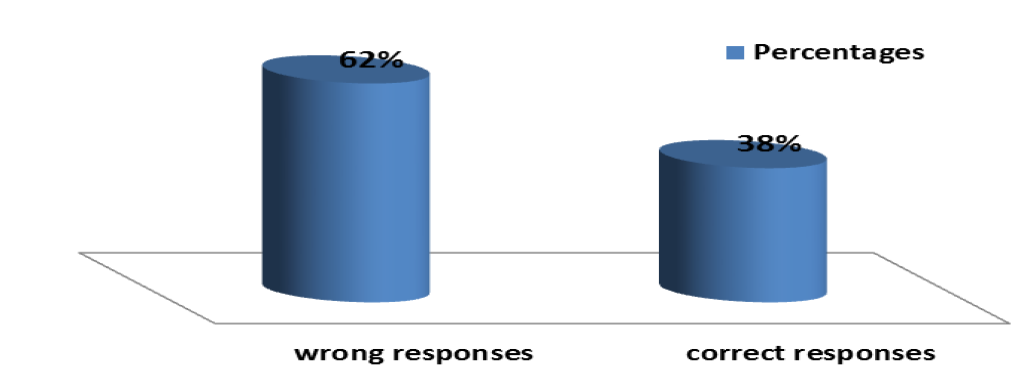
Figure 1 shows the frequency and percentage of both correct and incorrect answers given during the assessment test.


Table 1 and Figure 1 reveal that, despite learning English at degree level and with a yearlong English learning programme, the participants in this study gave significantly  more  incorrect  responses  when completing the English proficiency test than correct answers. This suggests that the level of English language attained by the participants is not yet sufficiently developed to give the participants ‘fluent’ status. This suits the purposes of this study as it is desirable to have participants that are not fully developed in their English proficiency; this may lead many to make decisions based on instinct or L1 rules/structure in terms of English and Arabic prepositions, instead of knowing or having memorised the rules off by heart.


Figure 1: Frequency and Percentage of Correct and Incorrect Responses Gained from the English Proficiency Assessment Test


Table 1: Frequency and Percentage of Correct and Incorrect Responses Gained from the English Proficiency Assessment Test

Assessment Test

Frequencies

Percentages

Correct responses

549

38%

Incorrect responses

891

62%


Table 2 shows the mean and standard deviation of correct and incorrect responses given in the assessment test.


Table 2 reveals that the mean percentage of correct responses was 22.88, whereas the mean percentage of incorrect responses was 37.13. The standard deviation was the same for both correct and incorrect responses. Thus, there are a significantly greater percentage of participants that gave incorrect responses than correct responses, although a standard deviation of 3.7 suggests there is quite a range of English proficiency level in this sample of participants.


Table 2: Mean and Standard Deviation of Correct and Incorrect Responses given in the Assessment Test

Assessment Test

Mean

Std. Deviation

Correct Responses

22.88

3.710

Incorrect Responses

37.13

3.710


Results from the Written Task

The results from the second written task were collated into a table and frequencies and percentages given for every correct answer given by each participant. These are shown in Table 3.


Table 3 shows the frequency (F) and percentage (P) of the correct responses for the four conditions (DLSH, SLDH, SLSH and DLDH) given by each participant. Interestingly,   the   DLSH   (dissimilar    low,    similar   high) variety reaped more correct answers from participants than the SLDH condition, with the only exceptions being participants 9 and 16, who answered slightly more SLDH questions correctly than DLSH questions. About 3 participants (numbers 4, 15 and 18) gave 0 correct answers for questions in the SLDH category. Only one participant (11) gave all 9 correct responses (100%) for one category, SLSH. The participant who scored the highest mark (participant 14), scored 72%, with 26 answers correct out of 36 (see the ‘total’ column). Interestingly, they achieved the highest score in the DLDH category, with identical results (67%) across all other categories. This could perhaps suggest that this participant has assimilated or memorised the structure and rules of English prepositions that are wholly dissimilar to both Standard and Colloquial Arabic and are thus perhaps more developed in their ESL learning.


Table 3: Frequency & Percentage of Correct Responses given for the 4 Conditions DLSH, SLDH, SLSH and DLDH


DLSH

SLDH

SLSH

DLDH

Total

No.

F

P

F

P

F

P

F

P

F

P

1

6

67%

5

56%

6

67%

4

44%

21

58%

2

8

89%

4

44%

5

56%

3

33%

20

56%

3

5

56%

5

56%

5

56%

6

67%

21

58%

4

4

44%

0

0%

7

78%

4

44%

15

42%

5

5

56%

3

33%

7

78%

2

22%

17

47%

6

3

33%

3

33%

6

67%

2

22%

14

39%

7

5

56%

1

11%

4

44%

3

33%

13

36%

8

4

44%

2

22%

3

33%

5

56%

14

39%

9

3

33%

4

44%

6

67%

3

33%

16

44%

10

4

44%

2

22%

4

44%

3

33%

13

36%

11

6

67%

2

22%

9

100%

6

67%

23

64%

12

5

56%

4

44%

8

89%

4

44%

21

58%

13

7

78%

4

44%

8

89%

6

67%

25

69%

14

6

67%

6

67%

6

67%

8

89%

26

72%

15

4

44%

0

0%

2

22%

4

44%

10

28%

16

3

33%

4

44%

8

89%

4

44%

19

53%

17

5

56%

1

11%

1

11%

6

67%

13

36%

18

6

67%

0

0%

3

33%

6

67%

15

42%

19

6

67%

2

22%

8

89%

5

56%

21

58%

20

4

44%

3

33%

1

11%

4

44%

12

33%

21

7

78%

3

33%

5

56%

6

67%

21

58%

22

5

56%

5

56%

7

78%

6

67%

23

64%

23

6

67%

5

56%

8

89%

5

56%

24

67%

24

5

56%

2

22%

4

44%

5

56%

16

44%


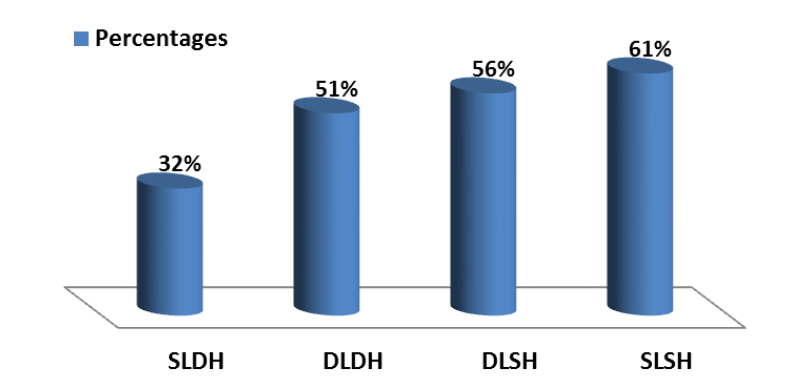
Figure 2: Percentage and Ranking of Correct Responses for the 4 Conditions DLSH, SLDH, SLSH and DLDH


Table 4 reveals the inverse of Table 3. It shows that participant 15 gained the most incorrect responses, with 72% of their answers being incorrect (26 out of 36). The category in which they had the most incorrect answers was SLDH, where prepositions in English are similar to low Arabic (Colloquial) and dissimilar to high (Standard) Arabic. In this category, there were instances where 100% of answers given by some were incorrect. This is consistent with other participants who gave over 20 incorrect answers-almost all these participants answered most incorrectly in the SLDH category of questions.


Table 4: Frequency & Percentage of Incorrect Responses Given for the 4 Conditions DLSH, SLDH, SLSH and DLDH


DLSH

SLDH

SLSH

DLDH

Total

No.

F

P

F

P

F

P

F

P

F

P

1

3

33%

4

44%

3

33%

5

56%

15

42%

2

1

11%

5

56%

4

44%

6

67%

16

44%

3

4

44%

4

44%

4

44%

3

33%

15

42%

4

5

56%

9

100%

2

22%

5

56%

21

58%

5

4

44%

6

67%

2

22%

7

78%

19

53%

6

6

67%

6

67%

3

33%

7

78%

22

61%

7

4

44%

8

89%

5

56%

6

67%

23

64%

8

5

56%

7

78%

6

67%

4

44%

22

61%

9

6

67%

5

56%

3

33%

6

67%

20

56%

10

5

56%

7

78%

5

56%

6

67%

23

64%

11

3

33%

7

78%

0

0%

3

33%

13

36%

12

4

44%

5

56%

1

11%

5

56%

15

42%

13

2

22%

5

56%

1

11%

3

33%

11

31%

14

3

33%

3

33%

3

33%

1

11%

10

28%

15

5

56%

9

100%

7

78%

5

56%

26

72%

16

6

67%

5

56%

1

11%

5

56%

17

47%

17

4

44%

8

89%

8

89%

3

33%

23

64%

18

3

33%

9

100%

6

67%

3

33%

21

58%

19

3

33%

7

78%

1

11%

4

44%

15

42%

20

5

56%

6

67%

8

89%

5

56%

24

67%

21

2

22%

6

67%

4

44%

3

33%

15

42%

22

4

44%

4

44%

2

22%

3

33%

13

36%

23

3

33%

4

44%

1

11%

4

44%

12

33%

24

4

44%

7

78%

5

56%

4

44%

20

56%


Table 5 and Figure 2 show frequencies, percentages and ranking of the correct responses for the four conditions (DLSH, SLDH, SLSH and DLDH).


Table 5 and Figure 2 show that the most correct responses (131 out of 433 or 61%) were gained in the SLSH   category,   where   the    English    prepositions    were similar to both low and high varieties of Arabic. The least correct responses were given in the category SLDH, as shown in Table 6 and Figure 3.


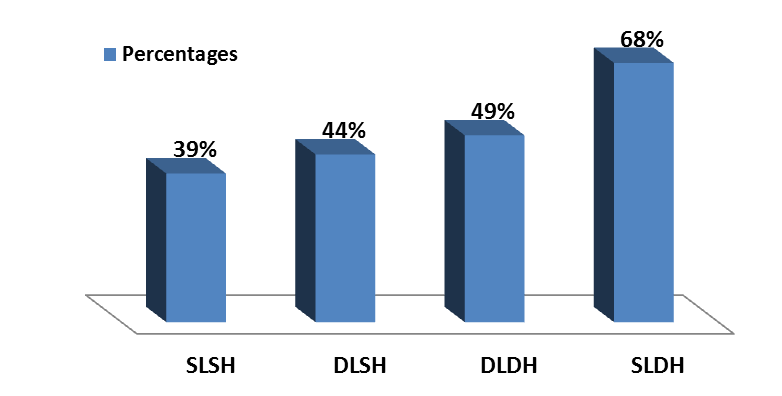
Only 39% responses for category SLSH were incorrect, whereas 68% responses were incorrect for the category SLDH.


Figure 3: Percentage and Ranking of the Incorrect Responses for the 4 Conditions DLSH, SLDH, SLSH and DLDH


Table 5: Frequency, Percentage and Ranking of Correct Responses for the 4 Conditions DLSH, SLDH, SLSH and DLDH

Conditions

Frequencies

Percentages

Ranking

SLSH

131

61%

1

DLSH

122

56%

2

DLDH

110

51%

3

SLDH

70

32%

4

Total out of 864

433

50.1%

-


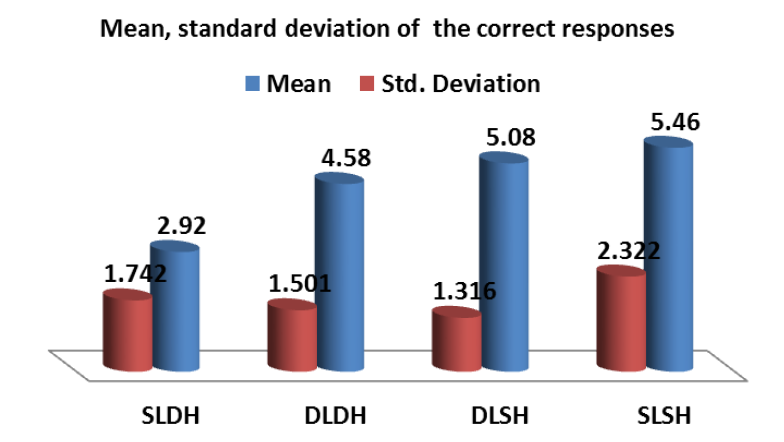
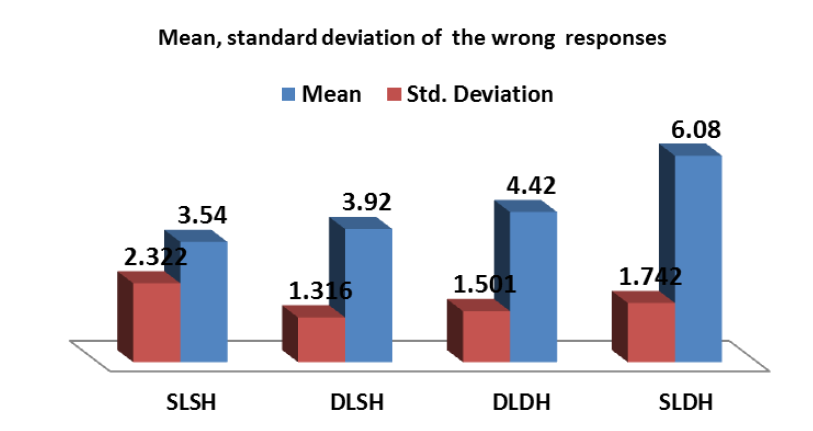
Table 6 shows the mean, standard deviation and ranking of the correct responses for the four conditions DLSH, SLDH, SLSH and DLDH. This is shown visually in Figure 4.


The results reveal that there is a greater mean (average)   for   the   number   of   correct   responses   given in   the  SLSH  category,  with  5.46  of  answers  being scored   correctly   (out   of  9)   in   this   category.  However, only a mean of 2.92 (out of 9) was achieved for the category SLDH, which is significantly lower than all other categories. Moreover, the standard deviation for SLSH is higher than other categories; this suggests that there is a wider range of means for this category, with some participants getting many of the answers in the SLSH category right and some participants getting many wrong. However, the lowest standard deviation, somewhat surprisingly, is for the DLSH category, where there is a similarity between high Arabic and English prepositions but a dissimilarity between low Arabic and English prepositions. This suggests that there was a closer range of answers given by participants, and, with a mean of 5.08, it could suggest that most participants were giving at least 50% of correct answers for this category (since half would be 4.5 and the mean is 5.08). Standard deviation for the SLDH category, which had the lowest mean of correct responses, was 1.742, suggesting that there was a fair range of correct answers given for this category, with some participants getting a few questions right in this category and others giving no correct answers for this category. Again, this could suggest that many participants were guessing at the answers or perhaps that a few participants gained good results and most gained poor results.


Table 6: Mean, Standard Deviation & Ranking for the Number of Correct Responses for 4 Conditions DLSH, SLDH, SLSH and DLDH

Conditions

Mean

Std. Deviation

Ranking

SLSH

5.46

2.322

1

DLSH

5.08

1.316

2

DLDH

4.58

1.501

3

SLDH

2.92

1.742

4


Table 7: Mean, Standard Deviation & Ranking for the Number of Incorrect Responses for 4 Conditions DLSH, SLDH, SLSH and DLDH

Conditions

Mean

Std. Deviation

Ranking

SLDH

6.08

1.742

1

DLDH

4.42

1.501

2

DLSH

3.92

1.316

3

SLSH

3.54

2.322

4


Figure 4: Mean & Standard Deviation for the Number of Correct Responses for 4 Conditions DLSH, SLDH, SLSH and DLDH


Figure 5: Mean & Standard Deviation for the Number of Incorrect Responses for 4 Conditions DLSH, SLDH, SLSH and DLDH


Table 7, conversely, reveals the mean, standard deviation and ranking of the incorrect responses given for the four conditions DLSH, SLDH, SLSH and DLDH. This is represented visually in Figure 5.


Naturally, the standard deviations in Table 7 are identical to Figure 4. Figure 5 clearly shows however that the category SLDH received a higher number of incorrect answers, with a mean of 6.08 out of 9 answers being incorrect by all participants in this category.


Table 8 shows the results of a one way ANOVA test on the results, showing the significance of differences between the averages of correct responses for the four conditions DLSH, SLDH, SLSH and DLDH.


Table 8: One Way ANOVA showing Significance of Average Correct Response Categories DLSH, SLDH, SLSH and DLDH


Sum of Squares

Df

Mean Square

F

Sig.

Between Groups

90.531

3

30.177

9.726**

0.000

Within Groups

285.458

92

3.103


Total

375.990

95


Note: ** means there are statistically significant differences at the level of significance <0.01


The results in Table 8 from the one way ANOVA reveal that there are statistically significant differences between the averages of correct responses for the four conditions, where a significance value of 0.000 was given (greater than the level of significance 0.05). This suggests that the results were not down to chance but due to an actual, measurable difference between the categories. In order to assess where these differences were most present, a Scheffe test was used and the results presented in Table 9.


The results from Table 9 can be interpreted as follows:


  • There are statistically significant differences between the averages of correct responses for the two conditions DLSH  and  SLDH,  for  the  benefit  of  the  average  of correct   responses   for   the   condition   DLSH.   Thus, there   was   a   significantly   greater  number    of    correct 


Table 9: Results from the Scheffe Test

Conditions

Mean

DLSH

SLDH

SLSH

DLDH

DLSH

5.08

-


SLDH

2.92

**

-


SLSH

5.46


**

-


DLDH

4.58


**


-


Responses given for DLSH (dissimilar low, similar high) than for SLDH (similar low, dissimilar high).


  • There are statistically significant differences between the averages of correct responses for the two conditions SLDH and SLSH, for the benefit of the average of correct responses for the condition SLSH. Thus, there was a significantly greater number of correct responses given for SLSH than SLDH

  • There are statistically significant differences between the averages of correct responses for the two conditions SLDH and DLDH, for the benefit of the average of correct responses for the condition DLDH. Thus, there was a significantly greater number of correct responses given for DLDH than for SLDH


The results reveal that, in all cases where high Arabic was similar to English prepositions, a greater number of correct responses were given than when high Arabic was dissimilar. However, when both low and high Arabic were dissimilar to English prepositions (DLDH), a greater number of correct responses were given than for SLDH, when high Arabic was still dissimilar but low (Colloquial Arabic) was similar to English prepositions.


Table 10 shows the results from a one way ANOVA completed on the averages of the incorrect responses given by participants, to show any statistical significance.


Table 10: One Way ANOVA showing Significance of Average Incorrect Response Categories DLSH, SLDH, SLSH and DLDH


Sum of Squares

Df

Mean Square

F

Sig.

Between Groups

90.531

3

30.177

9.726**

0.000

Within Groups

285.458

92

3.103


Total

375.990

95


The results reveal that there are statistically significant differences between the averages of incorrect responses for the four conditions DLSH, SLDH, SLSH and DLDH. Again, a Scheffe test was used to discern where these differences were most prevalent. This is shown in Table 11.


The results can be interpreted as follows:


  • There are statistically significant differences between the averages of correct responses for the two conditions DLSH and SLDH, for the benefit of the average of incorrect responses for the condition DLSH. Thus, significantly more incorrect answers were given for DLSH than for SLDH

  • There are statistically significant differences between the averages of correct responses for the two conditions SLDH and SLSH, for the benefit of the average of incorrect responses for the condition SLSH. Thus, significantly more incorrect answers were given for SLSH than SLDH

  • There are statistically significant differences between the averages of correct responses for the two conditions SLDH and DLDH, for the benefit of the average of incorrect responses for the condition DLDH. Thus, statistically significantly more incorrect answers were given for DLDH than SLDH


Table 11: Results from the Scheffe Test

Conditions

Mean

DLSH

SLDH

SLSH

DLDH

DLSH

3.92

-


SLDH

6.08

**

-


SLSH

3.54


**

-


DLDH

4.42


**


-


Conclusion to Results

The results reveal that there are significant results gained between various categories. The next section will discuss these results in greater detail and make reference to the literature review in order to support previous studies or to provide evidence that contradicts them.

DISCUSSION

Introduction to Discussion

The results gained and presented in the previous chapter provided some intriguing findings, which are discussed in this chapter. First, an overview of the general English proficiency level for this group of participants is given, before the results are discussed in turn by category, beginning with SLSH and continuing with DLSH, DLDH and SLDH.


General Proficiency

The short questionnaire given to the students showed their understanding of the relationship between Arabic and English. Most of the students indicted that there are some similarities and differences between English and Arabic. They referred to the word order and grammar as differences between the two languages; however, some of them claim that the order of object placement within a sentence in Arabic is similar to that in English and provided some examples, such as:

  • Ahmed (s) ate (v) an apple (o). Yakul (v) Ahmed (s) altufaha (o). S = subject

  • V = verb O = object


Furthermore, one of the students indicated that not everything can be translated literally from Arabic into English and vice versa. Additionally, one of the students refers to the meaning of the sentence by suggesting that the meaning of a sentence would be negatively transferred (that is, it would be convoluted) if a structural difference existed between the two languages in a given sentence.


The students’ performance in the assessment test did not reflect any relationship between their linguistic proficiency and their performance in the use of English prepositions. As can be seen in Table 1 and 2, the students scored lower in the assessment test conducted in the first written exercise (also exemplified by Figure 1). All the students gained between 18-26 correct answers. Thus, they are all performing at A2 level or above in English proficiency.


Generally, their overall level of English proficiency was low compared to their performance in the English preposition task. This means that their low level in the linguistic performance did not affect their performance in the use of English prepositions. The number of the correct responses differed from one condition to another.


Condition SLSH

Table 5 shows the highest frequency of correct responses from the participants was achieved for the condition SLSH. Most of the students achieved higher marks in this category compared to the other 3 conditions. Table 5 and Figure 2 reveal that the condition SLSH is first in the ranking out of all four conditions to gain the most correct answers when English preposition sentences were presented to the participants. The 9 sentences under the condition SLSH use the same preposition that is used in both varieties of Arabic language (H and L)-Colloquial and Standard. See Appendix A for the list of questions. For instance, question 3 for the SLSH category was as follows:


  • Milan is the North of Italy (where the correct answer would be the word ‘in’). Taqa, a Milan fii shama, al Italia (Arabic translation)
  • The preposition ‘fii’ is the Arabic equivalent for the English preposition ‘in’. Another example, question 2 in this category, is:
  • I am interested history (again, the correct answer here would be the word ‘in’).
  • Ana muhtam fii altarekh (Arabic translation 1) or
  • Ana muhtam biltarekh (Arabic translation 2)


As can be seen in the above example, both ‘fii’ and ‘bi’ are the Arabic equivalent for the English preposition ‘in.’ In this example, ‘fii’ is separate, whereas ‘bi’ is always inseparable [36]. All the quantitative results show that the SLSH condition comes first in the rank order of the correct responses (Table 5) and, therefore, last in the percentages and rank order of the incorrect responses (Figure 3). This shows that the students find the English prepositions that are similar to H and L easier to learn and produce, compared to other prepositions that are used differently. Thus, it could be claimed that more positive transference occurs in this category than any other category.


The findings from this condition do indeed support Asma [13] finding, when studying Algerian EFL students, that Standard Arabic is not the only source of transfer. When the English preposition is similar to both L and H, it follows that Arabic students, such as the participants in this study, would find it easier to transfer from Arabic to English and are more likely to gain the correct response to questions regarding English prepositions. This is because they already have the grammatical structure or ‘rules’ in place within their Arabic language (both varieties) and can therefore apply them more readily to English, as stated by James [17]. Allen and Corder [23] also highlighted this in the literature review, stating that similarities between two languages enable the facilitation of learning the L2 and thus greater positive transfer occurs. The findings of this study support that claim.


The findings from this study also could potentially support the theory of diglossia, as posited by Ferguson [61], given that some participants alternate between the codes of two different languages to achieve the correct English preposition. If SL and SH exist, perhaps diglossia is present in Saudi Arabian Arabic communities, with the two being spoken side by side in different scenarios. Moreover, if there is a smaller structural gap between L and H, in that they both follow similar grammatical rules to the English language (in terms of preposition use), then it follows that there is a greater chance that the participant will understand and positively transfer from the Arabic preposition to the English preposition, as is the case with these findings.


These findings could also support the interlanguage (IL) theory, as discussed by Frash and Kasper [51], as when a problem is presented in second language acquisition, the learner may create their own interlanguage through merging the structures of L1 and L2. With the SLSH condition, is could be said that participants were merging their L1 with their L2 and that, far from getting correct answers because the participants knew these answers to be correct, they were simply relying on their L1 knowledge to presuppose a similarity between the properties of L1 and their L2, as found by Corder [26]. In making educated guesses as to the English prepositions, as a result of the structure of L1 prepositions, one would naturally expect a greater frequency of correct answers for the SLSH condition than any other condition, which is exactly what was achieved here.


Condition DLSH

The condition DLSH contains those sentences that correspond to Standard Arabic (H) in the use of English prepositions but differ from those that are used in Colloquial Arabic (L). It is observed that the percentage of correct responses in this condition comes in between the two conditions SLSH and DLDH. This condition comes second in the ranking of correct answers amongst the four conditions.


The sentences show those used to test the participants on their understanding of English prepositions when there is a similarity between English and H but a difference between English and L (Table 12).


An example of a sentence in this category (DLSH) is as follows:


  • He entered    the room (no preposition required)


The Standard Arabic equivalent of the above sentence is:


  • Hwa dakhala algurfa


Most participants in this study answered with N, which suggests that no preposition is required in translation. This is evidence of the positive transfer from the H (standard) variety of Arabic. However, there were some participants that filled the gap with ‘in’ and this is indicative of the negative transfer from Colloquial Arabic (L) where the preposition [fii = in] is used before the noun [Algurfa = the room], as shown in the following example:


  • Hwa dakhal fii algurfa (Colloquial Arabic) He entered in the room (English translation)


In the second example, both English and H make use of the directional preposition ‘to’ to show the direction of the book ‘to Ali.’ However, in the L variety, there is no need to insert a preposition in such situations. For example:


  • Ataiat ilkitab Ali (Colloquial Arabic)

  • I gave the book Ali (literal translation to English)


There is an apparent difference between English and the H variety of Arabic compared to the L variety in the description of the word ‘breakfast.’ In other words, the word ‘breakfast’ is perceived as a cause for eating the eggs; whereas, it provides us with a spatial sense by considering it as a surface in the L variety, that is, ‘on breakfast.’ As a result of the L variety influence, a number of students answered with the locative preposition ‘on.’ In general, making such mistakes in the condition DLSH alerts us to the fact that the students may misuse some prepositions in Standard Arabic by using other inappropriate forms that are used in their L variety.


In the fourth example, ‘for’ is used in both English and H to identify the period of time of ‘two years.’ By contrast, the temporal meaning is expressed without using any prepositions. For example:


  • John tarak ilmadrasa, wa badeen ishtagal fii maktaba sanateen (L variety)

  • John left school. Then, he worked in a bookshop N years (literal English translation)


In example 5, ‘the piano’ is understood as an instrument in English and the H variety and it is expressed without using any prepositions. However, the locative preposition ‘on’ is used side by side with the word ‘piano’ to express a spatial sense by regarding ‘the piano’ as a surface or place. For example:


  • Hwa yalab ala ilbiano (Colloquial Arabic)

  • He plays on the piano (literal English translation)

  • The students who answered with N have positively transferred from their Standard Arabic (H)

  • whereas choosing ‘on’ is a sign of the negative transfer from the L variety of Arabic


This suggests that most participants rely more heavily on their Standard Arabic than their Colloquial Arabic when transferring to English, as if the opposite were the case, there would be a greater number of incorrect responses gained in this category. However, since the majority of participants gave correct responses, it suggests that the H structure in Arabic is being used by over half of the participants in order to translate to English. Thus, positive transference is also occurring for at least half of participants. However, there are some that are relying on their Colloquial Arabic, as evidenced by just under half of participants giving incorrect responses for this category.


The finding that more students use Standard Arabic (H) than Colloquial Arabic (L) contradicts the literature review, where Alayash [12] suggested, in his study on Libyan students, that Colloquial Arabic is used more than Standard Arabic when choosing English prepositions. This is especially true when one considers that the condition SLDH gained the lowest frequency of correct answers (discussed in due course). In this condition, more positive transfer occurred with DLSH than SLDH, suggesting that when there is a similarity between H and English prepositions, participants are more likely to give the right answers, than when there is a similarity between L and English prepositions but no similarity between H and English prepositions. It could be argued therefore that there is greater positive transference between H and English prepositions than L altogether.


Table 12: Sentences Used to Test Participants’ Use of English Prepositions in the DLSH Category

DLSH

The               colloquial (L) Arabic equivalent

  1. He entered the room

  2. I gave the book to Ali

  3. He always has eggs for breakfast

  4. John left school. Then, he worked in a bookshop for two years

  5. He plays the piano

  6. He complements the company

  7. Thanks forusing our service

  1. He entered in the room

  2. I gavethe book Ali

  3. He always has eggs on breakfast

  4. John left school. Then,he worked ina bookshop N years

  5. He plays on the piano

  6. He complements N the company

  7. Thanks on using ourservice


Condition DLDH

Moving to the condition DLDH (dissimilar low Arabic and dissimilar high Arabic), the frequency of the correct answers given for this condition ranks in third place in terms of the number of answers that were correctly given by participants, with an overall average of half of the correct responses out of the four conditions being gained. However, this percentage can be seen as a low percentage compared to the highest ones in SLSH and DLSH, revealing that many of the participants in this study experienced some difficulty with the prepositions that are used only in English compared to those that are used both in English and in Arabic (Standard and/or Colloquial). Moreover, participants also may struggle with sentences when prepositions are only present in Arabic but not required in English, perhaps transferring the structure of Arabic to English and adding prepositions where they are not necessary and thus are grammatically incorrect. This is called interference by Jie [18] or negative transfer of the grammatical rules or structure of one language to another.


Some sentences that reject interferences from both H and L are as follows:


  • The shirt’s made of cotton

  • The room of the teachers is clean

  • I jumped over the wall

  • Alan is a student at Manchester University

  • We arrived at 7 o’clock


The first and second examples include the preposition ‘of,’ which does not exist in H and L at all. Instead, both H and L use the preposition ‘from’ to express the spatial meaning ‘from cotton’. The use of ‘from’ by the participants explains the negative transfer from both H and L where ‘from’ is used to express the spatial sense. For example:


  • Alqumsan tusna'a min ilkotton (H and L Arabic)

  • The shirt’s made from the cotton (literal translation in English)


The second example contains the possessor ‘the room’ and the possessed ‘the teachers’ and they are presented by using the preposition ‘of’ in the sentence. Instead, in H and L, the possessed and the possessor are used in a sequence order. It is worth mentioning that most of the students answered with ‘of,’ and this shows that the students are aware of the use of the preposition ‘of’ more than ‘at’ and ‘over.’


The Standard and Colloquial Arabic equivalent of the third sentence is: Hwa qafaz ala iljedar.


The preposition [ala = on] is used instead of ‘over,’ which does not exist in H and L. Some of the students were not able to differentiate between the preposition ‘over’ in English and ‘ala’ in Arabic; therefore, they substitute the preposition ‘over’ for the locative preposition ‘on’ as a result of the negative transfer from H and L.


Example 4 and 5 show how the preposition ‘at’ can be used to express spatial or temporal meanings in different situations. The locative preposition ‘at’ is used in example 4 to express the spatial sense ‘at Manchester.’ In contrast, [fii = in] is used in both H and L instead; for example:


  • Alan taleb fii jameat Manchester (H and L variety of Arabic)


On the other hand, the preposition ‘at’ (non-directional) in question 5 refers to temporal sense. However, a number of the participants substituted ‘in’ for the temporal preposition ‘at’ as a sign of the negative transfer from H and L where [fii = in] is used to express the meaning of time. For example: ‘wasalna fii alsa’a alsabia’ is the Standard Arabic equivalent of the sentence ‘we arrived at 7 o’clock.’ The Colloquial (Gulf) Arabic has the same translation but without using special remarks that are used in the H variety. For instance, in H, the word ‘alsabia’ is used by adding ‘al’ at the beginning and ‘ia’ at the end, whereas Colloquial Arabic uses the word ‘saba’a’ instead. Like English, we can observe that an Arabic preposition can express spatial and temporal meanings in different situations.


On the other hand, the sentences show the prepositions that exist in English, H and L but are used differently in H and L (Table 13).


In example 1, the locative preposition ‘on’ is used with the noun ‘holiday.’ It refers to ‘holiday’ as a surface. However, ‘holiday’ in H and L is perceived as a surrounded space, so that [fii = in] is used instead of ‘on.’ For example:


  • Ana thaheb fii ijaza (H) or

  • Ana raih fii ijaza (L)

  • I am going in holiday (literal English translation)


As has been mentioned before, the Colloquial (Gulf) Arabic differs from other Arabic dialects; therefore, in Egyptian Arabic, speakers use ‘holiday’ without prepositions, as shown in the following example:


  • Ana rayeh igaza (Egyptian Arabic)

  • I am going holiday (literal English translation).

  • Such differences distinguish Arabic dialects from each other


In the second example, the preposition ‘for’ does not correspond to the Arabic preposition [bi = in] used in H and L equivalent. Therefore, some of the students do not master the use of some English prepositions as a result of the different use of some English prepositions in English and Arabic (H and L). Similarly, the third example shows the use of ‘for’ in English and [bi = in] in H and L to express the meaning of ‘cause’ by using different prepositions.


The category DLDH comes in second place in the ranking with an overall average of 49% for the percentage of incorrect responses given by participants among the four conditions (Figure 3). It is clear that participants deal a little better (to some extent) with the English prepositions that are dissimilar to those used in both H and L (Standard Arabic and Colloquial Arabic respectively) than SLDH. The condition DLDH includes the sentences that use prepositions that exist only in the English language such as ‘at,’ ‘of,’ and ‘above.’ In addition, it  includes  other  sentences  that  use  some  prepositions in  a  way  that differs  from  those  used  in  H and  L. As Jie [18] states, the rules of L2 can be generalised and applied to all circumstances which appear to be related (even if they are not actually related); the rules can be ignored and L1 rules can be used instead; a rule can be applied incompetently; or a new rule can be created. In the DLDH category, it seems that the rules of both Standard and Colloquial Arabic are wholly dissimilar for prepositional use in English and therefore, participants have given random answers or applied the rules of L and H in order to attempt to gain the English preposition (which is incorrect).


Lado [21] highlighted this in the literature review, suggesting that the reason why negative transfer might occur is due to learned habits, where the habits from one’s L1 will be carried over to the L2. This is indicative of negative transfer and is a learned behaviour or default when the rules of the L1 do not match the rules of the L2.


Table 13: Sentences Used to Test Participants’ Use of English Prepositions in the DLDH Category

The English sentence

The standard (H) and colloquial (L)   Arabic  equivalent  (DLDH  Category)

  1. I am going on holiday

  1. I am going in holiday

  1. You managed to buy the equipment fora very low price

  1. You managedto buy the equipment in a very low price

  1. We are famous for Chinese food

  1. We are famous in Chinese food


Condition SLDH

It is clear that the overall percentage of correct answers given was in the condition SLDH, which therefore ensures that it is ranked last in the order of frequency when it comes to correct responses. Compared to the other three conditions (SLSH, DLSH and DLDH), this very low percentage suggests that the participants experience difficulty when using the prepositions that are similar in L2 to those used in Colloquial Arabic (L) but used differently in Standard Arabic (H). For instance, question 9 is as follows:


  • I went to school happily


The students who filled the gap with N (no change) demonstrate positive transfer from Colloquial Arabic (L) to English, where the adverb ‘happily’ is used without any prepositions; however, in Standard Arabic (H), the adverb [happily = bisa’ada] is used with the preposition [bi = in], side by side (thus it is inseparable). The example can be seen as follows:


  • I went to school happily (English)

  • Thahabtu lilmadrasa bisaiada (Standard Arabic)

  • Here is another example (question 6) for the positive transfer from (L): There is a movie on TV

  • The Standard Arabic equivalent of the above example is: Hunak film fii altilfaz


In English, TV is perceived as a surface, whereas it is perceived as a whole entity in Standard Arabic. Like English, TV is perceived as a surface in Colloquial (Gulf) Arabic. Thus, the participants that answered with ‘on’ are using a positive transfer from Colloquial (Gulf) Arabic (H). By contrast, the students that chose the preposition ‘in’ in English suggest that they were negatively transferring from Standard Arabic (H), giving a different meaning in English and not abiding by the English grammatical structure for prepositions such as this. This differs to the case of Algerian Arabic where Asma [13] argues that TV is perceived as ‘a three dimensional object’; hence, the preposition [in = fii] is used instead of ‘on,’ which is only used in Standard Arabic (H) and English.


Thus, as can be seen, dialects can differ between each other, with Algerian Arabic using ‘in’ and Colloquial Arabic using ‘on’, whereas in Saudi Arabia, H uses ‘in’ and Standard Arabic (H) in Algeria uses ‘on’. Thus, the very small differences in Standard Arabic in different regions can reveal how that culture sees the world and the objects/phenomena within it, perhaps depending on their history (since Algeria was occupied by the French between 1930 and 1962 [16]). Again, this can make it harder for Arabic speakers to transfer their Arabic (H or L) to the Arabic used in another country and culture. It also means that EFL as a subject must be taught differently in different regions or cultures depending on the structure of H and L in that region [13].


The mean of the correct responses for SLDH was low (Table 6). However, there is no significant difference between the means in categories SLSH, DLSH and DLDH. This shows that the participants performed better when presented with prepositions that are used similarly in Standard Arabic (H), Colloquial Arabic (L) and English (SLSH). However, it also shows that the participants performed better when using prepositions that are used similarly in H but differently in L (DLSH). Again, this might be expected, if the students are transferring positively from Standard Arabic to English. However, what might be surprising is that students performed better with the prepositions that are different in structure to English in both L and H Arabic (DLDH), than they did with prepositions that are different in structure in H Arabic but similar in L Arabic.


Here is an example of the negative transfer from L and the positive transfer from H (DLSH):


  • Hwa athna ala (on) ilsharika (colloquial Arabic). He compliments on the company


Colloquial Arabic (L) makes use of the equivalent spatial preposition [on = ala]. Thus, any transference to English using this preposition would be inaccurate. However, Standard Arabic (H) and the English language do not use a preposition at all. Thus, the participants who filled the gap with ɸ reveal a positive transfer between H and English, where ‘company' is perceived to be a direct object as in the following structure:


  • He compliments ɸ the company

  • Hwa athna N ilsharika


However, some participants chose to fill the gap with the preposition ‘over.’ This is incorrect and these participants were clearly following the L structure and negatively transferring this to English. One possible explanation for this response is that students may not have known the answer and thus answered at random or perhaps they did not understand the sentence, given that such a choice does not correspond to any preposition used in Standard Arabic (H). In the same way, Asma [13] observed the same thing in the students’ answers that transferred negatively from Algerian Arabic, as shown in the following sentence:


  • Robinson Crusoe was marooned on an uninhabited island [13]


In the above example, both Standard Arabic and the English language use the same spatial preposition [ala = on]. However, Asma [13] observed that some of the students transfer negatively from Algerian Arabic by choosing the preposition ‘fii,’ or from French by choosing the preposition ‘dan,’ where ‘the island’ is considered to be an enclosed space. Moreover, some students chose an unrelated answer [N] and this suggests that the students could not understand the meaning of this particular sentence and thus they chose an answer at random [13].


Where dissimilar H occurs between Arabic and English in prepositional rules, it is possible that the cultural and linguistic distance between English and Arabic comes into play, leading to negative transfer [26]. An individual may not know the structural ‘map’ of the second language and fall back on the rules of their H language (in this case, Standard Arabic) in order to reach the appropriate translation. In this study, the results indicate that even if L is similar to English, the dissimilarity between H and English creates sufficient distance between the two languages to cause negative transfer. This distance could be both cultural [27] and linguistic [26], creating a clash between the two languages.


Moreover, negative transfer experienced by the participants of this study could be a result of a lack of proficiency in English. This would support Ringbom [28] theory that positive transfer can only occur when one has sufficient proficiency in the English language. The fact that some students were able to transfer positively between English and both L and H, regardless of how similar or dissimilar they were to English prepositions, suggests that some students have a greater proficiency in English language learning and therefore have a greater understanding of the structural ‘map’ of both Arabic and English, easily switching between the rules of both [26].


The results of this study suggest that it is difficult for Arabic speakers to learn English, given the fact that there are no clear functions and explanations of English prepositions available and that, as Takahaski [31] states, many learners must depend on memorisation in order to understand how prepositions can be used and the correct translation from Arabic (H and L) to English. Moreover, as Lakoff [5] suggests, when English prepositions have more than one meaning, such as ‘over’, Arabic speakers may have difficulty translating the sentence, with greater negative transfer occurring as a result. This idiomatic use of English prepositions can make both EFL and even English speakers themselves unsure of the correct prepositional form and Zughoul [40] suggests that cross-linguistic differences between languages can attribute to inaccurate prepositional use (again referring to the linguistic and cultural distance between English and Arabic, as described earlier). In the condition SLDH, crossed wires can occur; it is possible that the participants in this study second-guessed themselves and believed that they did not know the correct preposition to use in English despite similarities between L and English.


Moreover, with Arabic prepositions also being highly polysemous, with more than one meaning [35], it follows that confusion can arise when there is no similarity between Standard Arabic (H) and English. This is especially true when the prepositions in Arabic refer to time instead of place, which can generate confusion given the problems that Arabic students have with time-related prepositions (as found by Al-Yaari et al. [2]). Moreover, compound propositions in English are difficult for Arabic speakers, as discussed by Abu Humeid [41], given the complexities of structure and of their time- or place-related nature. In the case of DH, regardless of whether L is similar or dissimilar, this provides another reason why perhaps the participants of this study demonstrated greater negative transference in the results. It also suggests that the H form of Arabic was used more widely by the participants than the L form.


Conclusion to Discussion

This chapter has discussed the results gained from implementing the methodology and referred to the literature review to see how far current research supports or conflicts with the findings. The next chapter will summarise the findings and discuss how far they support the research hypothesis, before providing recommendations for future research.

CONCLUSION

Summary of the Study

This study set out to answer the following research question:


  • To what extent do Saudi female learners of English as a second language make the prepositional errors in each condition (DLSH, SLDH, SLSH DLDH)?


As can be seen from the results, students rely on both Standard Arabic (H) and Colloquial (Gulf) Arabic (L) in their use of English prepositions, as was found in the literature review. However, based on the students’ answers, it was observed that the students transfer from Standard Arabic (H) more frequently than they transfer from Colloquial Arabic (L), to the extent that even when the Colloquial Arabic was similar to the English preposition, if the Standard Arabic differed, participants were still more likely to answer a question incorrectly.


Moreover, it was obvious that the students experienced difficulties with prepositions that did not exist either in Standard Arabic (H) and Colloquial (Gulf) Arabic (L), as well as with those prepositions that are not used in H and L in the way that they are used in English. Moreover, most of the correct responses suggest that positive transfer happens more frequently from Standard Arabic (H) than Colloquial (Gulf) Arabic (L). On the other hand, negative transfer occurred more frequently from Colloquial (Gulf) Arabic (L) than from Standard Arabic (H). The same thing was observed in the use of English prepositions amongst Algerian students, where positive transfer occurred more from both Standard Arabic (H) and French than Algerian Arabic.


Although there are some differences between the prepositions used in the two varieties (H and L) and those used in English, Saudi learners tried to regard the varieties of the  Arabic  language  (H and L)  as  sources  of previous knowledge in the use of English prepositions. In this way, the interlanguage theory was supported. Not every English preposition has a specific equivalent in those two varieties. Therefore, Saudi learners may rely on either Standard Arabic (H) and/or Colloquial Arabic (L) to choose the appropriate preposition. Thus, when students find similarities between English and one of those varieties, they choose the correct preposition. This is clear given the highest percentage of the correct answers that was found in the condition SLSH. However, when the students perceive differences between English and one of those varieties, they make errors by choosing an inappropriate preposition. The learners’ errors have three different types: omission of the required preposition; the use of a different preposition; or the use of an unrelated preposition.


Diglossia, discussed extensively in the literature review and found to be present by many researchers, was also found to exist in Saudi Arabian Arabic, in their use of H and L. This was because when sentences in both H and L were similar in structure to English in the use of prepositions, the participants could switch between the two varieties of Arabic and achieve a correct answer in English. However, it is clear that, whilst the differences between SLSH and the other categories was statistically significant, this difference may not necessarily be due to diglossia; rather, it might be due simply to the similarity of H to English, instead of both SL and SH.


The findings of this study do support the hypothesis given at the end of Chapter 2, which was:


  • Students transfer either positively or negatively from both Standard (H variety) and Colloquial Arabic (L variety) and use structures from both varieties as sources for knowledge and understanding when using some English prepositions


It is clear that both L and H are used when transferring to English prepositions and that the most successful outcomes occurred when L and H were both similar to the English prepositions. Thus, whilst the hypothesis was supported, as was interlanguage and diglossia theory, more research is required if a truer picture of the effect of both these theories is to be gleaned in future. Moreover, the extent to which L and H are used must be discerned more accurately; the results revealed that participants use H (Standard Arabic) more than Colloquial Arabic, a finding that contradicts some studies in the literature review. However, Colloquial Arabic is also used. Thus, the precise levels at which both varieties are used is yet to be discovered.


Recommendations and Future Research

The results suggest that Standard Arabic is used more than Colloquial Arabic when transferring to English prepositions-this is the case for both negative and positive transfer. In future, teachers of English at the University of Tabuk in Saudi Arabia might try the following things to gain greater proficiency in their ESL students more quickly:


  • Use Standard Arabic when teaching ESL students, both in the written and spoken form, to encourage links with Standard Arabic and English language learning and structure

  • Highlight the areas where Colloquial Arabic is useful for learning English, when L has similarities with English prepositions and H does not. This is important given the low frequency of positive transference that occurred in the condition SLDH

  • Discern how much Standard Arabic is actually being spoken by students, and, if Colloquial

  • Arabic is being spoken more frequently, try to think of ways to link English language learning to Colloquial Arabic or ask students to switch to Standard Arabic more frequently in their everyday lives

  • When no similarities exist with L or H (DLDH), forge links in another way between Arabic and English prepositions, to encourage students to remember the structure of L2 by rote


Of course, these are simple actions that teachers could take in order to improve performance and language learning development in their EFL students. However, in order to give even more extensive recommendations to students, it is important that further research is undertaken to enable a more detailed view of the phenomenon of prepositional use by EFL students in Saudi Arabia to be gained.


This study had 24 female participants from the University of Tabuk in Saudi Arabia. All participants had been learning English since elementary school and were over the age of 18 (between 20 and 22 in age range). Thus, any findings are not representative of the general English- learning population of this university, let alone Tabuk as a city or Saudi Arabia as a country. It would be pertinent in future to have a larger sample, perhaps from universities all over the country, in order to generalise any findings gained.


One of the written tests was piloted, which ensured that it was valid and reliable as an instrument for answering the research question; it would be useful in future to pilot all written tests in the study to ensure that they all achieve the same reliability and validity. This is essential if the study is to be as accurate as possible and to answer the research question honestly and accurately.


Only quantitative research was carried out in this study. Whilst this was a useful means of ascertaining proficiency levels in English in general, as well as proficiency in English propositional use, it did not help to shed any light on why students struggle with propositions in English, either when H and L varieties of Arabic were similar or dissimilar. In future, qualitative research, such as interviews or a focus group, could be carried out with participants, to investigate their feelings about English propositions, as well as Colloquial and Standard Arabic and to dig a little deeper under the surface regarding their language learning development. Interviews would be an ideal means of discussing EFL learning with teachers in Saudi Arabia also. It might also help to provide a richer data set, enabling a triangulation approach that might reveal how far L or H is used in transference and why.


It would be of interest to branch the research out to other dialects of Arabic, such as from other countries like Algeria. This might help to create a framework for the different development stages of learners from different countries and their different uses of L or H when it comes to English propositions. Both male and female participants could be used in future studies to ascertain whether there are any differences in the way that the two sexes learn English as a foreign language and if there is a greater reliance on L or H depending on the sex of the participant.


Finally, it would also be of interest to discern whether there are any differences caused by the age of participants and whether older learners experience greater difficulty with English prepositions than younger learners, as posited by Krashen [53]. Having a wider participant group in terms of demographic, such as age, region and sex, might also enable results to be generalised to the rest of one or multiple, Arabic-speaking populations. This, alongside a richer data set, might enable a fuller picture of the issue to be achieved.

REFERENCE
  1. Corder, S.P. “Error analysis, interlanguage and second language acquisition.” Language Teaching and Linguistics: Abstracts, vol. 8, 1975, pp. 201-218.

  2. Al-Yaari, S. et al. “Vowel deletion in Arabic dialects of Yemen (ADY): A linguistic perspective.” International Journal of Linguistics, vol. 4, no. 2, 2012, pp. 430-458.

  3. Celce-Murcia, M. and D. Larsen. The Grammar Book. Newbury House Publishers, 1983.

  4. Gass, S. “Language transfer and universal grammatical relation.” Language Learning, vol. 29, 1979, pp. 327-344.

  5. Lakoff, G.Women, Fire and Dangerous Things: What Categories Reveal about the Mind. U of Chicago P, 1987.

  6. Tyler, A. and V. Evans. The Semantics of English Prepositions: Spatial Scenes, Embodied Meaning and Cognition. Cambridge UP, 2003.

  7. Hudson, A. “Outline of a theory of diglossia.” International Journal of the Sociology of Language, vol. 157, 2002, pp. 1-48.

  8. Ferguson, C. “Diglossia.” Word, vol. 15, 1959, pp. 325-340.

  9. Walters, K. “Diglossia, Linguistic Variation and Language Change in Arabic.” Perspectives on Arabic Linguistics VIII: Papers from the Eighth Annual Symposium on Arabic Linguistics, edited by M. Eid, John Benjamins, 1996, pp. 157-197.

  10. Versteegh, K.The Arabic Language. Edinburgh UP, 1997.

  11. Frawley, W.J. Editor. International Encyclopaedia of Linguistics. Vol. 4, Oxford University Press, 2003.

  12. Alayash, M. “The effect of Arabic prepositions on the use of English prepositions.” Managing Knowledge and Intellectual Capital in Higher Education Institutions in Egypt and Arab World, 4th annual conference, 11-12 April 2012, Faculty of Specific Education, Mansoura University.

  13. Asma, T. Transfer of simple prepositions from Standard Arabic into English: The case of third year LMD students of English language at Mentouri University - Constantine. 2010, MA thesis. www.umc.edu.dz/buc/theses/anglais/TEM11 43.pdf. Accessed 17 July 2015.

  14. “Preposition.” Cambridge Dictionaries, 2015. http:// dictionary.cambridge.org/dictionary/english/preposition. Accessed 14 August 2015.

  15. Huddleston, R. and G.K. Pullum. The Cambridge Grammar of the English Language. Cambridge University Press, 2002.

  16. Benjamin, R. Renoir and Algeria. Yale University Press, 2003.

  17. James, M.Interlanguage Variation and Transfer of Learning. 2007.

  18. Jie, X. “Error Theories and Second Language Acquisition.” US-China Foreign Language, vol. 6, no. 1, 2008, pp. 35-42.

  19. Webster, R. “Definition of Transfer.” Merriam-Webster Dictionarywww.merriam-webster.com/dictionary/ transfer. Accessed August 2015.

  20. Liu, S. “Studies on Transfer in Second Language Acquisition.” Guangxi Normal University Journal, vol. 3, 2001, pp. 1-29.

  21. Lado, R.Linguistics Across Cultures: Applied Linguistics for Language Teachers. U of Michigan P, 1957.

  22. Ellis, H.C. The Transfer of Learning. Macmillan Company, 1994.

  23. Allen, J.P.B. and S.P. Corder. Papers in Applied Linguistics. II. Oxford University Press, 1975.

  24. Weinreich, U.Languages in Contact. Columbia UP, 1953.

  25. Dulay, H. and M. Burt. “Natural sequences in child second language acquisition.” Language Learning, vol. 24, 1974, pp. 37-53.

  26. Corder, S.P. Error Analysis and Interlanguage. Oxford University Press, 1981.

  27. Zhang, C. “Variables Affecting L1 Transfer in L2 Acquisition.” Sino-US English Teaching, vol. 3, no. 5, 2006, pp. 53-55.

  28. Ringbom, H.The Role of the First Language in Foreign Language Learning. Multilingual Matters, 1987.

  29. Kharma, N. and A. Hajjaj. Errors in English Among Arabic Speakers: Analysis and Remedy. 1989.

  30. Jordens, P. “Rules, Grammatical Intuitions and Strategies in Foreign Language Learning.” ISB, vol. 2, no. 2, 1977, pp. 5-77.

  31. Takahaski, G. “Perceptions of Space and Function of Certain English Preposition.” Language Learning, vol. 19, 1969, pp. 217-234.

  32. Ringbom, H. “On L1 Transfer in L2 Comprehension and L2 Production.” Language Learning, vol. 42, 1992, pp. 85-112.

  33. Zughoul, M.R. “Teaching English Prepositions.” English Teaching Forum, vol. 17, 1979, pp. 24-29.

  34. Hamdallah, R.W. and H. Tushyeh. “A contrastive analysis of selected English and Arabic prepositions with pedagogical implications.” Papers and Studies in Contrastive Linguistics, vol. 28, 1993.

  35. Hassan, A. and I. Abdullah. “The conceptual mapping of the English preposition into Arabic.” European Journal of Social Sciences, vol. 4, no. 8, 2009, pp. 604-613.

  36. Almaloul, A. “Investigating interference errors made by Azzawia University 1st year students of English in learning English prepositions.” International Journal of Social, Education, Economics and Management Engineering, vol. 8, no. 1, 2014, pp. 15-26.

  37. Wishon, G. and J. Burks. Let’s Write English. American Book Company, 1980.

  38. Hamdallah, R.W. Syntactic Errors in Written English: A Study of Errors Made by Arab Students of English. University of Lancaster, 1988. Doctoral Dissertation.

  39. Gethin, H. Grammar in Context: Proficiency Level English. William Collins Sons and Co. Ltd., 1990.

  40. Zughoul, M.R.Teaching English Prepositions to Arab Student. MA Thesis, American U of Beirut, 1973.

  41. Abu Humeid, A. “Compound prepositions used by Iraqi EFL university students.” International Journal of English Linguistics, vol. 3, no. 2, 2013, pp. 98-114.

  42. Cantarino, V. Syntax of Modern Arabic Prose. Vol. 2, Indiana University Press, 1975.

  43. Alsobh, M. et al. “Diglossia as a result of language variation in Arabic: Possible solutions in light of language planning.” Journal of Language Teaching and Research, vol. 6, no. 2, 2015, pp. 274-279.

  44. Aramouni, E. The impact of diglossia on Arabic language instruction in higher education: Attitudes and experiences of students and instructors in the U.S. California State University, Sacramento, 2011. Doctoral Dissertation.

  45. Arbitman, Y.L. and A.R. Bomhard, editors. Essays in Historical Linguistics in Memory of J. Alexander Kerns. John Benjamins, 1981.

  46. Smith, M.S. “Strategies, Language Transfer and the Simulation of the Second Language Learner’s Mental Operations.” Language Learning, vol. 29, 1979, pp. 345-361.

  47. Corder, S.P. “Language-learner language.” Understanding Second & Foreign Language Learning, Issues and Approaches, edited by Richards, J.C., Newbury House Publishers, 1978.

  48. Taylor, B. “The Use of Overgeneralisation and Transfer Strategies by Elementary and Intermediate Students of ESL.” Language Learning, vol. 25, no. 1, 1975, pp. 73-107.

  49. Fries, C.C. Teaching and Learning English as a Foreign Language. University of Michigan Press, 1945.

  50. Maalej, Z. “Spatial Scenes in Arabic and English.” KSU Journal, vol. 3, 2010, pp. 3-9.

  51. Frash, S. and A. Kasper. “Transfer in production: Some implications for the interlanguage hypothesis.” Transfer in Language Production, edited by Dechert, H.W. and M. Raupach, Ablex Publishing Corporation, 1989.

  52. Selinker, L. “Interlanguage.” International Review of Applied Linguistics, vol. 10, 1972, pp. 219-231.

  53. Krashen, S. The Input Hypothesis. Longman, 1985.

  54. Mclaughlin, B.Theories of Second Language Learning. Edward Arnold, 1987.

  55. Ellis, R. The Study of Second Language Acquisition. Oxford University Press, 1994.

  56. Spolsky, B.Conditions for Second Language Learning. Oxford UP, 1989.

  57. Chomsky, N. Rules and Representations. Columbia University Press, 1980.

  58. Brown, D.B. Principles of Language Learning and Teaching. 3rd ed., Prentice Hall Regents, 1994.

  59. Scott and Tucker. “Error Analysis and English-Language Strategies of Arab Students.” Language Learning, vol. 24, no. 1, 1974, pp. 69-97.

  60. Nemser, W. “Approximate Systems of Foreign Language Learners.” International Review of Applied Linguistics, vol. 9, 1971, pp. 115-124.

  61. Ferguson, C.A. “Diglossia.” The Bilingualism Reader, 2nd Edn., Edited by Wei, L., Routledge, 2007.

  62. Kahane, L. and R. Kahane. “Decline and Survival of Western Prestige Languages.” Language, vol. 55, 1979, pp. 183-198.

  63. Fellman, J. “On ‘diglossia.’” Language Sciences, vol. 34, 1975, pp. 38-39.

  64. Coulmas, F. “Does the notion of diglossia apply to Japanese? Some thoughts and some documentation.” Southwest Journal of Linguistics, vol. 10, no. 1, 1991, pp. 125-142.

  65. Paolillo, J. “Sinhala Diglossia: Discrete or Continuous Variation?” Language in Society, vol. 26, 1997, pp. 269-296.

  66. Fishman, J. “Bilingualism with and without diglossia; diglossia with and without bilingualism.” Journal of Social Issues, vol. 23, no. 2, 1967, pp. 29-38.

  67. Greenberg, J. “Concerning inferences from linguistic to nonlinguistic data.” Language in Culture, Edited by Hoijer, Harry, University of Chicago Press, 1954, pp. 3-18.

  68. Keller, R. “Diglossia in German-Speaking Switzerland.” Standard Languages: Spoken and Written, edited by Haas, W., Manchester UP, 1982.

  69. Ferguson, C.A. “Diglossia revisited.” Southwest Journal of Linguistics, vol. 10, no. 1, 1991, pp. 214-223.

  70. Kaye, A. “Formal vs. Informal in Arabic: Diglossia, Triglossia, Tetraglossia, etc., Multiglossia-Polyglossia Viewed as a Continuum.” Journal of Arabic Linguistics, vol. 27, 1994, pp. 47-66.

  71. Gumperz, J. “The speech community.” Linguistic Anthropology: A Reader, edited by Duranti, A., vol. 1, 1968, pp. 66-73.

  72. Abdulaziz, M. “Factors in the development of modern Arabic usage.” International Journal of the Sociology of Language, vol. 62, 1986, pp. 11-24.

  73. Zughoul, M.R. “Studies in Contemporary Arabic-English Sociolinguistics.” Journal of Specialised Translation, vol. 10, 2007, pp. 582-597.

  74. Khamis-Dakwar, R. et al“Acquiring Diglossia: Mutual Influences of Formal and Colloquial Arabic on Children’s Grammaticality Judgments.” Journal of Child Language, vol. 39, no. 1, 2012, pp. 61-89.

  75. Rasinar, S.Quantitative Methods: Concepts, Frameworks and Issues. 2010.

  76. UCLES. The Oxford University Press and the University of Cambridge Local Examinations Syndicate. 2001.

  77. Blom, L. Swedish Problems with English Prepositions. Högskolan i Jönköping, 2006.

  78. Ruangjaroon, S. “Perception and Production of Thai Learners on English Prepositions.” 2015.

  79. Hall, J. “How to run statistical analyses.” Research Methods in Second Language Acquisition, edited by Mackey, A. and S. Gass, Blackwell Publishing, 2012.

  80. Seliger, H.W. and E. Shohamy. Second Language Research Methods. Oxford UP, 1989.

  81. Saunders, M. et al. Research Methods for Business Students. 6th ed., FT Prentice Hall, 2012.

  82. Thomas, G.How to Do Your Research Project: A Guide for Students in Education and Applied Social Sciences. Sage, 2009.

  83. Gratton, C. and I. Jones. “Analyzing data II: Qualitative data analysis.” Research Methods for Sport Studies, vol. 4, 2004, pp. 217-227.

License
CC BY-NC-ND
Creative Commons Attribution-NonCommercial-NoDerivatives 4.0 International License
The transfer from Standard and Colloquial Arabic While Using Simple English prepositions by Saudi Arabic Speaking Learners of English as a Second Language at The University of Tabuk © 2026 by Haya Nassir Alomeri licensed under CC BY-NC-ND 4.0
All papers should be submitted electronically. All submitted manuscripts must be original work that is not under submission at another journal or under consideration for publication in another form, such as a monograph or chapter of a book. Authors of submitted papers are obligated not to submit their paper for publication elsewhere until an editorial decision is rendered on their submission. Further, authors of accepted papers are prohibited from publishing the results in other publications that appear before the paper is published in the Journal unless they receive approval for doing so from the Editor-In-Chief.
Himalayan Journal of Education and Literature open access articles are licensed under a Creative Commons Attribution-Share A like 4.0 International License. This license lets the audience to give appropriate credit, provide a link to the license, and indicate if changes were made and if they remix, transform, or build upon the material, they must distribute contributions under the same license as the original.
Recommended Articles
Research Article
Understanding Regional Spaces vis-à-vis “the” Indian Space: A Study of Récits
Published: 10/02/2026
Download PDF
Research Article
Perceptions of Adolescent Pregnancy and Early Motherhood
Published: 30/12/2020
Download PDF
Research Article
Pragmatic Formatting of Poetic Discourse According to Al-A’sha: An Analytical Study التنسيق التداولي للخطاب شعري عند الأعشى: دراسة تحليلية
...
Published: 28/02/2026
Download PDF
Research Article
Interaction of Modern Literature-Paintings and Poetry, Storytelling, Literature
Published: 27/01/2025
Download PDF
Chat on WhatsApp
Flowbite Logo
Najmal Complex,
Opposite Farwaniya,
Kuwait.
Email: kuwait@iarcon.org

Editorial Office:
J.L Bhavan, Near Radison Blu Hotel,
Jalukbari, Guwahati-India
Useful Links
Order Hard Copy
Privacy policy
Terms and Conditions
Refund Policy
Others
About Us
Team Members
Contact Us
Online Payments
Join as Editor
Join as Reviewer
Subscribe to our Newsletter
Follow us
MOST SEARCHED KEYWORDS
scientific journal
 | 
business journal
 | 
medical journals
 | 
Scientific Journals
 | 
Academic Publisher
 | 
Peer-reviewed Journals
 | 
Open Access Journals
 | 
Impact Factor
 | 
Indexing Services
 | 
Journal Citation Reports
 | 
Publication Process
 | 
Impact factor of journals
 | 
Finding reputable journals for publication
 | 
Submitting a manuscript for publication
 | 
Copyright and licensing of published papers
 | 
Writing an abstract for a research paper
 | 
Manuscript formatting guidelines
 | 
Promoting published research
 | 
Publication in high-impact journals
Copyright © iARCON Internaltional LLP . All Rights Reserved.