Robinson and Bennett [1] defined deviant workplace behavior as “voluntary behavior that violates significant organizational norms and in so doing threatens the wellbeing of an organization, its members or both”. Therefore, deviant workplace behavior can be simply defined as an intentional behavior which breaks the norms of a workplace and threaten the health of the workplace and its employees. In an attempt to examine more effectible factors on deviant workplace behavior in an empirical review is being a huge sustenance for the government and the organizations at large, therefore, this study was focused on identified the factors affecting on deviant workplace behavior with the support of previous literature. Based on the nature of the paper: meta-analysis was conducted to find out the independent variables (organizational justice, organizational ethical climate and demographic variables) which are affecting on deviant workplace behavior, and for identification of dimensions of the independent variables an individual meta-analysis was also done. Based on the empirical background, conceptualization and operationalization of dependent and independent variables were identified and the research model was developed. Measures for deviant workplace behavior was based on the scale developed by Robinson, and Bennett [2]. Organizational justice was measured by the scale developed by Niehoff and Moorman [3] and Organizational ethical climate was measured by the scale developed by Victor and Cullen [4].
Keywords
Deviant Workplace Behavior
Employees’ Demographics
Organizational Justice
Organizational Ethical Climate
Moderate influence of Employees’ Demographics
INTRODUCTION
Literature Review
Present research was designed to explore the factors causing deviant workplace behavior (DWB) so that eliminate concurrent issues arising from DWB and to make better future for effective public sector in the country. Theoretical Framework emphasized the dimensions and typology of DWB. Researcher made positivistic approach confined to the extent to which the DWB is largely influenced by employees’ demographics, organizational justice and organizational ethical climate. Hence concepts and theories pertaining to the independent variables, describing the nature of selected variables covering their dimensions: typologies: definitions: and models are discussed in this literature review part. Furthermore, this section covers the review of literature conducted under each variable discussing the relationship between DWB and particular independent variables.
Selection of Independent Variables of Deviant Workplace Behavior
Having carefully gone through previous researches and empirical studies regarding the deviant workplace behavior, researcher pulled out list of researches and empirical studies which are conducted in recent past on DWB for the use of selecting variables to test the relationship with DWB. In addition to that past researches and empirical studies which are frequently cited in recent studies were also included in the particular list. By using that literature researcher prepared a meta-analysis as follows:
According to this Table 1, it is observed that four main variables: Organizational Justice OJ 18 researchers: Organizational Ethical Climate OEC 13 researchers: employees’ demographic variables ED 12 researches and Job Stress JS 07 researches have been used throughout last two decades as major predictors of measuring DWB.
Since the relationship between job stress and DWB has already been tested by Michelle [39] very recently at reputed Apparel Company, researcher decided to use other three factors to measure their influence on the DWB in the literature review. Hence the influence of OJ, OEC and ED factors in causing DWB would be discussed in this paper.
Table 1: Meta-Analysis for Deviant Workplace Behavior
No
Research/Study
Y Variable
X Variables
OJ
OEC
Demographic
Job Stress
Job Satisfactio
Job.performan
Wk.Eenvironnt
Abusiv Superv
Other
1
Sweeney and McFarlin [5]
DWB
1
-
-
-
-
-
-
-
-
2
Vardi and Wiener [6]
Org. Misbehavior
-
-
1
-
-
-
-
-
1
3
Skarlicki and Folger [7]
Work Place Retaliation
1
-
-
-
-
-
-
-
-
4
Robinson and O’Leary-Kelly [8]
Antisocial Behavior
-
1
-
-
-
-
-
-
-
5
Aquino, Lewis and Bradfield [9]
Employees’ Deviance
1
-
-
-
-
-
-
-
-
6
Baron, Neuman and Geddes [10]
Workplace Aggression
1
-
-
-
-
-
-
-
-
7
Greenberg and Barling [11]
Employees’ Aggression
1
-
-
-
-
-
-
-
-
8
Robinson and Bennett [2]
Workplace Deviance
1
-
-
-
-
-
-
-
-
9
Fritzsche [12]
Unethical Behavior
-
-
-
-
-
-
-
-
-
10
Vardi [13]
Org. Misbehavior
-
1
-
-
-
-
-
-
-
11
Sackett and De Vore [14]
C/productive Behavior
1
-
1
-
-
-
-
-
1
12
Fox et al. [15]
C/productive Behavior
1
-
-
1
-
-
-
-
-
13
Lee and Allen [16]
Workplace Deviance
-
-
1
-
-
-
-
-
-
14
Martinko et al. [17]
C/productive Behavior
1
-
1
-
-
-
-
-
-
15
Peterson [18]
DWB
-
1
-
-
-
-
-
-
-
16
Colbert et al. [19]
Workplace Deviance
-
-
1
-
-
-
1
-
-
17
Liao, Joshi and Chuang [20]
DWB
-
-
1
-
-
-
-
-
-
18
Appelbaum,Deguire and Lay [21]
DWB
-
1
-
-
-
-
-
-
-
19
Everton, Jolton and Mastrangelo [22]
DWB
1
-
-
-
-
-
-
-
-
20
Henle [23]
Workplace Deviance
1
-
1
-
-
-
-
-
1
21
Spector and Fox [24]
C/productive Behavior
-
-
-
-
-
-
-
-
1
22
Martin and Cullen [25]
Dysfunctional Behavior
-
1
-
-
-
-
-
-
-
23
McClurg and Butler
Unethical Behavior
-
1
-
-
-
-
-
-
-
24
Appelbaum, Laconi and Matousek [26]
DWB
-
1
-
-
-
-
-
-
-
25
Lara and Tacoronte [27]
Workplace Deviance
1
-
-
-
-
-
-
-
-
26
Mitchel and Ambrose [28]
Workplace Deviance
-
-
-
-
-
-
-
1
-
27
Bamikol et al.
DWB
-
1
-
-
-
-
-
-
1
28
Nasir and Bashir [29]
Workplace Deviance
1
-
-
-
1
-
-
-
-
29
Othman, Khalid and Shahrina [30]
DWB
-
-
1
-
-
-
-
-
-
30
Mardiana, Ahmed and Omar[31]
DWB
-
-
-
1
-
-
-
-
1
31
Zribi and Souai
DWB
1
-
-
-
-
-
-
-
-
32
Mazni et al. [32]
DWB
1
1
1
1
1
-
-
-
1
33
Pelin and Funda [33]
C/productive Behavior
-
1
-
-
-
-
-
-
-
34
Akikibofori and Magdalene
DWB
1
1
-
1
-
-
-
-
1
35
Uddin, Rahman and Howlader [34]
DWB
-
-
-
-
-
1
-
-
1
36
Rashid et al.
DWB
-
-
1
1
-
-
-
-
1
37
Mahdieh and Tayerani
DWB
1
-
-
-
-
-
-
-
-
38
Farhadi et al.[35]
DWB
-
-
1
1
-
-
-
-
-
39
Farhadi et al. [36]
DWB
-
-
1
-
-
-
-
-
-
40
Mohsen, Reza and Rajacipoor
DWB
1
-
-
-
-
-
-
-
-
Table 1: Continue
41
Faheem and Mahumud [37]
Workplace Deviance
1
-
-
-
1
-
-
-
-
42
Mazni and Rasdi [38]
Workplace Deviance
1
1
-
-
-
-
-
-
1
43
Yariv
DWB
-
-
-
-
-
-
-
-
1
44
Michelle [39]
DWB
-
-
-
1
-
-
-
-
-
Total
18
13
12
7
3
1
1
1
12
Source: Developed by the Researcher based on the previous Literature
Organizational Justice
Organizational Justice is the first independent variable selected for the purpose of identifing its influence on employees’ Deviant Workplace Behavior. This section covers the comprehensive literature on OJ including concepts: definitions: dimensions: types and findings of recent researches and empirical studies.
The Concept of Organizational Justice
As pointed out by Greenberg [40] “fairness” plays a prominent role in organizations by influencing certain organization variables. Early researchers tried to achieve comprehensive understanding of the concept by applying social justice theories such as the Distributive Justice Theory, Equity Theory and Relative Deprivation Theory [40]. However, there was a large requirement of further improved theories, best fitted to the organizational environments. As a result of this situation various studies were launched simultaneously to look into the conception of justice in organizational settings and thereby a new field of study was created as “Organizational Justice” [3].
In order to gain a better understanding of the ways in OJ research and to illustrate how various theories are differed and interconnected with each other, [3] made classification of OJ. He categorized various theories introduced until the time of the research along reactive-proactive and process-content dimensions, and thereby providing a format to the researchers to assist them which theory to use in examining a particular situation.
In the following sections, each conceptualization of OJ will be discussed in detail in light of the theories used to explain them. Subsequently, an analysis of the distinctions among the concepts will be done.
Distributive Justice
The concept of distributive justice was the first category introduced in the history of organizational justice literature. Distributive justice is primarily concerned with the perceived fairness of the outputs received. This construct highly builds on theory of inequity [3]
Adam’s theory of inequity proposes that, “inequity exists for person whenever he perceives that the ratio of his outcomes to inputs and the ratio of other’s outcomes to other’s inputs are unequal” (p.280). Thus a person is considered to make evaluations of his own state as well as other’s in reaching a decision about the fairness of the organization. In this definition, inputs refer to the contribution a person puts in to his/her job like physical and mental effort, education, accumulation whereas outputs usually refer to the rewards taken for performing the job like pay levels or job status.
Moreover, this theory also maintains that positive perceptions of equality will result in positive work behaviors whereas perceptions of inequality will create a tension which needs to be resolved. The reasoning behind is that, employees will try to restore the balance between inputs and outputs by either decreasing the input or increasing the output. As a proof of the validity of Adams’ theory, many studies revealed that highly paid workers increased their inputs in order to reduce inequity, whereas underpaid workers decreased their inputs to achieve the input-output balance.
Apart from the broadly accepted equity theory of Adams’, Leventhal’s ,1980 [3] justice judgment model is another prevalent theory used in explaining distributive justice perceptions. According to Greenberg’s taxonomy [3] Leventhal’s justice judgment model is seen as the proactive counterpart of Adams’ equity theory which was considered to be reactive. The common trait of these theories is that, they both consider the perceived fairness of the output distributions. However, Leventhal’s justice judgment model deviates from equity theory in the fact that, it also attaches importance to the fairness of the procedures that lead to the final outputs.
Leventhal’s theory raises major criticisms against equity theory’s unidimensionality. That is, the way of thinking that claims individuals to evaluate fairness by comparing their and other’s inputs with the outputs they have driven and thus to conclude that greater contributions should receive higher outcomes is not always true. Though accepting the validity of the “contributions rule” of equity theory, it is suggested that some other standards of justice may also influence justice perceptions. According to Leventhal 1980, [3] in some situations, the fairness evaluations could be influenced by the “needs rule” or the “equality rule”. In the judgment of fairness, whereas the first rule holds that the one who is more in need should receive higher outputs, the second rule states that despite of the contribution everyone should receive similar outcomes.
Procedural Justice
The concept of “procedural justice” proposes that the fairness perceptions are not only determined by the perceived fairness of the outcomes, but rather the procedures used to get outcomes play an important role too [3]. Therefore, the procedures were considered to be a way to reach fair outcomes. Hence: the concept of procedural justice was an extension of the study of distributive justice.
Another wave of argument highly dominating the literature besides the “process control effect” has been the “voice effect”. Voice effect theory argues that the more the individual is given with the opportunity to express his views about a decision before it is made, the more positive will be his perceptions of procedural fairness. Therefore, even if an individual has no direct control over the procedures itself, his perceptions of procedural justice will be fairer if he is given an opportunity to express his ideas.
According to this theory the timing of opportunity to give voice is also of significance. The research by Lind, Kanfer and Earley 1990 [3] has found out that, the fairness perceptions will be strongest when employees are given the chances to express their voice before the decision is made (pre-decision voice). It is revealed that, increase in fairness perceptions were not as high as in the pre-decision voice, when the employees were given the chance to express their opinions after the decision is made. Nevertheless, still perceptions about fairness was higher when employees were provided with the opportunity to express their opinions after the decision is made compared to the situation when employees were given no voice at all.
Lind and Tyler’s 1988 [3] “group value model” was another important contribution to the explanations of procedural justice. This model suggested that individuals judged fairness of the procedures and treatment they get on the basis of feelings of “respect within the group” and the feelings of “group pride”. Thus, the model suggested that, if employees perceive to be treated fairly by their employers in a group environment, then they would feel themselves as being valued. Secondly, if they believe that the decision making procedures in their organization are fair, then they would feel group pride. In determining judgments about fairness of the procedures, three factors: the neutrality of the decision-making procedure, trust in the third party, and the information the experience communicates about social standing were considered to be determinant. They further verified that neutrality, trustworthiness and the social standing were important elements in the proliferation of procedural justice perceptions.
Leventhal 1980 [3] was one of the first scholars emphasizing the importance of the procedures rather than the outcomes themselves. Leventhal argued that there were six rules to assess the fairness of the procedure whic were the consistency rule, bias-suppression rule, accuracy rule, correctability rule, representativeness rule and the ethicality rule. Whereas the consistency rule concerned maintenance of consistency in the performance and implementation of procedures across persons and across time, bias-suppression rule dictated that procedures be free of self-interest in the allocative process. Moreover, accuracy rule stated that employees should be fully informed about the decisions and the justifications of the decisions. The accuracy rule was also an important element as it affected all other five dimensions. The accuracy rule arranges the ground to ensure accountability in the selection and implementation of procedures.
Apart from that, “correctability rule” assumed that always some room should be left to reconsider or modify the decisions at various times and at various decision making levels. In the end, all the decisions were open to the likelihood of errors due to the human factor. Representativeness rule on the other hand, argued that the basic concerns, values and interests of all those who are affected by the decision should be taken into consideration. Lastly, ethicality rule described that procedures should be in line with the ethical values and standards of the individuals concerned.
Lind et al. 1990 [3] in their research made a distinction about the procedural justice theories as being either “instrumental” or “non-instrumental”. This distinction was mainly based on the suggestions of Lind and Tyler ,1988 [3]. Lind and Tyler argued that the theories in the field can be classified into two based on their explanations of procedural justice as to instrumental, self-interest concerns or to non-instrumental, group value concerns.
Therefore, this distinction involved that if the theory used the fairness of procedural justice perceptions as a means to explain high probability of a more favorable or fair outcome, then this theory would be named as instrumental. In this sense, “voice effect” and “process control” theories were considered to be among the instrumental theories. On the other hand, “group value model” as developed by Lind and Tyler 1988 [3] was classified among the non-instrumental ones.
Interactional Justice
Interactional justice was introduced to the justice literature by Bies and Moag 1986 [3]. Interactional justice concerns about the quality of the interpersonal treatment one receives from his managers/supervisor during the performance of organizational procedures. Interactional justice concept has attracted a lot of attention from the justice scholars [3]. Interactional justice arguments claim that besides the fairness of the procedures, interactional considerations also play an important role in judging fairness in a certain organization. Therefore, the treatment of the decision making authorities in the enactment of procedures deserves attention.
Bies and Moag 1986 [3] named four criteria that influenced evaluations about fairness of the treatment as: justification, truthfulness, respect and propriety. Justification required that the employees were given adequate and logical explanation about the decisions, whereas truthfulness necessitated decision making authority’s honesty. On the other hand, the authority figure’s treatment should have been based on respect and should be independent from prejudices or improper remarks. Similar to what Bies and Moag 1986 [3] suggested, Greenberg [40] proposed that five criteria shaped the perceptions about the fairness of the treatment. These were mainly: sufficiently considering others’ viewpoints, suppressing personal biases, consistently applying decision-making criteria, providing timely feedback about decision and adequately explaining the basis for decisions.
As can be inferred, the arguments of the scholars as to how managerial treatment should be overlaps to a great extent. All these arguments mainly suggest that interactional justice perceptions can be categorized under two mainstreams as either being treated with dignity or being provided with adequate explanation. However, Greenberg [41] developed two classifications labeled as “informational justice” and “interpersonal justice” instead of using the term interactional justice. According to this distinction, informational justice could be attained by “providing knowledge about procedures that demonstrate regard for people’s concerns”, whereas interpersonal justice could be achieved “by showing concern for individuals regarding the distributive outcomes they received.” Thus, interpersonal justice focused on the outcomes and not on the knowledge of the procedures as informational justice proposes.
It is argued that justice is best conceptualized as four distinct dimensions: procedural justice, distributive justice, interpersonal justice, and informational justice. Nevertheless, still the most widely accepted approach in the literature is to accept OJ as a three factor model separated into distributive, procedural and interactional justice elements.
One aspect that differentiates interactional justice from the other two justice classifications is its immediate impact on employee behaviors. In comparison to the distributive and justice perceptions, interactional justice is a better predictor of reactions to the supervisors and the immediate work environment. Remarkable percentage of the reported unjust incidences was derived not from distributive or procedural justice issues but from interactional justice considerations.
Difference between Distributive and Procedural Justice
In the OJ literature there is mostly an agreement that distributive and procedural justice are two separate concepts. The distinction between the two concepts is empirically established [40]. As already stated before, distributive justice perceptions focus on the fairness of the outcomes, whereas procedural justice perceptions rely on the fairness of the procedures. The procedural justice concept was a follow-up and an expansion of the distributive justice construct.
Besides their differences in scope, the two concepts can be differentiated from each other in terms of their effects on certain outcomes. Researches by different scholars provided evidence that distributive and procedural justice differed from each other in terms of the outcomes they produce [3,5]. Sweeney and McFarlin [5] found out whereas distributive justice perceptions predicted personal-level outcomes such as pay satisfaction, procedural justice perceptions affected organizational level outcomes such as organizational commitment. Further they pointed out that distributive justice predicted personal level outcomes such as pay satisfaction better than the procedural justice, whereas procedural justice was found to be a better predictor of organization level outcomes such as trust in supervisor and organizational commitment. Lind and Tyler 1988, p.17 [3] justified this distinction by stating “procedural justice has strong effects on attitudes about institutions or authorities as opposed to the attitudes about the specific outcome in question”.
Nevertheless, there are also some divergences from this viewpoint claiming that distributive and procedural justice are more similar concepts than what is mostly believed. Distributive and procedural justice perceptions interact with each other and thus can affect one another. According to this “monistic approach” one could form judgments about procedural justice by making inferences from distributive justice perceptions and could form judgments about distributive justice by making inferences from procedural justice perceptions. They claimed that both perceptions of justice are rooted in the expectations regarding outcomes: outcomes being either economic or socio-emotional. Regardless of the “processes” or the “distributions”, both perceptions had to do with reaching these outcomes.
Nevertheless, even though they stressed that their propositions just served to the opening of a new viewpoint for researchers, they still postulated that the dichotomy between distributive and procedural justice should be maintained. That is, the monistic approach was only complementary to this distinction. Leaving aside the similarities and the differences between the concepts, referent cognitions theory opens a new discussion by combining distributive and procedural justice perceptions.
Referent cognitions theory was an attempt to integrate the concepts of distributive and procedural justice. Referent cognitions theory in essence included reactions to the limitations of the equity theory. Criticizing equity theory, this theory proposes that two different reactions emerge as a response to the inequitable work outcomes. One of these is the “resentment reaction” that arises when the individual believes that the outcome would have been different if different procedures had been used in the making of that decision. Therefore, this aspect represents the procedural justice considerations. The second type of reaction is the “reactions of dissatisfaction” that are considered to be the results of relative outcomes themselves [40]. Here, the focus is on the outcome and not on the way the outcome is achieved, thus the latter represents the procedural justice dimension.
High-referent conditions existed when the individual believed that a more favorable outcome could have been obtained if a different procedure would have been adopted. On the other hand, low-referent conditions existed when there was not any significant change in the outcome if another procedure was to be adopted. In the end, it was found that the high-referent subjects displayed a higher level of resentment. However, the findings revealed that the level of resentment actually relied on whether parties were provided with justifiable reasons or not. As can be inferred, the referent cognitions model combines the perceptions about the fairness of an outcome together with the procedural justice considerations and provide some hint about how these factors can interact with each other to influence the reaction of a person.
Difference between Procedural and Interactional Justice
In the field of OJ literature a consensus cannot be reached as to whether procedural justice and interactional justice are two separate concepts or not. Some scholars like Skarlicki and Folger [7] supports this distinction while some others, Niehoff and Moorman [3]: Tyler and Bies, 1990 [40] view interactional justice as a subset of procedural justice.
Bies and Moag 1986 [3] who first introduced the term “interactional justice”, regarded interactional justice as a distinct and intermediate step between the enactment of organizational procedures and the resulting outcome. Procedural justice indicated an evaluation of the fairness of the processes and procedures whereas interactional justice mainly concerned the quality of the interpersonal treatment received.
Niehoff and Moorman [3] also verified the differential effects of procedural and interactional justice dimensions in an attempt to examine impact of justice perceptions on organizational citizenship behavior. Further they strongly differentiate procedural and interactional justice from one another by making reference to some other works that demonstrate that the two concepts are associated with different organizational behavior variables. It is confirmed that procedural and interactional justice diverged from each other with regard to their differential effects on various work outcomes.
Skarlicki and Folger [7] found out that distributive, procedural, and interactional justice interacted with each other to predict organizational retaliation behavior. Thus each category of justice had a relative role to play which implied that procedural and interactional justice was two separate concepts. Large percentage of the injustices was concerned with the manner in which people were treated in interpersonal interactions rather than distributive or procedural issues. Moreover, one of the measures that would be taken to define procedural and interactional justice as two separate concepts was viewed as the awareness among the people. The ability of the people to distinguish between different elements was considered to be a proof of distinctiveness of the interactional justice.
Another explanation supporting the distinction between procedural and interactional justice is constructed within the framework of the social exchange theory. The social exchange theory views organizations as forums for transactions and thus postulates that justice perceptions are formed according to the fairness of those transactions. In this respect individuals are considered to have two major transaction partners: organization and the supervisors. These two transaction partners correspond to the perceptions about two justice types. In the first instance, individuals view the organization as the source of the procedures they are subject to. Therefore, procedural justice plays a decisive role in shaping fairness perceptions. On the other hand, a crucial part of the justice perceptions is based on the transaction relationships with the immediate supervisors. Therefore, interactional justice performs an important role in judging the fairness of the exchange relationship.
Greenberg [41] argued that interactional justice differed from procedural justice in the sense that it concerns fairness at the stage of “enactment of procedures” rather than at development stage of procedures. Nevertheless, he did not foresee a different classification for interactional justice in his taxonomy: rather interactional justice was viewed as being the social dimension of procedural justice.
Furthermore, Greenberg [41] stressed the importance of the social facet of justice in his four-dimensioned structure of OJ: the factors being distributive, procedural, interpersonal and informational justice. By already accepting the distinction between distributive and procedural justice, he argued that further distinctions are necessary to identify structural and social determinants of justice. According to his argumentation, both distributive and procedural justice contained social determinants which focus on the treatment of individuals.
Moreover, informational justice was considered to be the social determinant of procedural and distributive justice [41]. That is informational justice affected justice perceptions through providing employees with knowledge about the procedures and thereby showing concern for their opinions and providing them with explanation about the outcomes they receive. However, the four factor taxonomy did not receive much attention in differentiating procedural justice from the interactional justice concept.
Likewise, some other scholars stressed upon the similarity of these two concepts [3,41]. The main argumentation followed that though procedural and interactional justice have divergent targets: one focusing on the fairness of the procedures and the other one on the quality of interpersonal treatment, in the end both considerations are parts of the allocation process.
Similarly, Greenberg [40] argued that not only the fairness of the procedures but also the explanations for those procedures had an effect on procedural justice perceptions. Nevertheless, quality of interpersonal treatment which represented the “social aspect” was considered to be an embedded part of the procedural justice construct which represented the “formal aspect”. Nevertheless, some scholars like observe a practical utility in separating these two concepts in order to address organizational problems more precisely.
Relationship between Organizational Justice and Dwb
The aim of this section is to describe the theories that analyze the influence and the effect of the OJ on DWB and analyze the recent researches and empirical studies which are conducted to explore the relationship between OJ and DWB. There are number of researches, Aquino, Lewis and Bradfield [9]: Robinson and Bennett,[2]: Baron, Neuman and Geddes [10]: Henle [23]: Lara and Tacoronte [27]: Skarlicki and Folger [7]: Nasir and Bashir [29]: Fox et al.[15]: Everton, Jolton and Mastrangelo [22]: Zribi and Souai : Mazni and Rasdi, [38]: Faheem and Mahumud [37] in the field conducted on this area of research to find the association between OJ and “deviant type” behaviors such as counterproductive behavior: employees’ retaliation: workplace aggression: workplace deviance: unethical behavior etc., which are described in the chapter II previously, under the term “workplace deviance” .
Organizational Justice as an Antecedent of DWB
Antecedents of OJ are basically categorized as situation - based antecedents which reflects of organizations’ general work environment and personal - based antecedents that demonstrates the personality of employees. With regard to this study, perceptions of OJ are considered as a situation – based model which illustrates the general posture or nature of workplace and its members in terms of fairness.
Adam’s Equity Theory pointed out that if employees feel unfairness in the workplace it leads to create tension among employees and the affected employees would react to that unjust situation with the idea of resolving particular unjust condition. Later, Greenberg [40] further elaborated the Adam’s Equity theory and he revealed that low level employees tend to steal from the organizations in order to equalize the inequity of their salaries. In addition to Adam’s Equity theory, Blau’s “Social Exchange Theory” also explains the logic of employees’ engagements of deviant behaviors. Work relationships in an organization are viewed by the employees as one of a “social exchange” and employees might engage in unethical acts (which are highly similar to the deviant acts) due to the fact that this kind of social exchange is out of the scope of strict contracts.
Introducing the “Referent Cognitions Theory” Folger 1987 [7] too demonstrated the relationship between employees’ unfairness perceptions and deviant behavior. According to this theory employee compare other workers’ actions and outputs in ascertaining the fairness of a workplace. Furthermore, they stated that employees tend to relate unequal outcomes to the actions of other employees rather than their own actions. According to Skarlicki and Folger [7], perception of unfairness would make negative impact on a part of employees who come forward to “punish” the organization as an aggressive response for unfairness. In other words, employees would organize themselves to launch some sort of retaliation towards their managers against the unfair treatments.
Employees’ Perception of Organizational Justice and DWB
As mentioned earlier in this chapter various researchers, Aquino, Lewis and Bradfield [9], Robinson and Bennett [2], Baron, Neuman and Geddes [10], Henle [23], Lara and Tacoronte [27], Skarlicki and Folger [7], Nasir and Bashir [29], Fox et al. [15], Everton, Jolton and Mastrangelo [22], Zribi and Souai , Mazni et al. [32], Faheem and Mahumud [37], Mazni and Rasdi [38] have been conducted to verify the relationship between OJ and “deviant type” behaviors.
Skarlicki and Folger [7] suggested that supervisors’ attention and sensitivity and respectable treatments on employees may tolerate the unfair situations such as unfair pay salary levels, unfair procedures in organizations. That means unless “supervisor factor” not moderate the employees’ behavior, otherwise employees perform aggressive behaviors towards the managers. They further revealed that distributive and interactional justice cooperated at low degree of procedural justice which set a favorable environment to increase the retaliation against the unfair situations. In addition to that, Fox et al. [15] pointed out that low level of distributive justice is positively associated with high level of work sabotage activities. They further stated that organizational injustice is directly associated with Counter Workplace Behavior (CWB)
Meanwhile Everton, Jolton and Mastrangelo [22] found that organizations where fairness is dominant, have less number of absentees: tardy incidents: stealing activities: workplace aggressions and fair and helpful organizations would not let employees to perform rude behaviors in the workplace. They recommended for managers to maintain equality in reward distribution: inform about the reward criteria to employees: allow workers to involve in process: create and maintain fair and valid procedures: respect others’ dignity and communicate the strictness on incivility to the employees.
A positive relationship between DWB and Organizational Injustice was found by Nasir and Bashir [29]. Apart from that they argued that organizational injustice contributes drastically towards the DWB and as a result of employees’ “bitter” experiences regarding the managers of workplace, employees may choose their way of retaliation as a response to such poor treatments. These “retaliations” may convert into deviant behaviors very easily unless these issues are properly addressed by the management.
Employees’ perception on organizational injustice has been defined as a “psychological contract break” by a study Zribi and Souai conducted in Tunisia. That means if an employee experience injustice in workplace, he/she perceives it as a break of psychological contract with the organization and performs deviant behaviors at work. They also found that the positive association between interactional injustice and interpersonal deviance is highly dominated by the psychological contract break. Furthermore, they have clearly identified a positive relationship between other two types of organizational injustice (distributive and procedural) and the organizational deviance, and the influence of each type of injustice in initiating deviant behaviors in workplace.
Mohammad Anzari et al. 2013 [38] also discovered a considerable negative association between distributive justice and counterproductive work behavior. They added that employees who believe that they are treated injustice in the workplace may tend to use different types of “tools” both legal and illegal to restore the justice resulting low production rate: reduction of working hours (by leaving early or coming late) etc. With these findings they suggest that managers should promote justice concept in their organizations to increase the justice appreciation in the organization which result employees’ revenge and other negative attitudes towards the laws and regulations. Further they emphasized that performance evaluation systems of a workplace should be based on a proper fair standard in such a way employees perceive that rules andregulations are fair and this results decrease their deviant activities.
Mazni Alias et al. [32] identified OJ as a predictor of deviant behavior amongst Malaysian Public Service personnel and found negative relationship between OJ and DWB. Conducting a research in Pakistan public sector hospitals, Faheem and Mahumud [37] revealed that OJ is highly correlated with DWB showing strong negative relationship. In addition to that Mazni et al. [32] conducted another study on Malaysian public sector and revealed that OJ has more influence on organizational deviance. That means interpersonal type of deviances (political deviance and personal aggression) is less influenced by OJ.
Henle [23] proved that the distributive justice perceptions are negatively associated with workplace deviance. They added that breach of distributive justice can promote “anti-normative” acts in organizations. Lind and Tyler 1988 [3] stated that the perception of procedural justice reveals the degree of the justice of organizational procedures used to make decisions as perceived by the employees. They further suggested an explanation for the employees’ reactions against unequal treatments by means of the “Group Value Model”. This theory explains that common believes of work group may largely effect on group members’ perceptions and motives. Lara and Verano-Tacoronte [27] also discovered procedural injustice can cause normative conflicts which may create deviant behaviors. Furthermore, procedural justice perceptions demonstrate negative association with deviant workplace behavior.
Robinson and Bennett [1] and Skarlicki and Folger [7] revealed that when the difference is raised between the employees’ thoughts: expectations on treatments and actual treatments he/she become frustrated and involve in deviant behaviors. Revealing further on the target of employees’ deviant behavior, they pointed out that employees who feel unfair treatments in organizations initially deviate from their co-workers and immediate supervisors/managers. Aquino, Lewis and Bradfield [9] concluded that interactional justice has significant effect on retaliatory behavior. Further they added that perception of interactional justice plays an important role in determining the DWB in organizations.
Having analyzed recent researches and empirical studies in which the influence of OJ on DWB was measured, researcher identified few prominent dimensions/indicators which were frequently used in recent past to measure the OJ as follows:
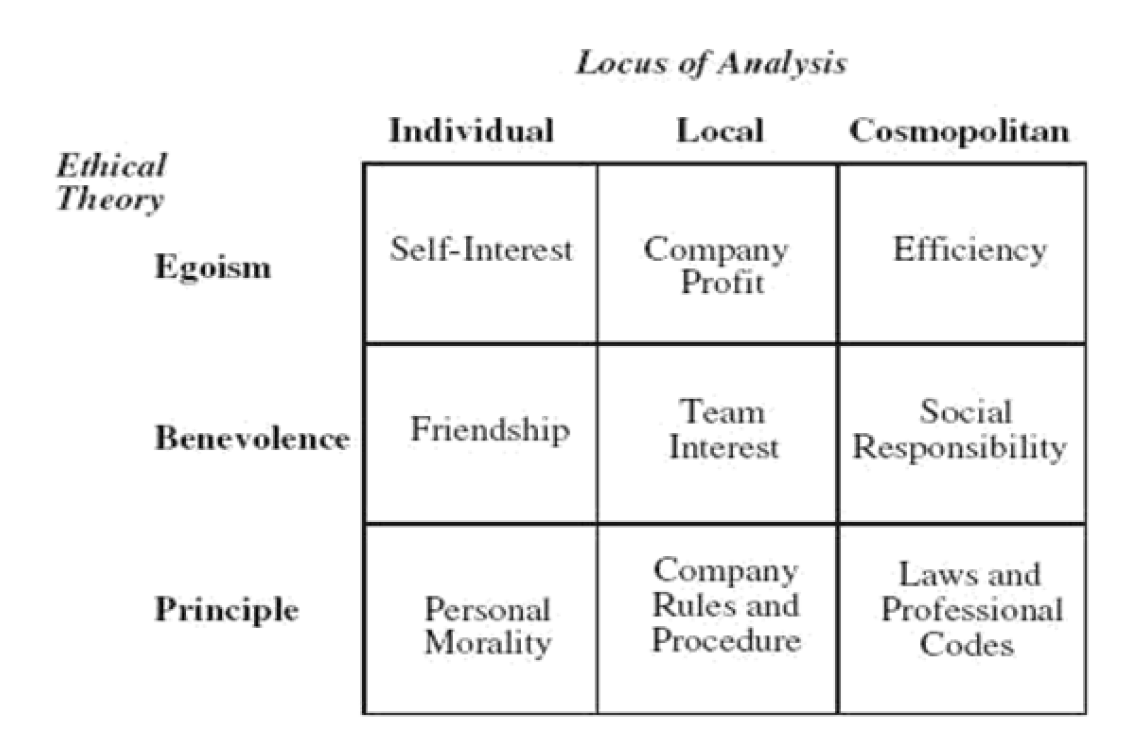
Kohlberg 1984 [44] argues that individuals pass through a sequential process of moral development in an irreversible manner. According to his typology in Figure 2, there are three broad levels of cognitive moral development (pre-conventional, conventional and principled) each being composed of two stages. In each of the moral development stages, certain beliefs about the “right” guide behaviors of the individuals. These three ethical standards closely align themselves with the three major of classes of ethical theory: egoism, utilitarianism and deontology. The theory of egoism foresees that individuals try to maximize their self-interest: whereas utilitarianism argues that the benefit for the greatest number of people must be taken into consideration. On the other hand, deontology maintains that individuals do the “right thing” regardless of the consideration of the outcomes and the effect of those outcomes on the interested parties.
Based on Kohlberg’s ethical standards, Victor and Cullen [4] classified ethical climates according to ethical as egoism, benevolence and principled. These theories differed in terms of the basic criteria used in moral reasoning. In a largely egoistic climate, self-interest might be the dominant consideration whereas in benevolent climate, consideration of the wellbeing of others may be the dominant reasoning used by employees to address and solve ethical problems. With a largely principled climate on the other hand compliance with the rules or laws becomes the dominant form of reasoning. In this type of climate that individuals make ethical decisions according to the common universal values of right and wrong.
The second dimension however, represented the locus of analysis which was defined as “the referent group identifying the source of moral reasoning used for applying ethical criteria to organizational decisions and/or the limits on what would be considered in ethical analyses of organizational decisions” [4]. This view suggested that the behaviors of the individuals were largely determined by the norms of particular groups.
Victor and Cullen [4] added the first dimension of “individual” to the spectrum and thus, the locus of analysis criteria included individual, local and cosmopolitan levels. The “individual” level was considered as external to the organization in the sense that the normative climate was supported by the ethical reasoning of the individual. In these types of climates, the personal norms and values constituted the reference point for making ethical decisions. Therefore, the organization or the society was somehow external to the individual as a referent source.
The second category the “local” locus represented sources of ethical reasoning within the organization, such as the workgroup. In these types of climates, the organizational norms guided the behavior of the employees. Lastly, the cosmopolitan level specified organizational sources of ethical reasoning external to the organization, such as a professional association or a body of law. Cosmopolitan sources of ethical reasoning were assumed to be “abstract concepts, generated outside organizations but used inside organizations as part of the institutionalized normative system” [4]. In this sense, professions that were highly technical in nature are expected to be classified along the cosmopolitan level of analysis, since the technical rules and regulations determines the ethical choices of the individuals rather than the organization or the individual itself.
Thus the nine element matrix was constructed by a combination of the two dimensions (ethical theory and locus of analysis), each including three categories. To summarize, guided by the ethical theory of “egoism”, the individual loci of analysis symbolizes the “self-interest” climate in which employees pursue and try to maximize their self-interests. At the “local” locus of analysis, the individual will care for the good of the organization regardless of personal interests. Therefore, this climate is labeled as “company profit”. Lastly, when the locus of analysis is at the cosmopolitan level, employees will try to protect the larger social or economic system’s interests. As a result, this climate is labeled as “efficiency”.
In the context of benevolence criterion: individual locus of analysis represents the “friendship” climate. In this type of climate individuals are highly sensitive about the personal needs of others. Nevertheless, organizational membership is not the reference point for such concern. The climate under benevolence at the local locus of analysis specifies the “team interest” climate. In such organizations, employees show great concern for the well-being of the organization as a whole. At the cosmopolitan level of analysis on the other hand, employees are rather guided with concern for the others (e.g. society) external to the organization. Therefore, the benevolent dimension crosscutting the cosmopolitan level of analysis represents the “social responsibility” climate.
Lastly, in the context of principle criterion, in individual locus of analysis, an individual’s actions are directed by his own personal ethics. Therefore, this climate is labeled as “personal morality”. At the local locus of analysis, the source of principles lies within the organization which is categorized as ‘company rules and procedures’. In such climates, employees strictly follow organization rules and procedures without making reference to the individual ethical decisions. At the cosmopolitan locus of analysis on the other hand, the source of principles is external to the organization like ‘laws and professional codes’. As can be inferred in local and cosmopolitan climates ethical reasoning is apart from personal ethical preferences.
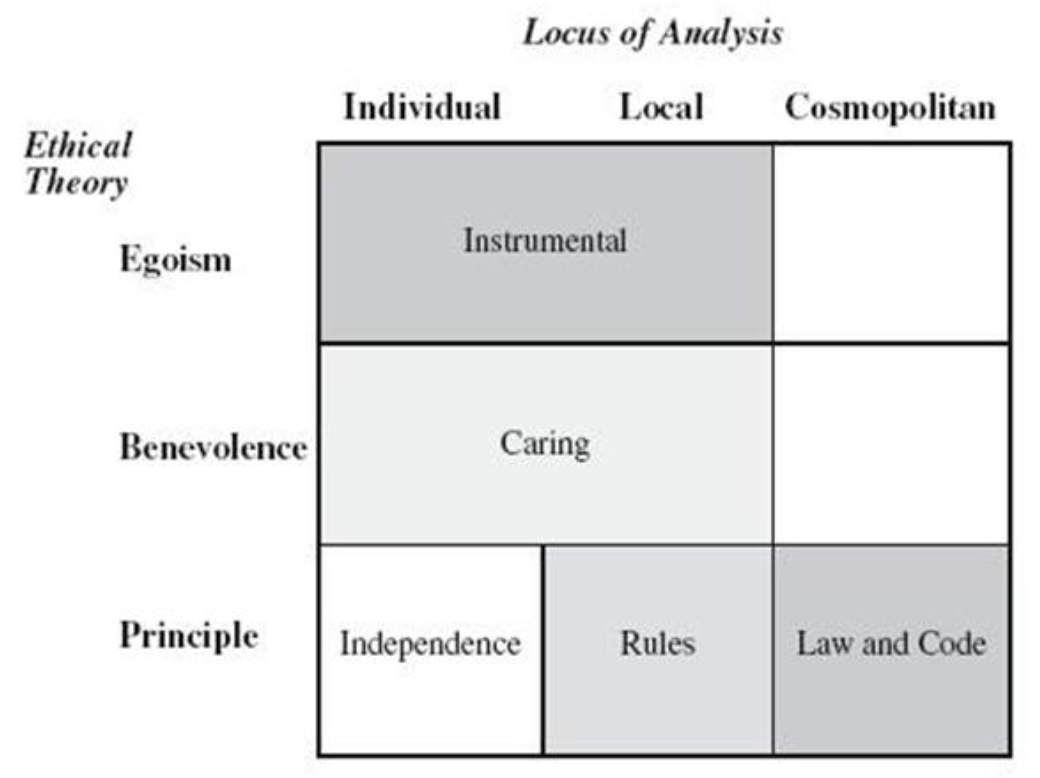
However as already stated, when these nine dimensions were factor analyzed, data supported only for a five factor solution [4]. To distinguish these new five factors from the theoretically developed nine dimensions, they were labeled differently from the former construct. These factors were namely, Instrumental, caring, law and code, rules, and independence respectively.
Table 2: Organizational Justice Dimensionality in Previous Studies
Dimension
Research/Empirical Study used particular dimension
Distributive Justice
1. Skarlicki and Folger [7]
6. Zribi and Souai
2. Sackett and De Vore [14]
7. Mazni et al. [32]
3. Fox et al. [15]
8. Mohsen, Reza and Rajacipoor
4.Everton, Jolton and Mastrangelo [22]
9. Faheem and Mahumud [37]
5. Nasir and Bashir [29]
10. Mazni and Rasdi [38]
Procedural Justice
Procedural Justice
1. Skarlicki and Folger [7]
6. Zribi and Souai
2. Sackett and De Vore [14]
7. Mazni et al. [32]
3. Fox et al. [15]
8. Mohsen, Reza and Rajacipoor
4.Everton, Jolton and Mastrangelo [22]
9. Faheem and Mahumud ([37]
5. Nasir and Bashir [29]
10. Mazni and Rasdi [38]
Interactional Justice
1. Skarlicki and Folger [7]
6. Zribi and Souai
2. Sackett and De Vore [14]
7. Mazni et al. [32]
3. Fox et al. [15]
8. Mohsen, Reza and Rajacipoor
4.Everton, Jolton and Mastrangelo [22]
9. Faheem and Mahumud [37]
5. Nasir and Bashir [29]
10. Mazni and Rasdi [38]
Source: Developed by the Researcher
Figure 1: Theoretical strata of ethical climate [42]
Figure 2: Five Common Derivatives of Ethical Climate [42]
Caring Climate
The caring climate is a “combination of the individual/benevolence and local/ benevolence climates” [12]. In these types of climate employees show a high degree of concern for the wellbeing of the self and the organization as whole. Caring work climates are normally the type of climate that is regularly preferred by the employees.
Law and Code Climate
Law and code climate represent a combination of the cosmopolitan/principled climates. In such climate the major type of consideration is adherence to laws and regulations in solving ethical dilemmas. Therefore, the decisions of the individuals are based on an external system (laws and codes) that dictates them how to behave.
Rules Climate
High loadings on local principle descriptors characterize and recognize the rules climate [4]. In rules climate, employees are expected to strictly go after organizational rules and procedures.
Instrumental Climate
Instrumental climates involve local and individual egoism criteria descriptors. In instrumental climates, employees are controlled by their self-interests. Employees in instrumental types of climates identify their organization as encouraging behaving egoistically and taking decisions based on personal ethics.
Independence Climate
Independence climates cover the high-loadings on the principled climates at the individual locus of analysis. In Independence climates employees behave in accordance with their personal moral beliefs based upon a set of well-considered principles” [45].
Existence of Multiple Ethical Climate Types
Victor and Cullen [4] claimed that “to the extent that different subgroups within organizations have identifiably different climates, such climates likely indicate the existence of organizational subcultures”. Therefore, they hypothesized that ethical work climates may differ with regard to situational (e.g. department, job level) and individual variables (e.g. age, tenure). Although they were unable to find any variations in the perceived ethical climates across different departments, their results proved a reasonable variation in perceived ethical climates for employees at different job levels (officer, manager, supervisor, nonsupervisory) and at different levels of age and tenure.
In accord with these results scholars such as Vardi [13], Weber 1995, [33]. Wimbush and Shepard [45] have confirmed the existence of multiple climates in organizations. Weber,1995 [33] hypothesized that ethical climates in an organization varied with regard to departmental tasks and stakeholder relationships. Weber 1995 [33] main aim was to discover the existence of multi-climates in organizations and how sub-climates surfaced in ethical climates. He argued that, the basis for making ethical decisions and the resulting ethical sub-climate vary in organizations affected by the departmental tasks and stakeholder relationships. Since OECs affect ethical decision making and behavior, he suggests that the studies must be launched on the ‘sub-climates’ comprising the organizations’ ethical work climates. In the same vein, Wimbush et al. 1997 [33] suggested that different ethical work climates might exist throughout the organization, particularly if the organization was consisted of a number of units with different operational functions, and that the ethical sub-climates would provide a exact way to evaluate the climate of the organization.
Similarly, Vardi [13] also hypothesized that there will be in-house differences among the ethical climates within an organization with regard to unit. He further described this principle by providing some examples. To illustrate, he has proposed that the focus of the production unit was productivity and the amount of sales whereas the main consideration for the sales department was the quality of service and customer relationships. Therefore, he concluded that the existing climates in these two separate types of organizational units will definitely be diverged from each other.
DISCUSSION
Impact of Ethical Climates on Ethical Behaviors: Within the scope of this study, it is hypothesized that the ethical climates can be an influential variable to cause deviant workplace behaviors. At this point, in order to get a deeper insight about ethical work climates as an antecedent of workplace deviance, it is also important to analyze the influence of Ethical Work Climate on Ethical Decision Making. Empirical evidence proposes that ethical work climates have a considerable influence on the ethical decision making process. Despite the large number of studies focused on the organizational level outcomes, researchers have shown a great interest to study the impacts of ethical work climates on ethical decision-making by employees and ethical behaviors of organizational member [12,18] Vardi, [13]. Wimbush and Shepard [45], Wimbush et al.[32]
Although ethical climate is a macro-level construct, the perception of ethical climate is relevant to individual ethical decision-making at the micro-level. Therefore, a logical extension of research on ethical climate was to test associations between individual perceptions of ethical climate and individual ethical decision-making. Trevino 1986 [8] proposed an “interactionist” model for ethical decision-making in organizations. This model connects individual variables (e.g. moral development) with situational variables to explain and predict the ethical decision-making behavior of individuals in organizations.
Similarly, Fritzsche [12] also looked into the relationship of ethical decision making to the ethical climates. He expected that the majority of ethical decisions occur in ethical climates where the locus of analysis is at the cosmopolitan level. On the other hand, the lowest proportion of ethical decisions were expected to be made in climates in which locus of analysis is the individual. In line with these expectations, he has found out that the greatest possibility of making unethical decisions were placed at the lowest level of moral development at the cosmopolitan level of analysis.
Apart from the ethical decision making impacts, Wimbush and Shepard [45] and Wimbush et al. 1997 [33] provided support that ethical work climates had an influence on the ethical behaviors of the employees.
Wimbush and Shepard [45] have attempted to analyze the relationship between ethical climate and ethical behavior in organizations and hypothesized that supervisor influence plays an important role in shaping up the ethical climate and on the behaviors of individuals. They argued that behaviors of individuals were largely dependent on the predominant dimension associated with the work group. They have hypothesized and verified that “Employees in workgroups characterized by caring, law and code, rules, or independence ethical climate dimensions are more likely to behave ethically than employees in workgroups adhering to the instrumental dimension of ethical climate” Wimbush andShepard.
Relationship Between Oec and Dwb
The aim of this section is to describe the theories that analyze the influence and the effect of the OEC on DWB and analyze the recent researches and empirical studies which are conducted to explore the relationship between OEC and DWB. There are number of researches, Peterson [18]: Robinson and O’Leary-Kelly, [8], Vardi, [13], Martin and Cullen [25], Robinson and Bennett [1], Bamikol et al., Mazni et al. [32], Pelin and Funda [33], Mazni and Rasdi [38] in the field conducted on this area of research to find the association between OEC and “deviant type” behaviors such as counterproductive behavior, employees’ retaliation, workplace aggression, workplace deviance, unethical behavior etc.
As already described in this chapter, employees’ perception about the ethically correct behavior and how ethical dilemmas should be handled is represented by organizational ethical climates. Cullen, Parboteeah and Victor (2003) suggested that employees’ perceptions on organizations’ ethical values, regular practices, procedures and systems have significant effect on their behaviors and reactions. Robinson and O’Leary-Kelly [8] revealed that antisocial behaviors of work groups are directly related with individual antisocial behaviors and therefore managers should focus on work group level in understanding and minimizing such antisocial behaviors.
In a related study that focused on theft which is considered as one of dimension of property deviance, McClurg and Butler 2006 [38] emphasized that ethical climate of work groups could be considered as a good predictor of workplace deviance. In his study of the impact of ethical work climates on organizational misbehavior, Vardi [13] found out that the concept of ethical work climate is better enough to explain organizational misbehavior compared to the organizational climate construct. Vardi [13] stated that, in each organization there is a climate for organizational misbehavior and the closest concept to the climate of organizational misbehavior is the ethical work climate. His study has concluded that organizational misbehavior is negatively related with some types of ethical work climates.
Peterson [18] research has proven that certain types of ethical climates were related to specific types of deviant behaviors and deviant workplace behaviors can be predicted from the ethical work climate of an organization. Meanwhile Bamikol et al. revealed that poor supervision, poor identification of the company and uncertainty of employees’ future which represent a negative perception on organizations’ ethical climate would predict the political deviance, personal aggression, property deviance and political deviance at workplace. Mazni et al. [32] emphasized that employees’ better perception on the social exchange relationship assists to create pleasant ethical work climate within organizations. Accordingly, they suggested that employees engage in Organizational Citizenship Behavior (OCB) instead of DWB provided that they distinguish better ethical work climate within the workplace. On the other hand, low perception of OEC highly accelerates the rate of DWB. Furthermore, they concluded their study with the finding of negative relationship between OEC and workplace deviant behavior amongst support personnel of Malaysia.
Pelin and Funda [33] have stated that employees’ attitudes or thoughts on their organizations’ ethical climate can determine their tendencies in engaging positive, negative, ethical or unethical behaviors. In other words, OECs effect on the occurrence of individual’s citizenship or counterproductive behaviors. When employees emotionally identified that organizational climate as more favorable and supportive climate for them, then they try to “deviate” from the counterproductive behaviors. They further revealed that negatively perceived organizational climate that does not assist employees is mostly expected to encourage counterproductive behavior within organization. Conversely organizational climate with employees’ blessings and match to workers’ personal objectives may cause positive attitudes towards co- workers and organization. In addition to that Mazni and Rasdi [38] conducted in Malaysia revealed a negative and low relationship between OEC and interpersonal deviance.
Having analyzed recent researches and empirical studies in which the influence of OECs on DWB was measured, researcher identified few prominent dimensions which were frequently used in recent past to measure the OEC as follows,
According to this Table 3 it is observed that five dimensions: Instrumental Climate (5 researches), Caring Climate (5 researches), Law and Code Climate (7 researches), Rules Climate (6 researches) and Independence Climate (4 researchers) have been used previously by the most of scholars to measure the nature of employees’ perception of OEC as a major predictor of DWB.
Ethical Work Climates in The Public Sector
An examination of the ethical work climates in the public sector worth attention since public service requires public servants to strictly obey laws and regulations. In Sri Lanka, the governments have “regularized” and “equalized” the Ethical Climates of government organizations by using “Establishment Code”, Financial Regulations (FR) and other rules and legally authorized institutions. In Sri Lankan context hardly any studies conducted to explore the Ethical Climates in both private sector and public sector. Even in international context though there is an extensive research on ethical work climates in private organizations, the number of studies that focus on the structuring of ethical work climates in the public sector are comparatively limited.
Ethical work climates of the public organizations are based on the democratic values and public interest rather than shareholder interest and profit considerations that are observed in the private sector. The reason for the existence of private sector is to make profit which provides employees with more space to engage in unethical behaviors with a view to derive economic benefits. Since the rationale for the existence of public institutions or non-profit institutions is only to serve, the examination of the ethical contexts of such organizations did not gain much interest. Similarly,
Public institutions as organizations have an ethical responsibility to ensure public trust and perform their functions consistent with the norms, values and expectations of the people. Most important goal of the public servants is to behave in accordance with the socially accepted values of the public and the major aspirations of public organizations as ensuring public trust, equality and equity, fairness and due process. Therefore, there is a clear difference between the private and public sector with regard to the norms and values that guide employee behavior.
Along with the principles of American Society of Public Administration’s (ASPA) code of ethics, It has been suggested that public employees consider five major interests in making ethical decisions. These five interests are: public interest, legal interest, personal interest, organizational interest, and professional interest. It further claimed that most people that work in the public sector regard public interest as the most important consideration in making decisions.
In an examination of separate interests of public servants, most of public employees show great respect for the law and due processes as well as the professional standards of their work in making ethical decisions. Public organizations are created by law and they are tasked with administering the law. Although in some circumstance compliance with the laws might not be necessary for a private sector employee, full recognition and execution of laws is mandatory for the public servants.
The Obligation to work in compliance with the formally and legally imposed rules and standards in public institutions would lead their employees to perceive a “law and code” climate. The behaviors of the public servants are guided by the public expectations that want public servants to act with “fairness, responsiveness, accountability, and honesty”. As can be inferred, all the listed qualifications make reference to the universally accepted rights and values which refer to the cosmopolitan level of analysis in the ethical work climate framework.
Employees’ Demographic Factors
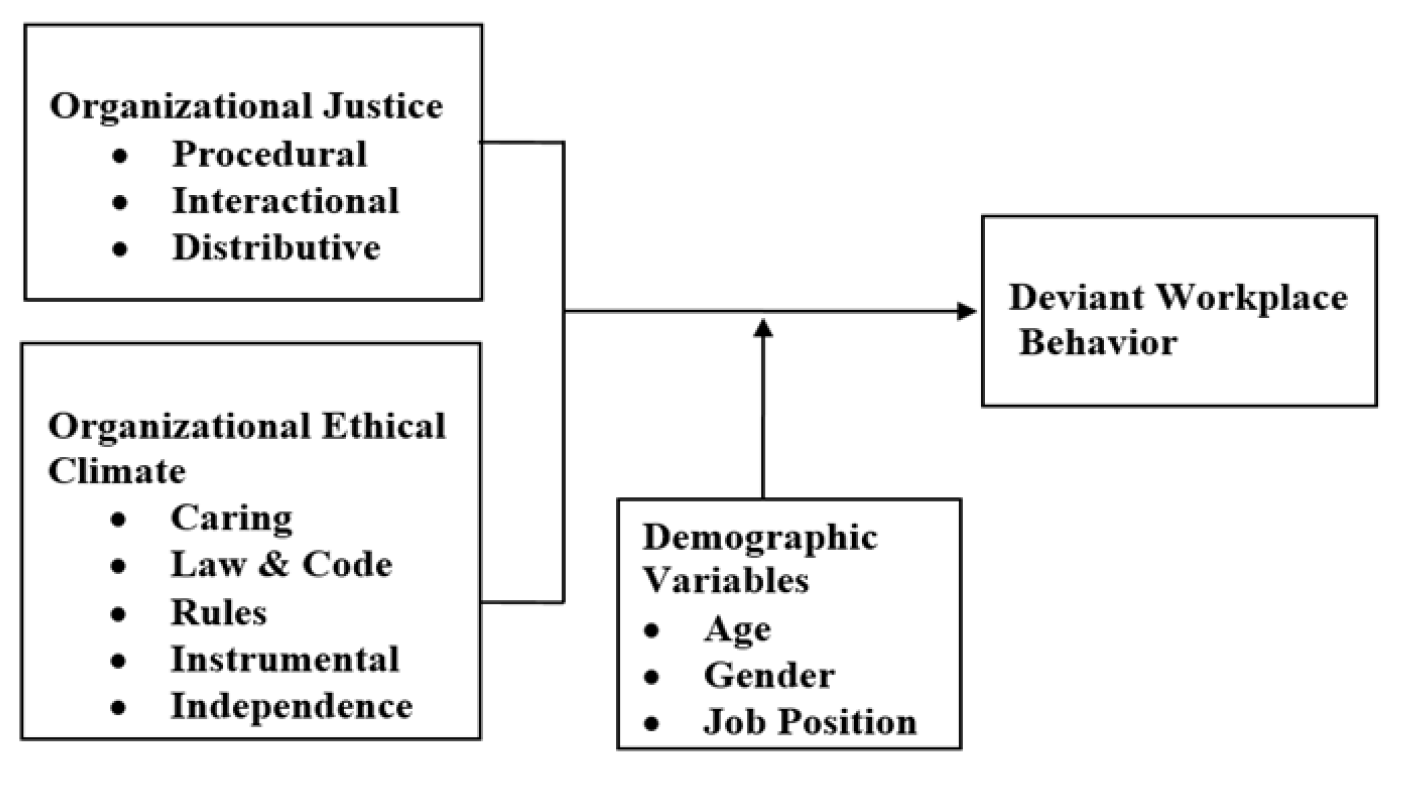
Employees’ demographic factor variable is tested as a moderate factor which moderates the influence of “X” variables (Organizational Justice: Ethical Climate) on the Deviant Workplace Behavior. Some of prominent employees’ demographic variables identified in previous part of literature review are further described here for the easy understanding of the nature of such demographic variables.
Gender
Gender differences have reasonable relationship with ethical decision making process and three different types of approaches have been used frequently to explain the relationship between gender differences and ethical decision making process. In explaining gender differences, “socialization theory” describes that the gender differences have been caused as a result of the differences in nature and frequency of exposing to the society. That means male are exposed to the society very early and they have regular social engagements while female have relatively less chances to engage with society.
Starting at very early ages men and women prepare to play their “conventional” roles in the society. Women practice themselves to their roles as wives and mothers where as men getting ready for their roles as husbands and fathers. As a result of this phenomenon, women pay their fullest attention to improve themselves in the areas of interpersonal relations, caring, and kindness. Men draw their consideration towards the competitive success and extrinsic rewards such as financial rewards and social status. Being more interested in competitive success than caring about others, men performs unethical and deviant behaviors to achieve their goals.
The second approach describes that gender differences have been originated as a result of the dissimilarities of ethical frame works used by men and women in their ethical decision making process. Men and women use two different kinds of approaches to cope up with ethical issues.
Empathy and compassion have been based for women’s view on ethical dilemmas while men view such issues based upon justice and fairness.
Gender differences could be explained by the “role of moral situations”. During extreme moral intensity situations, men make more ethical decisions than women. In other words, within extreme moral intensity situations (either totally unethical or totally ethical) men illustrate a tendency to have ethical decisions regularly. However as far as women are concerned they incline to make more ethical decisions, where the moral intensity lays in between totally unethical and totally ethical.
Tenure
Tenure means the period in which a particular employee has served in an organization. The longer the period work in a workplace, employees become more familiar to the workplace and get used to the rules, regulations and working environment. At the same time work related attitudes such as job involvement could be developed within employees. Hence as stated by most of researchers, tenure demonstrates negative relationship with regard to the deviant behavior. However, this situation could be changed at the other way also, when an employee has high level of ethical behavior and ethical decision making ability, enlisted to a workplace where majority of employees are performing deviant behaviors. In such a situation particular employee could be spoiled or enforced by the peers or co-workers to engage in deviant activities.
Education
Education is a process which develops skills, conceptual knowledge, and makes attitudes, values and perceptions of individuals. It helps individuals to improve their awareness about the society and understand their positions in the society. The higher the educational level the broader the individuals’ knowledge about the society and its’ rules, ethics, norms etc. An individual’s capacity of moral awareness increases with the level of education (As he/she possess primary, secondary and tertiary education). As revealed by Vansandt et al. 2006 [33] “development of moral judgment” is highly determined by education factor.
Employees’ Age
According to Appelbaum, Deguire and Lay [21], age factor demonstrates a positive correlation to employees’ ethical decision making process. Generally elder people are matured: Honest: experienced: responsible: and therefore have broad picture on society and work environment than younger people Appelbaum, Deguire and Lay [21]. Since theft involvements are regularly found among younger employees of organizations, they are bound with “epidemic of moral laxity” [11]. However, O’Fallon, and Butterfield 2005 [35] have stated a different expression saying that relationship between age factor and ethical decision making is complicated and therefore “hard and fast” relationship could not be forecasted regarding these two variables.
Status and Reference Groups
When someone has close relationships with various reference groups, his attitudes and activities are highly dominated by the broad views of reference groups and thereby their activities are become more ethical than isolated individuals. Further their capacity in verifying perspectives are broaden and thereby become highly efficient in analyzing situations on others’ point of views as well. In this kind of a situation, workplace innovations and creativity are sharpened considerably.
Religion
In any culture particularly in Asian countries, Religion directly shapes up the attitudes, values, and perceptions of devotees in accordance with the doctrine of particular religion. Since the religious diversity is very less in developed countries such as USA, Canada, European countries and Scandinavian countries, there were not enough researches were carried out to find out the different effects of religion to the employees ‘behavior.
However, in Asian countries there are plenty of religious groups, chapters are observed apart from main religions namely Buddhism, Hinduism, Christianity and Islam. In such a situation it is must to find out relationship of employees’ religion on organization behavior. Despite of the religions and religious groups: chapters: followed by employees, religious people are more ethical than the ordinary people [35]. However, there are some extremist religious groups who mislead the followers towards aggressive and unethical behaviors.
Marginality of Positions (Job Position)
The term “marginality positions” means that the positions in organizations, holders of which are considered as low ranked, vacancies of those positions are filled up with temporary enlisted casual or outsourced employees and employees in that positions are paid comparatively low salaries than other employees. Furthermore, these employees are treated as “second class” employees within organizations and therefore these employees are unable to build up a status and interpersonal relationships with both co-workers and managers. Apart from that they are given very less chance for job advancements giving less attention for their “voice”. Due to this “unfair” working conditions, unpleasant working environment and poor interpersonal relationships, they have been isolated within their own workplace and suffered with the mentality that “we are disposable people” [11].
Further these employment positions are mostly covered up with contract basis outsourced employees such as employees of cleaning services and manpower companies in Sri Lanka. This “Temporary nature” of work place has become highly dominant variable to drag the employees towards the unethical behaviors.
Relationship between Employees’ Demographics and DWB
The aim of this section is to describe the researches/theories/studies that analyze the moderate role of the employees’ demographics between employees’ perception of organizational: justice: ethical climate and DWB and analyze the recent researches and empirical studies which are conducted to explore the moderate influence of employees’ demographics between two independent variables and DWB. Numerous researches, Martinko et al. [17]: Liao, Joshi and Chuang [20]: Bamikol et al.: Zribi and Souai : Yariv in the field have discussed on this area while conducting their studies to explore the association of OEC, OJ, Job Satisfaction, Job Stress etc.
Martinko et al. [17] found that age and profession level shows a negative correlation with workplace aggression and distinction of aggression level according to the gender within their sample. Liao, Joshi and Chuang [20] have also proved the negative relationship of age with workplace deviance. They also found that ethnic differences could make distinctions of workplace deviance levels. Furthermore, Bamikol et al. clearly identified that there is a significant difference between male employees and female employees in terms of engage in production deviance and personal aggression. Further they stated that male employees’ average fraudulent behavior is greater than that of female employees. In addition, Zribi and Souai revealed that employees show an unbelievable low level of workplace deviance despite of high rate of injustice perceptions. As they suggested the reason behind was the cultural influence of employees.
Apart from those studies Mahdieh and Tayerani found significant difference between the perception of OJ and DWB in organizations in accordance with employees’ income level which is pretty much paralleled with job positions. Further they identified that rate of workplace deviance is declined as employees grow older. Yariv conducted a research to explore the relationship of job status which is highly correlated with job positions with workplace incivility, revealed that low employment status results high level of workplace incivility. They further reported a significant variance in employees’ deviance between high status employees and low status employees.
Conceptual Framework
Conceptual background elaborates the association between DWB with the independent variables. Factors namely employees’ demographics, organizational justice and organizational ethical climate were critically reviewed as the most influencing factors to the DWB. Each factor/variable is measured in terms of various dimensions. In conceptual framework Researcher identifies significant dimensions of each factor which were largely encountered the DWB as follows:
Employees’ Demographics
Having reviews, the literature in previous section, researcher selected three demographic variables which were frequently used to measure employees’ demographics as follows.
Employees’ Age
Age factor demonstrates a considerable impact on DWB. Generally elder people are matured: Honest: experienced: responsible: and therefore have broad picture on society and work environment than younger people. Hence elder the employees lower the involvements in DWB.
Gender
Gender differences have reasonable relationship with DWB process. Male employees show relatively high “attraction” towards the involvements in deviant behaviors while female employees are reluctant to perform deviant activities in the workplace.
Job Position
Job position means the level of employment categorized by the employers based on the nature of task perform by the employees. In Sri Lankan basically job positions are categorized as executives, clerical employees and lower level employees. Salaries, recognition and other fringe benefits are varied according to the job positions. Employees in high job positions get more benefits than the lower level employees. Therefore, employees belong to low job positions perform deviant activities regularly while high level employees like executives perform less deviant activities.
Organizational Justice
Having gone through the literature in previous section, researcher filtered four justice dimensions which were largely used to measure employees’ perception on organizational justice as follows.
Procedural Justice
Procedural justice dimension represents the employees’ perception of fairness in procedures adopted to reach organization targets. Therefore, the procedures were considered to be a fair way to reach outcomes of the organizations. When employees perceive that their organization has fair procedures then they are less intended to commit deviant behaviors.
Distributive Justice
Distributive justice dimension is primarily concerned with the employees’ perception on the fairness of the outputs (salaries and other benefits) received compared to their contribution to the organization. Employees’ positive perceptions of equality will result in positive work behaviors whereas perceptions of inequality will create a tension which needs to be resolved. Hence negative or low level perceptions in workplace fairness cause more deviant behaviors.
Interactional Justice
Interactional justice concerns about the quality of the interpersonal treatment employees receive from their managers/supervisors/co-workers during the performance of organizational procedures. Interactional considerations also play an important role in judging fairness in a certain organization. Therefore, employees’ positive interactional justice perceptions reduce the possibility of initiating deviant behaviors in workplaces.
Organizational Ethical Climate
Having studied the literature in previous section, researcher filtered five ethical climates which were regularly used to measure employees’ perception on organizational ethical climates as follows.
Caring Climate
The caring climate dimension represents the employees’ concern over the wellbeing of both employees and the organization as a whole. Employees prefer to have high level of caring work climate and if they perceive that caring climate in the organization is very low then it stimulates them to perform DWB.
Law and Code Climate
Law and code climate dimension represents the consideration on management/employer to adherence to laws and regulations in solving ethical dilemmas. Therefore, in high level of law and code climate laws, regulations and codes direct employees’ behavior. It has been found that higher the laws and regulations in the organizations, employees get less chance to involve in deviant activities.
Rules Climate
Rules climate dimension indicates the expectation of employers, in which they expect employees to strictly go after organizational rules and procedures. When employees perceive that their rules climate is very strict they discourage to perform deviant activities.
Instrumental Climate
Instrumental climate dimension represents the employees’ intention to behave according to their self-interests. Employees in positive perceptions on instrumental climate, taking decisions based on personal ethics. Therefore, employee’s positive perceptions on instrumental climate decreases the deviant behaviors in organizations.
Independence Climate
Independence climate dimension covers the employees’ behaviors in accordance with their personal moral beliefs based upon a set of well-considered principle. In independence climates employees get much chance to make contributions to decision making process of the organizations. Therefore, higher perceptions on independence climate motivate the employees to reduce deviant behaviors.
Conceptual Model
By using the conceptual and operational knowledge gathered in previous sections researcher developed a conceptual model. The dependent variable (deviant workplace behavior), fully or partially depends on employees’ demographics, organizational justice and organizational ethical climates. Three demographic variables (age, gender and job position) denoted as moderate variables between the DWB and organizational justice: ethical climate. Core variables (OJ and OEC) are measured in terms of influence level which was viewed to each key performance indicator. The conceptual model is illustrated in Figure 3.
Figure 3: Research Model
REFERENCE
Robinson, S.L. and Bennett, R.J. “A typology of deviant workplace behaviors: A multidimensional scaling study.” Academy of Management Journal, vol. 38, no. 2, 1995, pp. 555–572.
Robinson, S.L. and Bennett, R.J. “Development of a measure of workplace deviance.” Journal of Applied Psychology, vol. 85, no. 3, 2000, pp. 349–360.
Niehoff, B.P. and Moorman, R.H. “Justice as a mediator of the relationship between methods of monitoring and organizational citizenship behaviour.” Academy of Management Journal, vol. 36, no. 3, 1993, pp. 527–556.
Victor, B. and Cullen, J.B. “The organizational bases of ethical work climate.” Administrative Science Quarterly, vol. 33, no. 1, 1988, pp. 101–125.
Sweeney, P.D. and McFarlin, D.B. “Workers’ evaluations of the ‘ends’ and ‘means’: An examination of four models of distributive and procedural justice.” Organizational Behavior and Human Decision Processes, vol. 55, no. 1, 1993, pp. 23–40.
Vardi, Y. and Wiener, Y. “Misbehavior in organizations: A motivational framework.” Organization Science, vol. 7, no. 2, 1996, pp. 151–165.
Skarlicki, D.P. and Folger, R. “Retaliation in the workplace: The roles of procedural and interactional justice.” Journal of Applied Psychology, vol. 82, no. 3, 1997, pp. 434–443.
Robinson, S.L. and O’Leary-Kelly, A. “Monkey see, monkey do: The influence of work groups on the antisocial behavior of employees.” Academy of Management Journal, vol. 41, no. 6, 1998, pp. 658–672.
Aquino, K. et al. “Justice constructs negative affectivity and employee deviance: A proposed model and empirical test.” Journal of Organizational Behavior, vol. 20, no. 7, 1999, pp. 1073–1091.
Baron, R.A. et al. “Social and personal determinants of workplace aggression: Evidence for the impact of perceived injustice and the Type A behavior pattern.” Aggressive Behavior, vol. 25, no. 4, 1999, pp. 281–296.
Greenberg, L. and Barling, J. “Coworkers subordinates and perceived workplace factors: Predicting employee aggression against supervisors.” Journal of Organizational Behavior, vol. 20, no. 6, 1999, pp. 897–913.
Fritzsch, D.J. “Ethical climates and the ethical dimension of decision making.” Journal of Business Ethics, vol. 24, no. 2, 2000, pp. 125–140.
Vardi, Y. “The effects of organizational and ethical climates on misconduct at work.” Journal of Business Ethics, vol. 29, no. 4, 2001, pp. 325–337.
Sackett, P.R. and DeVore, C.J. “Counterproductive behaviors at work.” Handbook of Industrial Work and Organizational Psychology, vol. 1, 2001, pp. 145–164.
Fox, S. et al. “Counterproductive work behavior in response to job stressors and organizational justice.” Journal of Vocational Behavior, vol. 59, 2001, pp. 291–309.
Lee, K. and Allen, N.J. “Organizational citizenship behavior and workplace deviance: The role of affect and cognitions.” Journal of Applied Psychology, vol. 87, no. 1, 2002, pp. 131–142.
Martinko, M.J. et al. “Toward an interactive theory of counterproductive workplace behavior: A causal reasoning perspective.” International Journal of Selection and Assessment, vol. 10, 2002, pp. 36–49.
Peterson, D.K. “Deviant workplace behavior and organizational ethical climate.” Journal of Business and Psychology, vol. 17, 2002, pp. 47–61.
Colbert, A.E. et al. “Interactive effects of personality and situation on workplace deviance.” Journal of Applied Psychology, vol. 89, no. 4, 2004, pp. 599–609.
Liao, H. and Joshi, A. “Sticking out like a sore thumb: Employee dissimilarity and deviance at work.” Personnel Psychology, vol. 57, no. 4, 2004, pp. 969–1000.
Appelbaum, S.H. et al. “The relationship of ethical climate to deviant workplace behavior.” Corporate Governance, vol. 5, no. 4, 2005, pp. 43–55.
Everton, W.J. et al. “Be nice and fair or else: Understanding reasons for employees’ deviant behaviors.” Journal of Management Development, vol. 26, no. 2, 2005, pp. 117–131.
Henle, C.A. “Predicting workplace deviance from the interaction between organizational justice and personality.” Journal of Managerial Issues, vol. 17, no. 2, 2005, pp. 247–263.
Spector, P.E. et al.Emotions and violence. 2006, www.corwin.com/upm-data/8744_KellowayCh3.pdf.
Martin, K.D. and Cullen, J.B. “Continuities and extensions of ethical climate theory: A meta-analytic review.” Journal of Business Ethics, vol. 69, 2006, pp. 175–194.
Appelbaum, S.H. et al. “Positive and negative workplace behaviors: Causes impacts and solutions.” Corporate Governance, vol. 7, no. 5, 2007, pp. 586–598.
Lara, P.Z. and Verano-Tacoronte, D. “Investigating the effects of procedural justice on workplace deviance.” International Journal of Manpower, vol. 28, no. 8, 2007, pp. 715–729.
Mitchell, M. and Ambrose, M.L. “Abusive supervision and workplace deviance.” Journal of Applied Psychology, vol. 92, no. 4, 2007, pp. 1159–1168.
Nasir, M. and Bashir, A. “Examining workplace deviance in public sector organizations of Pakistan.” International Journal of Social Economics, vol. 39, no. 4, 2012, pp. 240–253.
Othman, M.Y. et al. “Personality traits and workplace deviant behaviors.” Elixir Human Resource Management, vol. 47, 2012, pp. 678–683.
Radzali, F.M. et al. “Workload job stress family-to-work conflict and deviant workplace behavior.” International Journal of Academic Research in Business and Social Sciences, vol. 3, no. 12, 2013, pp. 109–120.
Alias, M. et al. “Predictors of workplace deviant behavior: HRD agenda for Malaysian support personnel.” European Journal of Training and Development, vol. 37, no. 2, 2013, pp. 161–182.
Kanten, P. and Er, U.F. “The effect of organizational climate on counterproductive behaviors.” The Macrotheme Review, vol. 2, no. 4, 2013, pp. 144–160.
Uddin, A. et al. “Exploring the relationship among transformational leadership deviant workplace behavior and job performance.” ABAC Journal, vol. 34, no. 1, 2014, pp. 1–12.
Farhadi, H. et al. “The role of demographic factors on workplace deviant behavior.” e-Bangi, vol. 12, no. 3, 2015.
Farhadi, H. et al. “Understanding employees’ deviant behavior: The role of agreeableness and work stress.” International Conference on Social Sciences and Humanities, vol. 2, 2015, pp. 102–107.
Faheem, M.A. and Mahmud, N. “The effects of organizational justice on workplace deviance and job satisfaction.” Mediterranean Journal of Social Sciences, vol. 6, no. 5, 2015, pp. 342–352.
Alias, M. and Rasdi, R.M. “Organizational predictors of workplace deviance among support staff.” Procedia – Social and Behavioral Sciences, vol. 172, 2015, pp. 126–133.
Michelle, S.V. and Silva. “The impact of stress on deviant workplace behavior.” International Journal of Human Resource Studies, vol. 7, no. 1, 2017, pp. 1–15.
Greenberg, J. “Organizational justice: Yesterday today and tomorrow.” Journal of Management, vol. 16, no. 2, 1990, pp. 399–432.
Greenberg, J. “The social side of fairness.” Justice in the Workplace, edited by J. Greenberg, 1993, pp. 79–103.
Victor, B. and Cullen, J.B. A theory and measure of ethical climate in organizations. JAI Press, 1987.
Cullen, J.B. et al. “The effects of ethical climates on organizational commitment.” Journal of Business Ethics, vol. 46, no. 2, 2003, pp. 127–141.
Thio, Alex. Deviant behavior. 10th ed., Allyn and Bacon, 2010.
Wimbush, J.C. and Shepard, J.M. “Toward an understanding of ethical climate.” Journal of Business Ethics, vol. 13, no. 8, 1994, pp. 637–647
License
Creative Commons Attribution-NonCommercial-NoDerivatives 4.0 International License
All papers should be submitted electronically. All submitted manuscripts must be original work that is not under submission at another journal or under consideration for publication in another form, such as a monograph or chapter of a book. Authors of submitted papers are obligated not to submit their paper for publication elsewhere until an editorial decision is rendered on their submission. Further, authors of accepted papers are prohibited from publishing the results in other publications that appear before the paper is published in the Journal unless they receive approval for doing so from the Editor-In-Chief.
Himalayan Journal of Education and Literature open access articles are licensed under a Creative Commons Attribution-Share A like 4.0 International License. This license lets the audience to give appropriate credit, provide a link to the license, and indicate if changes were made and if they remix, transform, or build upon the material, they must distribute contributions under the same license as the original.
Recommended Articles
Research Article
Perceptions of Adolescent Pregnancy and Early Motherhood
Lucy Fonjong Udikoh,
Tamfuchia Ferdinard Baba
Published: 30/12/2020
Download PDF
Cite
x
APA
Fonjong Udikoh, L. & Ferdinard Baba, T. (2020). Perceptions of Adolescent Pregnancy and Early Motherhood. Himalayan Journal of Education and Literature, 1(1), 1-7.
MLA
Fonjong Udikoh, Lucy and Tamfuchia Ferdinard Baba. "Perceptions of Adolescent Pregnancy and Early Motherhood." Himalayan Journal of Education and Literature 1.1 (2020): 1-7.
Chicago
Fonjong Udikoh, Lucy and Tamfuchia Ferdinard Baba. "Perceptions of Adolescent Pregnancy and Early Motherhood." Himalayan Journal of Education and Literature 1, no. 1 (2020): 1-7.
Harvard
Fonjong Udikoh, L. and Ferdinard Baba, T. (2020) 'Perceptions of Adolescent Pregnancy and Early Motherhood' Himalayan Journal of Education and Literature 1(1), pp. 1-7.
Vancouver
Fonjong Udikoh L, Ferdinard Baba T. Perceptions of Adolescent Pregnancy and Early Motherhood. Himalayan Journal of Education and Literature. 2020 Jul;1(1):1-7.
Download PDF
Research Article
The Effect of Practicing Critical Thinking Skills on Undergraduates English Learners: Teachers’ Perspective
Azza Elmadani,
...
Shiraz Al-Ali
Published: 15/03/2026
Download PDF
Cite
x
APA
Elmadani, A., Hussein, J. A. T. & Al-Ali, S. (2026). The Effect of Practicing Critical Thinking Skills on Undergraduates English Learners: Teachers’ Perspective. Himalayan Journal of Education and Literature, 7(1), 1-5.
MLA
Elmadani, Azza, Jehan Adli Tawfig Hussein and Shiraz Al-Ali. "The Effect of Practicing Critical Thinking Skills on Undergraduates English Learners: Teachers’ Perspective." Himalayan Journal of Education and Literature 7.1 (2026): 1-5.
Chicago
Elmadani, Azza, Jehan Adli Tawfig Hussein and Shiraz Al-Ali. "The Effect of Practicing Critical Thinking Skills on Undergraduates English Learners: Teachers’ Perspective." Himalayan Journal of Education and Literature 7, no. 1 (2026): 1-5.
Harvard
Elmadani, A., Hussein, J. A. T. and Al-Ali, S. (2026) 'The Effect of Practicing Critical Thinking Skills on Undergraduates English Learners: Teachers’ Perspective' Himalayan Journal of Education and Literature 7(1), pp. 1-5.
Vancouver
Elmadani A, Hussein JAT, Al-Ali S. The Effect of Practicing Critical Thinking Skills on Undergraduates English Learners: Teachers’ Perspective. Himalayan Journal of Education and Literature. 2026 Jan;7(1):1-5.
Download PDF
Research Article
Interaction of Modern Literature-Paintings and Poetry, Storytelling, Literature
Jackline Njeri Murimi
Published: 27/01/2021
Download PDF
Cite
x
APA
Njeri Murimi, J. (2021). Interaction of Modern Literature-Paintings and Poetry, Storytelling, Literature. Himalayan Journal of Education and Literature, 2(1), 1-5.
MLA
Njeri Murimi, Jackline. "Interaction of Modern Literature-Paintings and Poetry, Storytelling, Literature." Himalayan Journal of Education and Literature 2.1 (2021): 1-5.
Chicago
Njeri Murimi, Jackline. "Interaction of Modern Literature-Paintings and Poetry, Storytelling, Literature." Himalayan Journal of Education and Literature 2, no. 1 (2021): 1-5.
Harvard
Njeri Murimi, J. (2021) 'Interaction of Modern Literature-Paintings and Poetry, Storytelling, Literature' Himalayan Journal of Education and Literature 2(1), pp. 1-5.
Vancouver
Njeri Murimi J. Interaction of Modern Literature-Paintings and Poetry, Storytelling, Literature. Himalayan Journal of Education and Literature. 2021 Jan;2(1):1-5.
Download PDF
Research Article
The Effect of Web Quest on the Achievement of Fifth Grade Literary Students in Philosophy and Psychology
Muntasser Mohammed Nada
Published: 30/05/2024
Download PDF
Cite
x
APA
Nada, M. M. (2024). The Effect of Web Quest on the Achievement of Fifth Grade Literary Students in Philosophy and Psychology. Himalayan Journal of Education and Literature, 5(1), 1-39.
MLA
Nada, Muntasser M.. "The Effect of Web Quest on the Achievement of Fifth Grade Literary Students in Philosophy and Psychology." Himalayan Journal of Education and Literature 5.1 (2024): 1-39.
Chicago
Nada, Muntasser M.. "The Effect of Web Quest on the Achievement of Fifth Grade Literary Students in Philosophy and Psychology." Himalayan Journal of Education and Literature 5, no. 1 (2024): 1-39.
Harvard
Nada, M. M. (2024) 'The Effect of Web Quest on the Achievement of Fifth Grade Literary Students in Philosophy and Psychology' Himalayan Journal of Education and Literature 5(1), pp. 1-39.
Vancouver
Nada MM. The Effect of Web Quest on the Achievement of Fifth Grade Literary Students in Philosophy and Psychology. Himalayan Journal of Education and Literature. 2024 Jan;5(1):1-39.
S.K, J. & D.A.T, K. (2021). Factors affecting on Deviant Workplace Behavior: A Critical Review of Literature. Himalayan Journal of Education and Literature, 2(1), 1-16.
MLA
S.K, Jeewandara and Kumari D.A.T. "Factors affecting on Deviant Workplace Behavior: A Critical Review of Literature." Himalayan Journal of Education and Literature 2.1 (2021): 1-16.
Chicago
S.K, Jeewandara and Kumari D.A.T. "Factors affecting on Deviant Workplace Behavior: A Critical Review of Literature." Himalayan Journal of Education and Literature 2, no. 1 (2021): 1-16.
Harvard
S.K, J. and D.A.T, K. (2021) 'Factors affecting on Deviant Workplace Behavior: A Critical Review of Literature' Himalayan Journal of Education and Literature 2(1), pp. 1-16.
Vancouver
S.K J, D.A.T K. Factors affecting on Deviant Workplace Behavior: A Critical Review of Literature. Himalayan Journal of Education and Literature. 2021 Jan;2(1):1-16.



 Download PDF
 Download XML