Effect of Piper Guineense and Dennettia Tripetala, two Insecticidal Plants on Eggs Laid by Female Callosobruchusmaculatus on Infested Cowpea Seeds
Ernest Olaolu Dawodu
1
1
(Phd), Department of Agricultural Science and Technology, Bamidele Olumilua University of Education, Science and Technology, Ikere-Ekiti, Ekiti State, Nigeria
A laboratory bioassay was carried out to determine the efficacy of two botanical powders, Piper guineense and Dennettiatripetala on the protection of cowpea seeds from a notorious pest Callosobruchusmaculatus oviposition on infested cowpea seeds. Powders of particle sizes 212µm, 300 µm, 500 µm, 1000 µm controlled egg lay, adult emergence and number of holes bored on cowpea seeds by the beetle. The application of particle size 212 µm of P. guineense at 0.5 g/ 20 g seeds resulted in the lowest values of number of laid eggs, emerged adults and number of bored holes (3.21, 0.44 and 4.81 respectively). The control experiment recorded the highest mean number of laid eggs (77.02), emerged adult (47.77) and number of bored holes (66.49). A progressive increase in the mean number of egg laid, emerged adults and holes bored on cowpea seeds by adult beetle recorded in protected cowpea seeds was as a result of increase in the particle sizes of the powders. The effect of powders of Dennettiatripetala on egg laid, adult emergence and mean number of holes bored on cowpea seeds followed the same trend. Powders of P. guineense and D. tripetala have proven to be effective in the control of C. maculatus. As it causesreduction in egg laid, emerged adults and number of holes bored on cowpea seeds. Lowest values were also recorded at the application of 5 g/ 20 g seeds of cowpea in D. tripetala in the number of laid eggs, emerged F1 adults and number of bored holes (24.99, 11.80 and 17.48, respectively).
Keywords
Piper guinnense
Dennettiatripetala
Egg laid
Emerged adults
Holes bored
Cowpea
Callosobruchusmaculatus
Particle sizes.
Important Note
Key findings:
The study evaluated the efficacy of Piper guineense and Dennettiatripetala botanical powders in protecting cowpea seeds from Callosobruchusmaculatus oviposition. Particle sizes of 212µm, 300 µm, 500 µm, 1000 µm were tested. Both powders significantly reduced egg laying, adult emergence, and number of holes bored by the beetles. P. guineense at 0.5 g/20 g seeds and D. tripetala at 5 g/20 g seeds exhibited the most effective control.
What is known and what is new?
Callosobruchus maculatus is a common pest of stored cowpea seeds, causing significant damage. Botanical powders have been used as a potential alternative to synthetic pesticides for insect control. This study specifically evaluates the efficacy of Piper guineense and Dennettiatripetala botanical powders in protecting cowpea seeds from C. maculatus oviposition. The study examines the effect of different particle sizes of the powders on egg laying, adult emergence, and seed damage, providing practical insights into their use for pest control in cowpea storage.
What is the implication, and what should change now?
The implication of this study is that Piper guineense and Dennettiatripetala botanical powders can be effective alternatives for controlling Callosobruchus maculatus infestation in stored cowpea seeds. Farmers and agricultural practitioners should consider incorporating these botanical powders into their pest management practices to reduce seed damage and improve seed quality. Further research could focus on optimizing application methods and dosage for practical implementation in cowpea storage facilities.
Introduction
Cowpea, Vignaunguiculata Walp is a leguminous crop of the family Fabaceae which is cultivated in the tropics [1]. It is an important source of vegetable proteins and a very cheap source of protein in the African sub- Saharan regions [2,3].
Over the years, cowpea an indigenous crop, has helped to fill in the gap of body protein requirement of the poor people in the tropics who could not afford animal source of protein [4]. The leaves and seeds can be processed into various edible forms such as Moimoi, CookieGbegiri, Red-Red Stew, Akara, Koki, Ndambe, Bread, Kathiakh, Couscous, and Ekuru [5,6]. Despite the importance of this crop, the problem of storage pest infestation has reduced the available consumable quantity to the lowest ebb which is a great challenge to the well-being of man [7-9].
The cowpea bruchid, Callosobruchusmaculatus (Coleoptera: Chrysomelidae) is a notorious pestthat ravages stored cowpea seeds in the tropical sub- Saharan region of the world [10,11]. Invasion of cowpea by beetle starts from the farm and completes its destructive prowess in the store, boring holes through the pods into the seeds and reducing it into un-consumable non-nutritional powder of no value. Similarly, infested salvaged seeds are often found with bored holes and not good for planting due to loss in viability [12]. C. maculatusis known as a pest of virtually all pulses, this may be due to the palatability of this group of crops [11]. Piper guinnenseis of the family Piperaceae found to be growing in the wet regions of West Africa. It is a spice which is derived from its dried fruit. It is known by different names by different people, these include Benin pepper, Ashanti pepper, etinkeni, Edo pepper, guinea pepper, masoro, false cubeb and kanafuru [13]. P. guineense contains between 5-8 % of the chemical piperine which is responsible for the spiciness, hotness and the pungent attribute of the plant [14].
D. tripetalais a member of the Anononaceae, a family confined to Eastern Nigeria and Cameroon was discovered to be effective in the control of C. maculatus. The presence of pyridine and benzylnitrite which are some of the compounds which constituted the phytochemicals present in D. tripetalamust have been responsible for the activity in the botanical [15,16]. The effectiveness of insecticidal powder in the control of insect pests as protective for stored products have been reported (Ofuya and Osadahun, 2005; Babarindeet al., 2015; Babarindeet al., 2016) [17,4,18]. The effect of mixing powders of P. guineenseand D. tripetalaon stored products have been reported (Dawodu and Ofuya, 2000). Despite the reports on the effectiveness of powders on the control of pest in storage, attention on the particle sizes of powders for greater efficacy need be reported. This has necessitated the report of this bioassay. Therefore, the objective of this study is to evaluate the effectiveness of particle size of powders of P. guineenseand D. tripetala (a) on egg laid by C. maculatus and (b) to determine number of adults that emerged from the cowpea.
Methodology
Study site, Bruchid and cowpea
The study was carried out in the laboratory of the Department of Agricultural Science and Technology, Bamidele Olumilua University of Education, Science and Technology, Ikere-Ekiti. Adult beetle were collected from an infested bag of cowpea from a local market, Oja-Oba in Ikere-Ekiti. The beetle were used to re-infest a clean un-infested variety of cowpea Ife Bimpe which were kept in a kilner jar. Generations of adult beetles used throughout the period of the bioassay were maintained at an ambient temperature of 35 ±50C and relative humidity of 70% in the laboratory. The cowpea variety used for the experiment was collected from Obafemi Awolowo University, Institute of Agricultural Research and Training, Moor Plantation Ibadan.
Insecticidal plant materials
Insecticidal plant parts, seeds of Piper guineense and fruits of Dennettiatripetala were obtained and authenticated from Forestry Research Institute of Nigeria, Ibadan. Each of the material was oven dried at a temperature of 40 0C for 72 hours to a constant weight. Each plant part was grind into powder and sieved using Engineer standard sieve size 212µm, 300µm, 500µm, 1000µm. Each particle size of sieved powder was kept in a plastic container with a tightly fitted lid, labelled and kept on the shelf until being used for the bioassay under ambient conditions.
Results and Discussion
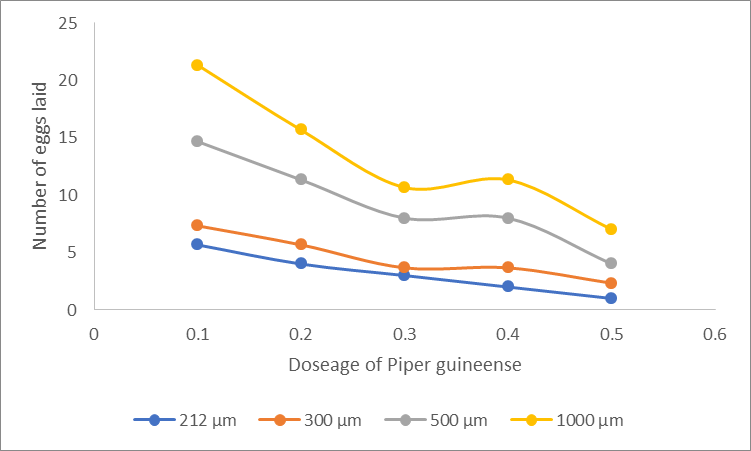
The efficacy of Piper guineense on Callosobruchusmaculatusovi position and emergence of adult is presented in Fig. 1. The mean number of eggs laid by female C. maculatus on infested cowpea seeds protected with P. guineense powder at different particles sizes and doses shows that there were significant differences (P˂0.05) with respect to the effect of particle size and doses applied, but the interaction between particle size and doses applied was not significant (P˃0.05). Each dose applied significantly reduced oviposition by female beetle compared with the control. Regardless of the sizes of powder of P. guineense applied at 0.5 g/ 20 g of seed, significantly (P˂0.05) reduced oviposition by the female beetle when compared with the application of 0.1 g/20 g of seed. Also, regardless of the applied dose, powder from P. guineense with particle size 212 µm significantly (P˂0.05) reduced oviposition by the beetle when compared with powder of particle size of 1000 µm. Regardless of the particle sizes, all doses of P. guineensesuppressed oviposition of C. maculatus.
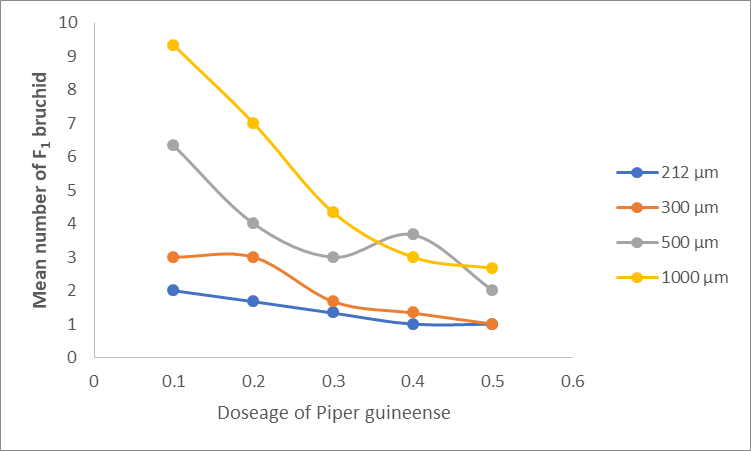
The result of the effect of P. guineensedoses and particle sizes on the F1 adult emergence follow the same trend with the result of oviposition deterrence. There were significant differences (P<0.05) with respect to effect of particle size and doses applied, but the interaction between size of particles and doses applied was not significant (P˃0.05). Regardless of the dose applied, there were significant reduction in the number of adult beetle that emerged from the eggs laid on protected seeds when compared with the control, in all the particle sizes (Fig.2). Regardless of the particle sizes, application of P. guineense at 0.5 g/20 g of seed significantly reduced the number of adult beetle that emerged from the eggs oviposited on protected seeds compared with the application of 0.1 g/20 g of seed, except with particle size of 212 µm. Also, regardless of the dose applied, P. guineense powder with particle size 212 µm caused significant reduction in the number of adult beetle that emerged from the eggs oviposited on the protected seeds compared with powder of particle size 1000 µm, however when P. guineense powders with particle size 500 µm was applied at 0.2, 0.3, 0.4 and 0.5 g/20 g of seed, adult beetle emergence was not significantly affected.
Fig.1: Mean number of eggs laid by female Callosobruchusmaculatus on infested cowpea seeds protected with Piper guineense powders of different particle sizes and doses
Fig.2: Mean number of adult beetle that emerged from eggs laid on cowpea protected with Piper guineense powder with different particle sizes and doses
The Efficacy of Insecticidal formulation from excipient materials and 212 µm particle size Piper guineenseon oviposition, adult emergence and cowpea seeds damaged by Callosobruchusmaculatus is presented in Table 1. The dosage of 212 µm particle size P. guineense significantly (p<0.05) caused mortality of the beetle at all the period of observations as well as the number of eggs laid, the number of emerged F1 adult and the number of holes bored on cowpea seeds due to C. maculatus when compared with the control. Application of P. guineense at 0.5 g/20 g seeds consistently produced the highest mean number of dead bruchid at all observation periods (6.21, 7.88, 8.76, 9.57 and 9.96, respectively) while the control steadily resulted in the lowest mean number of dead bruchid (0.00). The control experiment however recorded the highest mean number of laid eggs (77.02), emerged F1 adult (47.77) and number of bored holes (66.49) while application of P. guineense at 0.5 g/ 20 g seeds resulted in the lowest values of number of laid eggs, emerged F1 adults and number of bored holes (3.21, 0.44 and 4.81 respectively).
The excipient materials had significant effect (p<0.05) on the beetle mortality throughout the study period. It however had no significant effect on the number of eggs laid while it significantly influenced the number of holes bored and the number of emerged F1bruchid (Table 1). Highest mortality of bruchid was recorded with seeds treated with the flour of cowpea pod, as it steadily increased with increase in the study period of 24 hours, 36 hours, 48 hours, 60 hours and 72 hours (4.48, 5.91, 6.64, 7.57 and 8.01, respectively) while the lowest number of mortality throughout the study was observed with seeds treated with rice bran powder (2.85, 4.32, 5.25, 6.57 and 7.28, respectively). There was no significant difference in the number of eggs laid on seeds treated with the excipient materials. The highest number of emerged F1 adults (14.69) was observed in rice bran and bored holes (25.04) while maize husk produced the lowest (13.40 and 22.48).
The formulation ratio significantly influenced mortality, oviposition, and adult emergence of F1bruchid (Table 1). Ratio 70:30 formulation of P. guineense to each of the three excipients resulted in the highest mortality of bruchid between 24 and 60 HAT (5.22, 6.87, 7.44 and 7.78, respectively) while ratio 30:70 formulation resulted in the lowest mean mortality of adult C. maculatus (2.64, 4.14, 4.69 and 6.27, respectively). At 72 HAT, ratio 50:50 of P. guineense to each of the three excipients in the formulations resulted in the highest mean number of mortality of bruchid (8.20) which was not significantly different from the mortality produced by 60:40 and 70:30 formulations while ratio 30:70 produced the lowest mortality of adult bruchid (7.51). With ratio 60:40, the highest mean oviposition (28.91) was recorded while the lowest mean number of eggs (20.97) occurred with ratio 40:60. Ratio 30:70 formulation produced the highest mean number of F1 adult emergence and mean number of bored holes on cowpea seeds (19.70 and 39.60, respectively). The interaction between the dose, excipient materials and the formulation ratio significantly influenced (p<0.05) the mortality, F1 emergence and the number of holes bored on cowpea seeds but it had no significant effect on oviposition, (Table 1).
Table 1: Effects of treatment, excipient materials and the formulation ratios of Piper guineenseat 212 µm on the mortality, oviposition, F1 emergence and hole bored on cowpea seeds by Callosobruchusmaculatus
Mortality at Hours After Treatment
24
36
48
60
72
Number of eggs laid
Emerged F1
Number of holes
Dose
(g/20 g seed)
0.10
2.21
4.19
5.40
7.37
8.36
29.91
18.47
27.55
0.20
3.16
5.21
6.51
8.07
8.88
20.41
11.15
20.5
0.30
4.63
6.27
7.40
8.67
9.32
12.09
5.07
13.79
0.40
5.64
7.12
7.83
8.97
9.64
7.11
1.99
8.73
0.50
6.21
7.88
8.76
9.57
9.96
3.21
0.44
4.81
Control
0.00
0.00
0.00
0.00
0.00
77.02
47.77
66.49
Excipient materials
Cowpea pod
4.48
5.91
6.64
7.57
8.01
25.21
14.35
23.45
Maize husk
3.60
5.10
6.05
7.18
7.79
24.75
13.40
22.48
Rice bran
2.85
4.32
5.25
6.57
7.28
24.92
14.69
25.04
Ratio
30:70
2.64
4.14
4.69
6.27
7.51
26.33
19.70
39.60
40:60
3.67
4.76
5.40
6.10
6.80
20.97
16.57
37.04
50:50
3.16
4.71
6.01
7.73
8.20
22.71
11.02
13.10
60:40
3.52
5.08
6.37
7.67
7.93
28.91
11.96
15.07
70:30
5.22
6.87
7.44
7.78
8.02
25.88
11.49
13.47
LSD Dose
0.28
0.29
0.26
0.19
0.16
2.52
1.67
1.86
LSD Exp mat
0.2
0.2
0.18
0.14
0.11
Ns
1.18
1.31
LSD Ratio
0.25
0.26
0.23
0.18
0.14
2.3
1.53
1.7
LSD D x E x R
***
***
***
***
***
Ns
***
***
*** = significant at P=0.05probability level; ns = data not significant at P=0.005
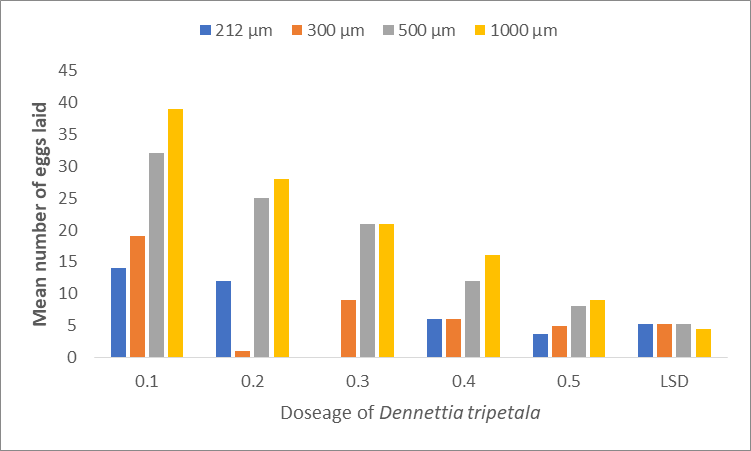
The efficacy of powders of Dennettiatripetala on Callosobruchusmaculatus oviposition and F1 emergence is presented in Fig. 3. The mean number of eggs laid by female C. maculatus on infested cowpea seeds protected with D. tripetala powder at different particles sizes and doses shows that significant differences (P˂0.05) were observed at the application of each particle size and dose, but the interaction between particle sizes and doses applied were not significant (P˃0.05). Each dose applied caused significant reduction in egg laid by the bruchid when compared with the control. Regardless of particle sizes, D. tripetala applied at 0.5 g/ 20 g of seed significantly (P˂0.05) reduced egg laid by the bruchid when compared with the application of 0.1 g, 0.2 g and 0.3 g/20 g of seed. Also, regardless of the applied dose, powder from D. tripetala with particle size 212 µm significantly (P˂0.05) reduced egg laid by the bruchid when compared with powder of particle sizes 500 µm and 1000 µm. Regardless of the particle sizes, all doses of D. tripetalasuppressed oviposition of C. maculatus.
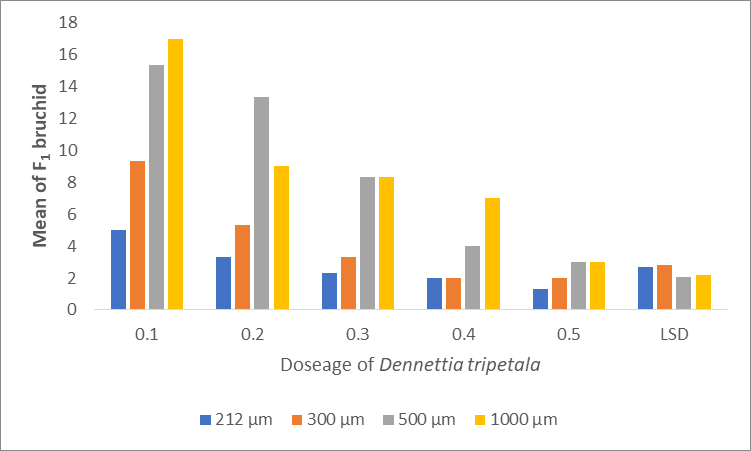
The result of the effect of D. tripetala dosesand particle sizes on the F1 adult emergence follow the same trend with the result of oviposition deterrence. Significant differences (P<0.05) were observed at the application of each particle size and at all the doses applied, but the interaction between particle sizes and doses applied were not significantly different (P˃0.05). Each dose applied significantly reduced F1 beetle that emerged from the eggs laid on protected seeds by the bruchids compared with the control, in all of the particle sizes (Fig. 4). Regardless of the particle sizes, application of D. tripetala at 0.5 g/20 g of seed significantly reduced the number of F1 beetle that emerged from the eggs laid on protected seeds compared with the application of 0.1 g and 0.2 g/20 g of seed. Also, regardless of the dose applied, D. tripetala powder with particle size 212 µm powder significantly reduced the number F1bruchid that emerged from the eggs laid by female C. maculatus on protected seeds compared with particle size 1000 µm, however. When D. tripetalapowder with 500 µm was applied at 0.2, 0.3, 0.4 and 0.5 g/20 g of seed, oviposition was not significantly affected.
Fig.3: Mean number of eggs laid by female Callosobruchusmaculatus on infested cowpea seeds protected with Dennettiatripetala powders of different particles sizes and doses
Fig.4: Mean of F1bruchid that emerged from eggs laid on cowpea protected with Dennettiatripetala powder with different particle sizes and doses
Efficacy of Insecticidal formulation from excipient materials and 212 µm particle sizeDennettiatripetalaon mortality, oviposition, F1 emergence and cowpea seeds damaged by Callosobruchusmaculatus
The interaction amongst doses, excipient materials and the formulation ratios significantly (p<0.05) influenced adult beetle mortality, number of laid eggs, number of emerged F1 adults and number of bored holes on cowpea seeds by C maculatus.
The dosage of 212 µm particle size D. tripetalasignificantly (p< 0.05) caused mortality of the beetle at all the periods of observations as well as reduced number of eggs laid, the number of emerged F1 adults and number of bored holes on cowpea seeds due to C. maculatuswhen compared with the control (Table 4.10). Application of D. tripetala 0.5 g/20 g seed consistently recorded the highest mean number of dead bruchids at all observation periods between 24 HAT and 72 HAT (2.01, 2.91, 3.64, 4.16 and 4.75, respectively) while the control steadily resulted in the lowest mean number of dead bruchids (0.00). The control experiment however recorded the highest mean number of laid eggs (116.21), emerged F1 adults (91.45) mean number of bored holes (106.48) while application of D. tripetalaat 0.5 g/20 g seeds resulted in the lowest values of number of laid eggs, emerged F1 adults and number of bored holes (24.99, 11.80 and 17.48, respectively).
The excipient materials had no significant effect (P > 0.05) on bruchid mortality throughout the study period except at 24 HAT. It also had no significant effect on the number of eggs laid and the number of bored holes on cowpea seeds due to C. maculatus when compared with the control. It significantly influenced the number of emerged F1 bruchids (Table 4.10). Highest mortality of bruchid was recorded in seeds treated with cowpea pod flour as it steadily increases with increasedwith time: 24 HAT, 36 HAT, 48 HAT, 60 HAT AND 72 HAT (0.98, 1.56, 2.03, 2.40 and 2.85, respectively) while lowest number of dead bruchid was observed in seeds treated with maize husk powder at 24 HAT and 60 HAT (0.88 and 2.33, respectively) and seeds treated with rice husk flour produced the lowest number of dead bruchids at 36 HAT (1.47).
There was no significant difference between the number of laid eggs and number of bored holes on seeds treated with the excipient materials. The highest number of emerged F1 adult bruchids was observed in seeds treated with maize husk powder (37.56) while cowpea pod flour recorded the lowest (34.99). Similarly, there was no significant difference in the number of emerged F1 adult from seeds treated with the excipient materials.
The formulation ratio significantly (p<0.05) influenced mortality, oviposition, bored holes and emergence of the F1 adult bruchid (Table 4.10). Ratio 50:50 formulation resulted in the highest number of dead adult bruchids at 24 HAT (1.27) while 30:70 formulation resulted in the lowest number of dead adult bruchid (0.60). Ratio 70:30 formulations steadily recorded the highest number of dead adult bruchids between 36 HAT and 72 HAT (2.40, 3.24, 4.14 and 4.88, respectively) while ratio 30:70 recorded the lowest mortality (0.79, 1.07, 1.24 and 1.40, respectively). With ratio 30:70 the highest number of oviposition, emerged F1 and bored holes on seeds treated with cowpea seeds (26.36, 21.03 and 22.97, respectively) and ratio 70:30 formulation recorded the lowest oviposition, emerged F1 and bored holes (26.36, 21.03 and 22.97, respectively).
Table 2: Effects of treatments, excipient materials and the formulation ratios of Dennettiatripetalaat 212 µm on the mortality, oviposition, F1 emergence and hole bored on cowpea seeds by Callosobruchusmaculatus
Mortality at Hour After Treatment
Dose
(g/20 g seed)
24
36
48
60
72
Number of eggs laid
Emerged F1
Number of holes
0.1
0.35
0.83
1.16
1.57
2.03
54.03
38.31
45.37
0.2
0.61
1.24
1.77
2.31
2.71
47.96
32.56
40.31
0.3
1.13
1.81
2.32
2.79
3.31
40.05
25.16
31.47
0.4
1.57
2.32
2.88
3.35
4.07
31.33
16.44
23.32
0.5
2.01
2.91
3.64
4.16
4.75
24.99
11.80
17.48
Control
0.00
0.00
0.00
0.00
0.00
116.21
91.45
106.48
Excipient materials
Cowpea pod
0.98
1.56
2.03
2.40
2.85
51.82
34.99
43.21
Maize husk
0.88
1.52
1.93
2.33
2.82
52.34
37.56
44.85
Rice bran
0.98
1.47
1.93
2.36
2.76
53.13
35.31
44.15
Ratio
30:70
0.60
0.79
1.07
1.24
1.40
75.18
52.49
64.43
40:60
0.99
1.19
1.38
1.57
2.00
70.03
45.49
57.47
50:50
1.27
1.68
2.20
2.61
3.06
53.92
35.12
44.90
60:40
1.04
1.53
1.92
2.24
2.71
36.66
25.63
30.59
70:30
0.83
2.40
3.24
4.14
4.88
26.36
21.03
22.97
LSD Dose
0.13
0.16
0.17
0.19
0.17
1.97
3.23
2.74
LSD Exp mat
0.09
Ns
Ns
Ns
ns
Ns
2.28
Ns
LSD Ratio
0.12
0.15
0.15
0.17
0.15
2.87
2.94
2.50
LSD D x E x R
**
**
***
***
**
Ns
Ns
Ns
***, ** and * = significant at p<0.05, and 0.05 probability levels respectively; ns = data not significant at P >0.05.
Discussion
Over the years, C. maculatushave caused man a great deal of reduction in the quantity of cowpea for feature usage. They have reduced the quality of the produce by contamination through excreta, dead remains, detached body parts and attraction of different types of micro- organisms which have acted and denatured unprotected produce [19,4]. The result of the study on P. guineense and D. tripetala shows that plants with insecticidal qualities are effective for the control of storage pests (Dawodu and Ofuya, 2000; Ofuya and Dawodu, 2002a; Babarindeet al., 2017a, Babarindeet al., 2017b, Dawoduet al.,2021) [1,20-23]. Regardless of the quantity of the insecticidal powders applied, both plants materials controlled egg laid and the number of adult that emerged. This is consistent with previous works (Chukwulobe and Echezona, 2014; Olayinka-Olagunju, 2014) [24,25] that powders and extracts of P. guineenseis effective in the control of adultbruchid in stored cowpea. In this bioassay, the efficacy of particle size has been found to have greater insecticidal effect on C. maculatusnumber of egg laid and adult emergence. Jayaramet al., (2022) [27] reported the ovicidal effect of the activities of botanicals against pulse beetle.
Dispersion of powder is easily influenced by the size of the powder thus greater surface area coverageis achieved with smaller particle sizes.This may be responsible for the why particle size 212 µm was most effective when compared with 300 µm, 500 µm and 1000 µm. Invariable, as beetle tries to reach out to cowpea seeds, it rubsboth thorax and abdominal parts on the protected seeds thus tiny sizes of powder particles finds their way into the respiratory tracts of the bruchid and causing a blockage of the structure which often lead to mortality.The use of varying proportions from rhizomes of Zingiberofficinale (Rosc). exhibited effective control of C. maculatus [28]. Formulation ratio 70:30 P. guineense to each of (rice husk powder, cowpea pod powder and maize husk powder) was the most effective of all the ratios in the formulations, as the least number of eggs laid and the least number of adult emergence was recorded. A gradual increase in the number of eggs laid and emerged adults was recorded as the ratio of active ingredient to excipients in the formulations reduced.
D. tripetalafruit powders was observed to be effective in the control of C. maculatus. This was corroborated by earlier reports of (Ofua and Dawodu, 2002b; Bamphitihiet al., (2015) [29,30] in the use of D. tripetala as protectants to cowpea seeds for the control of infestation, damage and destruction in store. Irrespective of the particle size, 0.1- 0.5 g of the powder reduced number of egg laid and emerged adults significantly. This may have resulted from the fumigant effect or and contact toxicity of the powder to the adult bruchid and already laid eggs. This was corroborated by (Jayaramet al 2022) [27] when the number of eggs laid was observed to have reduced as a result of the reduction in the fecundity and reproductive ability of beetle when powders of Azadiratchaindica seed powder was used to control C. maculatus. It was further observed in this experiment that size of particles of powder contributed to the efficacy of lower quantities of D. tripetala applied to control the bruchid. This is evident as D. tripetala was more effective in the control of older bruchids than the younger ones.A similar observation was made on the susceptibility of differently aged adults of C. maculatus when D. tripetala was used for its control in storage [31,32].
In the formulated powders used for the protection of cowpea seeds, the number of eggs laid and the number of adults C. maculatusthat emerged were significantly reduced as a result of the ovicidal effects exhibited in the bioassay. This was corroborated by (Mahdi & Rahman, 2008; Ekehet al., 2013) [33,34] in the assessment of the effect of mixing plant materials on the mortality and oviposition of C. maculatus. It was observed that when D. tripetala was used as active ingredient separately with excipient materials (rice husk powder, cowpea pod powder and maize husk powder) as formulated insecticides, it controlled egg laid, reduced the number of holes on the seeds and adult emergence. This is in line with earlier worker (Babarindeet al., 2011; Ukeh, 2011) [35,36] on the use of botanicals with insecticidal properties for the control of C. maculatus in store. It was observed that lowest egg laid and lowest adult emergence occurred when formulations with each of the excipient material with particle size 212 µm at 0.5 g was applied but the reverse is the case when particle size 1000 µmat 0.5 g was applied when formulated with each of the excipients. This suggest that, particle size is a function of the effectiveness of particle size 212 µmover 1000 µm. Similarly, the effectiveness of ratios in the formulations increased with higher active ingredients to excipient materials. Ratio 70:30 D. tripetala: excipients was the most effective in all the formulations. This is in line with previous worker on the effectiveness of higher ratios of botanical extracts in the control of insect pests.
In all, any of the excipient materials could be used in the formulations since there is no significant difference in the activity of the excipient materials as each perform the role of a carrier of the active ingredient causing effective control of the target bruchid. This was corroborated by earlier workers in a laboratory experiment on the use of botanicals for the control C. maculatus [34].
Conclusion
In conclusion, P. guineense and D. tripetalahas significant effect on the control of the number of eggs laid and emerged adults from cowpea in storage. Although, powders of P. guineense was observed to be more effective when compared with powders from D. tripetala. Particle size 212 µm at a dosage of 0.5 g was the most effective formulation in the bioassay. Any of the excipient materials will be good enough as a carrier to deliver the active ingredient to the target pest.Therefore, both powders are hereby recommended for the control of egg lay and adult emergence of C. maculatus in storage.
Conflict of Interest
The authors declare that they have no conflict of interest.
Funding: No funding sources
Ethical approval: The study was approved by the Institutional Ethics Committee of Bamidele Olumilua University of Education
References
Dawodu, E. O., and T. I. Ofuya. "Effects of mixing fruit powders of Piper guineense Schum and Thonn. and Dennetia tripetala Baker on oviposition and adult emergence of Callosobruchus maculatus (F.)(Coleoptera: Bruchidae)." Applied Tropical Agriculture 5.2 (2000): 158-162.
Ogunkanmi, L. A., K. Bolarinwa, and O. Ojobo. "Evaluation of four cowpea lines for bruchid (Callosobruchus maculatus) tolerance." (2013). URI: https://ir.unilag.edu.ng/handle/123456789/5399
Ofuya, T. I., et al. "Potential synergism of diatomaceous earth and Piper guineense for management of Callosobruchus maculatus in stored cowpea." Journal of Entomology and Zoology Studies 3.6 (2015): 366-372.
Babarinde, S. A., Dawodu, E. O., & Bello, S. A. (2016). Assessment of different levels of susceptibility of four local cowpea varieties of Vignaunguiculata infestation by cowpea Callosobruchusmaculatus (F.) (Coleoptera: Chrysomeloidiae). Science Research Annals, 8(1), 30-35.
Mamiro, P. S., et al. "Nutritional quality and utilization of local and improved cowpea varieties in some regions in Tanzania." African Journal of Food, Agriculture, Nutrition and Development 11.1 (2011). DOI: .4314/ajfand.v11i1.65876
Badiane, O. "Agriculture and Structural Transformation in Africa." Frontiers in Food Policy: Perspectives on Sub-Saharan Africa, edited by W. P. Falcon and R. L. Naylor, Stanford University, Center on Food Security and Environment, 2014, Create Space.
Oluwafemi, Akinkurolere Rotimi. "Comparative effects of three plant powders and pirimiphos-methyl against the infestation of Callosobruchus maculatus (F.)(Coleoptera: Bruchidae) in cowpea seeds." SOAJ Entomol 1 (2012): 87-99.https://www.academia.edu/download/30608232/20-142-1-PB.pdf
Tadesse, Daniel, et al. "Evaluation of improved varieties of haricot bean in West Belessa, Northwest Ethiopia." Int. J. Sci. Res 3.12 (2014): 2756-2759. https://core.ac.uk/download/pdf/199937424.pdf
Ogunkoya, M. O., and E. O. Dawodu. "Comparative analysis of damage sustained by unprotected cowpea varieties from the attack of Callosobruchus maculatus." The International Journal of Organic Agriculture Research and Development 9 (2010): 136-149. http://ijoardjournal.org/index.php/ijoardjournal/article/view/109
Olaifa, Julius I., and Wilson O. Erhun. "Laboratory evaluation of Piper guineense for the protection of cowpea against Callosobruchus maculatus." International Journal of Tropical Insect Science 9.1 (1988): 55-59. DOI: https://doi.org/10.1017/S1742758400010031
Beck, Christopher W., and Lawrence S. Blumer. "A handbook on bean beetles, Callosobruchus maculatus." National Science Foundation (2014): 1-17. https://www.beanbeetle.org/new_website/wp-content/images/handbook.pdf
Babarinde, Grace Oluwakemi, et al. "Chemical composition and toxicity of Jatropha curcas seed oil against Sitophilus zeamais Motschulsky as affected by pre-extraction treatment of seeds." Biocatalysis and agricultural biotechnology 21 (2019): 101333. http://www.elsevier.com/locate/bab
Younis, Nancy S., and Maged E. Mohamed. "β-Caryophyllene as a potential protective agent against myocardial injury: the role of toll-like receptors." Molecules 24.10 (2019): 1929. https://doi.org/10.3390/molecules24101929
Ojimelukwe, Philippa Chinyere. "Piper guineense-an underutilized aromatic spice with medicinal value." Advances in Traditional Medicine 23.2 (2023): 381-392. http://doi.org/10.1007/s13596-021-00586-3
Elekwa, I., S. C. Okereke, and C. S. Chukwudomo. "Phytochemical screening and GC-MS analysis of the essential oil of Dennettia tripetala (Pepperfruit) seeds." ABSU Journal of environment, science and technology 1 (2011): 93-98.
Ihemeje, A., et al. "Biochemical evaluation of pepper fruit (Dennettia tripetala) and its use as substitute for ginger in zobo drink production." Academic research international 4.6 (2013): 513. https://www.academia.edu/download/39486547/20134.6-54.pdf
Ofuya, T. I., and J. M. Osadahun. "Effects of three plant powders on behaviour, mortality and reproductive fitness of Callosobruchus maculatus (Fabricius)(Coleoptera: Bruchidae)." Zoological Research 26.6 (2005): 603.
Babarinde, Samuel Adelani, et al. "First report of toxicity of Xylopia parviflora (A. Rich.) Benth (Annonaceae) root bark's essential oil against cowpea seed bruchid, Callososbruchus maculatus Fabricius (Coleoptera: Chrysomelidae: Bruchinae)." Natural Product Research 29.4 (2015): 349-352. https://doi.org/10.1080/14786419.2014.940943
Olaifa, J. I., and A. O. Adenuga. "Neem products for protecting field cassava from grasshopper damage." International Journal of Tropical Insect Science 9.2 (1988): 267-270. DOI: https://doi.org/10.1017/S1742758400006111
Ofuya, T. I., and E. O. Dawodu. "Aspects of insecticidal action of Piper guineense Schum and Thonn fruit powders against Callosobruchus maculatus (F.)(Coleoptera, Bruchidae)." Nigerian Journal of Entomology 19 (2002): 40-50. http://www.esnjournal.com.ng/download/Vol_19/Vol_19_d5.pdf
Babarinde, Samuel Adelani, et al. "Comparative sensitivity of maize weevil to essential oil of Hoslundia opposita Vahl leaves subjected to different drying regimes." Acta Fytotechnica et Zootechnica 20.3 (2017): 54-59. https://pdfs.semanticscholar.org/21aa/7113908a6c7b432fb561e5c4702d26249705.pdf
Babarinde, Samuel Adelani, et al. "Insectifugal and insecticidal potentials of two tropical botanical essential oils against cowpea seed bruchid." Environmental Science and Pollution Research 24 (2017): 19785-19794. DOIhttps://doi.org/10.1007/s11356-017-9589-x
Dawodu, E. O., Edewor, T. I., & Babarinde, S. A. "Quantification of Total Phenolic and Flavonoid Contents, and GC-MS Profile of Extracts of Piper guineense, Dennettiatripetala and Ocimum gratissimum Used in the Control of Cowpea Bruchid Callosobruchus maculatus in Storage Grains." International Journal of Agriculture and Environmental Science, vol. 8, no. 5, 2021, pp. 9-18. doi:10.14445/23942568/IJAES-V815P102.
Chukwulobe, Modesta Ngozi, and Bonaventure Chukwujindu Echezona. "Efficacy of three protectants, primiphos methyl, Piper guineense and Eugenia aromatica, against Tribolium castaneum (Herbst)(Coleoptera Tenebrionidae) on stored chips of three Musa spp." World J Agric Res 2.3 (2014): 136-141. DOI:10.12691/wjar-2-3-9
Olayinka-Olagunju, J. O. "Effects of two eco-friendly insecticides (Dennetia tripletala and Piper guineense) against Dermestes maculatus (Degeer) on smoked dried Clarias gariepinus (Pisces: Clariidae)." J Environ Sci Toxicol Food Technol 7.1 (2014): 37-43.
Ogbonna, C. U., et al. "Bioefficacy of Zingiber officinale against Callosobruchus maculatus Fabricius (Coleoptera: Bruchidae) infesting cowpea." International Journal of Entomology Research 1.4 (2016): 19-25.
Jayaram, C. S., et al. "Chemical composition and insecticidal activities of essential oils against the pulse beetle." Molecules 27.2 (2022): 568. https://doi.org/10.3390/ molecule27020568
Ogbonna, C. U., et al. "Bioefficacy of Zingiber officinale against Callosobruchus maculatus Fabricius (Coleoptera: Bruchidae) infesting cowpea." International Journal of Entomology Research 1.4 (2016): 19-25.
Ofuya, T. I., and E. O. Dawodu. "Aspects of insecticidal action of powder from Dennetia tripetala Bak. against Callosobruchus maculatus (F.)(Coleoptera: Bruchidae)[J]." Nig J Exp Appl Biol 3 (2002): 303.
Bamphitlhi, T., Kesegofetse T., & Seipti, S. (2015). Control of cowpea weevil, Callosobruchusmaculatus (F.) (Coleoptera: Bruchidae). Using natural plant products. Insects, 6(1), 77-84.
Asawalam, E. F., and U. J. Dioka. "Evaluation of toxicity of Dennitia tripetala baker f. and curcuma longa l. rhizomes against cowpea seed bruchid, Callosobruchus maculatus (F.) coleoptera: bruchidae." Agricultural Science Research Journal 2.6 (2012): 308-311.
Idoko, Joy Ejemen, and Kayode David Ileke. "Comparative evaluation of insecticidal properties of essential oils of some selected botanicals as bio-pesticides against Cowpea bruchid, Callosobruchus maculatus (Fabricius)[Coleoptera: Chrysomelidae]." Bulletin of the National Research Centre 44 (2020): 1-7. doi:10.1186/s 42269-020-00380-2.
Mahdi, Shah Hussain Ahmad, and Md Khaladur Rahman. "Insecticidal effect of some spices on Callosobruchus maculatus (Fabricius) in black gram seeds." University journal of zoology, Rajshahi University 27 (2008): 47-50. http://journals.sfu.ca/bd/index.php/UJZRU
Ekeh, Felicia Nkechi, et al. "Effectiveness of botanical powders against Callosobruchus maculatus (Coleoptera: Bruchidae) in some stored leguminous grains under laboratory conditions." African Journal of Biotechnology 12.12 (2013).https://www.ajol.info/index.php/ajb/article/view/128425
Babarinde, Samuel A., Oyebamiji O. Oyegoke, and Adeyemi E. Adekunle. "Larvicidal and insecticidal properties of Ricinus communis seed extracts obtained by different methods against Tribolium castaneum Herbst (Coleoptera: Tenebrionidae)." Archives of phytopathology and plant protection 44.5 (2011): 451-459. https://doi.org/10.1080/03235400903093220
Ukeh, D. A., E. B. Adie, and J. A. Ukeh. "Insecticidal and repellent activities of pepper fruit, Dennettia tripetala (G. Baker) against the cowpea beetle, Callosobruchus maculatus (Fabricius)." (2011): 15-23. https://www.cabidigitallibrary.org/doi/full/10.5555/20123004092
License
Creative Commons Attribution-NonCommercial-NoDerivatives 4.0 International License
All papers should be submitted electronically. All submitted manuscripts must be original work that is not under submission at another journal or under consideration for publication in another form, such as a monograph or chapter of a book. Authors of submitted papers are obligated not to submit their paper for publication elsewhere until an editorial decision is rendered on their submission. Further, authors of accepted papers are prohibited from publishing the results in other publications that appear before the paper is published in the Journal unless they receive approval for doing so from the Editor-In-Chief.
Himalayan Journal of Agriculture open access articles are licensed under a Creative Commons Attribution-Share A like 4.0 International License. This license lets the audience to give appropriate credit, provide a link to the license, and indicate if changes were made and if they remix, transform, or build upon the material, they must distribute contributions under the same license as the original.
Recommended Articles
Research Article
Mating behaviour of Cavariella aegopodii
Nidhi Dhatwalia
Published: 19/07/2024
Download PDF
Cite
x
APA
Dhatwalia, N. (2024). Mating behaviour of Cavariella aegopodii. Himalayan Journal of Agriculture, 5(1), 1-7.
MLA
Dhatwalia, Nidhi. "Mating behaviour of Cavariella aegopodii." Himalayan Journal of Agriculture 5.1 (2024): 1-7.
Chicago
Dhatwalia, Nidhi. "Mating behaviour of Cavariella aegopodii." Himalayan Journal of Agriculture 5, no. 1 (2024): 1-7.
Harvard
Dhatwalia, N. (2024) 'Mating behaviour of Cavariella aegopodii' Himalayan Journal of Agriculture 5(1), pp. 1-7.
Vancouver
Dhatwalia N. Mating behaviour of Cavariella aegopodii. Himalayan Journal of Agriculture. 2024 Jan;5(1):1-7.
Download PDF
Research Article
The Role of Indigenous Microbes and Earthworm in the Bioconversion of Dairy Wastewater Solids into Organic Fertilizer
Marlina ,
...
N. Meynadhea
Published: 17/01/2024
Download PDF
Cite
x
APA
None, M., Rahayu, N. A., Badruzzaman, D. Z., Hidayati, Y., Harlia, E., Kurniawan, E. & Meynadhea, N. (2024). The Role of Indigenous Microbes and Earthworm in the Bioconversion of Dairy Wastewater Solids into Organic Fertilizer. Himalayan Journal of Agriculture, 5(1), 1-7.
MLA
None, Marlina, et al. "The Role of Indigenous Microbes and Earthworm in the Bioconversion of Dairy Wastewater Solids into Organic Fertilizer." Himalayan Journal of Agriculture 5.1 (2024): 1-7.
Chicago
None, Marlina, N. A. Rahayu, D. Z. Badruzzaman, Y.A. Hidayati, E. Harlia, E. Kurniawan and N. Meynadhea. "The Role of Indigenous Microbes and Earthworm in the Bioconversion of Dairy Wastewater Solids into Organic Fertilizer." Himalayan Journal of Agriculture 5, no. 1 (2024): 1-7.
Harvard
None, M., Rahayu, N. A., Badruzzaman, D. Z., Hidayati, Y., Harlia, E., Kurniawan, E. and Meynadhea, N. (2024) 'The Role of Indigenous Microbes and Earthworm in the Bioconversion of Dairy Wastewater Solids into Organic Fertilizer' Himalayan Journal of Agriculture 5(1), pp. 1-7.
Vancouver
Marlina M, Rahayu NA, Badruzzaman DZ, Hidayati Y, Harlia E, Kurniawan E, Meynadhea N. The Role of Indigenous Microbes and Earthworm in the Bioconversion of Dairy Wastewater Solids into Organic Fertilizer. Himalayan Journal of Agriculture. 2024 Jan;5(1):1-7.
Download PDF
Research Article
Efficiency of Some Salicylic Acid Concentrations in Tetranychus urticae Koch on Some Eggplant Varieties
Yusra Jamal Talib,
...
Nadia Kadhim Thamer
Published: 10/04/2023
Download PDF
Cite
x
APA
Talib, Y. J., Abass, M. H. & Thamer, N. K. (2023). Efficiency of Some Salicylic Acid Concentrations in Tetranychus urticae Koch on Some Eggplant Varieties. Himalayan Journal of Agriculture, 4(1), 1-7.
MLA
Talib, Yusra J., Mohammed H. Abass and Nadia K. Thamer. "Efficiency of Some Salicylic Acid Concentrations in Tetranychus urticae Koch on Some Eggplant Varieties." Himalayan Journal of Agriculture 4.1 (2023): 1-7.
Chicago
Talib, Yusra J., Mohammed H. Abass and Nadia K. Thamer. "Efficiency of Some Salicylic Acid Concentrations in Tetranychus urticae Koch on Some Eggplant Varieties." Himalayan Journal of Agriculture 4, no. 1 (2023): 1-7.
Harvard
Talib, Y. J., Abass, M. H. and Thamer, N. K. (2023) 'Efficiency of Some Salicylic Acid Concentrations in Tetranychus urticae Koch on Some Eggplant Varieties' Himalayan Journal of Agriculture 4(1), pp. 1-7.
Vancouver
Talib YJ, Abass MH, Thamer NK. Efficiency of Some Salicylic Acid Concentrations in Tetranychus urticae Koch on Some Eggplant Varieties. Himalayan Journal of Agriculture. 2023 Jan;4(1):1-7.
Download PDF
Research Article
The Effect of Green Marketing Mix on Purchasing Decisions by Greenly Salad Consumers in Surabaya
Almira Parahita Soekarno,
...
Sigit Dwi Nugroho
Published: 30/01/2023
Download PDF
Cite
x
APA
Soekarno, A. P., Hendrarini, H. & Nugroho, S. D. (2023). The Effect of Green Marketing Mix on Purchasing Decisions by Greenly Salad Consumers in Surabaya. Himalayan Journal of Agriculture, 4(1), 1-7.
MLA
Soekarno, Almira P., Hamidah Hendrarini and Sigit D. Nugroho. "The Effect of Green Marketing Mix on Purchasing Decisions by Greenly Salad Consumers in Surabaya." Himalayan Journal of Agriculture 4.1 (2023): 1-7.
Chicago
Soekarno, Almira P., Hamidah Hendrarini and Sigit D. Nugroho. "The Effect of Green Marketing Mix on Purchasing Decisions by Greenly Salad Consumers in Surabaya." Himalayan Journal of Agriculture 4, no. 1 (2023): 1-7.
Harvard
Soekarno, A. P., Hendrarini, H. and Nugroho, S. D. (2023) 'The Effect of Green Marketing Mix on Purchasing Decisions by Greenly Salad Consumers in Surabaya' Himalayan Journal of Agriculture 4(1), pp. 1-7.
Vancouver
Soekarno AP, Hendrarini H, Nugroho SD. The Effect of Green Marketing Mix on Purchasing Decisions by Greenly Salad Consumers in Surabaya. Himalayan Journal of Agriculture. 2023 Jan;4(1):1-7.
Dawodu, E. O. (2022). Effect of Piper Guineense and Dennettia Tripetala, two Insecticidal Plants on Eggs Laid by Female Callosobruchusmaculatus on Infested Cowpea Seeds. Himalayan Journal of Agriculture, 3(1), 1-9.
MLA
Dawodu, Ernest O.. "Effect of Piper Guineense and Dennettia Tripetala, two Insecticidal Plants on Eggs Laid by Female Callosobruchusmaculatus on Infested Cowpea Seeds." Himalayan Journal of Agriculture 3.1 (2022): 1-9.
Chicago
Dawodu, Ernest O.. "Effect of Piper Guineense and Dennettia Tripetala, two Insecticidal Plants on Eggs Laid by Female Callosobruchusmaculatus on Infested Cowpea Seeds." Himalayan Journal of Agriculture 3, no. 1 (2022): 1-9.
Harvard
Dawodu, E. O. (2022) 'Effect of Piper Guineense and Dennettia Tripetala, two Insecticidal Plants on Eggs Laid by Female Callosobruchusmaculatus on Infested Cowpea Seeds' Himalayan Journal of Agriculture 3(1), pp. 1-9.
Vancouver
Dawodu EO. Effect of Piper Guineense and Dennettia Tripetala, two Insecticidal Plants on Eggs Laid by Female Callosobruchusmaculatus on Infested Cowpea Seeds. Himalayan Journal of Agriculture. 2022 Jan;3(1):1-9.


 Download PDF
 Download XML