Background: The present study was carried out to evaluate the association of socio-clinical variables with Post Dural Puncture Headache (PDPH) in the obstetrics and non-obstetrics patients. Material & Methods: This was a observational Prospective study carried out at Department of Anaesthesia, Dr. Rajendra Prasad Medical College, Tanda conducted on consecutive patients ASA I and II, aged 20-60 years, obstetric/ non obstetric patients scheduled for surgery under subarachnoid block, over a period of 18 months including data collection, data organization, presentation, analysis and interpretation. After recruitment, the patients were divided into two groups comprising of obstetric and non-obstetric group. Results: The total patients included were 302, being 115 in obstetric group and 187 in non-obstetric group. In our study, out of 302 patients only 17 patients had post dural puncture headache, the total incidence being 5.6%.There were eight (7%) patients in obstetric and nine (4.8%) patients in non-obstetric group, however the difference was not statistically significant (P=0.597). Number of attempts were significantly higher in the patients who had PDPH (P=0.0001). The position of the patients was not significantly associated with incidence of PDPH (P=0.949). BMI of the patients in either group was not significantly associated with incidence of PDPH (P=0.830). Among the patients with median approach, 4.8% patients had PDPH while out of 11 patients with paramedian approach, 27.2% had PDPH. Incidence of PDPH was significantly more with paramedian approach (P=0.0001). With respect to gender in non-obstetric group, the female patients had significantly higher incidence of PDPH (P=0.0002). Patients having PDPH in non-obstetric group belonged to 31-40 yrs age group as compared to only two in the age more than 40years (P=0.0173). Start of ambulation at 10-hourswas significantly associated with incidence of PDPH (P=0.0001). Conclusion: We concluded that in the present study obstetric population had higher incidence of PDPH in comparison to non-obstetric population. PDPH was associated with increased number of attempts; types of approach used, and start of ambulation. Moreover, the incidence of PDPH was more in female gender, younger age as compared to male gender and elderly patients.
Key findings:
Key findings from the study on post dural puncture headache (PDPH) in obstetric and non-obstetric patients include: Higher incidence of PDPH in obstetric patients (7%) compared to non-obstetric patients (4.8%), increased number of attempts and paramedian approach associated with higher PDPH rates, and female gender and younger age group having more PDPH in non-obstetric patients.
What is known and what is new?
The known aspect in this abstract is the association of socio-clinical variables with post dural puncture headache (PDPH) in patients undergoing subarachnoid block. The new contribution is the specific focus on comparing PDPH incidence between obstetric and non-obstetric patients, highlighting factors like number of attempts, approach types, gender differences, and ambulation start time in relation to PDPH occurrence.
What is the implication, and what should change now?
The implication of this study on post dural puncture headache (PDPH) suggests the need for tailored strategies in obstetric and non-obstetric patient care to minimize PDPH risk factors like optimizing needle insertion attempts, considering approach types, and monitoring early ambulation. Changes needed include implementing targeted interventions based on gender, age, and procedural factors to reduce PDPH incidence and improve patient outcomes.
Spinal block is a reliable and easy technique frequently used in anaesthetic practice. However, the spinal anesthesia especially in obstetrics is associated with increased incidence of post dural puncture headache (PDPH) leading to prolonged hospital stay, increased morbidity and therefore decreased preference to subarachnoid block in the subsequent pregnancies. [1,2]
There are many factors affecting the frequency of PDPH. These factors may include age, female sex, needle size and type, pregnancy, previous history of PDPH, median paramedian difference in approach, puncture level [3]. The PDPH, which cause significant morbidity in obstetric patients, has higher incidence because of the increased cerebrospinal fluid (CSF) pressure related to pregnancy, dehydration, blood loss, postpartum diuresis, hormonal imbalance, high serum estrogen levels, and increased peridural pressure [4-5]. There is also direct relation between the incidence of the PDPH and the needle tip design, 30% with 22 G quincke needles and decreased to 0.37% with the 27 G pencil point needles.6 The non-cutting needles have been observed to cause less incidence of PDPH. [7-8]
This study has been planned to evaluate the association of socio-clinical variables with Post Dural Puncture Headache (PDPH) in the obstetrics and non-obstetrics patients undergoing surgeries under subarachnoid block.
Aim & Objectives:
To evaluate the association of socio-clinical variables with Post Dural Puncture Headache (PDPH) in the obstetrics and non-obstetrics patients undergoing surgeries under subarachnoid block
Study Design:
An Observational Prospective study.
Study Area:
The study was carried out at the Department of Anaesthesia, Dr. Rajendra Prasad Medical College, Tanda.
Study Population:
After obtaining approval from the Institution Ethics Committee, this observational study was conducted on consecutive ASA I and II, aged 20-60 years, obstetric/ non obstetric patients scheduled for surgery under subarachnoid block, over a period of 18 months.
Study Duration:
This study was conducted over a period of 18 months including data collection, data organisation, presentation, analysis and interpretation.
Inclusion Criteria:
Non obstetric patients/parturients belonging to the age group of 20 to 60 yrs, ASA physical status I, II scheduled for surgery under spinal anaesthesia were included.
Exclusion Criteria:
Patients presenting with foetal distress, toxaemia of pregnancy, CVS/CNS disorders, neuromuscular diseases (e.g., myopathies and neuropathies), hypovolemia, acid base disturbances and electrolyte imbalance, obese, infection on the back, on anticoagulant therapy and vertebral anomaly were excluded from the study.
Study Tools:
Semi structured Performa containing demographic profile of study population and preoperative parameters in relation to objectives of the study.
Methodology:
Preoperative evaluation included detailed history, general and spine examination, routine laboratory investigations. All patients received gastric aspiration prophylaxis. In the operating room, 3-lead ECG, noninvasive blood pressure and pulse oximetry were attached and parameters recorded.
A good intravenous access was established. After recording baseline vital parameters, parturients/patients were preloaded with 500-1000mL of crystalloid solution. Standardised anaesthetic technique was employed for every patient. The attending anaesthetist was free to choose the type of spinal needle (however in our institution we used 26 G quincke spinal needle because of availability), approach (median/ paramedian), dose of intrathecal drug, position for spinal.
After about five minutes, the level of the block (sensory, motor) was assessed. Surgeons were asked to proceed for surgery after adequate block to T5 is confirmed using pin prick for sensory and bromage scale for assessment of motor blockade. Demographic details of each patient were filled in the study questionnaire during the procedure.
The patients were assessed for hemodynamic variables i.e. heart rate, systolic, diastolic and mean blood pressure and percentile of oxygen saturation every three minutes till the end of the procedure. The patient was then followed up by another anaesthetist who was blinded to the patient and the size of the needle and the number of punctures. The patient was followed up in the day one and up to three days with regards to PDPH (incidence, onset, duration, and severity, associated symptoms like neck spasm and vomiting, methods of treatment).
Each patient was visited 6, 24, 36, 48 and 72 hours postoperatively to check for the presence or absence of PDPH, its onset and severity. Severity of headache was graded as per Lybecker classification. [3]
Any patient with dural puncture was included even if she/he experienced a surgical complication (bleeding, injury, hysterectomy), failed spinal, total spinal, or even request to have general anaesthesia after the spinal.
Patients diagnosed as having PDPH were not discharged till they became symptom free. Patients were advised to take bed-rest, avoid straining and were given additional fluids and analgesics in the form of NSAIDS, paracetamol as required.
Statistical Analysis:
he results in the study are presented in a tabulated manner as mean ± Standard Deviation (SD). Data was statistically analysed using SPSS (Version 23.0). For categorical data, Chi-Square test, for numerical data for inter group comparison, one way analysis of variance (ANOVA) test and Z test was applied for comparison of proportion between two groups. P-value of less 0.05 was considered statistically significant.
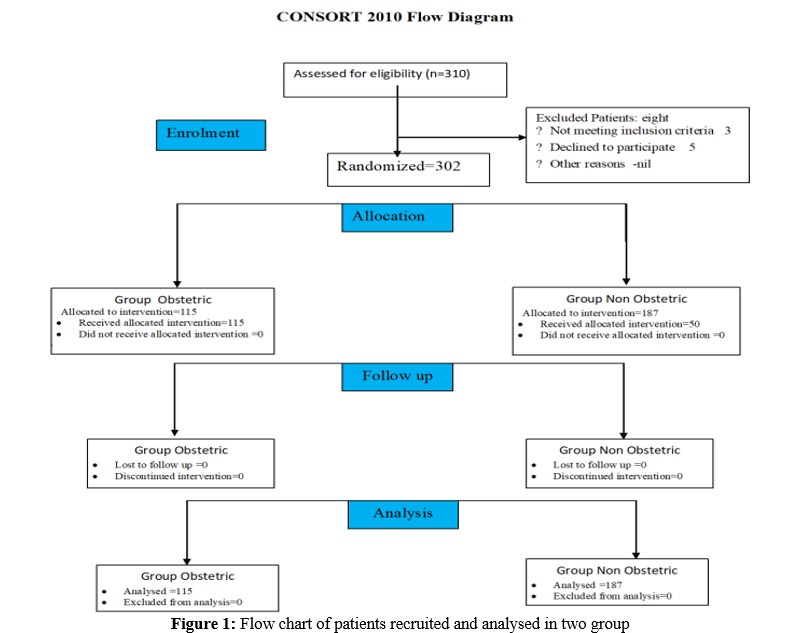
The present observational study was carried out to evaluate the association of socio-clinical variables with Post Dural Puncture Headache (PDPH) in the obstetrics and non-obstetrics patients undergoing surgeries under subarachnoid block. A total of 310 patients aged 20-60 years belonging to ASA I, II having BMI less than 30 kg/m2 and undergoing surgeries under subarachnoid block were enrolled comprising of parturients as well, over a period of 18 months at the Department of Anaesthesia, Dr. RPGMC Kangra at Tanda. The five patients were excluded due to unwillingness to participate in the study and three patients couldn’t meet inclusion criteria. Thereby 302 patients were randomised into 2 groups.
The total patients included were 302, being 115 in the obstetric group and 187 in the non-obstetric group [Fig.

Mean age of patients in group obstetric and group non obstetric was 30.66± 6.27 years and 52.88±12.72 years respectively (P=0.045). In our study, the majority of the obstetric population aged between 20-30 years, while 54% of the non-obstetric population was aged above 40 years [P Value=0.0001]. [Table-1].
Table 1: Demographic profile of the patients in two groups
| Parameters | Group Obstetric (n= 115) | Group Non-Obstetric (n=187 ) | P-value | |
Age (yrs)* | 20-30 | 92 (80%) | 55 (29.3%) | 0.0001 | |
31-40 | 23 (20.0%) | 31 (16.6%) | |||
>40 | 0 (0.0%) | 101 (54.0%) | |||
Mean±SD | 30.66± 6.27 | 52.88±12.72 | 0.045 | ||
BMI (Kg/m2)* | Mean±SD | 23.01 ±1.4 | 22.90 ±1.3 | 0.529 | |
Gender | (Female/male)† (Number ) | 115/0 | 76/111 | 0.001 | |
ASA Status | (Number/%) | I† | 0(0.0%) | 142(75.9%) | 0.001 |
| II | 115(100.0%) | 45(24.1%) | |||
Data expressed as* mean±SD and †number as appropriate. BMI: Body Mass Index, ASA: American Society ofAnaesthesiologist’s physical status.
Mean BMI of patients in group obstetric and group non obstetric was 23.01±1.4 kg/m2 and 22.90±1.3 kg/m2 respectively (P=0.529). With regards to gender distribution in the non-obstetric group, 76 were female patients, while 111 were male [P Value=0.001]. In relation to ASA grading 145 patients belonged to ASA I in non-obstetric group, whereas 42 patients belonged to ASA II in non-obstetric group and 115 in obstetric group [P Value=0.001].[Table-1]
Table 2: Patients having post dural puncture headache [PDPH] in two groups
| PDPH | Group Obstetric (n=115) | Group Non-Obstetric (n=187) | P value |
| Yes | 8 (7.0%) | 9 (4.8%) | 0.5977 |
| No | 107(93%) | 178(95.2%) |
In our study, out of 302 patients only 17 patients had post dural puncture headache, the total incidence being 5.6%. There were eight [7%] patients in the obstetric and nine [4.8%] patients in the non-obstetric group, however the difference was not statistically significant (P=0.597). [Table-2].
Table 3: Association between various clinical variables and PDPH
| Variables | PDPH | |||
|
| No | Yes | Grand Total | P value |
Number of attempts | Double | 26 | 11 | 37 | 0.0001 |
Single | 259 | 6 | 265 | ||
| Position for subarachnoid block | Lateral decubitus position | 69 | 4 | 73 | 0.949 |
Sitting | 216 | 13 | 229 | ||
Body mass index | Underweight | 0 | 0 | 0 | 0.830 |
Normal [20-25kg/m2] | 143 | 9 | 152 | ||
Overweight [25-30kg/m2] | 142 | 8 | 150 | ||
Obese [>30kg/m2] | 0 | 0 | 0 | ||
Spinal approach | Median | 277 | 14 | 291 | 0.0001 |
| Paramedian | 8 | 3 | 11 | |
In our study, the number of attempts were significantly higher in the patients who had PDPH (P=0.0001). The position of the patients was not significantly associated with incidence of PDPH (P=0.949). BMI of the patients in either group was not significantly associated with incidence of PDPH (P=0.830). Out of 291 patients with median approach, 4.8% patients had PDPH while out of 11 patients with paramedian approach, 27.2% had PDPH. Incidence of PDPH was significantly more with paramedian approach (P=0.0001). [Table 3]
Table 4: Association of Onset and duration of PDPH and type of patients in two groups
| Variable | Obstetric | Non-obstetric | p value |
Onset of PDPH (hours) | Mean± SD | 17.25±3.69 | 18.0±5.02 | 0.663 |
Duration of the PDPH | Day 1 | 2[25%] | - | 0.056 |
| Day 2 | 5[62.5%] | 4[44.4%] | ||
| Day 3 | 1[12.5%] | 4[44.4%] | ||
| Day 4 | 1[11.1%] |
All patients with PDPH had resolution of their symptoms by conservative management (hydration, bed rest, acetaminophen and NSAIDS), the PDPH resolved in 2(25%) of the parturients within the 1st day of its commencement. Whereas 5 patients (62.5%) and 4 patients [44.4%] in a non-obstetric group had relief on the 2nd day after commencement of the headache. One parturient [12.5%] and 4 patients [44.4%] in non-obstetric group got relief on the 3rd day. One patient in non-obstetric group (11.1%) had relief on the fourth day. [Table 4]
Table 5: Association between PDPH and gender in non-obstetric population
| Variables | PDPH | |||
|
| No | Yes | Grand Total | P value |
Gender | Male | 106 | 5 | 111 | 0.0002 |
Female | 72 | 4 | 76 | ||
Age groups | 20-30yrs | 40 | 1 | 36 | |
31-40yrs | 45 | 6 | 37 | .0173 | |
>40yrs | 93 | 2 | 95 | ||
| Grand Total | 178 | 9 | 187 | |
In our study, female patients among non-obstetrics had significantly higher incidence of PDPH (P=0.0002).In our study the6 patients having PDPH in non-obstetric group belonged to 31-40 yrs age group as compared to only 2 in the age more than 40 years (P=0.0173). [Table 5
Table 6: Association of ambulation with PDPH
PDPH with ambulation | Frequency | Percent | P value |
10 Hours | 12 | 70.5 | 0.0001 |
48 Hours | 5 | 29.5 | |
Total | 17 | 100.0 |
Start of ambulation at 10-hours was significantly associated with incidence of PDPH (P=0.0001).
[Table 6]
In our study the 6 patients having PDPH in the non-obstetric group belonged to the 31-40 years age group as compared to only 2 in the age more than 40 years (P=0.0173). Similarly, Turker et al.,[9] observed the incidence of PDPH to be 10.5% in patients posted for urological studies under the age group of 30-40yrs. The comparative increase incidence can be attributed to the 25 G spinal needle in the study. In the study by Weinrich J et al.,[10] the younger age [38 years] was associated with PDPH in orthopaedic patients.
In the study by Del Pizzo K et al.,[11] the percentage developing PDPH was 4.9% (3.0–7.8) among those aged 12–19 years and 1.8% (0.8–3.9) in the 20- to 45-year-old group patients undergoing ambulatory lower limb surgery with 27 G pencil point spinal needle. The age group between 12 and 19 years was associated with an almost 3-fold increase in the odds (2.8 [95% confidence interval {CI}, 1.1–7.3]) for the development of PDPH compared to that in the 20–45 age group. In our study the patients were not subjected to ambulation immediately after surgery as compared to the above-mentioned study. Moreover, we didn’t enrol patients in the age group of less than 20 years in our study.
In our study the incidence of PDPH was 6.2% and 5.8% in BMI<25 kg/m2 and <30 kg/m2 [P=0.830].In the study by Hashmi et al.,[12] the incidence was 23.2% in BMI<30kg/m2, while 12.15% in 30-40 kg/m2 group. Our study results corroborate with this study; however we have not included the patients having >30 kg/m2 in our study. The overall increased incidence in the abovementioned study was due to 25 G needle. Similar findings were observed in the study by Perlata et al.,[13] and Birajdar et al.,[14].
In our study, the incidence of PDPH was 4.5% and 5.2% in male and female population respectively in non-obstetric surgeries with 26 G quincke spinal needle. In the meta-analysis by Christopher et al.,[15] regarding the effect of gender on PDPH, the authors concluded that the odds of developing a post dural puncture headache were significantly lower for male than non-pregnant female subjects (odds ratio = 0.55; 95% confidence interval, 0.44–0.67). The authors concluded that estimated PDPH incidence was 2.9% and 6.1% in male and female patients using spinal needle ≥26 G. Mosaffa et al.,[16] also observed increased PDPH in females [16.7%] as compared to 6.3% in males and the comparative increased incidence could be attributed to 25 G spinal needle.
The position of the patients for the block was not significantly associated with incidence of PDPH.4 patients out of 69 in lateral decubitus position, and 13 out of216 patients in sitting position had post dural puncture headache (P=0.949). The meta-analysis by Zorrilla-Vaca A et al.,[17] the authors observed that the risk ratio of developing PDPH was 0.61 with lateral decubitus position as compared to sitting position. The needle size and number were varied in different studies incorporated in this meta-analysis. Similarly, Davoudi M et al.,[18] observed the incidence of PDPH was more in sitting position [20.8%] as compared to lateral position [4.3%] in parturients, however the needle size was 24 G needle in their patients.
In our study, the number of attempts were significantly higher in the patients who had PDPH (P=0.0001). The patients having attempts more than once [11] are associated with PDPH as compared to single attempt [6]. In the study by Weji et al.,[19] the number of attempts were directly proportional to the incidence of PDPH. However, another study by Salik et al.,[20] found that there is no significant difference observed in the incidence of PDPH between a single shot block and two or more attempts. The most probable reason is because of the difference in gauge and type of spinal needles.
In the majority of the patients the headache started within 15-18 hrs, whereas in the non-obstetric group the PDPH started after 18 hrs [P=0.663]. Similarly, in the study by Abdullayev et al.,[21] the onset time was 2.0±0.84 days with 26 G quincke needle. However in the study by Srivastava et al.,[22] and Montasser et al.,[23] the PDPH started after 24hrs, the most probable reason being the use of 27 G spinal needle as compared to 26 G quincke needle in our study.
In our study, out of 291 patients with median approach, 4.8% patients had PDPH while out of 11 patients with paramedian approach, 27.2% had PDPH. Incidence of PDPH was significantly more with paramedian approach (P=0.0001). Similar results were obtained by Mosaffa [16] and Nisar et al.,[24] with more incidence with paramedian approach. However, Firdous25 and Uluer et al.,[26] observed more incidence of PDPH in midline approach with the use of 25 G spinal needle in comparison to 26 G quincke spinal needle in our study. Moreover, in our study the paramedian approach was used in only 11 patients as compared to 291 having midline approach.
In our study the incidence of PDPH was more in the patients when allowed ambulation at 10 hrs, while in majority of patients with recumbent position for 48 hrs or beyond especially orthopaedic patients had less incidence of PDPH. In comparison, Hirachan et al.,[27] the PDPH was more with recumbent position, however the duration was taken up to 24 hrs and only parturients were enrolled. Moreover, in this study the ambulation was allowed, whenever feasible for the patients. In another study by Choi JS et al.,[28] the authors observed no difference in the PDPH incidence in immediate ambulation patients and patients having allowed bed rest for 4 and 6 hrs.
In the present study, the duration of PDPH was approximately 2-3 days in obstetric patients and up to 3-4 days in non-obstetric patients. In the study by Bakshi et al.,[29] the duration of PDPH was 3±2 days in non-obstetric patients and is comparable to our study. Whereas, Weinrich J et al.,[10] observed that the duration of PDPH was 4 days in orthopaedic patients, whereas 5-6 days in obstetric parturients.
Therefore, we concluded that in the present study the obstetric population had a higher incidence of PDPH in comparison to the non-obstetric population. PDPH was associated with an increased number of attempts; types of approach used, and start of ambulation. Moreover, the incidence of PDPH was more in female gender, younger age as compared to male gender and elderly patients.
Funding: No funding sources.
Conflict of interest: None declared.
Ethical approval: The study was approved by the Institutional Ethics Committee of Civil Hospital, Tauni Devi, Hamirpur.
Gogarten, Wiebke, and Hugo Van Aken. "A Century of Regional Analgesia in Obstetrics." Anesthesia & Analgesia, vol. 91, no. 4, 2000, pp. 773-775. DOI: 10.1097/00000539-200010000-00002.
Michie, A. R., et al. "Subarachnoid Anaesthesia for Elective Caesarean Section: A Comparison of Two Hyperbaric Solutions." Anaesthesia, vol. 43, no. 2, 1988, pp. 96-99. DOI: 10.1111/j.1365-2044.1988.tb05472.x.
Castrillo, Ana, et al. "Postdural Puncture Headache: Impact of Needle Type, A Randomized Trial." The Spine Journal, vol. 15, no. 7, 2015, pp. 1571-1576. DOI: 10.1016/j.spinee.2015.03.009.
Choi, Peter T., et al. "PDPH Is a Common Complication of Neuraxial Blockade in Parturients: A Meta-Analysis of Obstetrical Studies." Database of Abstracts of Reviews of Effects (DARE): Quality-Assessed Reviews, 2003. Centre for Reviews and Dissemination (UK), https://www.ncbi.nlm.nih.gov/books/NBK69595/.
Lybecker, Hans, et al. "Incidence and Prediction of Postdural Puncture Headache: A Prospective Study of 1021 Spinal Anesthesias." Anesthesia & Analgesia, vol. 70, no. 4, 1990, pp. 389-394.
Syed, Sumaya, et al. "Comparison of Post-Dural Puncture Headache Incidence and Severity in Obstetric Patients After Spinal Anesthesia for Caesarean Section with 25G and 27G Quincke Needle." International Journal of Research in Medical Sciences, vol. 5, no. 2, 2017, pp. 596-600.
Xu, Hong, et al. "Comparison of Cutting and Pencil-Point Spinal Needle in Spinal Anesthesia Regarding Postdural Puncture Headache: A Meta-Analysis." Medicine, vol. 96, no. 14, 2017, e6527. DOI: 10.1097/MD.0000000000006527.
Zhang, Di, et al. "Lower Incidence of Postdural Puncture Headache Using Whitacre Spinal Needles After Spinal Anesthesia: A Meta-Analysis." Headache: The Journal of Head and Face Pain, vol. 56, no. 3, 2016, pp. 501-510. DOI: 10.1111/head.12745.
Turker, G., et al. "Post-Dural Puncture Headache: A Comparison of Median and Paramedian Approaches." Journal of Turkish Anesthesia & Reanimation Association, vol. 33, 2005, pp. 139-144. DOI: [not available].
Weinrich, J., et al. "Postdural Puncture Headache After Neuraxial Anesthesia: Incidence and Risk Factors." Der Anaesthesist, vol. 69, 2020, pp. 878-885. DOI: 10.1007/s00101-020-00846-y.
Salik, Fikret, et al. "The Effects of the Quincke Spinal Needle Bevel Insertion on Postdural Puncture Headache and Hemodynamics in Obstetric Patients." Anesthesia Essays and Researches, vol. 12, no. 3, 2018, pp. 705-710. DOI: 10.4103/aer.AER_101_18.
Hashemi, Masoud, et al. "The Impact of Increased Body Mass Index on the Incidence and Severity of Post-Spinal Headache After Cesarean Section." Journal of Research in Medical and Dental Sciences, vol. 7, no. 2, 2019, pp. 1-5.
Peralta, Feyce, et al. "The Relationship of Body Mass Index with the Incidence of Postdural Puncture Headache in Parturients." Anesthesia & Analgesia, vol. 121, no. 2, 2015, pp. 451-456. DOI: 10.1213/ANE.0000000000000736.
Birajdar, Sanjeev Bhimashankar, Deepa Nijalingappa Allolli, and Mujahed Javed. "Study of Incidence of Postdural Puncture Headache (PDPH) in Pregnant Women with Different Body Mass Index Undergoing Caesarean Section Under Spinal Anaesthesia." Indian Journal of Clinical Anaesthesia, vol. 3, no. 3, 2016, pp. 443-445.
Wu, Christopher L., et al. "Gender and Post-Dural Puncture Headache." The Journal of the American Society of Anesthesiologists, vol. 105, no. 3, 2006, pp. 613-618. DOI: 10.1097/00000542-200609000-00027.
Mosaffa, Faramarz, et al. "Post-Dural Puncture Headache: A Comparison Between Median and Paramedian Approaches in Orthopedic Patients." Anesthesiology and Pain Medicine, vol. 1, no. 2, 2011, pp. 66. DOI: 10.5812/kowsar.22287523.2159.
Zorrilla-Vaca, Andres, and Jeetinder Kaur Makkar. "Effectiveness of Lateral Decubitus Position for Preventing Post-Dural Puncture Headache: A Meta-Analysis." Pain Physician, vol. 20, no. 4, 2017, E521.
Davoudi, Maryam, et al. "Effect of Position During Spinal Anesthesia on Postdural Puncture Headache After Cesarean Section: A Prospective, Single-Blind Randomized Clinical Trial." Anesthesiology and Pain Medicine, vol. 6, no. 4, 2016. DOI: 10.5812/aapm.35486.
Weji, Bedilu Girma, et al. "Incidence and Risk Factors of Postdural Puncture Headache: Prospective Cohort Study Design." Perioperative Medicine, vol. 9, 2020, pp. 1-6. DOI: 10.1186/s13741-020-00164-2.
Salik, Fikret, et al. "The Effects of the Quincke Spinal Needle Bevel Insertion on Postdural Puncture Headache and Hemodynamics in Obstetric Patients." Anesthesia Essays and Researches, vol. 12, no. 3, 2018, pp. 705-710. DOI: 10.4103/aer.AER_101_18.
Abdullayev, Ruslan, et al. "Incidence of Postdural Puncture Headache: Two Different Fine Gauge Spinal Needles of the Same Diameter." Journal of Obstetric Anaesthesia and Critical Care, vol. 4, no. 2, 2014, pp. 64-68. DOI: 10.4103/2249-4472.143874.
Srivastava, Vibhu, Parul Jindal, and J. P. Sharma. "Study of Post Dural Puncture Headache with 27G Quincke & Whitacre Needles in Obstetrics/Non-Obstetrics Patients." Middle East Journal of Anaesthesiology, vol. 20, no. 5, 2010, pp. 709-717.
Montasser, Mahmoud Gaballeh. "Post Dural Puncture Headache After Spinal Anesthesia for Caesarean Section: A Comparison of 27G Quincke and Whitacre Spinal Needles in Midline and Paramedian Approaches." Journal of Medical Sciences, vol. 15, no. 1, 2015, pp. 44.
Nisar, Afshan, et al. "Comparison of Postdural Puncture Headache in Median and Paramedian Approach Under Spinal Anesthesia in Cesarean Section." Pakistan Journal of Medical & Health Sciences, vol. 10, no. 1, 2016, pp. 298-301.
Firdous, Tanzeela, Maqsood Ahmed Siddiqui, and Safia Maqsood Siddiqui. "Frequency of Post Dural Puncture Headache in Patients Undergoing Elective Cesarean Section Under Spinal Anesthesia with Median Versus Paramedian Approach." Anaesthesia, Pain & Intensive Care, 2019, pp. 165-170.
Uluer, M. S., et al. "A Randomized Study to Evaluate Post-Dural Puncture Headache After Cesarean Section: Comparison with Median and Paramedian Approaches." Nigerian Journal of Clinical Practice, vol. 22, no. 11, 2019, pp. 1564-1569. DOI: 10.4103/njcp.njcp_100_19.
Hirachan, Niroj. "Incidence of Post Dural Puncture Headache in Parturients Following Early Ambulation and Recumbency." Journal of Patan Academy of Health Sciences, vol. 4, no. 2, 2017, pp. 14-20.
Choi, Jeong Sil, and Sun Ju Chang. "A Comparison of the Incidence of Post-Dural Puncture Headache and Backache After Spinal Anesthesia: A Pragmatic Randomized Controlled Trial." Worldviews on Evidence-Based Nursing, vol. 15, no. 1, 2018, pp. 45-53. DOI: 10.1111/wvn.12236.
Bakshi, Sumitra G., and Raghuveer Singh P. Gehdoo. "Incidence and Management of Post-Dural Puncture Headache Following Spinal Anaesthesia and Accidental Dural Puncture from a Non-Obstetric Hospital: A Retrospective Analysis." Indian Journal of Anaesthesia, vol. 62, no. 11, 2018, pp. 881-886. DOI: 10.4103/ija.IJA_354_18.