Stroke is a disease with a high prevalence in the world. Data from WHO shows that at least 15 million people worldwide have had a stroke. The prognosis is poor and results in death in the age range 55-85 years. Likewise, the prevalence of stroke in Indonesia is also a disease that many Indonesians suffer from, with an incidence reaching 9.7% of the causes of death that occur in Indonesia. Stroke is a disease that is guaranteed by national health insurance through the INA-CBG’s tariff by BPJS in Indonesia. The aim of this study is to review the comparison of real costs in stroke care compared to INA-CBG's claims and identify factors that cause high inpatient costs for stroke patients. This research was carried out by analysing a total of 7 articles obtained through selection of 984 articles available in the database. Articles are selected that really suit the topic. The results of this review show that there is a difference in the real costs of treating stroke patients with INA-CBG's claim rates. This especially occurs in cases of haemorrhagic stroke where the patient's hospitalization costs are higher than the INA-CBG's claim rates. The high costs incurred are due to several factors such as high drug costs, intensive care treatment that uses certain medical facilities and equipment, and suboptimal compliance with clinical pathways (CP). Thus, hospitals must carry out strict quality control and cost control in cases of treating stroke patients in hospitals.
Stroke is a disease with a fairly high prevalence in the world. Data from WHO shows that at least 15 million people worldwide have had a stroke. The prognosis is poor and results in death in the age range 55-85 years. Likewise, the prevalence of stroke in Indonesia is also a disease that many Indonesians suffer from, with an incidence reaching 9.7% of the causes of death that occur in Indonesia [1].
National Health Insurance is a policy taken by the government to guarantee the rights of citizens to receive guaranteed health services, including strokes. National Health Care is a policy taken by the government to guarantee the rights of its citizens to receive guaranteed health services, including strokes. This National Health Insurance is based on Government Law number 40 of 2004 on the National Social Insurance System. On the one hand, insurance really helps the Indonesian people in ensuring citizens' health rights, but on the one hand, the INA-CBG's national health insurance rates also challenge hospitals in carrying out effective and efficient management and management of therapy[2].
The health insurance system through the INA-CBG's tariff requires hospitals to carry out quality control as well as cost control. This is because the management of national health insurance managed by BPJS pays health service insurance based on predetermined diagnostic groups. This makes it interesting to carry out an analysis related to this in this paper [3].
The research method used in this research is a qualitative research method, in general the data collection method used is the literature review model, the literature review approach is an approach that collects various references related to the research problem. As stated by Phillippi and Lauderdale the study of this research uses a literature review in which the literature is taken according to the subject matter and analysed in depth so that conclusions and findings in the research can be drawn. Literature taken from books, national and international journal articles and other literature [4].
Literature review is synthesized using a narrative method by grouping similar extracted data according to the results measured to answer the objectives [5]. So it can be concluded that literature review or library study is a research method that reviews and collects needed references such as books, journals and so on, which then become research results.

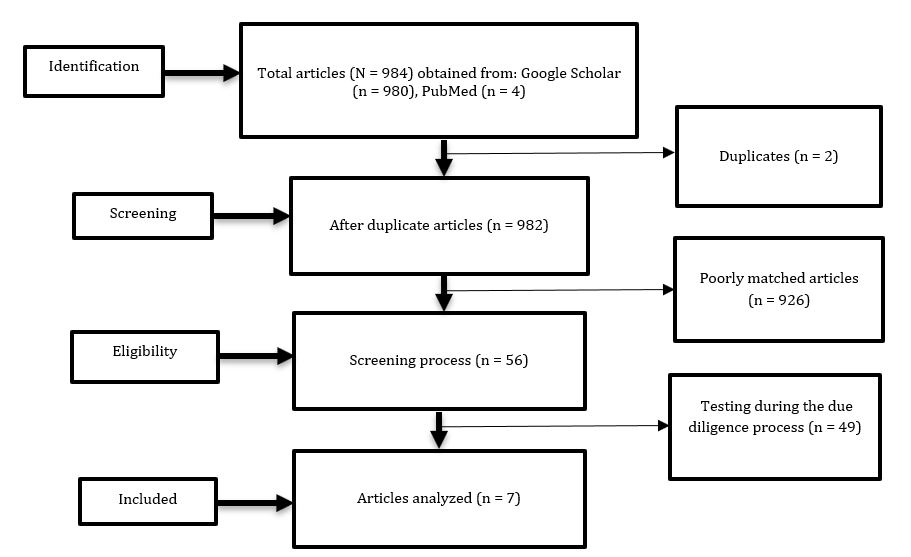
Figure 1:PRISMA of Literature Review
The ten research articles that meet the requirements will then be assessed for quality and synthesized in this literature review. The following PRISMA diagram can be seen in the image below.
Searches for related articles were carried out using search engines in the form of Google Schoolar and PubMed with the search keyword "analysis of INA-CBGs on stroke disease" resulting in a total of 984 articles obtained with details obtained from Google Schooler totalling 980 articles and PubMed rice totalling 4 articles. Of the 984 articles, it is known that 2 article was excluded due to duplication, 926 articles were excluded due to Poorly matched articles and 49 articles were excluded due to testing during the due diligence process. Thus, there are 7 articles remaining that are truly appropriate and will be discussed in this paper.
Research shows the average true cost of the first-class hospitalization was more than the INA-CBG rate for cerebral infarction and for an unidentified stroke. For cerebral infarction, the average real cost of a second-class hospital stay was less than the INA-CBG rate; however, for an undetermined stroke, the average real cost differed little from the INA-CBG rate. There were notable differences between the average real cost of third-class hospitalization and the INA-CBG rates for cerebral infarction and unidentified stroke. The majority of typical expenses exceeded the INA-CBG rate. As a result, the institution is unable to handle an INA-CBG cost-based therapy stroke. The hospital has had setbacks. It is necessary to assess the stroke treatment [3]. The same thing was also shown in other research the average rate of real stroke treatment cost at Jogja Hospital was higher insignificantly than INACBGs based cost and the highest treatment cost was on the medicine and medical equipment[1].
Other research shows that the difference between real costs and INA-BG's claim rates occurs especially in cases of haemorrhagic stroke, which shows that the real costs of haemorrhagic stroke patients are greater than the INA-CBG claim rates. The cost of medication for haemorrhagic stroke patients is greater than for ischemic stroke treatment [6,8]. Similar things have also been shown in other studies the cost of treating stroke patients at UNS Hospital is higher than that of INA-CBGs, which is impacted by the utilization of critical care and the tariff on medications [7].
The statistical analysis revealed that the doctor's commitment to CP implementation was 71.9%, and that the doctor's perception of organizational support for CP implementation was 67.67%. The doctor also demonstrated a 100% adherence to CP implementation based on the accuracy of laboratory examinations, 100% based on the accuracy of radiological examinations (head CT scan non-contrast), and 91.3% based on the accuracy of LOS in IS cases without variants. The maximum LOS was 8 days, or 1 patient, while the average LOS was 3.93 days. Four patients had variations, or issues. The difference between the inpatient BPJS cost and the INA CBG prices is 33.3% [9].
Table 1: Article Search Results
No | Citation | Sample | Study Location | Method | Result | |
1 | Hadning, I., Fathurrohmah, F., Ridwan, M., Rahajeng, B., Utami, P., & Cahyaningsih, I. [3]. Cost analysis of Indonesia case-based groups (INA-CBGs) tariff for stroke patients. J Manag Pharm Pract, 10, 137-144. | 49 stroke patients at a private hospital in Yogyakarta | Indonesia | cross-sectional observational study | The findings demonstrated that, with negligible differences, the average true cost of the first-class hospitalization was more than the INA-CBG rate for cerebral infarction and for an unidentified stroke. For cerebral infarction, the average real cost of a second-class hospital stay was less than the INA-CBG rate; however, for an undetermined stroke, the average real cost differed little from the INA-CBG rate. There were notable differences between the average real cost of third-class hospitalization and the INA-CBG rates for cerebral infarction and unidentified stroke. The majority of typical expenses exceeded the INA-CBG rate. As a result, the institution is unable to handle an INA-CBG cost-based therapy stroke. The hospital has had setbacks. It is necessary to assess the stroke treatment. | |
2 | Hadning, I., Ikawati, Z., & Andayani, T. M. Stroke [1] Treatment Cost Analysis for Consideration on Health Cost Determination Using INA-CBGs. International Journal of Public Health Science, 4(4), 288-293. | 67 stroke patients at Yogyakarta | Indonesia | cross sectional observational study | The average rate of real stroke treatment cost at Jogja Hospital was higher insignificantly than INACBGs based cost and the highest treatment cost was on the medicine and medical equipment | |
3 | Tandah, M. R., Mukaddas, A., Angriani, D., & Mangoting, G. N. A. [6]. Cost Evalution of Stroke Therapy Compared to INA-CBGs on Inpatients at Anutapura Hospital. The Indonesian Journal of Public Health, 6(1), 285-296. | 134 patients who met the inclusion criteria, 68% were ischemic stroke patients and 32% were hemorrhagic stroke patients. | Indonesia | descriptive research design with retrospective data collection. | Hemorrhagic stroke therapy patients' average total cost was IDR 10,606,834.34, with an average INA CBG rate of IDR 4,399,393.02 for 43 inpatients. The average total real cost of treatment for ischemic stroke therapy patients was IDR 7,360,196.70, and the cost of the INA-CBGs was IDR 7,427,251.65 for 91 inpatients. The result is that both stroke therapy and the money claimed by BPJS demonstrated a significant difference. The conclusion is both of stroke therapy proved significant difference compared to BPJS claimed amount of money. | |
4 | Wulandari, D., Indarto, D., & Tamtomo, D. [7]. Determinants of cost differences between Indonesian-case based groups tariff and hospital tariff for stroke patients: path analysis evidence from UNS Teaching Hospital Sukoharjo, Central Java. Journal of Health Policy and Management, 4(3), 176-181. | This research study involved 113 strokes patients. | Indonesia | This analytic study with cross sectional | The cost of treating stroke patients at UNS Hospital is higher than that of INA-CBGs, which is impacted by the utilization of critical care and the tariff on medications. | |
5 | Noviasari, N. A., & Anantaizaldy, N. L. [8]. Direct Medical Costs Related to Clinical Outcomes and Patterns of Ischemic Stroke Drug Therapy in Panti Rapih Hospital Yogyakarta. International Journal of Health and Pharmaceutical (IJHP), 2(2), 259-274. | 42 stroke ischaemic patients | Indonesia | analytic observational design | Hemorrhagic stroke medication costs an average of IDR 2,121,590, while ischemic stroke medication costs IDR 1,728,450. The aim of therapeutic services is to improve or attain a higher quality of life for patients, and the outcome of therapy is what's known as the clinical outcome. The majority of which are evident in the data collected from many hospitals. The prognosis for stroke can be viewed from six angles: impoverishment, suffering, illness, disability, and death. The early stages of a stroke or its aftermath are when the six prognostic factors occur. | |
6 | Rudianto, R., Sujadi, A., & Widodo, H. B. [9]. DOCTOR’S COMPLIANCE TO CLINICAL PATHWAY OF ISCHAEMIC STROKE: A CASE OF PRIVATE HOSPITAL IN INDONESIA. ICORE, 5(1).
| inpatients care of ischemic stroke was 27 patients | Indonesia | This study uses a quantitative method | The statistical analysis revealed that the doctor's commitment to CP implementation was 71.9%, and that the doctor's perception of organizational support for CP implementation was 67.67%. The doctor also demonstrated a 100% adherence to CP implementation based on the accuracy of laboratory examinations, 100% based on the accuracy of radiological examinations (head CT scan non-contrast), and 91.3% based on the accuracy of LOS in IS cases without variants. The maximum LOS was 8 days, or 1 patient, while the average LOS was 3.93 days. Four patients had variations, or issues. The difference between the inpatient BPJS cost and the INA CBG prices is 33.3%. | |
7 | Saragih, D. E., Nasution, A., & Khairunnisa, K. [10]. Cost of Illness Analysis and Quality of Life in Ischemic Stroke Patients in USU Medan Hospital. Asian Journal of Pharmaceutical Research and Development, 8(2), 1-6. | 39 patients with ischemic stroke inpatients. | Indonesia | prospective descriptive cohort study method | It is possible to draw the conclusion that 32 patients (96.96%) have an ischemic stroke with a decent quality of life. | |
The results of this review show that there is a difference in the real costs of treating stroke patients with INA-CBG's claim rates. This especially occurs in cases of haemorrhagic stroke where the patient's hospitalization costs are higher than the INA-CBG's claim rates. The high costs incurred are due to several factors such as high drug costs, intensive care treatment that uses certain medical facilities and equipment, and suboptimal compliance with clinical pathways (CP). Thus, hospitals must carry out strict quality control and cost control in cases of treating stroke patients in hospitals.
Hadning, I. et al. “Stroke treatment cost analysis for consideration on health cost determination using INA-CBGs at Jogja Hospital.” International Journal of Public Health Science (IJPHS), vol. 4, no. 4, 2015, p. 288. https://doi.org/10.11591/.v4i4.4748
Wulandari, D. et al. “Determinants of cost differences between Indonesian case based group’s tariff and hospital tariff for stroke patients: A path analysis evidence from UNS Teaching Hospital Sukoharjo, Central Java.” Journal of Health Policy and Management, vol. 4, no. 3, 2019, pp. 176–181. https://doi.org/10.26911/thejhpm.2019.04.03.05
Hadning, I. et al. “Cost analysis of Indonesia case based groups (INA-CBGs) tariff for stroke patients.” Jurnal Manajemen dan Pelayanan Farmasi (Journal of Management and Pharmacy Practice), vol. 10, no. 2, 2020, p. 137. https://doi.org/10.22146/jmpf.46720
Syakharani, A.W. and M.L. Kamil. “Culture and culture: An overview of various forms of culture, 7 universal elements of culture.” Cross-border, vol. 5, no. 1, 2022.
Sri, A.W. “Literature review: Differentiated approaches in science learning.” Journal of Mathematics and Natural Sciences Education, vol. 12, no. 2, 2022.
Tandah, M.R. et al. “Cost Evaluation of Stroke Therapy Compared to INA-CBGs on Inpatients at Anutapura Hospital.” Indonesian Journal of Public Health, vol. 16, no. 2, 2021, pp. 285–296. https://doi.org/10.20473/ijph.v 16i2.2021.285-296.
Wulandari, D. et al. “Determinants of Cost Differences between Indonesian-Case Based Groups Tariff and Hospital Tariff for Stroke Patients: A Path Analysis Evidence from UNS Teaching Hospital Sukoharjo, Central Java.” Journal of Health Policy and Management, vol. 4, no. 3, 2019, pp. 176–181. https://doi.org/10.26911/thejhp m.2019.04.03.05
Muslimah, N.A.N. et al. “Direct medical costs related to clinical outcomes and patterns of ischemic stroke drug therapy in Panti Rapih Hospital Yogyakarta.” International Journal of Health and Pharmaceutical (IJHP), vol. 2, no. 2, 2022, pp. 259–274. https://doi.org/10.51601/ij hp.v2i2.40
Rudianto, R. et al. “Doctor’s compliance to clinical pathway of ischaemic stroke: A case of private hospital in Indonesia.” ICORE, vol. 5, no. 1, 2020.
Saragih, D.E. et al. “Cost of illness analysis and quality of life in ischemic stroke patients in USU Medan Hospital.” Asian Journal of Pharmaceutical Research and Development, vol. 8, no. 2, 2020, pp. 1–6.