Pāli is an Indo-Aryan language that was devised specially to transcribe in the third century BCE the oral preaching of Gautama Buddha (who lived in the sixth-fifth centuries BCE) in Lumbini, Shakya Republic (present-day Nepal). Pāli is not so much an artificial language as a language adapted to the particular discourse it tries to transcribe and derived from probably several closely related other Indo-Aryan languages with Sanskrit being kept in the background all the time. Pāli has the originality not to be attached to a writing system so that it can be written with any of the writing systems in use in the Indian subcontinent and in Southeast Asia, including, in more recent times, the Latin writing system extended for some diacritic elements. We have to understand Buddhism is a particular development of old Sanskrit classic Vedas with the declared ambition to differentiate itself from the various trends and branches of Vedic and ascetic preaching that produced Hinduism. The main difference is the refusal of any godlike creator of the universe. Will study here the fundamental role of the four participles, the absolutive and the infinitive in the building of this predicatory discourse. The four participles are adjectival or nominal non-finite verbal forms predicatively expanding either noun phrases or verbal phrases with four possible forms and values: The past participle of an action seen as fully completed is an adjectival expansion of a noun phrase. The active past participle is an adjectival expansion of a noun phrase seen as the agent of an action that has been fully completed. The present participle is an adjectival expansion of a noun phrase with an action that is seen in progress, hence partly completed and partly virtual.The future passive participle is an adjectival form expanding a noun phrase with an action that should, must, or could be done with the contradiction between the injunctive or optative modalization and the passive completion attached to a noun phrase which is the virtual actant who should, must or could carry this completed passive value. The absolutive (at times called gerund) is a non-finite form that expresses an action or state that, at the time of utterance, has been completed, has been credited to the main actant of the main clause of the utterance or the general situation conveyed by the utterance, and whose completion and merit-crediting to the main actant make the action of the main clause of the utterance possible, and without which this very action is not possible. The infinitive is a simple non-finite verbal expansion of the main clause of the utterance attached to one particular actant of this main clause or to its verb to which it is subservient. It expresses the action in its fullness, though with various values in the sentences as for virtual completion, partial completion, or total completion.What kind of mapping of the inner time of these non-finite forms can we see and how can the passive/active and injunctive/optative dimensions be integrated? Are we in langue, or are we in discourse? Is such predicatory discourse dealing with time, both universe and inner times, the same way as any reporting discourse?
Keywords
Absolutive and Infinitive
INTRODUCTION
It is necessary to know the history of Pāli to understand its function and its originality. Pāli is an Indo-Aryan language developed from the preaching of Buddha that was purely oral for three centuries when it was decided to transcribe it. That was done in Sri Lanka on the order from Emperor Ashoka (Ashoka the Great (r. 268-232 BCE) was the third king of the Mauryan Empire (322-185 BCE) best known for his renunciation of war, development of the concept of dhamma (pious social conduct), and promotion of Buddhism as well as his effective reign as a nearly pan-Indian political entity. https://www.worldhisto ry.org /Ashoka_the_Great/) but a community of (The Buddha was born (ca. 563 B.C.E.) in a place called Lumbini near the Himalayan foothills, and he began teaching around Benares (at Sarnath). His general terrain was one of spiritual, intellectual, and social ferment. https:// asiasociety.org/education/origins-buddhism)Buddhist monks who had been conserving, broadcasting, and preaching the Buddha’s tradition the way it had been remembered in India in various vernacular Indo-Aryan languages, not only the first language of Buddha himself. What was his first language anyway? Probably Magadhi-Prakrit, or Māgadhī, the local language of his birthplace, plus Sanskrit as the elite second language of all educated people at the time.( The Buddha was born at a time when Sanskrit was the language of the elite groups who belonged to various religious schools, belief systems and ascetic movements. However, we do not clearly know what the native language of the Buddha was, or in which language he and his parents spoke. It is possible that they spoke more than one language, which was very common in India, and still is today, and which has been so since the earliest times due to its diversity. Considering his family background and the place of his birth, scholars believe that Māgadhī or Magadhi-Prakrit might have been his native tongue. It was the local vernacular language in the area, where he was born and where he spent most of his life.) But he preached to everyone and thus not in Sanskrit, and he probably was at least bilingual or trilingual in Prakrit languages. The monks, the members of the sangha, the order of the new religion, were from all over India and thus spoke many different Prakrit languages. Some three centuries later, the members of the Sangha, when confronted with the necessity to transcribe the Dhamma, the doctrine of Buddhism, under the suggestion, in fact, command, from Emperor Ashoka, being all from different areas in India, devised a particular Indo-Aryan language on the deeper foundation of Sanskrit – though we might insist too much on this Sanskrit foundational role, the same way as in romance languages they insist too much on the role of Latin – and with what probably was already Buddha’s practice: the elaboration of some common Prakrit language that could be understood by all, that could be spread all over the world in Ashoka’s ambitious global project, and written and read in all the various scripts existing in his vast empire and probably beyond, with original words for the basic Buddhist concepts. The choice was always to give the preference to modern Prakrit languages over Sanskrit. This meant Pāli did not have a writing system of its own, and all writing systems available could be used, Indo-Aryan, Sino-Tibetan, or Tibeto-Burman, and of course the alphabetical writing systems of the Greeks at the time, and then later the Romans. It is conceivable that Ashoka’s troops, or pilgrims, and missionaries got in touch with the various empires in the Middle East that were active in the third century BCE. We have to keep in mind Alexander the Great reigned from 336 to 323, less than one century before Ashoka.
Today, the situation has not changed a lot as for the use of Pāli. The main characteristic from a western point of view is that the Latin transcription of it is common and accepted by all sections of the Buddhist world, even if local writing systems are used such as the Sinhala writing system or the Tamil writing system in Sri Lanka, and then the writing systems of Myanmar, Thailand, Cambodia, Laos, and a few others including the Latin alphabet in Vietnam that is using it for its own national language. This language is the only common language among the various Asian Buddhist communities, and even probably the entire world, with the special case of the Tibetan Buddhists who have always used Tibetan, and its writing system, with Sanskrit and its writing system, for the references to Buddhist Dhamma, though they would prefer the Sanskrit word Dharma. We definitely can wonder if the two words are really and entirely equivalent, but that is too technical to deal with here.
In this present study, I am going to use quite a few resources (check the list at end of this paper). Most of them have been elaborated by close observation but vastly and deeply informed by the European linguistics of the 19th century centered on Latin and its grammar. Some of the concepts are simply imported into Pāli and prevent the understanding of what the non-finite forms of verbal items can be and how they work. The worst case is the importation of the duality Gerund-Gerundive in the very same logic as the one developed by Frederic M. Wheelock in Chapter 39 of his Wheelock’s Latin, seventh edition, 1956-2011. And what’s more, instead of working directly on Latin phrases, Frederic M. Wheelock systematically works on English translations, literal ones as he says, which is superficial and makes him describe the syntax of Latin in and within English words and concepts. This remark applies to the Pāli Text Society (The Society was founded in 1881 by T.W. Rhys Davids "to foster and promote the study of Pāli texts". It publishes Pāli texts in roman characters, translations into English, and ancillary works including dictionaries, a concordance, and books for students of Pāli and a journal. Most of the classical texts and commentaries have now been edited and many works translated into English. The Society aims to keep almost all its publications in print and to produce at least two new books and a volume of its Journal each year. The Society is non-profit making and depends on the sale of its publications, on members' subscriptions and on the generosity of donors. Alongside its publishing activities, it provides Research Studentships for a number of people in a variety of countries who are working in the field of Pāli studies. It also supports the Fragile Palm Leaves Project, which is involved in the conservation and identification of Southeast Asian manuscripts. Pāli Text Society, Old Market Studios, 68 Old Market Street, Bristol BS2 0EJ, U.K.) Too (both the heavy reference to Sanskrit and the just as heavy reference to Latin) which is an essential tool in our quest.
I do not pretend to reach in this paper the deepest or only a deeper logic of Pāli’s “langue,” but I will try to give a fair account of the various non-finite forms of Pāli verbs, and if there is one reference that could be used, it should be Sanskrit. Yet, Pāli being a linguistic development to codify the doctrine of Buddha’s preaching, it should be used with care because the Sanskrit words or formants identified behind the Pāli concerned items can, and in fact, should or even have to have a different value and a different syntactic logic or architecture. This is the beginning of research that will take time to reach any complete vision or at least a complete-enough vision. Things in languages are often just as much circumstantial as in material infrastructures. Imagine trains running on the left and underground trains running on the right in France. Why is it so? Why should “un grand homme” be “a great man” and “un homme grand” be “a big man”? And then why can’t we say “un grand homme grand” in French, though we can say “a great big man” in English? We are going to meet with hundreds of questions of the type with Pāli.
Pāli In Our Human Linguistic Archaeology
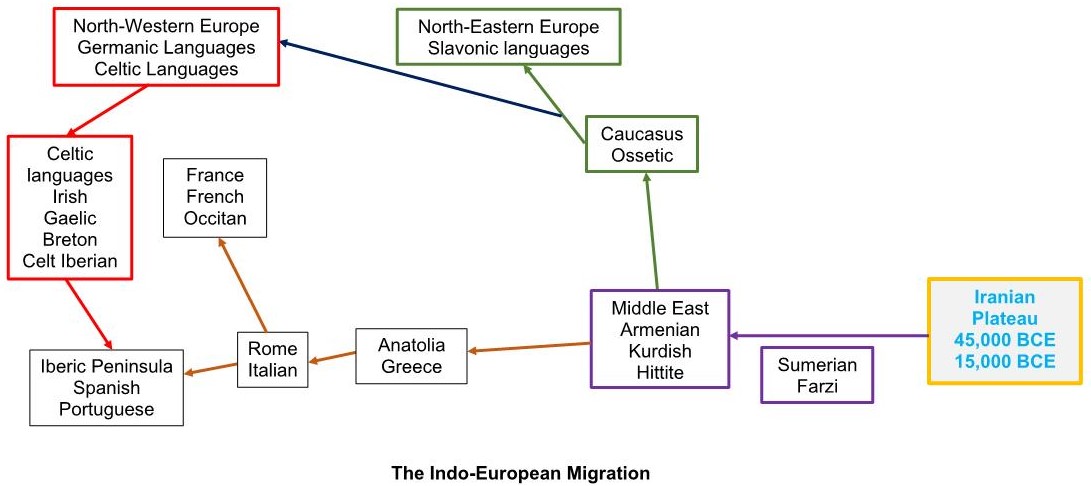
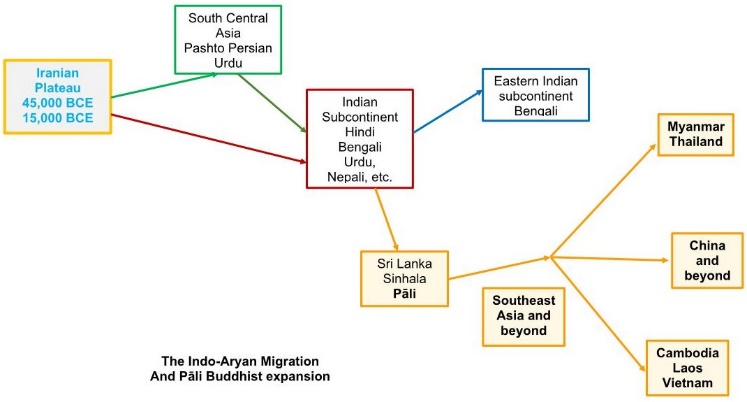
This is going to be a simple sketch of this twofold linguistic set that contains both the Indo-European and the Indo-Aryan families of languages with Farsi as the direct modern descendant of the original hot house in which the two families matured for thirty thousand years. The people behind this linguistic set arrived on the Iranian Plateau around 45,000-40,000 BCE and stayed there till after the Ice Age Peak. They came down from the Plateau in two directions. East, to evolve into the Indo-Aryan family, and West, to evolve into the Indo-European family. They found various populations in these areas after the Ice Age. They got into relationships with them and the languages that these people spoke, and the new arriving population (a minority according to DNA studies of various Indo-European-language speakers today, at the most 25%) who carried and phylogenetically produced, including in these contacts with these older populations, our modern Indo-European and Indo-Aryan languages that probably were influenced by the local pre-Indo-European or Indo-Aryan languages. These older languages were agglutinative languages of the vast Turkic family that occupied central Asia, the Caucasus, and the whole of Europe with modern-time groups surviving in the north (Sami people, Finns, and some groups in northern Russia, the Urals, and the later Hungarian migration from precisely this northern region in Russia and Finland. We must keep in mind most languages in the Caucasus are Turkic from Georgia, Abkhazia to Chechnya, Azerbaijan, and then around the Caspian Sea in Central Asia up to Siberia and the Urals.
We must also keep in mind Basque is a Turkic language that is the descendant of the Turkic languages Homo Sapiens spoke in Europe from the very beginning when they arrived and met or mixed with the Neanderthals (around 50,000 or 45,000 BCE), the same way as the Asian Turkic population met with Denisovans. It seems very difficult to make people nowadays understand that 75% of our DNA is from these old Turkic-speaking first Homo sapiens in Europe and only 25% is from the Indo-European population that moved into Europe after the Ice Age. There are something like 30,000 or even 35,000 years between the arrival time of the Turkic agglutinative languages spoken by the Old Europeans, and the synthetic-analytical Indo-European languages spoken by the New Europeans. In the Caucasus, there are only two Indo-European languages, Ossetic and Armenian. The next Indo-European language in the Middle East is Kurdish which is spoken in at least four countries with a failed attempt from the USSR in the 1920s to have a Republic of Kurdistan. It did not last very long. Then the next important Indo-European language in the Middle East is Farsi. Beyond this Farsi, to the east, we enter the Indo-Aryan field with Urdu in Pakistan.
The spread of Islam has also spread many characteristics of Arabic, a Semitic language that arrived in the Middle East from Northern Africa where they had migrated from Black Africa something like 250,000 BCE, maybe even 300,000 BCE if we accept the archaeological discovery of Homo Sapiens beads and other artifacts in Morocco dated as having been “deposited” here around 300,000 BCE. Just as Sanskrit is considered the oldest Indo-Aryan language because it was written very early (Vedic Sanskrit) and is still practiced by some populations like Tibetan Buddhists and Indian Hindus, on the Indo-European western side of this migration, Sumerian is the oldest written language of this Indo-European branch of this linguistic set. I consider the Sumerian language as being at the very start of the Indo-European family with a commercial influence proved as far as 6,000 BCE in Romania. Sumerian is a rather highly synthetic language of the synthetic-analytical phase of the phylogeny of Indo-European languages but in no way agglutinative.
To explain the splitting of this Indo-European family into a Northern Slavonic and Germanic (with the Celtic sub-branch developing in Germanic territory first, as opposed to the southern branch of Mediterranean Romance languages that grew from Greek and Latin into Spanish, Portuguese, French, Italian, and Greek mostly, to explain this splitting we have to consider two main migration routes from the Middle East to Europe, one through the Caucasus into Northern Europe, north of the Black Sea and moving through the Slavonic plains, the Germanic northern territories including Scandinavia, except Finland that remained Turkic and agglutinative along with the Sami people, and the other through Anatolia to Greece and from there, mostly using the Mediterranean Sea to travel west, the whole pf Southern Europe, the spreading of romance languages being the result of the conquest of this area by the Roman Empire, the most interesting case being the isolated case of Romanian. In France and the Iberic peninsula, they mostly found the Basque population on a vast territory going as far as the Garonne in France, and the Celtic population both in France and in Spain.
They conquered them and pushed the Celtic-speaking population into integrating the Empire, whereas the Basques remained very isolated and autonomous. Celtic is an Indo-European language, but Basque is an agglutinative Turkic language and this one refused to be swallowed up by the Indo-European population starting to arrive in Western Europe around 10,000-9,000 BCE bringing along agriculture, herding, and some architectural knowledge to build temples, cities, etc., instead of using caves as ritualistic places decorated for this function.
The same thing happened in Southern Asia with the Indo-Aryans pushing the populations they found to establish themselves, bringing agriculture, herding, and a few other elements, architecture, writing, and religion, pushing the agglutinative Turkic population mostly north of Afghanistan, and the Tibeto-Burmese Tamil population south, trapping them in the tip of the Indian peninsula. But let me provide you with a couple of maps showing this expansion.
Figure 1: There is Little Top Say on this Part Because this Migration is Well Documented
Figure 2: The Indo-Aryan Migration and the Spread of Pāli and Indic Languages
To understand the expansion and the power of this expansion of Pāli we have to consider two facts. The first fact is linguistic: Pāli does not have any specific writing system and it can be written in all the scripts available in Southeast Asia, though in Vietnam the Chinese writing system was used, particularly in the Northern half of the country. All other writing systems seem to be based on syllabic signs with eventually vocalic diacritic marks. Note this is not the Semitic writing system that only writes the consonants with diacritic signs for the vocalic sounds, and in the Hebrew press, these diacritic signs might be omitted, whereas, in the writing system in Southeast Asia and Indo-Aryan languages, consonants carry the basic /a/ vowel and the diacritic signs or vocalic letters modify this vocalic sound accordingly. The second fact is that the Buddhist movement is founded on the three jewels of Buddhism: Buddha, the teacher; Dhamma (Sanskrit Dharma), the teachings or the doctrine; and Sangha, the community or monastic order. In the two or three centuries BCE considered here, and then ten or fifteen centuries CE, Sri Lanka was the heart of the Theravada or Lesser Vehicle Buddhism, supposedly the most original form of Buddhism, and it then spread to China and the rest of the world. The Three Vehicles of Buddhism are Theravada or Hinayana, the Lesser Vehicle (Sri Lanka and South East Asia); Mahayana or the Great Vehicle (China and Northern Asia, including the special form in Japan); and Vajrayana or the Diamond or Thunderbolt Vehicle, also known as mantra Buddhism (mainly Tibet and its exiled form in northern India). (“Distinguishing the Vehicles of Therevada, Mahayana, and Vajrayana Buddhism” is one source of information, among others. https://networkologies.wordpress.com/2012/04/07/knowing-your-buddhisms-distinguishing-the-vehicles-of-th erevada-mahayana-vajrayana-and-beyond/) When we remember Buddha was born in a kingdom that would today sit akimbo on the border between India and Nepal, we can see the distance between this initial location and Sri Lanka, and then the ways Buddhism took to spread to the world and at the time that meant to Asia. The original form, Theravada, also known as the Way of the Elders, spread to Southeast Asia with a vast number of Sri Lankan missionaries who contributed to Buddhism there with a tremendous amount of doctrine and stories about the growth of Buddhism and the many lives, in many ways mythologized, of Buddha in the Jataka stories. The language was Pāli, and you can find some instances in Cambodia or Thailand in some older structures decorated with frescoes or with high relief sculptures. A great number of books and other textual or iconographic documents have survived from this period. We have to understand that it does not “look” like Pāli because of the various writing systems used, but it is often Pāli in different writing.
If I have given this general survey, it is to show how this language, in many ways an artificially developed language, has become and still is an important religious and cultural tool in this eastern half of the Indian Ocean. It explains the strong solidarity between the various countries and the strong link with China beyond. A last remark is necessary here. Theravada Buddhism does not believe in any god, and they believe the cosmos was not created. They do not ask the question of the origin because, as attributed to Buddha, “if I say the world was created by God, then who and what created God?” They believe in a higher form of energy and logic that governs the cosmos, but they do not ask about its origin of it. They only try to understand the rationale of it through and by meditation that is supposed to bring enlightenment, Nibbana in Pāli, Nirvana in Sanskrit, that will extract the individual becoming a sammā saṃbuddha, a perfect enlightened being, ready to escape saṃsāra, the cycle of successive rebirths based on kamma in Pāli, karma in Sanskrit, the accumulated good and bad balance sheets of our individual lives, hence these enlightened individuals will no longer be reborn and will merge into cosmic energy, leaving behind in the world nothing material and only a memory or a virtual, mental and cultural heritage. We can now turn to the object of this paper, the non-finite verbal forms in Pāli.
The Non-Finite Verbal Forms in Pāli
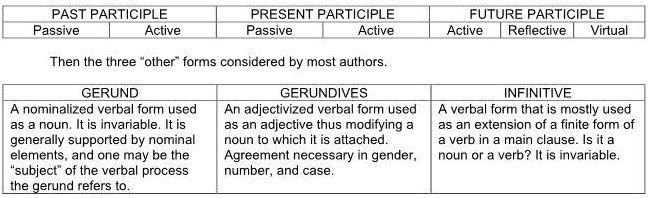
First of all, we have to list the forms themselves before exploring their phylogenetic and semantic values. I just use the terms more or less accepted by everyone in the one-century-old field of Pāli description. So far, I submit these terms to no discussion. I will when later I examine the real forms and examples of their uses. First of all, the three participles. The most surprising participle is the future participle with its supposed three dimensions.
We can already see the originality of the language, but this originality is seen so far as a difference from the standard conception of non-finite forms in western linguistics. We can wonder if what we have here is not an extension of this western vision. We will have to discuss this point with the forms, examples, and values we are going to discuss. We have to keep in mind these forms have to be analyzed within the syntax of the language at two levels: the inner syntax of the “participial, gerund, gerundive and infinitive clauses,” of which they are the main elements, and the outer syntax within or in connection with the main finite clause or clauses, if any. I will have to give translations of the forms beyond the descriptions, but I will certainly not remain at the surface of the discursive constructions but try to always refer to the functional architecture of every simple or complex element I call the thematic functional depth of the various forms. To make sure I am heard properly, I will not analyze the structure of a clause in terms of subject and objects, but in terms of agent, theme, source, goal, location, and composite functions. The term reflective is going to bring a very interesting discussion because it is only called reflective since in the translation into English or French a reflective pronoun is brought up like in “John is washing in the bathroom,” or “John is washing himself every night from top to toe,” or “John is washing his dirty shirt with soap.” In fact, this median voice in the first and second sentences is reflective because in French the reflective pronoun is compulsory, not in English: “Paul se lave dans la salle de bain,” “Paul se lave de la tête aux pieds tous les soirs,” and “Paul lave sa chemise sale avec du savon.” Active-Passive-Reflective is far from being accurate to describe and define the “voice” of a verbal construction, not to mention its value in discourse.
Another remark is that the serialization of past-present-future is typically Indo-European. Semitic languages work on a binary system and not a ternary system, and in fact, this Pāli language seems to work on seven forms at the level of the participles and the main category could have been the voice, hence Active [past, present, future], Passive [past, present, future], Reflective [if it can and have to be kept], and finally some Virtual dimension [if it can and have to be kept]. We have to keep in mind other languages and families of languages work differently. For example, the Semitic language known as Arabic does not work at all like Indo-European, and, maybe, Indo-Aryan languages.
"Verb tenses are used to express when an action takes place. In Arabic, there are two main tenses: the past tense and the present simple. Then there’s the imperative mood, which is considered to be the third tense in Arabic grammar.” (Tenses in the Arabic Language: All You Need to Know https://www.arabicpod101.com/ blog/202 1/07/08/arabictenses/#:~:text=In%20Arabic%2C%20there%20are%20two,third%20tense%20in%20Arabic%20grammar.)
We should rather refer to the inner time of a verbal process, the outer time of a verbal process, the universe time in which each verbal process has to be situated, and the mental time which is the basic langue-discourse-communication logic of each individual speaker-listener-writer-reader which is the operational time of this individual with two levels in this mental time: the time it takes to transfer a targeted meaning into an effective real communicational meaning; and all the possible modalizations the speaker can inject into his use of this or that verbal form, and I must say this modalization takes some time too, and this time is also part of the operational time Gustave Guillaume envisaged. When we enter a new language that is not closely connected to our first language or covered by our first level of linguistic elaboration and knowledge, we have to ask such questions before even looking at the forms.
But we have to consider the phylogeny of the various formants or formative elements used to produce the forms we are going to analyze, meaning where they come from and what was their values and how they changed to produce the present modern time values. Most of the time, the first reference is Sanskrit, but Rhys-Davids knows the value might be different. But then, he moved to connection with Latin, which is at least tentative since the connection between Pāli, and Latin is at best hypothetical. It is not because a formant in Pāli is similar to a formant in Latin, or even has a similar value to that of the Latin formant, that there is a link between the two. We have to take into account the distance and the route from one formant to the other, and once again the route from a Pāli formant to a Latin formant, or vice versa, is at least extremely indirect, and therefore, correspondences have to be considered as purely circumstantial, till proved differently. We have to keep in mind that T.W. Rhys Davids (1843-1922) was a 19th-century scholar and as such considered that Sanskrit was the original ancestor of Indo-European languages, which it is not. In fact, we know very little about the formants we are going to deal with. I will make some remarks on this question when I consider the various formants in question.
Figure 3: Types of Verbals: Participles, Gerunds, and Infinitives
Preliminary Consideration of Finite Verbal Forms
Before considering the non-finite forms, it is necessary to consider the various approaches to the verb in Pāli, and it is necessary to keep in mind there is no real consensus on the tenses, moods, voices, and other elements.
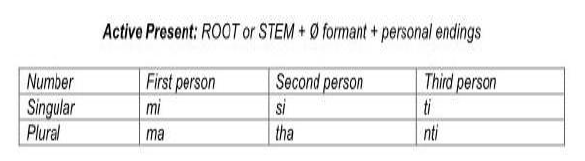
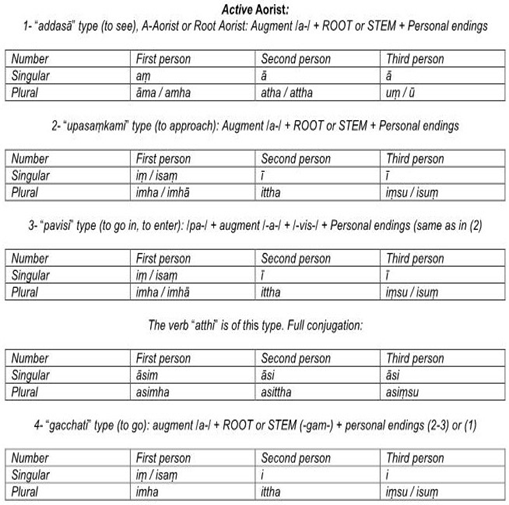
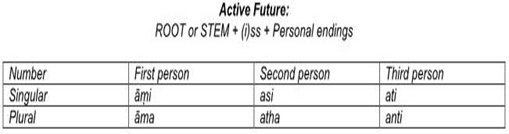
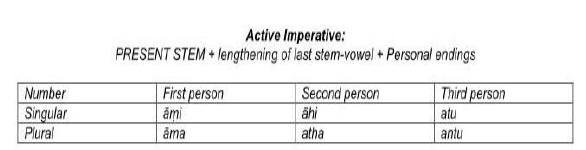
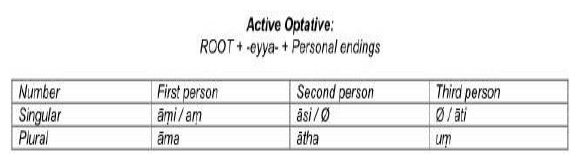
First, tenses and moods are considered in the active voice. They are characterized by various prefixed, infixed, and suffixed elements. The last suffixed elements or set of elements are personal markings or endings. If there is some logic in considering the present as first, it could come from the fact that the present is always built from the root of the verb, and the stem a particular verb uses by expanding the root with a vowel or a consonant, or by using a present stem that is “irregular” as compared to the root itself. The present only adds the personal endings to this root or stem. It is a common convention to identify a verb by giving the 3rd person singular of the present. It is translated either as the 3rd person singular of the present or as the full infinitive (to V) in English.
Brāmano: (Noun, nominative, singular, masculine, “the Brahman”)
Āgacchati: (Verb āgacchati, “comes,” “approaches,” from gacchati, “goes,” /ā-/ antonymizing (“antonym+ize, transitive verb; from the Greek word antonymia = instead of, opposite, means to map an entity to its opposite.” in Florentin Smarandache, Department of Mathematics, University of New Mexico, Gallup, NM 87301, USA. e-mail: smarand@unm.edu “Neutrosophic Diagram and Classes of Neutrosophic Paradoxes or to the Outer-Limits of Science,” in Progress in Physics, Volume 4, October 2010, available at https://www.aca demia. edu/6760847/Neutrosophic_Diagram_and_Classes_of_Neutrosophic_Paradoxes_or_to_the_Outer_Limits_of_Science) prefix, Present 3rd person singular)
Na Bhikkhave So Bhikkhu Idān’eva Taṃ Mīlhena Āsādesi, Pubbe Pi Āsādesi
Elizarenkova’s Translation: (“O monks, this bhikkhu has not soiled him with filth now, not even before [he] had soiled [him].” I would suggest the following translation: “O monks, this bhikkhu has not ever been attached to excremental vile pleasures, nor has he in any anterior life of his.” Elizarenkova’s translation would have been better if she had used the reflexive pronoun “himself” twice. She missed the Buddhist meaning.)
Na … Pi: (Negative and adversative particles)
Bhikkhave: (Vocative plural of “bhikkhu”)
So: (3rd person, singular, masculine, “he,” “that one”)
Idān: (Emphatic demonstrative, amplifying and amplified by the next element)
Eva: (Emphatic adverb)
Taṃ: (Demonstrative adverb of place and time)
Mīḷhena: (Instrumental, singular of “miḷha,” past participle of “mih,” “to produce liquid or solid excrement,” hence “vile pleasure.” Here the past participle “miḷha” is nominalized as “miḷho,” nominative, and then instrumentalized meaning entities or items that have to do with excremental vile pleasures.)
Āsādesi: (Orist, 3rd person, singular, Augment /a-/, antonymizing prefix /a-/, verb connected to root /saj/ or /sañj/ meaning “clinging,” hence the verb here means “not clinging to,” with a possible medial voice expressed by the /-e-/ infix. I prefer that line of understanding that goes along with the strong Buddhist meaning of taŋhā, the excessive attachment to anything, material, virtual, or mental, that causes negative “kamma” in the person that is attached in such a way to anything. This approach of the word goes along with the next word that precisely refers to previous incarnations, or lives.)
Pubbe: (locative of “pubba,” “previous,” “former,” “before,” “abode in a former life, one’s former state of existence,” reference to former lives before reincarnation, the famous Jātaka tales about the previous births of Buddha)
Āsādesi: (Aorist, 3rd person, singular. Note this reference to attachment, “taŋhā,” in this life and anterior lives is quite obvious when we know the quotation comes from the Jātaka tales about the previous births of Buddha. Taŋhā is the absolute kamma-pooper within this jātaka concept.)
Figure 4: Structure and Identification of Verb Forms through Present Stems
Figure 5: Morphological Analysis of the Sanskrit Verb 'Āgacchati
Figure 6: 3rd Person Singular Aorist in Pāli: Case Study of 'Āsādesi
Sace Attano Dhamme Ṭhassati Pubbe Sadisā Va Bhavissati
Elizarenkova’s translation: (“If she remains true to her Dhamma then she will become as she was before.” My suggested translation: “If he [singular but unspecified as for gender] keeps his own understanding, of the Dhamma, the Doctrine, [his own beliefs and principles], his [future life] will be the same as his previous lives.” Note the loss of the future in the temporal subordinate clause in English. I come here to a general remark about translating Pāli Buddhist texts: the translations most of the time economize on the Buddhist value of words: people fluent enough in this philosophy or religious corpus can interpret the English words, or any language, properly. Otherwise, the meaning is lost like when the complex concept of “dukkha” is translated as “suffering.”) (Ashoka the Great (r. 268-232 BCE) was the third king of the Mauryan Empire (322-185 BCE) best known for his renunciation of war, development of the concept of dhamma (pious social conduct), and promotion of Buddhism as well as his effective reign as a nearly pan-Indian political entity. https://www.worldhistory.org/ Ash oka_the_Great/)
Sace : (If)
Attano: (Genitive, singular “one’s own” from “attan” “self”)
Dhamme: (Accusative plural of “dhamma”)
Ṭhassati: (Future, 3rd person, singular of “tiṭṭhati,” “to stop, stand, and stay,” hence “to remain.”)
pubbe (locative of “pubba,” “previous,” “former,” “before,” “abode in a former life, one’s former state of existence,” reference to former lives before reincarnation, the famous Jātaka tales about the previous births of Buddha)
Sadisā: (Adjective, “same”)
Bhavissati: (Future, 3rd person, singular of “bhavati,” “becomes.” Note there is no mention in this sentence that the person concerned is a woman. The feminine reference in Elizarenkova’s translation is not justified. It can only come from the wider unspecified cotext or context
Adhimanasā bhavātha
Elizarenkova’s translation: (“Be concentrated.” Note the plural of the targeted audience and future subject of the concentration is lost in English. I would suggest a translation like: “You all must become and remain concentrated.”)
Adhimanasā: (Adjective “adhimana,” plural to agree with the plural beneficiary, and the induced subject of the verb in the imperative.)
Bhavātha: (Imperative, 2nd person, plural of “bhavati,” “be,” “become.”)
Adassena Bālānaṃ Niccaṃ Eva Sukhi Siyā
Elizarenkova’s Translation: (“May he always be happy without beholding fools.” I would propose the following translations: “May he always be happy when not contemplating fools” or “He should always be happy if deprived of the contemplation of fools.” I always think each verse in the Dhammapada is like a Haiku, dense and beautiful because explicit in its contradictory confrontation of antagonistic words that only make sense if you find the middle way between these terms.)
Bālānaṃ: (Accusative of “bāla,” “ignorant” moral meaning, hence fools)
Niccaṃ: (Adverb, “always,” “perpetually,” accusative for manner adverbial use.)
Eva: (Emphatic adverb)
Sukhī: (An adjective derived from the other adjective “sukha,” “happy,” or from the third adjective “sukhin,” “happy,” or from the past participle “sukhita” of the verb “sukheti,” causative from the adjective “sukha,” “make happy,” hence “happy.” This is a central concept in Buddhism. It is the positive dimension corresponding to the supposedly negative “dukkha,” the never-ending cycle of birth-life-death-rebirth, except when enlightenment is reached and “nibbana” is the reward. We are here in a deep debate in Buddhism that asserts that we can know happiness, despite dukkha, provided we concentrate on these moments of satisfaction, but do not get attached to them because they are “anicca,” “ever-changing,” hence “evanescent,” and “anatta,” with no essence, no conceptualizable definition that could last more than an evanescent instant.)
Siyā: (Potential 1st, 2nd, 3rd person singular of the verb “atthi,” “to be,” “to exist.”)
I would now like to present one case of an imperative used with an optative meaning.
Etena Saccena Suvatthi Hotu
Elizarenkova’s Translation: (“May he be blessed with this truth!” I would vastly prefer the use of an active verb, “May this truth bless him” or a standard “imperative” periphrastic auxiliary, “Let this truth bless him.” If the passive were to be used, I would prefer “Let him be blessed by this truth.” It is difficult to simply use the subjunctive like in “God Bless the Queen!” because “this truth” is not powerful enough to justify the structure, “This truth Bless him!” But I would also favor the use of another modal than “May” and would finally suggest “Should he be blessed by this truth!” which is a standard subjunctive periphrastic construction in American English, with “by” again to reinforce the power of this truth that “with” does not convey properly.)
Etena: (Demonstrative, singular, instrumental of “eso,” “this.”)
Saccena: (Adjective and noun “sacca,” instrumental singular. This instrumental case could imply we have a participial sentence, and this is the subject of the verbal process. But it is not the case: we do not have a participial sentence since the sentence is built with the finite verb “hoti” in the finite imperative 3rd person singular.)
Suvatthi: (Compound “su-” + “vatthi,” i.e., “su+asti,” “hail,” “well-being.” “Su-“is a reinforcing prefix that means “well,” “happily,” and “thorough.” “vatthi” is just bringing the concept of “being,” or “existing.”)
Hotu: ‘(Imperative 3rd person singular of the verb “hoti,” “be.” This construction is complex. Either suvatthi is an adjective and it should be agreed in gender, number, and function with the subject of the verb, here targeted by the imperative, or a participle which the “-atthi” element in the word would make possible since it is a verbal element,” atthi,” but it is the 3rd singular person of the indicative present, hence a form that seems to be neutral as for its connection with “hoti.” See what I say about these perfective constructions after the conditional. Yet the use of the instrumental seems to imply this construction is passive, or at least medial, and that “suvatthi” should be a past participle. But so far – for me – the form used here is a mystery.)
Elizarenkova’s Translation: (“Were you not besmeared with dung, I would have done away with you there and then.” My suggestion: “If you were not smeared with crap and excretion, I would have brought your life to an end a long time ago.”)
Sace: (“If”)
Tvaṃ: (2nd person singular, nominative, “thou.”)
Gāthamakkhito: (Nominalization of the past participle “makkhita” of “makkheti,” causative verb built on “makkha,” “smearing over,” hence one (masculine) who is smeared over with “gātha,” a word I cannot find
Nābhavissa (Negative /na-/ + Aorist augment /-a-/ + “bhavissa,” 2nd person singular conditional of “bhavati,” “to be,” “to become.” Note the keeping of the conditional in the if-clause.)
Idh’eva: (“Idh’,” “here and then,” “eva,” emphatic particle.)
Taṃ: (2nd person singular, accusative, “thee.”)
Jīvitakkhayaṃ: (“jīvi,” “life;” “jīvikkhaya,” “dissolution of life,” accusative, singular.)
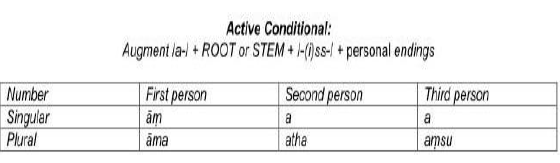
Apāpessaṃ (Conditional, 1st person, singular, verb “pāpeti,” causative of “pāpuŋati,” “to make attain.” Aorist augment /a-/ + ROOT or STEM “pāpe-“+ Future infix /-(i)ss-/ + /-aṃ/, 1st person singular ending.)
Figure 7: Pāli Syntax and Semantics: A Case Study in Future Tense and Nominal Forms
Figure 8: Reevaluating Translation Choices in Pāli: Plural Agency in Adhimanasā bhavātha
Figure 9: Verb-Complement Relations in Pāli Imperatives: The Enigmatic Role of 'Suvatthi
Figure 10: Temporal Inference and Assumption in Pāli Future Constructions
We should add two compound tenses with some perfective meaning.
Past Participle + “hoti” in the appropriate gender, person, and number form:
So Gehaṃ Gato Hoti: (“He has gone home.”)
So: (Pronoun 3rd person singular masculine)
+ Gehaṃ: (Home, accusative for a destination)
+ Gato: (Past participle of “gacchati,” go)
+ Hoti: (Present, 3rd person singular of the verb “hoti,” “to be,” “to exist”: note the translation given by James W. Gair might be right in colloquial English, but it is wrong linguistically. The “auxiliary” is one of the three verbs corresponding to the meaning of “to be” or “to exist.” According to A.P. Buddhadatta Mahathera’s English-Pāli Dictionary, “Have, verb transitive intransitive. Expressed by roots “bhū” (“bhavati”) and “as” (“atthi”), with the genitive of the possessor.” That means there is no “auxiliary” corresponding to the auxiliary “to have” in English, or “avoir” in French, or “haben” in German, etc. On the other hand, Pāli has several verbs to express the concept of “to possess.”)
Past Participle + “bhavissati” in the appropriate gender, person, and number form:
Figure 11: Reframing the Medial: Pāli’s Reflective Voice in the Indo-European Tradition
Figure 12: Temporal Assumptions and Immediate Futurity in Pāli Syntax
“Bhavissati” is a future form, here 3rd person singular. James W. Gair suggests translations like “might have,” “would have,” or “will have.” This compound tense is not necessarily a future but in fact the presumption or assumption that something has already occurred.
So Adhunā Gato Bhavissati: (“He will have gone (by) now.”)
So: (Pronoun 3rd person singular masculine)
+ Adhunā: (Adverb, “right now,” “by now”)
+ Gato: (past participle of “gacchati,” “go”)
+ Bhavissati: (Active future of “bhavati,” “becomes,” “is,” “exists,” 3rd person singular. The future form of the auxiliary implies that the speaker is assuming that, according to all he knows, the person concerned should already be gone, but it remains an assumption to be checked, even if immediately, hence in the immediate future. The future is thus justified here.)
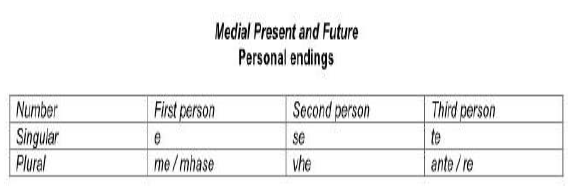
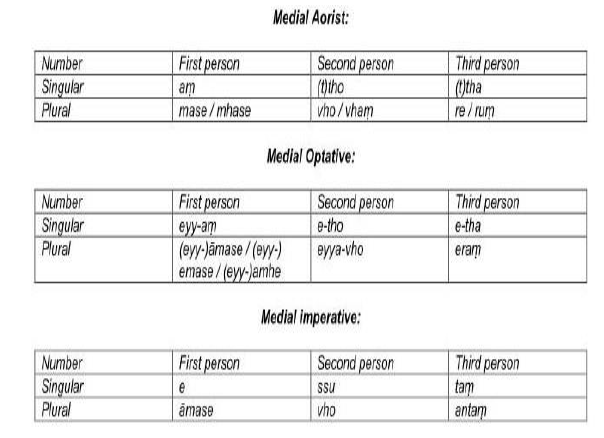
When we have done this, we have done one-third of the job to describe the temporal system of Pāli. The second chart has to take into account the Medial voice which is mostly different from the active chart by the Personal endings.
Kathaṃ Su Labhate Paññaṃ, Kathaṃ Su Vindate Dhanaṃ
Elizarenkova’s translation: (“How does one obtain wisdom; how does one find wealth.”)
Kathaṃ: (Interrogative pronoun, “how?” Note the accusative. It is the direct object of the interrogative verb.)
Su: (Adverb, “indeed,” “verily.”)
Labhate: (Medial, 3rd person singular, present of the verb “labhati,” “receives”)
Paññaṃ: (Accusative of “pañña,” “wisdom,” “knowledge,” meaning the knowledge you get from your meditation based on your learning the Dhamma in the Dhammapada and other Buddhist books of learning. It is a lot more than plain wisdom. It Is something you have to fight for all your life. Hence the orientation is on the subject of the action, meaning the unspecified actor that is making himself the benefactor of this action of acquiring that wisdom. That justifies the medial voice that some call the reflective voice because the agent of the action is also the beneficiary of the same action. In functional terms, this subject is both agent and Goal, agent to get the wisdom and the goal to be the receptacle that gets it in the end. Note this is based on self-learning in Buddhism. One does not learn wisdom at school, in the street, nor the marketplace but exclusively in one’s own meditation.)
kathaṃ: (Interrogative pronoun, “how?” Note the accusative. It is the direct object of the interrogative verb.)
Su: (Adverb, “indeed,” “verily.”)
Vindate: (Medial, 3rd person singular, present of the verb “vindati,” “knows,” “realizes.”)
Dhanaṃ: Accusative of “dhana,” “stake,” “prize at a game,” “booty.” The same remark as for “paññaṃ,” though this time it does not deal with wisdom, but with riches, possessions that can only be gotten via an action that permits the appropriation, self-appropriation if you want, of some “goods” or “possessions.”)
Then Elizarenkova moves to a second approach that prevents getting more examples of such medial voice sentences. To follow up on other forms she lists we would have to go to Duroiselle who calls this medial voice the reflective voice, on the model of the reflective verbs in Indo-European languages, and he speaks of an older system that worked on three voices: active – reflective-medial – passive. We’ll come to the passive later. Here are the three other cases of medial conjugation given by Elizarenkova.
To specify how difficult it is, to actually differentiate the medial voice from the active voice in the form itself of the conjugation let me give a double example from the Jātaka Stories proposed by Elizarenkova.
Elizarenkova’s Translation: (“sitting in a hut of leaves, the maiden cooks various tubers and roots.” I would suggest the following translation: “the maiden, after having seated herself properly, cooks the various donated tubers and roots.”)
Kumārikā: (“young girl” “virgin” derived from “kumārī,” “young girl,” the suffix /-ka/ seems to mean small and unproductive when applied to trees, hence the understanding as “virgin.”)
Paṇṇasālāya: “(Paṇṇa-,” “leaf,” “-sālā-,” “hall,” /-ya/ locative case, hence “a hut of leaves.”
nisīditvā (Gerund in /-tvā/ of the verb “nisidāti,” “to sit,” hence “having sat down properly,” with the full meaning of the Gerund, as we shall see later, of a comfortable, totally completed action of sitting down.)
kandamūlādīni: ‘ “kanda,” “tuber;” “mūlā,” “roots;” “dīni” for me seems to be connected to words like “dinna,” past participle of “daddāti,” ‘gives,” and it thus assumes the Buddhist context of receiving food from the people in the alms-bowl, or “patta” in Pāli, along with the reinforcing antagonistic and antonymous (antonymizing prefix /a-/) adjective “adinna,” “seizing or grasping that which is not given to one,” “stealing.” The maid or maiden is cooking what was offered to her or them.)
Pacati: (Present, 3rd person singular. This is active since the subject, the “kumārikā,” is doing the cooking.)
Atha Naṃ Sā “Nisīda Yāva Paccati”
Elizarenkova’s Translation: (“And then she [says] to him, “Stay while it cooks”.”)
Atha: (“Now,” “then.”)
Naṃ: (Alternative form of pronoun taṃ, 2nd person singular, accusative.
Sā: (3rd person singular, feminine, nominative.)
Nisīda: (Imperative, 2nd person singular of the verb “nisidāti,” “to sit down,” hence “remain seated.”)
Yāva: (Adverb, “until.”)
Paccati: (Present, 3rd person singular, subject unspecified. The maid is speaking to someone: she is not the one who is cooking in the pot, and the person she is speaking to is not the one who is cooking in the pot either. Typical the subject is the object of the previous sentence, hence the roots and bulbs. These bulbs and roots do not cook themselves. We have here a real medial voice since the subject of the cooking is the item that is cooking, in order to be eaten later on. But it is obviously not reflective. It is not passive either since neither the maid nor the second person is doing the real cooking that is done by the heating element. And we have to note the two quotations use the simple indicative present. At this point, I am inclined to think the medial voice is a ghost if not a myth, definitely a survival.)
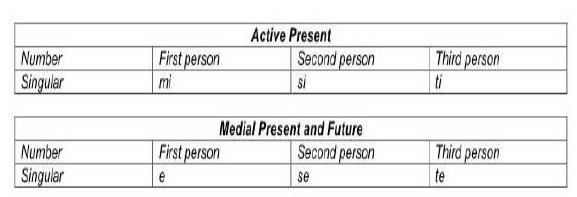
I would now like to give one simple remark on the fact that we do not know the phylogeny of such systems that got constructed over thousands of years. Look at the following singular personal endings for the present, first active, and second medial.
In phylogenetic terms, we can understand the value of /m/ as the lip movements of the baby sucking on his mother’s teat. The association with the first person goes along with this association with the mother giving to /ma/ the basic reference to the mother in most, Joseph Greenberg would say all, languages in the world.
Figure 13: A Note on the Unknown Origins of Pāli’s Voice Distinctions
Figure 14: Pāli Passive Voice: A Fully Inflected, Root-Based Construction
We can be surprised by the fact that the second sound, /p/, associated with the lip movements when rejecting the teat after feeding, is not integrated here. It did give one fundamental reference to the father with /pa/ and a certain distance from the infant in most cases. It is more difficult to understand the phylogenetic logic of /s/ and /t/. We find /t/ as an alternative or a competitive alternative for the father, and being a dental, it requires teeth, hence a distance in simple physiological growth. At the same time /s/ is the consonant that can be produced without teeth. /s/ is a sibilant and like fricatives, they do not need any dental articulation, and thus can come early in the infant’s articulation, hence before /t/. That could explain the order of the three personal endings: distance in articulatory time, hence in physiological phylogeny. Of course, all that has to be discussed. But to compare with Indo-European languages would be the wrong way to come to an explanation because there was and had ever been no relation between Pāli and Indo-European languages for millennia until the colonial era when some Indo-European languages invaded Africa, Asia, and the Americas imposing some of their mental frames.
But if we compare, then we have to explain why the /s/-/t/ sequence in Pāli is inverted in Indo-European languages like in French /moi-toi-soi/, in English /me-thou-self/, in German /mich-dich-sich/. We can always restrain our approach to the psycholinguistic or the psychomechanic vision of the psychogenesis of language, but that does not get rid of the phylogenetic dimension of language history and evolution. Comparing should not, the way it does in Rhys-Davids, for one and only one example because there are many, in any way imply and at times clearly state there is a genetic connection between Pāli, or as for that Sanskrit, and Gothic or other Indo-European languages. That is due to the fact that when Sanskrit was discovered it was at once compared with Indo-European languages and it was decreed Sanskrit was an ancestor if not the ancestor of Indo-European Languages, which it is not. Just a cousin for sure but several generations away.
Passive and Causative Verbs
The next stage in this presentation of the temporal verbal system of Pāli concerns two other domains of verbal derivation, and thus conjugation that systematically avoids any exteriorization of some values, categories, or tenses/moods by using auxiliaries. But we have to contemplate passive verbs and causative verbs not as externalized by auxiliaries or periphrastic constructions but as derived verbs.
Pāli does not use any periphrastic architecture to express the passive voice. It uses a simple infix directly attached to the ROOT or STEM that is used as the basis of the various tenses and moods. The verb is then a passive verb to which all temporal or modal prefixes (augments), infixes, and suffixes are attached. The passive verb can then be conjugated in all tenses and moods like any other verb.
For example, “karoti” (“does,” “makes”), ROOT “kar-“, present STEM “karo-“, becomes “kariyati” or “karīyati” (“is done,” “is made”). Note the assimilation of the stem vowel /o/ to /i/ or /ī/ under the influence of the passive infix /-iya-/ or /-īya-/. This passive verb is then conjugated in all possible ways though it is irregular in some cases. The present participle is either “karīyamāna” or “kayīramāna” (“doing,” “making”). The future is “kariyissati” (“will do,” “will make”). The Gerundive is “karanīya” or “kātabba.” Rhys-Davids opposes the Gerundive which is an adjective use of the derived participial forms of the verb (in /-iya-/ or /-tabba-/), and this adjective is variable in gender, number, and case, on one hand, and, on the other hand, the gerund which is a nominal use of this derived form of the verb (in /-tvā/) and this nominal form is invariable. More about it later. Here are two sentences, one active and the other passive.
Itthī Odānaṃ Pacati
Steven Collins’s Translation: (“The woman cooks rice.”)
Itthī: (Nominative, singular, feminine, “woman.” Agent of the action: she does the action.)
0dānaṃ: (Accusative, singular, masculine/neuter, theme or object of the action, the element that goes through the transformation expressed by the action, “rice.”)
pacati (Present, 3rd person singular of the verb “pacati,” root “pac-,” present stem “paca-,” (“to cook”).
Odamo Itthiyā Pacīyati
Steven Collins’s Translation: “Rice is cooked by the woman.”
Odamo: (Nominative, masculine/neuter, subject of the passive verb, the theme that goes through the transformation expressed by the verb.)
Itthiyā: (Instrumental, feminine, singular, “itthi-(i)yā.” She is the agent of the action expressed by the passive verb, but she is second in the thematic architecture of the sentence carried by the verb in the passive voice.
Pacīyati: (Present, 3rd person singular, passive voice, verb “pacati,” root “pac-,” present stem “paca-,” STEM “paca-“ + passive infix /-iya-/ [the /-i-/ is integrated into the final /-a-/ of the stem] + 3rd person personal ending “-ti,” “is cooked.” Do not mix this passive with the causative of the same verb, pācayati. Note I have already given a similar sentence for the medial voice that was not expressed via the conjugation but via the shifts of word order and thematic functions (cases). In fact, if the agent were not mentioned at all we could have “Odamo pacate.” This is a real medial voice though the subject in the nominative is in no way an agent, only the beneficiary of the action of cooking, the element that receives the transformation from raw to cooked. In other words, as I have already said, it is not a reflective voice at all since the patient subject is no agent at all. Steven Collins goes one step further but seems to be unclear.
“Words for someone else are words whose aim (goal, benefit, etc.) is for someone other (than the subject): e.g., Itthī odānaṃ pacati, the woman cooks rice. Words for oneself are words whose aim (goal, benefit, etc.) is oneself (= the subject): Itthī odānaṃ pacate, the woman cooks herself rice.” (Steven Collins, A Pāli Grammar for Students, Silkworm Books, Chang Mai, Thailand, 2005).He has it wrong because in the first case, the active voice, there is no mention of any goal, hence it can be anyone, including the agent-subject, and including the cooking agent herself alone. The second case is even more surprising since with no mention of a goal, once again the beneficiary of the action could be anyone, including the agent-subject but the translation does not correspond to the description. “The woman cooks herself rice” means she cooks rice for herself only if you consider “herself” as a goal complement, which it may not be because it could correspond to “the woman cooks rice by herself, and once again there is no mention of a beneficiary and in this last case “herself” can move around in the sentence: “the woman herself cooks rice,” which is not clear, and we would prefer “the woman herself is cooking rice,” or even, “the woman herself is cooking the rice/some rice.” The absence of any determiner in the Pāli sentences makes it necessary to palliate the absence with articles, including the zero article, Ø. Note Collins does not consider the case of the real medial voice when there is no agent mentioned, no beneficiary mentioned, and that the “cooking” only occurs with the “rice” on its own under no surveillance like in “The rice is cooking in the kitchen.” You find such situations in all cookbooks, without a subject since it is mentioned as a conclusion or an instruction in the imperative. In another technical field I have found this one just right now: “Under normal circumstances, [1-] it takes a minimum of 30 minutes [2-] for an overheated engine [3-] to cool down to a temperature where it is safe to inspect it and potentially work on it. December 1, 2020”
Figure 15: The Role of 'Karoti' in Accessing Non-Finite Forms in Pāli
Figure 16: Reframing Agency: The Subject as Theme in Pāli Causative Constructions
(Jack R. Nerad | Dec 01, 2020, How Long Does It Take for a Car to Cool Down?, https://www.jdpower.com /cars/shopping-guides/how-long-does-it-take-for-a-car-to-cool-down#:~:text=Under%20normal%20circumstan ces%2C%20it%20takes,and%20potentially%20work%20on%20it.) In this technical field they use an impersonal structure that rejects (the agent completely with “it takes” and) the beneficiary of the action into a structure like [“for + complement supposed to be the item that goes through the process of cooling in this example + To V non-finite form of the verb”], but it is in no way the agent of the cooling, only the beneficiary. It is a typical medial voice that enables this technical sentence to avoid the passive which would have been a lot more common some twenty years ago, but many people made fun of it, including me in conferences and articles, most of them published by the journal ASp. (ASp publishes peer-reviewed research articles and reviews related to the field of English for Specific Purposes (ESP) for both teaching and research. The thematic and non-thematic issues aim to give an insight into the specifics of ESP, notably in its linguistic, discursive, cultural and didactic aspects, and also to develop our knowledge of the various specific English registers used for different purposes. https://journals.openedition.org/asp/?lang=en)
The verb “karoti” we considered before this example leads us to the next element that has to be taken into account to understand the non-finite forms of this verbal system.
These causative verbs can be conjugated in all tenses, moods, and even the passive voice. But, more interestingly even, these causative verbs are known as CAUSATIVE ONE because there is a CAUSATIVE TWO which is the causative of a causative, hence a double causative.
In the case of “karoti,” the CAUSATIVE ONE has its meaning changed from “cause to do or make” to “construct” or “build.” This is important because of the second level of causative derivation.
CAUSATIVE ONE: PRESENT STEM + /-aya-/ + tense infixes + personal endings “kārayati” after the reduction of /-aya-/ to /-e-/, “kāreti” (“builds” or “constructs” understood as “causes to do” or “causes to make”)
CAUSATIVE TWO: PRESENT STEM + /-aya-āpe/ (reduced to /-āpe-/ for “karoti”) + tense infixes + personal endings “kārāpeti.”
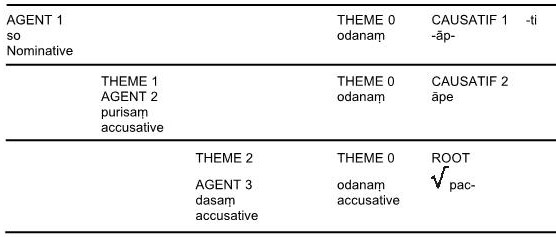
But for the verb “pācāti” (cooks, boils, roasts), we have the application of -āpe- twice to produce the CAUSATIVE ONE verb “pācāpeti” (Z-person causes Y-object to cook), and then the CAUSATIVE TWO verb “pacāpāpeti” (Z-person causes X-person to cook Y-object).
So Purisaṃ Dāsaṃ Odanaṃ Pācāpāpeti
Translation: (“He, the man, causes the slave to cook the rice.”)
So: (Pronoun 3rd person singular masculine, nominative)
purisaṃ: (“Puriso,” “man,” accusative singular)
Dāsaṃ: (“Dāsaṃ,” “slave or servant,” accusative singular)
Odanaṃ: (“Odana,” “boiled rice or gruel,” accusative singular)
Pācāpāpeti: (present stem “pāca-“ àcausative ONE “pacāpe” àcausative TWO “pācāpāpeti,” 3rd person singular, present, “causes the slave to cook the rice.”)
àNote the accusative on “purisaṃ” treated as a theme or object of the complex situation. The accusatives of the other two nominal terms are justified since “dāsaṃ” is the theme or object of the causing and “odanaṃ” is the theme or object of the cooking. In a way, “purisaṃ” is the object of the complex situation as well as the subject of it. He is the agent of the first causation but the theme of the double causation. In a way, he is the theme of his own agency. That’s what is missing in the various approaches and descriptions of Pāli: a real thematic functional analysis of the language. This last example could be seen in a stratified thematic functional approach as follows.
Theme 1-Agent 2 could have been in the instrumental case since he is the agent of the first causation, and yet he is not the agent of the action, in fact, he is twice removed from this action of cooking.
The Nonfinite Verbal Forms
Now we have seen most of this architecture we can consider the non-finite forms that are extremely common in Pāli. We are going to deal with examples in detail.
I will start with the Present Participle because the Present comes first in the Pāli verbal system since it is the root or the Present stem that is used for most other tenses and derived forms. That’s the logic of the language, probably its phylogeny too, and as for the psychogenesis of the language the first consciousness of time comes late, a lot later than the consciousness of space for the newborn who lives for a long time on the physiological cyclical tempo of his mother’s womb. For the newborn and then infant time is indiscriminate at first, at best some kind of sense of duration dictated by his natural needs, food, and other physiological functions. It is based on this continuous cyclical experience that the child will differentiate between what is present, here, now with this existential entity that will become “me” soon, and what is only a memory, and yet I am sure that what he needs, foodor whatever other functional needs, are making him call for the future rather than for the past. He does not cry because he remembers. He cries because he has something to be satisfied with, in the near future, and he wants it to be. Anyway, the past is a memorial, remembered from the present, and the future is provisional, desired, and imagined from the present. The present is the center of the time system that is emerging in the newborn and then, infant, and later, child. It is possible and probable that later on the child after maybe five or six years old, reorders his vision of time and builds the standard psychomechanic order of past, present, and future, but it is not what happens in many languages that do not have three basic conjugated, finite tenses past, present and future. Time is nothing but an opportunistic and circumstantial formalization of the private, personal, and collective experience we, as subjects and collectivities, have of our duration in life.
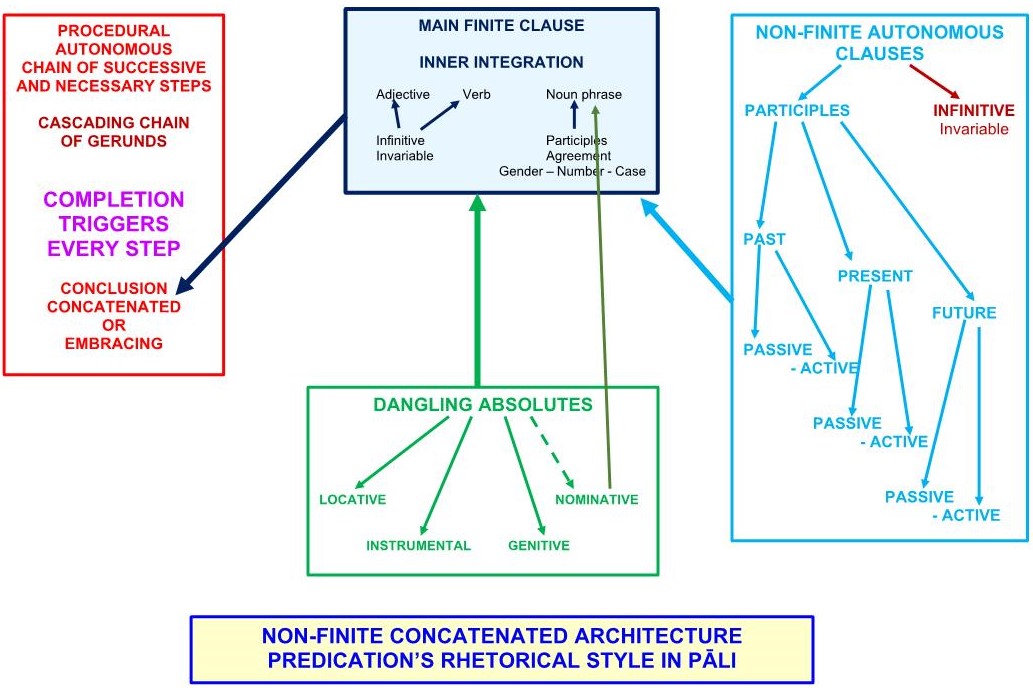
First of all, an overview of all the non-finite forms, visual, first, and then, in morphosyntactic architecture.
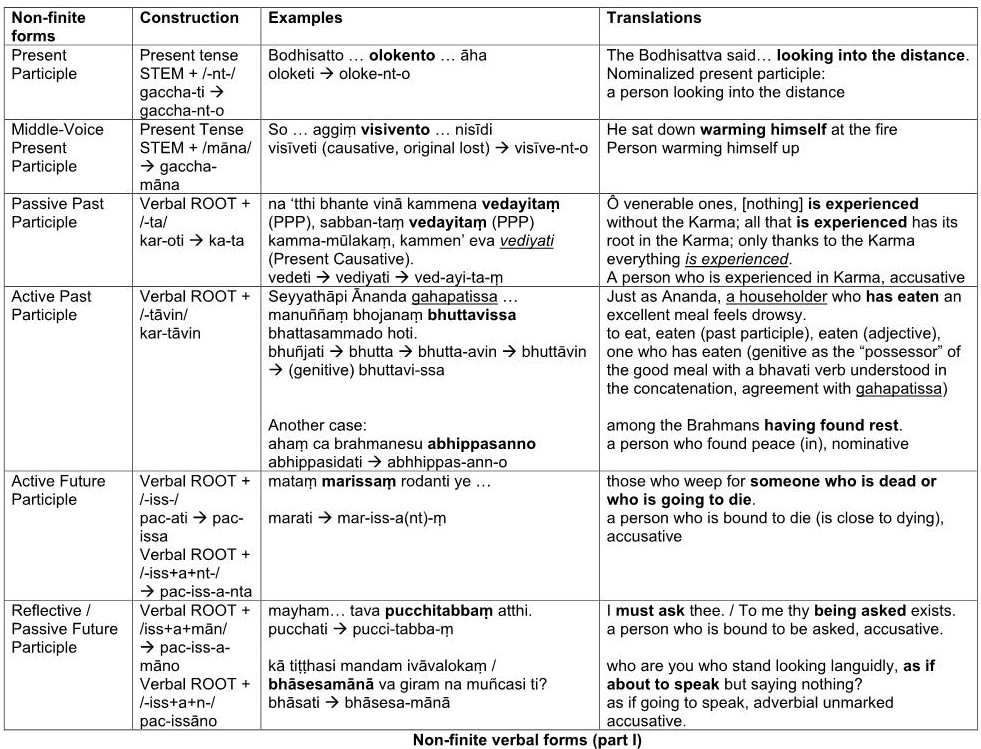
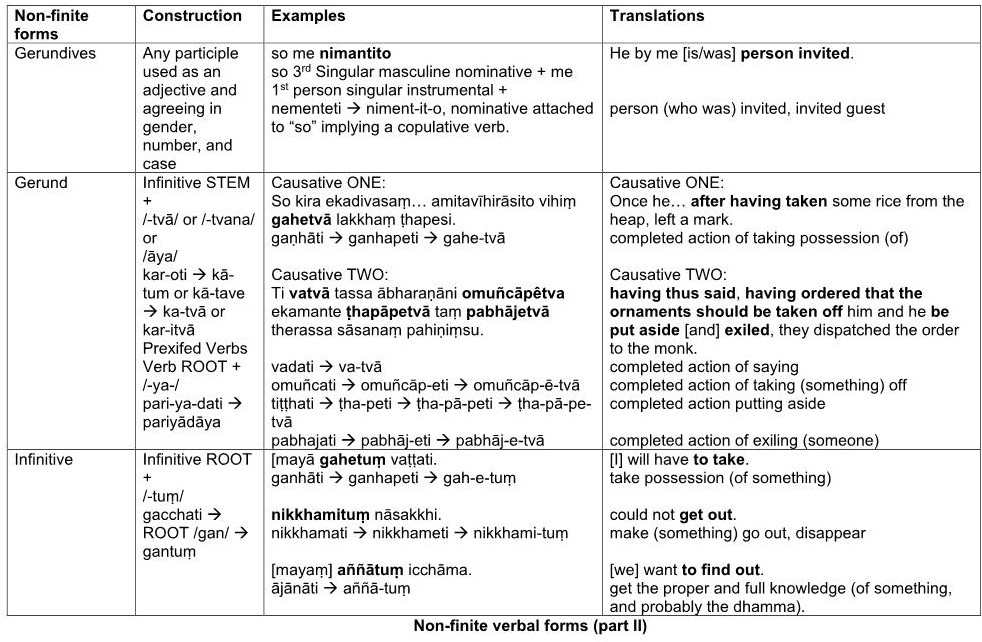
Now, a complete list of all non-finite forms as participles able to carry autonomous participial clauses that can be concatenated to a main finite clause. Then the cases of adjectivized participles called gerundives that agree in gender, number, and case with the nouns to which they are attached, and then the Gerund, an invariable form, and the infinitive, another invariable form. The examples are not yet specified in detail.
I can now add some remarks on the uses and values of these non-finite forms.
Figure 17: The Present as Axis: Language, Memory, and Desire in Temporal Cognition"
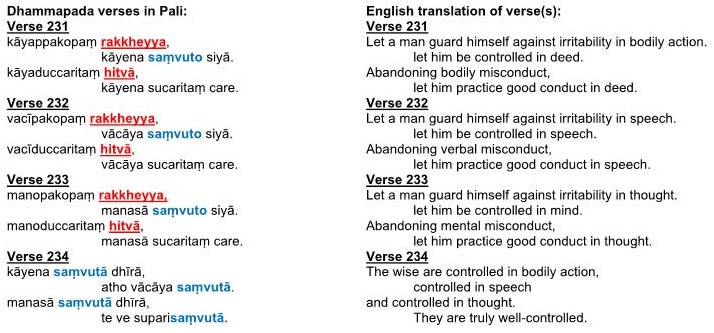
Figure 18: The Non-Finite Forms of Pāli: Participles, Gerundives, Gerunds, and the Infinitive
Figure 19: The Non-Finite Forms of Pāli: Participles, Gerundives, Gerunds, and the Infinitive
Present Participle
“Bodhisatto … olokento … āha.”The nominal element this present participle is attached to is the “subject,” hence the agent of the present participle that agrees in gender, number, and case with this nominal element. This is a general rule for these non-finite forms, except the Gerund and the infinitive that are invariable. All others are variable and agree with the nominal elements that support them. These participles are in a way either nominalized, and they are nouns, hence a person who is doing the action of the background verb, or they are adjectivized and carry the same “doing the action of the background verb” onto the nominal element it is supported by. These are general rules.
The present participle expresses an action that is simultaneous with the action of the main finite verb in the sentence or discursive sentential unit. It can be a short action captured in its totality or it can be an action captured in its processing, hence longer. It can be in the past, the present, or the future according to the tense of the finite verb it is contextually attached to. Participles do not deal with universe-time, outside time, or historical time, but mainly if not solely with inner time, the time of the processing of the action, and we will see the future participle deals with a modalized vision of the action, and it can be positioned in any time period imaginable. If the nominal element it is attached to is the agent of the background action, it has no obligation of being the same as the subject of the finite verb in the sentence. We are also going to see many cases are autonomous participial clauses with no finite verb present, though at times a verb might be implied by the cases, the architecture of the clause, or the meaning. The context is essential. We are dealing here with a fundamental trait of this language. It concatenates clauses, be they finite or non-finite, and the order of the clauses determines the meaning and seriation in time, which implies it may also convey the logical connections between the various clauses thus concatenated, and first of all the cause-effect relation, without most of the time specifying it explicitly.
Middle Voice Present Participle
“So … aggiṃ visivento … nisīdi.” In the various descriptions of Pāli, we find that “middle voice,” “reflective voice,” and “passive voice” are more or less equivalent or used as if they were equivalent. What remains is that the subject of the verb we see in these non-agentive voice options is not the agent of the action, or if this subject is the agent of the action, he is also the element that is submitted to the action, which is the beneficiary, positive or negative, of the action itself. The term “reflective” is typically understood in an Indo-European meaning, particularly in the languages that require a reflective pronoun for the agentive or non-agentive verb to make sense. This is particularly important in languages like French. English is a lot more ambiguous as we have seen. “Paul washes every Sunday,” can mean that every Sunday, he washes himself, or he washes his clothing, or he even washes the floors of his house. Due to the cyclical meaning brought by “every Sunday,” it is difficult to understand it as doing the washing-up. That’s something you generally do every day. The verb can be fully agentive when the object is different from the subject or is reflective if the object (theme or beneficiary) is the same element as the subject (agent). This verb can be used in the passive voice of course since it is transitive (even when it is reflective). We then get “The dishes are washed (up) every day in and by the dishwasher,” or “Paul is still young, so he is washed by his bigger brother every Sunday.”
These elements do not find a real expression in Pāli. The level of passive meaning is determined by the verb and the context. In the example, the subject is definitely the beneficiary of the action but in no way the agent. The agent is the fire. Note the main verb brings a past context and the present participle brings an action simultaneous with this past tense period.
This is the most common understanding of the past participle since it expresses an action that has been performed. It can be in the past, as well as in the present. In this latter case it may express an action that has been performed in the past, or simply an action that is passively said to have been performed or to be performed at the time of the context. The passive meaning can take over the past participle. That’s where Pāli is original with the next form.
It is original because it generally uses another infix. The result is a participle that agrees with its supporting nominal element. The participle in the above example, “bhuttavissa” using the specific /-tāvin/ infix is in the genitive case like the noun that supports it, “gahapatissa.” Note a phylogenetic question can be raised here with the /-ss-/ infix that has many values in Pāli with or without specific vowels: genitive case, future tense, conditional tense or mood, 2nd person singular imperative, not to speak of the nouns that contain it in their roots, stems or derivations that double sibilant consonant /-ss-/. In the above example, we do have an active past participle since the noun it is attached to is the agent of the action of eating, all the more so since the genitive expresses the fact that we shift from a simple /bhū/ understanding to a “have” understanding by applying the genitive case to the main actant of the action, hence the agent. This agent is more like someone who had a good meal (the complement in the accusative) than someone who was well fed, with the ambiguous meaning of the”be well-fed.” This use of the active past participle is what we will call a Genitive Absolute. More about it later.
The second example, “ahaṃ ca brahmanesu abhippasanno,” shows another past participle derivation and the meaning is only passive, or reflective, or middle, since the main actant is only feeling the peace, he has found among the Brahmans. To make it into an active past participle, we have to consider the said person who went into a search for these peaceful Brahmans that was a sort of hunt. Why not? But how can someone who is assumed to be a believer demonstrate such a case of “taŋhā”? No agency at all in this situation, at least on the side of the main actant of the action carried by the past participle. It is the past participle of the verb “abhippasīdati,” “to find one’s peace,” or “to have faith,” which implies faith is peace, faith brings peace.
Active Future Participle
“mataṃ marissaṃ rodanti ye.” This one has two derivations. The first one is compact with one infix, /-iss (a)/. The other one is twofold with the future infix, /-iss-/ a linking vowel /-a-/, and the present participle infix /-nt-/. The first derivation seems to be a reduction of the second in the example provided here. This future participle, what’s more active, expresses something that has not happened yet and that is modalized into the future as something that would (prediction), should (necessity, ethical advice, or wish) happen, or simply that is about to, is going to, is bound to happen.
Reflective/Passive Future Participle.
Two derivations are listed and a third one is exemplified. The first one is of the first active future participle with the future infix /-iss-/, the intermediary vowel /-a-/, and a second infix /-mān-/ and the example for this derivation, “kā tiṭṭhasi mandam ivāvalokaṃ / bhāsesamānā va giram na muñcasi ti?“: the present form of the verb, then the root of the verb in its future extension, and then the participial extension /-mānā/ in an adverbial unmarked manner accusative. The translation implies a supposition, comparison, and speculation on the intention of the person concerned about the action he is supposed to or is about to perform.
The second derivation is using a final extension for the participle /-n/ like in “pacissāno.”
The third is only exemplified and uses the specific passive future participle infix /-tabba-/: “mayham… tava pucchitabbaṃ atthi.” The value of this participle is quite special: it is here the assertion that for the speaker, his/her interlocutor will sometimes be asked questions, be interrogated. It is a potential event asserted as unavoidable and unescapable for the speaker.
Gerundives.
There is little to add here since most of the examples we have given so far attach the participles to nominal elements and thus adjectivize them with the necessary agreement. At times, the participle can stand alone and then be attached to the main clause and it will have to carry a case mark representing the function it performs in relation to the finite verb of the main clause. But we must also understand that a participle can be attached to another participle.
Gerund
This is the most surprising form and with the most original meaning. Most descriptions of Pāli do not capture the fundamental value of this form, a value that is entirely founded on the dhamma, the Buddhist doctrine, or maybe vice versa, the Dhamma is entirely founded on the possibilities provided by the language. Without entering the deepest details, let me consider that the general philosophy and even existential philosophy of Buddhism are cyclical. It is founded on three fundamental concepts that cannot be translated with only one word for each, hence three words, and as most translators do.
The three concepts are “anicca,” the fact that nothing is permanent, that everything changes all the time because life itself is a cycle represented by the concept of “dukkha” which says life is an absolute continuum that goes from pre-birth existence, through birth, life, death, post-death existence, and rebirth (that is not to be reduced to reincarnation). And finally, since everything changes and is impermanent, any entity, physical or mental, or even spiritual, is “anatta,” meaning that it does not have an essence, a soul if we are speaking of human beings and religion, any permanent definition, even one in a dictionary which is only an approximation of a definition for some generic and evanescent individual reading the dictionary and taking the definition as meaning whatever it may mean for each person reading it, and there is no reason to believe it means the same thing for all the fools we are, foolish enough to believe a dictionary and cite it as if it were eternal scientific truth directly out of the next door black hole.
Now, this cyclical conception is neither the result of some fate imposing itself onto the world and life, nor the result of some divine being since Buddhists do not believe in any god or creator of anything. All men are not created equal. All men have at each birth what they have accumulated in their long existence that determines what they can do then in the present life they are entering for some time. The evolution of religions and science is important for Buddhism that more and more refuse the idea of reincarnation, a Tibetan specialty, and rather speak of the mental, spiritual, or material heritage a person leaves behind when dying, and this heritage will be appropriated by other people and developed if it is developable.
An individual is what they do. Each action brings in some potential, either positive or negative. An Individual is thus this accumulated potential, “kamma” in Pāli. I insist on the Pāli that is similar, or even descends from the Sanskrit word “karma” but “kamma” and “karma” are not the same. “Karma” is used in Hinduism, and it contains castes. One cannot be anything else but what their castes permit. Buddhism refuses the concept of castes and thus “kamma” does not include such a segregational and even racist concept. It is true enough that the Tibetan Buddhists use Sanskrit instead of Pāli and they use Sanskrit concepts and “karma,” the castes are based on the creation of humanity by the Gods and each caste descends from one part of the body of the supreme Brahman, except the Dalits who – sorry “which” in their approach since the Dalits are not human beings since they do not have a section of Brahman in them – who were created from no part of the body of this God. Any western intellectual who translates “kamma” as “karma,” in English particularly, is showing they ignore one essential fact in Buddhist philosophy. Life is a long trip with successive actions, one after the other, and those actions are linked together along with one or several lines of progress. On each line of one’s life, each action determines, when it is completed, the possibility of a posterior action. If the first action is not completed, the posterior action is not possible. And the first action is, in the same way, what was made possible by a previous action that was completed.
This philosophical vision is the basic mental, spiritual and material concept behind the Gerund. This participle is invariable. It is built from the infinitive stem with or without some necessary vowel or consonant, and to which the simple suffix, /-tvā/ or /-tvana/ or /-āya/ is added. The last possibility is difficult, and probably rare because it is overlapping the same /aya/ or /eya/ infix that is vastly used in Pāli. The first one is the most common. But it becomes all the more complicated because this Gerund can be built from a simple active verb, a Causative ONE active verb, a Causative TWO active verb, and there is no formal rejection of using a passive stem to produce a Gerund. In fact, it is imaginable that the stem of any tense could be used. That makes the Gerund unescapable in Buddhist philosophy, in Pāli. But let us consider such Gerunds.
One basic example is
Cittaṃ Pariyādāya Tiṭṭhati
James W. Gair’s suggestions for translation: i- having taken over the mind, remains; ii- takes over the mind and remains.
Tiṭṭhati: (3rd person singular, present, “tiṭṭhati,” “he/she remains.”)
We then easily understand that out of the Buddhist reference this simple remark is difficult to understand. The person the text is speaking about has fully conquered the mind, and thus has reached full “nibbana” and then he has become a buddha and as such could depart, meaning get out of the dukkha’s cycle and reach sukha in the cosmic energy, hence escape the cycle of birth-death-rebirth. What is said in three words in Pāli, will require quite a longer translation like “having fully completed the full control of his mind and thus reached nibbana, he nevertheless remains in this world.” It is clear we must be speaking of Buddha himself and that means dying when you have reached “nibbana” is not necessary, compulsory, an obligation. You can stay in this life and help others reach this “nibbana.” The gerund is thus crucial to understand the tremendous sacrifice this enlightened buddha is making, but it is also assumed that when you have reached this level of “nibbana,” you cannot regress. All that in three words. That’s definitely better than a Haiku.
But I would like to give another example that is going to open the door of syntax. The following example is given by Elizarenkova when she explains gerunds are particularly prone to long series in a syntax she considers cyclical, meaning that based on one simple main finite clause, the sentence or discourse is going to add to this main clause participial clauses of all sorts, one after the other, and all participles can have their own “subjects” or rather agents that can be different from the agent of the main finite clause. The gerund is different. “The subject is generally the same as that of the main verb” (James W. Gair, op. cit. p. 52) This is confirmed by most descriptions at times in rules like the subject of a gerund may be different from that of the main verb, which implies it generally is the same. All participles have different rules: they are attached either to a noun in the main clause which is not necessarily the subject of this main clause, or they are attached to the main verb of the main clause, and then the subject may be the same as that of the main finite verb, or it is adjectivized and is attached as such to a noun that controls it completely, be it the agent or not. These rules for participles can look like the rules in our languages, except that we do not have seven participles. But the gerund is completely different in its most frequent dependence on the subject of the main finite verb, and on the meaning of completion of the action as the condition for the next action to take place.
And we must keep in mind that ‘agent” would be better in many cases than “subject” and the completion of the gerund’s action is the condition that enables the next action to happen. So, the next examples that attach TWELVE gerunds to one main finite verb, all of then embraced by the subject-agent “so” (third-person singular nominative, masculine) at the beginning and the finite verb “dassesi” (third-person singular aorist) at the end, preceded by an accusative complement of manner “matakākāraṃ.” The main clause is thus “so… matakākāraṃ dassessi” meaning “he appeared to be dead.” The twelve gerunds are the description of the animal, an antelope, which is dying in front of the witness, and it is this animal who is referred to as “so” cataphorically. But let us enter this discourse.
Elizarenkova’s Translation: (“The young antelope bound by a noose, without trying to break loose, lying on its side on the ground, its legs outstretched, was kicking its hoofs, trampling the dust and the weeds, defecating, its head down, its tongue out, sweat all over its body, its belly inflated, tears rolling from its eyes, letting out its breath through the lower nostril and keeping it in by the upper nostril, its body having become rigid, pretended to be dead.” She does not provide the source of this translation and we assume it is hers. We can see at once that the initial “so” is not translated though she treats the first nominal phrase, “migapotako pāse baddho” as the subject of the final verb, “dassesi.” She translated most of the gerunds with finite verbs which breaks the general feeling of accumulation of crucial steps and stages towards inescapable death and replaces it with a rather empathetic description of the death of the animal concluded by “pretended to be dead” which means the death was faked, whereas the gerunds imply that surviving would be a miracle since it is the fully completed realistic march to death, each gerund being one unretrievable step closer, till the last one.)
For the sake of the visual capture of this structure let us present it as follows:
So Pi: (No translation is provided by Elizarenkova.)
So: [It is the 3rd person singular masculine pronoun, hence “he.” It is sometimes treated as a simple deictic pronoun like James W Gair does when he translates it in his lexicon as “he, that one (male), (nominative singular of “sa”).” It is easy to think like that because of the attached or apposed definitional noun phrase that follows and is in the nominative case. But it is a mistake nevertheless because this “so” is the nominative subject (along with its apposition) of the final verb.]
Pi: (Emphatic particle and I would favor translation “so pi” by “He, this…” with the noun phrase introduced by this deictic. I would reject “that” because it would introduce a distantiation that may mean the speaker is condemning the antelope, or whatever, to death, to its fate. more about this right below.)
Migapotako Pāse Baddho: (The young antelope bound by a noose)
Migapotako: (“Miga-potako,” nominative singular masculine of compound “wild animal – the young of an animal” hence “a young wild animal.” “Antelope” is an interpretation reconstructed from the details that follow. Then it ensues that “so” is this young wild animal.)
Pāse: (“Pāsa” meaning “sling,” “snare,” “fetter.” I consider this to be an instrumental reduced form of the noun, from “pāsena.” it is functionally attached to the following element which is fundamentally verbal.)
Baddho: (Past participle of “bandhati” meaning “to bind down.” It is normalized by the ending /-o/ meaning “one that is bound” and this is part of the nominative nominal phrase we are considering here. We can wonder which one of the two nominative nominal elements is the head of the phrase. I lean towards “migapotako,” and this makes the past participle behave as if it were an adjective that agrees with the noun it is attached to. But the main question is the fact that in my reading of “so pi” this noun phrase is BOTH the extension-apposition of the 3rd person singular nominative masculine pronoun, AND the nominative subject of the first gerund that follows, and indirectly the reference to all the other gerunds as the subject of them or to a possessive adjective that sends back to it. It is difficult to know the gender of this “baddho” except that the nominalization makes it a masculine noun, but “baddha” is both the past participle nominalized into “baddho,” and the neuter “baddha” for “leather straps.”) It is important because in the rest of the description the possessive adjectives referring to this “baddho” or “migapotako” have to be masculine and not neuter. The same thing for “potako” from “potaka” in nominative singular is probably masculine because the feminine of this word is “potikā,” which implies “potako” is masculine.)
Œ Avippanditvā: (Without trying to break loose)
Avippanditvā: (The previous noun phrase is the subject, agent probably, at least submissive victim, but is it by his own decision or by simple resignation? Note I will systematically treat this young wild animal as a male, a masculine noun because this is a description of death that is valid for human beings. You have to submit to it and just let it go through its various stages. The masculine is thus metaphorical. Gerund of the negative verb “a-vipphandati” with an antonymizing prefix that turns the following verb, “to resist,” into its opposite, hence “to submit” or “not to resist.” The metaphorical value is all the more valid here with a gerund: the various phases of death can only be suffered when the subject has accepted his fate by lying down, bound, fettered, and submitting to the process he is going to go through. This metaphorical dimension is in perfect agreement with what the Tibetan Buddhist Book of the Dead (Bardo Thodol) describes in the long process from life to death corresponding to the struggle on the other side to get the best reincarnation possible. in other words, we are here at the core of much Buddhist mythology. Theravada Buddhism does not officially believe in those mythological elements, but they are common in Buddhist literature when it is not canonical.)
yeva bhūmiyaṃ mahāphāsukapassena pāde pasāretva: (Lying on its side on the ground, its legs outstretched)
Veva: (Emphatic particle)
Bhūmiyaṃ: (“Bhumi” for “ground,” plural “bhumiyo.” Either “bhūmiyaṃ is a genitive-dative of the plural, or it is the locative of the singular. Here it sounds logical to consider the singular, hence the locative and it means then “on the ground.”)
Mahāphāsukapassena: (Instrumental with /-ena/ of a compound “mahā-phāsuka-passa” meaning “the flank or side of the great ribs.” The instrumental is justified because being on the side, lying down on the side, enables the legs to be free in their movements, which is essential for the gerund and its adverbial modifier.)
Pāde: (From “pāda,” foot,” hence “leg,” but surely plural and then accusative “pāde,” but we could also see it as an adverbial shortened instrumental from “pādena.” The meaning remains the same, but the instrumental would emphasize the agentive dimension of the young wild animal, aka the dying man, in his dying moments. The accusative plural only deals with the legs as simple items with no will or metaphorical dimension
Pasāretva: (Gerund of a causative verb, “pasareti,” meaning “to cause to move forward,” hence “to outstretch.” The causative insists on the will, and the control of this dying procedure on the side of the dying young wild animal, aka the dying man.
nipanno (Past participle of “nipajjati,” meaning “lying down” with a nominative nominalizing final mark /-o/ and meaning “the one lying down,” thus expanding the previous mention of this position and with the nominative re-expanding the initial “so” and “its nominative expanding noun phrase. We are here at the level of the oral rendition of a very complex sentence. It needs some reassertion of or rebinding to the main initial element.)
Pādānaṃ: (From “pāda,” “a foot,” and its plural “pādā,” “feet.” Genitive/dative of this plural word, to be attached to the hoofs two words down since they are the hoofs of the legs.)
Āsannaṭṭhāne: (Antonymizing /a-/ + “sanna,” past participle of “sandati,” “to flow,” hence “flown” + “aṭṭha,” a mark of respectability + instrumental mark turning the action of the hoofs into a sign of a total loss of any flowing respectability, total degradation, a total absence of dignity.)
Khureh: (“khura,” a “hoof” hence “khureh,” plural, here adverbial complement of the gerund.)
‘Eva: (Emphatic particle)
Paharitvā (Gerund of “paharati,” for “strike,” “hit.”)
Paṃsu Ca Tiṇāni Ca Uppāṭetvā: (trampling the dust and the weeds)
Paṃsu: (“dust”)
Ca: (coordinating element in an enumeration)
Tiṇāni: (“grass,” “weeds.” “tiṇnajāti,” for “grass creepers,” probably having to do with what is called crabgrass in English. “tiṇāni” seems to be a more general name for grass.)
Ca: (coordinating element in an enumeration)
Uppāṭetvā: (Gerund of “uppāṭeti,” for “cut off,” “rend asunder,” “destroy.”)
Paṃsu Ca Tiṇāni Ca Uppāṭetvā: (trampling the dust and the weeds)
Paṃsu: (“dust”)
Ca: (coordinating element in an enumeration)
tiṇāni (“grass,” “weeds.” “tiṇnajāti,” for “grass creepers,” probably having to do with what is called crabgrass in English. “tiṇāni” seems to be a more general name for grass.)
Ca: (coordinating element in an enumeration)
Uppāṭetvā: (Gerund of “uppāṭeti,” for “cut off,” “rend asunder,” “destroy.”)
Sarīraṃ Kheḷakilinnaṃ Katvā: (Sweat all over its body.)
Sarīraṃ: (accusative of “sarīra,” “the body.”)
kheḷakilinnaṃ: (accusative of the compound adjective “kheḷa” – “(kheḷa)kilinna” meaning wet with exudation, “kheḷa” being this exudation or sweat. The adjective agrees with the noun it is attached to; hence it is accusative.)
katvā: (Gerund of “karoti,” for “do” or “make.” The meaning is clearly that the subject in this situation is producing that sweat all over his body, and that is of course emphasized by the Gerund meaning that this has to be completed to enter the next phase.)
Vātaggahaṇena: (“vāta” is both atmospheric winds and internal winds. Attached to “gabbha,” the belly. The compound noun is in the instrumental case, meaning that it causes the action stated by the rest of the gerundial clause.)
Udaraṃ: (Accusative of “udara,” the stomach.)
Uddhumātakaṃ: (Accusative of “uddhumātaka,” an adjective meaning “swollen” and agreed in case with the previous noun, hence accusative
Katvā: (Gerund of “karoti,” for “do” or “make.” In this case, it is the inner winds that are the agent (instrumental) of the situation this generative action produces, the inflation of the stomach.)
Œ‹ Akkhīni Parivattetvā: (tears rolling from his eyes. Note the shift from “its” to “his.”)
Akkhīni: (“akkhi,” the “eyes,” “akkhīni,” the “tears.” Neuter noun in /-i/, nominative singular, or generically plural as an old dual that must have survived here
Parivattetvā (Gerund of “parivatteti,” causative of “parivattati,” “set going,” “put forth.” Note the prefix “pari-“ expresses the complete completion of the action, and thus reinforces the Gerund itself.
ŒŒ Heṭṭhānāsikasotena Vātaṃ Sañcarāpento Uparimanāsikasotena Vātaṃ Sannirumhitvā: (letting out breath through the lower nostril and keeping it in by the upper nostril)
Heṭṭhānāsikasotena: (instrumental of “heṭṭhā” (lower)-“nāsika” (“belonging to the nose”)-“nāsikasota” (“nose,” “nostril)-“-ena” (Instrumental), henceforth “by the lower nostril.”)
Vātaṃ: (emphatic particle in enumeration, “indeed”)
sañcarāpento Present participle masculine nominative of “sañcarapeti,” causative of sañcarati, hence “cause to go.”)
Uparimanāsikasotena: (instrumental of “upama” (upper)-“nāsikasota” (upper nostril)-“-ena” (instrumental), henceforth “by the upper nostril.”)
Vātaṃ: (emphatic particle in enumeration, “indeed”)
Sannirumhitvā: (Gerund of “sannirumbhati,” “to restraint.” [“saŋ-“(“together,” “close relation”)-“-ni-” (verbal prefix, “movement downward”)-“rumbhati” (“to obstruct,” “to surround,” “to besiege”).] When then the last intake is followed by no release of air, then this completion is a fair sign we have nearly reached death. One more stage and it will be final.)
Œ Sakalasarīraṃ Thaddhabhāvaṃ Gāhāpetv: (its body having become rigid)
Sakalasarīraṃ: (Accusative of “sakala” (entire)-“sarīra” (body)-aṃ (accusative)
Thaddhabhāvaṃ: (“thaddha” (hard, rigid)-“bhāva” (conditions for birth)-“aṃ” (accusative). It is clear what is to come, which is death, is here neatly identified as what all these gerunds have brought, the completion of an action after the completion of another action from the first to the last, and this is death but in reality, rebirth. To be born again, you have to die. What a beautiful demonstration that life is death and death is birth
Gāhāpetvā: (Gerund of “gāhāpeti,” causative of “ganhāti,” hence “cause to be seized,” though this does not fit with the accusative of the complement that should be in the instrumental case. What is caused by this long procedure is that the body becomes hard, hence ready for birth. I would prefer “receives the final stiffness making rebirth possible or imminent.)
Matakākāraṃ Dassesi: (pretended to be dead)
Matakākāraṃ: (“mata” (“dead”-“matakākāra” (“condition of one who is dead”), hence all that certifies he is dead has been completed, phase after phase.)
Dassesi: (3rd person singular, aorist of “dasseti,” causative of “dassati,” (“to see” or “to perceive”). The subject, as you remember, was the personal pronoun, 3rd person singular, masculine, “so.” And here he is not pretending to be dead but, in the state he is in, he is causing everyone to see, to perceive he is dead, which means ready to be reborn (thaddhabhāvaṃ). The translation proposed here is completely off the point
Now, we are finished with the exploration and description of the text as a text, of the ideas as Buddhist ideas, hence of the discourse as a description of the successive phases of the dying procedure, each phase targeting the next phase with its own completion, the worst part is befalling us: how to translate these Gerunds in a language that does not contain such a non-finite verbal form. What we call gerund in English has little to do with this Pāli Gerund. (“Yesterday night, I did not like Paul’s overdramatic reading of Hamlet. He completely missed the magic of death fascination in this play.” All other V-ing forms are plain present participle, either purely verbal like in, “I did not like Paul reading Hamlet in such an emphatic way,” or a partially and superficially nominalized present participle, “I did not like Paul’s reading Hamlet from beginning to end without a pause.”) But this English gerund does not have the meaning of an action completely completed that empowers the subsequent logical action to be possible, and thus to be performed.
That leads me to say here that the non-finite forms of Pāli do not only map some inner time in the verbal processes they come from and refer to, but also something that has nothing to do with time, inner or outer, but with the logic, the material, modal and mental logic of the material, mental and spiritual life of the universe, of the world, of humanity, of any community, and finally of any member of such communities. This depends enormously on the “culture” of the people concerned, and I am not ready right now to map that logical necessity or those cultures. We are many universes beyond the culture maps of Erin Meyer. (Erin Meyer, the Culture Map, Public Affairs, New York, 2014-2015) We have been through two or three wormholes.
In this perspective, I would suggest a translation for the whole description, in English first, and in French second, knowing that all translations are adaptations, hence treacherous renderings of the meaning the way the translator gets it.
“Look at him, the young wild animal collared in a hunter’s trap lace who, once he had abandoned the idea of freeing himself, once he had let himself go on the ground, his legs outstretched, once he had stopped kicking out with all his four legs, once he had brought to an end his trampling the dust and the grass, once he had released excrements and urine, once he had let his head go on the side, once he had let his tongue hang out from his mouth, once he had discharged floods of perspiration all over his body, once his stomach had fully swollen, once tears had flown from his eyes, once his breath had ceased exhaling, and once his body had become tense in complete rigidity, then this young wild animal stuck in this hunter’s trap lace appeared fully dead.”
“C’est lui, le jeune animal sauvage pris à un lacet de chasseur qui, une fois qu’il eût abandonné l’idée de se libérer, qu’il se fût abandonné au sol, les quatre pattes tendues, qu’il eût fini de ruer de ses quatre sabots, qu’il eût arrêté de piétiner la poussière et l’herbe, qu’il eût libéré excréments et urine, qu’il eût laissé choir sa tête sur le côté, qu’il eût laissé sa langue pendre hors de sa bouche, qu’il eût relâché des flots de sueur sur tout son corps, que son ventre eût gonflé, que ses larmes eussent coulé de ses
Figure 20: Spacetime Distortion by a Cosmic String
Figure 21: We can now consider the last non-finite form
yeux, que son souffle eût cessé de s’exhaler, et que son corps se fût rigidifié dans une raideur totale, alors, oui, lui, le jeune animal sauvage pris à un lacet de chasseur nous apparut bien totalement mort.”
But let us contemplate the modern and recent illustrations of what physicists call wormholes. This one representation is slightly warped if we believe in perspective. And the next one is imagined by physicists who are obsessed with time travel.
Infinitive
This is the second invariable non-finite form. It is always expressing some intention and objective. Its construction is simple yet highly irregular. Normally you must take the present stem of the verb and add the suffix /-tuṃ/ but the final vowel of the stem may be changed, and many verbs build their infinitive on the basis of another root or stem. The first value of the infinitive is that of purpose, motive, and intention, in other words, what the subject of the main clause targets to do.
Taṃ Gantuṃ, Na Dassāmi: (Charles Duroiselle’s translation: “I will not let him go.”)
Taṃ: (3rd person singular masculine/neuter/feminine pronoun.)
Gantuṃ: (Infinitive of “gacchati,” “go.”)
Na: (negative element)
Dassāmi: (1st person singular of future of “dadāti,” “to give.”)
We can easily see that the subject of the infinitive who is the agent of the going if he is authorized to go, is in the accusative and thus is not carrying the case he should be carrying as the subject of the infinitive, the nominative, but he is carrying the case of the object of the main verb. Note this fact is the same as in English, though the “naked stem” of the English verb is used that could be called the root of the verb, and not the full infinitive. In this case, the use of the verb “dadāti” does not change the meaning of this verb after an infinitive as Duroiselle says, but the infinitive first, with its own subject is a challenge sent by the subject of the main clause and he gives or refuses to give his permission, to give a green light of some sort.
Then the infinitive can express an attempt to do something like in the following example:
So Taṃ Ukkhipituṃ Ussahati: (Charles Duroiselle’s translation: “he endeavored to lift it.”)
So: (3rd person singular, masculine nominative pronoun)
Taṃ: (3rd person singular, neuter accusative pronoun)
ukkhipituṃ (Infinitive of “ukkhipati,” “to hold up,” “to take up.”
Ussahati. (3rd person singular present, “is able to,” “dares,” “ventures.”)
We have here the embracing structure “so… ussahati.” It contains the infinitive applied to its own object that becomes the object of the infinitive verb too since it is the item the main subject is going to try to lift. In the previous example “taṃ” was the object of the main finite verb and the subject of the infinitive. Here it is the object of the main finite verb but also the object of the infinitive.
The last case I will consider here is a present participle clause that contains an infinitive.
Gehabahi Nikkhamituṃ Alabhanto: (Charles Duroiselle’s translation: “not being allowed to go out of the house.”)
Gehabahi: (“geha,” “house,” “bahi,” adverb “outside” used here as a suffix specifying a spatial movement or position.)
Nikkhamituṃ: (infinitive of “nikkhamati,” “to come out”)
Alabhanto: (antonymizing prefix /a-/ + present participle of “labhati,” “to obtain permission, to receive an opportunity,” “labhanta;” nominalized masculine /-o/; “the one who is not allowed to do something,” hence “one who is not allowed to go out of the house.”)
The Absolutes
First of all, let’s define what an absolute is. We know it from Latin Grammar.
“Allen and Greenough, Latin Grammar.
“419. A noun or pronoun, with a participle in agreement, may be put in the ablative to define the time or circumstances of an action. This construction is called the Ablative Absolute.
Caesar, acceptīs litterīs, nūntium mittit. (B. G. 5.46)
Having received the letter, Caesar sends a messenger.
(the letter having been received)
Quibus rēbus cōgnitīs Caesar apud mīlitēs cōntiōnātur. (B. C. 1.7)
Having learned this, Caesar makes a speech to the soldiers.
Note 1 The Ablative Absolute is perhaps of instrumental origin. It is, however, sometimes explained as an outgrowth of the locative, and in any event, certain locative constructions (of place and time) must have contributed to its development. https://dcc.dickinson.e du/grammar/latin/ablative-absolute#fn1” (Joseph Henry Allen and James Bradstreet Greenough, New Latin grammar for schools and colleges, founded on comparative grammar; by Allen, Joseph Henry, 1820-1898; Greenough, J. B. (James Bradstreet), 1833-1901; Kittredge, George Lyman, 1860-1941; Howard, Albert Andrew, 1858-1925; D'Ooge, Benjamin L. (Benjamin Leonard), born 1860, Publication date 1903, Topics Latin language – Grammar, Publisher Boston, London : Ginn & Company, Collection cdl; americana, Digitizing sponsor MSN, Contributor University of California Libraries, Language English, https://www.mtnbrook. k12. al.us/cms/lib/AL01901445/Centricity/Domain/1258/NEW%20LATIN%20GRAMMAR%20OCR.pdf) A nominal element (pronominal or substantive) and a participle carrying the same case, here the ablative, are a quasi-adverbial circumstantial element opposed to the main clause and its finite verb. The note implies a phylogeny from instrumental on the model of some locative constructions, and specifies the temporal or circumstantial use, without really limiting the phenomenon. That’s precisely the starting point of Charles Duroiselle:
“Ablative absolute: In Latin grammar, an adverbial phrase syntactically independent from the rest of the sentence, and containing a noun plus a participle, an adjective, or a noun, both in the ablative case.” (Page 174)
Then he seems to be lost in translation. “A Gerund so-called, which is but the Case-form of a derivative noun having the force of an absolute participle.” (Point 363, page 81) And in the Preface to the Second Edition, he writes, in the preface to the second edition: “In section (603), Page 160, mention is made of a so-called "Nominative Absolute"; it is explained in a Pāli work called the Niruttidīpanī, printed in Rangoon. M. Monier Williams also mentions it in the preface to his Sanskrit Grammar.” Such an absolute is highly debatable and could only be the attachment of a participle to a subject nominative noun in the main clause with nominative agreement from this noun to the participle.
James W. Gair mentions two absolutes. The Locative absolute first in his lesson VIII:
Locative Absolute
“An absolute construction expresses an action which is prior to or simultaneous with that of the main verb, but which has a different subject (unlike the gerund or present participle.) In Pāli, one absolute construction is formed by using a present or past participle in the locative case. If the subject is expressed it will also be in the locative, but objects, instruments, etc., will be in their usual cases. The past participle expresses a prior action, and the present participle expresses a simultaneous one. Note that the word order is variable so that the subject need not precede the participle…” (Page 114)
Purise Agacchante
When the man was coming
Purise: (Locative of “puriso,” “the man.”)
Agacchante: (Locative of the present participle of the verb “āgacchati,” antonymizing particle /ā-/ + “gacchati,” “to go,” hence “āgacchati,” “to come.”)
Tanhāya Sati: (there being craving [I would by far prefer “there being excessive attachment”]
Tanhāya: (“tanhā-ya,” locative of “tanhā.”)
Sati: (Locative of past participle santa of the verb “as-“or “atthi,” “to be.”)
Then, James W. Gair mentions the Genitive Absolute.
Genitive Absolute
“Absolute constructions also occur in the Genitive. This construction is similar to that with the locative, except that the participle and its subject (if present) will both be in the genitive case. As with the locative absolute, the subject of the absolute and the participle will agree in case, number and gender, and the subject will be different from that of the main clause.” (Page 138)
Acira-Pakkantassa Bhagavato Ayaṃ Kathā Udapādi: (J. W. Gair’s Translation: “Shortly after the Blessed One had departed… this conversation arose.)
Pakkantassa: (genitive of the past participle of “pakkamati,” hence “gone;” “pakkant-assa”
Bhagavato: (nominalized adjective “Bhagavant” with masculine suffix /-o/ with reduction of the /-n-/ before the /-t-/. This word is equivalent to “Lord” and is generally used for Buddha himself. The genitive is conveyed by the following pronoun, see below.)
Ayaṃ: (Pronoun 3rd person singular, genitive of all genders in general as a possessive pronoun of the 3rd person: his, hers, its. It thus functions as a cataphoric genitive mark.)
Udapādi: (aorist of “uppajjati,” “to arise,” “to originate.”)
But after this temporal value of the genitive absolute, James W. Gair comes back to this genitive absolute for a second value.
“The genitive absolute may also be used in the sense of “even though” or “although.” In that use, the present participle is commonly used [Order of participle and subject is variable.] Such variable order is possible for effect.” (Page 170)
Evaṃ Vadantiyā Eva Attano Mātuyā Sā Kaññā Vāpiyaṃ Nahāyituṃ Gacchi: (James W. Gair’s translation: “Despite her mother’s saying that, that girl went to the tank (artificial irrigation water reservoir) to bathe”
Evaṃ: (adverb, “thus”)
Vadantiyā: (genitive feminine of the present participle “vadant-“ of the verb “vadati,” “say.” The genitive is similar to the one carried by the mother, hence /-iyā/.)
Eva: (emphatic particle.)
Attano: (Genitive singular of “attan,” reflexive adjective here “(her)self.”)
Mātuyā: (Genitive feminine of “mātu,” “mother.”)
sā (Personal pronoun, nominative, 2nd person singular, feminine.)
kaññā: (adjective, feminine, “young girl.”)
Vāpiyaṃ: (Accusative of “vāpiya,” unluckily unlisted in any dictionary available. It means irrigation water reservoir” or “tank” in the local language in Sri Lanka for example. The name of them in Sinhala is “vewa.”
Nahāyituṃ: (Infinitive of the intransitive verb “nahāyati,” “nahāy-i-tuṃ
Gacchi: (3rd person singular, aorist of “gacchati,” “go.”)
But we are not finished with them because Steve Collins published A Pāli Grammar For Students in 2006 at Silkworm Books in Thailand and he expands the concept of absolute constructions to cover locative absolutes, genitive absolutes, instrumental absolutes, accusative absolutes, and even nominative absolutes. His definition of an absolute is as follows:
“An absolute construction, which usually contains a noun and a participle, both in the same case, is syntactically separate from the main clause. It functions as an adverbial phrase in relation to the main clause, typically though not only to indicate time, manner, or circumstance. The word “absolute” was not used in this way by classical Latin writers and seems to have been a development of late grammar in Europe. In order of frequency, absolutes are in the locative, genitive, accusative, and, rarely if at all, instrumental and nominative cases.” (Page 37)
I will pass the two cases I have already exemplified, and I will concentrate on the extra cases with some examples. But we must keep in mind these absolutes are mentioned by Pāṇini, the Sanskrit Grammarian. ( Pāṇini (Devanagari: पाणिनि, pronounced [paːɳɪnɪ]) was a Sanskrit philologist, grammarian, and revered scholar in ancient India, variously dated between the 6th and 4th century BCE. Since the discovery and publication of his work by European scholars in the nineteenth century, Pāṇini has been considered the "first descriptive linguist", and even labelled as “the father of linguistics.” Pāṇini's grammar was influential on such foundational linguists as Ferdinand de Saussure and Leonard Bloomfield. https://en.wikipedia.org/wiki/P%C4%81%E1%B9%87ini) at the time Latin was not even what we know it is, has been, and was. We are several centuries before Julius Caesar?
Instrumental Absolute
Aññena Blessajena Karanīyena, Aññaṃ Blessajaṃ Viññāpeti, Āpatti Pācittiyassa: (Steven Collins’s translation: “(If) although one medicine is necessary, he asks for another, there is a fault of expiation.”)
Aññena: (antagonizing particle to oppose two elements. Instrumental treating this word as an adjective agreeing with the noun it is connected to.)
karanīyena (Gerund “karaniya” of “karoti,” “do” or “make.” Gerunds are supposed to be invariable. It seems that only gerunds in /-tvā/ are.)
Aññaṃ: (antagonizing particle to oppose two elements. Accusative treating this word as an adjective agreeing with the noun it is connected to.)
Blessajaṃ: (“blessaja,” “medicine,” Accusative.)
Viññāpeti: (Causative II of “vijānāti,” 3rd person singular, present, “to give an order in a store,” for example, to cause someone to cause to do.)
Āpatti: (antonymizing prefix /-a-/ + “patti,” “merit-giving action,” hence “offense against the dhamma.” Note “patti” is feminine.)
Pācittiyassa: (Genitive of adjective “pācittiya.” This genitive does not make sense if the word is an adjective since it is connected to “āpatti” which is not in that genitive. We have thus to consider the adjective has been nominalized first into a neuter or masculine noun like “pacittiyaṃ,” “something requiring expiation,” and then declined to the genitive “pācittiyassa,” and this connects to the previous noun in a simple basic nominative form as an opposition to the main clause. The meaning then is “an offense deserving expiation.”)
Two remarks have to be done, apart from the fact the gerund was agreed in case. The first question concerns the double antagonizing particle “aññena- aññaṃ.” They are not conjunctions since the first clause is a participial absolute. The meaning is “despite this fact, he ostentatiously does the reverse.” The translation with “although” is fine and the “(if)” suggestion is off the syntactic point. The second is whether this instrumental absolute is not dictated or required by the double antagonizing particle. We would need many other examples to make sure the instrumental is always used in such circumstances. Why not a genitive or a locative? I would suggest one modification in the translation: “although needing one medicine, he orders another, a merit-wasting fault requiring expiation.”
Accusative Absolute
These usages can be regarded as extensions of the adverbial and referential uses of the accusative. Here is one example.
Nīte Dārake Adassanaṃ Gamite Na Phali Badayaṃ Sathadā Vā Sabassashā Vā: (Steven Collins’s translation: “when his children were led away and had gone out of sight, his heart did not break into a hundred or a thousand pieces.)
Nīte: (past participle of the verb “neti,” hence “led,” “guided.” Accusative plural.)
Dārake: (“dāraka,” “boy,” “dārika,” “girl.” Accusative plural inclusive of both genders.)
Gamete: (past participle of “gameti,” causative of “gacchati,” “to make go,”), hence “gone out of sight.”
Na: (expletive-emphatic particle)
Phali: (connected to “phulla,” past participle of “phalati,” “to split,” hence “broken.”)
Badayaṃ: (Accusative of “badaya,” “heart.”)
Sathadā: (Adverb, invariable, a hundred times)
Vā: (particle of disjunction, “or.”)
Sabassashā: (Adverb, invariable, one thousand times.)
Vā: (particle of disjunction, “or.”)
Nominative Absolute
Stephen Collins is skeptical about this case, especially since then the subjects of these participles are also the subject in the nominative of the main finite verb to which they are attached and to which they agree in case, among other things.
“It is sometimes claimed that there exists a nominative absolute in Pāli, but the evidence is not clear-cut… Modern grammar would see the participles simply as adjectives qualifying the subject of the main clause.” (Page 40)
IV. / Some Hypotheses to envisage the next phases of this research.
We would like to open a few questions without pretending to have an answer or even answers to each one of them.
Pāli is a concatenating language that avoids subordination and prefers by far the simple concatenation of elements, henceforth of various autonomous clauses in larger discursive units concatenating participle clauses to one finite-verb clause. It works very well in writing if you reconstruct the oratory discourse behind this architecture, but it works a lot better in preaching, teaching, and producing oral discourse because of intonation and other extra-linguistic elements. Pāli developed as a homiletic language and this basic function determined this favored architecture. But even if it is only a pile of more or less grammatically autonomous clauses, there is a deeper logic in it, what we could call the logical architecture of discourse as reflected in the various non-finite forms and the concatenation of them. Do not forget for some people, preaching is “the art and science of homiletics.”(https://investinthefuture.theamerica ncolle ge.edu/reader/768f7b578c4e28e8b9b938a679b55868/homiletics-the-art-and-science-of-preaching-pdf).
The case of the twelve gerunds embraced within a nominative subject and an aorist verb is in no way syntactically integrated into this embracing finite clause though the pronominal nominative subject is extended into a nominal phrase in the nominative and this nominative nominal phrase is also the subject of all the gerunds but not by any syntactic connection, only by simple concatenation. The nominative case of the nominal phrase is dictated by the agreement with the pronoun in the nominative case it expands. It is like a keystone in a vault: it holds the whole discourse together and it founds the embracing structure. Then since all the twelve gerunds are conveying the same meaning, viz. once completed each gerund makes the next one possible, and when the twelfth gerund is completed, implying the previous eleven had been completed in their turn and in due time, then the finite clause and the action it contains can be acted. The whole sequence of twelve gerunds one after the other is like a succession of twelve clock strokes banging and chiming one after another onto the audience of this oration, this homily. Since in our languages we do not have a way to express this value of the gerunds, we would find it very difficult to translate the whole description with the same efficiency and concision. We would have to consider the logic of the discourse, of the dying stages, to reach a conclusion, the conclusion that the “young wild animal” was finally dead, which means the human being it represents metaphorically is finally dead for the transmigration of death into rebirth. This is not said, but it is entirely contained in the culture of any person in the audience. It sounds like a user’s guide for a complicated machine, or like a recipe in a cookbook. But the subject is a lot more important and serious than blending some cooked vegetables into some smooth soup for dinner tonight.
If you compare the two translations I gave after the detailed study of this homily on the metaphorical death of a young wild animal, an antelope if you want, you will find out that the English translation only uses pluperfects echoing the adverb “once” that means with the pluperfect that the action has been completed, but also that the French translation uses another trick, the subjunctive, and since the text is in the past, the pluperfect of the subjunctive known as “plus que parfait du subjonctif” which when doubled with “une fois que” implies that this tense has a totally and conclusive perfective value despite the subjunctive mood that is supposed to suspend the action of the verb in some kind of potential but highly improbable effectiveness. But in both cases, we had to integrate all the gerund clauses into the sentence as subordinate clauses carried by a relative pronoun that will be the distant subject of the final finite verb, though some emphatic means had to be used in both languages to make this rhetorical figure powerful enough to be really impressive.
But the question remains about the capture of time in this language, in these non-finite forms of verbs beyond, under, or behind the logical-modal capture of accumulated clauses in linear concatenation.
Gustave Guillaume’s model of chronogenesis is tremendously Euro-centered, and even some might say romance-centered. Can we reduce the quasi-nominal mode or chronothesis to the three elements we have in Guillaume: all-performed or completed, half-performed/half virtual or in process, all virtual or in perspective? We have to keep in mind this model was done for languages that have three basic non-finite forms, past participle, present participle, and infinitive. But in Pāli we have future participles, and all participles oppose passive or medial voice participles to active participles. And these differences are only understandable if we consider the participles in the time context of the concerned discourse, hence the context and cotext. Pāli does not conceive inner time outside the modalizations coming from the discursive situation, the environment, the context, the cotext, and the mood of the speaker. And what is the time logic of the gerund? And what about the infinitive? And since the participles, the gerund, and the infinitive are mostly used in autonomous non-finite clauses, it is difficult to say they are quasi-nominal forms. They are fully verbal forms but non-finite, meaning their articulation onto universe- and contextual-time can only be captured precisely in the context, hence in a general capture of universe time that can only come from the finite clauses to which the non-finite clauses are concatenated to.
What vision of time do we get with and from Pāli?
Inner time (third chronothesis): complicated and highly modalized, certainly not the simple vision /done – being-done - to do/, and by the way, the third element would be better captured as /to-be-done/ which brings in the passive dimension conveyed by the two other participles.
Can we keep the concept of the second chronothesis that is already difficult with Germanic languages but is split over non-finite forms, finite forms, and simply contextualized modalization in Pāli? The same remark about the first chronothesis and the more general fact that verbs are plain action verbs; plain static (are they really static?) verbs of the type BHŪ[BE/BECOME] (sein-werden in German); causative ONE verbs that contain two time-levels, the causation’s time and the caused action’s time; causative TWO verbs that contain three time-levels, the first causation’s time, the second causation’s time and the caused action’s time; and passive and medial voices added to all verbs including causative verbs which leaves open the question of where the passive voice is going to apply in these two latter cases, and that leads to the concept of double causatives where one agent is definitely passive like a slave ordered to pick cotton by the supervisor who was entrusted with this causation and supervision by the master or mistress of the slave. How can we capture the nature of a passive agent as opposed to an active agent? Does the sentence “He was caused to cause the tragic accident” mean anything in English in this analytical expression that would be contained in one single double causative verb in Pāli?
Operational time does not represent a real problem: it is purely mechanical.
Universe time is a lot more complex because of the total shift in culture from mostly Christian languages, or languages of mostly Christian countries or nations for whom life is nothing but a vale of suffering and tears, whereas Pāli is the language of Buddhism with no creator, no god, and for whom life is aniccā/dukkha/anattā, the never-ending chain of “saṃsāra” that is a constantly shifting chain of states that last very little, that die always very soon and fast, and the necessity for all human beings to use their minds to cope with it and reach some stability in the project of accumulating “kamma” in order to reach “nibbana,” enlightenment and final liberation into cosmic energy. It is obvious that the translation of this chain of “saṃsāra” as being “suffering” as most translators of “dukkha” say, and first of all, Rhys-Davids is highly inadequate. It is from this chain of “saṃsāra” that the joy of enlightenment can come. So, universe time is complicated because Buddhism states it is and can only be the developing duration of cosmic bodies captured by the human mind into some kind of mental phylogenetic concept of time.
And that leads us to imaginary time, virtual time, future time, unreal time, etc. All these times are real for Buddhism and Pāli. The debate around the painted female figures on Sigiriya’s rockface between those who consider these pictures are real, as real as the women they represent on one hand, and on the other hand, those who consider that this first position is typical of tanhā, excessive attachment to material things, objects, concepts, or people, and that we have to cultivate detachment which tells us these pictures are just pictures. This debate is typically Buddhist, and, in the West, we do make a slightly radical difference between Jacqueline Picasso as a woman, or even Picasso’s model, and Jacqueline as the picture in so many paintings by Picasso. We would never imagine Picasso painted Jacqueline so that she could hang on the canvas till death may come to liberate her from this canvass and the frame around it. In the 9th-12th centuries, the whole debate was scribbled in verse on the Mirror wall by the visitors and/or pilgrims coming to see these pictures that were a lot more numerous at the time.
That’s exactly what the Paleolithic women, Gravettians, or others tried to capture on the bones or stone pegs where they inscribed the days, weeks, and months (no matter what regrouping they may have used) when observing the women and their menstrual cycles and their pregnancies from impregnation to delivery. They wanted to know when they could impregnate them and what happened during the pregnancy and after.
These considerations about time cannot be reduced to discursive meaning-effects because then we would reject the really fundamental cultural dimension of the language itself. Just as much as a culture cannot be reduced to the language in which it is expressed, a language cannot be cut off from the culture it may express or convey. A language evolves along with the culture it carries, just as much as a culture evolves along with the language that expresses it.
And that leads us to the last question I would like to ask here: What does it mean to use a language for preaching? What is discursive preaching? What is the art and science of homiletics?
But first of all, let me give you a short excerpt of one of the most famous public sermons or public homilies or public speeches in the whole western world, showing how the rhetorical writing of it is absolutely dictated by the oral delivery of the speech in short phrases that come one after the others, with or without any syntactic links, in a constant cascading chain reinforced by repetitive elements. Double red slashes for the rhetorical cuts, and bold green font for the repetitive elements.
“Let us not wallow // in the valley of despair, // I say to you today, // my friends. //
“And so even though // we face the difficulties // of today and tomorrow, // I still have a dream. // It is a dream // deeply rooted in // the American dream. //
“I have a dream // that one day this nation will rise up // and live out the true meaning of its creed: // "We hold these truths to be self-evident, // that all men are created equal." // [and seven more « I have a dream » opening phrases]
“… And so // let freedom ring // from the prodigious hilltops // of New Hampshire. //
Figure 22: Dhammapada Verses on Self-Control (Verses 231–234) in Pali and English
“Let freedom ring // from the mighty mountains // of New York. //
“Let freedom ring // from the heightening Alleghenies // of Pennsylvania. //
“Let freedom ring // from the snow-capped Rockies // of Colorado. //
“Let freedom ring // from the curvaceous slopes // of California. // [and six more “let freedom ring” phrases.] (Martin Luther King, Jr., “I Have a Dream,” delivered on 28 August 1963, at the Lincoln Memorial, Washington D.C., https://www.americanrhetoric.com/speeches/mlkihaveadream.htm)
In English, or French as for that, such oratory language is based on the skill to produce a discourse that can easily be cut up into “breathing units” without disrupting the general running syntax of the sentences these breathing units slice up for emotional effect and as an attention-call on the audience. The difference with Buddhist Pāli oratory, which has to be messianic in a way, meaning it has to captivate the attention of the audience and nurture some conviction in the people listening, is that the concatenating architecture of this predicating language provides the cutting up and the accumulation of independent elements that fascinate and carry along the audience. Pāli is the perfect language for haikus and Buddhist verses. Note: Gerunds in red fonts, bold and underlined. Past participle in blue font, bold. More in the detailed study below, but you can see the structural importance of these elements. (https://www.liste nnotes.com/podcasts/dhamm apada-part-i/Dhammapa da-verses-231-234-3ndwh6_-k5U/, Translated by Acharya Buddharakkhita, with recording)
The first thing we can notice is that these four verses are all cut up in four half-lines, which is standard. All the half-lines have eight syllables, and each line then is sixteen syllables long. Each half-line is really autonomous syntactically and the language is highly repetitive. The first three verses are using gerunds at the ends of the first and third half-lines, and a past participle in the middle of the second half-line. The fourth verse is built with the same past participle in the middle of the first and third half-lines and at the end of the second and fourth half-lines. The four half-lines of the first verse start with the same word, “kāya” (the body). The second verse is identical except for this word that is replaced with “vācā” (speech). The same thing in the third verse and the concerned word is replaced with “mano/mana” (the mind, the same reference as “citta,” though “citta” is more the ability to meditate and hence think in detachment, and “mana” is more engaged in real life, and it is more the product of thinking more than the ability to think.)
Verse 231
kāyappakopaṃ: (“kāya”-“(p)pakopaṃ,” accusative of the nominal compound: two nouns: “body”-“misbehavior.” Note the vast over-translation.)
Rakkheyya: (Gerund of “rakkhati,” “to guard against,” “to keep away from.” Another form is “rakkhiya.” It is a gerund, meaning this has to be absolutely completed for the subject to be able to advance in his search for enlightenment. Note the systematic use of the imperative in English to translate the gerunds in /-eyya/ and the finite potential tenses, or imperatives.)
Kāyena: (Instrumental of “kāya.”)
Saṃvuto: (past participle of “saṃvarati,” “to restrain,” “to control,” “to self-control.” Nominalized in nominative case as a masculine being characterized by this quality of restraint.)
Siyā: (Potential or optional, singular, here 3rd person. The value of this tense is a very strong piece of advice given from the deepest heart of the dhamma, the doctrine, the knowledge that covers a lot of ethical behaviors.)
kāyaduccaritaṃ (“kāya”-“duccaritaṃ,” accusative of the nominal compound: two nouns: “body”-“misconduct by the body.”)
Hitvā: (Gerund of “dahati,” “to put down.” It is a gerund, meaning this has to be absolutely completed for the subject to be able to advance in his search for enlightenment. Those are the only gerunds, in /-tvā/, that are translated with a present participle losing the meaning of these gerunds.)
Kāyena: (Instrumental of “kāya.”)
sucaritaṃ: (opposite of “duccaritaṃ,” “ducca,” “negative,” and “suca,” “positive.” Hence “good conduct.”)
care: (Imperative 3rd person singular of “carati,” “to move, to turn around.”)
You can see at first sight the way the gerunds are imposing their strong “necessary completion” meaning onto the verse, and how the whole structure of the verse is based on repetitions and differences, mostly repetitions, which tremendously dynamize the differences. This rhythmic, phonetic, syntactic, and semantic architecture becomes like a strong cascade of elements, each one reinforcing the previous and reinforced by the next one. From such special oratory art, the mantras can easily develop. Mantras are simple catchphrases that are repeated many thousand times, if need be, to achieve the perfect concentration that can actually be close to hypnosis. What is important here is that the simple concatenation of autonomous phrases strengthened the power of the preaching. The language itself is the tool of this efficiency. That’s why translation is extremely difficult.
Verse 232
Vacīpakopaṃ: (“vacī/vācā”-“pakopaṃ,” accusative of the nominal compound: two nouns: “speech”-“misbehavior.” Note the vast over-translation.)
Rakkheyya: (Gerund of “rakkhati,” “to guard against, to keep away from.” Another form “rakkhiya.” It is a gerund, meaning this has to be absolutely completed for the subject to be able to advance in his search for enlightenment. Note the systematic use of the imperative in English to translate the gerunds in /-eyya/ and the finite potential tenses, or imperatives.)
Vācāya: (Dative of “vācā.”)
saṃvuto (past participle of “saṃvarati,” “to restrain,” “to control,” “to self-control.” Nominalized in nominative case as a masculine being characterized by this quality of restraint.)
siyā: (Potential or optional, singular, here 3rd person. The value of this tense is a very strong piece of advice given from the deepest heart of the dhamma, the doctrine, the knowledge that covers a lot of ethical behaviors.)
Vacīduccaritaṃ: (“vācī”-“duccaritaṃ,” accusative of the nominal compound: two nouns: “speech”-“misconduct in speech.”)
Hitvā: (Gerund of “dahati,” “to put down.” It is a gerund, meaning this has to be absolutely completed for the subject to be able to advance in his search for enlightenment. Those are the only gerunds, in /-tvā/, that are translated with a present participle losing the meaning of these gerunds.)
Vācāya: (Dative of “vācā.”)
Sucaritaṃ: (opposite of “duccaritaṃ,” “ducca,” “negative,” and “suca,” “positive.” Hence “good conduct.”)
Care: (Imperative 3rd person singular of “carati,” “to move,” “to turn around.”)
In fact, in this second verse, only one word was changed, and apparently the instrumental case used on this word in the second and fourth half-lines of the previous verse is replaced by a dative. It can be understood that language or speech is of a different nature than the body in the first verse and thought in the next verse. The three are translated with the locative preposition “in” in English. The architectural pattern gerund-/-eyya/-potential-gerund-/-tvā/-imperative is kept in the first three verses. It gives each half-line a total syntactic autonomy that makes the verses very hefty, as for their convincing power. The English translation systematically uses imperatives for third-person singular, hence “let a man”/”let him” + naked infinitive root. The meaning is slightly different since this English imperative sounds more like the speaker giving the green light to the believer to do what he has to do, whereas the Pāli version puts some hope that the believer will do what he has to do with the potential, that the believer will abide by the doctrine, the dhamma and do what he has to do with the gerunds and only the final imperative is an incitation or encouragement for the believer to do what he has to do. In other words, the English translation is increasing the role of the speaker in the decisions and actions that only the believer is to make and do, respectively. That more or less pushes aside the role of the dhamma in such behaviors, which should be clearly indicated in the English translation. The dhamma is not a set of things not to do, but a vast procedure to implement with one’s own mind a general behavior toward the world and other people that is respectful, empathetic, and supportive. We are here in a deeply positive culture and not a set of restrictions. You may tell me the restrictions are actually expressed but not as something you MUST NOT do, but as something against which you have to guard yourself or protect yourself or keep under control.
Verse 233
Manopakopaṃ: (“mano/mana”-“pakopaṃ,” accusative of the nominal compound: two nouns: “thought”-“misbehavior.” Note the vast over-translation.)
Rakkheyya: (Gerund of “rakkhati,” “to guard against, to keep away from.” Another form “rakkhiya.” It is a gerund, meaning this has to be absolutely completed for the subject to be able to advance in his search for enlightenment. Note the systematic use of the imperative in English to translate the gerunds in /-eyya/ and the finite potential tenses, or imperatives.)
manasā (Instrumental of “mana.”)
saṃvuto (past participle of “saṃvarati,” “to restrain, to control, to self-control.” Nominalized in nominative case as a masculine being characterized by this quality of restraint.)
siyā (Potential or optional, singular, here 3rd person. The value of this tense is a very strong piece of advice given from the deepest heart of the dhamma, the doctrine, the knowledge that covers a lot of ethical behaviors.)
manoduccaritaṃ (“mano”-“duccaritaṃ,” accusative of the nominal compound: two nouns: “thought”-“misconduct in speech.”)
hitvā (Gerund of “dahati,” “to put down.” It is a gerund, meaning this has to be absolutely completed for the subject to be able to advance in his search for enlightenment. Those are the only gerunds, in /-tvā/ that are translated with a present participle losing the meaning of these gerunds.)
manasā (Instrumental of “mana.”)
sucaritaṃ (opposite of “duccaritaṃ,” “ducca,” “negative,” and “suca,” “positive.” Hence “good conduct.”)
care (Imperative 3rd person singular of “carati,” “to move, to turn around.”)
There is little to add to this third verse. We said all we had to say before. Note the return to the instrumental case. Note “mana” is not “citta” though they are close. The translation by “thought” is well chosen to keep “mind” for “citta.” the misbehavior in “thought” is less serious than possible misbehavior in “mind.” If the “mind” was misbehaving it would be a lot more serious than the resulting “thoughts.” It is a belief that “citta” is pure and equal in all subjects, as Buddha specified in his time, be they women or from any caste, even the Dalits, the Untouchable. The idea is that it is up to the believer to mobilize his “citta” as properly as possible to establish control over his body, his speech, and his thought, and it is by doing this that the believer can develop, enrich and improve his own “citta.” On the “citta” side we are speaking of mental competence, whereas on the “mana” side we are speaking of resultative behaviors. The translation keeps this nuance by using “thought” but that is not explicit for English-speaking people, and even less for French-speaking people who do not have a noun for this “citta,” this “mind.” The use of “esprit” is very dubious and critical, meaning it has to be criticized because in the west and in French, “esprit” is connected to “Esprit Saint,” the Holy Spirit of the Christians. “La pensée” would be reductive. “La compétence mentale” would be arrogant and maybe even meaningless. “Le mentalisme” would refer to the TV series The Mentalist. “Le mental” would be too abstract, cold, distant, and even arrogant. And the list of possible translations could go on. As Lamartine would say, “Un seul être vous manque, et tout est dépeuplé.” (Only one being is missing and the world is empty. Alphonse de Lamartine, in “L’isolement,” in Méditations Poétiques, 1820.) In the same way, one word is missing and the whole language is a Waste Land. (T.S. Eliot, The Waste Land, 1922, 102 years after Lamartine’s “L’isolement.”)
Verse 234
kāyena (Instrumental of “kāya.”)
saṃvutā (past participle of “saṃvarati,” “to restrain,” “to control,” “to self-control.” Nominalized in the nominative case, “samuto,” as a masculine being characterized by this quality of restraint, and in the plural, hence men who are characterized by this restraint. Those are the believers who abide by Buddha, Dhamma, and Sangha. According to Elizarenkova the voices, hence medial or active, are not specified for the perfective or past participle as it is for the present or imperfective participle. Rhys-Davids gives us an indication both for the verb and the past participle, when the translation in the dictionary is specified as self-control, third choice in translation, and this translation gives the possibility of a medial-voice understanding, though the first two suggestions do not imply this medial-voice understanding. The translation proposed here in the present passive voice sort of blocks the medial-voice possibility
dhīrā (adjective “dhira,” “wise.” It agrees in case, gender, and number with the previous word that has been nominalized in order to be granted the plural, masculine, nominative case. The two words are thus one: “those who restrained themselves and are thus wise,” for short in the translation “the wise are controlled.” We can note that the nominalized past participle is translated as a verbalized passive construction, in fact, “self”-passive, meaning medial voice since the subject is both the controller and the’ controlled being. The English translation does not provide this specification because the medial voice in English is semantic more than syntactic.)
atho (copulative or adversative particle. Plain concatenation, in no way subordination.)
vācāya (Dative of “vācā.”)
saṃvutā (see above)
manasā (Instrumental of “mana.”)
saṃvutā (see above)
dhīrā (see above)
te (pronoun, 3rd person masculine plural, nominative, or accusative.)
ve (affirmative, emphatic particle applied to the word before it, a usage that could be called anaphoric.)
suparisaṃvutā (compound “supari”-“saṃvutā.” For “saṃvutā,” see above. “supari” is another complicated compound. “su-,” particle to express the notion “well,” “happily through.” “-pari-,” a particle or prefix for verbs expressing the completion of a forward movement. the compound “supari” can be found in the past participle “suparikappita” meaning “well-meant.” We don’t need to go further in the derivation of this past participle. It provides us with the meaning of the compound prefix “supari-“ as being “well.” when applied to “saṃvutā,” it produces the meaning of “well-controlled.” Since we are in the Dhammapada, this “well-controlled” can only be understood as “well-self-controlled,” hence in the medial voice. And this self-controlled quality is nominalized as a masculine plural nominative. The translation proposed above is too passive to be correct. This last half-line means: “they (them) the truly perfectly self-controlled believers.” We could discuss the word “believer” and prefer something positioned in a paradigmatic field less connected with faith and more connected with the mind, the meditation of a wise man using his mind to find the true behavior and implement it. Buddhism believes that you can change the world by changing yourself. It is your self-control over your body, speech, and thought as directed to yourself and others that can change the world by bringing together all members of your community.)
This last verse that brings together the previous three verses is entirely built with four half-lines all centered on a past participle nominalized in the plural and thus meaning “those (who are) self-controlled” or even a completely un-finite construction like “those fully self-controlled wise men” (last half-line) That would provide the following translation of the verse:
The wise men self-controlled in their body
These wise men self-controlled in their speech
The same wise men self-controlled in their thought
Them all perfectly and truly self-controlled wise men
This translation gives the feeling you have in the original verse: we are dealing with a world in which you meditate your own improvement to improve the world. It is not defending an action directed at other people but defending an action onto oneself that will make it possible to deal with other people differently. But what is essential is one’s own self-control over one’s own body, speech, and thought with one’s own mind. Pāli can provide the necessary language to express this meditation that leads to self-improvement in a very internal reflection captured in mostly nominalized processes that keep under these static nominalizations a dynamic understanding and architecture.
Such deverbalized (deprived of any finiteness) and nominalized (into non-finiteness) is perfectly possible in English and other languages, but it is considered literary. One recent example comes from Anne Rice and Christopher Rice:
“Aktamu, one of Bektaten’s loyal guards, dressed the gentleman as always, with his round, boyish face and lean muscular body thousands of years old.”(Anne Rice & Christopher Rice, Ramses the Damned, The Reign of Osiris, Anchor Books, New York, 2022, page 82.)
And those will be my final homiletic words. Dr. Jacques COULARDEAU
All papers should be submitted electronically. All submitted manuscripts must be original work that is not under submission at another journal or under consideration for publication in another form, such as a monograph or chapter of a book. Authors of submitted papers are obligated not to submit their paper for publication elsewhere until an editorial decision is rendered on their submission. Further, authors of accepted papers are prohibited from publishing the results in other publications that appear before the paper is published in the Journal unless they receive approval for doing so from the Editor-In-Chief.
Himalayan Journal of Humanities and Cultural Studies open access articles are licensed under a Creative Commons Attribution-Share A like 4.0 International License. This license lets the audience to give appropriate credit, provide a link to the license, and indicate if changes were made and if they remix, transform, or build upon the material, they must distribute contributions under the same license as the original.
Recommended Articles
Research Article
Development of a Blended Learning Model to Increase Learning Effectiveness at University
Hairul ,
...
Darman Manda
Published: 10/12/2022
Download PDF
Cite
x
APA
None, H., Tolla, I. & Manda, D. (2022). Development of a Blended Learning Model to Increase Learning Effectiveness at University. Himalayan Journal of Humanities and Cultural Studies, 3(2), None-None.
MLA
None, Hairul, Ismail Tolla and Darman Manda. "Development of a Blended Learning Model to Increase Learning Effectiveness at University." Himalayan Journal of Humanities and Cultural Studies 3.2 (2022): None-None.
Chicago
None, Hairul, Ismail Tolla and Darman Manda. "Development of a Blended Learning Model to Increase Learning Effectiveness at University." Himalayan Journal of Humanities and Cultural Studies 3, no. 2 (2022): None-None.
Harvard
None, H., Tolla, I. and Manda, D. (2022) 'Development of a Blended Learning Model to Increase Learning Effectiveness at University' Himalayan Journal of Humanities and Cultural Studies 3(2), pp. None-None.
Vancouver
Hairul H, Tolla I, Manda D. Development of a Blended Learning Model to Increase Learning Effectiveness at University. Himalayan Journal of Humanities and Cultural Studies. 2022 Jul;3(2):None-None.
Download PDF
Research Article
A Study on the Current Situation and Innovation Strategies of Museum Cultural and Creative Product Development: taking Shanghai Museum as an Example
Shuyou Shi
Published: 30/04/2024
Download PDF
Cite
x
APA
Shi, S. (2024). A Study on the Current Situation and Innovation Strategies of Museum Cultural and Creative Product Development: taking Shanghai Museum as an Example. Himalayan Journal of Humanities and Cultural Studies, 5(1), 1-8.
MLA
Shi, Shuyou. "A Study on the Current Situation and Innovation Strategies of Museum Cultural and Creative Product Development: taking Shanghai Museum as an Example." Himalayan Journal of Humanities and Cultural Studies 5.1 (2024): 1-8.
Chicago
Shi, Shuyou. "A Study on the Current Situation and Innovation Strategies of Museum Cultural and Creative Product Development: taking Shanghai Museum as an Example." Himalayan Journal of Humanities and Cultural Studies 5, no. 1 (2024): 1-8.
Harvard
Shi, S. (2024) 'A Study on the Current Situation and Innovation Strategies of Museum Cultural and Creative Product Development: taking Shanghai Museum as an Example' Himalayan Journal of Humanities and Cultural Studies 5(1), pp. 1-8.
Vancouver
Shi S. A Study on the Current Situation and Innovation Strategies of Museum Cultural and Creative Product Development: taking Shanghai Museum as an Example. Himalayan Journal of Humanities and Cultural Studies. 2024 Jan;5(1):1-8.
Download PDF
Research Article
The Role of SEAMEO CECCEP in Creating Accessibility to Early Childhood Education in Indonesia
Ratna Wulan,
Elisabeth A. Satya Dewi
Published: 01/08/2024
Download PDF
Cite
x
APA
Wulan, R. & Dewi, E. A. S. (2024). The Role of SEAMEO CECCEP in Creating Accessibility to Early Childhood Education in Indonesia. Himalayan Journal of Humanities and Cultural Studies, 5(2), 1-8.
MLA
Wulan, Ratna and Elisabeth A. S. Dewi. "The Role of SEAMEO CECCEP in Creating Accessibility to Early Childhood Education in Indonesia." Himalayan Journal of Humanities and Cultural Studies 5.2 (2024): 1-8.
Chicago
Wulan, Ratna and Elisabeth A. S. Dewi. "The Role of SEAMEO CECCEP in Creating Accessibility to Early Childhood Education in Indonesia." Himalayan Journal of Humanities and Cultural Studies 5, no. 2 (2024): 1-8.
Harvard
Wulan, R. and Dewi, E. A. S. (2024) 'The Role of SEAMEO CECCEP in Creating Accessibility to Early Childhood Education in Indonesia' Himalayan Journal of Humanities and Cultural Studies 5(2), pp. 1-8.
Vancouver
Wulan R, Dewi EAS. The Role of SEAMEO CECCEP in Creating Accessibility to Early Childhood Education in Indonesia. Himalayan Journal of Humanities and Cultural Studies. 2024 Apr;5(2):1-8.
Download PDF
Research Article
Stamp Game Intervention to Overcome Numeracy Difficulties in Slow Learner Children
Florentina Nining Hastiani,
Adnani Budi Utami
Published: 30/05/2024
Download PDF
Cite
x
APA
Hastiani, F. N. & Utami, A. B. (2024). Stamp Game Intervention to Overcome Numeracy Difficulties in Slow Learner Children. Himalayan Journal of Humanities and Cultural Studies, 5(1), 1-4.
MLA
Hastiani, Florentina N. and Adnani B. Utami. "Stamp Game Intervention to Overcome Numeracy Difficulties in Slow Learner Children." Himalayan Journal of Humanities and Cultural Studies 5.1 (2024): 1-4.
Chicago
Hastiani, Florentina N. and Adnani B. Utami. "Stamp Game Intervention to Overcome Numeracy Difficulties in Slow Learner Children." Himalayan Journal of Humanities and Cultural Studies 5, no. 1 (2024): 1-4.
Harvard
Hastiani, F. N. and Utami, A. B. (2024) 'Stamp Game Intervention to Overcome Numeracy Difficulties in Slow Learner Children' Himalayan Journal of Humanities and Cultural Studies 5(1), pp. 1-4.
Vancouver
Hastiani FN, Utami AB. Stamp Game Intervention to Overcome Numeracy Difficulties in Slow Learner Children. Himalayan Journal of Humanities and Cultural Studies. 2024 Jan;5(1):1-4.
COULARDEAU, J. (2022). Non-Finite Verbal Forms in Pāli Participles, Absolutive and Infinitive. Himalayan Journal of Humanities and Cultural Studies, 3(2), 1-29.
MLA
COULARDEAU, Jacques. "Non-Finite Verbal Forms in Pāli Participles, Absolutive and Infinitive." Himalayan Journal of Humanities and Cultural Studies 3.2 (2022): 1-29.
Chicago
COULARDEAU, Jacques. "Non-Finite Verbal Forms in Pāli Participles, Absolutive and Infinitive." Himalayan Journal of Humanities and Cultural Studies 3, no. 2 (2022): 1-29.
Harvard
COULARDEAU, J. (2022) 'Non-Finite Verbal Forms in Pāli Participles, Absolutive and Infinitive' Himalayan Journal of Humanities and Cultural Studies 3(2), pp. 1-29.
Vancouver
COULARDEAU J. Non-Finite Verbal Forms in Pāli Participles, Absolutive and Infinitive. Himalayan Journal of Humanities and Cultural Studies. 2022 Jul;3(2):1-29.


 Download PDF
 Download XML