Contents
Download PDF
pdf Download XML
1018 Views
507 Downloads
Share this article
Research Article | Volume 3 Issue 1 (Jan-June, 2022) | Pages 1 - 4
Capital Budgeting Analysis for Mobile Banking and Internet Banking of Bank Xyz Syariah
 ,
1
School of Business and Management Institut Teknologi Bandung
Under a Creative Commons license
Open Access
Received
Oct. 3, 2021
Revised
Nov. 1, 2021
Accepted
Dec. 21, 2021
Published
Jan. 10, 2022
Abstract

Until mid-2021, Bank XYZ Syariah not yet has banking services through electronic channels. Due to customer requests, plus the pandemic conditions that limit out-of-branch service, the bank decided to make mobile and internet banking which the bank plan to release at the end of 2021. Before implementing the plan, Bank XYZ Syariah needs to ensure that the investment decisions taken will provide positive financial results for the company in the long term. A study was conducted with two types of tests, a feasibility study using the method of capital budgeting analysis and sensitivity analysis to obtain a clear projection of the financial performance for the next five years. The study results show that the Net Present Value indicator returns positive. The Internal Rate of Return exceeds the Cost of Capital value. The cash flow is projected to return positive in the third year after the investment. In the next step in sensitivity analysis, the calculation identifies four financial factors that are the most sensitive in influencing the financial condition of the project: operating expenses to operating income, effective margin rate, average balance from new customers, and the financing-to-deposit ratio. These four factors have the lowest tolerance level, so it needs special attention from the management to be kept as close as possible to the initial assumptions so that the project's financial condition remains positive. By considering the two test methods, the conclusion that can be drawn is that the mobile and internet banking projects are feasible to continue. Bank XYZ Syariah also needs to set targets for new customers and their average balance and measure pirate metrics related to product effectiveness in customer activation and retention.

Keywords
INTRODUCTION

Bank  XYZ Syariah  tends  to focus  more  on financing  activities as the primary business because it is typical for their funding customers to not use their accounts for daily transactions. As a result, business funding needs are often not a priority. Such is the case with the mobile banking product, which has not been updated since its creation in 2015.


The Covid-19 pandemic in 2020 has made the need for electronic banking services even more urgent and essential because transactions via branch offices are limited. Hence, customers have no other choice but to use mobile banking. However, the mobile banking performance is minimal because of insufficient investment and maintenance, thus making it difficult for the funding customers (both individuals and corporations) to access their accounts.


In order to solve these business issues, management instructed the bank's funding team to create internet banking products and re-engineer the current mobile banking, which is being developed and will release at the end of 2021. This research intends to assess the feasibility of the company's investment decision to develop both products for the bank's funding customers. The research will also seek to understand which financial factors will significantly impact the project's financial condition.


This study limits the research's result within a five-year time frame and under several financial assumptions, determined by the company's internal data and references from Indonesia's banking industry and economic condition. The analysis method will be based on the calculation results from the data to determine the feasibility of the project using the capital budgeting method and sensitivity analysis.

LITERATURE REVIEW

Capital Budgeting

Capital budgeting is defined in a book titled Principles of Managerial Finance chapter 10 as follows: "The process of evaluating and selecting long-term investments that are consistent with the firm's goal of maximizing  owners   wealth"  [3].  These   long -  term investments are elaborated in the book titled Capital Budgeting:  Financial  Appraisal of Investment Projects chapter 

1 as "...tangible items such as property, plant or equipment or intangible ones such as new technology, patents or trademarks. Investments in processes such as research, design, development, and testing - through which new technology and new products are created - may also be viewed as investments in intangible assets" [3].


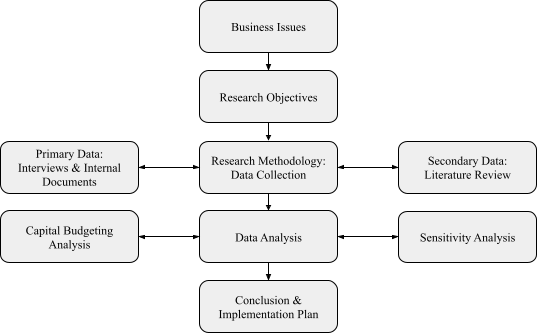
Figure 1: Research Framework


Sensitivity Analysis       

Sensitivity analysis is defined in a book titled Fundamentals of Corporate Finance Chapter 11 as follows: "Sensitivity analysis is a variation on scenario analysis that is useful in pinpointing the areas where forecasting risk is especially severe. The basic idea with sensitivity analysis is to freeze all of the variables except one and then see how sensitive our estimate of NPV is to changes in that one variable. Suppose our NPV estimate turns out to be very sensitive to relatively small changes in the projected value of some component of project cash flow. In that case, the forecasting risk associated with that variable is high [9].

MATERIALS AND METHODS

Research Design

In this thesis, the quantitative approach is mainly used to assess the development of Bank XYZ Syariah's mobile and internet banking project. The primary data sources are the data projections collected from the internal company document and interviews with the management of Bank XYZ Syariah. The secondary data sources are from academic books or journals related to financial management and the internet. After obtaining the data, the next step is to calculate based on the projections. The calculations will have resulted in capital budgeting indicators for the feasibility study and the acceptable range for     each     assumption      in      the     sensitivity     analysis.


Analysis Method

There are five capital budgeting financial indicators used in this study which are:


  • Net Present Value: The net present value (NPV) is found by subtracting a project’s initial investment from the present value of its cash inflows discounted at a rate equal to the firm’s cost of capital [3]

  • Internal Rate of Return: The internal rate of return (IRR) is the discount rate that equates the NPV of an investment opportunity with $0 (because the present value of cash inflows equals the initial investment). It is the rate of return that the firm will earn if it invests in the project and receives the given cash inflows [3]

  • Payback Period: The payback period is the amount of time required for a firm to recover its initial investment in a project as calculated from cash inflows. Although popular, the payback period is generally viewed as an unsophisticated capital budgeting technique because it does not explicitly consider the time value of money [3]

  • Discounted Payback Period: One of the shortcomings of the payback period rule was that it ignored time value. The discounted payback period is a variation of the payback period that fixes this particular problem. It is the length of time until the sum of the discounted cash flows is equal to the initial investment [9]

  • Profitability Index: The present value of an investment’s future cash flows divided by its initial cost [9]


As for the sensitivity analysis result, the study compares the pre-established hypothetical value with the hypothetical value of zero NPV. This study will calculate the size between the two values and shows it as a percentage. A small percentage of change indicates that the particular indicator is very sensitive, with small movements able to reduce NPV to zero or even negative.

FINDINGS AND ARGUMENT

This study will limit the revenue estimates based on two income   sources:   financing   margin  income  and treasury


Table 1: Feasibility Study Result 


2021

2022

2023

2024

2025

2026

Margin Revenue


34,515

49,534

109,380

293,245

539,082

Treasury Revenue


107

154

340

911

1,675

Gross Revenue


34,622

49,688

109,720

294,156

540,757

Operating Expense


(30,600)

(45,474)

(97,744)

(248,803)

(450,902)

Marketing Expense


(20,197)

(23,035)

(24,598)

(39,486)

(59,371)

EBITDA


(16,175)

(18,821)

(12,622)

5,867

30,485

Depreciation


(2,393)

(2,393)

(2,393)

(2,393)

(2,393)

Tax


0

0

(4,622)

(19,529)

(39,484)

Net Income


(18,568)

(21,214)

(19,637)

(16,055)

(11,392)

Depreciation

-

2,393

2,393

2,393

2,393

2,393

Initial Investment

(13,845)

-

-

-

-

-

Cash Flow

(13,845)

(7,486)

(2,873)

18,780

71,633

142,381

PVIF

1.0000

0.8758

0.7670

0.6718

0.5883

0.5153

PresentValue

(13,845)

(6,556)

(2,203)

12,616

42,144

73,364

NPV

Rp105,519.88

IRR

76.74%

Payback Period

3.08 years

Discounted Payback Period

3.24 years

Profitability Index

8.62 times


Table 2: Sensitivity Analysis Result

Sensitivity Rank


Variable


Standard

Sensitivity Analysis Result


Change


Absolute

Change

1

Beban Operasional terhadap Pendapatan Operasional (BOPO)

64.15%

81.17%


26.52%


26.52%

2

Effective Margin Rate

51.00%

21.00%

-58.81%

58.81%


3

Average balance from the new customers

Rp56.59


Rp20.07


-64.54%


64.54%


4

Financing-to-Deposit Ratio (FDR)


97.00%


33.58%


-65.38%


65.38%

5

Customer Engagement Cost per Cust (Mio)


Rp1.50

Rp4.92


228.05%


228.05%

6

Corporate Tax Rate

22.00%

88.44%

302.01%

302.01%

7

Marketing Fee Rate (Y3-Y5)

6.00%

25.74%

329.04%

329.04%

8

Beta

1.10

10.636

866.92%

866.92%

9

Marketing Fee Rate (Y1-Y2)

12.00%

131.53%

996.09%

996.09%

10

Inflation Rate

3.00%

-43.18%

-1539.25%

1539.25%

11

Operation Expense Annual Increase Rate

10.00%

284.71%

2747.09%

2747.09%

12

Customer Activation Cost per New Cust (Mio)

Rp0.10

Rp4.24

4135.91%

4135.91%

13

Corporate Lending Rate/SUN 5 years

5.13%

-964.71%

-18923.69 %

18923.69 %

CONCLUSION

The net present value (NPV) of Bank XYZ Syariah's mobile and internet banking project returns positive at Rp105,519,881,036, indicating that the project is feasible because the projected cash inflow is more than the projected cash outflow in the next five years. The calculation already includes the concept of the time value of money with a 14.18% discount rate. The internal rate of return (IRR) of Bank XYZ Syariah's mobile and internet banking project is 76.74%, far exceeding the project's 14.18% weighted average cost of capital. This calculation also indicates that the project's likelihood to be profitable is likely.


Based on the payback period indicator, the project is expected to achieve the breakeven point in 3 years and 28 days from the start of the investment period. By that time, the project will recover the investment value from the cash inflows potentially generated from the project. As for the discounted payback period indicator, the breakeven point of the project takes a bit longer in 3 years, two months, and 26 days from the start of the investment period. By that time, the project will recover the investment value from the cash inflows potentially generated from the project after considering the time value of money (TVM) concept.


Based on the profitability index ratio of the project, for every rupiah spent on the project, the potential return on investment is evaluated to be around 8.62 times. Since the ratio is greater than 1, the project is estimated to be profitable and should proceed. From the net profit margin indicators, the project shows negative results in the first two years after the project is launched at -22.81% and -8.02%, but will regain the positive result starting from the third year onwards at 11.24%, 18.25%, and 20.23%.


The sensitivity analysis shows that the most sensitive expense to the project is the BOPO ratio (Beban Operasional terhadap Pendapatan Operasional). This ratio is the most dominant expense, taking around 64.15% of the gross revenue. The ratio should not exceed 81.17%, which will reduce the project's NPV to negative. The current 51% effective margin rate is the second most sensitive metric to the project, as it will determine the revenue generated from the outstanding that the bank manages. Based on the sensitivity analysis, this indicator cannot go lower than 21.00%, which will reduce the project's NPV to negative.


The bank has to set the target to have an average balance of at least Rp20,065,126 from potential new customers as this is the third most sensitive indicator to the project. If the average balance from new customers is less than that, the project’s NPV might turn negative. The fourth most sensitive indicator is the financing-to-deposit ratio (FDR) which currently hovers at around 97%. It means that 97% of the outstanding will be distributed to financing activities. The change in FDR cannot go lower than 33.58%, in which the project's NPV will return negative.


To sum up, the mobile and internet banking project of Bank XYZ Syariah is feasible and predicted to be profitable under several assumptions established. The project should stay feasible if the BOPO ratio, effective margin rate, average balance from the new customers, and financing-to-deposit ratio stay within a specific range, as it will maintain the positive NPV result. Overall, the project is worth the investment because of the potential high profitability for the company in the long run.

REFERENCE
  1. Bank Indonesia. Inflation datahttps://www.bi.go.id /en/statistik/indikator/data-inflasi.aspx. Accessed 3 Dec. 2021.

  2. Bank Indonesia. Transaksi delivery channel periode 2021https://www.bi.go.id/id/statistik/ekonomi-keu angan/ssp /transaksi-delivery-channel.aspx. Accessed 29 Nov. 2021.

  3. Damodaran, Aswath. Country default spreads and risk premiums. 8 Jan. 2021, http://pages.stern.nyu.edu/~a damodar/New_ Home_Page/datafile/ctryprem.html. Accessed 2 Dec. 2021.

  4. Dayananda, Don, et al. Capital budgeting: financial appraisal of investment projects. Cambridge University Press, 2002.

  5. Gitman, Lawrence, and Chad Zutter. Principles of managerial finance. Pearson Education Limited, 2015.

  6. Kementerian Keuangan Republik Indonesia. UU 7 Tahun 2021. https://jdih.kemenkeu.go.id/download /a9faab97-aca7-4f87-9fdc-faa8123d1454/7TAHUN2021UU.pdf. Accessed 4 Dec. 2021.

  7. Kristof, Nicholas, and Sheryl WuDunn. "The women’s crusade." The New York Times, 17 Aug. 2009, https://www nytimes.com/ 2009/08/23/magazine/23 Women-t.html. Accessed 2 Oct. 2021.

  8. KSEI. Obligasi Negara Republik Indonesia Seri FR0090. https://www.ksei.co.id/services/registered-securities/government-bonds/lc/FR. Accessed 2 Dec. 2021.

  9. Naja, Hasanul. Modal inti Bank Syariah. Republika, 22 Sept. 2021, https://republika.co.id/berita/qzmc9p457/modal-inti-bank-syariah. Accessed 11 Dec. 2021.

  10. Osterwalder, Alexander, and Yves Pigneur. Business model generation. John Wiley & Sons, 2010.

  11. Ross, Stephen, Randolph Westerfield and Bradford Jordan. Fundamentals of corporate finance. The McGraw-Hill Companies, 2003.

  12. The World Bank. Individuals using the Internet (% of population) – Indonesiahttps://data.worldbank.org/indic ator/IT.NET.USER.ZS?locations=ID. Accessed 29 Nov. 2021.

  13. Yahoo Finance. PT Bank BTPN Syariah Tbk (BTPS.JK). https://finance.yahoo.com/quote/BTPS.JK/. Accessed 2 Dec. 2021.

  14. Backer, Gust. The Pirate Funnel. Business Growth Blog, 17 Aug. 2009, https://gustdebacker.com/pirate-funnel-aarrr-framework/. Accessed 10 Dec. 2021.

License
CC BY-NC-ND
Creative Commons Attribution-NonCommercial-NoDerivatives 4.0 International License
Capital Budgeting Analysis for Mobile Banking and Internet Banking of Bank Xyz Syariah © 2026 by Brian Yohanes Wiseso, Subiakto Soekarno licensed under CC BY-NC-ND 4.0
All papers should be submitted electronically. All submitted manuscripts must be original work that is not under submission at another journal or under consideration for publication in another form, such as a monograph or chapter of a book. Authors of submitted papers are obligated not to submit their paper for publication elsewhere until an editorial decision is rendered on their submission. Further, authors of accepted papers are prohibited from publishing the results in other publications that appear before the paper is published in the Journal unless they receive approval for doing so from the Editor-In-Chief.
Himalayan Journal of Economics and Business Management open access articles are licensed under a Creative Commons Attribution-Share A like 4.0 International License. This license lets the audience to give appropriate credit, provide a link to the license, and indicate if changes were made and if they remix, transform, or build upon the material, they must distribute contributions under the same license as the original.
Recommended Articles
Research Article
Influence of Leadership on Poverty Reduction in the Devolved Government in Trans-Nzoia County, Kenya
...
Published: 30/06/2021
Download PDF
Research Article
Modelling Structure Job Quality, Job Design and Job Satisfaction
...
Published: 30/08/2022
Download PDF
Research Article
Accountability and Transparency of Village Fund Management in Lumajang District
...
Published: 28/12/2023
Download PDF
Research Article
The Constitutional and Legislative Basis for Considering the Taxable Capacity of Taxpayers in Iraqi Tax Legislation
Published: 05/05/2025
Download PDF
Flowbite Logo
Najmal Complex,
Opposite Farwaniya,
Kuwait.
Email: support@himjournals.com

Useful Links
Order Hard Copy
Privacy policy
Terms and Conditions
Refund Policy
Others
About Us
Team Members
Contact Us
Online Payments
Join as Editor
Join as Reviewer
Subscribe to our Newsletter
Follow us
MOST SEARCHED KEYWORDS
scientific journal
 | 
business journal
 | 
medical journals
 | 
Scientific Journals
 | 
Academic Publisher
 | 
Peer-reviewed Journals
 | 
Open Access Journals
 | 
Impact Factor
 | 
Indexing Services
 | 
Journal Citation Reports
 | 
Publication Process
 | 
Impact factor of journals
 | 
Finding reputable journals for publication
 | 
Submitting a manuscript for publication
 | 
Copyright and licensing of published papers
 | 
Writing an abstract for a research paper
 | 
Manuscript formatting guidelines
 | 
Promoting published research
 | 
Publication in high-impact journals
Copyright © Himalayan Journals . All Rights Reserved.