In Nigeria, the movement-restriction policies, associated with COVID-19 outbreak, disrupted container freight transportation/logistics, particularly on last mile corridors between seaports and hinterland markets. The study compared transportation costs of Twenty-Foot-Equivalent-Units (TEU), on last mile corridors between Onne seaport and the hinterland markets in Aba, Onitsha, Port-Harcourt City, Uyo, Makurdi, Jos, Abuja and Kano; with a view to determining the significances of the increase in TEU container freight transportation costs, via the last mile corridors to the hinterland markets. It also determined the level of disruption to container trade flow and supply chain operations on last mile corridors, between the seaport and hinterland markets. It employed survey method, using questionnaire as survey instrument to collect primary data for pre COVID-19 and in COVID-19 periods. The difference of means model and the paired sample t-test, were used to analyzed the data obtained. It was found that, the outbreak of the COVID-19 pandemic led to significant increases in TEU transportation costs, on all the corridors. The outbreak of the COVID-19 pandemic also caused a significant decline in, and disruption of container trade flow from the seaport, to the major hinterland markets. Post COVID-19 economic recovery measures must consider the inflationary influence of the increased TEU transportation costs on last mile corridors.
The ‘last mile’ is a concept, used to denote the transportation of goods on the last leg of the delivery process to the consignee’s /shipper’s warehouse, destination market, depot and customer’s store, from hub-distribution center, seaport and/or central distribution point and/or origin. Chen and Srai [1] opine that the last mile denotes the final leg of the complete journey, before goods reach the customer from the port and/place of origin. Aized and Srai [2] view it, as the linkage between the distribution system at the hub terminal and a hinterland market and/or customers’ warehouse/store.
Though freight forwarders, shippers, container-freight-operators, have over the years faced numerous challenges with last mile deliveries, as consignments are moved from the seaports to the hinterland markets and consignees warehouses; such challenges which include but not limited to frequent accidents induced by poor conditions of roads infrastructure along the last mile corridors, high insurance cost, increased Twenty-Foot-Equivalent-Units (TEU) transportation cost leading to inflation, delay and distortion of logistics and supply chain network, etc. Thus, service quality to shippers on last mile freight corridors as import goods leaves the seaports to hinterland markets are generally poor.
It is important to note that the performance of container trade delivery process via last mile corridors, as cargoes leave the hub-ports is vital, and pre-informs stakeholders of the likely performance outcomes of the container logistics and supply operations, directly involved in shipping export and import trade [3]. The performance of the logistics and supply operations involved in shipping export and import trade, have impacts on the overall economic performance of the various sectors of the economy; since all aspects of the economy hinges on one form of either export or import trade, for optimal economic performance and sustenance. Moreover, last mile deliveries of finished goods from seaports to hinterland markets have direct thrust, on the availability and accessibility of such goods in the local marketplaces, as well as market prices. As a result, it has capacity to significantly influence inflation, scarcity and competition for access to goods by consumers [4-5]. Utility and consumer satisfaction is derailed at the end, when the last mile delivery processes are disrupted, and the performance of the last mile delivery operations is poor, while service quality is low [6]. The importance of last mile operations necessitates the need for structuring of the operations and management of last mile delivery corridors and activities to achieve faster times of goods delivery to hinterland markets from hub seaports, to reduce haulage cost, reduce accident risks and the associated high insurance costs, improve service quality and maximize utility derivable from last mile operations
In Nigeria for example, seaborne import trade mostly from Asia, Europe and the Americas arrive at the hub ports, situated in Lagos, Port-Harcourt, Onne, Warri and Calabar; from where it transits via the last mile corridors, to the hinterland markets in different regions of the Country, for delivery to the consignees. For instance, the Onne Port which is host to the West African Container Terminal (WACT) and a hub-port, serving the logistics needs of shippers in the hinterland markets, in the regional blocks; prior to the outbreak of the covid-19 pandemic, was faced with accessibility challenges occasioned by the deplorable roads and traffic congestion problems on the last mile corridors.
The outbreak of the covid-19 pandemic is however believed to have seriously disrupted container logistics and supply chain operations, from the hub ports, to the hinterland markets. This is evidenced in the high prices of commodities in the local markets induced by inflation. Report by the Nigerian shippers’ Council show that the ocean carriers responsible for the sea leg of the journey from major import destinations, to Nigeria, increased the TEU ocean freight rates, following the outbreak of the covid-19 pandemic and the associated disruption of global supply chain operations. On the last mile corridors, container freight (Twenty Foot Equivalent, (TEU) transportation costs, from hub seaports to hinterland markets, in Nigeria seem to have also increased significantly. Thus it is viewed that, the increase in TEU transportation costs on last mile corridors, is as a result of the disruption of container logistics and supply chain operations, which has led to decline in demand for freight transportation, from hub ports, via last mile corridors, to the hinterland markets, following the outbreak of the COVID-19 pandemic. For example, survey revealed that the major last mile corridors served by major road freight operators in the Onne seaport zone, witnessed increased TEU transportation cost during the COVID-19 lockdown and currently.
Freight forwarders and haulage operators argue that, the increase in TEU transportation cost on last mile orridors became necessary, following the impact of the COVID-19 pandemic, which led to disruption of global logistics and supply chain networks, leading to decline in demand for freight transport, from hub seaports, via last mile corridors, to hinter markets; coupled with the seeming inability of Government to consider haulage operators and freight forwarders in the post COVID-19 economic recovery plans.
To address the price inflation effects caused by COVID-19 induced increase in TEU transportation costs, on consumer goods, and to capture the freight forwarders and container freight operators, operating on the last mile corridors, in the post COVID-19 economic recovery plan; there is serious need for empirical evidences on the level of significance of the increment in TEU transportation costs, to hinterland markets on the last mile corridors, associated with COVID-19 outbreak. This can be achieved by comparing the pre COVID-19 and in COVID-19 TEU transportation costs, along the last mile routes. The level and significance of the decline in demand for TEU freight transportation on the corridors, can equally serve as empirical evidences, of the level of disruption to logistics and supply networks, between hub seaports and last miles corridors, to hinterland markets. In line with the above, the main aim which this study is set to achieve is to, determine the effect of covid-19, on TEU transportation costs, following the disruption of logistics and supply chain operations, between hub seaports and hinterland markets, as basis for mitigation of cost push inflation in the prices of consumer goods, in the domestic markets; using Onne seaport as case study.
The specific objectives of the study include:
To measure the difference in TEU transportation cost from Onne seaport to major hinterland markets, in the pre COVID-19 and COVID-19 era.
To determine the level of disruption in demand for TEU freight transportation from Onne seaport via last mile corridors to hinterland markets in Nigeria, following the outbreak of COVID-19.
These will serve the need for empirical information needed in planning the economic recovery of the transport, logistics and supply chain sector, as well as the overall domestic economy, from the impacts of COVID-19. See figure1 below for the last mile corridors and hinterland markets in various regions served by Onne seaport, considered in the study.
Literature Review
covid-19 and The Disruption of Transport and Container Supply Chain Operations On Last Mile Corridors: As aforementioned, the last mile is the final leg in a journey consisting of multiple legs (more than one leg), and in most cases may involve multi modes (multi modal), in the delivery consignment to the recipient, at a predetermined destination point, market and/or warehouse [7]. The last mile movement is a multimodal transport system represents the transport mode by which the final delivery of the consignment to the shipper and/or consignee was made possible [8]. The efficiency and effectiveness of last mile transportations operations influences the performance of the logistics and supply chain of market commodities, industrial goods, raw material and economic stability of major sectors, as costs, prices, availability and accessibility to goods, materials and services, among other things, are influenced by the operational efficiency and effectiveness of the last mile delivery services[9-11].
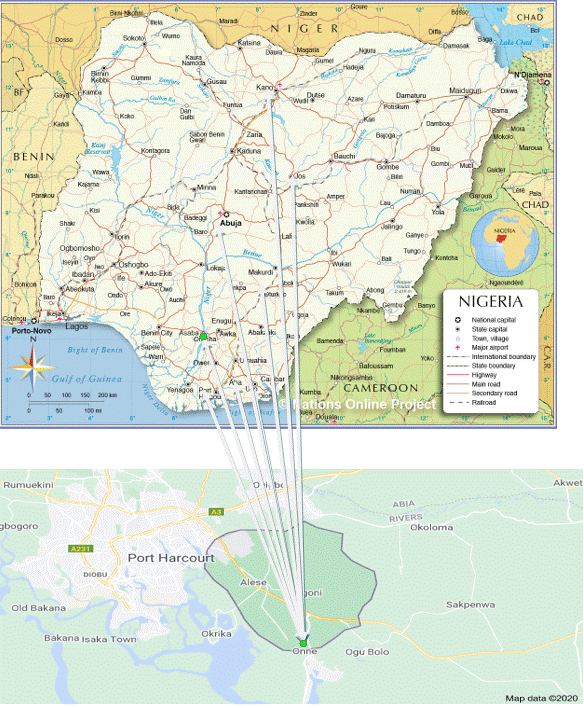
Figure1: Major Last mile road corridors to hinterland markets from Onne seaport Nigeria
Source: Modified/prepared by author from existing map of Nations online project and satellite map of Onne seaport
For example, previous studies in the pre covid-19 era estimates that expenditure on product distribution alone contributes between 10 to 20 precent of the actual costs of goods in local markets [12-13] however note that, the last mile contributes an estimated 28 percent to 30 percent of the total distribution costs of goods. The importance of the last mile is such that, without it, it is impossible that the consignment can reach the shippers warehouses in the destination markets, thus the original objective of the transport operation cannot be achieved. Notwithstanding, the last mile remains the least efficient leg in the supply chain network in Nigeria and most developing Countries in Africa.
The outbreak of the covid-19 pandemic led to serious disruption in global supply chain operations. It also seriously disrupted the operations in the local transport, logistics and supply chain sector, including TEU delivery operations from hub seaports to hinterland markets in Nigeria. Though several studies carried out in recent time examined the impact of the covid-19 outbreak on the transport, logistics and a supply chain sector. For example, Mogaji [14] explored the impact of COVID-19 on transportation in Lagos, Nigeria. The study note that, the restrictions to movement and ban on inter and intra state travels occasioned by the outbreak of COVID-19 created economic hardship, accessibility challenges, inflation, etc., among the numerous population living in Lagos. Mogaji [14] notes that the closure of businesses in Lagos created including banking institution, created enormous financial challenges among business owners, such that, the consequences of the challenges may not be sufficiently overcame by small businesses, in the post covid-19, with a Government instituted recovery and support plan, which should aim at resuscitating the economy of Lagos. Similarly, Alade [15] observes that, there was a positive correlation between transportation affected by the pandemic and its impact on economic, social and religious activities of the people. Alade [15] notes that the pandemic made impossible residents to travel nor engage in economic activities, as it notes that, there was significant increase in transportation fare, accessibility and traffic congestion challenges in most Cities.
Andam et al. [16] estimated the economic cost of COVID-19 in Nigeria. The study adopted simulations, using a multiplier model based on the 2018 Social Accounting Matrix (SAM) for Nigeria, which includes supply-use tables for 284 goods and services to estimate the economic cost of COVID-19 in Nigeria. It estimated that, during the lockdown periods, Nigeria’s GDP suffered a 34.1 percent loss due to COVID-19, amounting to USD 16 billion, with two-thirds of the losses coming from the services sector [16]. The agriculture was estimated to have suffered about 13.1 percent loss, amounting to output losses of about USD 1.2 billion. According to Andam et al. [16], households lost an average 33 percent of their incomes during the period, with rural households and economies accounting for the heaviest losses occurring during the period. The study notes that about 27 million more Nigerians fell below poverty line as a result of the COVID-19 lockdown, thus increasing the Nigeria poverty headcount by 14 percent. The study underscores the importance of developing adequate empirical data on the impacts of the COVID-19 pursuant to design of a policy framework for planning the recovery of the economy in the post COVID-19 [16]. A survey carried out by Peoples Republic of Bangladesh Port Authority on the impacts of the COVID-19 on port operations and logistics indicates that the average cost of port operation in most ports increased following the extra cost of risk assessment, mitigation and measures put in place to curtail the spread of the pandemic in the industry. The disruption of the crew changing and crew transfer procedures as a result of the pandemic has equally altered onboard work schedules and plans, leading to extra crew changeover costs. It is believed that, these extra costs are at the end of the day transferred to the final consumers of imported commodities in terms of high prices and inflation in the economy.
In the air freight and aviation sub-sector, the International Air Transport Association in August 2020 [17], notes that the impacts of the COVID-19 pandemic in the aviation sector in Africa worsened between April and August 13, 2020; such that, job losses in aviation and related industries increased by up to 3.5 million, which is above half of the region’s 6.2 million aviation-related employment and 400,000 more than the previous estimate. IATA [17] report notes that the full-year 2020 air traffic is expected to plummet by 54% (more than 80 million passenger journeys) compared to 2019.it further estimates that the aviation sector contribution to the GDP of African Countries may decline by up to $35 billion against previous estimated $28 billion decline [17]. The increased cost of air travels caused by COVID-19 outbreak and restrictions on domestics and international air travels has serious consequences for the African aviation economy. IATA [17] opines that restarting African Countries with a view to minimizing COVID-19 impacts on jobs and economy will require accelerated recovery of the aviation sector through government action, by harmonizing the restart of air transport in Africa using International Civil Aviation Organization (ICAO) Council’s Aviation Recovery Task Force (CART) Take-off guidance. A second approach will require the continual stepping up of financial and regulatory support, in form of financial relief--that does not increase industry debt levels--through direct cash injections, credit or loans and deferrals or discounts on user charges are essential to support airlines over the restart and recovery period [17].
Abiodun notes that in the maritime transport and port logistics sector, multinational shipping companies in order to recover from rising cost of operations associated with COVID-19 disruptions of the global maritime logistics and supply chain operations, has continued to increase freight and surcharges on Nigeria bound cargo, particularly Peak Season Surcharge (PSS). The intervention of the Nigerian Shippers Council is however believed to have forced the shipping companies to reduce the surcharges which are believed to be 100 percent higher than it was in the preceding years. Adepoju [18] also notes that , following the outbreak of the pandemic and the consequent disruption of the supply chain operations, 57% of firms experienced elongated lead times, with average lead times doubling in most cases, from previous year values. The manufacturing sector was found to have operated at between 50% and 56% of installed capacity, a situation which led to scarcity of many household commodities and goods [18].
It is clear that while some studies provide empirical evidences and literatures on the impacts of the COVID-19 pandemic on sub-sectors of the transport sector such as the aviation, the ocean shipping sector, the road passenger, etc.; pursuant to development of an economic recovery policy, as seen aforementioned literatures; there seems to be lacking, empirical evidence on the level of decline and disruption of logistics and supply chain operations in last mile corridors between hub seaports and hinterland markets. The extra cost of TEU transportation from hub ports to hinterland markets associated with the COVID-19 pandemic need to be evaluated as basis for planning the recovery of both shippers and freight forwarders operating on the last mile corridors, in Nigeria. This forms the knowledge gap, which the study aims to address pursuant to developing a post COVID-19 economic recovery plan that, is based on empirical data of the impacts of the pandemic on the all the major sectors of the economy, that includes the last mile transport corridors between seaports and hinterland markets in Nigeria.
In order to assess the impact of COVID-19 on last mile TEU freight transportation cost between hub seaports and hinterland markets, and to determine the quantum of decline in demand for freight transportation from hub ports to hinterland markets occasioned by the disruption of supply chain operations in last mile transport corridors, between seaports and hinterland markets in Nigeria, the study adopted a survey method, in the Onne seaport and the main hinterland markets, in major Cities, and regions was used as case the case study. Questionnaire was used as the instrument of the survey, administered to the haulage operators, operating from Onne seaport as base, to the hinterland markets in Onitsha, Aba, Uyo, Kano, Markudi, Jos, Abuja and Port-Harcourt City. The questions were calibrated to elicit the responses of haulage operators the transportation cost of delivering per TEU of freight from the Onne to each hinterland Cities/markets, in the pre COVID-19 and COVID-19 era as well as the level of level of disruption in container supply chain operations, measured by the level of decline in demand for TEU delivery from Onne seaport to the hinterland markets during the COVID-19 pandemic. The questionnaire was administered randomly to the haulage operators under the Nigeria Road Transport Owners Association (NRTOA), Onne seaport branch.
To determine the sample size, we used the Yarmanyaro formula for a definite population given that the Onne branch of the NRTOA constitute of about 2,650 haulage operators operating multiple haulage trucks on the various last mile corridors.
Thus we will thus use Taro Yamane formula used in Hamed for calculating sample size for a known population with 95% level of confidence and 5% (0.05) margin of error and a population of about 2,650 haulage operators, operating multiple road trucks on the various corridors . According to Yamane, sample size (n) is given as:
![]()
(1)
Where :
N: sample size required for the survey
N: the population size
E: margin error (%)
Based on the formula the survey will be conducted with approximately 378 operators were sampled. The study used purposeful random sampling method in which, 47 operators were selected from each of the eight major last mile corridors, used in the study. However, only about 250 respondents, constituting about 70% of the operators sampled, correctly filled and returned the questionnaires.
We employed statistical comparative tools consisting of the gap analysis and the independent sample t-test, to analyze the data; pursuant to determining the gap ( increase or decrease) in TEU transportation cost from the seaport to each hinterland market; as well as disruption in supply chain operations on last mile corridors between hub ports and hinterland markets. The SPSS version 20 analytical software was used in carrying out the analysis.
The table shows that, the average cost of TEU transportation from the port to Onitsha hinterland markets is approximately 196,000 and 250,000 in the pre COVID-19 and COVID-19 periods respectively. It shows a mean difference of -53.20000, indicating that, the disruption of supply chain operations on last mile corridors by COVID19 forced TEU transportation cost from Onne seaport to the Onitsha hinterland markets to increase by approximately 53,000 naira, during COVID-19 period. The mean differences of the TEU transportation cost on last mile corridors from Onne seaport to hinterland markets in Aba, Uyo, Port-Harcourt City and Markudi are -15.83333, -30.00, -20.33333 and -70.00000 respectively. The implies that, The cost of transportation per TEU of freight from Onne seaport through each of the last mile corridors to the hinterland markets in Aba, Uyo, Port-Harcourt City, and Markudi, during the COVID-19 lockdown increased by 15,000.00 naira, 30,000 naira, 20,000 and 70,000 naira respectively. The result also reveal that, the cost of transportation of per TEU from Onne seaport to hinterland markets in Jos, Abuja and Kano increased by 50,000 naira, 50,000 naira and 100,000 naira respectively. Thus in all the port –to-hinterland last mile corridors considered in the study, the disruption of the container logistics and supply chain operations occasioned by the outbreak of the COVID-19 pandemic increased TEU transportation cost. The result further reveals that, TEU transportation cost on last mile corridors from the port to hinterland markets in Onitsha, Aba, Uyo, Port-Harcourt, Markudi, Jos, Abuja,and Kano increased by 27.10%, 11.8%, 20%, 25%, 14.6%, 8.33%, 10% and 14.3% respectively. The significances of the increase in TEU transportation cost on last mile corridors is examined in Table 2 below.
The test of hypotheses shows that, for all the last mile corridors sampled in the study, the p-value are less than 0.05; i.e. 0.000<0.05, we reject the null hypotheses to accept the alternate hypotheses that; the cost of transporting per TEU of freight from the port to the hinterland markets significantly increased, following the outbreak of the COVID-19 pandemic which disrupted global supply chain operations. The implication is that is that on domestic consumption is that, purchases power of the local population will decline as the increase in transportation/delivery cost is past onto market prices, causes inflation. Thus, to post COVID-19 inflation reduction policies should duly consider the influence of last mile transportation costs on markets goods and aim reverse it.
Table1: Difference/ Gap in TEU Transportation Cost from Onne Seaport to Hinterland Markets in Pre COVID-19 and COVID-19 periods
Last mile corridor | Variables | Mean | Mean Difference | N | Std. Deviation |
Onne - Onitsha | 196.3333 | -53.20000 | 32 | 5.07416 | |
249.5333 |
| 32 | 5.03596 | ||
Onne - Aba | 134.1667 | -15.83333 | 32 | 3.73320 | |
150.0000 | 32 | 3.93919 | |||
Onne – Uyo
| 150.0000 | -30.00000 | 30 | 3.71391 | |
180.0000 | 30 | 4.91304 | |||
Seaport – PH City | 79.6667 100.0000 | -20.33333 | 32 | 4.35494 | |
32 | 6.55656 | ||||
Seaport - Markudi | 480.0000 | -70.00000 | 30 | 15.31283 | |
550.0000 | 30 | 10.17095 | |||
Seaport - Jos | 600.0000 | -50.00000 | 32 | 13.39068 | |
650.0000 | 32 | 10.50451 | |||
- | |||||
Onne seaport - Abuja | 500.0000 | -50.00000 | 32 | 12.31764 | |
550.0000 | 32 | 7.42781 | |||
- | - | - | |||
Onne seaport - Kano | 700.0000 | -100.00000 | 30 | 12.31764 | |
800.0000 | 30 | 13.39068 | |||
Source: Authors calaculation
Table3: Measuring the Significance of the Increase in TEU Transportation Cost between Onne Seaport and Hinterland Markets
| Last mile corridor(s) | t-score | df | p-value | Sig. (p<0.05) | Decision |
Onne - | Onitsha | -39.417 | 31 | .000 | Yes | Reject null hypothesis |
Onne - | Aba | -17.006 | 31 | .000 | Yes | Reject |
Onne - | Uyo | -24.542 | 29 | .000 | Yes | Reject |
Onne - | Port-Harcourt City | -13.257 | 31 | .000 | Yes | Reject |
Onne - | Markudi | -21.07 | 29 | .000 | Yes | Reject |
Onne - | Jos | -16.091 | 31 | .000 | Yes | Reject |
Onne - | Abuja | -18.435 | 31 | .000 | Yes | Reject |
Onne - | Kano | -65.870 | 29 | .000 | Yes | Reject |
Source: Authors calculation
Table2: Determining the Level of Disruption in Container Supply Chain Operations between Onne seaport and Hinterland Markets
| Mean | N | Std. Deviation | Std. Error Mean | |
Pair 1 | Precoviddemand | 8.7692 | 250 | 1.01274 | 0.28088 |
Postcoviddemand | 4.0100 | 250 | 2.01030 | 0.30050 | |
| Paired Differences | ||||
Mean | Std. Deviation | Std. Error Mean | 95% Confidence Interval of the Difference | ||
Lower | |||||
Pair 1 | Precoviddemand | 4.76923 | 1.01274 | .28088 | 4.15724 |
Source: Author’s calculation
The result indicates that prior to the outbreak of the COVID-19 pandemic, each container freight haulage operator secure contract to deliver an average of 8.76 containers, approximately 9.0, TEUs per month, to various hinterland markets, from Onne seaports. Similarly, the result also shows that, following the outbreak of the pandemic and lockdown policies and other restrictions to movement imposed by Government to control the spread of the epidemic, the demand for the delivery of container freight through to the hinterland markets secured by each operator in the port declined to approximately 4.0TEUs per month. The difference of means is 4.76, with a standard deviation of 1.0127; implying that, the COVID-19 outbreak and the associated restrictions and disruption of trade flows and supply chain operations caused a decline in of about 52.2% in container trade flows from the seaport to hinterland markets through the last mile corridors. By implication, the freight forwarders and haulage operators providing haulage services to hinterland markets via Onne port lost 52.2% of the trade along the corridors to as a result of the disruptions caused by COVID-19 outbreak and the associated movement restriction policies. This has certainly has serious implications on the revenue earnings of the operators and the economic survival of their businesses. This possibly motivated the increase in transportation cost on the last mile corridors. The implications of this disruption supply chain operations and decline in demand for container freight haulage on the last mile corridors on the revenue of the operators is such that, assuming a proportionate loss for all operators, each operator on Onne-to-Aba service corridor for example, lost an average of 629,000 naira per month as a result of the COVID-19 and the associated movement restriction policies and disruptions of supply chain operations. The implications on Government tax revenues are also enormous, since government tax revenues are based on personal income of individuals. It equally has implications on employment and job losses in the local economy. The significance of the level of disruption and decline in container logistics and supply chain operations on last mile corridors is assessed in Table 4 below.
Table4: Significance of The Disruption and Decline in Demand for TEU Transportation Between Onne Seaport and Hinterland Markets
| All Last Mile Corridors | T | Df | P-Value | Sig. (P<0.05) | Decision |
Pair 1 | Precoviddemand - Postcoviddemand | 16.979 | 238 | 0.000 | Yes | Reject |
Source: Authors calculation
The result of the test of hypothesis shows that the p-value is less than the alpha value. i.e, 0.00<0.05. Thus, we reject the null hypothesis and conclude that, the outbreak of the COVID-19 caused a significant decline/disruption in TEU trade flow between hub seaports and hinterland markets in Nigeria.

The outbreak of the COVID-19 pandemic and the associated restrictions to movement and lockdown strategies caused serious disruptions in container trade logistics and supply chains on last mile corridors between Onne seaport and hinterland markets in Nigeria. It caused an aggregate decline in container supply chain operations on the last mile corridors of about 52.2%. These disruptions led to increased TEU transportation cost to hinterland markets in Onitsha, Aba, Uyo, Port-Harcourt, Markudi, Jos, Abuja,and Kano by 27.10%, 11.8%, 20%, 25%, 14.6%, 8.33%, 10% and 14.3% respectively. This has direct influence on inflation in the prices of market commodities in major markets across the major markets in Nigeria. The national COVID-19 economic recovery policies should integrate the impacts of COVID-19 on the transportation sector; it should particularly emphasize the impact on container supply chain operations on last mile corridors. By implication, inflation control policies in the post COVID-19 should consider the influence of transportation cost, particularly, transportation cost on last mile corridors.
Alade B. "Fare hike, traffic congestion mar transportation in Lagos." Opinion in the Guardian Newspaper, 2020. http://www.guardiannewspaper.org
Aized T. and Srai J.S. "Hierarchical modelling of last mile logistic distribution system." The International Journal of Advanced Manufacturing Technology, vol. 70, no. 5, 2014, pp. 1053–1061. http://dx.doi.org/10.1007/S00170-013-5349-3
Andam K. et al. "Estimating the economic costs of COVID-19 in Nigeria." Strategy Support Program Working Paper, 2020.
Adepoju B. "Impacts of COVID-19 on supply chain operations in Nigeria." International Journal of Business and Management Invention, vol. 9, no. 4, 2020, pp. 43–52.
Battini D. et al. "Application of humanitarian last mile distribution model." Journal of Humanitarian Logistics and Supply Chain Management, vol. 4, no. 1, 2014, pp. 131–148. http://dx.doi.org/10.1108/JHLSCM-01-2013-0001
Boyer K. et al. "The last mile challenge: evaluating the effects of customer density and delivery window patterns." Journal of Business Logistics, vol. 30, no. 1, 2009, pp. 185–201. https://doi-org.uplib.idm.oclc. org/10.1002/j.2158-1592.2009.tb00104
Bushuev M. and Guiffrida A. "Optimal position of supply chain delivery window: concepts and general conditions." International Journal of Production Economics, vol. 137, no. 2, 2012, pp. 226–234. https://doi-org.uplib.idm. oclc.org/10.1016/j.ijpe.2012.01.039
Chen C. and Srai P. "Using the crowd of taxis to last mile delivery in e-commerce: a methodological research." Service Orientation in Colonic and Multi-Agent Manufacturing, vol. 640, 2016, pp. 61–70. https://doi. org/10.1007/978-3-319-30337-6_6
De Souza R. et al. "Collaborative urban logistics – synchronizing the last mile a Singapore research perspective." Procedia - Social and Behavioral Sciences, vol. 125, 2014, pp. 422–431. https://doi.org/ 10.1016/j.sbspro.2014.01.1485
Eremosele A. "Nigeria: Government tackles shipping companies over outrageous surcharges." 2020. http://www.allafrica.com
Gevaers R. et al. "Cost modeling and simulation of last-mile characteristics in an innovative B2C supply chain environment with implications on urban areas and cities." Procedia - Social and Behavioral Sciences, vol. 125, 2014, pp. 398–411. https://doi.org/10.1016/j.sbspro.2014. 01.1483
Grasas A. and Ramalhinho H. "Teaching distribution planning: a problem-based learning approach." The International Journal of Logistics Management, vol. 27, no. 2, 2016, pp. 377–394. https://doi.org/10.1108/IJLM-05-2014-0075
Hübner A. et al. "Last mile fulfilment and distribution in omni-channel grocery retailing: a strategic planning framework." International Journal of Retail & Distribution Management, vol. 44, no. 3, 2016, pp. 228–247. https://doi.org/10.1108/IJRDM-11-2014-0154
International Air Transport Association. "Impact of Covid-19 on African aviation and economies is worsening.", 2020. V
Minguela-Rata B. and De Leeuw S. "Managing the last mile of the supply chain for spare parts." Universia Business Review, no. 39, 2013, pp. 104–117.
Mogaji E. "Impact of COVID-19 on transportation in Lagos Nigeria." Transportation Research Interdisciplinary Perspectives, vol. 6, 2020, p. 100154.
Schmidt M. "Amazon's going the 'last mile'." Quality Progress, vol. 47, no. 6, 2014, pp. 10–11.
Talonen T. and Hakkarainen K. "Elements of sustainable business models." International Journal of Innovation Science, vol. 6, no. 1, 2014, pp. 43–54. https://doi.org/10.1260/1757-2223.6.1.43
Wang Y. et al. "Towards enhancing the last-mile delivery: an effective crowd-tasking model with scalable solutions." Transportation Research Part E: Logistics and Transportation Review, vol. 93, 2016, pp. 279–293. https://doi-org.uplib.idm.oclc.org/10.1016/j.tre.2016.06.002
Wu H. et al. "Locating self-collection points for last-mile logistics using public transport data." Advances in Knowledge Discovery and Data Mining, vol. 9077, 2015, pp. 498–510.