In order to compete due to the implementation of QRIS, digital wallets in Indonesia are racing to add values for their merchants and customers. One segment that is not tapped on to is loyalty where it enables merchants to retain their customers and users to re-purchase at their preferred store. However, many merchants don't have enough knowledge on building loyalty strategies. On the other hand, customers who already have good knowledge on loyalty programs, received lack of engagements from the merchants. In this study, authors analyze the phenomenon using external and internal analysis with a case study of DANA Loyalty. The research is done through quantitative methods by spreading questionnaires to respondents. In addition, a qualitative method was added through in depth interviews with business owners regarding their challenges on implementing loyalty strategy. The results show that there is market potential in creating loyalty programs for the FnB category as it is one of the most attractive programs for users, while merchants require a platform for them to explore and automate their loyalty program. The proposed strategy is analyzed using several frameworks, resulting in the innovation of Business Model Canvas where the value propositions will be creating a seamless loyalty platform for users and merchants, a new revenue stream for platform fees, and new customer channel of community engagement for merchants. The strategy can be achieved by delivering products in iteration, increasing brand awareness, research on technology, and doing market expansion.
Keywords
Digital Wallet
Loyalty Platform
INTRODUCTION
The internet has become a public infrastructure that connects millions of people worldwide, giving access to streams of information that is adapted to many use cases such as ecommerce, social media, education, into payment and finance. The finance sectors (popularly known as fintech,- stands for financial technology) are the sectors that utilize digital technology to improve financial services, providing easier and more efficient facilities to society [1]. They do this by adopting many technologies such as mobile applications, artificial intelligence and blockchain that enables them to become faster and more secure compared to traditional financial institutions. The fintech industry in Southeast Asia is the fastest-growing sector with a compound annual growth rate of 70% from 2015 to 2020. Ranging from digital banking, lending, and most importantly digital wallets, fintech becomes widely recognized as more people rely on online transactions for their daily financial needs.
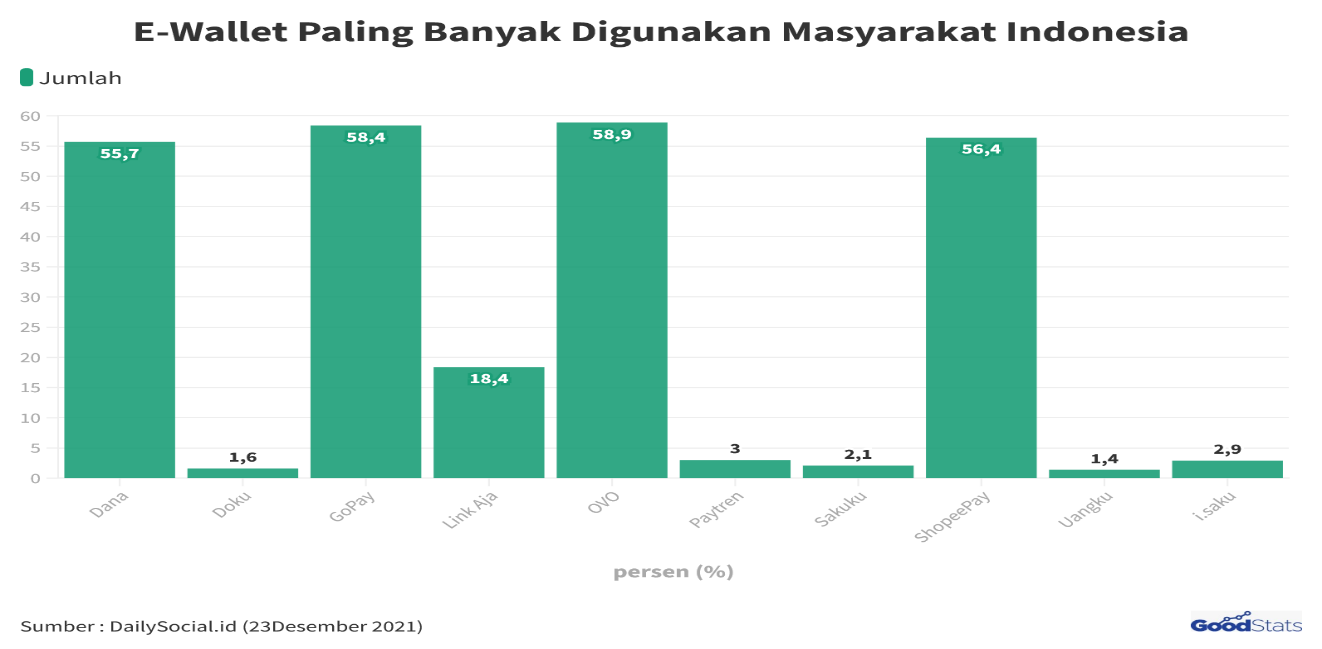
The growth of digital wallets in Indonesia are deemed to be booming significantly. The four most popular wallets in Indonesia are Gopay, OVO, DANA and Shopeepay. As stated by the research from Katadata [2], 26% of the respondents are using digital wallets once a month while another 22% are using them more than once a month. The competition becomes very fierce in this sector, as the well-known wallet in the mentioned above has already strengthened their market positioning.
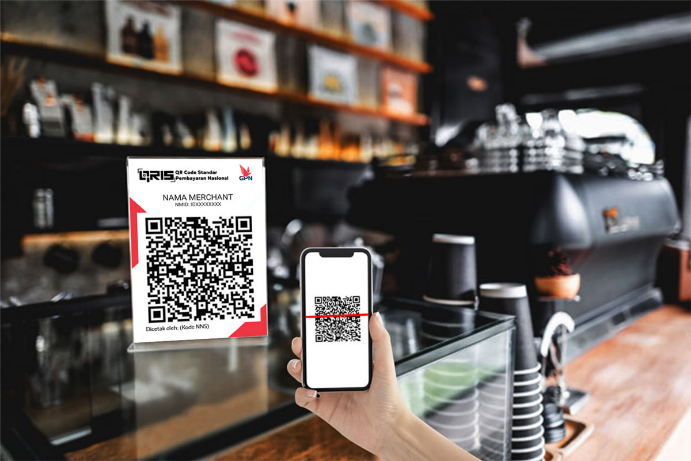
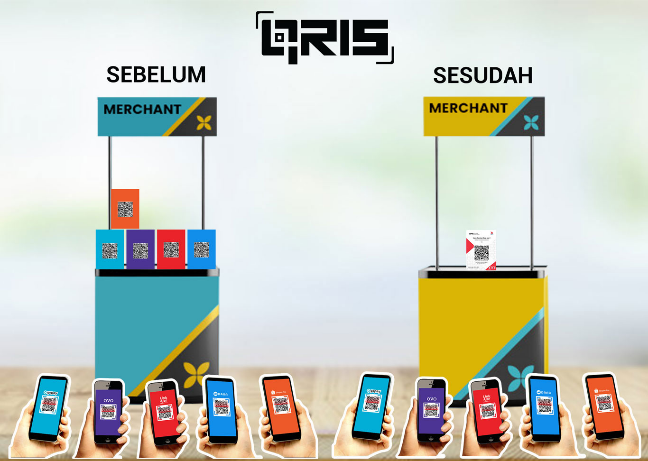
It becomes tougher for the competition of digital wallet as Indonesia implemented QRIS (Quick Response code Indonesian Standard). The standard was launched by the central bank of Indonesia in the year of 2019 to promote cashless payments and enable digital financial literacy in the nation. With QRIS, all payments from any banks, wallet or any digital payment providers can be processed so that merchants will only need 1 single QR printed on their stands. This initiative is welcomed by many as it is seen as a breakthrough in the digital payment movement in the country. However, the competitive advantage that used to be had by digital wallets are greatly reduced. The barrier of entrance to digital payments seems to be easier, causing many banks to develop QR payments and creating a fierce competition between banks and digital wallets to promote their use of applications.
Figure 1: Most Popular eWallet in Indonesia
Source: Dailysocial, 2021
Figure 2: QRIS in Indonesia
Source: QRIS homepage, 2023
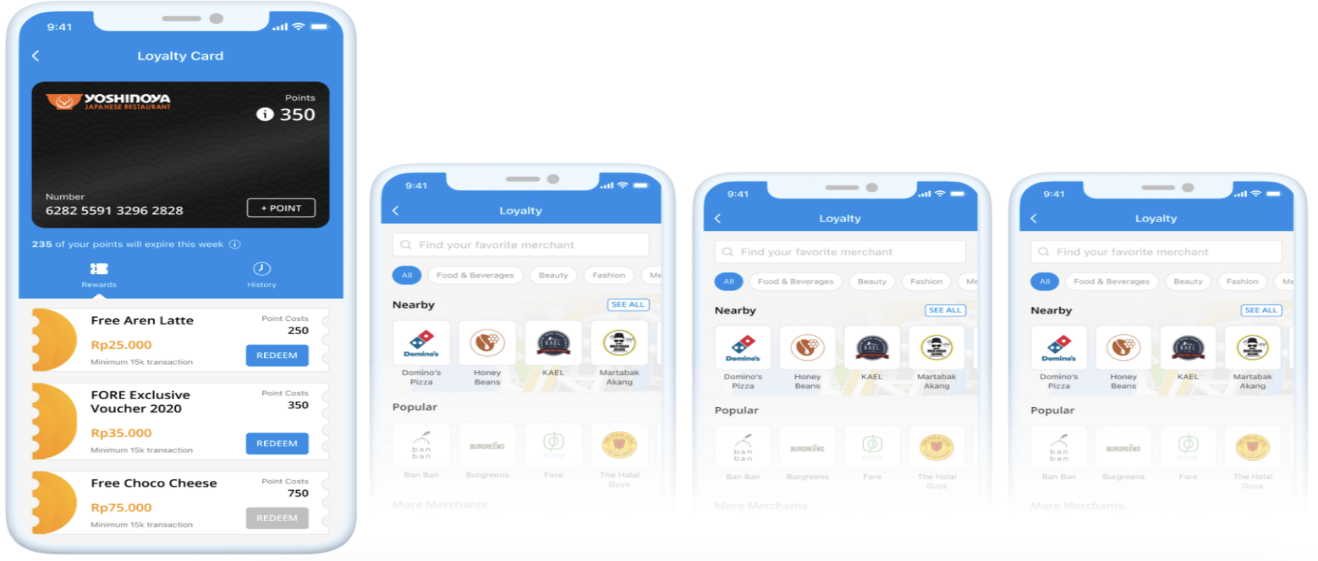
Figure 3: DANA Loyalty
Source: Company Website, 2023
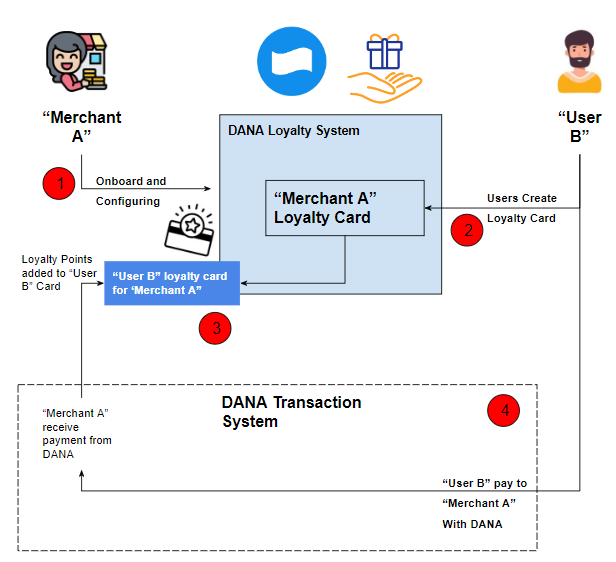
Figure 4: Business Flow of DANA loyalty
Source: Internal Observation, 2023
With the rising popularity of QRIS implementation in many applications, each digital wallet then pursues their own competitive advantage in order to compete in the market. Gopay, as an exclusive payment inside Gojek the giant ride hailing, has a great advantage. With a complete service from ordering online transportations to food available on the app, Gopay becomes the primary payment platform that sticks to their customers. OVO, on the other hand, offers many incentives to the SMEs by offering financial services such as investment, insurance and financing (loan). ShopeePay, as one of the rising wallets in Indonesia, also strongly benefitted from their parent brand of Shopee as one of the leading ecommerce in Indonesia.
For DANA, a limited study was then completed by the product research team to find the best added values that the firm can offer to SMEs. In the study, DANA found that one of the key issues for these SMEs for offline stores is returning customers and to support their loyalty marketing program. Hence, DANA product team proposed a new feature called DANA Loyalty.
Inside the market, there are various players for loyalty programs such as intouch, GLE (Alfagift), openLoyalty. WIth the concern of customer’s data, a lot of brands build their own personal loyalty programs such as Bakmi GM, mitra Aqua, Garuda Frequent Flyers or FNB memberships such as Boga Applications. DANA then launched this loyalty feature in 2020 where the business model is charging the merchant’s MDR whenever the user redeems their vouchers.
The business process for DANA loyalty features is described on the above diagram.
After an agreement from the merchant to join the DANA loyalty system, they will be onboarded as one of DANA loyalty merchants.
Their configured loyalty card will be shown on the DANA app and can be seen by the users and can be created.
The created loyalty card will be stored inside the DANA app.
The final process for the user to use this app is to do transactions to the said merchants. The loyalty card will receive additional points based on the paid amount.
The collected points can then be redeemed into vouchers that the users can use to get discounted prices whenever they transact again on the merchant. The commercial scheme to DANA that is currently implemented is by charging the merchants whenever the users use the voucher that has been redeemed from the collected points. When the user pays, an additional 1% MDR is charged based on transaction amount, adding the loyalty MDR as a value added price the merchant is required to pay on top of the 0.7% QRIS MDR that the merchant has to pay to DANA.
However, the popularity of this feature is still very low, as currently only less than 20 merchants are joining the program. Most of the merchants are also considered as “key account” merchants and not considered as SMEs. By looking at the 5000 integrated merchants in DANA and thousands of participants for DANA Bisnis, the feature has great potential to be used and explored for providing alternative revenue to the company, and gaining competitive advantage in the market. Therefore, this research will discuss the proposed business model for this potential feature and whether the feature will be important for merchants to use DANA Loyalty to gain benefits and prefer DANA to other competitors.
In general, the goal of this study project is to give a proposed business model for the DANA Loyalty feature that is profitable, sustainable and preferred by both merchants and customers. The first objective is to analyze the internal and external factors that affect DANA Loyalty business model as a digital loyalty platform for small medium enterprise. The second objective is to propose a developed comprehensive business model innovation that is suitable for DANA Loyalty that can be offered to be implemented in the future. The final objective is to develop a product feature backlog for DANA loyalty that can attract both customers and MSMEs.
The limitation of this research applied in order to find a new business model for the feature of DANA Loyalty. Other features inside DANA applications will not be covered in this research. The result of this new business model will not be covered in this research.
Literature Review
Loyalty and Technology Applied for Loyalty: Customer loyalty is a strategy developed by marketeers to regain customers’ repurchase. Loyalty, according to Watson et al. [3], based on a meta-review of previous research, is ‘a collection of attitudes aligned with a series of purchase behaviors that systematically favor one entity over competing entities’ (p. 803). As a behavior, The development of customer loyalty, from Oliver's [4] conceptualisation onward, has been viewed as an evolutionary and incremental process that begins with rational, logical reasons (cognitive loyalty), then shifts to emotional attachment (affective loyalty) and finally to behavior (conative loyalty and action). This means that Loyalty for consumers in general is enabling users’ logical reason to repurchase a product or service that is available on top of their minds.
A company can also create their own loyalty program in the intention to gain repurchase from the users. The research found the loyalty program may attract users to choose 1 brand among others, but not necessarily change their purchase behavior. However there's a great implication that the loyalty program increases the number of money spent on a brand [5]. This means that loyalty programs created by a firm can attract their consumers’ purchasing decisions. However the effort should be calculated as an expense or investment. Having reward tier or levels is a popular strategy among brands. However the programs may need to change to get more benefit or revenue and changing this frequently will increase consumer defection to the company [6].
Whether customers successfully interpret these meanings depends on customers' sensemaking in the context where they encounter the store or advertising. The analytical units are the dynamic and context-dependent meanings through which consumers relate to customer loyalty in the data [7]. Data is key for developing a good loyalty program, as the objective is to understand consumer behavior, firms should utilize existing purchase data and define what the key things that can attract customers are. A lot of experiments can be done, but to increase ROI, many brands need to utilize technology and incorporate it as part of their approach to loyalty as a CRM tool.
Product Development in Software or Mobile Application
Product, in theory, can be a physical object or service that is functional and satisfies the customer’s need that offers value based on what the customer demanded. In developing a new product, coordination between manufacturing, engineering, research and development (R&D), marketing, finance and purchasing is required to assess and produce the product that is ready for the customer [8].
There are several popular theories that indicate the process of product development. However, Gurbuz stated that the key to successful new product development is in being customer-centric, by listening to the "voice of customer" and addressing "customer pain-points". This means that understanding the customer is key to developing the product. Some theories on product developments related to customers are the Kano Model where the customer requirements are divided into basic requirements that are essential for them, performance requirements that meet their expectations on the product, and excitement requirements that go beyond their expectations and get their sense of delightment. This theory indicates that in building a product there are a minimum requirements that a product should meet, but in the context of an industry with high competitive rivalry, the performance and excitement requirements can become a key identifier of a product compared to their competitors. There are also other theories such as User-Centered Design where the behavior of the customers are part of the product development process [9]. A user research, creating personas, and employing usability testing before the product launch is required in order to create the product that meets the customer’s needs.
In lean startup theory by Eric Ries, one of the best ways to reach this success is through experimenting, validating, learning and rapid iterations where a product then goes to multiple cycles of development to meet the customer needs. These startups are required to develop a minimum viable product (MVP) and launch early to gain customer’s feedback. Hence in software and application development, this process can be addressed through agile development. The agile methodologies emphasize on iterative and incremental development so that a collaborative environment between team members can be created so they can respond faster to the customer needs [10].
Product development in the digital industry is a lengthy process that generally runs in an iterative process. The key objective of every development is to produce a minimum viable product (MVP) that can be used and gain feedback from the customers.
Conceptual Framework
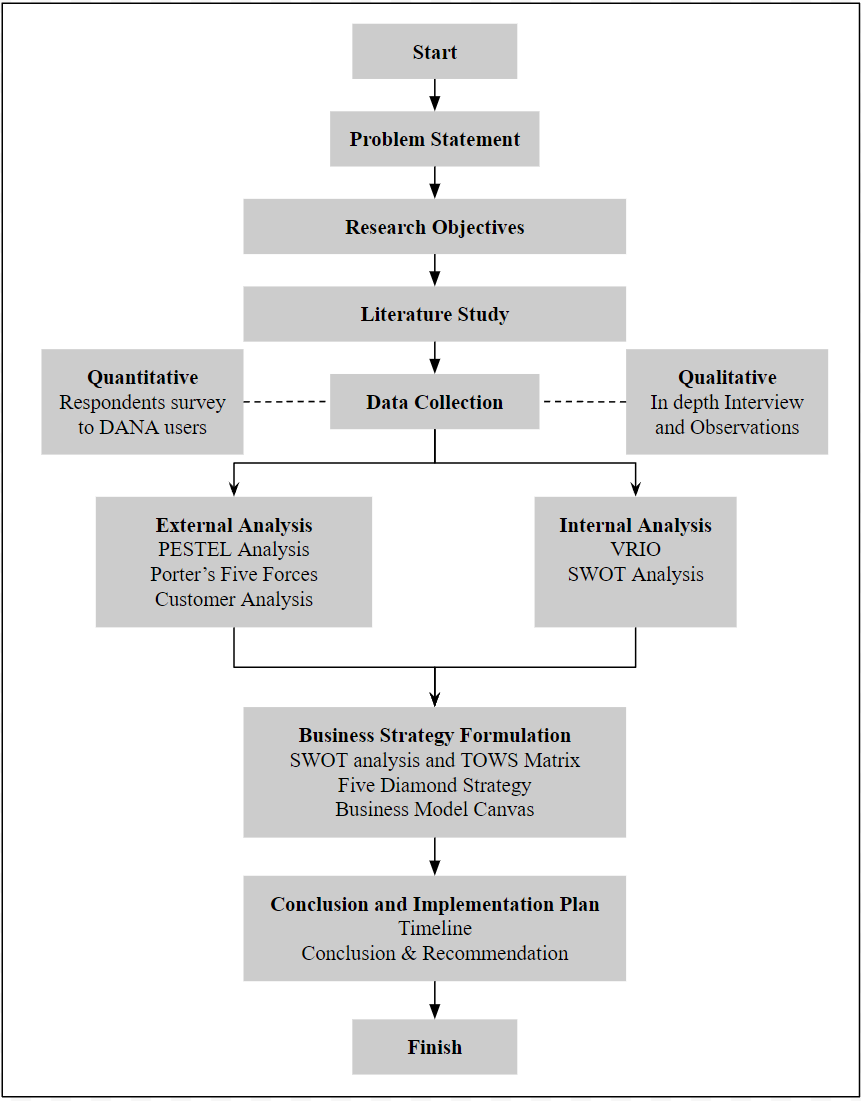
In this paper, a selection of frameworks is used to understand the current business of DANA loyalty in order to find a proper proposal for a business solution. The analysis will be divided into internal and external approaches to find expected variables for the proposals. Internal analysis will be using VRIO and SWOT Analysis. Meanwhile the external analysis will be using Pestel, and Porter’s five forces. The formulated variables will be then mapped into a TOWS matrix and five diamond matrices. Finally, the business model canvas will be used to formulate the overall business proposed solution.
MATERIALS AND METHODS
Research Design
To achieve the research objectives by providing conceptual framework that is using Business Model Canvas, authors will gather primary and secondary data from existing customers of DANA (application user and SME merchants) through quantitative and qualitative method, underrated internal and external analysis, create a business strategy formulation and established establish business model canvas for DANA loyalty feature.
Research methodology and Data Collection
In this research, the data collection will be taken with two kinds of methodology: first is through quantitative sampling of surveys based on the designated demography; and second is a qualitative interview with representatives of SMEs in Jakarta. From this data collection, the author would like to get the survey results that will return quantitative data that can be used to represent overall DANA users. The qualitative survey to the SMEs will show a baseline for building a formulated strategy.
The targeted audience for quantitative data will refer to the overall DANA users where the overall number will be specifically targeted to Jakarta Users. The total population will be smartphone users in Jakarta as the feature can be used through non DANA users, with the numbers referring to 71% of Jakarta population that is 7,497,600. To define the sample, the author will use the Slovin formula that is: n = N / (1+Ne2), where N is the population size and e is the margin of error. In this research, the author is expecting an error of margin as 10%. According to the calculation, the minimum sample required to do the analysis will be 99 where it is rounded to be 100. Hence the minimum sample of respondents will be 100 data.
The questionnaire design is addressed to DANA users who are living in Jabodetabek area, through internet questionnaires. Each question is grouped into different objectives as an aspect of interaction that are identification, capacity, capability, and engagement. The questionnaire results will then be presented and summarized to get the general insights on DANA users as their main customers. It will also be used to get facts and findings through standard measurement to profiled DANA users and segment them into each required cluster.
On the qualitative method, an interview is completed with 2 separate merchants under the FnB category. The merchants, considered as an SMEs that fulfilled the required criteria, interviewed under two separate time slots and given similar questions grouped into several objectives that are: identification of the business, current business capacity, and digitalization strategy.
ANALYSIS
PESTLE Analysis: The PESTLE framework analyzes the importance of external factors (Political, Economical, Sociocultural, Technological, Legal and Ecological) and their impact on the business. Firstly, Digital wallet, as part of a payment infrastructure, is highly supervised by the central banks. On creating a loyalty program, DANA should also adhere to the customer data protection policy in indonesia. Secondly on the economic factors, the economy can greatly impact the business of DANA Loyalty application. If the economy is running well and business competition exists, a loyalty program can increase the transaction value of one MSMEs. Thirdly, for sociocultural factors, Indonesian customers are greatly affected by promos, reducing their willingness to remain purchasing in a single brand [11]. This means that combining loyalty and promotions can change the behavior of transacting in the users. Fourthly on technological factors, the recent growth of artificial intelligence will provide opportunities for the loyalty platform to increase customer relationships. Fifty, on legal factors, the development of any features inside DANA Loyalty should ensure data protection becomes the policy that is not violated. Lastly, the ecological factors will not be significant as the product itself is going to be digital.
Figure 5: Research Design
Source: Author, 2023
Table 1: Summary of Porter’s Five Forces Analysis
Forces
Impact
Potential Aspects
Threat of New Entrants
High
Low barrier of entrants for new players
Easy to replicate products, causing low uniqueness of the products
Bargaining Power of Buyers
High
Great potential of growth for loyalty industry
Pushing higher promotional values from merchants
Bargaining Power of Suppliers
Medium
Plays a role in providing prices for operational cost
Will not be able to impact availabilities or quality of the products as the service they provided is mass and offered to other features in DANA
Threat of Substitutes
Low
Merchants will not have enough resource and capability to developed their own loyalty platform
Competitive Rivalry
Low
Current loyalty platform in the market are not integrated to digital payment
No digital wallet is providing loyalty platforms to their business
Porter’s Five Forces
Below is the summarized result of Porter’s Five Forces Analysis that can be used as a baseline for designing the business strategy for DANA Loyalty.
It shows that the industry is in the mid level of attractiveness. It still has great potential to grow with its low supplies and growing demand from the customers and the merchant.[12-14].
DANA Loyalty User Analysis based on Quantitative Questionnaire
In this analysis, the author used a quantitative approach with 100 respondents as a target based on Slovin calculation and was able to get 112 respondents.
Table 2: Summary of VRIO Analysis
DANA Loyalty current Resources & Capabilities
V
R
I
O
Impact
Notes
Expertise talent in software application
v
v
v
Competitive parity
The talent inside DANA company is one of the best in the industry, many are experts in delivering high quality products in effective and efficient cost.
Strong brand as a digital wallet company
v
v
v
Temporary competitive advantage
DANA has one of the highest transacting users per month, making it easier for new products to be known.
Integrated payment user experience
v
v
v
v
Sustainable competitive advantage
DANA has well integrated payment experience with many payment methods such as balance, debit cards, credit cards; and type such as one time or recurring.
Secure and mature technological architecture
v
v
v
v
Sustainable competitive advantage
As a digital payment infrastructure DANA develop a secure and safe database management system that is strong and not easily penetrable.
Strong merchant engagement team
v
v
Competitive parity
DANA has a good business team that supports the acquisition of many small and big merchants.
Advanced promotional engine
v
v
v
Unused competitive advantage
DANA has an effective promotional engine that not only burns marketing budget but also gives high return of investments.
Table 3: SWOT Analysis
Strength (S)
Strong Digital Wallet Brand
Talent
Efficient Technology
Weakness (W)
Product Sustainability
Brand presence
Expansion strategy
Opportunities (O)
Loyalty program literacy
Digital Market Growth
Not many competitors
Threats (T)
New entrants
Lack of Loyalty Strategy from Merchants
Risk of Data breach
Table 4: TOWS Matrix
TOWS Matrix
Strength (S)
S1. Strong Digital Wallet Brand
S2. Talent
S3. Technology
Weakness
W1. Product Sustainability
W2. Brand presence
W3. Expansion strategy
Opportunities (O)
O1. Loyalty program literacy
O2. Digital Market Growth
O3. Not many competitors
S-O Strategies
SO 1 - Increase brand awareness on DANA Loyalty to targeted market (S1, O2)
SO 2 - Increase product value for DANA loyalty to offer end to end loyalty service (S2, S3, O1, O3)
SO 3 - Offer expert classes for Loyalty marketing (S2, O1)
W-O Strategies
WO 1 - Create iterations for DANA Loyalty product, create proper pricing strategy for revenue collection (W1, O1, O2)
WO 2 - Increase brand awareness of DANA loyalty to potential market (W2, O2)
WO 3 - Create market expansion strategy to big cities in Indonesia (W3, O3)
Threats (T)
T1. New entrants
T2. Lack of Loyalty Strategy from Merchants
T3. Risk of Data breach
S-T Strategies
ST 1 - Enable differentiation through product iteration fast and effectively (S1, S2, T1)
ST 2 - Increase brand engagement for current DANA merchants to enable DANA Loyalty (S2, S3, T2) ST 3 - Enable good data policy and technology to prevent data breach (S2, S3, T3)
W-T Strategies
WT 1 - Do market research to create needs on loyalty platform (W1, W2, T2)
WT 2 - Do technological research to prevent data breach and improve product quality (W1,W2, T3)
WT 3 - Create good engagement (community) with DANA Loyalty merchants (W3, T1)
Identification
Based on gender identification, male respondents have a slightly bigger proportion with 56.3%. Regarding age, most of them aged 24-29 years old, standing as late millennials with 62.5%. The second highest group of respondents stands at 30-35 years old as millennials, standing at 26.8%. There’s also a small percentage of users that are aged 23 below as generation Z. Related to the last education level, 70.5% of the respondents have a Bachelor degree, while 20.5% of them are Master graduates. The rest are highschool or diploma holders. And finally, related to monthly expenses, the majority of the respondents spendRp 5,000,000 or above every month with 71.4%. While the next group are respondents with spendings at Rp 2,500,001 to Rp 5,000,000 where they are considered as middle income groups at 15.2%.
Usage
After doing identification and demographic, the respondents answer how they are using DANA. Based on their length of using the application, 70.5% have been using DANA since more than 2 years ago, followed by 15.2% users who have used it up to 2 years and 14.3% users who use the application for less than a year. On their last usage, the results are varied. The majority of respondents used DANA in the past 2 days, but 25% of them used DANA last year or later. The results also followed by similar numbers of DANA usage in the past weeks, months, and several months ago. Related to the last used feature, 49.1% of the respondents used DANA as payment method through QRIS or any online merchants. This figures followed by money transfer to bank accounts by 14.3%, money transfer to other DANA accounts by 12.5%, bill payments and top up games by 9.8%, and other use cases that don't have significant numbers. The most frequently used features data are also gathered with payment to QRIS also stands as the highest use case with 63.4%, while sending money to other DANA accounts and Bank accounts sits at the second place at 35.7%. Other features followed such as Bill payments (25%), Pulsa (21.4%), Top up games (17.9%), charity and investments (under 10% combined) [15-17].
Perception
On understanding of loyalty programs, 60% of respondents know about them while the rest don’t. In addition, 53% of all respondents are registered loyalty members, while the rest are not. Meanwhile, the most popular loyalty program in the market will be restaurant loyalty programs as 61% of the respondents are registered to at least one of FnB categories. The other loyalty programs spread out almost evenly at airlines (33.7%), hotel and travel (34.9%), fashion (40.7%), and others (29.1%). The most common way for these respondents to access their loyalty information is through native application with 73.8%, while 52.4% of respondents accessed it through websites and email.
On the benefit, most of the respondents also agreed that Loyalty programs allowed them to redeem points collected from every transaction into discounts and vouchers by 75%. Some of them are also satisfied with gaining new information on the brand such as new items or special offers by 26% and 45% respectively. In addition, how the respondents redeemed their points is also surveyed with 40% of them indicating that they rarely redeemed the said benefits in the selected stores or brand. Meanwhile 36% and 22% of them redeemed the prizes they received through once, twice, and everytime they visited the store.
Engagement
The last section analyzes how DANA Loyalty is perceived by users. Out of all respondents, 58.9% stated that they didn’t know about DANA loyalty. In addition, 86.6% from all respondents is a non DANA Loyalty user.
On their feedback, the majority of respondents stated that DANA loyalty should offer integrations to more merchants by 40%, while 36% stated that DANA should increase the awareness of this feature. The minority of the group gives feedback for DANA loyalty to improve its quality and better offer to the users.
From the given survey to respondents, author concluded that:
The majority of DANA users based on respondents are coming from the middle upper class with a high education background. This means that as customers, it will be challenging for them to be satisfied with digital products. If they are unhappy with the product, they will move to another digital wallet
DANA is not frequently used by the respondents. Frequently used for QR payments to selected merchants, online payment, or bill payments. This means that for them to use additional features in DANA will require them to go on a digital payment journey
Most of the respondents have knowledge on loyalty programs, but lack initiatives to apply. They understand the benefits but rarely redeemed the points or voucher that they already have from previous purchase
The awareness for DANA Loyalty is low even among DANA users
MSMEs Analysis based on Qualitative Interview
The following findings are found from analyzing the current pains and problems that these business owners face on the possibility of implementing loyalty programs in their firm [18].
Lack of loyalty strategy to engage returning users
One of the findings that becomes a blockers on introducing DANA Loyalty to the merchants is the lack of loyalty strategy in the merchants. They are able to identify when there’s returning users, but don't know how to engage them well. Another insight is the owner started to realize that the lack of returning customers in a business is due to the lack of loyalty strategy. This realization shows that business owners still have lack of knowledge on engaging returning customers, while realizing that most of their purchase is coming from returning customers (instead of newer ones)
Loyalty program should be addressed with good products
When a business owner creates a loyalty program, it will result in the expectations of returning consumers. If a product or service is inconsistent, then the loyalty program will not work even though it has attractive offers. As an insight, the loyalty program for any business requires effort and full implementation not only from the owner but also from the staff. In the author's opinion, this means that the program should be offered to the customer, constantly being reminded on the availability of the program, then to be regularly reviewed by the team to see whether the program works [19-20].
Area of explorations on creating
Based on the interview, a loyalty platform should allow SMEs to learn more about their customers. As business owners who would like to gain more profits by having more customers, it is important for them to have more understanding of their customer’s behavior, including repurchasing. A good loyalty platform will enable the merchants to have various types of offers alongside the popular discount and promotional price, such as birthday offers, difference offers per period, or offering customers with various new products to engage them.
VRIO Analysis
Below is the area of DANA Loyalty’s competitive advantage based on VRIO Framework.
SWOT Analysis
Based on the internal resource and external environment of the business for DANA Loyalty, here are the strengths, weaknesses, threats and opportunities that the firm can capture and capitalize for proposed business model.
TOWS Matrix
For DANA Loyalty, the TOWS matrix is formulated on the following figures where revelations between Strength - Opportunity (SO), Strength - Threats (ST), Weakness -
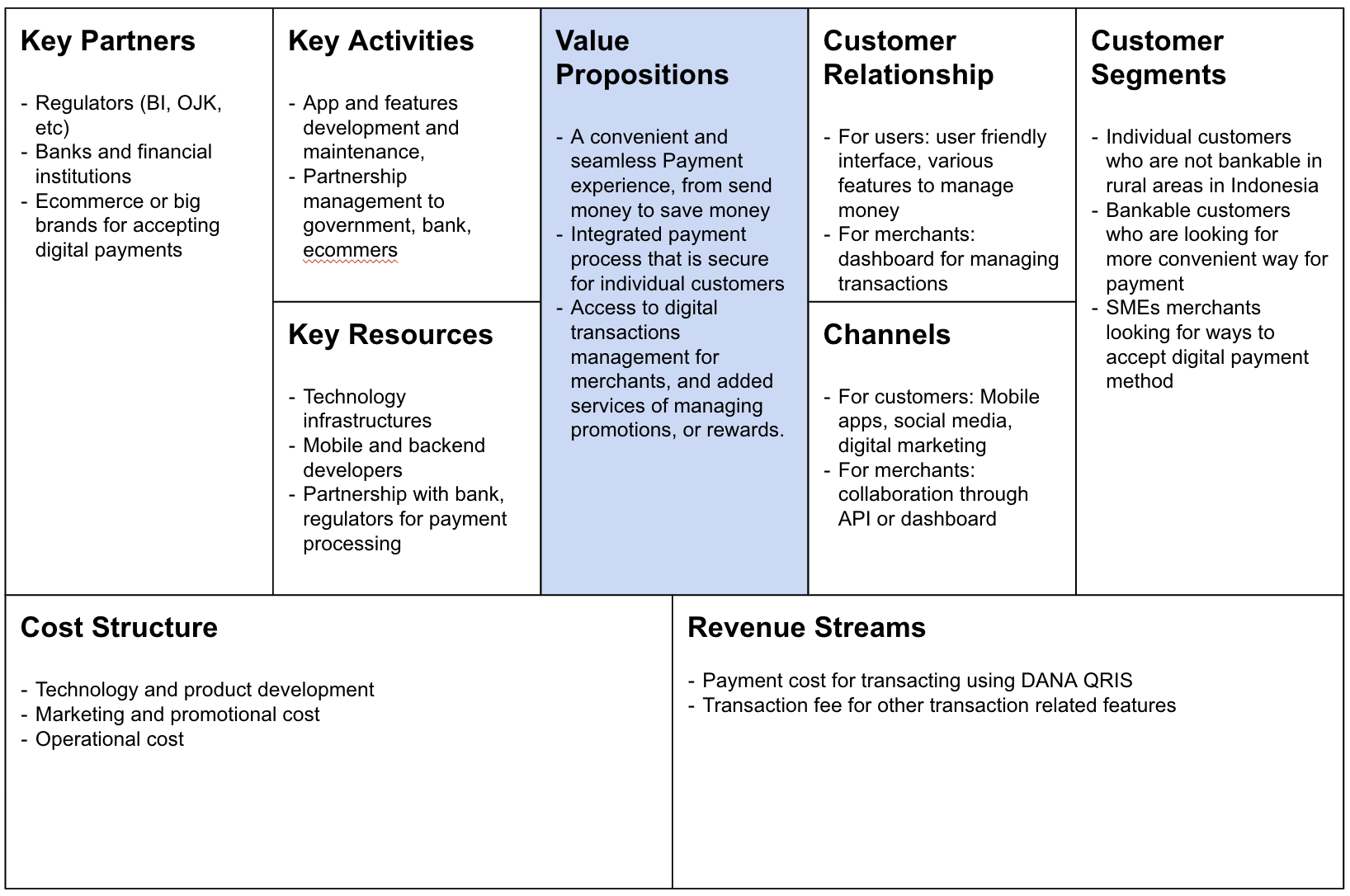
Figure 6: Business Model Canvas of DANA
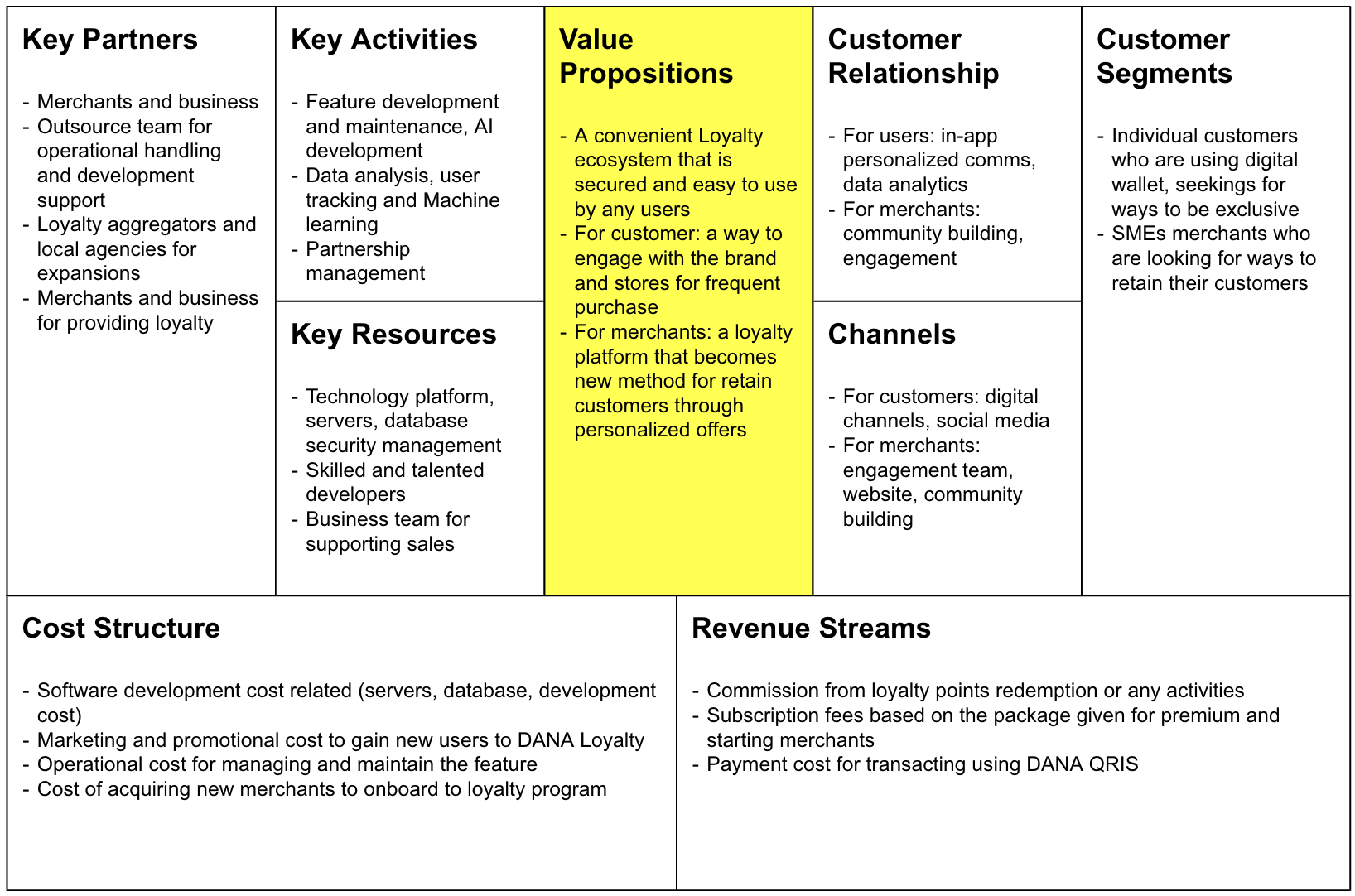
Figure 7: New Business Model Canvas for DANA Loy
Opportunity (WO), and Weakness - Threats (WT) is described [21-22].
Five Diamond Strategy
The Five Diamond strategy is used to provide strategies that can address how DANA Loyalty can achieve its objectives. Each strategy is based on economic logic, arenas, vehicles, differentiation, and staging. With the main goals for DANA Loyalty to engage many merchants and enable them to implement loyalty strategy, while providing loyalty features as added values for customers to transact with DANA wallet.
Arenas (Where Will We Be Active)
On product categories, DANA Loyalty will definitely tap on enabling a business to business loyalty platform that is well integrated to the merchant application currently provided for payments. Adding on the new features will be loyalty management where existing merchants can explore and implement their loyalty strategy. The focus for DANA loyalty in the first half of the year will be for FnB categories, where they can offer and focus its feature to enhance FnB merchants’ end to end service to its customers. The market will be focused on growing the middle income market, through various types of FnB categories, located in big cities in Indonesia. The technology implemented will be automated end-to-end customer relationship management that automates when the users agree to join the loyalty membership, and their transaction data will then be utilized to provide them better promotional offers [23].
Vehicle (How to Get There)
To get to the objectives, there are several ways for DANA Loyalty to create valuable product iterations. Mainly considered into two: internal product development and strategic partnerships. For internal product development, a team is formed to develop the product backlog that fits the market needs. They start to build the product in iteration and agile methodologies, and iterate fastly. After multiple releases, additional technical improvements will be required so DANA Loyalty can also outsource their engineering or operational efforts to improve scalability. On building strategic partnership, DANA can also integrate with many loyalty aggregators such as Ottopoint or GLI to enable more merchants to be available with DANA Loyalty.
Differentiators (How Will We Win In the Market?)
As a digital wallet application, DANA Loyalty is greatly benefitted from the brand. It already has a DANA Merchant application where it manages end to end transactions with a merchant. DANA loyalty will then be offered and already has a big user base. DANA loyalty should also offer a customized loyalty program that can match with various user needs. This feature will be released in iteration, by studying and analyzing the market needs. Through DANA expertise in software engineering, its speed to market allows DANA loyalty to have fast iterations and adaptation in the market. By leveraging machine learning, DANA Loyalty can also offer a personalized program based on the user criteria, and the merchant’s input. In addition, DANA’s reputation as a secured financial institution will be supported by DANA’s effort to build a secure and safe data company. All of this will enable DANA Loyalty to be a reliable, complete, and secured loyalty platform enabler.
Staging (What Will be our Speed and Sequence Move?)
DANA Loyalty will be developed into several stages where each step represents the focus for DANA Loyalty. The staging process will be implemented through internal development, beta, launch, market expansion, and advance product development. In internal development, DANA loyalty will develop Minimum Viable Product that fulfill the most valuable features for customers. The Beta stage is where the feature is introduced to be reviewed by the users. To generate good feedback, a small number of merchants and users are engaged to try and give feedback for the feature. If the beta is launched, DANA Loyalty will then be re launched to the public. From this stage, the marketing team is intended to do regular brand awareness testing, by seeing how the people respond to DANA Loyalty. Meanwhile, the business development team will start doing canvassing and offer DANA Loyalty to the current integrated merchants. Finally As the launch is completed, the expansion strategy is implemented where each big city in Indonesia becomes the target market. And in the advanced product development stage, the requirements of the features will enable customizations for each merchant so that DANA Loyalty becomes their playground to implement and develop their loyalty strategy [24].
Economic Logic (How to Obtain Returns?)
To gain profits, there will be several points to be charged to merchants as the main customers to provide loyalty programs to the users. The first will be platform fees for merchants. The fee will then be separated into several packages, similar to a lot of platform payment schemes. The second will be advertisement support. From the created loyalty program, DANA can provide marketing support to make the program for each merchant popular inside DANA applications. The final will be the payment. As a digital wallet through existing QRIS implementation, DANA gains a certain amount of profit from becoming a digital payment channel.
Business Model Canvas
To summarize the sustainable strategy, a business model canvas is used to give the management a new approach to DANA Loyalty. However, to present the differences, the old business model canvas of DANA is shared to show the difference and how DANA Loyalty becomes an extension of its original business model [25].
As shared from the current business model of DANA, loyalty is just an additional value proposition for merchants to accept DANA as their payment method. The revenue will only rely on the payment and transaction fee for using DANA. Hence, based on the insights of industry attractiveness, as well as potential demand from customers and merchants, a new business model canvas is proposed to innovate new ways for delivering the value of Loyalty platform to the customers. The new and developed prepositions will give DANA Loyalty on building a community of Loyalty Program, monetization, and continuous improvement to provide value for its customers [26].
Value Propositions
A new value proposition for DANA Loyalty is to provide a convenient loyalty ecosystem for both merchants and users. Through this platform, merchants can explore and propose their loyalty program, configure it and launch it to the users. For merchants, it can benefit them to win in the market by providing loyalty engagements so they can target repurchase from existing customers. In addition for users, it provides them promotions that are tailored based on their purchase, that is personalized and gives them exclusive offers. DANA loyalty program will then become an engaging platform for merchants to connect with their loyal customers.
Customer Segments
The target customer for DANA Loyalty will be divided into two: Individual customers who frequently use digital wallets, and seeking for ways to have exclusive offers, or loyalty promotions. These individual customers have been frequently visiting a store, and will do repurchase if they are triggered with promotions. The next customers will be SMEs as the merchants are providing loyalty programs. As a platform, DANA loyalty enables this merchants to start having a loyalty strategy, and explore around to provide the best return for customer repurchase.
Channels
This section describes how we are going to reach the customers. For individual users, DANA Loyalty will reach these users through digital channels such as paid ads, website, KOL, or social media marketing. DANA loyalty can also propose offline marketing for these customers through billboard, TVC, and offline booths or events. Meanwhile for the merchants, an engagement team is formed to reach out and promote DANA Loyalty. This team will have their own sales funnel through emails, websites, and canvassing to reach out multiple merchants as potential customers for DANA Loyalty. For onboard merchants, DANA can provide loyalty packages such as banners or posters that the merchants can put on. Finally, the engagement team is also expected to build a community, where they promote merchants to have loyalty strategies. They managed it offline through community based learnings and events, to digital channels such as websites or blogs.
Customer Relationships
The relationship between DANA Loyalty and its customers are divided into two. For merchants, it is expected to have personal engagements to ensure merchants fully utilize the feature of DANA loyalty. As most merchants also don't have good loyalty strategy, the community will be learning based where there will be experts and study cases for merchants to share about the success of their loyalty program. For customers there will be personalized communications to ensure personalization works through the in-app DANA assets. There will also be digital analytics to learn more about the users’ transaction pattern, so that the way to reach them can be improved over time. Customer support is provided for both merchants and users to consult when they are having issues with their loyalty program.
Key Partners
The key partners for DANA loyalty will be merchants and businesses that can help DANA Loyalty to grow. These key merchants usually have many branches and can increase exposure to DANA Loyalty. DANA can also outsource its operational and development support to ensure internal resources are focused on developing the features and managing key business. There will also be partnerships with loyalty aggregators such as TADA to increase engaged loyalty merchants, as well as local agencies to help DANA to expand its market to big and small cities in Indonesia [27].
Key Activities
The main activities for DANA loyalty will be to develop the feature inside DANA Applications that cater the needs of the merchants and users. In extension of feature development, there will be research by the DANA Development team on AI or machine learning and how it can be implemented to the use case of DANA Loyalty. This can be implemented through data analysis, user tracking and data management. The research team can introduce the feature to the development team to be used by the merchants and general public. Finally, partnership management becomes key activities for establishing trust to merchants so DANA Loyalty becomes the preferred platform for developing their loyalty strategy.
Key Resources
In order to deliver the value prepositions, DANA will be working to develop the features on advanced technology platforms and servers. To ensure data protection, DANA will also manage a security system through all data gained from transactions. The key resources of this business will be the skilled and talented developers to create the features, and the support from the business team to generate sales and increase the engagement of DANA Loyalty.
Cost Structure
The cost structure will describe what are the costs and expenses related to DANA Loyalty. The biggest cost will be development and IT infrastructure cost, ranging from hiring talent to enabling servers for development. The next will be marketing costs from promoting DANA Loyalty to gain big awareness in the market. There are also staff salaries and operational costs for maintaining the operation of DANA Loyalty. And finally there will be the cost of acquiring new merchants for DANA Loyalty as canvasing is using local agencies in the region [28].
Revenue Streams
Finally, the revenue will be coming from multiple streams. First will be commission of every loyalty point redeemed by the merchants. For every loyalty point redeemed as vouchers or transactions, there will be a small sharing fee cost per transaction that is charged to the merchant. There will also be subscription fees for the merchants to use the platform and all features provided inside DANA Loyalty. Finally, the payment cost will be charged to merchants for transacting using DANA QRIS.
Justification of the Proposed Implementation
In order to justify the proposed implementation plan, the summarized strategy is completed with action items as below:
To create a valuable loyalty platform that enable merchants to formulate and run their loyalty strategy, DANA Loyalty needs to established dedicated teams from existing tech departments, create workshop to define and gather requirements, and start building MVP through estimated budgets
To Increase brand awareness for DANA Loyalty to compete with new entrants and invite new users to try this new feature by creating marketing and branding strategy by 2023, proposed budget for hiring advertising agency, and proposed budget for digital and offline branding
Improve the product quality for DANA loyalty platform through quality management checking
Iterate the product and gain feedback fast and regularly, to improve the value proposition of DANA loyalty by producing features that are effective and efficient. This can be done by creating list of features for beta (MVP), engagement team to develop feedback systems, and do prioritization,
To ensure that the product is well secured from external threats, DANA needs to do technological research from the RnD team, hire penetration testers, and report existing and proposed technology to regulators
DANA Loyalty will established community and engage merchants regularly through classes, expert seminars and others to ensure DANA Loyalty is utilized well by the merchants
DANA Loyalty will create market expansion strategy to big cities in Indonesia through support from canvassing team
CONCLUSION
To conclude the study, the external factors that can influence the business were found from merchants and users. SME merchants realize the importance of having a loyalty strategy to engage returning customers, but most of them don’t know how to properly engage them. Meanwhile many customers are delighted for loyalty program that gives them exclusivity and feeling appreciated by the merchants. Internally, DANA has a strong brand presence as a digital wallet and employed talented resources. By the support of the management, DANA Loyalty can be developed through multiple iterations and research, by continuously finding what the market needs are and how to address their problems. Externally, there are not many players in the market that are playing in the loyalty business. This becomes a key opportunity for DANA to tap into where it can bring a new source of revenue for the firm.
The proposed strategy for DANA is to make DANA Loyalty as a platform, by enabling merchants to create and deploy their loyalty strategy. They can play around and see what kind of offer fits their customer best, and find various ways to engage with their returning customers. Once existing merchants in big cities are engaged with DANA Loyalty, DANA can focus on expanding the market to smaller cities, as well as developing advanced technology such as machine learning for giving personalizations to DANA Loyalty users.
Recommendation
To support development of this product, there may need to be more deep research on the best promotional offers that DANA can give to the merchants. Loyalty programs are still very new to some SMEs and DANA needs to ensure that the strategy is known, and managed by each merchant well. So that the loyalty platforms can be utilized well by the merchants.
DANA management should calculate the cost of development, maintenance, and define pricing correctly for DANA loyalty so the sustainability of the product can be extended for a long term. To build a loyalty platform, it requires long term management from the tech and business team. DANA has successfully completed this when building a wallet, and is able to transform the payment culture in Indonesia to be digital. So to create and implement a new community will need to have a room of explorations and improvements.
In addition, the management should focus that the government and regulation will not block DANA loyalty to be expanded rapidly. The support from local governments is also needed to ensure that the growth of SMEs is sustainable by enabling loyalty strategies in their business. Future research is recommended to define a more detailed product development plan and prioritization to cater the needs of the consumer.
REFERENCE
Frankel. "What is fintech? Intro to financial tech." The Motley Fool, 2023.
Vania. "Frekuensi penggunaan dompet digital di Indonesia." Katadata Databooks, 2022.
Watson, G.F., et al. "Building, measuring, and profiting from customer loyalty." Journal of the Academy of Marketing Science, vol. 43, no. 6, 2015, pp. 790–825.
Oliver, R.L. "Whence consumer loyalty." Journal of Marketing, vol. 63, special issue, 1999, pp. 33–44.
Evanschitzky, H., et al. "Consequences of customer loyalty to the loyalty program and to the company." Journal of the Academy of Marketing Science, vol. 40, no. 4, 2012, pp. 625–638.
Bolton, R.N., Kannan, R.K., and Bramlett, M.D. "Implications of loyalty program membership and service experiences for customer retention and value." Journal of the Academy of Marketing Science, vol. 28, no. 1, 2000, pp. 95–108.
Narvanen, et al. "A meaning-based framework for customer loyalty." Emerald Insight, 2020.
Norman, D.A., and Draper, S.W., editors. User-Centered System Design: New Perspectives on Human-Computer Interaction. 1986.
Sutherland, J., and Sutherland, J.J. Scrum: The Art of Doing Twice the Work in Half the Time. Currency, 2014.
Surveysensum. Indonesia E-commerce Trends 2022. Surveysensum.com, 2022.
Editorial The Jakarta Post. "QRIS: The end for e-wallets?" The Jakarta Post, 2023.
Liu, Yuping. "The long-term impact of loyalty programs on consumer purchase behavior and loyalty." Journal of Marketing, vol. 71, no. 4, 2007, pp. 19–35.
Manyika, and Roxburgh. "The great transformer: The impact of the internet on economic growth." McKinsey Global Institute, 2011.
McCall, M., and McMahon, D. "Customer loyalty program management: What matters to the customer." Cornell Hospitality Quarterly, vol. 57, no. 1, 2016, pp. 111–115.
Nurhayari-Wolff. "Internet penetration in Indonesia and internet penetration rate in Indonesia (n.d.)." Statista, 2021.
Nurhayari-Wolff. "Internet usage in Indonesia." Statista, 2023.
Osterwalder, A., and Pigneur, Y. Business Model Generation. John Wiley & Sons, 2010.
Pareek, A. "How Starbucks is also a bank?" Medium, 13 Feb. 2021.
Purohit, A., and Thakar, U. "Role of information and communication technology in improving loyalty program effectiveness: A comprehensive approach and future research agenda." Information Technology and Tourism, vol. 21, no. 3, 2019, pp. 259–280.
Researchandmarkets.com. Indonesia Loyalty Spend Market Size and Future Growth Dynamics by Functional Domains. Indonesia Loyalty Programs Market Intelligence and Future Growth Dynamics Databook, 2023.
Ries, E. The Lean Startup: How Today’s Entrepreneurs Use Continuous Innovation to Create Radically Successful Businesses. Currency, 2011.
Saunders, Mark, et al. Research Methods for Business Students. 2019.
Schneider. "New survey reveals consumer conflict between privacy and personalization." SheerID, 2018.Sekretariat Kabinet Republik Indonesia. "Government to maintain MSMEs’ role as economic backbone." Website Resmi Setkab RI, 2022.
Shuler. "How does the internet work?" Stanford, 2002.
Barney, J.B. "Firm resources and sustained competitive advantage." Journal of Management, vol. 19, no. 1, 1991, pp. 99–120.
VISA. The Mobile Internet: Alternative Payment Methods. VISA Consumer Payment Attitudes Study 2023, 2023.
License
Creative Commons Attribution-NonCommercial-NoDerivatives 4.0 International License
All papers should be submitted electronically. All submitted manuscripts must be original work that is not under submission at another journal or under consideration for publication in another form, such as a monograph or chapter of a book. Authors of submitted papers are obligated not to submit their paper for publication elsewhere until an editorial decision is rendered on their submission. Further, authors of accepted papers are prohibited from publishing the results in other publications that appear before the paper is published in the Journal unless they receive approval for doing so from the Editor-In-Chief.
Himalayan Journal of Economics and Business Management open access articles are licensed under a Creative Commons Attribution-Share A like 4.0 International License. This license lets the audience to give appropriate credit, provide a link to the license, and indicate if changes were made and if they remix, transform, or build upon the material, they must distribute contributions under the same license as the original.
Recommended Articles
Research Article
Influence of Leadership on Poverty Reduction in the Devolved Government in Trans-Nzoia County, Kenya
Kinisu Sifuna,
...
Peter Simotwo
Published: 30/06/2021
Download PDF
Cite
x
APA
Sifuna, K., Lwangale, D. W., Simotwo, P., Sifuna, K., Lwangale, D. W. & Simotwo, P. (2021). Influence of Leadership on Poverty Reduction in the Devolved Government in Trans-Nzoia County, Kenya. Himalayan Journal of Economics and Business Management, 2(1), None-None.
MLA
Sifuna, Kinisu, et al. "Influence of Leadership on Poverty Reduction in the Devolved Government in Trans-Nzoia County, Kenya." Himalayan Journal of Economics and Business Management 2.1 (2021): None-None.
Chicago
Sifuna, Kinisu, David W. Lwangale, Peter Simotwo, Kinisu Sifuna, David W. Lwangale and Peter Simotwo. "Influence of Leadership on Poverty Reduction in the Devolved Government in Trans-Nzoia County, Kenya." Himalayan Journal of Economics and Business Management 2, no. 1 (2021): None-None.
Harvard
Sifuna, K., Lwangale, D. W., Simotwo, P., Sifuna, K., Lwangale, D. W. and Simotwo, P. (2021) 'Influence of Leadership on Poverty Reduction in the Devolved Government in Trans-Nzoia County, Kenya' Himalayan Journal of Economics and Business Management 2(1), pp. None-None.
Vancouver
Sifuna K, Lwangale DW, Simotwo P, Sifuna K, Lwangale DW, Simotwo P. Influence of Leadership on Poverty Reduction in the Devolved Government in Trans-Nzoia County, Kenya. Himalayan Journal of Economics and Business Management. 2021 Jan;2(1):None-None.
Download PDF
Research Article
Modelling Structure Job Quality, Job Design and Job Satisfaction
Moch Nurhadi,
...
Avi Sunani
Published: 30/08/2022
Download PDF
Cite
x
APA
Nurhadi, M., Bisyri Effendi, M., Saiful Ulum, A. & Sunani, A. (2022). Modelling Structure Job Quality, Job Design and Job Satisfaction. Himalayan Journal of Economics and Business Management, 3(2), 1-4.
MLA
Nurhadi, Moch, et al. "Modelling Structure Job Quality, Job Design and Job Satisfaction." Himalayan Journal of Economics and Business Management 3.2 (2022): 1-4.
Chicago
Nurhadi, Moch, Moch Bisyri Effendi, Achmad Saiful Ulum and Avi Sunani. "Modelling Structure Job Quality, Job Design and Job Satisfaction." Himalayan Journal of Economics and Business Management 3, no. 2 (2022): 1-4.
Harvard
Nurhadi, M., Bisyri Effendi, M., Saiful Ulum, A. and Sunani, A. (2022) 'Modelling Structure Job Quality, Job Design and Job Satisfaction' Himalayan Journal of Economics and Business Management 3(2), pp. 1-4.
Vancouver
Nurhadi M, Bisyri Effendi M, Saiful Ulum A, Sunani A. Modelling Structure Job Quality, Job Design and Job Satisfaction. Himalayan Journal of Economics and Business Management. 2022 Jul;3(2):1-4.
Download PDF
Research Article
Accountability and Transparency of Village Fund Management in Lumajang District
Nurina Ayuningtiyas,
...
Muhammad Miqdad
Published: 28/12/2023
Download PDF
Cite
x
APA
Ayuningtiyas, N., Santosa Putra, H. & Miqdad, M. (2023). Accountability and Transparency of Village Fund Management in Lumajang District. Himalayan Journal of Economics and Business Management, 4(2), 1-4.
MLA
Ayuningtiyas, Nurina, Hendrawan Santosa Putra and Muhammad Miqdad. "Accountability and Transparency of Village Fund Management in Lumajang District." Himalayan Journal of Economics and Business Management 4.2 (2023): 1-4.
Chicago
Ayuningtiyas, Nurina, Hendrawan Santosa Putra and Muhammad Miqdad. "Accountability and Transparency of Village Fund Management in Lumajang District." Himalayan Journal of Economics and Business Management 4, no. 2 (2023): 1-4.
Harvard
Ayuningtiyas, N., Santosa Putra, H. and Miqdad, M. (2023) 'Accountability and Transparency of Village Fund Management in Lumajang District' Himalayan Journal of Economics and Business Management 4(2), pp. 1-4.
Vancouver
Ayuningtiyas N, Santosa Putra H, Miqdad M. Accountability and Transparency of Village Fund Management in Lumajang District. Himalayan Journal of Economics and Business Management. 2023 Jul;4(2):1-4.
Download PDF
Research Article
The Constitutional and Legislative Basis for Considering the Taxable Capacity of Taxpayers in Iraqi Tax Legislation
Hussein Kamel Wadaa
Published: 05/05/2025
Download PDF
Cite
x
APA
Wadaa, H. K. (2025). The Constitutional and Legislative Basis for Considering the Taxable Capacity of Taxpayers in Iraqi Tax Legislation. Himalayan Journal of Economics and Business Management, 6(1), 1-10.
MLA
Wadaa, Hussein Kamel. "The Constitutional and Legislative Basis for Considering the Taxable Capacity of Taxpayers in Iraqi Tax Legislation." Himalayan Journal of Economics and Business Management 6.1 (2025): 1-10.
Chicago
Wadaa, Hussein Kamel. "The Constitutional and Legislative Basis for Considering the Taxable Capacity of Taxpayers in Iraqi Tax Legislation." Himalayan Journal of Economics and Business Management 6, no. 1 (2025): 1-10.
Harvard
Wadaa, H. K. (2025) 'The Constitutional and Legislative Basis for Considering the Taxable Capacity of Taxpayers in Iraqi Tax Legislation' Himalayan Journal of Economics and Business Management 6(1), pp. 1-10.
Vancouver
Wadaa HK. The Constitutional and Legislative Basis for Considering the Taxable Capacity of Taxpayers in Iraqi Tax Legislation. Himalayan Journal of Economics and Business Management. 2025 Jan;6(1):1-10.
Aryun, Q., Agus Prasetio, E. & T, MBA, S. (2023). Proposed Business Model for Loyalty Platform Feature of a Digital Wallet Company. Himalayan Journal of Economics and Business Management, 4(2), 1-13.
MLA
Aryun, Qanitan, Eko Agus Prasetio and S. T, MBA. "Proposed Business Model for Loyalty Platform Feature of a Digital Wallet Company." Himalayan Journal of Economics and Business Management 4.2 (2023): 1-13.
Chicago
Aryun, Qanitan, Eko Agus Prasetio and S. T, MBA. "Proposed Business Model for Loyalty Platform Feature of a Digital Wallet Company." Himalayan Journal of Economics and Business Management 4, no. 2 (2023): 1-13.
Harvard
Aryun, Q., Agus Prasetio, E. and T, MBA, S. (2023) 'Proposed Business Model for Loyalty Platform Feature of a Digital Wallet Company' Himalayan Journal of Economics and Business Management 4(2), pp. 1-13.
Vancouver
Aryun Q, Agus Prasetio E, T, MBA S. Proposed Business Model for Loyalty Platform Feature of a Digital Wallet Company. Himalayan Journal of Economics and Business Management. 2023 Jul;4(2):1-13.



 Download PDF
 Download XML