In this study, we isolated and identified the lipopeptides produced by Bacillus amyloliquefaciens strains RO from sugarcane. Bacillus amyloliqufaciens RO strain able to produce lipopeptide which exhibit potential antimicrobial compounds. Lipopeptides were evaluated for disease control activity against pokkah boeng disease of sugarcane. The characterisation of lipopeptides was studied by various analytical techniques. Studied Bacillus spp. strains were able to produce cyclic lipopeptides – surfactin, iturin A and bacitracin by Bacillus amyloliquefaciens. Antifungal metabolites were separated and characterized by using LC-ESI-MS/MS and MALDI-TOF. These results suggest that the screening and optimization of antimicrobial activity of lipopeptides from strain RO showing a great potential for future application.
Key findings:
The study isolated lipopeptides from Bacillus amyloliquefaciens strains RO in sugarcane, identifying potential antimicrobial compounds. The lipopeptides, including surfactin, iturin A, and bacitracin, showed activity against pokkah boeng disease. Characterization was done using various analytical techniques, including LC-ESI-MS/MS and MALDI-TOF. This research highlights the potential of these lipopeptides for future antimicrobial applications.
What is known and what is new?
Prior to this study, the production and antimicrobial activity of lipopeptides from Bacillus amyloliquefaciens strains in sugarcane were not extensively studied. This research confirms the ability of these strains to produce cyclic lipopeptides with antifungal properties, specifically surfactin, iturin A, and bacitracin. The study also characterizes these lipopeptides using advanced analytical techniques, expanding the knowledge of their potential applications.
What is the implication, and what should change now?
The implication of this study is significant for agriculture, particularly in sugarcane production. The identification of lipopeptides with antimicrobial properties suggests a potential alternative to chemical fungicides for controlling pokkah boeng disease. Farmers and researchers should explore the practical application of these lipopeptides as biocontrol agents, which could lead to more sustainable and environmentally friendly disease management practices in sugarcane cultivation.
Sugarcane is one of the most important cash crops and has a significant impact on the global economy. Pokkah boeng is the current primary pathogen threatening sugarcane and sugar production. Excessive usage of chemical fertilisers resulted in pest and disease outbreaks. Biological pest control using naturally hostile microorganisms has emerged as a possible alternative to conventional pesticides for more rational and safe crop management. Several species of Bacillus genus are able to produce active substances capable of disintegrating the fungal cell walls [1]. Some lipopeptides generated by Bacillus are very desirable biosurfactants due to their biodegradability and minimal toxicity to humans, animals, and plants [2]. Lipopeptides are essential for increasing bacterial colonization on plant tissues and inducing plant resistance to pathogens. They can prevent infections by competing for niche and nutrients, increasing the host plant's defence capabilities, and releasing fungal toxic chemicals. Bacillus is a biocontrol bacterium that is particularly effective against fungal and bacterial diseases [3]. It also includes well known substances such as bacitracin, bacteriocins and antimicrobial lipopeptides produced by multiple step enzymatic processes. Several reports have shown the efficiency of matrix-assisted laser desorption/ionization time of flight MS (MALDI-TOF MS) to identify small molecule biomarkers that distinguish and characterize different Bacillus species [4]. The study describes detailed mass spectrometric analysis of surfactin, iturin, and bacitracin produced by B. amyloliquefaciens RO strain. The novel bacterium RO isolated from sugarcane showed strong antifungal activity against.
CULTURE MEDIUM AND GROWTH CONDITIONS
Bacillus amyloliquefaciens RO was isolated directly from the leaf of sugarcane located at the State Key Laboratory for Conservation and Utilization of Subtropical Agro-biological Resources (Nanning, China). B.amyloliquefaciens RO strain isolates were cultured in LB (Luria Bertania) broth medium. In 500 mL shake flask containing 100 mL of chemical defined medium containing per litre was inoculated with culture (10g of trypone, 5g of yeast extract, and 10 g of NaCl). The inoculate culture was incubated in an orbital shaker at 200 rpm for 24 hours at 32°C. The active substances from cultured supernatant were added 50 mL ethyl acetate and cultured in shaker at the speed of 10,000 rpm for 5 minutes. After 2 hours, the culture filtrate was mixed with 10% (v/v) of organic solvents such as Acetone, Chloroform and Ethyl Acetate were separated two layers and the antibiotic would be got in the filtered liquid (after the supernatant filtered by RC 0.2 mm filters).The lower phase (organic phase) was separated from the exhausted supernatant (upper phase), All the above procedures were repeated three times.
Ethyl acetate was seen to be compatible for extraction of antibiotics. The culture filtrate was therefore extracted with ethyl acetate in the ratio of 3:1. The mixture (media and solvent) was shaken vigorously for 15 min and kept stationary for another 15 min to separate the organic phase from the aqueous phase. The extract antibiotic solvent through a Bond-Elut strong anion-exchange (SAX) clean-up was evaporated to dryness, then dissolved in 5mL of 75% methanol and then stored at 4°C. At finally the antibiotic compounds were separately test analyzed using the solvent of mobile phases (i) acetonitrile with 0.1% TFA; and (ii) water with 0.1% TFA.
LC-MS/MS ANALYSIS
A Shimadzu LC/MS-2010 EV system0EVv (Shimadzu, Milan, Italy) with an ESI source and a Discovery HS C18 column was used for the LC-MS/MS analysis. The separation was carried out on a C18 column (2.1mm150mm, particle size 3.5 m;) at a flow rate of 0.5mLmin1 and a column temperature of 40 C. Lipopeptides were eluted using a two-component solvent system in which mobile phase A was water containing 0.1 percent formic acid and mobile phase B was acetonitrile/methanol (70/30, v/v) containing 0.1 percent formic acid.The gradient conditions were as follows: 0–3 min, 15% A; 3–15 min, 40%–100% A; 17 min, 100% A; 17.1 min, 15% A; and 20 min, 15% A. Ions were collected using electrospray ionisation mass spectrometry (ESI-MS) in positive-ion mode at a capillary voltage of 3 kV and a sample cone voltage of 75 V. The temperatures of the source block and desolvation were set at 100°C and 400°C, respectively. The scan spanned from 50 to 2,000 m/z. All chemicals, however, may be recognised selectively in MS detection (qualitative analysis) based on variations in their relative molecular mass and MS spectra.
MATRIX - ASSISTED LASER DESORPTION / IONIZATION TIME – OF – FLIGHT (MALDI-TOF)
Mass analysis was performed in Bruker Daltonics Ultraflex (Bruker Daltonics, Bruker corporation, Billerica, USA) apparatus consisting of a linear ion analyzer, a nitrogen laser and an electrostatic ion reflector. For this analysis, dried samples of purified elution peaks were suspended in 70% acetonitrile in water containing 0.1 percent trifluoroacetic acid (v/v) for this analysis. The samples were then combined with 1 l of matrix solution, which was a saturated solution of a-cyano-4-hydroxycinnamic acid in 30% aqueous acetonitrile containing 0.1 percent TFA (v/v). 1 l of the mixture was placed in spots on a MALDI plate and dried using an air flow chamber. A nitrogen laser (337 nm, repetition rate 20 Hz) was used for desorption and ionisation and mass spectra were collected and recorded. The reflector positive ion mode was used for all studies. For each mass spectrum, between 100 and 500 laser pulses were collected. The programme flexAnalysis v 2.0 was used to analyse the data (Bruker Daltonics).
DETECTION AND QUANTITATION LIMITS (LOD AND LOQ)
For qualitative methods, parallel studies with accessible validated methods with known outcomes are required. The limit of detection (LOD) and limit of quantitation (LOQ) were established for LC–MS-MS methods .The limit of detection (LOD) and quantitation (LOQ) were estimated from the signal-to-noise ratio. The LOQ was obtained at 10:1 signal-to-noise ratio and 3:1 signal-to-noise ratio was used for the LOD. In the present method, LOD and LOQ were calculated based on the standard deviation of the response and slope.
LOD = 3.3 × SD/S and
LOQ = 10 × SD/S
SD: Standard deviation of blank response; S: Slope of the calibration curve.
From the calibration curve, the slope is indication of the systematic sensitivity of the method for the analyte. Calibration curve were designed based on the specific spans with magnitude and bracket the limit of detection and the upper limit of quantification.
The species B. amiloliquefaciens has been reported to produce lipopeptides with antimicrobial proprieties. In this study, we have analyzed with lipopeptides such as iturin and sufactin whereas ribosomally synthesized peptides the bacteriocins (Abrioul et al., 2011) [5] have been used. Some of the potential mechanisms of biocontrol determined from previous studies are the production of metabolites with antimicrobial activity, and the induction of systemic resistance [6,7]. The antimicrobial activity of lipopeptides generated by strain RO at 3, 6, 9, and 12 days of culture was evaluated against the sugarcane disease pokkah boeng. B. amiloliquefaciens RO secreted two lipopeptides that play essential roles in the inhibition of fungal pathogen activity. B. amyloliquefaciens RO were cultivated in the LB broth medium under predetermined conditions. Spectra of isolated LPs revealed peaks with masses extremely comparable to LP compounds. Based on calibration curves for standard iturin and surfactin, the concentration of iturin, surfactin in the culture was determined. Lipopeptides, including iturin, surfactin, were described as a foremost of Bacillus peptide antibiotics, which have a vast potential for biotechnological and biopharmaceutical applications [8]. The LB broth medium produced the highest concentration of LPs. However, iturin and surfactin synthesis are strain dependent, with a broad range of changes found in the detection and concentration of diverse produced LPs. The quantity of diverse biological active compounds was detected in order to allow for a further separation by preparative chromatography and their associated compound regions. Antimicrobial substances isolated from Bacillus amyloliquefaciens strain RO were analysed using two complimentary analytical techniques: LC-MS and MALDI-TOF-MS [3].
DETECTION OF BIOACTIVE COMPOUNDS USING LC-ESI-MS/MS ANALYSIS
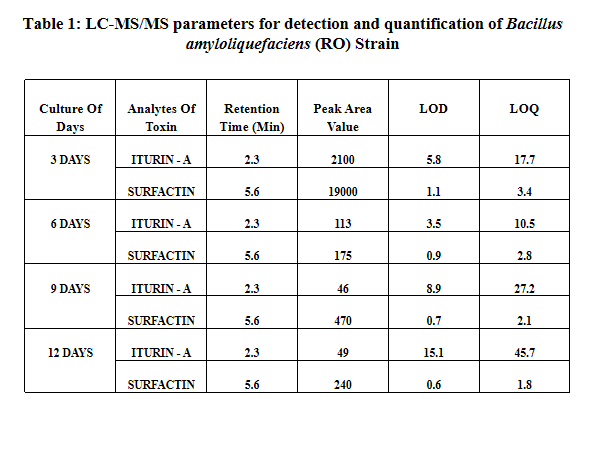
To establish linearity, calibration curves were achieved with spiked samples at various levels. The LC conditions and flow rate of the mobile phase being used to generate the detection of lipopeptides with an amalgamation of water, a volatile organic acid, and an organic solvent methanol or acetonitrile have been determined. It is conceivable that not all of the substances can be evaluated in a single analysis; in this instance, the chromatography can be done at either positive or negative ionisation. In order to establish ideal LC conditions, the tests were carried out in positive ionisation modes. The results reveal that utilizing 0.1 percent formic acid in water as mobile phase A and methanol as mobile phase B yielded the optimum reactivity for the compounds. The acid serves as a suppressant to reduce the incidence of various separation processes. The retention durations of the lipopeptides are indicated on the recorded chromatograms (Figure 1), and the retention times for iturin A and Surfactin were 2.3 and 5.6 on different days of culture, respectively. The peak area values of iturin A and sufactin in the third culture were 2100 and 19000, respectively. Similarly, on the sixth day (113 and 175), the ninth day (46 and 470), and the twelfth day (49 and 240), respectively. It has been shown that producing iturin and surfactin at the same time has a synergistic impact and increases antimicrobial activity [9]. Thus, the development of two distinct lipopeptide antibiotics may be connected to the biocontrol efficiency of the selected strain. The variance in molecular weight indicates differences in the number of methylene groups in the lipid or peptide part of the components. When comparing the mass spectra of iturin and surfactin, the chromatographic retention durations and the possibility of adduct ion formation should be considered. Some peaks in an electrospray mass spectrum represent sodium or potassium adducts, i.e. [M+Na]+ or [M+K]+. Alternatively, certain antibiotics production might be delayed in comparison to others (Hofemeister et al., 2004) [10], which could explain the discrepancies in peak intensities. The evolution of quantification using LC-MS will be facilitated by an effective and efficient control to monitor the active components of antimicrobial substances.
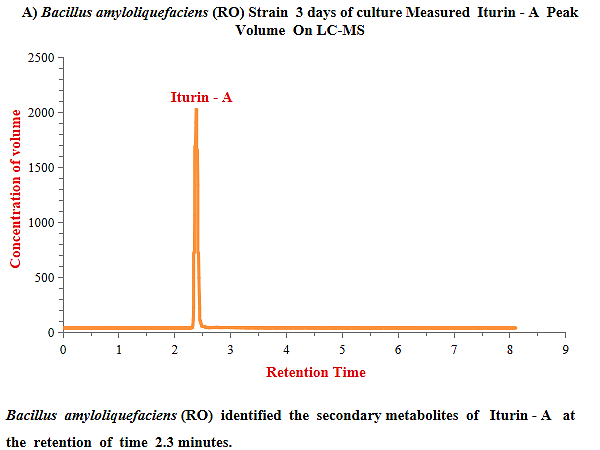
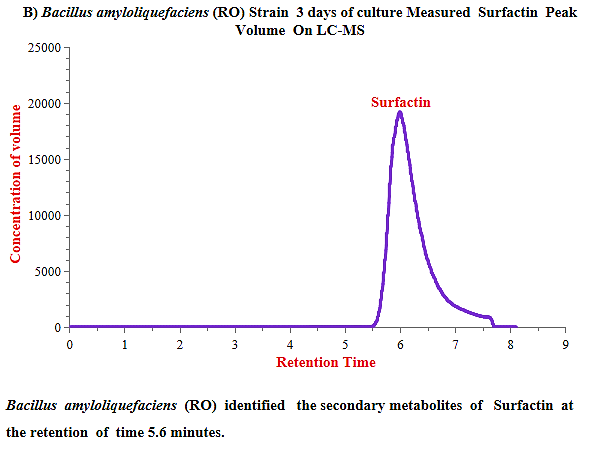
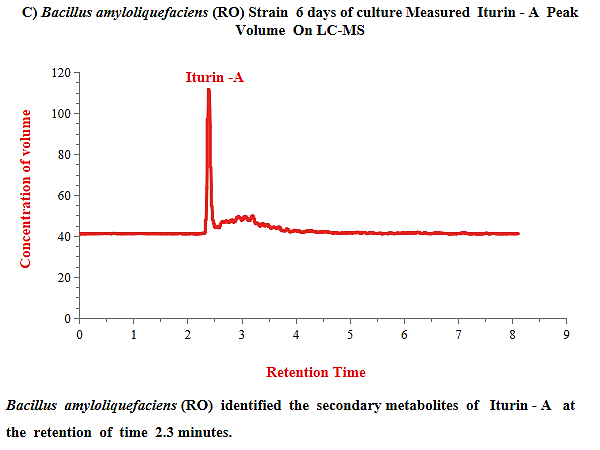
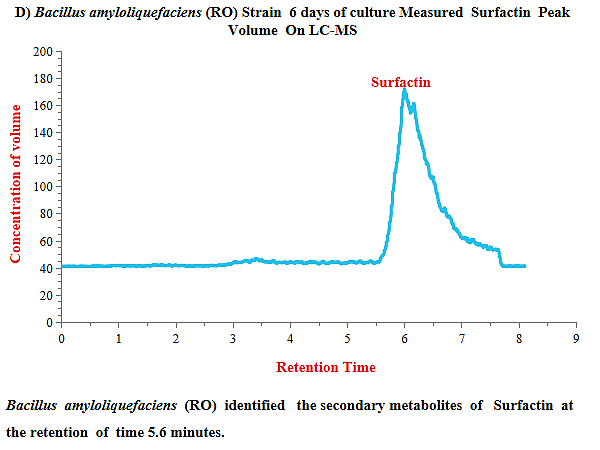
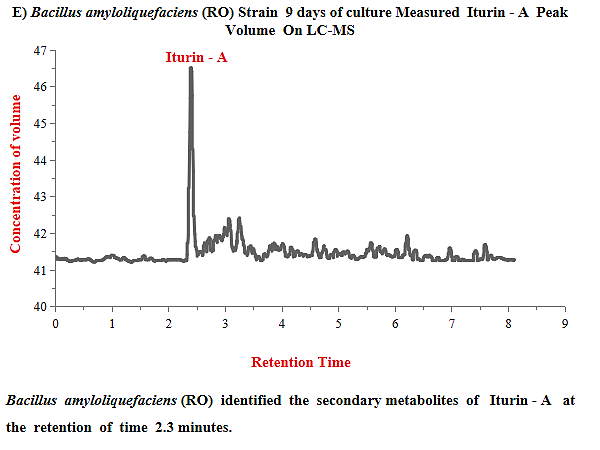
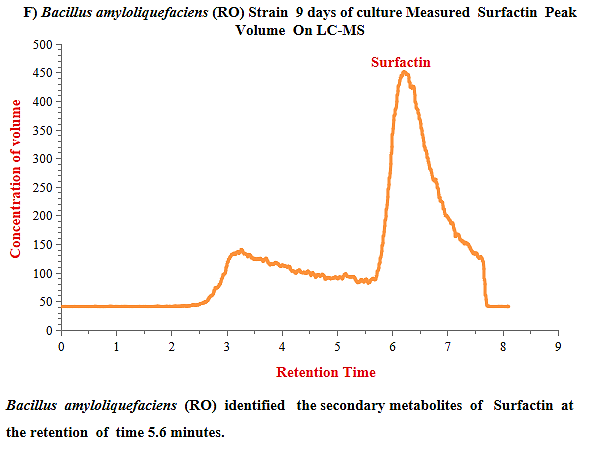
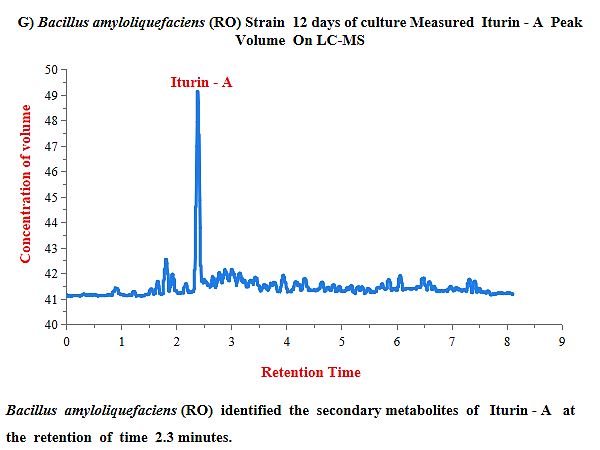
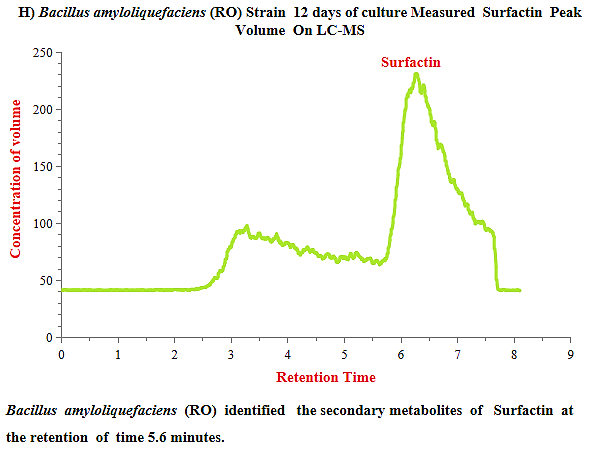
Figure 1: LC-MS Results on Bacillus amyloliquefaciens (RO) Strain culture of various days
LOD AND LOQ EVALUATION
For most analytes, the data used to produce the LOD values also met the requirements for establishing the LOQ value. Calibration of detection limits and variability are critical features of every quantitative experiment. The concentration of analyte that can be quantitatively determined with an acceptable level of uncertainty.
Regression analysis was used to determine the linearity of the calibration graphs. The S/N ratio of 3:1 was used to compute the limits of detection (LOD). The limits of quantitation (LOQ) were established at the lowest level with a S/N ratio of 10:1. The results further demonstrated that the devised approach is very accurate and precise, with good inter- and intraday reproducibility. The peak area value and bioactive chemicals are shown in (Table - 1). Overall, an appropriate and reliable approach for simultaneous quantification of the lipopeptides Surfactin and Iturin A in biological materials using LC-MS was developed and validated.
IDENTIFICATION OF BIOACTIVE COMPOUNDS USING MALDI - TOF ANALYSIS
MALDI-TOF mass spectrometry analysis of the purified active compounds led to the identification of cyclic lipopeptides belonging to the three known groups: iturin A, surfactin and bacitracin. Mass spectra obtained from B. amiloliquefaciens RO showed very clear peak clusters (Figure - 2). The matrix compound plays a key role by strongly absorbing the laser light energy, indirectly causing the analyte to vaporize [11]. The particular mass peaks and the corresponding antibiotics are listed in (Table - 2). The m/z peak value of 1036.34 was used to represent iturin –A; m/z of 1043.35 for surfactin and m/z of 1422.69 for Bacitracin. Similarly the peak area value of bioactive compounds such as Iturin A, surfactin and bacitracin were 14800, 15950, 20100 detected respectively. Generally these lipopetides exhibit highly rigid, and cyclic structures. Various types of mass spectroscopy have shown differences in analyte ionisation efficiency. The current study assessed the use of MALDI-TOF MS in a culture collection to facilitate the identification of strains after conservation. Iturin , the lipopeptide antibiotics with abroad antifungal spectrum. They have wide application in industries and medicine [12]. The incompatible performances exhibited by the same antibiotics in different studies suggest that their performance might be changed by various uncertain factors. In some instances certain antibiotics showed stronger activity than others. The production of these metabolites was reported to be a growth phase dependent. Therefore the typical secondary metabolites, produced during the stationary growth phase. These results agree with the fact that Bacillus may produce a diversity of antimicrobial peptides that vary according to the strain [5]. In this study identified surfactin as the prominent lipopeptide in B. amyloliquefaciens strain RO in LC-MS, whereas in MALDI-TOF bacitracin has been identified. In this observation, the supernatant indicated that two cyclic lipopeptides - iturin A , surfactin and bacitracin are produced from the RO strain and contribute to the biocontrol activity directly and indirectly. This study highlights the potential of Bacillus amyloliquefaciens RO strains that inhibit different microhabitats to generate a range of antibiotics and indicates the prospect of utilizing certain strains as prospective biocontrol agents in other environments distant from their origin. This suggests that the most prevalent lipopeptide antibiotics generated by Bacillus species are iturin A, surfactin, and bacitracin.
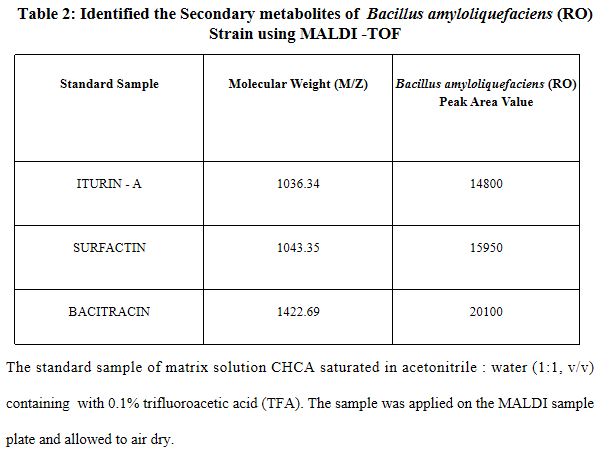
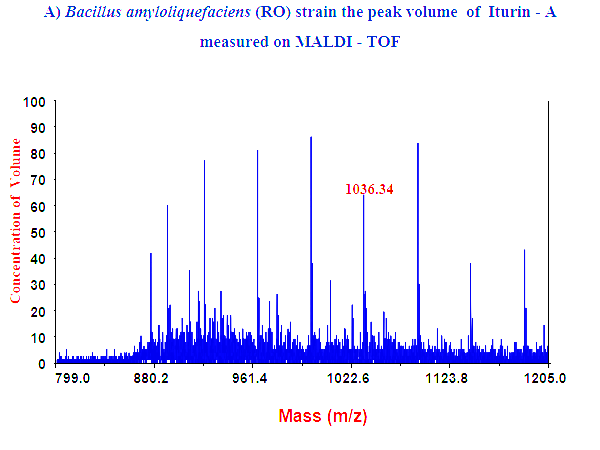
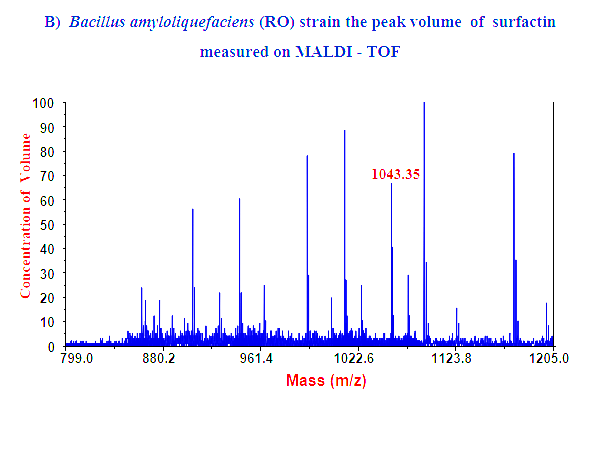
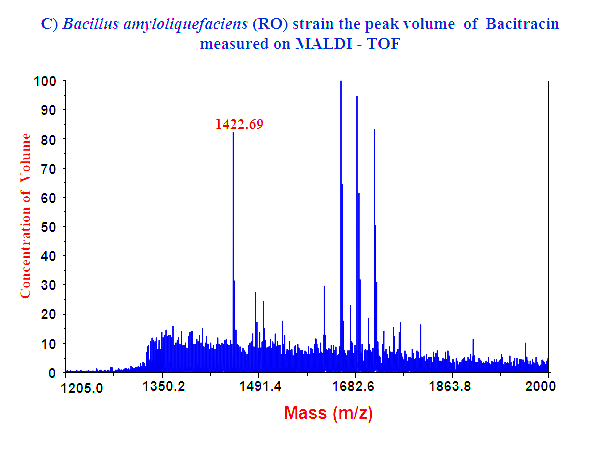
Figure 2: MALDI-TOF results on Bacillus amyloliquefaciens (RO) Strain culture

B.amyloliquefaciens is used as biocontrol agent in agriculture which is important in controlling plant pathogens. The production of metabolites with antimicrobial activity is one determinant of their ability to control plant diseases. Numerous biosurfactants synthesized by environmental isolates have been broadly explored due to their antimicrobial property. These biosurfactants plays potential role in the agricultural sector in order to eliminate plant pathogens. In this study, a strain of RO with a wide spectrum of antimicrobial capacities was isolated from soil. This strain exhibits high antagonistic activity against a large number of plant pathogens, particularly against the sugarcane pokkah boeng diseases. Bacillus amyloliquefaciens ROhas potent antibiotics and other secondary lipopeptides for biocontrol of plant pathogens. However, further investigation is needed on modes of action, spectrum of effects on other pathogens, effects on plant growth promotion, and the biological control efficacy of strain RO in the agro eco system.
Conflict of Interest
The authors declare that they have no conflict of interest.
Funding: No funding sources
Ethical approval: The study was approved by the Institutional Ethics Committee of Guangxi University, Nanning
Tserkovniak, L. S., A. O. Roĭ, and I. K. Kurdysh. "Synthesis of amino acids of Bacillus subtilis IMV V-7023 in the medium with glycerophosphates." Mikrobiolohichnyi Zhurnal (Kiev, Ukraine: 1993) 71.5 (2009): 18-23. https://europepmc.org/article/med/20458933
Jeyakumar, J. M. J., and M. Zhang. "Analytical Quantification of mycotoxin by LC-ESI-MS/MS, and MALDI-TOF MS in Phoma species-infected sugarcane." Annals of Plant Sciences 10.4 (2021): 4195-4205.
Shu, Lin-Jie, and Yu-Liang Yang. "Bacillus classification based on matrix-assisted laser desorption ionization time-of-flight mass spectrometry—effects of culture conditions." Scientific Reports 7.1 (2017): 15546. https://www.nature.com/articles/s41598-017-15808-5
Abriouel, Hikmate, et al. "Diversity and applications of Bacillus bacteriocins." FEMS microbiology reviews 35.1 (2011): 201-232. https://doi.org/10.1111/j.1574-6976.2010.00244.x
Duan, Guifang, et al. "Evaluation of crude toxin and metabolite produced by Helminthosporium gramineum Rabenh for the control of rice sheath blight in paddy fields." Crop Protection 26.7 (2007): 1036-1041. https://doi.org/10.1016/j.cropro.2006.09.014
Maget-Dana, Régine, et al. "Surfactin/iturin A interactions may explain the synergistic effect of surfactin on the biological properties of iturin A." Biochimie 74.12 (1992): 1047-1051. https://doi.org/10.1016/0300-9084(92)90002-V
Domon, Bruno, and Ruedi Aebersold. "Mass spectrometry and protein analysis." science 312.5771 (2006): 212-217. https://www.science.org/doi/10.1126/science.1124619
Tendulkar, S. R., et al. "Isolation, purification and characterization of an antifungal molecule produced by Bacillus licheniformis BC98, and its effect on phytopathogen Magnaporthe grisea." Journal of applied microbiology 103.6 (2007): 2331-2339. https://doi.org/10.1111/j.1365-2672.2007.03501.x