This research assessed the diversity in species of woody species within the lowland rainforest floristics of Ika region, Nigeria. The research design used was the quasi experimental approach. The Ika region was stratified into 12 sub-areas, while selection of sampling units was made using the technique of random sampling. The sampling units were specified into two different groups as secondary (degraded areas) and primary (mature rainforest within conserved areas) groves. From each sub-area, 2 sampling units were selected randomly, making 24 sampling units. Data collection which was based on species of the woody trees and their populations together with the sampling areas, adopted the quadrat size of 10m x 10m to ensure effectiveness. Standard approaches were followed in data collection; while data generated were analysed using graph, Simpson’s index and student t-test statistics. Population of the tree species varied in the 2 ecosystems. Tree species such as Milicia excelsa, Swietenia macrophylla, Alstonia boonei and Aniba rosaeodora are gradually becoming threatened. Tree species diversity varied between the 2 ecosystems, with observed loss of biodiversity. Tree species were more diverse in the primary grove. Simpson’s indices of tree species diversity values for the secondary and primary groves are 0.5783 and 0.8050. With probability, variance and t-values of 0.000, 0.0015 and -14.027 respectively, species diversity between the 2 ecosystems is significant at 0.05 level of confidence. Degradation has negatively impacted on the rainforest and its tree species. Reforestation of the degraded rainforest is recommended for sustainability.
Keywords
Biodiversity
Conservation
Rainforest
Simpson’s Index
Sustainability
INTRODUCTION
Overexploitation of resources has continued to modify and destroy the natural state of rainforest and consequently, the ecological systems globally [1]. These uncontrolled disturbances, modification and destruction of the natural ecosystem have resulted in severe ecological degradation, which are negative impacts. The overexploitation of rainforest resources is established in the form of destruction of forest cover, biodiversity loss, species extinction, destruction and loss of habitats, ecological imbalance, habitat fragmentation [2-4].
The rainforest ecosystem has been identified as a very valuable ecosystem in the world [5], forms a veritable base from which substantial proportion of the populace derive their means of livelihood [4] and has for several years, contributed greatly towards the national economic growth of nations [6]. The rainforest ecosystem is a primary aid to the sustainable livelihood of teaming human populations. Upon the contributions of rainforest ecosystem to humans, Shaheen, Qureshi and Shinwari [7], emphasized that Himalayan mountain rainforest provides the valuable livelihood goods and services to the inhabitants of the region in regulating, providing and supporting human resource needs and materials supplies.
Rainforests play a vital role as source of raw materials for wood based industries, food for man and as a buffer against ecological hazards. For these reasons their conservation is inevitable to ensure that even with infrastructural developments, the resulting environment is satisfactory to the people, self-sustaining and offers opportunities for future challenges [8,9]. This requires judicious utilization and effective management as well as, conservation of forest resources which cannot be isolated from ecological factors [10,11].
Biodiversity loss is a significant problem resulting from rainforest resource exploitation [12,13]. The act of tree felling for timber without plans for replacements, leads to biodiversity loss and promotes ecosystem degradation [14]. In the past, when populations of humans were low and there was no export of timber, the removal of trees for building and fuel wood did little harm. But with time, the export of timber has decimated the rich rainforest of its species [15].
The uniquely multi-layered and species-rich rainforests are now characterised with few species and island patterned ecosystem due to Settlement development and expansion, road construction, infrastructural development, agricultural activities, commercial lumbering, fuel-wood collection, medicinal herb collection and charcoal making [16]. Species extinction is a major problem caused due to overexploitation of the rainforest resources, which has negatively impacted on the varieties of plant species. The removal of forest cover resulted in the displacement and extinction of many plant species.
Presently, this rainforest is fast disappearing from different regions of the world, southern Nigeria inclusive; thus, causing unprecedented biodiversity loss and reduced ecosystem services. Floristic composition is that aspect of ecosystem’s inventory made up of species diversity and taxonomic components of the equatorial region [17].
Several researches have investigated different aspects of rainforest tree species and their levels of diversity across different regions globally. In a study which took place in Congo, Kafuti et al., [4], carried out analysis of specific diversity of floristic compositions. Farmilo, Melbourne, Camac and Morgan [18], examined the changes associated with the density of species of trees in forest fragments of Austral. A study by Adekunle, Adewole and Akindele [13], examined species of trees and their diversity in Nigeria. Another research by Shaheen et al. [7], investigated structural diversity and vegetation dynamics in sub-tropical forest of Kashmir. The study by Onwubuya, Ogbonna and Ezeobiora [19], assessed forest resources conservation by farmers in the Anambra State rainforest region of Nigeria. Fashing, Forrestel, Scully and Cords [20], assessed the population dynamics of forest trees and their long-term impact in Kenya. Köhler [5], studied how fragmentation influences biodiversity in the East African rainforest; while Dunne, Williams and Martinez [11], examined biodiversity loss in relation to network structure.
However, this research assessed the diversity of the species of woody trees in the lowland rainforest floristics of Nigeria. This is with the primary intent to suggest ecological measures effective towards the management of the degraded rainforest floristics and avoid tree species extinction. Therefore, this study tested the hypothesis which states that “diversity of tree species is not significant between the secondary and primary rainforest groves of Ika region at 0.05 confidence level.
MATERIALS AND METHODS
The assessment of woody trees within the lowland rainforest floristic of southern Nigeria took place in the Ika rainforest region. The research design used was the approach of the quasi experimental. Ika region was divided into 12 sub-areas using the technique of stratified sampling, while selection of sampling units was done using the approach of random sampling. The sampling units were specified into 2 groups as secondary (degraded areas) and primary (mature rainforest within conserved areas) groves. From each sub-area, 2 sampling units were selected randomly, making 24 sampling units. Data collection was from the type of tree species and their populations. Quadrats measuring 10m x 10m were used in the data collection to ensure effectiveness [1,16]. In determining the size of the sampling areas, measuring tape and ranging poles were used. Populations of each species of the woody trees were ascertained in each quadrat and summed up for a given sampling unit. The data generated were analysed using graph, Simpson’s index of tree species diversity [2] and student t-test statistics.
RESULTS
Tree Species contained in the Secondary and Primary Groves
Although the scientific names of these species were known, their common names are presented because, within the study area, the tree species were easily known and identified by through their common names. For instance, Piptadeniastrum africanum could only be identified by the dominating area name.
Table 1 presents the scientific and common names of tree species contained in both secondary and primary rainforest groves. The species are the rainforest indigenous trees. These species are the only ones presently contained within the study area. It is possible that other species of rainforest indigenous trees have become threatened and therefore scarce in the region, due possibly to human impact.
Species of Woody Trees and their Populations in the Secondary and Primary Groves
The populations of the species of woody trees varied in both secondary and primary rainforest groves. Some tree species contained in the primary groves were not found in the secondary sites. This is possibly due to species loss owing to degradation, which has limited the presence of some species of the rainforest trees that were indigenous to the ecosystem. Variation in the populations of trees was also observed in the research by Humphrey [12] and Fashing et al., [20]. Tables 2 and 3 present the populations of tree species in the secondary and primary rainforest sites respectively.
From Table 2, trees populations vary across the sites. While some species of trees were found in some sites, some major rainforest tree species such as M. excelsa, S. macrophylla, P. africanum, C. pentandra, A. rosaeodora and A. boonei, were not found in some other sites. Such species are possibly becoming threatened and are gradually going into extinction from the ecosystem.
Table 1: Species of Trees Contained in the Secondary and Primary Groves
Tree Species Scientific Names
Common Names
Milicia excelsa
Iroko
Elaeis guineensis
Oil palm
Swietenia macrophylla
Mahogany
Irvingia gaboneensis
Bush mango
Piptadenastrium africanum
Sapele wood
Triplochyton scleroxylon
Obeche
Ceiba pentandra
Kapok
Aniba rosaeodora
Rose wood
Newbouldia laevis
Boundary tree
Antiaris toxicaria
Sacking tree
Pentaklepta macrophylla
Oil bean tree
Alstonia boonei
Chees wood
Authors Field Work, 2022
Table 2: Tree Species and Their Populations in the Secondary Groves
Tree Species
Populations in Secondary Grove
1
2
3
4
5
6
7
8
9
10
11
12
M. excelsa
1
0
0
0
0
1
0
0
0
1
0
0
E. guineensis
2
4
3
5
3
3
2
4
4
3
6
3
S. macrophylla
1
2
0
0
0
0
0
0
0
1
1
0
I. gaboneensis
2
2
3
4
5
2
1
1
3
0
0
1
P. africanum
1
0
1
0
0
0
0
0
0
1
2
0
T. scleroxylon
0
3
1
1
0
1
3
0
0
2
0
1
C. pentandra
0
1
0
1
0
1
0
0
0
1
1
0
A. rosaeodora
1
0
0
0
0
1
0
0
0
1
0
0
N. laevis
2
3
2
4
4
3
2
4
3
2
1
1
A. toxicaria
3
2
4
3
3
4
2
5
1
0
2
2
P. macrophylla
4
3
5
2
4
3
2
5
3
4
1
1
A. boonei
1
1
0
0
0
0
0
1
1
0
0
1
Total Populations in Sites
18
21
19
20
18
19
12
20
15
16
14
10
Authors Field Work, 2022
Table 3: Simpson’s Index of Diversity of Tree Species in the Secondary and Primary Groves
Sites
Secondary groves
Primary groves
Simpson’s Index of Diversity
Simpson’s Index of Diversity
1
0.58
0.78
2
0.63
0.77
3
0.54
0.75
4
0.61
0.84
5
0.57
0.82
6
0.60
0.86
7
0.55
0.78
8
0.52
0.88
9
0.56
0.80
10
0.62
0.81
11
0.63
0.79
12
0.53
0.78
Authors’ Computations, 2022
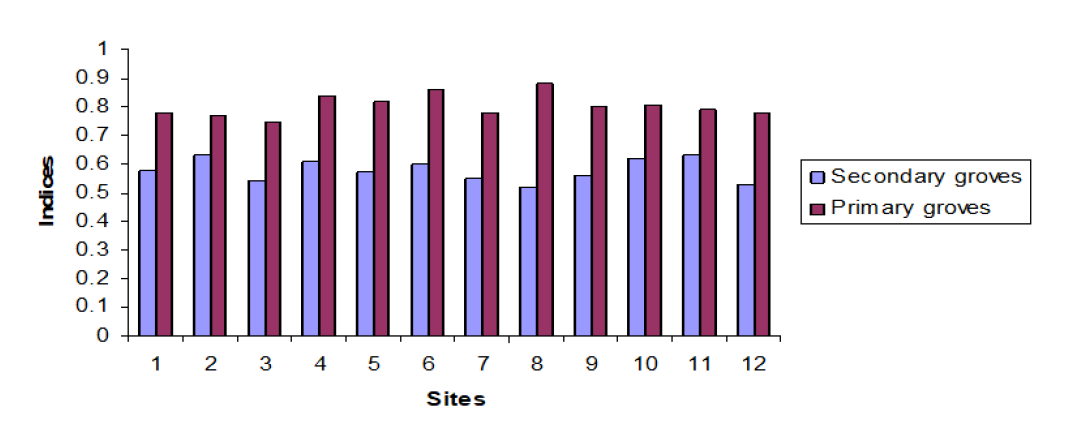
Figure 1: Index of Diversity of Woody Tree Species in the Secondary and Primary Rainforest Groves
This could also be attributed to species loss, leading to reduction in the species diversity of trees within the ecosystem. Some tree species such as P. macrophylla, E. guineensis, I. gaboneensis, N. laevis and A. toxicaria, featured much in several sites. This variation in tree species population is in tandem with findings in the studies earlier reported by Humphrey [12].
From Table 3, trees populations vary across the sites. Although, many of the sites contained all the tree species examined, a few of the site do not contain tree species such as M. excelsa, A. rosaeodora, S. macrophylla, P. africanum and T. scleroxylon. However, the dominance of all the tree species prevailed in almost all the sites within the primary rainforest groves. The absence of some indigenous tree species within sections of contiguous rainforest was reported in a study by Ndakara et al., [2].
Diversity of Tree Species between Secondary and Primary Rainforest Groves
The level of tree species diversity varies between the secondary and primary rainforest groves. This is due possibly to the observed variations in the populations of individual tree species contained in both ecosystems. Due to increased levels of degradation within the rainforest, biodiversity loss was observed. Variation in the species of woody trees contained in both ecosystems was also observed. Some tree species have gone threatened. For others, their populations vary across the rainforest sites. This study revealed that certain trees which characterise lowland rainforest are common to all the sites, accounting for the rainforest tree species distribution pattern within the regional climate and edaphic distribution [1]. The Simpson’s Index was utilized to ascertain diversity of the tree species and their level of dominance in the different rainforest sites.
Table 4: Statistical Results of Simpson’s Indices of Species Diversity between Secondary and Primary Rainforest Groves
S/N
Sites
Species populations
Simpson’s Index (S.I)
Variance (S²)
t-value
Sig. (2-tailed)
1
Secondary Rainforest Sites
202
0.5783
0.0015
-14.027
0.000
2
Primary Rainforest Sites
1066
0.8050
0.0015
Table 4, shows the indices of diversity at different sites. The indices are higher in the primary groves than the secondary groves. This shows that the tree species are more diverse in the primary groves than the secondary groves. This situation is as a result of the impact of resource exploitation that has affected the rainforest tree species in the secondary sites.
The difference in the diversity of tree species between the secondary and primary rainforest groves was tested at 0.05 level of confidence.
Table 5 shows the statistical results of Simpson’s Indices of diversity between secondary and primary rainforest sites. The Simpson’s index values for secondary and primary groves are 0.5783 and 0.8050. The variance values are 0.0015 in the two ecosystems. The t-value is -14.027, with a probability value of 0.000. The result is therefore significant at 0.05 level of confidence. This implies that degradation of the rainforest has negative impact on the tree species diversity. This result corroborates findings reported by Ndakara et al., [2], Bradshaw, Sodhi and Brook [9].
CONCLUSION
However, this research assessed woody tree species diversity in the lowland rainforest floristic of Nigeria. The study which was conducted in the Ika region, investigated 2 defined sampling units called secondary (degraded areas) and primary (mature rainforest within conserved areas) groves. The focus of the study was to determine the woody tree species diversity between the two ecosystems, one being degraded while the second served as a control to the study.
The populations of woody tree species varied in both secondary and primary rainforest groves. While some of the sites contained some of the tree species, some of the major rainforest tree species such as M. excelsa, S. macrophylla, P. africanum, C. pentandra, A. rosaeodora and A. boonei, were not found in some of the sites. Such tree species are becoming threatened and are gradually going into extinction. The level of tree species diversity varies between the secondary and primary rainforest groves. Loss of biodiversity was observed. The indices are higher in the primary groves than the secondary groves. This shows that the tree species are more diverse in the primary groves than the secondary groves. The Simpson’s index values for secondary and primary groves are 0.5783 and 0.8050. The variance values are 0.0015 in the two ecosystems. The t-value is -14.027, with a probability value of 0.000. The result is therefore significant at 0.05 level of confidence. This implies that degradation of the rainforest has negative impact on tree species diversity. The enhancement of biodiversity is central and at the heart of forest resource conservation strategy is the idea that human impacts should mimic the biodiversity levels and functioning of local ecosystems [17]. These ideas are geared towards improving a sustainable forest development while conserving biodiversity in the ecosystem.
This study recommends the application of the Ecosystem-Based Management concept, which is focused on forest conservation and its resources through an integrated network that involves the full participation of the rural inhabitants in the forested regions. The strategy must be applicable under the highly heterogeneous and diverse conditions in which the land holders live. It must be environmentally sustainable and based on the use of local resources and indigenous knowledge. The exercise includes ways to improving the quality of forests by controlling the degradation of forest trees and its associated resources in the face of conservation.
REFERENCES
Ndakara, O.E. “Hydrological nutrient flux in isolated exotic stands of Mangifera indica Linn: Implications for sustainable rainforest ecosystem management in south-southern Nigeria.” Nigerian Journal of Science and Environment, vol. 14, 2016, pp. 125–131.
Liu, J. et al. “How does habitat fragmentation affect the biodiversity and ecosystem functioning relationship?” Landscape Ecology, vol. 33, 2018, pp. 341–352.
Kafuti, C. et al. “The impact of industrial logging on species diversity and floristic composition of a tropical rainforest: Case of cotrefor-alibuku concession forest in DRC.” 2016.
Köhler, J. Biodiversity in Conversion: The Influence of Fragmentation and Disturbance on the Biodiversity of East African Highland Rain Forests.BIOTA East Africa: Final Report Phase I: 2001–2004, 2004.
Obi, C.K. and O.E. Ndakara. “The effect of COVID-19 pandemic on OPEC spatial oil production: A macro analysis.” Journal of Advanced Research in Dynamical and Control Systems, vol. 12, no. 8, 2020, pp. 393–402. https://doi.org/10.5373/JARDCS/V12I8/20202487
Shaheen, H. et al. “Structural diversity, vegetation dynamics and anthropogenic impact on lesser himalayan sub-tropical forests of bagh district, Kashmir.” Pakistan Journal of Botany, vol. 43, no. 4, 2011, pp. 1861–1866.
Pawar, K.V. and V.R. Ravi. “Forest Conservation and Environmental Awareness.” Procedia Earth and Planetary Science, vol. 11, 2015, pp. 212–215.
Bradshaw, C.J.A. et al. “Tropical turmoil: A biodiversity tragedy in progress.” Frontiers in Ecology and the Environment, vol. 7, 2009, pp. 79–87.
Amiolemen, S.O. et al. “Assessment of the nutrient status of soil under Chromolaena odorata L. (Siam Weed) Fallow in Moniya, Oyo State, South-Western Nigeria.” Journal of Environmental Studies and Management, vol. 5, no. 3, 2012, pp. 252–259.
Dunne, J.A. et al. “Network structure and biodiversity loss in food webs: robustness increases with connectance.” Ecology Letters, vol. 5, 2002, pp. 558–567.
Humphrey, I.A. “Tree species composition and diversity in Oban forest reserve.” Nigerian Journal of Agricultural Studies, vol. 3, no. 1, 2015, pp. 10–24.
Adekunle, V.A.J. et al. “Tree species diversity and structure of a Nigerian strict nature reserve.” Tropical Ecology, vol. 54, no. 3, 2013, pp. 275–289.
Haastrup, N.O. et al. “Diversity and abundance of tree species at owo forest reserve state, south-western Nigeria.” International Journal of Research and Innovation in Applied Science, vol. 4, no. 7, 2019, pp. 27–32.
Salami, K.D. and A.U. Jibo. “Morphological species diversity and abundance of tree species in owo reserve, Nigeria.” Journal of Agriculture and Environment, vol. 15, no. 1, 2019, p. 199.
Ndakara, O.E. “Biogeochemical consequences of hydrologic conditions in isolated stands of terminalia cattapa in the rainforest zone of southern Nigeria.” Proceedings in Hydrology for Disaster Management, edited by Martins et al., Special Publication of the Nigerian Association of Hydrological Sciences, 2012, pp. 134–144.
Ndakara, O.E. “Throughfall, stemflow and litterfall nutrient flux in isolated stands of persea gratissima in a moist tropical rainforest region, southern Nigeria.” Journal of Physical and Environmental Science Research, vol. 1, no. 1, 2012, pp. 5–14.
Farmilo, B.J. et al. “Changes in plant species density in an experimentally fragmented forest landscape: Are the effects scale-dependent?” Austral Ecology, vol. 39, 2014, pp. 416–423.
Onwubuya, E.A. et al. “Conservation of forest resources by rural farmers in Anambra state, Nigeria.” Journal of Agricultural Extension, vol. 8, no. 2, 2014, pp. 177–184.
Fashing, P.J. et al. “Long-Term tree population dynamics and their implications for the conservation of the kakamega forest, Kenya.” Biodiversity and Conservation, vol. 13, 2004, pp. 753–771.
License
Creative Commons Attribution-NonCommercial-NoDerivatives 4.0 International License
All papers should be submitted electronically. All submitted manuscripts must be original work that is not under submission at another journal or under consideration for publication in another form, such as a monograph or chapter of a book. Authors of submitted papers are obligated not to submit their paper for publication elsewhere until an editorial decision is rendered on their submission. Further, authors of accepted papers are prohibited from publishing the results in other publications that appear before the paper is published in the Journal unless they receive approval for doing so from the Editor-In-Chief.
Himalayan Journal of Agriculture open access articles are licensed under a Creative Commons Attribution-Share A like 4.0 International License. This license lets the audience to give appropriate credit, provide a link to the license, and indicate if changes were made and if they remix, transform, or build upon the material, they must distribute contributions under the same license as the original.
Recommended Articles
Research Article
The Role of Indigenous Microbes and Earthworm in the Bioconversion of Dairy Wastewater Solids into Organic Fertilizer
Marlina ,
...
N. Meynadhea
Published: 17/01/2024
Download PDF
Cite
x
APA
None, M., Rahayu, N. A., Badruzzaman, D. Z., Hidayati, Y., Harlia, E., Kurniawan, E. & Meynadhea, N. (2024). The Role of Indigenous Microbes and Earthworm in the Bioconversion of Dairy Wastewater Solids into Organic Fertilizer. Himalayan Journal of Agriculture, 5(1), 1-7.
MLA
None, Marlina, et al. "The Role of Indigenous Microbes and Earthworm in the Bioconversion of Dairy Wastewater Solids into Organic Fertilizer." Himalayan Journal of Agriculture 5.1 (2024): 1-7.
Chicago
None, Marlina, N. A. Rahayu, D. Z. Badruzzaman, Y.A. Hidayati, E. Harlia, E. Kurniawan and N. Meynadhea. "The Role of Indigenous Microbes and Earthworm in the Bioconversion of Dairy Wastewater Solids into Organic Fertilizer." Himalayan Journal of Agriculture 5, no. 1 (2024): 1-7.
Harvard
None, M., Rahayu, N. A., Badruzzaman, D. Z., Hidayati, Y., Harlia, E., Kurniawan, E. and Meynadhea, N. (2024) 'The Role of Indigenous Microbes and Earthworm in the Bioconversion of Dairy Wastewater Solids into Organic Fertilizer' Himalayan Journal of Agriculture 5(1), pp. 1-7.
Vancouver
Marlina M, Rahayu NA, Badruzzaman DZ, Hidayati Y, Harlia E, Kurniawan E, Meynadhea N. The Role of Indigenous Microbes and Earthworm in the Bioconversion of Dairy Wastewater Solids into Organic Fertilizer. Himalayan Journal of Agriculture. 2024 Jan;5(1):1-7.
Download PDF
Research Article
Mating behaviour of Cavariella aegopodii
Nidhi Dhatwalia
Published: 19/07/2024
Download PDF
Cite
x
APA
Dhatwalia, N. (2024). Mating behaviour of Cavariella aegopodii. Himalayan Journal of Agriculture, 5(1), 1-7.
MLA
Dhatwalia, Nidhi. "Mating behaviour of Cavariella aegopodii." Himalayan Journal of Agriculture 5.1 (2024): 1-7.
Chicago
Dhatwalia, Nidhi. "Mating behaviour of Cavariella aegopodii." Himalayan Journal of Agriculture 5, no. 1 (2024): 1-7.
Harvard
Dhatwalia, N. (2024) 'Mating behaviour of Cavariella aegopodii' Himalayan Journal of Agriculture 5(1), pp. 1-7.
Vancouver
Dhatwalia N. Mating behaviour of Cavariella aegopodii. Himalayan Journal of Agriculture. 2024 Jan;5(1):1-7.
Download PDF
Research Article
Efficiency of Some Salicylic Acid Concentrations in Tetranychus urticae Koch on Some Eggplant Varieties
Yusra Jamal Talib,
...
Nadia Kadhim Thamer
Published: 10/04/2023
Download PDF
Cite
x
APA
Talib, Y. J., Abass, M. H. & Thamer, N. K. (2023). Efficiency of Some Salicylic Acid Concentrations in Tetranychus urticae Koch on Some Eggplant Varieties. Himalayan Journal of Agriculture, 4(1), 1-7.
MLA
Talib, Yusra J., Mohammed H. Abass and Nadia K. Thamer. "Efficiency of Some Salicylic Acid Concentrations in Tetranychus urticae Koch on Some Eggplant Varieties." Himalayan Journal of Agriculture 4.1 (2023): 1-7.
Chicago
Talib, Yusra J., Mohammed H. Abass and Nadia K. Thamer. "Efficiency of Some Salicylic Acid Concentrations in Tetranychus urticae Koch on Some Eggplant Varieties." Himalayan Journal of Agriculture 4, no. 1 (2023): 1-7.
Harvard
Talib, Y. J., Abass, M. H. and Thamer, N. K. (2023) 'Efficiency of Some Salicylic Acid Concentrations in Tetranychus urticae Koch on Some Eggplant Varieties' Himalayan Journal of Agriculture 4(1), pp. 1-7.
Vancouver
Talib YJ, Abass MH, Thamer NK. Efficiency of Some Salicylic Acid Concentrations in Tetranychus urticae Koch on Some Eggplant Varieties. Himalayan Journal of Agriculture. 2023 Jan;4(1):1-7.
Download PDF
Research Article
Efficiency of Production Factors Usage on Sorgum (Sorghum Bicolor L) (Case in Keyongan Village, Babat Sub-District, Lamongan Regency)
Evi Maf'idatul Ilmi,
...
Hamidah Hendrarini
Published: 20/12/2022
Download PDF
Cite
x
APA
Ilmi, E. M., Amir, I. T. & Hendrarini, H. (2022). Efficiency of Production Factors Usage on Sorgum (Sorghum Bicolor L) (Case in Keyongan Village, Babat Sub-District, Lamongan Regency). Himalayan Journal of Agriculture, 3(2), None-None.
MLA
Ilmi, Evi M., Indra T. Amir and Hamidah Hendrarini. "Efficiency of Production Factors Usage on Sorgum (Sorghum Bicolor L) (Case in Keyongan Village, Babat Sub-District, Lamongan Regency)." Himalayan Journal of Agriculture 3.2 (2022): None-None.
Chicago
Ilmi, Evi M., Indra T. Amir and Hamidah Hendrarini. "Efficiency of Production Factors Usage on Sorgum (Sorghum Bicolor L) (Case in Keyongan Village, Babat Sub-District, Lamongan Regency)." Himalayan Journal of Agriculture 3, no. 2 (2022): None-None.
Harvard
Ilmi, E. M., Amir, I. T. and Hendrarini, H. (2022) 'Efficiency of Production Factors Usage on Sorgum (Sorghum Bicolor L) (Case in Keyongan Village, Babat Sub-District, Lamongan Regency)' Himalayan Journal of Agriculture 3(2), pp. None-None.
Vancouver
Ilmi EM, Amir IT, Hendrarini H. Efficiency of Production Factors Usage on Sorgum (Sorghum Bicolor L) (Case in Keyongan Village, Babat Sub-District, Lamongan Regency). Himalayan Journal of Agriculture. 2022 Jul;3(2):None-None.
Ofudjaye Emmanuel, N. & Tobechukwu Louis, O. (2022). Woody Tree Species Diversity Assessment of the Moist Lowland Rainforest Floristics of Nigeria. Himalayan Journal of Agriculture, 3(2), 1-5.
MLA
Ofudjaye Emmanuel, Ndakara and Okwuokei Tobechukwu Louis. "Woody Tree Species Diversity Assessment of the Moist Lowland Rainforest Floristics of Nigeria." Himalayan Journal of Agriculture 3.2 (2022): 1-5.
Chicago
Ofudjaye Emmanuel, Ndakara and Okwuokei Tobechukwu Louis. "Woody Tree Species Diversity Assessment of the Moist Lowland Rainforest Floristics of Nigeria." Himalayan Journal of Agriculture 3, no. 2 (2022): 1-5.
Harvard
Ofudjaye Emmanuel, N. and Tobechukwu Louis, O. (2022) 'Woody Tree Species Diversity Assessment of the Moist Lowland Rainforest Floristics of Nigeria' Himalayan Journal of Agriculture 3(2), pp. 1-5.
Vancouver
Ofudjaye Emmanuel N, Tobechukwu Louis O. Woody Tree Species Diversity Assessment of the Moist Lowland Rainforest Floristics of Nigeria. Himalayan Journal of Agriculture. 2022 Jul;3(2):1-5.


 Download PDF
 Download XML