Two of the most significant killers of the U5 children are Pneumonia and diarrhea where pneumonia leads the race. Pneumonia is clubbed under the blanket of Acute Respiratory Infections (ARI). Currently, the issue gains further significance with the issue of increased air pollution both indoor and outdoor.The current article examines the contribution of Homoeopathy to deal with pneumonia. The article traces the importance of dealing with pneumonia both at global and the national level. Thereafter, it deals with the subject of pneumonia through the dimension of how, why, when, where and whom of pneumonia. Following that the burden of the disease as such is explained along with the intervention of Co-trimoxazole and Amoxycillin (CA) duo to deal with the disease. Interventions are also seen through the lens of prevention and protection as well. Taking cue from one of the elaborate and established books in the Homoeopathic world, it deals with what Homoeopathy had offered, is offering and the potential to offer in the future to deal with this acute respiratory problem.
Keywords
Homoeopathy
Acute Respiratory Infections (ARI)
Co-Trimoxazole and Amoxicillin (CA duo)
Child Health Interventions
INTRODUCTION
In the past, in the 20th century, Homoeopathy had been used successfully for Acute Respiratory Infections (ARIs) like influenza, whooping cough, flu. One such use in the epidemic was during the Spanish flu in 1918-20. In the 21st century, with COVID 19 affecting the respiratory system in a great way, Homoeopathy has not only dealt the respiratory symptoms but also the whole issue of COVID 19. The major issue is that the treatment of pneumonia through Homoeopathy has not been reflected in large scale surveys like the NFHS series.
Although in the NFHS 4 questionnaire, there is a section mentioning seeking treatment from a homoeopath for pneumonia, in the analysis of the indicator related to treatment, it is clubbed under the indicator ‘taken to a health facility or health provider’ and the NFHS 4 report says that 78% of children who had ARI were taken to health facility or health provider. Here, we do not know how many health facilities were homoeopathic or how many providers were homoeopathic. Hypothetically, if we see the 2012 data of GOI, only 1.8% of children used homoeopathy and only 0.2% went to a homoeopathic doctor, it emerges that only 2% (1.8+0.2) of the 78% of children with ARI were treated homoeopathically either from private or public sector.
With this issue in the background, the current article examines what Homoeopathy can offer in the emerging and challenging nature of the respiratory diseases and Acute Respiratory Infections.
Officially both the interventions like Cotrimoxazole and Amoxicillin emerged at global level and in India in the late 1980s. Hence, it is wise to see the journey of homoeopathic treatment in pneumonia/ARI diseases in India as till date, they have travelled parallel as the Homoeopathic act was passed in Indian parliament in 1973. Unfortunately, there is no large-scale survey to decipher the role of homoeopathy in the reduction of these deaths but what we have is only the number of users of homoeopathy in pneumonia without any follow up data. The article uses the report of NFHS 4 as the report of NFHS 5 for India is yet to be released.
The current effort aims to suggest a treatment protocol as per the age categories of children till 5 years of age for ARI.
Histrorical Journey of Pneumonia
Using the evidence from the decade of 1970s, the framework of Integrated Management of Childhood Illnesses (IMCI) was developed to frame the pneumoniarelated guidelines. In the late 1980s, pneumonia was dealt with cotrimoxazole orally for not severe cases a d injectable penicillin for severe cases.
Table 1: Program Timeline
1990
National ARI control program launched with case management with cotrimoxazole.
1992
ARI control program became a part of Child Survival and Safe Motherhood Program (CSSM).
1997
CSSM became a part of Reproductive and Child Health program (RCH).
2003
Integrated Management of Neonatal and Childhood Illnesses (IMNCI) strategy became a part of RCH phase II program.
2005
Became a part of child health program and Childhood Pneumonia Management and Control Program launched.
2009
November 12 becomes world pneumonia day by Global Coalition against Child Pneumonia (GCCP).
2013
RMNCH+A launched with case management with amoxicillin.
2014
India Action Plan for Pneumonia and Diarrhea (IAPPD) launched following the Global Action Plan for Pneumonia and Diarrhea (GAPPD) launched by WHO in 2013.
In 2009, a Global Action Plan for Prevention and Control of Pneumonia (GAPP) was developed by WHO, UNICEF and partners. In 2012, amoxicillin became the drug of choice after treating pneumonia in HIV cases in 2010. In 2013, the GAPPD framework was developed at global level [1-4,6,17,19].
History of Pneumonia Program in India
Table 1 describes the time line of the progress of the pneumonia control program in India [1-4,6,17,19].
About Pneumonia
Pneumonia is a form of Acute Respiratory Infection that affects the lungs. In Pneumonia, the alveoli are filled with pus and fluid instead of air making breathing difficult. It can be caused by bacteria, viruses or fungi. Among bacteria, Streptococcus Pneumoniae, Haemophilus Influenzae type b (Hib) and Pneumocystis Jiroveci (in HIV infected infants) are most common. Among viruses, respiratory Syncytial viruses are common [4,5].
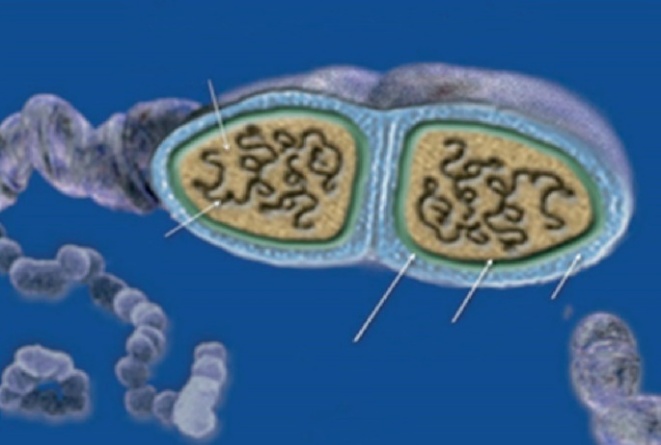
The figure below gives the magnified image of Streptococcus Pneumoniae. It is transmitted if the child inhales the virus or bacteria commonly present in the nose and throat, air borne droplets through cough or sneeze, through blood during and just after birth. The symptoms of viral pneumonia are more numerous than the bacterial pneumonia. In U5 children who have cough and difficult breathing, with or without fever, pneumonia is diagnosed through the presence of fast breathing or lower chest wall in-drawing where them chest moves in or retracts during inhalation. Normally, the chest expands during inhalation. Wheezing is more common in viral pneumonia.
Very severely ill infants may not be able to feed or drink and may also experience unconsciousness, hypothermia and convulsions. Undernourishment, HIV, Measles led to poor immunity and thereby the risk of pneumonia increases. In addition, environmental factors like indoor air pollution, living in crowded places and parental smoking are other risk factors.
Indoor and Outdoor Pollution
The indoor pollution mainly as a result of using bio-mass as fuels contributes to ARI and pneumonia. As per NFHS 4, 43.8% of house-holds were using clean fuel for cooking and the uses of clean fuels have increased. In NFHS 5, data informs us that 58.6% of house-holds currently use clean fuels for cooking. This clearly shows that schemes like Ujjwala yojana launched in 2018 have reduced indoor pollution. Efforts of Tata trust in providing COEL (Carbon monoxide Emission Level) bangles to women are successful efforts to reduce indoor pollution. The COEL bangle measures the Carbon Monoxide and Particulate Matter (PM) in the wearer’s surroundings and informs them visually, audibly when the air around them starts to harm their health [5,28,29,34].
Similarly for outdoor pollution, the Ministry of Environment, Forest and Climate Change (MEFCC) launched the National Clean Air Program in January 2019 to prepare clean air action plans with an objective to reduce the PM2.5 pollution by 20-30% by 2024 as compared to 2017 in 122 cities. As a result of this effort, the Air Quality Index for cities are displayed by the pollution control boards at centre and state level.
Indoor pollution is a major factor contributing to ARI in children. In fact, these two types of pollution directly impact the Childhood Pneumonia Management Program.
About SDG and Pneumonia
Pneumonia comes under the Global Action Plan for Prevention and control of Pneumonia and Diarrhea (GAPPD) sector interventions of public health and comes under the domain of air borne diseases. Among Sustainable Development Goals (SDG), Goal #3.2.1 is related to good health, wellbeing and reducing child mortality through ending pneumonia related deaths [22].
Burden of Pneumonia
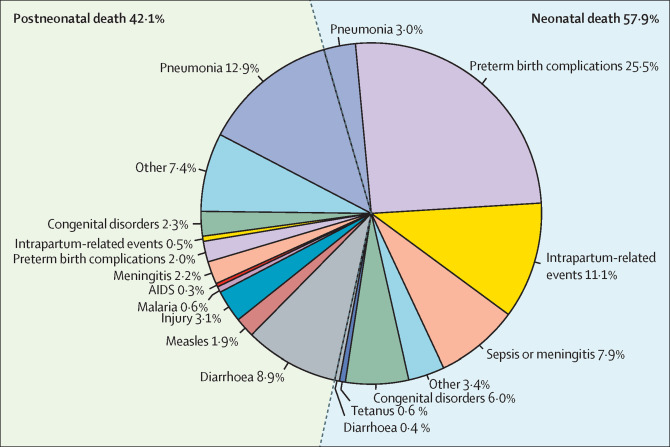
As evident from the Figure 1, pneumonia causes 12.9% of all deaths from 1-59 months aged children in the under 5 group and 3% deaths in the 0-1 months aged children in the under 5 group. Thus, globally it is a more potent killer than diarrhoea as it accounts for 15.9% deaths among all the deaths among under 5 children. This data also holds good for India as the cause of mortality for specific groups is deduced at global level. The total number of live births in India as per census 2011 is 2% of 125 crore which is 2.5 crore. Further, the current U5 mortality rate of India is 34 per 1000 live births. Hence in 2.5 crore live births, there will be 8,50,000 deaths among U5 children in India in a year. Among these deaths, 15.9% are due to pneumonia in a year. Rounding up 15.9% to 16%, we see that 16% of 8,50,000 deaths or 1,36,000 deaths are due to pneumonia in India in a year [8,33].
A study by Save The Children in 2019 on pneumonia reports that in rural areas, the cost of treatment of pneumonia was six times higher in private facilities compared to the public facilities Figure 1.
Situation of Pneumonia inIndia
From 2006-2016, India reduced 1% deaths in neonatal stage and 2% reduction of deaths in post neonatal stage because of Acute Respiratory Infections. The current situation of pneumonia can be best seen from the cross-sectional survey on pneumonia through the National Family Health Surveys. The table 2 shows the details of pneumonia related indicators from NFHS 4 to NFHS 5. The latest data is from NFHS 5 as the full data of NFHS 5 was released in November 2021 [5,27].
Dealing with Pneumonia
The three essential steps to reduce pneumonia are to recognize the case, seeking care followed by treatment. As mentioned above, Pneumonia was dealt with only cotrimoxazole, pencillin followed by amoxicillin. The Protection, Prevention and Treatment (PPT) model is adopted to deal with pneumonia. The following table details out the model [2-4].
Pneumonia Vaccination
The Hib (Haemophilus Influenzae type b) containing pentavalent vaccine was introduced in 2011 in phased
Figure 1: Streptococcus pneumoniae cytoplasm [26]
manner and covering the entire nation by 2015. Similarly, the PCV (Pneumococcal Conjugate Vaccine) was introduced in June 2017 gradually covering the entire nation by 2018. As part of Mission Indradhanush, currently Pentavalent-1 and PCV-1 is given at 1.5 months of age followed by pentavalent-2 at 2.5 months of age. At the age of 3.5 months, pentavalent-3 and PCV-2 is given. The booster dose of PCV is given at 9-12 months of age [7,30].
Example of A Work Load Of Asha Regarding Pneumonia
On an average, An Accredited Social Health Activist (ASHA) covers 1000 population which means there are 150 U5 children in her catchment area as 15% of population constitutes U5 children. Every year, each ASHA will have 40-60 cases which means per month, there will be 3-5 cases. The Health Management Information System of Government of UP informs that only 25% of all pneumonia cases report to the public health system annually. Hence, the ASHA will be given cotrimoxazole for 15 cases where each child gets a dose of 2 tablets per day for 5 days. Hence, each case needs 10 tablets and, in this way, 15 cases will need 150 tablets so each ASHA gets 150 tablets per year.
The majority of the supply i.e. 75% of these tablets will be given to ASHA during October to January when the pneumonia episodes are at peak in the community. This is the seasonal trend as per the science of epidemiology. Amoxicillin is given to ANMs only [14,19].
Figure 2:Source - Liu et al. [8]
Table 2:
NFHS 4 2015-16
NFHS 5 2019-21
Indicator: Prevalence of symptoms of ARI in the two weeks preceding the survey-2.7%
Children having ARI taken to a health facility or health provider-73.2%
Indicator: Prevalence of symptoms of ARI in the two weeks preceding the survey-2.8%
Children having ARI taken to a health facility or health provider-69%
Table 3:
Protection
Prevention
Treatment
Colostrum feeding (Early Initiation of Breast Feeding)
Exclusive Breast Feeding from 0-6 months of age (allowed substances are oral vaccines, ORS and prescribed medicines)
Infant and Young Child Feeding (IYCF) that includes Complementary feeding along with breast feeding for 6months to 2 years old children.
Balanced diet that includes cereals, pulses, green vegetables, green leafy vegetables, fruits, dairy products and non-vegetarian foods for 2–5-year-old children. Vitamin A supplementation
Hand washing with soap before 7 critical action points
Clean drinking water and clean air to breathe (indoor and outdoor)
Use of functional toilets, masks
Hib, Pertussis, Measles and PCV vaccination
Cotrimoxazole prophylaxis for HIV infected and exposed children
Improved care seeking and referral
Case management at health facility and community level
Cotrimoxazole for not severe cases, amoxicillin for severe cases
Oxygen
Continued feeding including breastfeeding
Concept of Essential Medicine
The National List of Essential Medicine (NLEM) mentions cotrimoxazole as an essential medicine. An essential medicine has to have three qualities which are effectiveness clinically, cost effective and should not have side effects. Cotrimoxazole meets all the three criteria to deal at community level. It is clinically effective andhas side effects for only a few who are allergic to sulpha drugs. As an example, the Government of UP buys one tablet for ₹1 and 10 tablets for each case would cost ₹10. So, in all at community level, ₹10 is spent on each episode of pneumonia. This demonstrates that cotrimoxazole is cost effective as well. It is also used at all the three levels of care viz. Primary, Secondary and Tertiary (PST) so that all the prescribers at these levels develop the habit of prescribing cotrimoxazole for not severe cases at health facilities [15-17,19].
Homoeopathic Approach- Current Situation
The Essential Drug List (EDL) of Homoeopathy mentions ARI as one of the many disorders for which a list of 233 medicines besides the 12 biochemics, ointments and drops. The preferred potencies of the 233 medicines are only color coded with a color index. There is no clarity for which the medicine is to be given. It is highly vague and broad as it is a guideline only.
Another document in the public domain is the 7th training module of ASHAs where a few homoeopathic medicines are mentioned against their therapeutic uses for the dissemination of the information by ASHAs at the community level. The drug kit supplied to ASHA by the states does not have homoeopathic medicines [39,40].
Homoeopathic Approach- A New Dimension
The current article does not try to repeat the Materia Medica related to pneumonia therapeutics. Instead, it approaches Homoeopathy through the eyes of the PPT model discussed above. Please note that oxygen therapy to be given in all severe cases as per the dose according to the age that is mentioned on the guidelines for oxygen therapy. It is to be given till the breathlessness lasts.
For newborn (0-28 days old child)- Prescribe ‘Pneumococci’ in potency in repeated doses. Specifically prescribe Colostrum for all newborns who did not receive colostrums in their first three days of life. As we know, all potencies are immune boosters. On that line, Colostrum will build up the immunity. Breast feeding has to be continued optimally as usual. If there is stridor in the newborn, prescribe Morbilinum in potency in repeated doses. Stridor is a high-pitched wheezing sound caused by disrupted air flow and it affects children more than adults. In the presence of Grunting in newborn, prescribe ‘Influenzinum Streptococcus Pneumonia’ in potency as grunting indicates Lower Respiratory Tract Infections and Streptococcus Pneumoniae is the leading cause. In Grunting, sound is produced during exhalation with nose flaring and is due to vocal cord approximation as the care providers try to provide increased Positive End Expirations Pressure (PEEP) and keep their lower airways open. Aconite in low potency can be prescribed as exhalation aggravates the condition in grunting as the particular symptom of aggravation during exhalation is covered in Aconite. Based upon nasal flaring, Lycopodium can be prescribed in low potency in grunting as the flying alae nasi is a particular symptom of Lycopodium. Generality like thirst clearly distinguishes these two medicines thereby making the choice easier for each case.
For 1-5 months old or 0-6 months old- Prescribe Lac Humanum, Lac Materna. These are prepared from human breast milk only. Since this is the time when only mother’s milk is to be given and even water is not be given. Besides mother’s milk, only oral vaccines, ORS and prescribed medicines are allowed as per the concept of Exclusive Breast Feeding (EBF). During treatment, breast feeding to be continued optimally as usual. Here, we can prescribe Klebsiella Pneumoniae, Pneumococcean vaccine, Influenzinum Pneumo and Fel Vulpis in potency in repeated doses.
For 6-23 months old or children under 2 years of age- Breast feeding and home-made complementary feeding is given as weaning practices. Since at this time, we need to complete the need, from 6-12 months old child, breast feeding to be reduced to 50% and the other 50% needs to come from homemade complementary foods. Similarly, for 12-24 months, breast feeding to fulfill 25% need and the other 75% to come from homemade complementary foods. Here we can add Kochs Lymph, Flavus Bacillus, Pertussis vaccine and Influenzinum Hispanica in potency. Along with that, we can add Brucella Melitense and Typhofebrinum if there is fever.
For 2–5-year-old- Complete diet including cereals, pulses, green vegetables, green leafy vegetables and fruits. No Breast Feeding is to be given in this age as breast feeding is up to 2 years of age only. Here, we can prescribe Tussilago Farfara in mother tincture, Tuberculinum Bacillinum and Aqua Marina in potency as immune booster and blood purifier respectively.
Prednisolone in potency and Aspidosperma in mother tincture should be prescribed in all cases so that it reduces inflammation in the entire body and the lungs are especially protected along with the entire respiratory tract. To recall, Aspidosperma mother tincture was highly effective in COVID 19. In all severe cases, prescribe Oxygenium in potency as oxygen is vital for these cases.
Taking cue from the program related interventions and the use of OZ, the above prescriptions are based on ‘Nosodes and Tautopathy’ method of prescription in homoeopathy. These medicines will also prevent the child from ‘undernutrition’, as these are immune boosters, excellent assimilators and pave the way for the body to respond to treatment positively. The importance of the issue of undernutrition is critical as undernourished children are more prone to ARI.
As mentioned above, the indoor and outdoor pollution contributes to ARI. Homoeopathic medicines suggested above will only strengthen the respiratory system to deal with PM2.5 which damages the respiratory system. All children should be encouraged to take Jaggery during winter as the air is toxic during winter and Jaggery will clear the respiratory system while providing essential nutrients. Jaggery has the potential to act as a protective agent for workers in dusty and smoky environments [20,21,23,35-37].
CONCLUSION
Many Homoeopaths may not agree to the concept mentioned above. The point is if targeted and homoeopathic approaches are not followed in dealing with issues of public health that aims to reduce mortality and morbidity, homoeopathy will lag behind. The homoeopathic fraternity has to adhere to the program guidelines of various ongoing programs to allow homoeopathy to come to the limelight. Currently, many homoeopaths are working as third medical officers on contractual basis under NHM at the district and block level but they do not use homoeopathy at all. They simply adhere to their routine work and in the process have forgotten homoeopathy completely. Conventional homoeopathy is OK in private practice and in educational institutions but when you want to address masses; homoeopathy has to complement the existing program roll out guidelines. Pneumonia is still a major killer of U5 children in India currently. Although we have controlled the indoor pollution, it is the outdoor pollution that will stay. Homoeopathy has a big role to play to prepare the masses especially U5 children to deal with outdoor pollution while strengthening their respiratory system. Adhering to the new approach will only strengthen homoeopathic system of therapeutics in the long run thereby enabling it to deal with emerging challenges in future.
Declaration
The authors declare that there was no funding received for this article. Professor Shankar Das, a co-author of this article was the Ph.D. guide of the lead author of this article at Tata Institute of Social Sciences, Mumbai. The lead author thanks all the co-authors for their input in the non-homoeopathic section of the article. The lead author declares that the homoeopathic section is only suggestive in nature.
REFERENCES
GOI. Management of ARI. gmch.gov.in/sites/default/files/documents/management%20of%.20ARI.pdf.
GOI. World Pneumonia Day 2017. nhp.gov.in/world-pneumonia-day-2017-pg.
World Health Organization. "Pneumonia." WHO, 11 Nov. 2021, who.int/new-room/fact-sheets/detail/pneumonia.
World Health Organization. Ending Preventable Deaths from Pneumonia and Diarrhoea by 2025. Apr. 2013, ISBN 978 92 4 1505239.
NFHS. National Family Health Surveys 2, 3, 4 and 5. International Institute for Population Sciences, Mumbai.
Government of India. Guidelines on ARI. Ministry of Health and Family Welfare, 1990.
Government of India. National Operational Guidelines: Introduction of PCV. Ministry of Health and Family Welfare, 2017.
Liu, L. et al. "National, regional and state-level all causes and cause-specific under-5 mortality in India in 2000–2015: A systematic analysis with implications for the SDGs." The Lancet Global Health, vol. 7, no. 6, 2019, doi:10.1016/s2214-109x (19)30080-4.
Government of India. India Newborn Action Plan. Ministry of Health and Family Welfare, Sept. 2014, nhm.gov.in.
Bhatnagar, S. et al. "IAP guidelines 2006 on management of acute diarrhea." Indian Paediatrics, vol. 44, 2007, pp. 380–389.
Government of India. Action Plan Against Pneumonia and Diarrhea. Press Information Bureau, 24 Feb. 2015.
UNICEF and World Bank. Mortality Estimates. Population Division of United Nations, Department of Economic and Social Affairs, 2019.
Government of India. Census of India 2011. Registrar General of India.
Singh, M. and S. Saini. Conceptual Review of Preventive and Social Medicine. 2nd ed., CBS Publishers and Distributors Pvt Ltd, 2019-2020, ISBN 978-93-88725-84-2.
Government of India. NLEM: Free Drugs. National Health Mission, 1 Oct. 2021, nlm.gov.in.
Government of India. Cotrimoxazole Tablet Pricing. Department of Pharmaceuticals, NPPA, No. 31015/33/2017-Pricing, 24 Aug. 2017.
World Health Organization. Revised Classification and Treatment of Childhood Pneumonia at Health Facilities. 2010.
Venkat Homoeo. "A review on epidemic success of homoeopathy." venkathomeo.org/archives/vhmcarticles/article-006, 2021.
Government of Uttar Pradesh. Pneumonia and Diarrhea Circular to All CMOs. Directorate General of Family Welfare, Ref. No. 2135-75, 12 Aug. 2015.
Tripathy, T. et al. "Homoeopathy in COVID-19: A treatment protocol for second and third wave." Scholars International Journal of Traditional and Complementary Medicine, vol. 4, no. 6, pp. 86–90.
Tripathy, T. et al. "Homoeopathy in COVID-19: a multi-stage and multi-dimensional approach." European Journal of Biomedical and Pharmaceutical Sciences, vol. 7, no. 5, pp. 263–266. ISSN 2349-8870.
United Nations. Sustainable Development Goals. Passed in UN General Assembly, Sept. 2014, for the period 2015–30.
Murphy, Robin. Lotus Materia Medica. 6th impression, B. Jain Publishers Private Limited, 2017, ISBN 978-81-319-0859-4.
Government of India. Essential Drug List: Homoeopathy. Department of AYUSH, Drug Control Cell, Ministry of Health and Family Welfare, Mar. 2013, www.indianmedicine.nic.in.
Government of India. Induction Training Modules for ASHA. National Health Systems Resource Centre, 2005.
National Foundation for Infectious Diseases. "Magnified image of streptococcus pneumoniae." chori.org/principal_investigatiors/test_samuel_T/test research.html.
World Health Organization. "Data source for india: estimates of global, regional, national morbidity and mortality, aetiologies of lri in 195 countries: a systematic analysis of global burden of disease study." The Lancet, vol. 17, 2017.
Government of India. National Clean Air Program. Ministry of Environment, Forest and Climate Change, 2019.
Tata Trusts. "Follow the sound of bangles." tatatrusta.org/our-stories/article/follow-the-sound-of-bangles, 2019.
Government of India. Launching of Mission Indradhanush. Ministry of Health and Family Welfare, 25 Dec. 2014.
Government of India. "Use of homoeopathy." 2012, https://www.nccih.nih.gov.
Government of India. Central Council of Homoeopathy Act. 19 Dec. 1973, https://www.nhp.gov.in.
Save The Children. Pneumonia in India: Mapping the Challenges and Calling for Action. 2019.
Bhat, R.Y. and N. Manjunath. "Correlates of acute lower respiratory tract infections in U5 children." 2013.
"About stridor in pneumonia." Healthline, https://www.healthline.com.
"About grunting in pneumonia." Medscape, https://emedicine.medscape.com.
Sahu, A.P. and A.K. Saxena. "Enhanced translocation of particles from lungs by jaggery." Environmental Health Perspectives, vol. 102, suppl. 5, Oct. 1994, pp. 211–214.
License
Creative Commons Attribution-NonCommercial-NoDerivatives 4.0 International License
All papers should be submitted electronically. All submitted manuscripts must be original work that is not under submission at another journal or under consideration for publication in another form, such as a monograph or chapter of a book. Authors of submitted papers are obligated not to submit their paper for publication elsewhere until an editorial decision is rendered on their submission. Further, authors of accepted papers are prohibited from publishing the results in other publications that appear before the paper is published in the Journal unless they receive approval for doing so from the Editor-In-Chief.
Himalayan Journal of Applied Medical Sciences and Research open access articles are licensed under a Creative Commons Attribution-Share A like 4.0 International License. This license lets the audience to give appropriate credit, provide a link to the license, and indicate if changes were made and if they remix, transform, or build upon the material, they must distribute contributions under the same license as the original.
Recommended Articles
Research Article
Digital Implantology: Current Concepts, Clinical Applications, Limitations and Future Directions - A Narrative Review
Anukrity Chandra
Published: 30/07/2026
Download PDF
Cite
x
APA
Chandra, A. (2026). Digital Implantology: Current Concepts, Clinical Applications, Limitations and Future Directions - A Narrative Review. Himalayan Journal of Applied Medical Sciences and Research, 7(2), 1-7.
MLA
Chandra, Anukrity. "Digital Implantology: Current Concepts, Clinical Applications, Limitations and Future Directions - A Narrative Review." Himalayan Journal of Applied Medical Sciences and Research 7.2 (2026): 1-7.
Chicago
Chandra, Anukrity. "Digital Implantology: Current Concepts, Clinical Applications, Limitations and Future Directions - A Narrative Review." Himalayan Journal of Applied Medical Sciences and Research 7, no. 2 (2026): 1-7.
Harvard
Chandra, A. (2026) 'Digital Implantology: Current Concepts, Clinical Applications, Limitations and Future Directions - A Narrative Review' Himalayan Journal of Applied Medical Sciences and Research 7(2), pp. 1-7.
Vancouver
Chandra A. Digital Implantology: Current Concepts, Clinical Applications, Limitations and Future Directions - A Narrative Review. Himalayan Journal of Applied Medical Sciences and Research. 2026 Jul;7(2):1-7.
Download PDF
Research Article
Study of the Role of Serum Interleukin-6 in Inflammation among Pregnant Women with COVID-19
Aynar Talib Samad,
Yossra Saleh Khudhur
Published: 27/07/2021
Download PDF
Cite
x
APA
Talib Samad, A. & Khudhur, Y. S. (2021). Study of the Role of Serum Interleukin-6 in Inflammation among Pregnant Women with COVID-19. Himalayan Journal of Applied Medical Sciences and Research, 2(2), 1-6.
MLA
Talib Samad, Aynar and Yossra Saleh Khudhur. "Study of the Role of Serum Interleukin-6 in Inflammation among Pregnant Women with COVID-19." Himalayan Journal of Applied Medical Sciences and Research 2.2 (2021): 1-6.
Chicago
Talib Samad, Aynar and Yossra Saleh Khudhur. "Study of the Role of Serum Interleukin-6 in Inflammation among Pregnant Women with COVID-19." Himalayan Journal of Applied Medical Sciences and Research 2, no. 2 (2021): 1-6.
Harvard
Talib Samad, A. and Khudhur, Y. S. (2021) 'Study of the Role of Serum Interleukin-6 in Inflammation among Pregnant Women with COVID-19' Himalayan Journal of Applied Medical Sciences and Research 2(2), pp. 1-6.
Vancouver
Talib Samad A, Khudhur YS. Study of the Role of Serum Interleukin-6 in Inflammation among Pregnant Women with COVID-19. Himalayan Journal of Applied Medical Sciences and Research. 2021 Jul;2(2):1-6.
Download PDF
Research Article
Evalution CD11b, CD4, IL-17A and IL-23 as Biomarkers Immunological in Patients with Behçet’s Disease
Layla Saleh Abdul-Hassan,
...
Saeed hilal khudhair
Published: 13/07/2026
Download PDF
Cite
x
APA
Abdul-Hassan, L. S., Fadel, R. H. & khudhair, S. H. (2026). Evalution CD11b, CD4, IL-17A and IL-23 as Biomarkers Immunological in Patients with Behçet’s Disease. Himalayan Journal of Applied Medical Sciences and Research, 7(2), 1-7.
MLA
Abdul-Hassan, Layla S., Radhia H. Fadel and Saeed H. khudhair. "Evalution CD11b, CD4, IL-17A and IL-23 as Biomarkers Immunological in Patients with Behçet’s Disease." Himalayan Journal of Applied Medical Sciences and Research 7.2 (2026): 1-7.
Chicago
Abdul-Hassan, Layla S., Radhia H. Fadel and Saeed H. khudhair. "Evalution CD11b, CD4, IL-17A and IL-23 as Biomarkers Immunological in Patients with Behçet’s Disease." Himalayan Journal of Applied Medical Sciences and Research 7, no. 2 (2026): 1-7.
Harvard
Abdul-Hassan, L. S., Fadel, R. H. and khudhair, S. H. (2026) 'Evalution CD11b, CD4, IL-17A and IL-23 as Biomarkers Immunological in Patients with Behçet’s Disease' Himalayan Journal of Applied Medical Sciences and Research 7(2), pp. 1-7.
Vancouver
Abdul-Hassan LS, Fadel RH, khudhair SH. Evalution CD11b, CD4, IL-17A and IL-23 as Biomarkers Immunological in Patients with Behçet’s Disease. Himalayan Journal of Applied Medical Sciences and Research. 2026 Jul;7(2):1-7.
Download PDF
Research Article
Bones in Balance: Awareness of Rickets and Nutritional Deficiencies Among the Hamirpur Community
Vishal Dhatwalia,
Swati Chandel
Published: 10/12/2024
Download PDF
Cite
x
APA
Dhatwalia, V. & Chandel, S. (2024). Bones in Balance: Awareness of Rickets and Nutritional Deficiencies Among the Hamirpur Community. Himalayan Journal of Applied Medical Sciences and Research, 5(2), 1-5.
MLA
Dhatwalia, Vishal and Swati Chandel. "Bones in Balance: Awareness of Rickets and Nutritional Deficiencies Among the Hamirpur Community." Himalayan Journal of Applied Medical Sciences and Research 5.2 (2024): 1-5.
Chicago
Dhatwalia, Vishal and Swati Chandel. "Bones in Balance: Awareness of Rickets and Nutritional Deficiencies Among the Hamirpur Community." Himalayan Journal of Applied Medical Sciences and Research 5, no. 2 (2024): 1-5.
Harvard
Dhatwalia, V. and Chandel, S. (2024) 'Bones in Balance: Awareness of Rickets and Nutritional Deficiencies Among the Hamirpur Community' Himalayan Journal of Applied Medical Sciences and Research 5(2), pp. 1-5.
Vancouver
Dhatwalia V, Chandel S. Bones in Balance: Awareness of Rickets and Nutritional Deficiencies Among the Hamirpur Community. Himalayan Journal of Applied Medical Sciences and Research. 2024 Jul;5(2):1-5.
Tripathy, T., Das, S., Tripathy, A., Dwivedi, R., Gautam, M. & Chandra Tripathy, S. (2022). Homoeopathy in Childhood Pneumonia Management Program. Himalayan Journal of Applied Medical Sciences and Research, 3(1), 1-6.
MLA
Tripathy, Tridibesh, et al. "Homoeopathy in Childhood Pneumonia Management Program." Himalayan Journal of Applied Medical Sciences and Research 3.1 (2022): 1-6.
Chicago
Tripathy, Tridibesh, Shankar Das, Anjali Tripathy, Rakesh Dwivedi, Mohini Gautam and Sovesh Chandra Tripathy. "Homoeopathy in Childhood Pneumonia Management Program." Himalayan Journal of Applied Medical Sciences and Research 3, no. 1 (2022): 1-6.
Harvard
Tripathy, T., Das, S., Tripathy, A., Dwivedi, R., Gautam, M. and Chandra Tripathy, S. (2022) 'Homoeopathy in Childhood Pneumonia Management Program' Himalayan Journal of Applied Medical Sciences and Research 3(1), pp. 1-6.
Vancouver
Tripathy T, Das S, Tripathy A, Dwivedi R, Gautam M, Chandra Tripathy S. Homoeopathy in Childhood Pneumonia Management Program. Himalayan Journal of Applied Medical Sciences and Research. 2022 Jan;3(1):1-6.


 Download PDF
 Download XML