Tuberculosis is one of the foremost public health problems and causes enormous burden of combined suffering and death. One of the basic approach to control clinical tuberculosis is chemotherapy also known as DOTS, directly observed treatment short course, or FDC, fixed dose combination. There have been instances where there is an insult to the hepatocytes due to intake of anti-tubercular drugs. Through this article we discuss the mechanism of drug induced liver injury in the patients receiving anti tubercular treatment.
Keywords
Hepatotoxicity
Anti Tubercular drugs
Tuberculosis
Mechanism.
INTRODUCTION
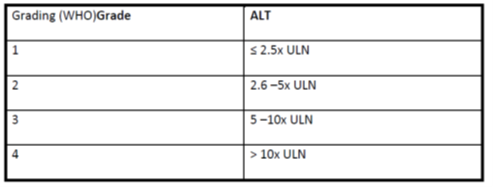
WHO GRADING OF DILI
DILI patients were classified according to WHO criteria for grading of DILI according to ALT levels.
ATT and altered Baseline LFT values
With the prevalence of alcoholism and diabetes more in developing countries, a significant proportion of patients has baseline altered LFT values. There are no clear cut evidence-based guidelines exist for the use prescribing ATT, in patients with cirrhosis. When no other alternatives are advisable, close monitoring is needed and risk factors should also be evaluated. In patients with history of alcohol intake and cirrhosis, ATT is associated with hepatotoxicity in 10%. “Recommended ATT in Child class A cirrhosis is the same as a noncirrhotic population but strict follow up is required. In Child class B Pyrazinamide should be avoided”. Isoniazid and Rifampicin may be avoided. Medications should be individualized depending upon various factors. Surveillance using liver enzymes is recommended with use of INH but still it can cause acute liver failure. The cause for the underlying liver enzyme abnormality or the liver disease must be established before starting ATT [1].
In a retrospective study by Abbara A et al there were 105 (6.9%) cases of ATT-associated DILI amongst 1529 patients diagnosed with active TB between April 2010 and May 2014. Risk factors for DILI were: low patient weight, HIV-1 co-infection, higher baseline ALP, and alcohol intake. Half (53%) of the cases occurred within 2 weeks of starting ATT and 87.6% occurred within 8 weeks. Five (4.8%) of seven deaths were attributable to DILI.
In another retrospective study by Jeong I (2015) et al among the 195 patients, 17 (8.7%) developed hepatotoxicity, and their mean AST/ALT values (mean± SD) were 249±229/249±250 IU/L. Among the 17 patients who developed hepatotoxicity, 5 were excluded for having anti-TB DIH. Acetaminophen (2 patients) and alcohol (2 patients) were the other putative causes of hepatotoxicity, and viral hepatotoxicity was presumed to be the cause in 1 patient. The median latent period for developing DIH was 37 days (range 13-112) in anti-TB DIH group. Thirty other patients showed mild LFT abnormality, as defined previously (60 IU/L≤serum AST or ALT level<120 IU/mL).
In a study by Ramanadougar et al [4] the study group of 100 pulmonary tuberculosis patients consisted of 67 males and 33 females. Age varied from 15 – 80 years. Twenty eight patients (28%) developed anti-tuberculosis treatment induced liver damage which included 23 (23%) patients who had asymptomatic elevation of liver enzymes and 5 (5%) patients who developed overt drug induced hepatotoxicity. Among patients who developed ATT induced liver damage 46.4% patients had history of high alcohol intake, 50% patients had BMI < 18, 53.6% patients had radio logically severe disease and 78.6% patients had pre-treatments albumin < 3.5% gm/dl.
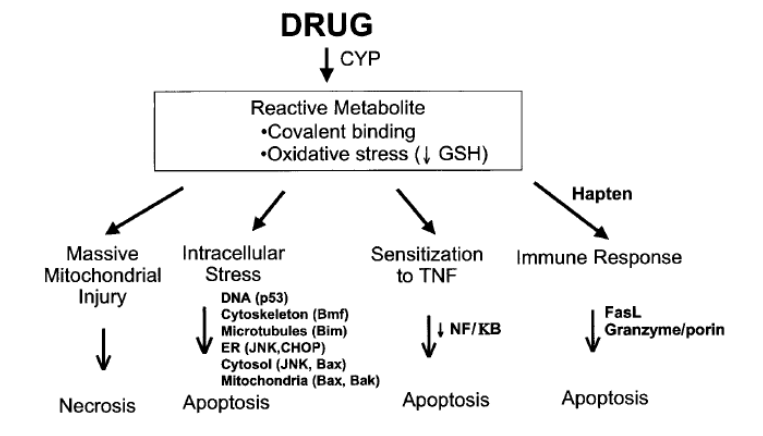
Figure 1: Mechanism of DILI
In a study analyzing the pattern of ADRs caused by the anti-tubercular drugs. Inpatient files of all the TB patients during the period from 1st January 2001 till 31st December 2006. 326 patients were identified among which 40 (females 24, males 16) experienced at least one ADR. The most common ADR was elevated liver enzymes [24 (57.14%)] and hepato-biliary system was the most common system affected. More than half the ADRs [21 (52.55%)] developed within 20 days of initiation of therapy. Isoniazid and Pyrazinamide were the suspected drugs. The most common laboratory abnormality observed was elevated SGOT level in 21 patients (52.5%)]. Seven (17.5%) patients needed specific drug treatment for managing the ADRs and 10 (25%) needed symptomatic management. Thirty five (87.5%) patients recovered following the ADR.
A study regarding incidence of anti-tuberculosis drug induced hepatotoxicity and associated risk factors among the patients in Dawro Zone, South Ethiopia: A Cohort Study was conducted. 124 new tuberculosis positive individual available from Tercha Hospital and Five health Centre’s during data collection were consecutively included. The socio-demographic data and anthropometric measurement were obtained. The incidence of anti- TB-DIH was found to be 8%. The drug responsible for hepato-toxicity was not known. Chronic high alcohol intake was associated with development of anti-TB-DIH.
In another prospective study to determine the clinical profile in patients with ATT-induced hepatotoxicity and to test a predefined strategy of reintroduction of ATT. 72 consecutive patients with clinical evidence of ATT-induced hepatotoxicity were included. Jaundice was the presenting symptom in 44 (61%) patients; prodromal symptoms were present in 28 (39%). Serious complications developed in 12 (16.6%) patients (fulminant hepatic failure in seven, sub acute hepatic failure in four, hepatic encephalopathy in one). Nine patients (three males, six females) died from these complications. The mean duration of treatment before the onset of hepatitis was significantly longer in the group that died than in the rest of the patients. Malnutrition was present in 37 of the 72 patients. After resolution of drug induced hepatitis, reintroduction of Isoniazid and Rifampicin was possible in 41 of 44 patients. Thus, results showed that ATT-induced hepatitis carried significant morbidity and mortality, that malnutrition was common in patients with ATT-related hepatitis, and that potentially hepatotoxic anti-tuberculosis agents could be safely reintroduced after recovery from hepatitis.
In a study by Buntoro IF et al [8] in Indonesia in which they compared liver function test after treatment with FDC in tuberculosis patients. They observed a rise of 54.69±37.66 % in SGPT levels as compared to baseline levels in patients who were not malnourished and a rise of 135.05±117.45 in patients with malnutrition. In younger patients the rise was of 9.1±12.7 IU/L and in older patients the rise observed was 15.5±12.6 IU/l.
No further studies are available or conducted in India regarding FDC induced hepatitis/ DILI in Indian population and hence this study was planned to find the incidence and risk of DILI in tuberculosis patients receiving FDC DOTS.
CONCLUSION
Advanced age, female sex, moderately/far advanced/extensive disease, hypo-albuminemia, malnutrition, alcoholism, underlying liver disease, Hepatitis B virus infection, Hepatitis C virus infection, HIV infection, acetylator phenotype, N-acetyl transferase(NAT) activity and Glutathione s-transferase activity are the factors responsible for drug induced liver injury in the patients receiving anti tubercular treatment.
REFERENCE
Vaishnavi Priyaa, C. A Study on LFT Monitoring in ATT and the Spectrum of Anti-Tuberculosis Drug-Induced Liver Injury [MD thesis]. Guindy, Chennai, Tamil Nadu: Dr. MGR Medical University, 2015.
Abbara, A., et al. "Drug-Induced Liver Injury from Antituberculous Treatment: A Retrospective Study from a Large TB Centre in the UK." BMC Infectious Diseases, vol. 17, 2017, Article ID 231.
Jeong, I., et al. "Drug-Induced Hepatotoxicity of Anti-Tuberculosis Drugs and Their Serum Levels." Journal of Korean Medical Science, vol. 30, 2015, pp. 167–172.
Ramanagoudar, P.S. Effect of Anti-Tubercular Treatment on Liver in Freshly Diagnosed Pulmonary Tuberculosis Patients Receiving DOTS Therapy [MD thesis]. Bangalore, Karnataka: Rajiv Gandhi University of Health Sciences.
Alam, K., et al. "Reporting Adverse Drug Reactions Among Hospitalized Medical Patients: A Prospective Study from Tertiary Care Hospital in Western Nepal." Nepal Journal of Epidemiology, vol. 4, no. 1, 29 Mar. 2014, pp. 330–336.
Abera, W., et al. "Incidence of Anti-Tuberculosis Drug-Induced Hepatotoxicity and Associated Risk Factors Among Tuberculosis Patients in Dawro Zone, South Ethiopia: A Cohort Study." International Journal of Mycobacteriology, vol. 5, no. 1, Mar. 2016, pp. 14–20.
Singh, J., et al. "Hepatotoxicity Due to Anti-Tuberculosis Therapy: Clinical Profile and Reintroduction of Therapy." Journal of Clinical Gastroenterology, vol. 22, no. 3, Apr. 1996, pp. 211–214
Buntoro, If., et al. "Decrease of Liver Function After Treatment of Anti-Tuberculosis Drugs in Tuberculosis Patients with Malnutrition and Alcohol Consumption." International Journal of Pharmacy and Pharmaceutical Sciences, vol. 8, no. 7, 2016, pp. 269–273
License
Creative Commons Attribution-NonCommercial-NoDerivatives 4.0 International License
All papers should be submitted electronically. All submitted manuscripts must be original work that is not under submission at another journal or under consideration for publication in another form, such as a monograph or chapter of a book. Authors of submitted papers are obligated not to submit their paper for publication elsewhere until an editorial decision is rendered on their submission. Further, authors of accepted papers are prohibited from publishing the results in other publications that appear before the paper is published in the Journal unless they receive approval for doing so from the Editor-In-Chief.
Himalayan Journal of Applied Medical Sciences and Research open access articles are licensed under a Creative Commons Attribution-Share A like 4.0 International License. This license lets the audience to give appropriate credit, provide a link to the license, and indicate if changes were made and if they remix, transform, or build upon the material, they must distribute contributions under the same license as the original.
Recommended Articles
Research Article
Digital Implantology: Current Concepts, Clinical Applications, Limitations and Future Directions - A Narrative Review
Anukrity Chandra
Published: 30/07/2026
Download PDF
Cite
x
APA
Chandra, A. (2026). Digital Implantology: Current Concepts, Clinical Applications, Limitations and Future Directions - A Narrative Review. Himalayan Journal of Applied Medical Sciences and Research, 7(2), 1-7.
MLA
Chandra, Anukrity. "Digital Implantology: Current Concepts, Clinical Applications, Limitations and Future Directions - A Narrative Review." Himalayan Journal of Applied Medical Sciences and Research 7.2 (2026): 1-7.
Chicago
Chandra, Anukrity. "Digital Implantology: Current Concepts, Clinical Applications, Limitations and Future Directions - A Narrative Review." Himalayan Journal of Applied Medical Sciences and Research 7, no. 2 (2026): 1-7.
Harvard
Chandra, A. (2026) 'Digital Implantology: Current Concepts, Clinical Applications, Limitations and Future Directions - A Narrative Review' Himalayan Journal of Applied Medical Sciences and Research 7(2), pp. 1-7.
Vancouver
Chandra A. Digital Implantology: Current Concepts, Clinical Applications, Limitations and Future Directions - A Narrative Review. Himalayan Journal of Applied Medical Sciences and Research. 2026 Jul;7(2):1-7.
Download PDF
Research Article
Study of the Role of Serum Interleukin-6 in Inflammation among Pregnant Women with COVID-19
Aynar Talib Samad,
Yossra Saleh Khudhur
Published: 27/07/2021
Download PDF
Cite
x
APA
Talib Samad, A. & Khudhur, Y. S. (2021). Study of the Role of Serum Interleukin-6 in Inflammation among Pregnant Women with COVID-19. Himalayan Journal of Applied Medical Sciences and Research, 2(2), 1-6.
MLA
Talib Samad, Aynar and Yossra Saleh Khudhur. "Study of the Role of Serum Interleukin-6 in Inflammation among Pregnant Women with COVID-19." Himalayan Journal of Applied Medical Sciences and Research 2.2 (2021): 1-6.
Chicago
Talib Samad, Aynar and Yossra Saleh Khudhur. "Study of the Role of Serum Interleukin-6 in Inflammation among Pregnant Women with COVID-19." Himalayan Journal of Applied Medical Sciences and Research 2, no. 2 (2021): 1-6.
Harvard
Talib Samad, A. and Khudhur, Y. S. (2021) 'Study of the Role of Serum Interleukin-6 in Inflammation among Pregnant Women with COVID-19' Himalayan Journal of Applied Medical Sciences and Research 2(2), pp. 1-6.
Vancouver
Talib Samad A, Khudhur YS. Study of the Role of Serum Interleukin-6 in Inflammation among Pregnant Women with COVID-19. Himalayan Journal of Applied Medical Sciences and Research. 2021 Jul;2(2):1-6.
Download PDF
Research Article
Evalution CD11b, CD4, IL-17A and IL-23 as Biomarkers Immunological in Patients with Behçet’s Disease
Layla Saleh Abdul-Hassan,
...
Saeed hilal khudhair
Published: 13/07/2026
Download PDF
Cite
x
APA
Abdul-Hassan, L. S., Fadel, R. H. & khudhair, S. H. (2026). Evalution CD11b, CD4, IL-17A and IL-23 as Biomarkers Immunological in Patients with Behçet’s Disease. Himalayan Journal of Applied Medical Sciences and Research, 7(2), 1-7.
MLA
Abdul-Hassan, Layla S., Radhia H. Fadel and Saeed H. khudhair. "Evalution CD11b, CD4, IL-17A and IL-23 as Biomarkers Immunological in Patients with Behçet’s Disease." Himalayan Journal of Applied Medical Sciences and Research 7.2 (2026): 1-7.
Chicago
Abdul-Hassan, Layla S., Radhia H. Fadel and Saeed H. khudhair. "Evalution CD11b, CD4, IL-17A and IL-23 as Biomarkers Immunological in Patients with Behçet’s Disease." Himalayan Journal of Applied Medical Sciences and Research 7, no. 2 (2026): 1-7.
Harvard
Abdul-Hassan, L. S., Fadel, R. H. and khudhair, S. H. (2026) 'Evalution CD11b, CD4, IL-17A and IL-23 as Biomarkers Immunological in Patients with Behçet’s Disease' Himalayan Journal of Applied Medical Sciences and Research 7(2), pp. 1-7.
Vancouver
Abdul-Hassan LS, Fadel RH, khudhair SH. Evalution CD11b, CD4, IL-17A and IL-23 as Biomarkers Immunological in Patients with Behçet’s Disease. Himalayan Journal of Applied Medical Sciences and Research. 2026 Jul;7(2):1-7.
Download PDF
Research Article
Bones in Balance: Awareness of Rickets and Nutritional Deficiencies Among the Hamirpur Community
Vishal Dhatwalia,
Swati Chandel
Published: 10/12/2024
Download PDF
Cite
x
APA
Dhatwalia, V. & Chandel, S. (2024). Bones in Balance: Awareness of Rickets and Nutritional Deficiencies Among the Hamirpur Community. Himalayan Journal of Applied Medical Sciences and Research, 5(2), 1-5.
MLA
Dhatwalia, Vishal and Swati Chandel. "Bones in Balance: Awareness of Rickets and Nutritional Deficiencies Among the Hamirpur Community." Himalayan Journal of Applied Medical Sciences and Research 5.2 (2024): 1-5.
Chicago
Dhatwalia, Vishal and Swati Chandel. "Bones in Balance: Awareness of Rickets and Nutritional Deficiencies Among the Hamirpur Community." Himalayan Journal of Applied Medical Sciences and Research 5, no. 2 (2024): 1-5.
Harvard
Dhatwalia, V. and Chandel, S. (2024) 'Bones in Balance: Awareness of Rickets and Nutritional Deficiencies Among the Hamirpur Community' Himalayan Journal of Applied Medical Sciences and Research 5(2), pp. 1-5.
Vancouver
Dhatwalia V, Chandel S. Bones in Balance: Awareness of Rickets and Nutritional Deficiencies Among the Hamirpur Community. Himalayan Journal of Applied Medical Sciences and Research. 2024 Jul;5(2):1-5.
S, K. & A, R. (2022). Factors Implicated In the Development of Anti-Tuberculosis Treatment Induced Hepatotoxicity: A Critical Review. Himalayan Journal of Applied Medical Sciences and Research, 3(1), 1-3.
MLA
S, Kheora and Rana A. "Factors Implicated In the Development of Anti-Tuberculosis Treatment Induced Hepatotoxicity: A Critical Review." Himalayan Journal of Applied Medical Sciences and Research 3.1 (2022): 1-3.
Chicago
S, Kheora and Rana A. "Factors Implicated In the Development of Anti-Tuberculosis Treatment Induced Hepatotoxicity: A Critical Review." Himalayan Journal of Applied Medical Sciences and Research 3, no. 1 (2022): 1-3.
Harvard
S, K. and A, R. (2022) 'Factors Implicated In the Development of Anti-Tuberculosis Treatment Induced Hepatotoxicity: A Critical Review' Himalayan Journal of Applied Medical Sciences and Research 3(1), pp. 1-3.
Vancouver
S K, A R. Factors Implicated In the Development of Anti-Tuberculosis Treatment Induced Hepatotoxicity: A Critical Review. Himalayan Journal of Applied Medical Sciences and Research. 2022 Jan;3(1):1-3.


 Download PDF
 Download XML