It's indeed striking to read these excerpts on tuberculosis (TB) at the beginning of the third millennium, highlighting the ongoing challenges and urgent need for action in TB control. Despite significant progress in medicine and technology, TB remains a major global health concern, especially in vulnerable populations such as prisoners, military personnel and those living in crowded conditions. The statistics on TB's impact are sobering, with millions of deaths and infections projected if immediate action is not taken. The development of laser systems for TB treatment represents a promising approach, with different types of lasers offering varying levels of effectiveness and safety considerations. Excimer lasers and solid-state diode-pumped lasers are two approaches being explored for TB treatment. The wavelength of 265 to 266nm is considered optimal for bacteriostatic activity, with excimer lasers emitting at 248nm and solid-state Nd: YAG lasers at 266nm. However, careful consideration must be given to pulse energy and exposure time to avoid tissue damage and ensure effectiveness.
Keywords
Tuberculosis (TB)
Global Health
Laser Systems
Excimer Lasers
Solid-State Lasers
INTRODUCTION
A Bit Scary Statistics
For a start, as a preamble, here are some excerpts from various sources on the problem of tuberculosis (TB), which are quite strange to read at the beginning of the third millennium, since many people confidently believed that there has been enough time to solve this problem during the past two millennia [1]:
Tuberculosis symptoms and signs: cough, loss of weight, chest pain, fever, night sweats. If untreated, 50 percent of patients die within five years
More than any other infectious disease, TB kills approximately 1 million women per year. Each year, TB kills 100 000 children. Tuberculosis is the most common cause of orphanage
Untreatable bacteria can destroy the progress of TB control achieved in the last 50 years. There are no drugs to combat some resistant TB bacteria (in developed countries 50 million people may be infected)
The majority of people infected with TB never become sick because their immune system prevents the development of TB mycobacteria. Only 5 to 10 percent of those infected develop TB. Scientists today do not know exactly why some infected people develop TB and die, while others do not
At least one person is infected with TB every second, 1 percent of the world's population are infected each year. Untreated persons infect on average 10–15 neighbors during a year. For major cities, this figure is considerably higher
The most susceptible to infection are prisons, the Army and the Navy, where the concentration of people living together for a long time is the greatest [2].
According to the WHO over the past two centuries, TB killed about a billion people. The WHO warns that unless we take urgent action, in the next 10 years, TB will kill an estimated 30 million people and infect 90 million people. Further, by the end of 2020 a billion people will have been already infected: 200 million people will be sick and 70 million people will die. So much for the White Plague (because of the extreme pallor seen among those infected).
Laser Treatments for Tuberculosis
Currently, we know two approaches to fabricating laser systems for the TB treatment. They are based on excimer lasers and installations making use of important benefits of miniature solid-state diode-pumped lasers. The peak of the bacteriostatic activity of the generated laser radiation in various forms of TB lies at a wavelength of 265 to 266nm and in this case, the effectiveness of its action is equal to unity. The wavelength of 248nm, which is emitted by an excimer laser, is closest to this range. At this wavelength, the interaction efficiency amounts to 0.8, which requires a proportional increase in the irradiation time. For a solid-state Nd: YAG laser (fourth harmonic) the radiation wavelength is equal to 266nm. The interaction efficiency of this wavelength is 1.0. The pulse energy with an average output power of 10mW (equal to the product of the energy in a single pulse by the pulse repetition rate). The power is determined experimentally in cultures of bacteria for the exposure time of 10 to 15min [3].
For an excimer laser the pulse repetition rate is no more than 100Hz; therefore, the energy of a single pulse is less than 0.1mJ, which can lead to tissue burn at a pulse duration of 5–10ns. To ensure a ‘soft’ effect on tissues, it is needed to reduce the pulse energy by one or two orders of magnitude, which is possible, but requires a proportional increase in the exposure time. At these energies (0.1mJ) an optical fiber is usually damaged. An optical fiber requires a high optical purity of working surfaces which is problematic when administering it in various cavities. The destruction of the output end of the fiber may cause penetration of small glass fragments into the patient. In a solid-state laser the pulse repetition rate is maintained at a level of 10000Hz; therefore, the energy of a single pulse is only 0.001mJ. That is why the soft tissue burn and destruction of optical fibers in the case of solid-state lasers is fundamentally impossible [3].
Now let us say a few words about the service life of some elements of lasers. In the case of an excimer laser, the main element is a gas tube, whose service life is about 1000–2000 hours at a cost of about 1000 USD. High-energy pulses can also lead to an early failure of optical elements. In the case of a solid-state laser, the essential element is a laser diode, whose service life amount to least 5000 hours at a cost of 700–800 USD.
The presence of hazards when working with lasers discussed is as follows. An excimer laser has in its design a significant amount of harmful gas. Besides, this laser requires a high voltage for its operation (about 10kV). The design of solid-state lasers is free of hazards, whereas the cost of the components of these lasers is approximately comparable with that of excimer lasers [2].
As for the additional conditions of production of the laser sources discussed, excimer lasers, apart from standard an optical-mechanical and an installation sites, also require the presence of a vacuum site, equipped to work with poisonous gases. The production of solid-state lasers requires only a standard optical-mechanical and an installation sites.
Amulet Semiconductor Laser Apparatus
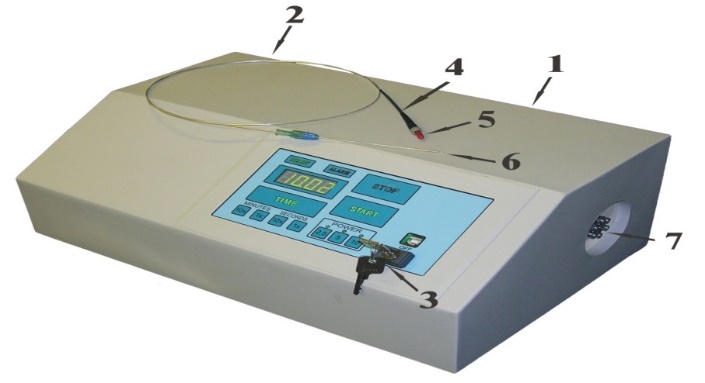
An Amulet semiconductor laser apparatus with a fiber for introducing radiation in the affected area through an injection needle is intended for the treatment of destructive forms of pulmonary and bone TB that are resistant to conventional medical treatment, as well as to shorten the treatment of common forms of TB by topical exposure of the infected surface to Ultraviolet (UV) radiation with a wavelength of 266 nm, which has very strong bactericidal and bacteriostatic effects. UV radiation in this case has low intensity and only affects the microflora without any damage of the living tissues of the human body. The typical time of UV irradiation of the affected area is 5 to 15min. In this case, the traumatic effect is absent.
The Amulet apparatus (Figure 1) is designed to treat patients with tuberculosis affecting lungs, bronchi, bones and joints, to cure diseases associated with suppurative infections and other inflammatory processes, with the abnormal healing process, with the immune system variations and instability of the capillary circulation. In addition, the apparatus can be used in endosurgery, phthisiology, otolaryngology, traumatology, stomatology, treatment of burns, gynecology, therapy, surgery, urology, proctology and dermatology.
Figure 1: General Appearance of the Amulet Apparatus
Clinical Trials of the Amulet Apparatus
In accordance with the decision of the Commission on Tools, Instruments, Apparatus and Materials used in General Surgery of the Committee on New Medical Technology of the Ministry of Health of the Russian Federation (Protocol No. 3 dated 22 March 2001) and relevant orders of the Main Military Medical Directorate of the Ministry of Defence (Department of endoscopy and surgical department for treatment of patients with complicated forms of TB of the lungs), the Director of the Research Institute of Phthisiopulmonology, I.M. Sechenov Moscow Medical Academy (Department for the treatment of patients with bone and joint tuberculosis) and the Director of the Central Research Institute of Tuberculosis of Russian Academy of Medical Sciences (Department of pulmonary tuberculosis), we performed clinical trials of a prototype of a therapeutic UV solid-state diode-pumped laser (Amulet), produced by LLC Energomashtehnika. The laser emits middle-level low-energy UV radiation with a wavelength of 266nm and intensity of up to 10mW/cm2 at the fiber output.
Table 1: The Main Technical Characteristics of the Amulet Apparatus
Emission wavelength (nm)
266
Average output power (mW)
2.5, 5, 10
Pulse repetition rate (kHz)
10 – 20
Pulse duration (ns)
5 – 7
Beam diameter (mm)
<0,5
Radiation outcoupling
Fiber
Fiber diameter (µm)
400 – 800
Power consumption (220V/50Hz) (W)
<200
Service life (h)
>2000
Cooling
Air
Dimensions (mm)
450×165×290
Weight (kg)
<12
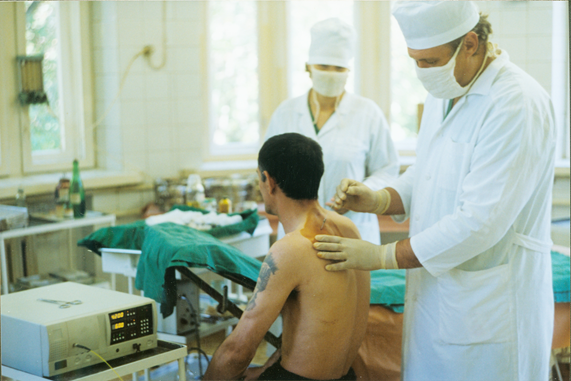
Figure 2: Treatment of TB by laser
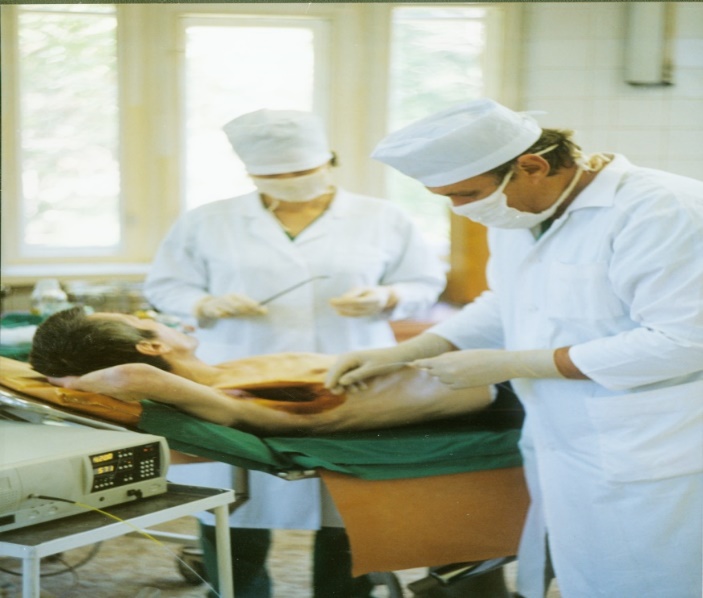
Figure 3: Treatment of TB by laser
The use of low-energy laser radiation in medicine is very beneficial in the treatment of TB patients because of its ability to cause an analgesic, an anti-inflammatory and an anti-edema effects, as well as physiological and reparative regeneration of tissues (Figure 2,3).
The effectiveness of the therapeutic UV solid-state diode-pumped laser was tested in 7 patients with bronchial tuberculosis, 4 patients with laryngeal tuberculosis, 7 patients with chronic tuberculous empyema, 14 patients with osteoarticular tuberculosis complicated by surface wounds [1].
During the clinical trials, we improved the optical fibers which made it possible to increase the area of laser radiation scattering both in the case of endobronchial and transthoracic introduction of the fiber. Pathologically altered tissues were irradiated as a part of complex therapy of TB, including 4–5 anti-tuberculosis medications. In the process of clinical trials, we monitored the presence of TB mycobacteria in abnormal tissues and performed histological studies of inflammatory changes. The TB-affected tissues of the patients were irradiated through a bronchoscope. The TB process in these patients had the following localization and character:
Bronchial TB in the middle lobe, fistula
Bronchial TB in the middle lobe, ulcer
Bronchial TB at segmental (B6) bronchi, infiltration
Laryngeal TB with the destruction of epiglottis
Pulmonary TB, cavern and thoracic fistulas
Mycobacterium TB was found in all the patients.
Exposure Conditions
The intensity of the radiation is constant
The distance of the distal end of the optical fiber from the irradiated surface is 1-2cm
The exposure time is 30s
The number of laser treatments is 8-12
The use of therapy solid-state diode-pumped laser UV radiation together with specific and intensive health-improving restorative treatment at the end of clinical trials showed that the oronasal fistula was free of cheesy masses. In the course of the microscopy of broncho alveolar lavage fluids, TB mycobacteria were net found. Besides, a decrease in inflammation of the bronchial mucosa was visually ascertained. The histological examination of biopsy material revealed rapid healing, formation of fibrosis in the bronchial mucosa with signs of hyalinization and narrowing of the bronchial lumen. In patients with laryngeal TB, a decrease in swelling and redness of the mucous larynx above the vocal cords as well as the healing of erosive and ulcerative lesions were visually observed. During laser irradiation of TB empyema (10–12 laser treatments for each patient) the volume of purulent discharge and increased bleeding were observed, which we attribute to the reduction of inflammatory changes and improvement of local blood circulation.
In the case of bone TB, application of UV radiation leads to copious and purulent discharge of necrotic masses, which clearly demonstrates the bactericidal and bacteriostatic effect of UV radiation on flora. In all cases, after 6–12 irradiation sessions held daily, the wound surface was cleaned and a pink granulation tissue covered the wound bed and its edges. Examination of swabs and inoculations from the wounds demonstrated a drastic decrease in the presence or growth of the colonies. This allows the surgical treatment of wounds and placement of secondary sutures, which greatly accelerates the healing of wounds.
CONCLUSION
Thus, the clinical trials performed allow us to make a conclusion that a therapy UV solid-state diode-pumped Amulet laser is effective in the treatment of TB-affected tissues and bones due to the bactericidal and bacteriostatic effect and stimulation of reparative processes. It could be used for many other applications in the practical medicine.
REFERENCES
Victor, V. Apollonov High Power P-P Lasers. NOVA, 2014.
Victor, V. Apollonov High Power Lasers in Our Life. NOVA, 2016.
Victor, V. Apollonov High Power Molecular Lasers. Springer, 2017.
License
Creative Commons Attribution-NonCommercial-NoDerivatives 4.0 International License
All papers should be submitted electronically. All submitted manuscripts must be original work that is not under submission at another journal or under consideration for publication in another form, such as a monograph or chapter of a book. Authors of submitted papers are obligated not to submit their paper for publication elsewhere until an editorial decision is rendered on their submission. Further, authors of accepted papers are prohibited from publishing the results in other publications that appear before the paper is published in the Journal unless they receive approval for doing so from the Editor-In-Chief.
Himalayan Journal of Applied Medical Sciences and Research open access articles are licensed under a Creative Commons Attribution-Share A like 4.0 International License. This license lets the audience to give appropriate credit, provide a link to the license, and indicate if changes were made and if they remix, transform, or build upon the material, they must distribute contributions under the same license as the original.
Recommended Articles
Research Article
Ethnomedicinal Plants for Obesity Management - Phytochemicals, Molecular Targets and Prospects of Green Nanotechnology
Arpana Ashokrao Durge,
Utpal Jagdish Dongre
Published: 25/03/2026
Download PDF
Cite
x
APA
Durge, A. A. & Dongre, U. J. (2026). Ethnomedicinal Plants for Obesity Management - Phytochemicals, Molecular Targets and Prospects of Green Nanotechnology. Himalayan Journal of Applied Medical Sciences and Research, 7(1), 1-6.
MLA
Durge, Arpana Ashokrao and Utpal Jagdish Dongre. "Ethnomedicinal Plants for Obesity Management - Phytochemicals, Molecular Targets and Prospects of Green Nanotechnology." Himalayan Journal of Applied Medical Sciences and Research 7.1 (2026): 1-6.
Chicago
Durge, Arpana Ashokrao and Utpal Jagdish Dongre. "Ethnomedicinal Plants for Obesity Management - Phytochemicals, Molecular Targets and Prospects of Green Nanotechnology." Himalayan Journal of Applied Medical Sciences and Research 7, no. 1 (2026): 1-6.
Harvard
Durge, A. A. and Dongre, U. J. (2026) 'Ethnomedicinal Plants for Obesity Management - Phytochemicals, Molecular Targets and Prospects of Green Nanotechnology' Himalayan Journal of Applied Medical Sciences and Research 7(1), pp. 1-6.
Vancouver
Durge AA, Dongre UJ. Ethnomedicinal Plants for Obesity Management - Phytochemicals, Molecular Targets and Prospects of Green Nanotechnology. Himalayan Journal of Applied Medical Sciences and Research. 2026 Jan;7(1):1-6.
Download PDF
Research Article
Digital Implantology: Current Concepts, Clinical Applications, Limitations and Future Directions - A Narrative Review
Anukrity Chandra
Published: 30/07/2026
Download PDF
Cite
x
APA
Chandra, A. (2026). Digital Implantology: Current Concepts, Clinical Applications, Limitations and Future Directions - A Narrative Review. Himalayan Journal of Applied Medical Sciences and Research, 7(2), 1-7.
MLA
Chandra, Anukrity. "Digital Implantology: Current Concepts, Clinical Applications, Limitations and Future Directions - A Narrative Review." Himalayan Journal of Applied Medical Sciences and Research 7.2 (2026): 1-7.
Chicago
Chandra, Anukrity. "Digital Implantology: Current Concepts, Clinical Applications, Limitations and Future Directions - A Narrative Review." Himalayan Journal of Applied Medical Sciences and Research 7, no. 2 (2026): 1-7.
Harvard
Chandra, A. (2026) 'Digital Implantology: Current Concepts, Clinical Applications, Limitations and Future Directions - A Narrative Review' Himalayan Journal of Applied Medical Sciences and Research 7(2), pp. 1-7.
Vancouver
Chandra A. Digital Implantology: Current Concepts, Clinical Applications, Limitations and Future Directions - A Narrative Review. Himalayan Journal of Applied Medical Sciences and Research. 2026 Jul;7(2):1-7.
Download PDF
Research Article
Study of the Role of Serum Interleukin-6 in Inflammation among Pregnant Women with COVID-19
Aynar Talib Samad,
Yossra Saleh Khudhur
Published: 27/07/2021
Download PDF
Cite
x
APA
Talib Samad, A. & Khudhur, Y. S. (2021). Study of the Role of Serum Interleukin-6 in Inflammation among Pregnant Women with COVID-19. Himalayan Journal of Applied Medical Sciences and Research, 2(2), 1-6.
MLA
Talib Samad, Aynar and Yossra Saleh Khudhur. "Study of the Role of Serum Interleukin-6 in Inflammation among Pregnant Women with COVID-19." Himalayan Journal of Applied Medical Sciences and Research 2.2 (2021): 1-6.
Chicago
Talib Samad, Aynar and Yossra Saleh Khudhur. "Study of the Role of Serum Interleukin-6 in Inflammation among Pregnant Women with COVID-19." Himalayan Journal of Applied Medical Sciences and Research 2, no. 2 (2021): 1-6.
Harvard
Talib Samad, A. and Khudhur, Y. S. (2021) 'Study of the Role of Serum Interleukin-6 in Inflammation among Pregnant Women with COVID-19' Himalayan Journal of Applied Medical Sciences and Research 2(2), pp. 1-6.
Vancouver
Talib Samad A, Khudhur YS. Study of the Role of Serum Interleukin-6 in Inflammation among Pregnant Women with COVID-19. Himalayan Journal of Applied Medical Sciences and Research. 2021 Jul;2(2):1-6.
Download PDF
Research Article
Evalution CD11b, CD4, IL-17A and IL-23 as Biomarkers Immunological in Patients with Behçet’s Disease
Layla Saleh Abdul-Hassan,
...
Saeed hilal khudhair
Published: 13/07/2026
Download PDF
Cite
x
APA
Abdul-Hassan, L. S., Fadel, R. H. & khudhair, S. H. (2026). Evalution CD11b, CD4, IL-17A and IL-23 as Biomarkers Immunological in Patients with Behçet’s Disease. Himalayan Journal of Applied Medical Sciences and Research, 7(2), 1-7.
MLA
Abdul-Hassan, Layla S., Radhia H. Fadel and Saeed H. khudhair. "Evalution CD11b, CD4, IL-17A and IL-23 as Biomarkers Immunological in Patients with Behçet’s Disease." Himalayan Journal of Applied Medical Sciences and Research 7.2 (2026): 1-7.
Chicago
Abdul-Hassan, Layla S., Radhia H. Fadel and Saeed H. khudhair. "Evalution CD11b, CD4, IL-17A and IL-23 as Biomarkers Immunological in Patients with Behçet’s Disease." Himalayan Journal of Applied Medical Sciences and Research 7, no. 2 (2026): 1-7.
Harvard
Abdul-Hassan, L. S., Fadel, R. H. and khudhair, S. H. (2026) 'Evalution CD11b, CD4, IL-17A and IL-23 as Biomarkers Immunological in Patients with Behçet’s Disease' Himalayan Journal of Applied Medical Sciences and Research 7(2), pp. 1-7.
Vancouver
Abdul-Hassan LS, Fadel RH, khudhair SH. Evalution CD11b, CD4, IL-17A and IL-23 as Biomarkers Immunological in Patients with Behçet’s Disease. Himalayan Journal of Applied Medical Sciences and Research. 2026 Jul;7(2):1-7.


 Download PDF
 Download XML