Contents
Download PDF
pdf Download XML
800 Views
121 Downloads
Share this article
Research Article | Volume 2 Issue 2 (July-Dec, 2021) | Pages 1 - 4
Management of Cholelithiasis with Choledocholithiasis in a Tertiary Care Hospital of Northern India: A Cross-Sectional Descriptive Study
 ,
 ,
 ,
 ,
1
Department of Surgery, IGMC Shimla, HP-India
2
Professor, Department of Surgery, IGMC Shimla, HP-India
3
Assistant Professor, Department of Surgery, IGMC Shimla, HP-India
4
Department of Physiology, IGMC Shimla, HP-India
Under a Creative Commons license
Open Access
Received
Feb. 24, 2025
Revised
April 1, 2025
Accepted
May 22, 2025
Published
Aug. 31, 2021
Abstract

Introduction: The management of concomitant gall bladder and CBD stones has evolved significantly over the past 20-30 years. In the era of open surgery, open CBD exploration (choledocholithotomy) used to be performed if any common bile duct stones were identified at cholangiography. Following the introduction of ERCP, open CBD exploration was reserved for patients with failed ERCP. Material and Methods: This cross-sectional study was carried out in the department of General surgery in concordance with Department of Gastroenterology Indira Gandhi Medical College Shimla (H.P.) on patients admitted with diagnosis of Cholelithiasis with choledocholithiasis from 1-August-2018 to 31-July-2019. Results: Out of 108 patients of Cholelithiasis with choledocholithiasis, seventy-two patients (66.67%) underwent ERCP. Out of seventy-two patients 60 patients (83.33%) were cleared of CBD stones and underwent cholecystectomy. Out of Sixty patients laparoscopic cholecystectomy was performed in 52 patients (86.67%) and 8 patients (13.33%) were subjected to open cholecystectomy. Conclusion: Cholelithiasis with choledocholithiasis is a common condition worldwide. Associated CBD stones are seen in 10-15% of patients with cholelithiasis. ERCP for the management of CBD stones followed by cholecystectomy is the most common modality of treatment. Presently it is a convenient, safe and cost-effective procedure with a success rate of 83.33%.

Keywords
INTRODUCTION

The management of concomitant gall bladder and CBD stones has evolved significantly over the past 20-30 years. In the era of open surgery, open CBD exploration (choledocholithotomy) used to be performed if any common bile duct stones were identified at cholangiography. Following the introduction of ERCP, open CBD exploration was reserved for patients with failed ERCP. Earlier diagnosis of CBD stones used to be made by clinical symptoms, preoperative ultrasound, LFT’s and preoperative intravenous cholangiography. Nowadays intravenous cholangiography has been replaced by magnetic resonance cholangiopancreatography (MRCP), endoscopic ultrasound (EUS) and ERCP.  There remains a conflict of opinion in approach to treatment of cholelithiasis with choledocholithiasis. Available options range from open surgery, endoscopic and laparoscopic exploration.


With the advent of various modern technologies, open surgical procedures, such as CBD exploration or biliary-enteric bypasses, are now usually considered where ERCP fails to retrieve stones or where facilities of advanced laparoscopic surgery are not available. A relative indication for open exploration is large or multiple stones or the need to perform a Trans duodenal sphincteroplasty. Laparoscopic common bile duct exploration: Because over 80% of cholecystectomies are done laparoscopically, simultaneous laparoscopic common bile duct exploration can be done. The advantage is that the gallbladder and CBD stones are taken care of simultaneously in a minimally invasive manner. Successful laparoscopic management of CBD stones depends on several factors including surgical expertise, adequate equipment, the biliary anatomy and the number and size of CBD stones. The most direct method of dealing with choledocholithiasis preoperatively is by endoscopic retrograde cholangiopancreatography (ERCP). It was introduced in 1968 by Drs. McCune, Shorb, and Moscovitz [1]. Decompression of the ductal system can be achieved by means of endoscopic removal of stones with or without sphincterotomy. This procedure has a reported success rate of 70% to 90%. Because the published morbidity rates for ERCP and laparoscopic common bile duct exploration are  roughly  equivalent,  ERCP plus or minus sphincterotomy followed by laparoscopic cholecystectomy is a good technique.


Generally, in well-equipped centers of the world, ERCP followed by laparoscopic cholecystectomy is recommended as a safe and cost-effective procedure. However, various centers advocate laparoscopic cholecystectomy with common bile duct (CBD) exploration or a Rendezvous technique where endoscopy and laparoscopy are performed simultaneously. They both have a similar efficacy profile with the added benefit of saving time [2]. The objective of this study is to explore and assess treatment strategies employed in cases of cholelithiasis with choledocholithiasis, and to determine their outcome in IGMC Shimla.

MATERIALS AND METHODS

This cross-sectional study was carried out in the department of General surgery in concordance with Department of Gastroenterology Indira Gandhi Medical College Shimla (H.P.) on patients admitted with diagnosis of Cholelithiasis with choledocholithiasis from 1-August-2018 to 31-July-2019. This study comprised of 108 patients of cholelithiasis and choledocholithiasis diagnosed by ultrasound or MRCP. Consent of all patients was taken. Detailed history was taken, thorough clinical examination was done and required investigations were done.


Criteria for Inclusion and Exclusion were

Inclusion criteria

  • All diagnosed cases of cholelithiasis with choledocholithiasis


Exclusion criteria

  • Patients below 20yrs and above 70yrs of age

  • Patients with empyema gall bladder and cholangitis

  • Patients in whom prior cholecystectomy has been done

  • Pregnant patients, immunocompromised patients and patients with suspicion of carcinoma

  • Patients with uncontrolled DM/HTN/thyroid disorders


All the patients who were diagnosed to have gallstones with choledocholithiasis were included in the study. Patients had undergone biochemical and radiological investigations CHG, RBS, RFT, Electrolytes, LFT, Serum Amylase, Serum Lipase, CXR, USG Abdomen and MRCP. Therapeutic decision making was based on expertise availability, number and size of CBD stones, impacted stones and presence of stricture at the lower end of CBD. Laparoscopic cholecystectomy with laparoscopic exploration of CBD was done in some cases depending on availability of expertise. In all cases, operative findings were noted;       post-operative morbidity and mortality were noted.


Out of one hundred eight patients, patients were posted for

  • ERCP followed by Cholecystectomy

  • Open cholecystectomy with choledocholithotomy with Primary closure of CBD or T-tube drainage

  • 2A) Open cholecystectomy with choledocholithotomy with Primary closure of CBD

  • 2B) Open cholecystectomy with choledocholithotomy with T- tube drainage

  • Open cholecystectomy with choledocholithotomy with choledochoduodo-nostomy

  • Laparoscopic Common Bile Duct Exploration with Primary closure or T- tube drainage


Statistical Analysis

Data was entered in Microsoft excel spreadsheet, cleaned for errors and was analyzed using Stata Software version 15. Descriptive statistics were used to summarize the demographic data. Frequencies, percentages and their 95% confidence intervals were used to describe categorical variables.

RESULTS

Out of 108 patients of Cholelithiasis with choledocholithiasis, seventy-two patients (66.67%) underwent ERCP. Out of seventy-two patients 60 patients (83.33%) were cleared of CBD stones and underwent cholecystectomy. Out of Sixty patient’s laparoscopic cholecystectomy was performed in 52 patients (86.67%) and 8 patients (13.33%) were subjected to open cholecystectomy. Ten laparoscopic cholecystectomies were done within 72 hours of ERCP and forty-two were done after 6 weeks. Out of fifty-two patients posted for laparoscopic cholecystectomy, eight were converted to open cholecystectomy (11.54%) (Table 1).


Table 1:    Different modalities of management of cholelithiasis with choledocholithiasis

Different Modalities

Number

Percentage (%)

ERCP followed by cholecystectomy

60

55.56

Open cholecystectomy with choledocholithotomy with choledochoduodonostomy

34

31.48

Open cholecystectomy with CDL with primary closure of CBD

2

1.85

Open cholecystectomy with CDL with T-tube drainage of CBD

4

3.70

LC with LCBDE with

Primary closure

T-tube drainage

8

(6)

(2)

7.40

(75)

(25)

TOTAL

108

100


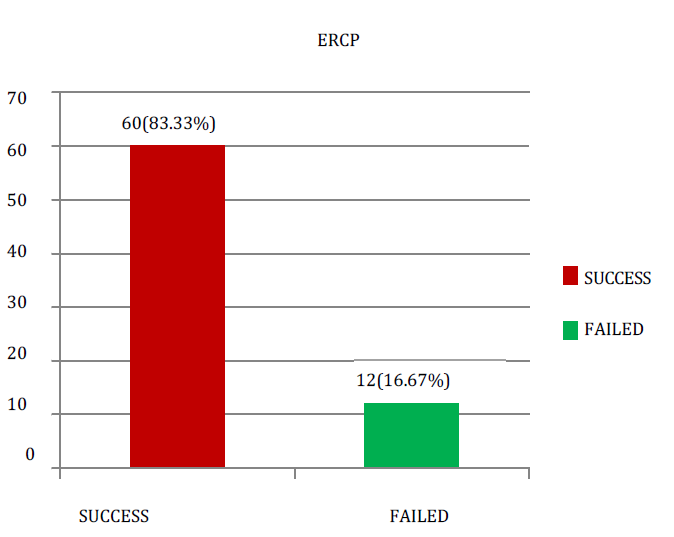
Out of one hundred eight patients, 72 patients (66.67%) were subjected to ERCP clearance for the CBD stones. Out of these sixty (83.33%) patients were cleared of CBD stones. And 12 patients (16.67%) had failed ERCP. These patients with failed ERCP were then subjected to open procedure (CBD exploration). Eight patients were subjected to Laparoscopic clearance of CBD.   Twenty-eight patients were dealt with open procedure (including patients with failed ERCP) and they had successful CBD clearance. (Table 2 & Figure 1)


Table 2: Number of patients in which ERCP was done

ERCP Procedure

Number

Percentage (%)

Done

72

66.67

Not done

36

33.33

Total

108

100


Figure 1: Results of ERCP


Table 3: Intra operative Findings (CBD Status)

Variable

Number (n=108)

Percentage (%)

Status of CBD

Dilated

Not dilated


91

17


84.96

15.74

Intra operative CBD stones

Single

Multiple


44

64


40.74

59.26


DISCUSSION

Choledocholithiasis has an incidence of 10-15% in patients with cholelithiasis. There are several options for management of cholelithiasis with choledocholithiasis. (Laparoscopic CBD Exploration) as a better option. But this policy is not widely accepted, probably due to its steep learning curve and equivocal results with other alternatives [3].


In this study 72 patients were subjected to ERCP. Out of seventy-two, 60 patients (83.33%) had successful ERCP clearance. In study done by Mohamed Salem in Group B (ERCP f/b LC), ERCP was successful for 21 of 25 patients (84.0%) [4]. A study done by Qi Wei et al showed the ductal stone clearance was successful in 51 out of 57 patients (89%) [5]. which is in comparison is nearly equal to our study. In Twelve patients (16.67%) CBD couldn’t be cleared (failed ERCP). In study done by Mohamed Salem et al [4] CBD stones could not be cleared by ERCP in 4 patients (16%) which is similar to our study. From 52 patients in whom laparoscopic cholecystectomy was done, 44 was successful (84.62%) and 8 were converted to open cholecystectomy (15.38%). The causes of conversion were bleeding (seven cases) and dense adhesions (one case), In study by Mohamed Salem LC was completed for 19 of 21 patients (85.7%), and converted to open cholecystectomy in two cases (14.3%).


Nandesh M. et al [6] did a study in which laparoscopic to open conversion rate was 10%. In our study in two patients (1.85%) open cholecystectomy with choledocholithotomy with primary closure was done. In four patients (3.70%) open cholecystectomy with choledocholithotomy with T- tube drainage was done & in thirty-four (31.48%) patients open cholecystectomy      with choledocholithotomy with choledochoduodonostomy was done.


All patients in this study group were cleared of their CBD stones. M. Ambreen et al. [7] observed that out of total 35 patients in their study group, sixteen underwent primary closure and in nineteen patients’ closure over T-tube was done. All had successful CBD clearance. Rajkumar Sharma et al [8] did a study in 2017 in 14 patients in whom open cholecystectomy with choledocholithotomy with T-tube drainage resulted in complete duct clearance in 93% of patients. One patient having a residual CBD stone discovered on postoperative T-tube cholangiography, which was retrieved by endoscopic management before removal of T-tube.


Laparoscopic Common Bile Duct Exploration was done in Eight (7.40%) patients during the study period, 6 (75%) with primary closure of CBD and 2 (25%) with closure over T- tube. Eight patients who were subjected to laparoscopic common bile duct exploration stone were cleared in 7 patients (87.5%). This is in comparison to a study done by Virender Kumar Bansal et al [9] in year 2013 in which the success rates of laparoscopic CBD exploration and clearance of CBD was 91.7%. In our study, success rate in clearance of CBD stones in ERCP, Open CBD exploration (primary closure, T-tube drainage, choledochoduodonostomy) and Laparoscopic CBD exploration was 83.33%, 100% & 87.5% respectively.

REFERENCE
  1. Wanis, K.N., S. Haimanot, and R. Kanthan. "Endoscopic Retrograde Cholangiopancreatography: A Review of Technique and Clinical Indications." Journal of Gastrointestinal & Digestive System, vol. 4, 2014, p. 208.

  2. Ghazanfor, R., N. Liaqat, M. Changeez, M. Tariq, S. Malik, K.R. Ghazanfar, and J.S. Khan. "Choledocholithiasis: Treatment Options in a Tertiary Care Setup in Pakistan." Cureus, vol. 9, no. 8, Aug. 2017.

  3. Herrero, A., C. Philippe, F. Guillon, B. Millat, and F. Borie. "Does the Surgeon’s Experience Influence the Outcome of Laparoscopic Treatment of Common Bile Duct Stones?" Surgical Endoscopy, vol. 27, no. 1, Jan. 2013, pp. 176–180.

  4. Salem, M.M., M.E. Esmat, A.M. Hassan, Y. Amer, H. Abdelaziz, and M. Rady. "Comparative Study Between Laparoscopic Common Bile Duct Exploration and Endoscopic Retrograde Cholangiopancreatography Plus Laparoscopic Cholecystectomy for Choledocholithiasis." International Surgery Journal, vol. 6, no. 7, 29 June 2019, pp. 2250–2257.

  5. Wei, Q., J.G. Wang, L.B. Li, and J.D. Li. "Management of Choledocholithiasis: Comparison Between Laparoscopic Common Bile Duct Exploration and Intraoperative Endoscopic Sphincterotomy." World Journal of Gastroenterology, vol. 9, no. 12, 15 Dec. 2003, p. 2856.

  6. Nandesh, M., K.V. Shivanand Reddy, and A. Shenoy. "Ideal Timing for Laparoscopic Cholecystectomy Post-ERCP in Patients with Choledocholithiasis and Cholelithiasis." Indian Journal of Applied Research, vol. 5, no. 10, Oct. 2015.

  7. Ambreen, M., A.R. Shaikh, A. Jamal, J.N. Qureshi, A.G. Dalwani, and M.M. Memon. "Primary Closure Versus T-Tube Drainage After Open Choledochotomy." Asian Journal of Surgery, vol. 32, no. 1, 1 Jan. 2009, pp. 21–25.

  8. Sharma, R., V. Kumar, N. Gupta, K. Rana, A. Dogra, and A. Nanda. "Is It Time to Write Obituary for Open Choledocholithotomy in the Present Era of Endoscopic Management? Outcome of Surgery for Failed Endoscopic Extraction, Retrospective Study." International Surgery Journal, vol. 4, no. 4, 25 Mar. 2017, pp. 1350–1354.

  9. Bansal, V.K., M.C. Misra, K. Rajan, R. Kilambi, S. Kumar, A. Krishna, A. Kumar, C.S. Pandav, R. Subramaniam, M.K. Arora, and P.K. Garg. "Single-Stage Laparoscopic Common Bile Duct Exploration and Cholecystectomy Versus Two-Stage Endoscopic Stone Extraction Followed by Laparoscopic Cholecystectomy for Patients with Concomitant Gallbladder Stones and Common Bile Duct Stones: A Randomized Controlled Trial." Surgical Endoscopy, vol. 28, no. 3, Mar. 2014, pp. 875–885.

License
CC BY-NC-ND
Creative Commons Attribution-NonCommercial-NoDerivatives 4.0 International License
Management of Cholelithiasis with Choledocholithiasis in a Tertiary Care Hospital of Northern India: A Cross-Sectional Descriptive Study © 2026 by Dhiman A, Ram B, Gupta AK, Gupta J, Kumari S licensed under CC BY-NC-ND 4.0
All papers should be submitted electronically. All submitted manuscripts must be original work that is not under submission at another journal or under consideration for publication in another form, such as a monograph or chapter of a book. Authors of submitted papers are obligated not to submit their paper for publication elsewhere until an editorial decision is rendered on their submission. Further, authors of accepted papers are prohibited from publishing the results in other publications that appear before the paper is published in the Journal unless they receive approval for doing so from the Editor-In-Chief.
Himalayan Journal of Applied Medical Sciences and Research open access articles are licensed under a Creative Commons Attribution-Share A like 4.0 International License. This license lets the audience to give appropriate credit, provide a link to the license, and indicate if changes were made and if they remix, transform, or build upon the material, they must distribute contributions under the same license as the original.
Recommended Articles
Research Article
Digital Implantology: Current Concepts, Clinical Applications, Limitations and Future Directions - A Narrative Review
Published: 30/07/2026
Download PDF
Research Article
Study of the Role of Serum Interleukin-6 in Inflammation among Pregnant Women with COVID-19
Published: 27/07/2021
Download PDF
Research Article
Evalution CD11b, CD4, IL-17A and IL-23 as Biomarkers Immunological in Patients with Behçet’s Disease
...
Published: 13/07/2026
Download PDF
Research Article
Bones in Balance: Awareness of Rickets and Nutritional Deficiencies Among the Hamirpur Community
Published: 10/12/2024
Download PDF
Flowbite Logo
Najmal Complex,
Opposite Farwaniya,
Kuwait.
Email: support@himjournals.com

Useful Links
Order Hard Copy
Privacy policy
Terms and Conditions
Refund Policy
Others
About Us
Team Members
Contact Us
Online Payments
Join as Editor
Join as Reviewer
Subscribe to our Newsletter
Follow us
MOST SEARCHED KEYWORDS
scientific journal
 | 
business journal
 | 
medical journals
 | 
Scientific Journals
 | 
Academic Publisher
 | 
Peer-reviewed Journals
 | 
Open Access Journals
 | 
Impact Factor
 | 
Indexing Services
 | 
Journal Citation Reports
 | 
Publication Process
 | 
Impact factor of journals
 | 
Finding reputable journals for publication
 | 
Submitting a manuscript for publication
 | 
Copyright and licensing of published papers
 | 
Writing an abstract for a research paper
 | 
Manuscript formatting guidelines
 | 
Promoting published research
 | 
Publication in high-impact journals
Copyright © Himalayan Journals . All Rights Reserved.