Perianal warts are among the most common sexually transmitted infections worldwide. The condition may be persistent, increase in size and number, and have a high recurrence rate. There are many therapeutic options of Perianal warts, but none of them prevent recurrence, only yield partial responses and have the propensity to cause scars. Immunotherapy by purified protein derivative (PPD) is one of the therapeutic options for AGW, which effectively reduces the number of lesions until complete clearance, with minimal side effects and less recurrence rate. We reported a case of a 23-year-old male adult having Perianal Warts and treated successfully with Intradermal Purified Protein Derivative.
Keywords
Perianal Warts
Intradermal Purified Protein Derivative
Treatment
INTRODUCTION
Perianal warts are brought on by the human papillomavirus (HPV), which affects the genital and anal regions and is spread through sexual contact. Ablation therapies are just one of the many therapeutic alternatives available for the treatment of Perianal warts, but the most of them are inherently uncomfortable, may leave scars, and cannot stop recurrence. [1,2]
Immunotherapy, a more recent therapeutic strategy, has been applied to treat Perianal warts with encouraging results. This includes immunotherapy using pure protein derivative (PPD) intralesional injections. PPD acts as an immunomodulator and boosts the immune system against lesions both nearby and far from the injection site. PPD immunotherapy stimulates cell-mediated immunity by stimulating NK cells, Th1 cells, and cytokine production, which is part of the immunotherapeutic agent's mode of action. This therapy provides long-lasting immunity with few negative effects. [1,3]
A sterile protein extract from Mycobacterium TB is known as a purified protein derivative. Injections of purified protein derivative antigens into the lesion trigger an immune response against both HPV and M. tuberculosis, causing the wart to recover. [1,3]
Immunotherapy has a low recurrence rate compared to conventional therapy, which has a recurrence rate of 20–30%. Eight months following treatment with no recurrence is the longest observation period of PPD treatment for Perianal warts that has been documented.
This case report aims to demonstrate the effectiveness, safety, and recurrence rate in long after intralesional injection of PPD as a treatment for Perianal warts in adult male.
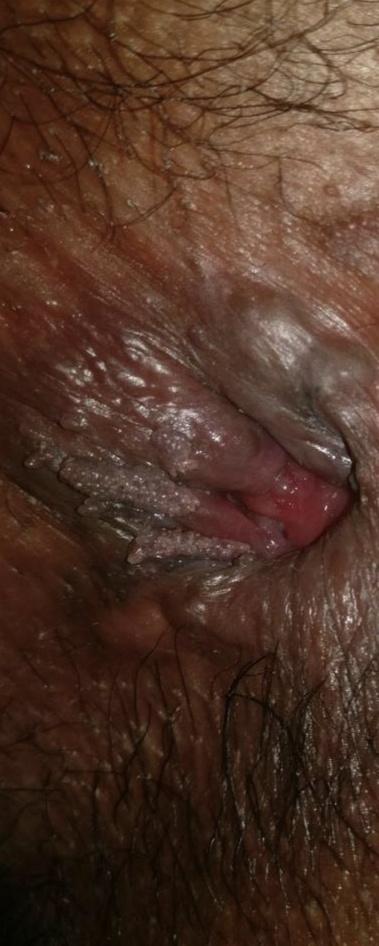
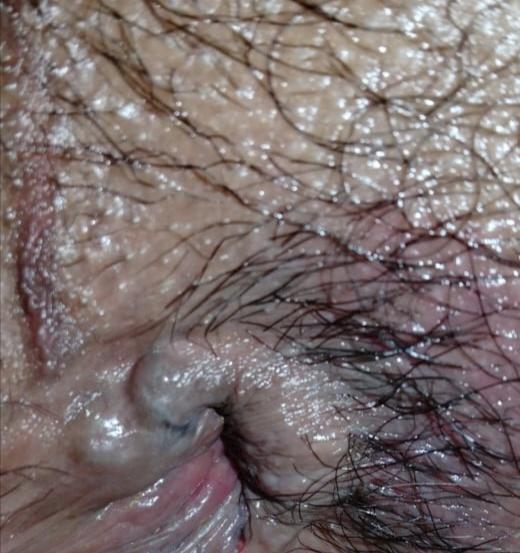
A 23-year-old male adult presented to the Department of Dermatology with complaints of asymptomatic multiple skin coloured raised lesions in the perianal area for the last 2 weeks. Lesions were asymptomatic. His sexual history revealed frequent episodes of receptive anal intercourse. Clinical examination demonstrated multiple verrucous papules and plaques in the perianal area.
Case Description
A 23-year-old male adult presented to the Department of Dermatology with complaints of asymptomatic multiple skin coloured raised lesions in the perianal area for the last 2 weeks. Lesions were asymptomatic. His sexual history revealed frequent episodes of receptive anal intercourse. Clinical examination demonstrated multiple verrucous papules and plaques in the perianal area. Figure 1
General physical examination and systemic examination was normal. The patient underwent biochemical tests and virology assessment for investigations for HIV, HBsAG, Anti HCV) which were found to be non-reactive.
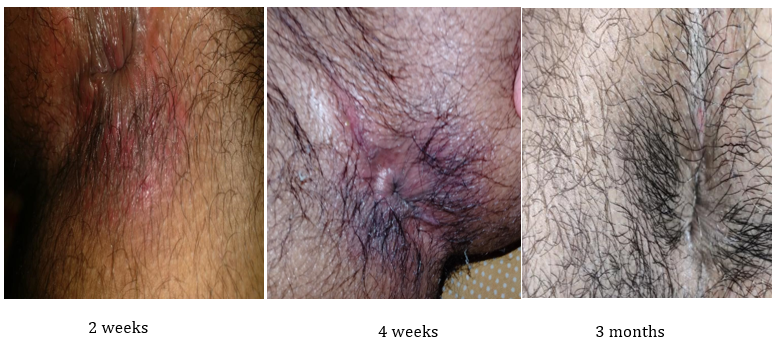
Patient was planned immunotherapy with intradermal purified protein derivatives in the dose of 10 TU /0.1 ml to be given 2 weekly for a maximum of 5 injections. A volume of 0.1 ml of PPD was given intradermally with an insulin syringe into the middle third of the right forearm after cleaning with 70% alcohol. After two weeks of first follow up, more than 90% of warts had regressed. Second session heralded complete clearance of lesions. Patient has been on regular follow up and even after three months, there had been no recurrence. Figure 2
DISCUSSION
One of the most frequent clinical signs of HPV infection in the vaginal area, which largely affected industrialized nations, is perianal warts. There is significant evidence linking these warts to anogenital malignancies. Men and women between the ages of 25 and 29 have the highest rate of perianal warts, respectively. [1,4]
Men who have sex with men (MSM) have an HPV seroprevalence that is roughly 2–6 times greater than that of heterosexual men, and it has been linked to 80–85% of anal malignancies. Anal warts are more prevalent in MSM who have engaged in condom-free anogenital contact or other anal-piercing sexual conduct, and their occurrence is ten times higher in HIV patients. Genital contact, early coitarche, multiple sex partners, and a history of STIs are a few more variables that increase the chance of HPV infection. Both sexual and non-sexual methods can be used to transmit genital HPV. HPV is very contagious and can spread between sexual partners even when no visible warts are present. [1,5]
The contour look of papules or verrucous, which can be flat or pedunculated, is highly diverse in the clinical form of Perianal warts. The lesion may be white, pink, purple, red, or skin-colored, or it may have other colors or patterns. Usually, the characteristics of skin lesions are
Figure 1: Baseline
Figure 2:
Wart recurrence is a common issue because the main treatments for Perianal warts up to this point have focused on removing the warts rather than treating the underlying infection. However, a patient's preference, convenience, the expertise of the doctor, cost, and side effects can all be taken into account while deciding on a Perianal warts therapy. [1,4]
Perianal warts can be treated surgically using electrocautery, excision surgery, cryotherapy, laser, and other methods, as well as non-surgically with podophyllin, podophyllotoxins, trichloroacetic acid, and immunotherapy. Anal warts may be treated with electrocautery, excision surgery, cryotherapy, and trichloroacetic acid. However, a number of studies have noted that the therapy's side effects include pain, burning, crust, ulceration, infection, and permanent scarring. Immunotherapy is an established treatment option with a lesser likelihood of forming scar tissue and a reasonably low recurrence rate. [1,4,5]
An effective biological treatment against infections, cancer, and other disorders is immunotherapy. Cimetidine, imiquimod, interferons, Candida albicans antigens, measles, mumps, rubella (MMR), intralesional vitamin D, Bacillus-Calmette-Guerin (BCG), and PPD are a few immunotherapy medications that have been used in the past to treat Perianal warts. These medications work by triggering the immune system's defense against the warts' HPV-induced proliferation. [1,3]
PPD is safe and effective for treating persistent warts (including multiple warts, large lesions, palmoplantar, periungual, and vaginal kinds) intralesionally, according to several studies. To boost the immune response against HPV infection on the injection site and distant lesions, intralesional immunotherapy, such as PPD injection, has been utilized to completely eradicate all warts. The proinflammatory cytokines interferon gamma (IFN-) and interleukin (IL)-12, which have a T-helper 1 pattern, are released when PPD generates a robust systemic immune response, activating cytotoxic T cells and natural killer (NK) cells to fight HPV infection. [1,4,5]
Numerous studies have been done to evaluate the efficiency of PPD versus other immunotherapies for warts. In this instance, a dose of 10 TU/0.1 ml was administered twice weekly for a total of 5 injections. After washing with 70% alcohol, 0.1 ml of PPD was injected intradermally using an insulin syringe into the middle third of the right forearm. More than 90% of warts had returned after the first two weeks of follow-up. Complete elimination of lesions was announced by the second session. Even after three months of consistent follow-up care for the patient, there had been no recurrence. [1,4]
Less chance of scarring and a lower recurrence rate are immunotherapy's key benefits. Rashes, swelling, pain or discomfort at the injection site, and fever have all been reported as frequent PPD adverse effects in studies. The emergence of painful nodules that could grow into blisters or abscesses at the injection site is a serious adverse effect that may occur; however the occurrence was uncommon. Eight months following treatment, prior research on anogenital and common warts revealed no recurrence. In our trial, the side effect was slight pain at the injection site for PPD, but it quickly subsided and did not return even three months later. [1,5]
CONCLUSION
Overall, Intradermal PPD appears to be an effective, safe, and acceptable treatment modality for perianal warts. It is easy to perform, easily available, inexpensive, easy to use, well-tolerated mode of treatment with minimal side effects and carries the advantage of patient compliance and high patient satisfaction.
Conflict of Interest
None declared
Funding
No funding sources
Ethical Approval
The study was approved by the Institutional Ethics Committee of Civil Hospital, Nurpur
REFERENCE
Achdiat, Pati Aji et al. "Success of Intralesional Purified Protein Derivative Immunotherapy in the Treatment of Anogenital Warts: A Case Report." Journal of Experimental Pharmacology, 2022, pp. 131–135. https://orcid.org/0000-0002-6924-0833.
Eassa, Bayoumy I., Amany A. Abou-Bakr, and Mohamed A. El-Khalawany. "Intradermal Injection of PPD as a Novel Approach of Immunotherapy in Anogenital Warts in Pregnant Women." Dermatologic Therapy, vol. 24, no. 1, 2011, pp. 137–143. https://doi.org/10.1111/j.1529-8019.2010.01388.x.
Saoji, Vikrant et al. "Immunotherapy Using Purified Protein Derivative in the Treatment of Warts: An Open Uncontrolled Trial." Indian Journal of Dermatology, Venereology and Leprology, vol. 82, 2016, p. 42. doi:10.4103/0378-6323.171650.
All papers should be submitted electronically. All submitted manuscripts must be original work that is not under submission at another journal or under consideration for publication in another form, such as a monograph or chapter of a book. Authors of submitted papers are obligated not to submit their paper for publication elsewhere until an editorial decision is rendered on their submission. Further, authors of accepted papers are prohibited from publishing the results in other publications that appear before the paper is published in the Journal unless they receive approval for doing so from the Editor-In-Chief.
Himalayan Journal of Applied Medical Sciences and Research open access articles are licensed under a Creative Commons Attribution-Share A like 4.0 International License. This license lets the audience to give appropriate credit, provide a link to the license, and indicate if changes were made and if they remix, transform, or build upon the material, they must distribute contributions under the same license as the original.
Recommended Articles
Research Article
Ethnomedicinal Plants for Obesity Management - Phytochemicals, Molecular Targets and Prospects of Green Nanotechnology
Arpana Ashokrao Durge,
Utpal Jagdish Dongre
Published: 25/03/2026
Download PDF
Cite
x
APA
Durge, A. A. & Dongre, U. J. (2026). Ethnomedicinal Plants for Obesity Management - Phytochemicals, Molecular Targets and Prospects of Green Nanotechnology. Himalayan Journal of Applied Medical Sciences and Research, 7(1), 1-6.
MLA
Durge, Arpana Ashokrao and Utpal Jagdish Dongre. "Ethnomedicinal Plants for Obesity Management - Phytochemicals, Molecular Targets and Prospects of Green Nanotechnology." Himalayan Journal of Applied Medical Sciences and Research 7.1 (2026): 1-6.
Chicago
Durge, Arpana Ashokrao and Utpal Jagdish Dongre. "Ethnomedicinal Plants for Obesity Management - Phytochemicals, Molecular Targets and Prospects of Green Nanotechnology." Himalayan Journal of Applied Medical Sciences and Research 7, no. 1 (2026): 1-6.
Harvard
Durge, A. A. and Dongre, U. J. (2026) 'Ethnomedicinal Plants for Obesity Management - Phytochemicals, Molecular Targets and Prospects of Green Nanotechnology' Himalayan Journal of Applied Medical Sciences and Research 7(1), pp. 1-6.
Vancouver
Durge AA, Dongre UJ. Ethnomedicinal Plants for Obesity Management - Phytochemicals, Molecular Targets and Prospects of Green Nanotechnology. Himalayan Journal of Applied Medical Sciences and Research. 2026 Jan;7(1):1-6.
Download PDF
Research Article
Digital Implantology: Current Concepts, Clinical Applications, Limitations and Future Directions - A Narrative Review
Anukrity Chandra
Published: 30/07/2026
Download PDF
Cite
x
APA
Chandra, A. (2026). Digital Implantology: Current Concepts, Clinical Applications, Limitations and Future Directions - A Narrative Review. Himalayan Journal of Applied Medical Sciences and Research, 7(2), 1-7.
MLA
Chandra, Anukrity. "Digital Implantology: Current Concepts, Clinical Applications, Limitations and Future Directions - A Narrative Review." Himalayan Journal of Applied Medical Sciences and Research 7.2 (2026): 1-7.
Chicago
Chandra, Anukrity. "Digital Implantology: Current Concepts, Clinical Applications, Limitations and Future Directions - A Narrative Review." Himalayan Journal of Applied Medical Sciences and Research 7, no. 2 (2026): 1-7.
Harvard
Chandra, A. (2026) 'Digital Implantology: Current Concepts, Clinical Applications, Limitations and Future Directions - A Narrative Review' Himalayan Journal of Applied Medical Sciences and Research 7(2), pp. 1-7.
Vancouver
Chandra A. Digital Implantology: Current Concepts, Clinical Applications, Limitations and Future Directions - A Narrative Review. Himalayan Journal of Applied Medical Sciences and Research. 2026 Jul;7(2):1-7.
Download PDF
Research Article
Study of the Role of Serum Interleukin-6 in Inflammation among Pregnant Women with COVID-19
Aynar Talib Samad,
Yossra Saleh Khudhur
Published: 27/07/2021
Download PDF
Cite
x
APA
Talib Samad, A. & Khudhur, Y. S. (2021). Study of the Role of Serum Interleukin-6 in Inflammation among Pregnant Women with COVID-19. Himalayan Journal of Applied Medical Sciences and Research, 2(2), 1-6.
MLA
Talib Samad, Aynar and Yossra Saleh Khudhur. "Study of the Role of Serum Interleukin-6 in Inflammation among Pregnant Women with COVID-19." Himalayan Journal of Applied Medical Sciences and Research 2.2 (2021): 1-6.
Chicago
Talib Samad, Aynar and Yossra Saleh Khudhur. "Study of the Role of Serum Interleukin-6 in Inflammation among Pregnant Women with COVID-19." Himalayan Journal of Applied Medical Sciences and Research 2, no. 2 (2021): 1-6.
Harvard
Talib Samad, A. and Khudhur, Y. S. (2021) 'Study of the Role of Serum Interleukin-6 in Inflammation among Pregnant Women with COVID-19' Himalayan Journal of Applied Medical Sciences and Research 2(2), pp. 1-6.
Vancouver
Talib Samad A, Khudhur YS. Study of the Role of Serum Interleukin-6 in Inflammation among Pregnant Women with COVID-19. Himalayan Journal of Applied Medical Sciences and Research. 2021 Jul;2(2):1-6.
Download PDF
Research Article
Evalution CD11b, CD4, IL-17A and IL-23 as Biomarkers Immunological in Patients with Behçet’s Disease
Layla Saleh Abdul-Hassan,
...
Saeed hilal khudhair
Published: 13/07/2026
Download PDF
Cite
x
APA
Abdul-Hassan, L. S., Fadel, R. H. & khudhair, S. H. (2026). Evalution CD11b, CD4, IL-17A and IL-23 as Biomarkers Immunological in Patients with Behçet’s Disease. Himalayan Journal of Applied Medical Sciences and Research, 7(2), 1-7.
MLA
Abdul-Hassan, Layla S., Radhia H. Fadel and Saeed H. khudhair. "Evalution CD11b, CD4, IL-17A and IL-23 as Biomarkers Immunological in Patients with Behçet’s Disease." Himalayan Journal of Applied Medical Sciences and Research 7.2 (2026): 1-7.
Chicago
Abdul-Hassan, Layla S., Radhia H. Fadel and Saeed H. khudhair. "Evalution CD11b, CD4, IL-17A and IL-23 as Biomarkers Immunological in Patients with Behçet’s Disease." Himalayan Journal of Applied Medical Sciences and Research 7, no. 2 (2026): 1-7.
Harvard
Abdul-Hassan, L. S., Fadel, R. H. and khudhair, S. H. (2026) 'Evalution CD11b, CD4, IL-17A and IL-23 as Biomarkers Immunological in Patients with Behçet’s Disease' Himalayan Journal of Applied Medical Sciences and Research 7(2), pp. 1-7.
Vancouver
Abdul-Hassan LS, Fadel RH, khudhair SH. Evalution CD11b, CD4, IL-17A and IL-23 as Biomarkers Immunological in Patients with Behçet’s Disease. Himalayan Journal of Applied Medical Sciences and Research. 2026 Jul;7(2):1-7.
Sharma, J., Sharma, G. & Sharma, K. (2023). Successful Treatment of Perianal Warts with Intradermal Purified Protein Derivative. Himalayan Journal of Applied Medical Sciences and Research, 4(1), 1-3.
MLA
Sharma, Jyotshna, Gaurav Sharma and Komal Sharma. "Successful Treatment of Perianal Warts with Intradermal Purified Protein Derivative." Himalayan Journal of Applied Medical Sciences and Research 4.1 (2023): 1-3.
Chicago
Sharma, Jyotshna, Gaurav Sharma and Komal Sharma. "Successful Treatment of Perianal Warts with Intradermal Purified Protein Derivative." Himalayan Journal of Applied Medical Sciences and Research 4, no. 1 (2023): 1-3.
Harvard
Sharma, J., Sharma, G. and Sharma, K. (2023) 'Successful Treatment of Perianal Warts with Intradermal Purified Protein Derivative' Himalayan Journal of Applied Medical Sciences and Research 4(1), pp. 1-3.
Vancouver
Sharma J, Sharma G, Sharma K. Successful Treatment of Perianal Warts with Intradermal Purified Protein Derivative. Himalayan Journal of Applied Medical Sciences and Research. 2023 Jan;4(1):1-3.


 Download PDF
 Download XML