Background: Hygiene is a part of WASH Strategy which is associated with better health outcomes across the globe. Personal Hygiene practices are essential for prevention of communicable diseases like Pneumonia, Diarrhea, Influenza, COVID etc. Personal Hygiene includes Hand Hygiene, Menstrual Hygiene& Daily routine activities. Objective: To assess the knowledge and practices of population in Shimla city in relation to Personal Hygiene promotion practices. Methodology: Population based house to house survey in randomly selected households of all 34 wards using a semi structured questionnaire. Results: A total of 640 households were surveyed.Majority were (71.7%) females, Hindus (97%)& literate.Around 38% of the study participants had perception that cleaning house & household items, while 50% mopping, dusting & 41.7% daily bathing, brushing teeth, trimming nailswere the practicesto maintain good Hygiene. Almost every participant washes his hands after coming from market, 99.8% before eating, 99.8% before preparation of food. Around 71% clean the seat of public toilet before use, 17% wear trouserswhereas 15% shirt, 6% inner wear for 2 days or more in a row.13.6% of the study participants were not washing their hands at workplace. Around 10% of the study participants were still not using soap for Handwashing. Around 6% still use disposable clothes, 6% reusable cloth & 2% use cotton during menstruation. Conclusions:Most PersonalHygiene practices were found to be satisfactory in our study group. Handwashing at Workplace was still not being followed especially during COVID times also. Women were still using materials other than sanitary pads during menstruation. There are plenty who were not using both soap and water for handwashing which needs intensive IEC for benefits of handwashing. Each and every woman need to be aware of usage and also access to economical disposable sanitary pads.
Keywords
Water Sanitation and Hygiene
PersonalHygiene
Hygiene Promotion Practices
Handwashing
Menstrual Hygiene.
INTRODUCTION
Since 1990, the Joint Monitoring Programme (JMP) for Water Supply, Sanitation and Hygiene by WHO and UNICEF has regularly produced estimates of global WASH progress. In September 2015, world leaders in a meeting of United Nations pledged to achieve 17 Sustainable Development Goals by 2030. The Goal No. 6 aims on the availability and livable management of water and sanitation for all [1]. The JMP is now responsible for tracking progress towards those SDG 6 Targets [2].
Hygiene has two aspects Personal& environmental. PersonalHygiene includes clothing, washing, bathing, washing hands &care of nails, feet & teeth. Training forPersonalHygiene should begin at early age [3].
Hygiene is the simplest &most important measure in preventing many communicable diseases.Perception of Hygiene varies from individual to individual. Hygienebehaviors and practices among a given population will thus provide a great deal of insight towards the preventive medicine process.
Keeping a good standard of Hygiene helps to prevent the development and spread of infections and disease.According to a World Health Organization (WHO) estimate, 1.5 million children die from diarrheal diseases each year worldwide, with 88% of these deaths occurring due to inadequate sanitation, Hygiene, and drinking water [4]. Access to sanitation facilities alone does not indicate their hygienic use or adoption of other hygienic practices[5].
Despite a large base of evidence showing that adequate Hygiene Practices are associated with better health outcomes, results from several studies show that complex factors stillremainthat influence individual, household, and community motivations to change behavior. There is not enough literature available for assessing the progress of WASH strategy at household levels in Himachal Pradesh.
Thereforean extensive survey was undertaken by the Department of Community Medicine, Indira Gandhi Medical College Shimla along with Department of Environment, Science & Technology, Himachal Pradesh from July through October 2020 to establish a baseline of the current knowledge, attitudes and behavior of population in Shimla city in relation to water, sanitation, Hygieneand other health-related practices. This article is a part of that survey and presents the Hygiene promotion practices in the Shimla city, the capital ofHimachal Pradesh.
Objective of the study
To Assess The Knowledge And Practices Of Population In Shimla City In Relation To PersonalHygienePromotion Practices.
MATERIALS AND METHODS
Study Design:
Cross sectional survey.
Study Area:
Shimla city of Himachal Pradesh.
Study Period:
Four months; July 2020 through October 2020.
Study Population:
Population residing in all 34 wards under Municipal corporation area of Shimla City.
Sample Size:
Sampling unit was households in the Municipal corporation area of Shimla city. Sample size was estimated to be 640 expecting 50% of households having adequate knowledge about hygiene promotion practices, with 95% level of confidence, design effect 1.5, 5% absolute error and non-response rate of 5%.
Sampling Design:
Stratified Random Sampling was done for the selection of Households for survey. We equally divided the households in all the 34 wards of Shimla city and average 15-30 households per municipal ward were selected. First household of the ward was selected randomly and then every 10th household was selected to complete the sample size in the respective ward. An effort was made to have a balance of males and females, as well as to involve some younger persons as respondents. The Principal Investigator & Co- Principal Investigator in collaboration with the Local community leaders conducted the sampling process.
Data collection:
Before doing the data collection, the survey teams consisting of medical social workers and residents of Department of Community Medicine were given training regarding the administration of the questionnaire. The data collectors obtained consent from the head of Family and Pretested Standardized Questionnaire administered in every selected household, and the respondents (who willing to participate) were asked questions regardingPersonal Hygiene PromotionPractices. Only one adult member per household was selected for data collection.
The data was collected to obtain information on following parameters:
Socio demographic profile
Knowledge, Attitude and Practices about Personal Hygiene Promotion Practices
Inclusion Criteria
Any adult person (only One per household) in selected household who was willing to participate in the study and had given consent.
Exclusion Criteria
Not available at the time of survey or refused due to unavoidable issues after consenting.
RESULTS
In the study maximum (71.7%) respondents were females, 97% were Hindus, 93.1% were literate and 37.7% were employed or working. (Table 1)
37.8% of the study participants consider cleaning house & household items, 50.2% consider mopping & dusting, 41.7% consider daily bathing, brushing teeth, trimming nails, and 12.1% participants consider other things that they do to maintain good Hygiene. (Table 2).
On the question about signs of lack of Hygiene in the household, 61.3% answered Presence of Flies and Mosquitos, 30.8% answered unclean home, 25.6% answered bad smell, 17.1% answered presence of rodents and insects and 18.6% of the study participants answered presence of more diseases in the household members.68.1% participants consider that maintenance of good Hygiene is important to prevent diseases.
On the question about how to prevent Head Lice, 49.8% answered maintaining Personal Hygiene, 43.8% consider applying Anti-Lice lotions, 19.7% answered Daily Hair-washing, and 6% answered avoiding crowded areas.
In our study group, 95.3% respondents bath daily, 95.5% brush daily, 51.7% clean their ears weekly,91.4% cut their nails weekly,97.2% wash their clothes regularly,98.8% use shoes while going to the toilet,99.4% wash their hands when coming from market,99.8%wash their hands before eating, 99.8% wash their hands before preparation of food,99.8% wash fruits and vegetable before eating, 70.8% clean the seat of public toilet before use, 82.5% wear trouser for 2 days or more, 15.55 wear shirt for 2 days in a row,6.09 % use inner wear for more than 2 days and 5.8% skip their bath for more than 2 days. 13.6% of the study participants were not washing their hands at workplace. (Table 3)
Table 1: Distribution of the Participants According to Socio-demographic characteristics
Frequency
(N=640)
Percent
(100%)
Gender
Female
459
71.7
Male
181
28.3
Religion
Hindu
621
97.0
Muslim
8
1.3
Others
5
.8
Sikh
6
.9
Educational Qualification
Graduate / PG
287
44.8
Illiterate
44
6.9
Intermediate/ Post High school diploma
128
20.0
Matric
96
15.0
Middle
45
7.0
Primary
24
3.8
Professional
16
2.5
Occupation
Clerk/shop Owner/farm owner
51
8.0
Professional
112
17.5
Semiprofessional
21
3.3
Skilled worker
36
5.6
Unemployed/Housewife
399
62.3
Unskilled worker
21
3.3
Table 2: Perception about Hygiene
Answer
Frequency
Percentage
What do you do to maintain good Hygiene (N=640)
Cleaning House and household items
242
37.8
Mopping & Dusting
321
50.2
Daily Bathing, Brushing Teeth & Trimming Nails
267
41.7
Other Practices
78
12.1
Nothing
61
9.5
Signs of Lack of Hygiene in household (N=640)
Flies & Mosquitos
392
61.3
Unclean Home
197
30.8
Bad Smell
164
25.6
Rodents & Insects
109
17.1
More Diseases
119
18.6
Other Signs
117
18.3
Why is it important to maintain good Hygiene (N=640)
Prevent Diseases
436
68.1
Stay Fit & Healthy
273
42.7
Better Lifestyle
69
10.8
Others
48
7.5
How can we prevent head lice (N=640)
Maintain PersonalHygiene
319
49.8
Anti-lice lotion
280
43.8
Daily Hair-washing
126
19.7
Avoid congested areas
39
6.1
Don’t Know
41
6.4
Table 2: Perception about Hygiene
Answer
Frequency
Percentage
What do you do to maintain good Hygiene (N=640)
Cleaning House and household items
242
37.8
Mopping & Dusting
321
50.2
Daily Bathing, Brushing Teeth & Trimming Nails
267
41.7
Other Practices
78
12.1
Nothing
61
9.5
Signs of Lack of Hygiene in household (N=640)
Flies & Mosquitos
392
61.3
Unclean Home
197
30.8
Bad Smell
164
25.6
Rodents & Insects
109
17.1
More Diseases
119
18.6
Other Signs
117
18.3
Why is it important to maintain good Hygiene (N=640)
Prevent Diseases
436
68.1
Stay Fit & Healthy
273
42.7
Better Lifestyle
69
10.8
Others
48
7.5
How can we prevent head lice (N=640)
Maintain PersonalHygiene
319
49.8
Anti-lice lotion
280
43.8
Daily Hair-washing
126
19.7
Avoid congested areas
39
6.1
Don’t Know
41
6.4
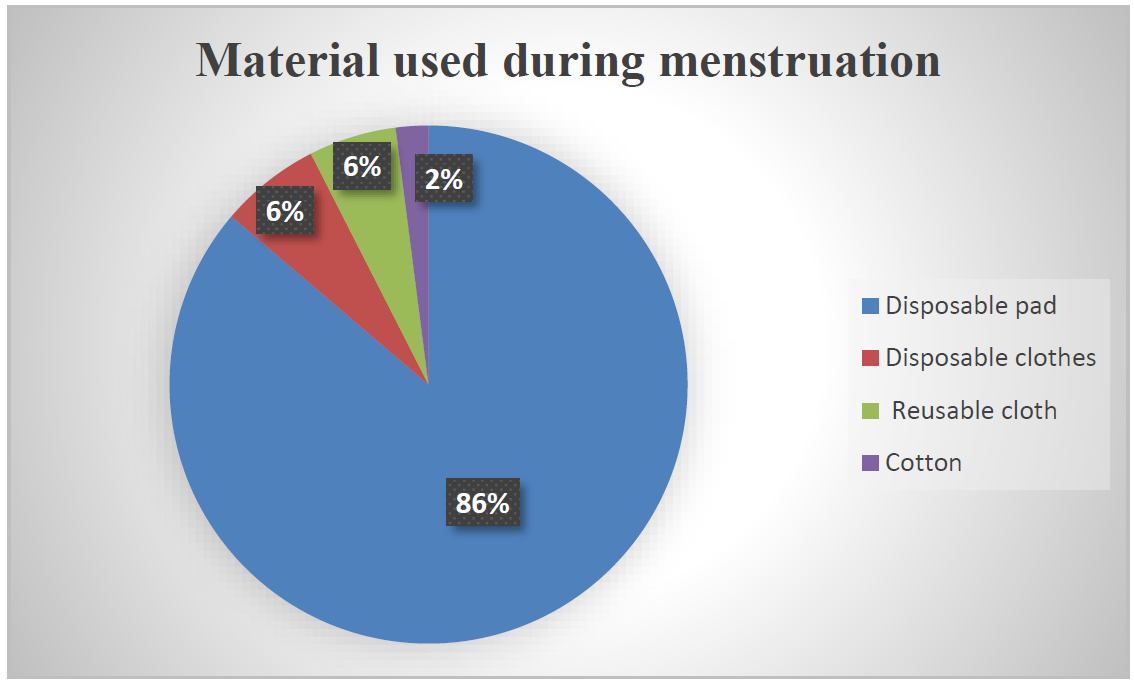
In our study respondents (459 were females out of total 640 households) , 86% females were using Sanitary pad while 6% still use disposable clothes, 6% reusable cloth & 2% use cotton during menstruation. (Figure 1)
Figure 1: Type of material used during menstruation(N=459)
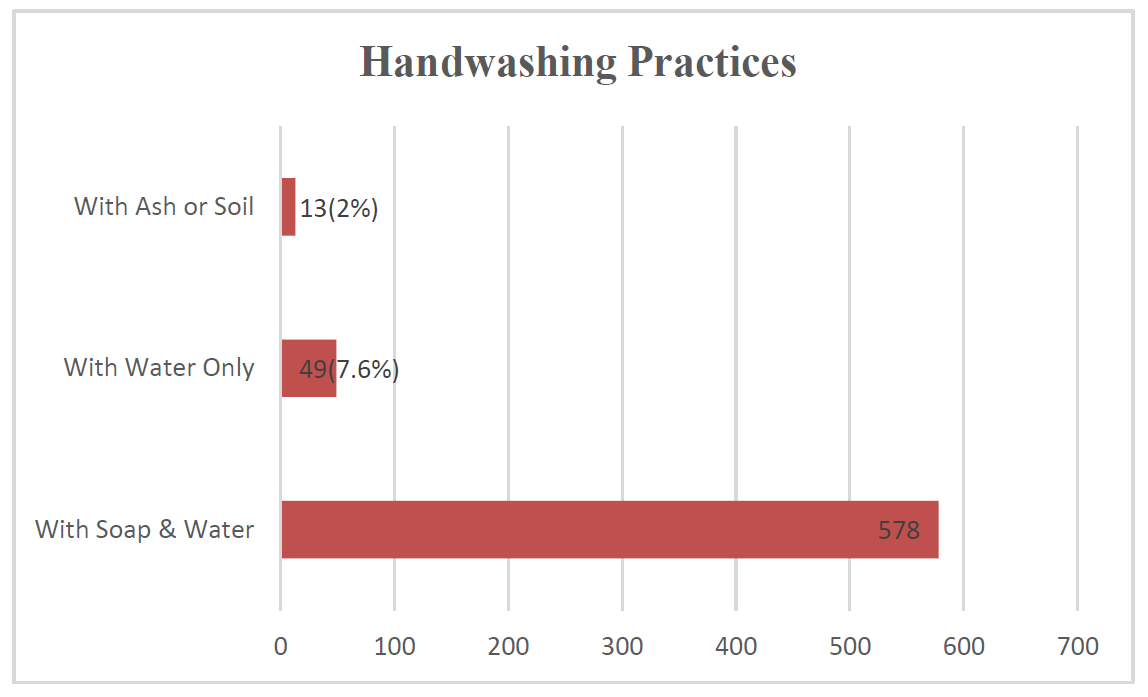
Figure 2: What do you use for Handwashing (N=640)
When asked about the handwashing, 62study participants i.e. 9.6% were still not using soap. (Figure 2)
DISCUSSION
In the present study, 95.3% respondents bath daily. In a study done by Farah Set al[6] in Bangladesh in 2015 it came out to be 81% &98% in a study done by Shekhawat R et al[7] in Bikaner Rajasthan in 2019 which were in concordance with our study. In our study 95.5% of the participants brush their teeth daily. This is in concordance with the study done by Shekhawat R et al (93%) and in contrast to in study done by Farah S et al (60%). 91.4% cut their nails weekly which is in contrast with study done by ShekhawatR et al (68%). 97.2% wash their clothes regularly. This is in contrast to the study done by Farah S et al (22%) and in concordance with study done by Shekhawat R et al (95.7%).Majority of our study participants i.e. 98.8% use shoes while goingto the toilet which is in contrast to the study done by Farah S et al which reported it to be 60.6%. 99.4% wash their hands when coming from market, 99.8%wash their hands before eating, 99.8% wash their hands before preparation of food which is in concordance with the study done byVivas A et al[8] in Ethiopia in (99.8%) 2010, Rajbhandari KA et al [9] in Nepal in 2018 (81.2%)&Hothur R et al[10] in Andhra Pradesh in 2019 (81.8%). 99.8% wash fruits and vegetable before eating which is in concordance with Rajbhandari KA et al. 70.8% of the households responded that they clean the seat of public toilet before use. 82.5% wear trouser for 2 days or more which is in contrast to the study done by Vivas A et al (18.5%), 15.55 wear shirt for 2 days in a row,6.09 % use inner wear for more than 2 days and 5.8% skip their bath for more than 2 days.These findings are in contrast with the findings of the study done by Sarkar M et al in Kolkata in 2013(87.5%) [11].
Regarding perception about hygiene, most of the participants in this study (50.2%) perceive Mopping & Dusting while 37.8% cleaning house and household items, 41.7% daily bathing, brushing & trimming nails to maintain good hygiene. 61.3% study participants identify lack of hygiene by presence of flies & mosquitos in the house, 30.8% by unclean home, 25.6% by bad smell, 18.6% by presence of more diseases. These Personal Hygiene practices were found to be satisfactory among the households in the Shimla city.
In the currentstudy respondents, 86% females were using Sanitary pad for menstruation but there are still many women who were using other materials for menstrual Hygiene which needs to be discouraged.
When asked about the handwashing, 9.6% of the study participants were still not using soap which is worrisome as many hand washing programs are being run by various departments for promoting handwashing with soap and water.
CONCLUSION
Most PersonalHygiene practices were found to be satisfactory in the present study. The study shows good perception about hygiene promotion practices among residents of Shimla city. Handwashing at Workplace was still not being followed especially during COVID times also.Women were using materials other than sanitary pads during menstruation.There were plenty who do not use both soap and water for handwashing.
Recommendations
People were aware of the uses of handwashing, but were not practicing it regularly at workplace, which needs to be re-emphasized especially during COVID times to achieve SDGs by 2030. Use of Sanitary pads needs to be encouraged for each and every woman and they need to be sensitized about the harmful effects of other items used during menstruation. Intensive IEC activities about Hygiene Promotion Practices should be carried out.
REFERENCE
Envision2030: 17 Goals to Transform the World for Persons with Disabilities. United Nations, https://www.un.org/development/desa/disabilities/envision2030.html.
Progress on Drinking Water, Sanitation and Hygiene: 2017 Update and SDG Baseline. World Health Organization, 2017, https://www.who.int/mediacentre/news/releases/2017/launch-version-report-jmp-water-sanitation-Hygiene.pdf.
Park, K. Park’s Textbook of Preventive and Social Medicine. 24th ed., 2017.
Lipson, J. The Public Health Benefits of Sanitation Interventions. EPAR Brief No. 104, Evans School of Public Affairs, University of Washington, 2010.
Samanta, B.B., and C.A. van Wijk. “Criteria for Successful Sanitation Programmes in Low-Income Countries.” Health Policy and Planning, vol. 13, no. 1, 1998, pp. 78–86.
Shekhawat, Rekha, et al. “Knowledge and Practice Regarding Personal Hygiene among Students of Government Schools of Bikaner, Rajasthan.” International Journal of Advanced Community Medicine, vol. 2, no. 2, 2019, pp. 108–111.
Farah, Shayela, et al. “Knowledge and Practice of Personal Hygiene and Sanitation: A Study in Selected Slums of Dhaka City.” Delta Medical College Journal, vol. 3, no. 2, 2015, pp. 68–74. https://doi.org/10.3329/dmcj.v3i2.24425.
Nguyen, N.L., et al. “Intestinal Parasitic Infection and Nutritional Status among School Children in Angolela, Ethiopia.” Journal of Preventive Medicine and Hygiene, vol. 53, no. 3, 2012.
Rajbhandari, Ajay Kumar, et al. “Knowledge and Practice of Personal Hygiene among Secondary School Grade Nine and Ten Students.” Journal of Patan Academy of Health Sciences, vol. 5, no. 2, December 2018, pp. 107–113.
Hothur, R., et al. “A KAP Study on Water, Sanitation and Hygiene among Residents of Parla Village, Kurnool District, Andhra Pradesh.” International Journal of Community Medicine and Public Health, vol. 6, 2019, pp. 2081–2085.
About Water, Sanitation and Hygiene. UNICEF, https://www.unicef.org/wash/3942_3952.html. Accessed November 2020.
License
Creative Commons Attribution-NonCommercial-NoDerivatives 4.0 International License
All papers should be submitted electronically. All submitted manuscripts must be original work that is not under submission at another journal or under consideration for publication in another form, such as a monograph or chapter of a book. Authors of submitted papers are obligated not to submit their paper for publication elsewhere until an editorial decision is rendered on their submission. Further, authors of accepted papers are prohibited from publishing the results in other publications that appear before the paper is published in the Journal unless they receive approval for doing so from the Editor-In-Chief.
Himalayan Journal of Community Medicine and Public Health open access articles are licensed under a Creative Commons Attribution-Share A like 4.0 International License. This license lets the audience to give appropriate credit, provide a link to the license, and indicate if changes were made and if they remix, transform, or build upon the material, they must distribute contributions under the same license as the original.
Recommended Articles
Research Article
Assessing the Role of Community Engagement in Promoting Malaria Prevention and Treatment Practices in Mashonaland Central Province, Zimbabwe: A Case of Centenary District
Dzamara Tafadzwa,
Mapuranga Danemore
Published: 13/08/2026
Download PDF
Cite
x
APA
Tafadzwa, D. & Danemore, M. (2026). Assessing the Role of Community Engagement in Promoting Malaria Prevention and Treatment Practices in Mashonaland Central Province, Zimbabwe: A Case of Centenary District. Himalayan Journal of Community Medicine and Public Health, 7(1), 1-6.
MLA
Tafadzwa, Dzamara and Mapuranga Danemore. "Assessing the Role of Community Engagement in Promoting Malaria Prevention and Treatment Practices in Mashonaland Central Province, Zimbabwe: A Case of Centenary District." Himalayan Journal of Community Medicine and Public Health 7.1 (2026): 1-6.
Chicago
Tafadzwa, Dzamara and Mapuranga Danemore. "Assessing the Role of Community Engagement in Promoting Malaria Prevention and Treatment Practices in Mashonaland Central Province, Zimbabwe: A Case of Centenary District." Himalayan Journal of Community Medicine and Public Health 7, no. 1 (2026): 1-6.
Harvard
Tafadzwa, D. and Danemore, M. (2026) 'Assessing the Role of Community Engagement in Promoting Malaria Prevention and Treatment Practices in Mashonaland Central Province, Zimbabwe: A Case of Centenary District' Himalayan Journal of Community Medicine and Public Health 7(1), pp. 1-6.
Vancouver
Tafadzwa D, Danemore M. Assessing the Role of Community Engagement in Promoting Malaria Prevention and Treatment Practices in Mashonaland Central Province, Zimbabwe: A Case of Centenary District. Himalayan Journal of Community Medicine and Public Health. 2026 Jan;7(1):1-6.
Download PDF
Research Article
Curves of Concern: Public Awareness of Scoliosis and Its Impact on Childhood Development in Hamirpur
Vishal Dhatwalia,
Swati Chandel
Published: 10/12/2024
Download PDF
Cite
x
APA
Dhatwalia, V. & Chandel, S. (2024). Curves of Concern: Public Awareness of Scoliosis and Its Impact on Childhood Development in Hamirpur. Himalayan Journal of Community Medicine and Public Health, 5(2), 1-6.
MLA
Dhatwalia, Vishal and Swati Chandel. "Curves of Concern: Public Awareness of Scoliosis and Its Impact on Childhood Development in Hamirpur." Himalayan Journal of Community Medicine and Public Health 5.2 (2024): 1-6.
Chicago
Dhatwalia, Vishal and Swati Chandel. "Curves of Concern: Public Awareness of Scoliosis and Its Impact on Childhood Development in Hamirpur." Himalayan Journal of Community Medicine and Public Health 5, no. 2 (2024): 1-6.
Harvard
Dhatwalia, V. and Chandel, S. (2024) 'Curves of Concern: Public Awareness of Scoliosis and Its Impact on Childhood Development in Hamirpur' Himalayan Journal of Community Medicine and Public Health 5(2), pp. 1-6.
Vancouver
Dhatwalia V, Chandel S. Curves of Concern: Public Awareness of Scoliosis and Its Impact on Childhood Development in Hamirpur. Himalayan Journal of Community Medicine and Public Health. 2024 Jul;5(2):1-6.
Download PDF
Research Article
Etiological Analysis of the Incident of Computer Vision Syndrome (Cvs) in Students of the Faculty of Medical Muhammadiyah University Semarang
Anang Kriswantoro,
...
Swasty
Published: 20/01/2026
Download PDF
Cite
x
APA
Kriswantoro, A., Martiningsih, W. R., Novitasari, A. & None, S. (2026). Etiological Analysis of the Incident of Computer Vision Syndrome (Cvs) in Students of the Faculty of Medical Muhammadiyah University Semarang. Himalayan Journal of Community Medicine and Public Health, 7(1), 1-5.
MLA
Kriswantoro, Anang, et al. "Etiological Analysis of the Incident of Computer Vision Syndrome (Cvs) in Students of the Faculty of Medical Muhammadiyah University Semarang." Himalayan Journal of Community Medicine and Public Health 7.1 (2026): 1-5.
Chicago
Kriswantoro, Anang, Wahju R. Martiningsih, Andra Novitasari and Swasty . "Etiological Analysis of the Incident of Computer Vision Syndrome (Cvs) in Students of the Faculty of Medical Muhammadiyah University Semarang." Himalayan Journal of Community Medicine and Public Health 7, no. 1 (2026): 1-5.
Harvard
Kriswantoro, A., Martiningsih, W. R., Novitasari, A. and None, S. (2026) 'Etiological Analysis of the Incident of Computer Vision Syndrome (Cvs) in Students of the Faculty of Medical Muhammadiyah University Semarang' Himalayan Journal of Community Medicine and Public Health 7(1), pp. 1-5.
Vancouver
Kriswantoro A, Martiningsih WR, Novitasari A, Swasty S. Etiological Analysis of the Incident of Computer Vision Syndrome (Cvs) in Students of the Faculty of Medical Muhammadiyah University Semarang. Himalayan Journal of Community Medicine and Public Health. 2026 Jan;7(1):1-5.
Download PDF
Research Article
Silent Threats Unveiled: Gauging Public Awareness and Understanding of Blood Clotting Disorders in Ambala, Haryana
Ashmita Joshi,
...
Sanjeev Kumar
Published: 30/07/2024
Download PDF
Cite
x
APA
Joshi, A., kaur, J. & Kumar, S. (2024). Silent Threats Unveiled: Gauging Public Awareness and Understanding of Blood Clotting Disorders in Ambala, Haryana. Himalayan Journal of Community Medicine and Public Health, 5(2), 1-6.
MLA
Joshi, Ashmita, Jasleen kaur and Sanjeev Kumar. "Silent Threats Unveiled: Gauging Public Awareness and Understanding of Blood Clotting Disorders in Ambala, Haryana." Himalayan Journal of Community Medicine and Public Health 5.2 (2024): 1-6.
Chicago
Joshi, Ashmita, Jasleen kaur and Sanjeev Kumar. "Silent Threats Unveiled: Gauging Public Awareness and Understanding of Blood Clotting Disorders in Ambala, Haryana." Himalayan Journal of Community Medicine and Public Health 5, no. 2 (2024): 1-6.
Harvard
Joshi, A., kaur, J. and Kumar, S. (2024) 'Silent Threats Unveiled: Gauging Public Awareness and Understanding of Blood Clotting Disorders in Ambala, Haryana' Himalayan Journal of Community Medicine and Public Health 5(2), pp. 1-6.
Vancouver
Joshi A, kaur J, Kumar S. Silent Threats Unveiled: Gauging Public Awareness and Understanding of Blood Clotting Disorders in Ambala, Haryana. Himalayan Journal of Community Medicine and Public Health. 2024 Jul;5(2):1-6.
Sharma, S., Thakur, R., Sachdeva, A. & Gupta, A. (2020). Assessment of Hygiene Promotion Practices in Shimla City of Himachal Pradesh. Himalayan Journal of Community Medicine and Public Health, 1(1), 1-5.
MLA
Sharma, Sumit, et al. "Assessment of Hygiene Promotion Practices in Shimla City of Himachal Pradesh." Himalayan Journal of Community Medicine and Public Health 1.1 (2020): 1-5.
Chicago
Sharma, Sumit, Rakesh Thakur, Amit Sachdeva and Anmol Gupta. "Assessment of Hygiene Promotion Practices in Shimla City of Himachal Pradesh." Himalayan Journal of Community Medicine and Public Health 1, no. 1 (2020): 1-5.
Harvard
Sharma, S., Thakur, R., Sachdeva, A. and Gupta, A. (2020) 'Assessment of Hygiene Promotion Practices in Shimla City of Himachal Pradesh' Himalayan Journal of Community Medicine and Public Health 1(1), pp. 1-5.
Vancouver
Sharma S, Thakur R, Sachdeva A, Gupta A. Assessment of Hygiene Promotion Practices in Shimla City of Himachal Pradesh. Himalayan Journal of Community Medicine and Public Health. 2020 Jul;1(1):1-5.


 Download PDF
 Download XML