Contents
Download PDF
pdf Download XML
1283 Views
195 Downloads
Share this article
Research Article | Volume 1 Issue 1 (July-Dec, 2020) | Pages 1 - 3
Assessment of menstrual practices in reproductive age Shimla City of Himachal Pradesh
 ,
 ,
 ,
1
Department of Community Medicine, IGMC, Shimla, Himachal Pradesh, India
Under a Creative Commons license
Open Access
Received
Sept. 7, 2020
Revised
Oct. 22, 2020
Accepted
Nov. 12, 2020
Published
Dec. 30, 2020
Abstract

Background: Menstruation or menses is the natural bodily process of releasing blood and associated matter from the uterus through the vagina as part of the menstrual cycle. Menstrual practices are influenced by taboos and socio-cultural restrictions for women. Material & method: population based Cross-sectional study involving 32 wards of Shimla city. Sampling unit was household in MC Shimla. Sample size estimated 640 stratified random sampling was done for selection of sampling unit.  Results: Perception regarding menstrual hygiene was considered by 71.4% of the respondents and 24.1% as important & only 4.5 % regarded it as slightly Regarding practices of menstrual hygiene 88.4% respondents use disposable pad for menstrual hygiene and 48.59 dispose off them in household waste. Conclusion: Menstrual hygiene perception was regarded as very important by majority of respondent as well as good practices were followed by majority.

Keywords
INTRODUCTION

The onset of menstruation is called “Menarche”.The terms "menstruation" and "menses" are derived from the Latin mensis (month), which in turn relates to the  Greek mene (moon) and to the roots of the English words month and moon.1Menstruation or menses is the natural bodily process of releasing blood and associated matter from the uterus through the vagina as part of the menstrual cycle. Even after the attainment of menarche, very little information is given to young girls about the physiological processes involved and the hygienic practices to be followed [1].


Menstruation is still a taboo in India and it is common for people across society to feel uncomfortable about the subject. Menstrual practices are influenced by taboos and socio-cultural restrictions for women as well as adolescent girls. Poor awareness of the physiology, unscientific attitude, myths, and misconceptions including the notion that menstruating women are “contaminated,” “dirty,” and “impure” adversely affect their health and social lives. Coupled with it, the lack of access to menstrual hygiene (which includes sanitary napkins, toilets in schools/household, availability of water, privacy and safe disposal) could restrict school attendance, social mobility and contribute to local infections during this period [2].


It was observed that around 57% of women between the ages of 15 and 24 use a hygienic method of MHM & 62% women are using cloth which can be reused after washing, cleaning, and drying. However, these reusable materials are not sanitized with soap and clean water in compelling circumstances or due to lack of awareness and social taboos also restrict women to dry them indoors, away from sunlight.


Menstruation hygiene is an issue that has not received adequate attention in the reproductive health and water, sanitation and hygiene (WASH) sectors in developing countries like India and its impact on achieving many Sustainable development goals (SDGs). 


Menstrual hygiene is often regarded as a multi-sectoral issue that requires an integrated action from the Department of Education, Health, Women, and Child Development and Water Sanitation Hygiene (WASH) 
MATERIALS AND METHODS

Objectives of the Study

Perception and practices of menstrual hygiene among reproductive age group in Shimla city.


Study design

Cross sectional survey 


Study area 

Shimla city of Himachal Pradesh 


Study period

6 months July 2020 through October 2020)


Study Population

Population residing in all 34 wards under Municipal corporation area of Shimla City 


Sample Size

Sampling unit was households in the Municipal corporation area of Shimla city. Sample size is estimated to be 640 expecting 50% of female of Reproductive age group have good menstrual practices with 95% level of confidence, design effect 1.5 and 5% confidence interval and non-response rate of 5%.


Sampling Design:

Stratified random Sampling was done for the selection of Households for survey. We equally divided the households in all 34 wards of Shimla city. (18-19 households per municipal ward in Shimla city). First household of the ward was selected randomly and then every 10th household was selected to complete the sample size in the respective ward. 


Data Collection:

Before doing the data collection, the survey team consisting of medical social workers and residents of department of community medicine was given training regarding the testing of water with potables kits and administration of the questionnaire. The data collectors obtained consent from the head of Family and Pretested Standardized Questionnaire administered in every selected household, and the respondents (who willing to participate) were asked questions regarding menstrual perception &practices etc.


Inclusion Criteria

Any female of reproductive age group (only One per household) in selected household who was willing to participate in the study and had given consent.


Exclusion Criteria

Person who didn’t give consent and decline to answer the questions was excluded in the study

RESULTS

A total of 640 households were selected for the survey. (8-25 households per ward according to the population and further consent given by the people in those wards.


In the study from each household a reproductive aged women were selected out of them mean age 37.26 ± 7.65 years, 97% were Hindu, 93% were literate & 37% were employed.


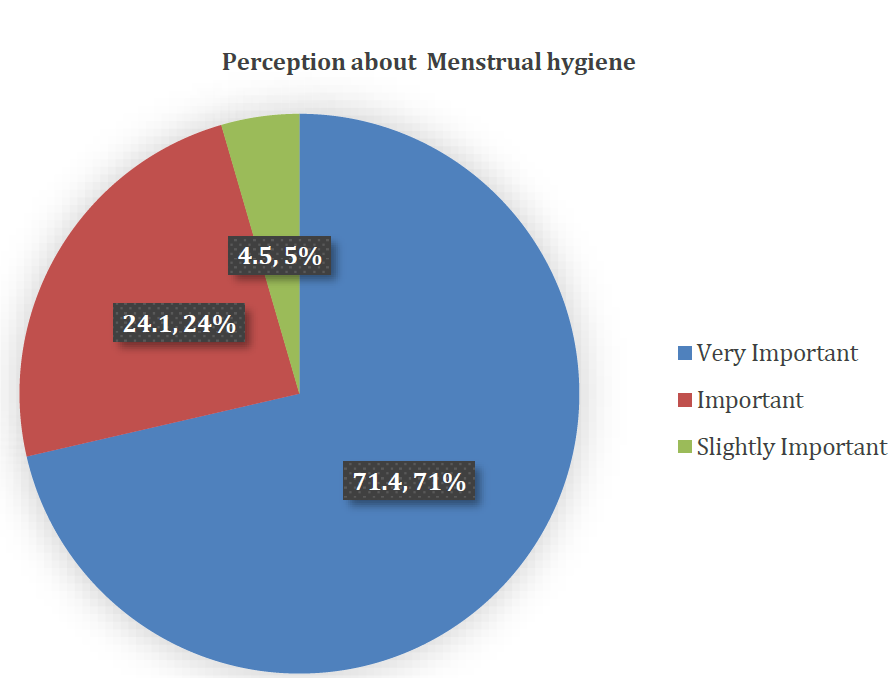
Perception regarding menstrual hygiene was considered by 71.4% of the respondents and 24.1% as important & only 4.5 % regarded it as slightly important (Table 1& Figure 1)


Regarding practices of menstrual hygiene 88.4% respondents use disposable pad for menstrual hygiene and 48.59 dispose of them in household waste. (Table 2)


88.4% respondents use disposable pad for menstrual hygiene and 48.59 dispose of them in household waste.


Table 1: Perception of the Participants According to Menstrual Hygiene Practices 

Response 

Percent (n=640)

Very important 

71.4%

Important 

24.1

Slightly important

4.5%


Table 2: Menstrual hygiene practices 

Practices

Percent (n=640)

What_material for MH

Disposable pad

88.4

Disposable clothes

6.25

 Reusable cloth

2.2

Cotton

2.0

Total

100.0

Methods_of_Disposal

Burn

0.2

Household waste

48.59

Main Garbage bin

36.72

Wash and reuse

5.47

Open

3.59

Toilet

5.16


Figure 1: Perception of the participants according to menstrual hygiene practices

DISCUSSION

United Nations adopted 17 SDGs and each of these SDGs are structured and defined in such a way that they address the important problem from a health and sustainability perspective [3]. However Menstrual Hygiene is not explicitly mentioned in any of the Sustainable development goals as adopted by United Nation (UN) but still directly linked in achieving several of the proposedSDGs, from SDG 3 ( Ensure healthy lives and promote well –being for all at all age); SDG4 (Ensure inclusive and equitable quality education and promote lifelong learning); SDG5 (Achieve gender equality and empower all women and girls); SDG 6 (Ensure availability and sustainable management of water and sanitation for all) and SDG 8 (Decent Work & Economic Growth). Considering the fact that more than two billion women between the age group of 12 yrs -50 yrs in the world are menstruating between 2-7 days a month, MH remains important in all the dimensions specific to women and girls involving them directly in the process of sustainable development [4].


In the present study we found that majority of the women perceived the menstrual hygiene as very important apart of personal hygiene.


As the study shows that most of women (88%) of reproductive age group (15-49) use disposable pad during menstruation which is also seen NFHS 4 Women age 15-24 years who use hygienic methods (Locally prepared napkins, sanitary napkins and tampons) of protection during their menstrual period (%) 90.0 (urban) [3]. Another study conducted in Nahan reflected that adolescent girls in study area that (95.28%) used sanitary napkin as absorbent for menstrual flow [5].


In our study we found that method of disposal of sanitary napkin, tampon etc. are 85.1% in household and community bins. Which is more in study conducted in among unmarried girls studying in selected colleges of UT Chandigarh during September 2014-15 the disposal in dustbins (household & community) are 94.4% [6].

CONCLUSION

Majority of females of reproductive age group are practicing sanitary pads/ napkin. The majority are disposing their menstrual hygiene product in disposable bins. There is not much awareness for disposing of menstrual hygiene product by ecofriendly methods. Therefor community menstrual pad incinerator should be installed in public toilets & other convenient sites. In contrast to these results we should come up with additional methods which should be more safer, sustainable & ecofriendly.

REFERENCE
  1. National Guidelines on Menstrual Hygiene Management. Government of India, 2015, http://unicef.in/Story/1177/The-National-Guidelines-on-Menstrual-Hygiene-Management.

  2. Allen, Kevin. The Reluctant Hypothesis: A History of Discourse Surrounding the Lunar Phase Method of Regulating Conception. Lacuna Press, November 2007, p. 239.

  3. National Family Health Survey (NFHS-4) 2015–16. Ministry of Health & Family Welfare, March 2017.

  4. Tiwary, A.R. “Role of Menstrual Hygiene in Sustainable Development Goals.” International Journal of Health Sciences & Research, vol. 8, no. 5, May 2018, pp. 377–387.

  5. Kaur, M. “Menstrual Awareness, Hygiene, Practices and Perceptions among the Adolescent Girls of Nahan, Himachal Pradesh, India.” International Journal of Reproduction, Contraception, Obstetrics and Gynecology, vol. 7, no. 3, March 2020, pp. 1145–1152.

  6. Sachdeva, A., and S. Sharma. “Knowledge about Menstrual Problems and Menstrual Hygiene Practices among College Going Unmarried Girls in Chandigarh, India.” Journal of Evidence Based Medicine & Healthcare, vol. 4, no. 64, 2017, pp. 4019–4025.


License
CC BY-NC-ND
Creative Commons Attribution-NonCommercial-NoDerivatives 4.0 International License
Assessment of menstrual practices in reproductive age Shimla City of Himachal Pradesh © 2026 by Vandana, Parika Tanwar, Amit Sachdeva, Anmol Gupta licensed under CC BY-NC-ND 4.0
All papers should be submitted electronically. All submitted manuscripts must be original work that is not under submission at another journal or under consideration for publication in another form, such as a monograph or chapter of a book. Authors of submitted papers are obligated not to submit their paper for publication elsewhere until an editorial decision is rendered on their submission. Further, authors of accepted papers are prohibited from publishing the results in other publications that appear before the paper is published in the Journal unless they receive approval for doing so from the Editor-In-Chief.
Himalayan Journal of Community Medicine and Public Health open access articles are licensed under a Creative Commons Attribution-Share A like 4.0 International License. This license lets the audience to give appropriate credit, provide a link to the license, and indicate if changes were made and if they remix, transform, or build upon the material, they must distribute contributions under the same license as the original.
Recommended Articles
Research Article
Curves of Concern: Public Awareness of Scoliosis and Its Impact on Childhood Development in Hamirpur
Published: 10/12/2024
Download PDF
Research Article
Etiological Analysis of the Incident of Computer Vision Syndrome (Cvs) in Students of the Faculty of Medical Muhammadiyah University Semarang
...
Published: 20/01/2026
Download PDF
Research Article
Silent Threats Unveiled: Gauging Public Awareness and Understanding of Blood Clotting Disorders in Ambala, Haryana
...
Published: 30/07/2024
Download PDF
Research Article
Knowledge About HBV Infection and Its Association with HBSAG Positivity among Residents of Kaza Sub- Division Of District Lahaul & Spiti In Himachal Pradesh
...
Published: 30/07/2024
Download PDF
Flowbite Logo
Najmal Complex,
Opposite Farwaniya,
Kuwait.
Email: support@himjournals.com

Useful Links
Order Hard Copy
Privacy policy
Terms and Conditions
Refund Policy
Others
About Us
Team Members
Contact Us
Online Payments
Join as Editor
Join as Reviewer
Subscribe to our Newsletter
Follow us
MOST SEARCHED KEYWORDS
scientific journal
 | 
business journal
 | 
medical journals
 | 
Scientific Journals
 | 
Academic Publisher
 | 
Peer-reviewed Journals
 | 
Open Access Journals
 | 
Impact Factor
 | 
Indexing Services
 | 
Journal Citation Reports
 | 
Publication Process
 | 
Impact factor of journals
 | 
Finding reputable journals for publication
 | 
Submitting a manuscript for publication
 | 
Copyright and licensing of published papers
 | 
Writing an abstract for a research paper
 | 
Manuscript formatting guidelines
 | 
Promoting published research
 | 
Publication in high-impact journals
Copyright © Himalayan Journals . All Rights Reserved.