Knowledge About HBV Infection and Its Association with HBSAG Positivity among Residents of Kaza Sub- Division Of District Lahaul & Spiti In Himachal Pradesh
Dr. Brij Sharma
1
,
Dr. Anmol Gupta
2
,
Dr. Rajesh Sharma
1
,
Dr Vishal Bodh
1
,
Dr. Aashish Chauhan
1
,
Dr. Dipesh
3
,
Dr. Neetu Sharma
4
,
Sidhant Sharma
5
,
Dr. Amit Sachdeva
2
1
Department of Gastroentrology, Indira Gandhi Medical College & Hospital, Shimla, Himachal Pradesh, India
2
Department of Community Medicine, Indira Gandhi Medical College & Hospital, Shimla, Himachal Pradesh, India
3
Department of Community Medicine, Dr. Rajendra Prasad Government Medical College, Tanda, Himachal Pradesh, India
4
Assistant Professor, Department of Physiology,Indira Gandhi Medical College & Hospital, Shimla, Himachal Pradesh, India
Background: Hepatitis B and C virus infection is an issue for public health worldwide. We conducted this study to assess the Knowledge about HBV infection and its association with HBsAg positivity among residents of Kaza sub- division of district Lahaul & Spiti in Himachal Pradesh. Material & Methods: From June 2015 to October 2017, the study was carried out at Kaza, a division of Lahaul & Spiti, by the department of gastroenterology, community medicine, and microbiology of Indira Gandhi Medical College Shimla. By using the cluster sampling technique, the target sample size of 4000 was attained. 40 Clusters were chosen using probability proportionate to size sampling, and 100 research participants were added to each Cluster. For data collection, a pretested interview plan was used. Five millilitres of blood were drawn from each study participant and tested for HBsAg. Results: Around 53% participants had not heard about the disease. Breast feeding as a mode of transmission was known among 18.8% of population. Traditional medicine was thought to be the cure of Hepatitis B in 13.9% population. Around one fourth of the population knew that there is no effective treatment for hepatitis B (25.2%) and there is a vaccine to prevent the same (25.7%). Around one third of the study population (32.6%) who have heard about Hepatitis B infection were tested to be positive for the same as compared to 34.1% among those who have had no knowledge about it. (OR: 0.93; 95%CI:0.80-1.09; p: 0.41). There was 50% less risk of HBsAg positive among vaccinated as compared to those who were not (p<0.001) Receiving information about HBV infection from more than one source (print media, health service providers and entertainment media) had 80% less risk of HBV infection as compared to those who have never heard of the infection (OR: 0.20; 95% CI: 0.07-0.61; p:0.01). Immunization against HBV was a significant independent protective factor against the infection as compared to non immunized (OR: 0.52; 95% CI: 0.40-0.68; p<0.001). Conclusion: Present study concluded that knowledge of source of infection, and immunization against HBV emerged as independent factors associated with HBsAg positive test after adjusting for confounders.
Keywords
Knowledge
HBV infection
Lahaul & Spiti
Himachal Pradesh
Introduction
The hepatitis B virus causes hepatitis B, a potentially fatal liver infection. Hepatitis B virus infection is a major public health hazard worldwide. Around the world, this virus has infected close to 2 billion individuals. Nearly 350 million of them have a persistent infection. About 3-4% of the population in India is afflicted. It can result in chronic liver disease, persistent infection, and a significant chance of death from liver cancer and cirrhosis. Over 240 million people worldwide suffer from chronic (ongoing) liver illnesses. Approximately 600 000 people per year pass away from the acute or long-term effects of hepatitis B.1-3
Most cases of hepatitis B are brought on by parenteral exposure to infected bodily fluids. Receiving infected blood or blood products, invasive medical operations utilising contaminated equipment, and for hepatitis B transmission from mother to baby at birth, from family member to child, as well as through sexual contact, are common routes of transmission for these viruses. Acute infections can present with few or no symptoms, or they can present with signs including jaundice (a yellowing of the skin and eyes), dark urine, acute exhaustion, nausea, and vomiting, as well as stomach discomfort. The age at which a person contracts the hepatitis B virus determines the risk that the infection will become chronic.4,5
Kaza health block in Lahaul & Spiti District has a population of 12,547 and the health institutions in the block include one CHC, five PHCs and 10 health sub-centers. In the past three years more than 200 cases of Viral Hepatitis B have reported to the department of gastroenterology at Indira Gandhi Medical College & Hospital indicating a high prevalence of viral hepatitis B.6 The reasons behind such a high prevalence need to be investigated taking into consideration the serious health consequences of the infection. As viral hepatitis C transmission is similar to the transmission of viral hepatitis B, we conducted this study to assess the Knowledge about HBV infection and its association with HBsAg positivityamong residents of Kaza sub- division of district Lahaul & Spiti in Himachal Pradesh
Aims & Objectives
To assess the Knowledge about HBV infection and its association with HBsAg positivity among residents of Kaza sub- division of district Lahaul & Spiti in Himachal Pradesh
MATERIAL & METHODS
The study was conducted by the department of Gastroenterology, Community Medicine and Microbiology, Indira Gandhi Medical College Shimla. Survey was undertaken at Kaza, a sub division of the district, Lahaul & Spiti.
Study design: The study design had two components/stages. Initially it was a cross sectional survey done to identify individuals with and without HBV infection. The second stage was a case- control study to identify risk factors for higher transmission among those infected as compared to the controls (uninfected)
Study duration: June 2015 through October 2017.
Study population: The study population with comprise all residents of Kaza sub-division of district Lahaul & Spiti of Himachal Pradesh.
Sample size: The sample size was calculated with the reported prevalence of 16.0% at 5% level of significance with 80.0% study power, 2.0% level of precision and design effect of 3. It came out to be 3864 (Appox. 4000).
Kaza Sub Division of Lahaul & Spiti has a population of 12,547 including 6,691 males & 5,766 females (Census 2011). There is one Community Health Centre, 5 Primary Health Centers, 9 sub-centers and 11 Villages panchyats.
Exclusion criteria
Those who do not consent to participate in the study.
METHODOLOGY:
The desired sample size was obtained by cluster sampling technique. All the villages in Spiti area along with their population were listed in ascending order. By Probability proportionate to size sampling 40 Clusters (One cluster with one or more villages) were selected. In each Cluster 100 study subjects were enrolled for the study by simple random sampling.
Data collection
A pretested interview schedule was used for data collection. The data elements included a complete history of illness (if any), risk behaviors leading to high transmission of HBV. This interview schedule was filled by trained health workers and field Investigators who were appointed from the local inhabitants from Spiti area.
From each study subject 5ml of blood sample was taken by trained laboratory technician. Collected blood samples were transported in cold chain equipment at suitable temperatures to Microbiology, Hematology and Biochemistry laboratories of IGMC Shimla for analysis. The blood samples were analyzed for HBsAg.
Data analysis
Data was analyzed using EpiInfo software version 7.1.2 for windows. Descriptive analysis was conducted to describe the study population characteristics at baseline, the risk behaviors, immunization status and clinical profile (only sick or found to be HBV/HCV positive) of the study participants.
Bivariate analysis was done to identify for factors likely to be significantly associated with HBsAg. Logistic regression analysis was conducted to control for confounding to identify independent risk factors. A p-value of 0.05 or below was considered as statistically significant.
Quality assurance
The proposal was peer reviewed by subject matter experts before implementation in the field. The sampling procedure adopted was a robust one with a cluster size of at least 40 and simple random clustering procedure within each cluster. The serum/blood sample was analyzed in the laboratories of the tertiary care hospital of the state (IG Medical College, Shimla) under strict quality control of the heads of the respective laboratories.
Ethical issues
The survey was started after taking ethical permission from the Institutional Ethical Committee, IGMC Shimla (HFW(MS)G-5(Ethics)/2014-5257). Informed written consent was obtained from the head of the selected family to voluntarily participate in the study. The information obtained was kept strictly confidential and used only for research purposes and dissemination to the department of Health & Family Welfare for the recommended interventions without disclosing the identity of the individuals. Those found to be infected were given appropriate care as per the existing standards by the department of gastroenterology as per the existing norms of the IGMC & Hospital, Shimla. Blood samples collected were destroyed after testing as per the Hospital Waste Management protocols.
RESULTS & OBSERVATION
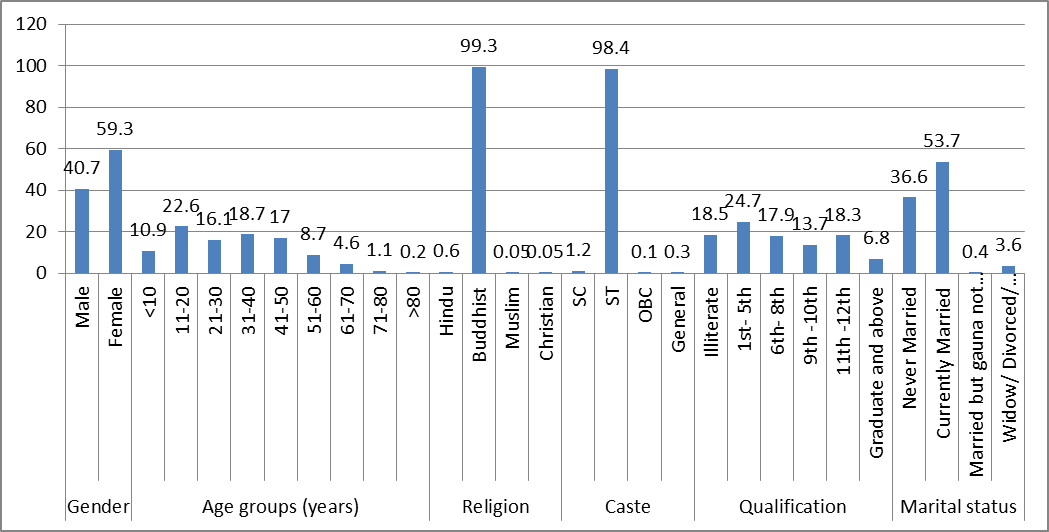
The study was undertaken at Kaza, a sub division of the district, Lahaul & Spiti by the department of Gastroenterology, Community Medicine and Microbiology, Indira Gandhi Medical College Shimla The study population surveyed was 4238, of which information regarding seven were missing hence were excluded from final analysis. The final analysis was conducted on 4231. The study population comprised of 59.3% of females. Majority of the study population was in the age group 21-50 years; the age group 11-20 years comprising 22.6%, 31-40 years comprising 18.7% and 41-50 years age group comprising 17.0%. Buddhism was the most followed religion in the area (99.3%) and 98.4% of the population were scheduled tribe. Around one fourth of the population had attained school between 1st and 5th standard (24.7%). Only 6.8% were graduate and above. Agriculture was the major occupation of the area with 20.4% study population involved in it.There were 31.7% students, 16.8% homemakers and 14% service class. More than half of the population (53.7%) was currently married, 5.4% were monks/nuns and 36.6% were never married. Currently 68.9% of the population was living with family without their sexual partner and 19% and 10.2% were living with spouse and friends respectively. (Figure-1).
Figure-1: Socio demographic profile of study population
The knowledge of study population was assessed before testing for the same. Around 53% have not heard about the disease. Breast feeding as a mode of transmission was known among 18.8% of population. Traditional medicine was thought to be the cure of Hepatitis B in 13.9% population. Around one fourth of the population knew that there is no effective treatment for hepatitis B (25.2%) and there is a vaccine to prevent the same (25.7%). (Table -1)
Number
Percent
Total
4231
100
Heard about Hepatitis B
Not applicable
21
0.5
Yes
1953
46.2
No
2257
53.3
Hepatitis B is transmitted from an infected mother to the new born child through Breast feeding
Don’t know
2284
54.0
Yes
795
18.8
No
1152
27.2
Hepatitis B be cured by taking traditional medicines
Don‟t know
2208
52.2
Yes
590
13.9
No
1433
33.9
There is effective treatment for hepatitis B
Don‟t know
2206
52.1
Yes
958
22.6
No
1067
25.2
Knowledge about any vaccine to prevent Hepatitis B
Don‟t know
2228
52.7
Yes
1086
25.7
No
917
21.7
Table -1: Knowledge about Hepatitis B
Around one third of the study population (32.6%) who have heard about Hepatitis B infection were tested to be positive for the same as compared to 34.1% among those who have had no knowledge about it (OR: 0.93; 95%CI:0.80-1.09; p: 0.41). Health service provider was the most common source (17.7%) of knowledge about Hepatitis B and 35.5% among these were tested positive. Majority (28.2%) of population had no knowledge about the infection being transmitted from mother to child and one third of these (33.0%) were tested to be positive (p: 0.63). Knowledge about various ways of prevention of infection and consequences of disease was not associated with lower proportion of infection. 25.5% of the population have heard about the vaccine and out of these 70.6% were negative for HbsAg (p: 0.03). However, only 13.6% (393/2886) reported of receiving the vaccine and of these 21.6% (85/393) were tested to be positive as compared to 35.3% (861/2440) and 30.2% (16/53) of those who reported of not receiving or were not sure about receiving the vaccine (OR: 0.50, 95% CI: 0.39 - 0.65; p <0.001). (Table -2).
HBSAG
Total
P value
Heard about Hep B
Positive
Negative
Yes
459
951
1410
0.41
32.6%
67.4%
100.0%
No
503
973
1476
34.1%
65.9%
100.0%
Total
962
1924
2886
33.3%
66.7%
100.0%
Sources
Radio
11
32
43
0.06
25.6%
74.4%
100.0%
Television
64
128
192
33.3%
66.7%
100.0%
Newspaper
5
12
17
29.4%
70.6%
100.0%
Magazine
16
26
42
38.1%
61.9%
100.0%
Poster/Billboards/Wall
writing/Hoarding
26
50
76
34.2%
65.8%
100.0%
Public announcements H
148
318
466
31.8%
68.2%
100.0%
Street play/Drama
1
3
4
25.0%
75.0%
100.0%
Health Service Provider
181
329
510
35.5%
64.5%
100.0%
Multiple sources
7
53
60
11.7%
88.3%
100.0%
Total
459
951
1410
32.6%
67.4%
100.0%
Knowledge about Mother to child transmission
Don‟t know
13
24
37
0.63
35.1%
64.9%
100.0%
Yes
201
393
594
33.8%
66.2%
100.0%
No
269
546
815
33.0%
67.0%
100.0%
Known modes of transmission
Don‟t know
11
16
27
0.03
33.4%
66.6%
100.0%
Mother to child transmission
14
37
51
27.5%
72.5%
100.0%
IDU
12
21
33
36.4%
63.6%
100.0%
Tattooing
4
19
23
17.4%
82.6%
100.0%
Body piercing
19
30
49
38.8%
61.2%
100.0%
Unsafe injection
199
335
534
37.3%
62.7%
100.0%
Unsafe sex
71
154
225
31.6%
68.4%
100.0%
Drinking polluted water
14
15
29
48.3%
51.7%
100.0%
Contaminated food
16
31
47
34.0%
66.0%
100.0%
Shared razors/toothbrushes
23
52
75
30.7%
69.3%
100.0%
Multiple answers
101
254
355
28.5%
71.5%
100.0%
Knowledge about Ways of prevention
Don‟t know
10
23
33
0.87
30.3%
69.7%
100.0%
Vaccination
357
746
1103
32.4%
67.6%
100.0%
Avoid infected needles
36
64
100
36.0%
64.0%
100.0%
Others
56
118
174
32.2%
67.8%
100.0%
Known Consequences ofinfection
Don‟t know
8
29
37
0.39
21.6%
78.4%
100.0%
Liver failure
153
346
499
30.7%
69.3%
100.0%
Liver cancer
205
384
589
34.8%
65.2%
100.0%
Impaired liver function
36
71
107
33.6%
66.4%
100.0%
Premature death
14
22
36
38.9%
61.1%
100.0%
Multiple
43
99
142
30.3%
69.7%
100.0%
Knowledge about Cure by traditional medicine
Don‟t know
13
28
41
0.90
32.0%
68.0%
100.0%
Yes
138
275
413
33.4%
66.6%
100.0%
No
308
648
956
32.2%
67.8%
100.0%
Any effective treatment
Don‟t know
8
17
25
1.00
34.0%
66.0%
100.0%
Yes
193
457
650
29.7%
70.3%
100.0%
No
258
477
735
35.1%
64.9%
100.0%
Heard about any vaccine to prevent Hep B
Don‟t know
16
28
44
0.03
36.4%
63.6%
100.0%
Yes
216
519
735
29.4%
70.6%
100.0%
No
227
404
631
36.0%
64.0%
100.0%
Ever been immunized for HBsAg
Not sure
16
37
53
<0.001
30.2%
69.8%
100.0%
Yes
85
308
393
21.6%
78.4%
100.0%
No
861
1579
2440
35.3%
64.7%
100.0%
Table -2: Knowledge of Hepatitis B among those with and without the disease
Those independent variables which on bivariate analysis yielded p<0.10 on applying test of significance were subjected to binary logistic regression modeling with HBsAg positive as dependent variable. The independent variables which were subjected to model were source of knowledge about HBV, knowledge about mode of transmission, knowledge about vaccination as method of prevention and immunization status. Receiving information about HBV infection from more than one source (print media, health service providers and entertainment media) had 80% less risk of HBV infection as compared to those who have never heard of the infection (OR: 0.20; 95% CI: 0.07-0.61; p:0.01). Immunization against HBV was a significant protective factor against the infection as compared to non immunized (OR: 0.52; 95% CI: 0.40-0.68; p<0.001); there was 48% reduced risk of HBsAg positive. (Table-3)
Sig.
Adj OR
95% C.I.for AdjOR
Lower
Upper
Source
Not heard of hepatitis B
0.12
1.00
Radio
0.13
.444
.152
1.299
TV
0.48
.739
.320
1.707
Newspaper
0.53
.652
.171
2.486
Magazine
0.87
.924
.335
2.544
Poster/Billboards/Wall
writing/Hoarding
0.26
.584
.228
1.497
Public announcements
0.24
.621
.278
1.387
Street play/Drama
0.75
.681
.061
7.614
Health Service Provider
0.49
.759
.343
1.678
Multiple sources
0.01
.203
.067
.614
Knowledge of Mode of transmission
Don’t know
0.20
1.00
Mother to child
0.06
.571
.318
1.025
IDU
0.34
.708
.347
1.443
Tattooing
0.76
.882
.394
1.974
Body piercing
0.14
.424
.136
1.323
Unsafe injection
0.55
1.224
.626
2.393
Unsafe sex
0.21
1.246
.882
1.761
Drinking polluted water
0.99
1.003
.674
1.493
Contaminated food
0.16
1.815
.795
4.144
Shared razor/toothbrush
0.66
1.162
.591
2.282
Multiple answers
0.68
1.129
.637
2.001
Knowledge about vaccines
No
0.10
1.00
Don‟t know
0.55
1.249
.602
2.589
Yes
0.06
.773
.590
1.013
Immunization status
Non immunized
0.00
1.00
Don’t know/ remember
0.30
.716
.378
1.354
Immunized
<0.0001
.523
.400
.683
Table 3: Binary logistic regression analysis to identify risk factors for Hepatitis B infection
DISCUSSION
The study was conducted at Kaza, a sub division of the district, Lahaul & Spiti by the departments of Gastroenterology, Community Medicine and Microbiology, Indira Gandhi Medical College Shimla. The study was planned owing to increasing number of lab reported cases of HBV hailing from this district from a tertiary care hospital of the state. Various cultural and behavioral factors were hypothesized to be associated with the infection among population. The bivariate analysis revealed that knowledge about the infection, ways about prevention or transmission was not significantly associated with positivity. Insufficient public awareness of HBV and HCV is a huge barrier to appropriate diagnosis of infection. Also lack of testing tools and confidentiality of results in hard to reach population like these aggravates the problem.7,8 After subjecting the variables to the logistic regression modeling knowledge of source of infection, and immunization against HBV emerged as independent factors associated with HBsAg positive test after adjusting for confounders. Hence health education regarding mode of transmission and prevention is not only important for health care workers of high risk groups but also for general public. 9,10
CONCLUSION
Present study concluded that knowledge of source of infection, and immunization against HBV emerged as independent factors associated with HBsAg positive test after adjusting for confounders. In order to reduce the risk of infection, immunisation of this high-risk group and public awareness are the most cost-effective elements.
Center for Disease Control and Prevention. . Available at: https://www.cdc.gov/hepatitis/hbv/bfaq.htm(Accessed on 22 June 2022)
Sharma RK, Shukla MK, Minhas N, Barde PV. Seroprevalence and risk factors of hepatitis B virus infection in tribal population of Himalayan district Lahaul and Spiti, India. Pathog Glob Health. 2019 Sep;113(6):263-267.
Petersen Z, Myers B, van Hout MC, Pluddemann A, Parry C. Availability of HIV prevention and treatment services for people who inject drugs: fi ndings from 21 countries. Harm Reduct J 2013; 10: 13.
Sandesh K, Varghese T, Harikumar R, et al. Prevalence of hepatitis B and C in the normal population and high risk groups in north Kerala. Trop Gastroenterol. 2006;27:80–83.
Puri P. Tackling the Hepatitis B disease burden in India. J Clin Exp Hepatol. 2014; 4 (4): 312– 319.
License
Creative Commons Attribution-NonCommercial-NoDerivatives 4.0 International License
All papers should be submitted electronically. All submitted manuscripts must be original work that is not under submission at another journal or under consideration for publication in another form, such as a monograph or chapter of a book. Authors of submitted papers are obligated not to submit their paper for publication elsewhere until an editorial decision is rendered on their submission. Further, authors of accepted papers are prohibited from publishing the results in other publications that appear before the paper is published in the Journal unless they receive approval for doing so from the Editor-In-Chief.
Himalayan Journal of Community Medicine and Public Health open access articles are licensed under a Creative Commons Attribution-Share A like 4.0 International License. This license lets the audience to give appropriate credit, provide a link to the license, and indicate if changes were made and if they remix, transform, or build upon the material, they must distribute contributions under the same license as the original.
Recommended Articles
Research Article
Assessing the Role of Community Engagement in Promoting Malaria Prevention and Treatment Practices in Mashonaland Central Province, Zimbabwe: A Case of Centenary District
Dzamara Tafadzwa,
Mapuranga Danemore
Published: 13/08/2026
Download PDF
Cite
x
APA
Tafadzwa, D. & Danemore, M. (2026). Assessing the Role of Community Engagement in Promoting Malaria Prevention and Treatment Practices in Mashonaland Central Province, Zimbabwe: A Case of Centenary District. Himalayan Journal of Community Medicine and Public Health, 7(1), 1-6.
MLA
Tafadzwa, Dzamara and Mapuranga Danemore. "Assessing the Role of Community Engagement in Promoting Malaria Prevention and Treatment Practices in Mashonaland Central Province, Zimbabwe: A Case of Centenary District." Himalayan Journal of Community Medicine and Public Health 7.1 (2026): 1-6.
Chicago
Tafadzwa, Dzamara and Mapuranga Danemore. "Assessing the Role of Community Engagement in Promoting Malaria Prevention and Treatment Practices in Mashonaland Central Province, Zimbabwe: A Case of Centenary District." Himalayan Journal of Community Medicine and Public Health 7, no. 1 (2026): 1-6.
Harvard
Tafadzwa, D. and Danemore, M. (2026) 'Assessing the Role of Community Engagement in Promoting Malaria Prevention and Treatment Practices in Mashonaland Central Province, Zimbabwe: A Case of Centenary District' Himalayan Journal of Community Medicine and Public Health 7(1), pp. 1-6.
Vancouver
Tafadzwa D, Danemore M. Assessing the Role of Community Engagement in Promoting Malaria Prevention and Treatment Practices in Mashonaland Central Province, Zimbabwe: A Case of Centenary District. Himalayan Journal of Community Medicine and Public Health. 2026 Jan;7(1):1-6.
Download PDF
Research Article
Curves of Concern: Public Awareness of Scoliosis and Its Impact on Childhood Development in Hamirpur
Vishal Dhatwalia,
Swati Chandel
Published: 10/12/2024
Download PDF
Cite
x
APA
Dhatwalia, V. & Chandel, S. (2024). Curves of Concern: Public Awareness of Scoliosis and Its Impact on Childhood Development in Hamirpur. Himalayan Journal of Community Medicine and Public Health, 5(2), 1-6.
MLA
Dhatwalia, Vishal and Swati Chandel. "Curves of Concern: Public Awareness of Scoliosis and Its Impact on Childhood Development in Hamirpur." Himalayan Journal of Community Medicine and Public Health 5.2 (2024): 1-6.
Chicago
Dhatwalia, Vishal and Swati Chandel. "Curves of Concern: Public Awareness of Scoliosis and Its Impact on Childhood Development in Hamirpur." Himalayan Journal of Community Medicine and Public Health 5, no. 2 (2024): 1-6.
Harvard
Dhatwalia, V. and Chandel, S. (2024) 'Curves of Concern: Public Awareness of Scoliosis and Its Impact on Childhood Development in Hamirpur' Himalayan Journal of Community Medicine and Public Health 5(2), pp. 1-6.
Vancouver
Dhatwalia V, Chandel S. Curves of Concern: Public Awareness of Scoliosis and Its Impact on Childhood Development in Hamirpur. Himalayan Journal of Community Medicine and Public Health. 2024 Jul;5(2):1-6.
Download PDF
Research Article
Etiological Analysis of the Incident of Computer Vision Syndrome (Cvs) in Students of the Faculty of Medical Muhammadiyah University Semarang
Anang Kriswantoro,
...
Swasty
Published: 20/01/2026
Download PDF
Cite
x
APA
Kriswantoro, A., Martiningsih, W. R., Novitasari, A. & None, S. (2026). Etiological Analysis of the Incident of Computer Vision Syndrome (Cvs) in Students of the Faculty of Medical Muhammadiyah University Semarang. Himalayan Journal of Community Medicine and Public Health, 7(1), 1-5.
MLA
Kriswantoro, Anang, et al. "Etiological Analysis of the Incident of Computer Vision Syndrome (Cvs) in Students of the Faculty of Medical Muhammadiyah University Semarang." Himalayan Journal of Community Medicine and Public Health 7.1 (2026): 1-5.
Chicago
Kriswantoro, Anang, Wahju R. Martiningsih, Andra Novitasari and Swasty . "Etiological Analysis of the Incident of Computer Vision Syndrome (Cvs) in Students of the Faculty of Medical Muhammadiyah University Semarang." Himalayan Journal of Community Medicine and Public Health 7, no. 1 (2026): 1-5.
Harvard
Kriswantoro, A., Martiningsih, W. R., Novitasari, A. and None, S. (2026) 'Etiological Analysis of the Incident of Computer Vision Syndrome (Cvs) in Students of the Faculty of Medical Muhammadiyah University Semarang' Himalayan Journal of Community Medicine and Public Health 7(1), pp. 1-5.
Vancouver
Kriswantoro A, Martiningsih WR, Novitasari A, Swasty S. Etiological Analysis of the Incident of Computer Vision Syndrome (Cvs) in Students of the Faculty of Medical Muhammadiyah University Semarang. Himalayan Journal of Community Medicine and Public Health. 2026 Jan;7(1):1-5.
Download PDF
Research Article
Silent Threats Unveiled: Gauging Public Awareness and Understanding of Blood Clotting Disorders in Ambala, Haryana
Ashmita Joshi,
...
Sanjeev Kumar
Published: 30/07/2024
Download PDF
Cite
x
APA
Joshi, A., kaur, J. & Kumar, S. (2024). Silent Threats Unveiled: Gauging Public Awareness and Understanding of Blood Clotting Disorders in Ambala, Haryana. Himalayan Journal of Community Medicine and Public Health, 5(2), 1-6.
MLA
Joshi, Ashmita, Jasleen kaur and Sanjeev Kumar. "Silent Threats Unveiled: Gauging Public Awareness and Understanding of Blood Clotting Disorders in Ambala, Haryana." Himalayan Journal of Community Medicine and Public Health 5.2 (2024): 1-6.
Chicago
Joshi, Ashmita, Jasleen kaur and Sanjeev Kumar. "Silent Threats Unveiled: Gauging Public Awareness and Understanding of Blood Clotting Disorders in Ambala, Haryana." Himalayan Journal of Community Medicine and Public Health 5, no. 2 (2024): 1-6.
Harvard
Joshi, A., kaur, J. and Kumar, S. (2024) 'Silent Threats Unveiled: Gauging Public Awareness and Understanding of Blood Clotting Disorders in Ambala, Haryana' Himalayan Journal of Community Medicine and Public Health 5(2), pp. 1-6.
Vancouver
Joshi A, kaur J, Kumar S. Silent Threats Unveiled: Gauging Public Awareness and Understanding of Blood Clotting Disorders in Ambala, Haryana. Himalayan Journal of Community Medicine and Public Health. 2024 Jul;5(2):1-6.
Sharma, B., Gupta, A., Sharma, R., Bodh, V., Chauhan, A., None, D., Sharma, N., Sharma, S. & Sachdeva, A. (2024). Knowledge About HBV Infection and Its Association with HBSAG Positivity among Residents of Kaza Sub- Division Of District Lahaul & Spiti In Himachal Pradesh. Himalayan Journal of Community Medicine and Public Health, 5(2), 1-8.
MLA
Sharma, Brij, et al. "Knowledge About HBV Infection and Its Association with HBSAG Positivity among Residents of Kaza Sub- Division Of District Lahaul & Spiti In Himachal Pradesh." Himalayan Journal of Community Medicine and Public Health 5.2 (2024): 1-8.
Chicago
Sharma, Brij, Anmol Gupta, Rajesh Sharma, Vishal Bodh, Aashish Chauhan, Dipesh , Neetu Sharma, Sidhant Sharma and Amit Sachdeva. "Knowledge About HBV Infection and Its Association with HBSAG Positivity among Residents of Kaza Sub- Division Of District Lahaul & Spiti In Himachal Pradesh." Himalayan Journal of Community Medicine and Public Health 5, no. 2 (2024): 1-8.
Harvard
Sharma, B., Gupta, A., Sharma, R., Bodh, V., Chauhan, A., None, D., Sharma, N., Sharma, S. and Sachdeva, A. (2024) 'Knowledge About HBV Infection and Its Association with HBSAG Positivity among Residents of Kaza Sub- Division Of District Lahaul & Spiti In Himachal Pradesh' Himalayan Journal of Community Medicine and Public Health 5(2), pp. 1-8.
Vancouver
Sharma B, Gupta A, Sharma R, Bodh V, Chauhan A, Dipesh D, Sharma N, Sharma S, Sachdeva A. Knowledge About HBV Infection and Its Association with HBSAG Positivity among Residents of Kaza Sub- Division Of District Lahaul & Spiti In Himachal Pradesh. Himalayan Journal of Community Medicine and Public Health. 2024 Jul;5(2):1-8.


 Download PDF
 Download XML