Background: Premarital screening (PMS) is a major preventative strategy used to diminish the chance of inherited conditions and infections transmitted sexually. Aim: To understand students' knowledge and attitudes toward PP in southern technical university in Basra city. Methods: A cross-sectional design used to study carried out at southern technical university students (sample 250) (19-31) years in Basra in three college and two technical institutes. The sample collected by direct interview through questionnaire consisted from two parts: Frist part: socio-demographic characteristic for students and Second parts: included students' knowledge and attitudes toward premarital program (PP). The Pearson Chi-square test (2-test) used to study association among qualitative data, P-value ≤ 0.05 was considered statistically significant. Results: The study reveals that 84.7% of the students with positive attitudes towards the (PP) is thinking essential to carry out, the mean of them was 2.54±0.761. Also shows that the highest percentage 50.0% of the participants report that the reason for agreement with PP was to avoid passing of illnesses to their children, while 35.6% of them reported that reason for disagreement with PP was Afraid that the test results will not support my choice. A high percentage (85.2%) of the students were thinking appropriate time to do PP before marriage. The highest percentage (30.4%) of the participants report that cancel engagement in PP if informed children affected. Overall score of attitude(59%) of the students have neutral attitudes towards PP. The study found that there is statically significant correlation between positive (personal and family history) and positive attitudes of the students (P. value ≤0.05). Conclusion: The majority of the students have positive attitudes towards PP is thinking essential to carry out. Overall score of attitude (59 %) of the students have neutral attitudes towards PP. There is significant association between the positive attitudes of the students and positive (personal and family history) of them (P. value 0.017, 0.014) respectively.
The World Health Organization (WHO) reports that thalassemia major and sickle cell disorder are the two most prevalent hereditary hemoglobin disease worldwide (5).
The WHO has frequently advocated a number of approaches, including education programs and the promotion public understanding and attitudes about managing inherited disorders (3).
Premarital screening (PMS) is the most essential for avoiding a variety of medical, psychological, and genetic abnormalities in marriage. (13).
Premarital counseling involves personal interaction, reduces conflict by tackling expectations within marriage, health and genetic consultation that explores the foundations of reproductive health, including contraceptive concerns, menstruation, ovulation, family planning, fertilization and preventive challenges for married people as well as their offspring. (18).
Premarital inspection is indeed the strategy consists that may assist on disease control and prevention, because the intervention of hereditary and infectious illness is expensive and puts a significant financial burden on the healthcare system. (8), so public health encourage on PP and promote healthy decision-making after receiving test. (9)
PMS is an inspection practice made available to couples to decrease the occurrence of genetic disorders by determine out if they are carriers of thalassemia and sickle cell disorder and reduce sexually transmitted illnesses such as Human Immunodeficiency Viruses, hepatitis B, and C.(1)
Premarital testing includes routine tests like complete blood count (CBC), analysis of urine, peripheral blood tests for checking for healthy or abnormal cells, blood grouping, communicable diseases like syphilis, hepatitis-B and c virus and genetic disorder like thalassemia. (17).
One technique for empowering people to choose a healthy lifestyle is health education, it gives them the information and encouragement to increase awareness about reproductive health. (16).
Study aims:
To understand Students' knowledge and attitudes toward PP in southern technical university in Basra city.
Study design, place, and sample:
A cross-sectional descriptive design of study was carried out between November 2022 and March 2023 at southern technical university (250) students in Basra city in three college (college of health and medical techniques, college of administrative techniques and college of engineering techniques) and two institutes (technical medical and administrative institutes) interviewing face to face and asked about premarital programs (knowledge and attitude) by special questionnaire.
Data collection: The questionnaire consisted from two parts:
Frist part: socio-demographic characteristic for students such as age, sex, college
Second parts: included Students' knowledge and attitudes toward PP such as (thinking the premarital screening is essential, Agreement on making premarital screening is required before marriage, agreement to implement regulations and laws to terminate the marriage if the premarital screening test is positive).
Analysis of statistics
The data was typed into computer and analyzed by the statistical package of social science SPSS-28. The data was shown in simple measurements of frequency, percent, mean, and the standard deviation, the Pearson Chi-square test (c2-test) used to study association among qualitative data at P-value was ≤ 0.05.
Criteria for scoring
The scale of the three categories was evaluated on the three points (Likert responder scale), a scored of agreed about by presenting a score of (three) for "Agree", (two) for "Neutral", and (one) for "Disagree".
The questions regarding assessment of attitudes” so the Minimum of mean Score= 1, Maximum of mean Score= 3, and the Median for mean Score = 2. A score of over 75 percent had positive attitudes. (>2.5 MS), 50-75 percent had neutral attitudes (2-2.5 MS), and less than 50 percent was deemed negative attitudes (<2 score).
About the overall an assessment score of attitudes, included 4 items, hence the minimal score was 4, the maximum score was 12 and a median score was 8. A score of over seventy-five percent indicated a positive attitude (>10 score), fifty to seventy percent neutral attitudes (8-10 score) and less than fifty percent negative attitudes (<8 score).
Table (1) demonstrates that the mean ± SD ages of the participants was 21.8±2.74 years, with a range of 19-31 years. The greatest a percentage (56.0%) was in ages group <22 years, while the smallest percentage (44.0%) was in ages group ≥22 years. According to gender 70.8% was male. The study found that 54.4% of students having parents who were not consanguineous, also the results reveal that most of the participants have no personal, and family history (68.8%, and 63.2%) respectively.
Table (1) Distribution of students by socio-demographic features
Socio- Demographic Variables | No. | % | |
Age groups | <22 years | 140 | 56.0 |
≥ 22 years | 110 | 44.0 | |
Mean ± SD (Min-Max) | 21.8±2.74 (19-31) | ||
Gender | Male | 177 | 70.8% |
Female | 73 | 29.2% | |
College | Medical technical | 55 | 22.0% |
Administrative technical | 68 | 27.2% | |
Engineering technical | 72 | 28.8% | |
Medical institution | 3 | 1.2% | |
Administrative institution | 52 | 20.8% | |
Type of relation of parents | 1st cousin | 77 | 30.8% |
2nd cousin | 37 | 14.8% | |
Not consanguineous | 136 | 54.4% | |
Personal history | Positive | 78 | 31.2% |
Negative | 172 | 68.8% | |
Family history | Positive | 92 | 36.8% |
Negative | 158 | 63.2% | |
Table (2) reveals that 84.7% of the students with positive attitudes towards the premarital program is essential, the mean of them was 2.54±0.761. As for other attitudes, the results reveal that most students have neutral attitudes regarding (Agreement to the premarital program, Agreement to PP is required before marriage, and Agreement to PP laws and regulations) with response rates (of 83.3%, 80.0%, and 74.7%) respectively.
Table (2) The distribution and assessment of the students according to their attitudes
| No. | % | Mean ± SD | Response Rate | Attitude | |
Thinking a premarital program is essential | Disagree | 41 | 16.4% | 2.54±0.761 | 84.7% | Positive |
Neutral | 34 | 13.6% | ||||
Agree | 175 | 70.0% | ||||
Agreement to premarital program | Disagree | 42 | 16.8% | 2.50±0.767 | 83.3% | Neutral |
Neutral | 41 | 16.4% | ||||
Agree | 167 | 66.8% | ||||
Agreement to PP is required before marriage. | Disagree | 47 | 18.8% | 2.40±0.786 | 80.0% | Neutral |
Neutral | 57 | 22.8% | ||||
Agree | 146 | 58.4% | ||||
Agreement on PP laws and regulations | Disagree | 59 | 23.6% | 2.24±0.812 | 74.7% | Neutral |
Neutral | 71 | 28.4% | ||||
Agree | 120 | 48.0% | ||||
Table (3) shows that the highest percentage 50.0% of the participants report that the reason for agreement with PP was to avoid passing of illnesses to my children while 35.6% of them reported that reason for disagreement with PP was fearful that the test findings won't support my choice. A high percentage (85.2%) of the students were thinking right time to do PP before marriage. The highest percentage (30.4%) of the participants report that cancel engagement in PP if informed children affected.
Table (3) The distribution of the students according to their answers
| No. | % | |
Justification for agreeing to PP | To avoid passing of illnesses to my children | 125 | 50.0% |
To make sure my partner is well | 46 | 18.4% | |
To assure suitable for marriage | 63 | 25.2% | |
To keep myself from being ill | 16 | 6.4% | |
Justification for not agreeing to PP | Fearful that the test findings won't support my choice. | 89 | 35.6% |
Think the test's findings is offensive to me. | 16 | 6.4% | |
Respect to God's will without interfering | 55 | 22.0% | |
Anxious that positive result prohibit continuing of marriage | 53 | 21.2% | |
Family will deny continuance of marriage. | 37 | 14.8% | |
Thinking right time to do PP. | During high school | 9 | 3.6% |
On attending college | 24 | 9.6% | |
Before the marriage | 213 | 85.2% | |
After the marriage | 4 | 1.6% | |
Response to PP if informed children affected. | Decision depends on the likelihood of acquiring the condition. | 50 | 20.0% |
Sustain marriages because I have trust in God. | 67 | 26.8% | |
Have no idea to do. | 25 | 10.0% | |
Cancel engagement. | 76 | 30.4% | |
Continue marriage for emotional reasons. | 32 | 12.8% | |
Continued marriage under familial pressure | 0 | 0.0% | |

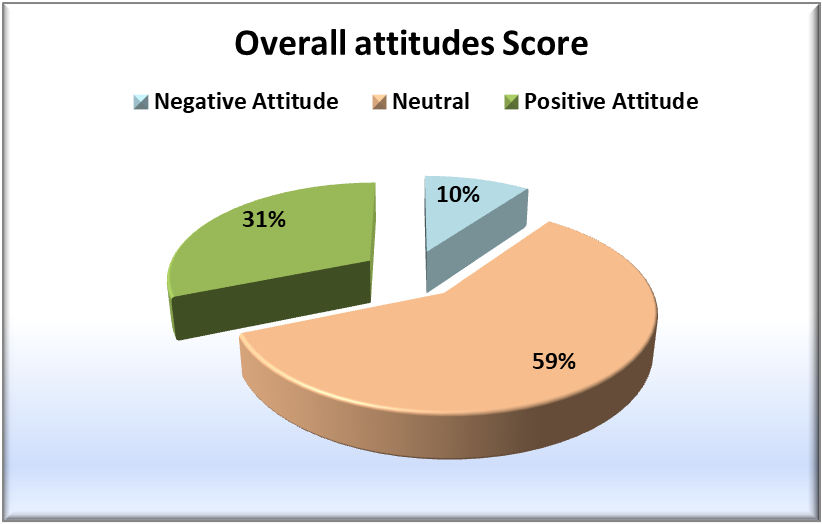
Figure (1): The overall Attitudes score of the participants
Figure (1) shows the overall Attitudes score of the participants, the results report that the largest percentage (59.0%) of the students with neutral attitudes followed by 31.0% with positive attitudes. While the lowest percentage 10.0% of the participants have negative attitudes.
Table (4) explains the relationship between the overall Attitudes score and socio-demographic factors of the students, the study found that there is significant correlation between positive (personal and family history) and positive attitudes of the students towards PP (P. value 0.017, 0.014) respectively.
Table (4): The relationship between the overall Attitudes score and socio-demographic feature of the students
| The Overall Attitudes Score | ||||||||
Negative Attitude | Neutral | Positive Attitude | X2 | P. value | |||||
No. | % | No. | % | No. | % | ||||
Age groups | <22 years | 16 | 11.4% | 80 | 57.1% | 44 | 31.4% | 0.803 | 0.669 |
≥22 years | 9 | 8.2% | 67 | 60.9% | 34 | 30.9% | |||
Gender | Male | 16 | 9.0% | 108 | 61.0% | 53 | 29.9% | 1.373 | 0.503 |
Female | 9 | 12.3% | 39 | 53.4% | 25 | 34.2% | |||
College | Medical technical | 7 | 12.7% | 26 | 47.3% | 22 | 40.0% | 10.758 | 0.216 |
Administrative technical | 11 | 16.2% | 36 | 52.9% | 21 | 30.9% | |||
Engineering technical | 4 | 5.6% | 49 | 68.1% | 19 | 26.4% | |||
Medical institution | 0 | 0.0% | 2 | 66.7% | 1 | 33.3% | |||
Administrative institution | 3 | 5.8% | 34 | 65.4% | 15 | 28.8% | |||
Type of relation | 1st cousin | 7 | 9.1% | 46 | 59.7% | 24 | 31.2% | 1.174 | 0.882 |
2nd cousin | 4 | 10.8% | 19 | 51.4% | 14 | 37.8% | |||
Foreign | 14 | 10.3% | 82 | 60.3% | 40 | 29.4% | |||
Personal history | Positive | 7 | 9.0% | 37 | 47.4% | 34 | 43.6% | 8.187 | 0.017 |
Negative | 18 | 10.5% | 110 | 64.0% | 44 | 25.6% | |||
Family history | Positive | 8 | 8.7% | 45 | 48.9% | 39 | 42.4% | 8.511 | 0.014 |
Negative | 17 | 10.8% | 102 | 64.6% | 39 | 24.7% | |||
PMS is a major preventative strategy and crucial steps in the medical management used to diminish the chance of inherited conditions and infections transmitted through sex. (13), this studies related to PMS less in Basra especially among universities students, so this study aimed to identify how well southern technical university students was known and thought about PP.
This study reveals that 84.7% of the students with positive attitudes towards the premarital program is essential, the mean of them was 2.54±0.761and this result agree with other studies shows that the overwhelming most of the students strongly concurred that the program of PMS is essential. (2) (13), other study in Kuwait university show poor knowledge of students about importance of premarital programs (4).
This study shows that the highest percentage 50.0% of the participants report that the reason for agreement with PP was to inhibit transfer of illness to their offspring this result agree with other study showed majority of the students used PMS to avoid passing sickness to their children and also another cause for refuse PMS was Afraid that the test results prohibit continuing of marriage. (15).
A high percentage (85.2%) of the students were thinking the best time to do PP was before marriage, this provide a favorable attitude to protect them self and partners from many genetic disease that affected their children, also to readiness toward premarital screening tests that may impact on emotional and economic statues in the futures this study agreement with others studies (6) (14). Although it is generally recommended to use health-protective measures in the islamic religion, some islamic religious groups still oppose premarital screening (19).
The highest percentage (30.4%) of the participants report that cancel engagement in PP if told children influenced, this may be due to fear from delivered newborns baby affected, or may be due spent money to management medical health, while other study showed the answer with higher percentage (32%) was continue relationship and getting married because I believe in God (7).
This study shows the overall Attitudes score of the participants, the results report that the largest percentage (59.0%) of the students with neutral attitudes followed by 31.0% with positive attitudes. While the lowest percentage 10.0% of the participants have negative attitudes, this acceptable percentages for attitude due to scientific difference among students and lack of health education about PP, another study showed the majority of students at the college of health sciences in Abha, Saudi Arabia, have positive opinions regarding premarital preparation (11) (15).while other study showed negative attitude of student towards PP (12).
The study explains the relationship between the overall attitudes score and socio-demographic features of the students, it found that there is significant relationship between the positive attitudes of the students and positive (personal and family history )of them (P. value 0.017, 0.014) respectively, this medical history may be effected on attitude of student due to experience with genetic conditions and make them more aware towards premarital screening, premarital screening procedures need to be used by legislation to cut off transmission of hereditary illnesses and this laws need to strike an agreement between couples autonomy and prevention (10).
High percentage of the students have positive attitudes towards PP by thinking it is essential.
The overall Attitudes score of the participants, the results report the largest a percentage (59.0%) of the students with neutral attitudes towards PP.
There is significant association between the positive attitudes of the students and positive (personal and family history) of them (P. value 0.017, 0.014) respectively.
Recommendation:
Offering regular PMS health education workshops for students in high schools and colleges to increase their understanding of premarital program.
Moreover, studies should concentrate on persons with a history of genetic illness. Also advocate for mandated laws and regulations for premarital screening testing and improved counseling approaches.
Nil.
There are no dispute interests
Thanks to southern technical university students in Basra city.
Al-Shafai, M., Al-Romaihi, A., Al-Hajri, N., Islam, N., and Adawi, K. "Knowledge and Perception of and Attitude toward a Premarital Screening Program in Qatar: A Cross-Sectional Study." International Journal of Environmental Research and Public Health, vol. 19, no. 7, 2022, p. 4418. DOI: 10.3390/ijerph19074418.
Al-Aama, J. Y., Al-Nabulsi, B. K., Alyousef, M. A., Asiri, N. A., and Al-Blewi, S. M. "Knowledge Regarding the National Premarital Screening Program Among University Students in Western Saudi Arabia." Saudi Medical Journal, vol. 29, no. 11, 2008, pp. 1649-1653. DOI: 10.15537/smj.2008.11.1963.
Alam, A. A. "Perception of Female Students of King Saud University Towards Premarital Screening." Journal of Family & Community Medicine, vol. 13, no. 2, 2006, p. 83. DOI: 10.4103/1319-1683.122731.
Al-Enezi, K., and Mitra, A. K. "Knowledge, Attitude, and Satisfaction of University Students Regarding Premarital Screening Programs in Kuwait." European Journal of Environment and Public Health, vol. 1, no. 2, 2017, p. 07. DOI: 10.20897/ejeph.201707.
Alhowiti, A., and Shaqran, T. "Premarital Screening Program Knowledge and Attitude Among Saudi University Students in Tabuk City." International Journal of Medical Research & Health Sciences, vol. 8, no. 11, 2019, pp. 75-84. DOI: 10.36348/ijmrhs.2019.v08i11.003.
Alkalbani, A., Alharrasi, M., Achura, S., Al Badi, A., Al Rumhi, A., Alqassabi, K., and Alomari, O. "Factors Affecting the Willingness to Undertake Premarital Screening Test Among Prospective Marital Individuals." SAGE Open Nursing, vol. 8, 2022, Article 23779608221078156. DOI: 10.1177/23779608221078156.
Al-Khaldi, Y. M., Al-Sharif, A. I., Sadiq, A. A., and Ziady, H. H. "Attitudes to Premarital Counseling Among Students of Abha Health Sciences College." Saudi Medical Journal, vol. 23, no. 8, 2002, pp. 986-990. DOI: 10.15537/smj.2002.8.986.
Almoliky, M. A., Abdulrhman, H., Safe, S. H., Galal, M., Abdu, H., Towfiq, B., et al. "Knowledge and Attitude of Engaged and Recently Married Couples Toward Premarital Screening: A Cross-Sectional Study." INQUIRY: The Journal of Health Care Organization, Provision, and Financing, vol. 59, 2022, Article 00469580221097424. DOI: 10.1177/00469580221097424.
Al-Shroby, W. A., Sulimani, S. M., Alhurishi, S. A., Dayel, M. E. B., Alsanie, N. A., and Alhraiwil, N. J. "Awareness of Premarital Screening and Genetic Counseling Among Saudis and Its Association with Sociodemographic Factors: A National Study." Journal of Multidisciplinary Healthcare, vol. 14, 2021, pp. 389-396. DOI: 10.2147/JMDH.S317642.
Altaany, Z., Khabour, O. F., Alzoubi, K. H., Alkaraki, A. K., and Al-Taani, G. "The Perception of Premarital Genetic Screening Within Young Jordanian Individuals." Public Health Genomics, vol. 24, no. 3-4, 2021, pp. 182-188. DOI: 10.1159/000515787.
Fatma, A. M., Samia, A. H., and Bothina, E. "Attitudes to Premarital Counseling Among Female Students of Abha Health Sciences College at Kingdom of Saudi Arabia." 2009.
Gharaibeh, H., and Mater, F. K. "Young Syrian Adults' Knowledge, Perceptions and Attitudes to Premarital Testing." International Nursing Review, vol. 56, no. 4, 2009, pp. 450-455. DOI: 10.1111/j.1466-7657.2009.00718.x.
Ibrahim, N. K. R., Al-Bar, H., Al-Fakeeh, A., Al Ahmadi, J., Qadi, M., Al-Bar, A., and Milaat, W. "An Educational Program About Premarital Screening for Unmarried Female Students in King Abdul-Aziz University, Jeddah." Journal of Infection and Public Health, vol. 4, no. 1, 2011, pp. 30-40. DOI: 10.1016/j.jiph.2010.10.001.
Jamal, S. A., Naqid, I. A., Hussein, N. R., Yousif, S. H., Yousif, S. A., Hasso, S. S., et al. "The Prevalence of Hepatitis B and C Virus in Healthy Women in Zakho City, Kurdistan Region of Iraq: A Brief Report." Journal of Kermanshah University of Medical Sciences, vol. 23, no. 4, 2019. DOI: 10.22102/jkums.2019.107801.1316.
Melaibari, M., Shilbayeh, S., and Kabli, A. "University Students’ Knowledge, Attitudes, and Practices Towards the National Premarital Screening Program of Saudi Arabia." Journal of Egyptian Public Health Association, vol. 92, no. 1, 2017, pp. 36-43. DOI: 10.1186/s42506-020-00034-1.
Mohamed, H. A. A., Lamadah, S. M., and Hafez, A. M. "Improving Knowledge and Attitude of Medical and Non-Medical Students at El Minia University Regarding Premarital Screening and Counseling." American Journal of Nursing Science, vol. 4, no. 5, 2015, pp. 270-279. DOI: 10.11648/j.ajns.20150405.13.
Natarajan, J., and Joseph, M. A. "Premarital Screening for Genetic Blood Disorders—An Integrated Review on the Knowledge and Attitudes of Middle Eastern University Students." Middle East Fertility Society Journal, vol. 26, no. 1, 2021, pp. 1-7. DOI: 10.1186/s43043-021-00005-4.
Osman, H. T., Baraia, Z. A. A., and Abdelati, I. H. "Awareness and Attitude of University Students Regarding Premarital Counseling and Examination." Trends in Nursing and Health Care Journal, vol. 3, no. 2, 2021. DOI: 10.31586/tnhc.2021.02.16.
Sulaiman, K. D. "Pre-Marital Test of Genetic Compatibility for Effective Child Health: An Islamic Perspective." Alqalal Journal of Medical and Applied Sciences, vol. 1, no. 2, 2020, pp. 1-12. DOI: 10.5281/zenodo.3776985.