Contents
Download PDF
pdf Download XML
1480 Views
207 Downloads
Share this article
Research Article | Volume 3 Issue 1 (Jan-June, 2022) | Pages 1 - 4
To Estimate Baseline Liver Injury In New Tuberculosis Patients Initiated on Daily DOTS From Indira Gandhi Medical College Shimla
 ,
1
Department of Medicine, IGMC Shimla, India
2
MO [Surgery], District Solan, India
Under a Creative Commons license
Open Access
Received
Oct. 19, 2021
Revised
Nov. 27, 2021
Accepted
Dec. 15, 2021
Published
Jan. 10, 2022
Abstract

It has been hypothesised that various factors can lead to this diversity like age, sex, baseline liver function tests, underlying liver diseases, malnutrition and severity of tuberculosis disease. Also, genetic susceptibility of the patients to drug liver injury has been identified such as NAT2 polymorphism.  We conducted a cross-sectional study to estimate the baseline liver injury in newly diagnosed tuberculosis patients before the initiation of anti-tubercular drugs. There was a total of 312 participants in our study. The mean age of all patients was 40.26±17.82 years. All patients had normal liver function tests before the initiation of therapy. Liver function tests were monitored at initiation, 2ndand 4th week of the treatment to note the elevation in serum bilirubin and liver transaminase levels which indicate the anti-tuberculosis treatment induced hepatotoxicity.

Keywords
INTRODUCTION

As per the global burden of disease report of world health organisation in 1990, tuberculosis ranked as the 7th most common disease in world causing morbidity globally [1]. It affects nearly eight million new people yearly and causes two million deaths each year [2,3]. This can be interpreted as that in every 4 seconds one person becomes a case of tuberculosis and in every 10 seconds one person dies because of tuberculosis. Tuberculosis was declared as a global emergency in 1993 by world health organisation and is still an emergency and every year the cases are increasing [4,5]


First line anti-tuberculosis drugs are Isoniazid (INH), Rifampicin (RMP), Pyrazinamide (PZA), Ethambutol (E) and Streptomycin (S) [6,7]. These drugs were recommended by WHO under brand name of Directly observed treatment short-course (DOTS) to control tuberculosis. Use of DOTS by healthcare providers was a vital step in controlling tuberculosis under the framework of Revised National Tuberculosis Control Programme (RNTCP).


The incidence of Anti- tuberculosis Drug induced Hepatitis varies from 3 -28% in various studies with higher incidence in Asian countries [8]. Reason for the development of this hepato-toxicity despite all patients receives same doses of drugs is still unclear.


Drug induced liver injury or DILI, one of the leading causes of acute liver failure in US, accounts for 13% of cases of acute liver failure posing a major challenge for drug development and safety [9].


In India and other developing countries, ATT is the most important drug implicated in DILI. .Anti Tuberculosis drug induced liver injury is mostly due to inadequate evaluation of risk factors and “inappropriate dosing”. Worldwide, incidence of Anti Tuberculosis  DILI ranges between 5 to 33% [10].


India which contributes significant proportion of TB cases, the incidence of ATT DILI ranges between 33 to 35%. In India, approximately 70% cases are ATT induced Acute Liver Failure [11].


There are studies about risk factors and predisposing factors for DILI.  But  there  are only few studies about the frequency of monitoring LFT in patients with these risk factors. WHO, which has put monumental effort in eradicating TB, says, frequent LFT monitoring in all cases are    far    from     reality   due    to    financial    drawbacks.

MATERIALS AND METHODS

Study Design

Prospective cohort study.


Study Period

One year from the protocol approval


Study Population: The study was conducted in all patients presented in the Department of Medicine IGMC Shimla who satisfied the inclusion criteria.


Inclusion Criteria

  • Age ≥ 15 years            

  • Registered on Daily DOTS at IGMC Shimla 


Exclusion Criteria

  • Non-consenting patients 

  • Severe liver injury needing modified ATT at baseline 


Recruitment strategy/Sampling

All consecutive patients presented in the DOTS centre of IGMC Shimla were recruited after proper counselling and written informed consent. Baseline liver function were done before initiation of first dose of anti-tubercular treatment. The patient was then followed at 2 and 4 weeks for repeat liver function tests. The test results were obtained telephonically if the patient was unable to visit at 2 and 4 weeks. 


In case of significant alteration of liver functions at follow-up, the patient was requested to visit the treating physician for modification of the treatment on the lines of drug induced liver injury. The details of intervention for drug induced liver injury were recorded.


Diagnosis of drug induced liver injury (DILI)

DILI was defined as alteration of liver function after initiation of all anti-tuberculosis drugs, and the presence of at least one of the following criteria 


  • A rise of three times the baseline levels of serum aspartate aminotransferase (AST) and/or alanine amino-transaminase (ALT) 

  • A three times rise in the level of serum total bilirubin from baseline levels. 


Laboratory monitoring

Liver function tests were performed on all patients before anti-tuberculosis therapy. During treatment, liver enzymes and bilirubin were measured at initiation, 2nd week and 4th  week of treatment.


The patients who developed drug induced liver damage in the form of asymptomatic elevation of liver enzymes and bilirubin, were grouped as “DILI Present” and others who did not show any significant change in liver enzymes and bilirubin were classified as “DILI Absent”.


In the DILI group, medications were stopped and serum transaminases were measured weekly until they returned to normal levels. Thereafter, anti TB drugs were gradually reintroduced.


Statistical Analysis 

The data was entered in Microsoft excel sheet and was analysed using Epi-info software. Descriptive statistical analysis has been carried out in the present study. Results on continuous measurements are presented on Mean ± SD (Min-Max) and results on categorical measurements are presented in Number (%). Chi-square and fisher exact test were used to find the significance of drug induced liver damage for various risk factors. Significance is assessed at 5% level of significance.

RESULTS

There were a total of 312 patients in our study. Out of them there were 179 (57.4%) males and 133 (42.6%) females. There were 149/179 (83.3%) males of age less than 60 years while 114/133 (85.7%) females were of age less than 60 years. The mean age of all patients was 40.26±17.82 years and that of males and females was 43.25±17.02 years and 36.23±18.14 years respectively.


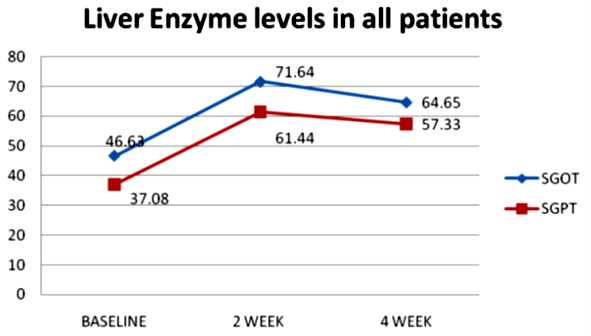
Liver function tests were done of patients on ATT. The total  bilirubin  levels  of  patients at baseline, 2nd week and 4th week were 0.9±0.63, 1.24±1.84 and 1.3±2.85mg/dl respectively with significant association of total bilirubin levels with treatment duration. Likewise SGOT, SGPT and ALP levels increased from baseline to 2nd week and then decreased at 4th week with significant association of all parameters with duration of treatment.

DISCUSSION

In this study, 312 patients who were started on ATT under Revised National Tuberculosis Control Programme (RNTCP) in Indira Gandhi Medical College, Shimla were studied for adverse effects of anti-tuberculosis drugs.


Table 1: Age and gender wise distribution of patients

AGE GROUP

MALE

FEMALE

TOTAL


NUMBER

PERCENTAGE

NUMBER

PERCENTAGE

NUMBER

≤60

149

83.3

114

85.7

263

>60

30

16.7

19

14.2

49

TOTAL

179

100

133

100

312

MEAN±SD

43.25±17.02

36.23±18.14

40.26±17.82


Table 2: Effect of anti TB drugs on liver


BILIRUBIN TOTAL (mg/dl)

SGOT (IU/L)

SGPT(IU/L)

ALP (IU/L)

N

MEAN±SD

N

MEAN±SD

N

MEAN±SD

N

MEAN±SD

BASELINE

295

0.9±0.63

295

46.63±75.66

295

37.08±40.7

292

122.59±111.88

2ND WEEK

310

1.24±1.84

307

71.64±152.6

306

61.44±119.5

303

129.66±169.6

4TH WEEK

246

1.3±2.85

244

64.65±150.6

244

57.33±96.3

255

116.50±94.86

P value (Friedman test)

0.047

<0.001

<0.001

0.013


Figure 1: Pattern of rise of total bilirubin(mg/dl) during the course of RX


Data was collected for one year and analysed with clinical data, haematological and biochemical investigation. All patients   had    normal   liver    function  tests  before the initiation of therapy. Liver function tests were monitored at initiation, 2ndand 4th week of the treatment to note the elevation in serum bilirubin and liver transaminase levels which indicate the anti-tuberculosis treatment induced hepatotoxicity.


There were 179 (57.4%) males and 133 (42.6%) females in the study group. The age of the group ranges from 15-88 years with mean age of 40.29±17.72 years. There were more number of patients was in age group of ≤60 years (263 cases). In males 149/179 (83.24%) and 30/179 (16.75%) cases were in age groups of ≤60 years and >60 years respectively. In females 114/133 (85.71%) and 19/133 (14.2%) were in age group of of ≤60 years and >60 years respectively. The mean age of males was 43.25±17.02 years and of females was 36.31±18.04 years.


These findings were close to the study done by Daphne yee et al [19] which had 65% males and 35% females. They had maximum number of cases between age group of 17-34 years (51%) with mean age of 40.3 years.


The mean age of cases in similar study done by JN Pande et al [20]was 39 years with range from 15-70 years.These finding suggest that tuberculosis affects economically productive age group and also affects significantly larger number of males than females. This can be due to either tuberculosis affects men more than women or men tend to use the medical services, such as RNTCP services more readily.

CONCLUSION

In our study we found that advancing age is independent risk factor for development of anti-tuberculosis treatment induced hepatotoxicity.


It can be concluded that monitoring of LFTs during the first 2 months of ATT should identify the majority of DILI earlier, possibly shortening treatment interruption and reducing mortality.


Hence, every patient of tuberculosis should be given Anti-tubercular drugs under direct supervision, as it increases the patient adherence to treatment regimens, less increase of SGOT and SGPT, thus less prone to develop hepatotoxicity, more compliant to patient, increased effectiveness with easy availability in all government hospitals and awareness of patient about the disease.

REFERENCE
  1. Agarwal, S.P., and L.S. Chauhan. Tuberculosis Control in India. Directorate General of Health Services, Ministry of Health and Family Welfare, Government of India, 2005.

  2. Nehaul, L.K. "Tuberculosis." Clinical Pharmacy and Therapeutics, edited by R. Walker and C. Edwards, 3rd ed., Churchill Livingstone, 2003, pp. 583–595.

  3. Kishore, P.V. Forn et al. "Pattern of Adverse Drug Reactions Experienced by Tuberculosis Patients in a Tertiary Care Teaching Hospital in Western Nepal." Pakistan Journal of Pharmaceutical Sciences, vol. 21, no. 1, 2008, pp. 51–56.

  4. Tak, D.K. Forn et al. "Safety Evaluation of Anti-Tubercular Therapy Under Revised National Tuberculosis Control Programme in India." Journal of Clinical and Diagnostic Research, vol. 3, 2009, pp. 1395–1401.

  5. Maher, D., and M. Raviglione. "Global Epidemiology of Tuberculosis." Clinics in Chest Medicine, vol. 26, 2005, pp. 167–182.

  6. Koju, D. Forn et al. "Occurrence of Side Effects from Anti-Tuberculosis Drugs in Urban Nepalese Population under DOTS Treatment." Kathmandu University Journal of Science, Engineering and Technology, vol. 1, no. 1, 2005, pp. 1–2.

  7. Enarson, D.A. Forn et al. Tuberculosis Guide for Low Income Countries. 4th ed., International Union Against Tuberculosis and Lung Disease, 1996.

  8. Kumar, R. Forn et al. "Anti-Tuberculosis Therapy–Induced Acute Liver Failure: Magnitude, Profile, Prognosis, and Predictors of Outcome." Hepatology, vol. 51, no. 5, 2010, pp. 1665–1674.

  9. Ostapowicz, G. Forn et al. "Results of a Prospective Study of Acute Liver Failure at 17 Tertiary Care Centers in the United States." Annals of Internal Medicine, vol. 137, 2002, pp. 947–954.

  10. Saukkonen, J.J. "Hepatotoxicity of Anti-Tuberculosis Therapy." American Journal of Respiratory and Critical Care Medicine, vol. 174, no. 8, 2006, pp. 935–952.

  11. Devarbhavi, H., and W. Kremers. "Fulminant Hepatic Failure: Cause, Course and Predictors of Outcome." Indian Journal of Gastroenterology, vol. 24, suppl. 1, 2005, p. A116.

  12. Parthasarathy, R. Forn et al. "Hepatic Toxicity in South Indian Patients During Treatment of Tuberculosis with Short Course Regimens Containing Isoniazid, Rifampicin and Pyrazinamide." Tubercle, vol. 67, 1986, pp. 99–108.

  13. Purohit, S.D. Forn et al. "Rifampicin and Hepatotoxicity." Indian Journal of Tuberculosis, vol. 30, 1983, pp. 107–109.

  14. Taneja, D.P., and D. Kaur. "Study on Hepatotoxicity and Other Side Effects of Anti-Tuberculosis Drugs." Journal of the Indian Medical Association, vol. 88, 1990, pp. 278–280.

  15. Mehta, S. "Malnutrition and Drugs; Clinical Implications." Developmental Pharmacology and Therapeutics, vol. 15, 1990, pp. 159–165.

  16. Snider, D.E. Forn et al. "Six Months Isoniazid and Rifampicin Therapy for Pulmonary Tuberculosis: Report of a United States Public Health Service Co-Operative Trial." American Review of Respiratory Disease, vol. 129, 1984, pp. 573–579.

  17. Dutt, A.K. Forn et al. "Short Course Chemotherapy for Tuberculosis with Mainly Twice Weekly Isoniazid and Rifampicin: Community Physician’s Seven Year Experience with Mainly Out Patients." American Journal of Medicine, vol. 77, 1984, pp. 233–242.

  18. British Thoracic and Tuberculosis Association. "Short Course Chemotherapy in Pulmonary Tuberculosis." The Lancet, vol. 1, 1975, pp. 119–124.

  19. Yee, D. Forn et al. "Incidence of Serious Side Effects from First Line Antituberculous Drugs among Patients Treated for Active Tuberculosis." American Journal of Respiratory and Critical Care Medicine, vol. 167, 2003, pp. 1472–1477.

  20. Pande, J.N. Forn et al. "Risk Factors for Hepatotoxicity from Anti-Tuberculosis Drugs: A Case Control Study." Thorax, vol. 51, 1996, pp. 167–170.

License
CC BY-NC-ND
Creative Commons Attribution-NonCommercial-NoDerivatives 4.0 International License
To Estimate Baseline Liver Injury In New Tuberculosis Patients Initiated on Daily DOTS From Indira Gandhi Medical College Shimla © 2026 by Amita Chaudhary, Siddhartha Kheora licensed under CC BY-NC-ND 4.0
All papers should be submitted electronically. All submitted manuscripts must be original work that is not under submission at another journal or under consideration for publication in another form, such as a monograph or chapter of a book. Authors of submitted papers are obligated not to submit their paper for publication elsewhere until an editorial decision is rendered on their submission. Further, authors of accepted papers are prohibited from publishing the results in other publications that appear before the paper is published in the Journal unless they receive approval for doing so from the Editor-In-Chief.
Himalayan Journal of Community Medicine and Public Health open access articles are licensed under a Creative Commons Attribution-Share A like 4.0 International License. This license lets the audience to give appropriate credit, provide a link to the license, and indicate if changes were made and if they remix, transform, or build upon the material, they must distribute contributions under the same license as the original.
Recommended Articles
Research Article
Curves of Concern: Public Awareness of Scoliosis and Its Impact on Childhood Development in Hamirpur
Published: 10/12/2024
Download PDF
Research Article
Etiological Analysis of the Incident of Computer Vision Syndrome (Cvs) in Students of the Faculty of Medical Muhammadiyah University Semarang
...
Published: 20/01/2026
Download PDF
Research Article
Silent Threats Unveiled: Gauging Public Awareness and Understanding of Blood Clotting Disorders in Ambala, Haryana
...
Published: 30/07/2024
Download PDF
Research Article
Knowledge About HBV Infection and Its Association with HBSAG Positivity among Residents of Kaza Sub- Division Of District Lahaul & Spiti In Himachal Pradesh
...
Published: 30/07/2024
Download PDF
Flowbite Logo
Najmal Complex,
Opposite Farwaniya,
Kuwait.
Email: support@himjournals.com

Useful Links
Order Hard Copy
Privacy policy
Terms and Conditions
Refund Policy
Others
About Us
Team Members
Contact Us
Online Payments
Join as Editor
Join as Reviewer
Subscribe to our Newsletter
Follow us
MOST SEARCHED KEYWORDS
scientific journal
 | 
business journal
 | 
medical journals
 | 
Scientific Journals
 | 
Academic Publisher
 | 
Peer-reviewed Journals
 | 
Open Access Journals
 | 
Impact Factor
 | 
Indexing Services
 | 
Journal Citation Reports
 | 
Publication Process
 | 
Impact factor of journals
 | 
Finding reputable journals for publication
 | 
Submitting a manuscript for publication
 | 
Copyright and licensing of published papers
 | 
Writing an abstract for a research paper
 | 
Manuscript formatting guidelines
 | 
Promoting published research
 | 
Publication in high-impact journals
Copyright © Himalayan Journals . All Rights Reserved.