Contents
Download PDF
pdf Download XML
2845 Views
260 Downloads
Share this article
Research Article | Volume 2 Issue 2 (July-Dec, 2021) | Pages 1 - 3
Epidemiological and Clinical Characteristics of Corona Virus Disease (Covid-19) Suspected Individuals it Covid Testing Center of Tertiary Care Hospital In New Delhi
1
Department of Community Medicine, Dr. Baba Saheb Ambedkar Medical College and Hospital, New Delhi, India
Under a Creative Commons license
Open Access
Received
Jan. 3, 2021
Revised
Jan. 9, 2021
Accepted
Jan. 19, 2021
Published
Jan. 27, 2021
Abstract

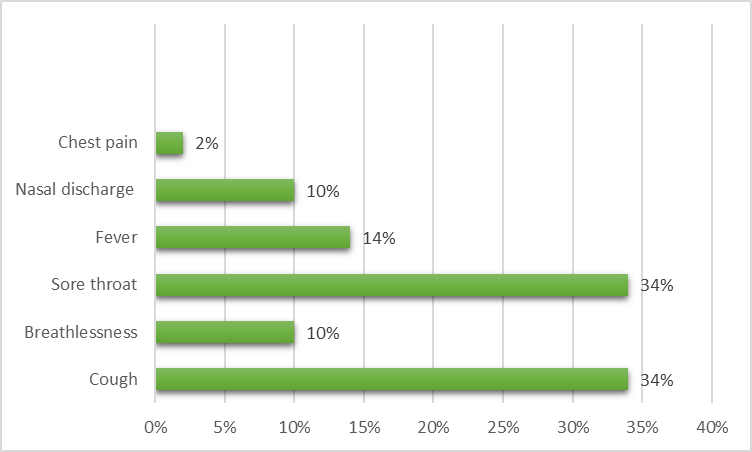
Background: Coronavirus disease 2019 (COVID-19) is a respiratory illness caused by Severe Acute Respiratory Coronavirus-2 (SARS-CoV-2). The disease has infected many and also causes high mortality since first case was reported in China on December 2019. Transmission of virus is very high and occurs mainly by droplet infection. Aims and objective: To find out the rate of SARS-CoV-2 positivity among individuals attending Covid testing center. Methodology: A prospective study was carried out on population attending the CTC attached to Dr. Baba Saheb Ambedkar Medical College and Hospital, New Delhi between 3rd May 2020 and 20th May 2020. Epidemiological, demographic and clinical data was collected and analyzed by using SPSS version 22. Consecutive sampling was done. Results: Out of 50 samples the positivity rate for SARS-CoV-2 was only 8%. The positivity rate among males was 7.40% and among females was 8.69%. The most common symptoms were cough (34%), sore throat (34%), fever (14%), breathlessness (10%), nasal discharge (10%) and chest pain (2%). Conclusion: In a single-center of New Delhi, the case positivity rate was very low. And incidents of becoming positive was higher in symptomatic cases.

Keywords
INTRODUCTION

In December 2019, few cases of acute respiratory illness with unknown origin was detected. Those cases were linked with Huanan seafood wholesale market of Wuhan.  On 7th January 2020, SARS-CoV-2 was identified as a new and 7th coronavirus which was never seen before [1]. Earlier identified corona virus had caused dreaded diseases like SARS (Severe Acute Respiratory Syndrome) with 774 deaths from 8094 confirmed cases and MERS (Middle East Respiratory Syndrome) with 858 deaths from 2494 confirmed cases. On 11th February 2020, the World Health Organization named the disease, coronavirus disease, coronavirus disease 2019 (Abbreviated COVID-19). And on 11th March 2020, the World Health Organization declares COVID-19 as a pandemic. Globally, total 36,361,054 confirmed cases and 1,056,186 deaths were reported till 9th October 2020. 


In India, first case was identified in Kerala on 24th January 2020 (MOHFW, 2020). Due to increasing number of cases Hon’ble Prime Minister issued an order of one day “Janta Curfew” on 22nd March 2020 and later on 25th March 2020, lockdown for containment of COVID-19 pandemic. (WHO south east Asia).According to Ministry of Health and Family welfare (MOHFW), total 6,906,151 confirmed cases and 106,490 deaths were reported till 9th October 2020 in India [2]. 


According to CDC also, confirmed COVID-19 cases presents with Fever, Cough and Shortness of breath.Illness usually manifests as a respiratory infection, or sometimes gastrointestinal infection. The clinical spectrum of illness varies from no symptoms or mild respiratory symptoms to severe, rapidly progressive pneumonia, acute respiratory distress syndrome, septic shock, or multi-organ failure resulting in death [3].         


METHODS

Study design and study participants 

A prospective observational study design was conducted among individuals attending Covid testing center attached to Dr. Baba Saheb Ambedkar Medical college and Hospital, New Delhi. The study was conducted between 3rd May 2020 and 20th May 2020. A selection criteria was based on strategy for Covid-19 testing in India [4] by ICMR.

MATERIALS AND METHODS

A Predesigned and pretested semi-structured questionnaire was used for this study. Questionnaire has three parts: 1stpart of questionnaire consists of few basic socio-demographic detail including age, gender, residence, previous history of Covid testing, 2nd part consist questions regarding patient category like symptomatic individuals having history of international travel in last 14 days, symptomatic contacts of laboratory conformed cases, all symptomatic healthcare workers/ frontline workers in containment area, all patients with severe acute respiratory infection, asymptomatic contacts of lab confirmed cases, all symptomatic with Influenza like illness and the 3rd part consist of symptoms present and preexisting medical conditions. 


Outcome Variable

Positive result on real-time RT-PCR assay of nasal/oropharyngeal swab specimens. 


Laboratory Procedure

All health care workers posted at testing center received comprehensive training on infection control practices and procedures. Combined nasal and throat swab specimens in a single viral-transport medium tube were obtained with all precautions. The samples were collected by nylon-flocked swab. All biological samples were sealed and sent to laboratories in specimen transport box on the same day of collection. All patients were enrolled in ICMR testing application via their contact number, later the testing result was also sent. 


Working Definitions

Fever: An A.M temperature of >37.2 degree Celsius (>98.9-degree Fahrenheit) would define a fever. The normal daily temperature variation, also called the circadian rhythm, is typically 0.5 degree Celsius (0.9-degree Fahrenheit)


Influenza like illness: ILI case is defined as one with acute respiratory with fever ≥ 38 degree Celsius and cough [2].

Severe acute respiratory infection: SARI case is defined as one with acute respiratory with fever ≥ 38 degree Celsius and cough and requiring hospitalization [2].


Statistical analysis

Epidemiological, demographic and clinical data was collected and analyzed by using SPSS (Statistical Package for the Social Sciences) version 22.0 software.

RESULTS

It was observed that majority participants belonged to middle age group i.e 40-49 years (30%), 30-39 years (22%) and 18-29 years (18%). Majority of the study participants were males (54%) than females (46%) but the rate of SARS-CoV-2 positivity was similar in both genders (Table1). The positivity rate among males was 7.40% and among females was 8.69%.


Out of total, most of the study participants were asymptomatic direct and highrisk contacts of lab confirmed case-family member (40%), followed by symptomatic contacts of laboratory confirmed case (32%). Out of all patient categories, maximum SARS-CoV-2 positivity were from symptomatic contacts of lab conformed cases. (Table 2) No one belonged to categories like symptomatic international travellers in the last 14 days and hospitalized SARI patients. The most common symptoms were cough (34%), sore throat (34%), fever (14%), breathlessness (10%), nasal discharge (10%) and chest pain (2%). No one came with presenting complaints of abdominal pain, vomiting, diarrhea, sputum, body ache, hemoptysis and nausea (Figure 1). Majority of the study participants had no pre-existing medical history.


Table 1: Demographic Characteristics of Study Participants (N=50)

Sr.No

Variable

Categories

Frequency 

Percentage

1.

Age

0-4 years

02

4%

5-17 years

06

12%

18-29 years

09

18%

30-39 years

11

22%

40-49 years

15

30%

50-64 years

01

02%

65-74 years

05

10%

75-84 years

01

02%

2

Gender

Male

27

54%

Female

23

46%


Table 2: Patient Profile Testing for Covid-19 (N=50)

Sr. No

Testing categories

Number tested

Positive

1

Symptomatic contacts of laboratory confirmed case

16 (32%)

02

2

Symptomatic healthcare worker

01 (2%)

00

3

Asymptomatic direct and high risk contacts of lab confirmed case-family member

20 (40%)

01

4

Asymptomatic healthcare worker in contact with confirmed case

02 (4%)

00

5

ILI identified in hot zones

06 (12%)

01

6

Symptomatic Frontline worker

04 (8%)

00

7

Not specified

01 (2%)

00

Note: SARI, severe acute respiratory infection, ILI, influenza-like illness


Table 3: Pre-Existing Medical History of the Participants (N=50)

Sr.No.

Medical condition

Frequency

%

1

Hypertension and diabetes

02

4

2

Heart disease and hypertension 

01

2

3

Diabetes

01

2

4

Heart disease

01

2

5

Hypertension

01

2

6

Immunocompromised condition

01

2

7

No previous medical history

43

86


Figure 1: Symptoms Reported at the Time of Specimen Collection

Note: *Multiple response possible

DISCUSSION

Similar results were found in a study conducted by Priya Abraham et al [5] among 1,021,518 individuals between 22 January 2020 to 30 April 2020 in various states of India. It was observed that 40,184 (3.9%) were found to be positive on RT-PCR assay. The portion of positive cases was highest among symptomatic and asymptomatic contacts. Similarly in a retrospective study conducted by Ashish Goel at al [6] among 2592 individuals atvGuru Teg Bahadur Hospital, Delhi between March 2020 to May 2020 and it was found that out of 2592 individuals, 201 (7.6%) were found to be positive on RT-PCR analysis (The Cureus,2020).  In contrast to the present study, a study conducted by Maria Khan et al. [7] among 845 individuals at Covid-19 screening clinic in Rehman Medical Institute, Pakistan between 15 March 2020 to 21 April 2020. It was found that positive rate of SARS-CoV-2 was 14.3%. The proportion of positive Covid result was higher in males and geriatric age group.


In a study conducted by Yiping Wei et al. [8] among 276 hospitalized COVID-19 patients in Zengdu Hospital, China between 27 January 2020 to 11 March 2020, similar results were found regarding symptoms i.e fever (82%) and cough (78%). Other upper respiratory tract infection and gastrointestinal symptoms were rare (BMJ, Infectious disease). Similarly in a study conducted by Jingshan Lian et al. [9] among 465 hospitalized COVID-19 patients between 17 January 2020 to 31 January 2020 in China, common symptoms were fever and cough.

CONCLUSION

In a single-center of North west Delhi, the case positivity rate was very low. And incidents of becoming positive was higher in symptomatic cases. The positivity rate was higher among symptomatic contacts of laboratory confirmed cases. And most common symptoms were fever, cough and sore throat. Gastrointestinal symptoms were very rare.


Acknowledgment

I offer my sincere thanks to staff members of covid testing center for helping me to complete my study. And also wants to thanks all my study participants.


Ethical Approval

The study was approved by the Institutional Ethics Committee.

REFERENCE
  1. World Health Organization. "Novel coronavirus – China." Disease outbreak news update, 2020, January 12. Retrieved from https://www.who.int/csr/don/12-january-2020-novel-coronavirus-china/en/

  2. Ministry of Health and Family Welfare. "Press Information Bureau." Government of India, 2020. Retrieved from https://pib.gov.in/newsite/PrintRelease.aspx?relid=197738

  3. World Health Organization South East Asia. "Novel coronavirus disease: India situation report 8." WHO India Situation Report, 2020, March 28. Retrieved from https://www.who.int/docs/default-source/wrindia/situation-report/india-situation-report-8.pdf?sfvrsn=c883d0c2_2

  4. Indian Council of Medical Research. "Strategy for COVID-19 testing in India (version 5, dated 18/05/2020)." ICMR Reports, 2020. Retrieved from https://www.icmr.gov.in/pdf/covid/strategy/Testing_Strategy_v5_18052020.pdf

  5. Abraham P. et al. "Laboratory surveillance for SARS-CoV-2 in India: Performance of testing and descriptive epidemiology of detected COVID-19, January 22 - April 30, 2020." Indian Journal of Medical Research, vol. 151, no. 5, 2020, pp. 424.

  6. Goel A. et al. "Profile of patients suspected to be COVID-19: A retrospective analysis of early pandemic data." Cureus, vol. 12, no. 8, 2020, p. 1.

  7. Khan M. et al. "Epidemiological and clinical characteristics of coronavirus disease (COVID-19) cases at a screening clinic during the early outbreak period: a single-centre study." Journal of Medical Microbiology, vol. 69, no. 8, 2020, pp. 1114.

  8. Wei Y. et al. "Clinical characteristics of 276 hospitalized patients with coronavirus disease 2019 in Zengdu District, Hubei Province: A single-center descriptive study." BMC Infectious Disease, vol. 20, no. 549, 2020, pp. 1.

  9. Lian J. et al. "Epidemiological, clinical, and virological characteristics of 465 hospitalized cases of coronavirus disease 2019 (COVID-19) from Zhejiang province in China." Influenza and Other Respiratory Viruses, vol. 14, 2020, pp. 564.

License
CC BY-NC-ND
Creative Commons Attribution-NonCommercial-NoDerivatives 4.0 International License
Epidemiological and Clinical Characteristics of Corona Virus Disease (Covid-19) Suspected Individuals it Covid Testing Center of Tertiary Care Hospital In New Delhi © 2026 by Yachna Setu licensed under CC BY-NC-ND 4.0
All papers should be submitted electronically. All submitted manuscripts must be original work that is not under submission at another journal or under consideration for publication in another form, such as a monograph or chapter of a book. Authors of submitted papers are obligated not to submit their paper for publication elsewhere until an editorial decision is rendered on their submission. Further, authors of accepted papers are prohibited from publishing the results in other publications that appear before the paper is published in the Journal unless they receive approval for doing so from the Editor-In-Chief.
Himalayan Journal of Community Medicine and Public Health open access articles are licensed under a Creative Commons Attribution-Share A like 4.0 International License. This license lets the audience to give appropriate credit, provide a link to the license, and indicate if changes were made and if they remix, transform, or build upon the material, they must distribute contributions under the same license as the original.
Recommended Articles
Research Article
Assessing the Role of Community Engagement in Promoting Malaria Prevention and Treatment Practices in Mashonaland Central Province, Zimbabwe: A Case of Centenary District
Published: 13/08/2026
Download PDF
Research Article
Curves of Concern: Public Awareness of Scoliosis and Its Impact on Childhood Development in Hamirpur
Published: 10/12/2024
Download PDF
Research Article
Etiological Analysis of the Incident of Computer Vision Syndrome (Cvs) in Students of the Faculty of Medical Muhammadiyah University Semarang
...
Published: 20/01/2026
Download PDF
Research Article
Silent Threats Unveiled: Gauging Public Awareness and Understanding of Blood Clotting Disorders in Ambala, Haryana
...
Published: 30/07/2024
Download PDF
Flowbite Logo
Najmal Complex,
Opposite Farwaniya,
Kuwait.
Email: support@himjournals.com

Useful Links
Order Hard Copy
Privacy policy
Terms and Conditions
Refund Policy
Others
About Us
Team Members
Contact Us
Online Payments
Join as Editor
Join as Reviewer
Subscribe to our Newsletter
Follow us
MOST SEARCHED KEYWORDS
scientific journal
 | 
business journal
 | 
medical journals
 | 
Scientific Journals
 | 
Academic Publisher
 | 
Peer-reviewed Journals
 | 
Open Access Journals
 | 
Impact Factor
 | 
Indexing Services
 | 
Journal Citation Reports
 | 
Publication Process
 | 
Impact factor of journals
 | 
Finding reputable journals for publication
 | 
Submitting a manuscript for publication
 | 
Copyright and licensing of published papers
 | 
Writing an abstract for a research paper
 | 
Manuscript formatting guidelines
 | 
Promoting published research
 | 
Publication in high-impact journals
Copyright © Himalayan Journals . All Rights Reserved.