Contents
Download PDF
pdf Download XML
2663 Views
335 Downloads
Share this article
Research Article | Volume 2 Issue 2 (July-Dec, 2021) | Pages 1 - 3
Estimation of Duration of Analgesia in Patients Being Administered With 0.25% Levobupivacaine: A Cross Sectional Observational Study in a Medical College Of Trans-Himalayan Region
 ,
1
Department of Anesthesia, DRPGMC Tanda, Himachal Pradesh, India
2
Department of Community Medicine, PGIMER Chandigarh, India
Under a Creative Commons license
Open Access
Received
June 12, 2021
Revised
July 25, 2021
Accepted
Aug. 12, 2021
Published
Aug. 31, 2021
Abstract

Various local anaesthetic agents like bupivacaine, levobupivacaine, ropivacaine and lignocaine have been used with safety and efficacy in performing such blocks. Out of various agents which are used for brachial plexus block, levobupivacaine is the agent which not only prolongs motor and sensory blockade but is also less cardiotoxic and neurotoxic. The study was done with an objective to estimate the duration of analgesia and the requirement of rescue analgesia post operatively. We also intended to study the intra-operative cardiovascular stability by assessing the heart rate and mean arterial pressure of the study participants. There were 30 study participants who were provided with 0.25% Levobupivacaine plus dexamethasone 4 mg. The mean duration of the surgery was 41.6 (SD=11.64) minutes. The mean duration of the pain free period was 229 minutes (95% Confidence Interval: 222.75 -243.5). Our study also observed that requirement of rescue analgesia was 4 with a range from 3.0-4.0. In conclusion, the use of 0.25% levobupivacaine with dexamethasone (4 mg) as adjuvant in USG guided supraclavicular brachial plexus block resulted in smooth induction of analgesia, with a pain free period of nearly 4 hours. The requirement for rescue analgesia is delayed. This anaesthetic has also been found to maintain cardiovascular stability. Further studies are required to assess the relative efficacy of this anaesthetic.

Keywords
INTRODUCTION

Recent years have witnessed increasing interest in postoperative pain management. The aim of postoperative pain management is to provide subjective comfort in addition to inhibiting trauma-induced nociceptive impulses to blunt autonomic and somatic reflex responses to pain. 


Brachial plexus block remains the only practical alternative to general anaesthesia for significant surgery on the upper limb. It provides a superior quality of analgesia and avoids the common side-effects associated with general anaesthesia such as postoperative nausea and vomiting. The brachial plexus supraclavicular block is extremely useful in patients with significant co-morbidities such as severe respiratory and cardiovascular disease, morbid obesity and in those with potential airway difficulties. 


These blocks are therefore particularly useful in the ambulatory surgical setting for a wide variety of patients and procedures [1]. Various local anaesthetic agents like bupivacaine, levobupivacaine, ropivacaine and lignocaine have been used with safety and efficacy in performing such blocks [2]. Local anaesthetic preferentially binds to the inactivated state of voltage gated sodium channels, but has also been found to bind potassium channels, G-protein coupled receptors, N-methyl-D-aspartate (NMDA) receptors and calcium channels in vitro [3]. Concentration of local anaesthetic which has been used for a blockade of different local anaesthetics varies from 0.5%, 0.25% and 0.375%. It has been observed that it is not the concentration but volume that affects the effective dose of local anaesthetic [4].


Out of various agents which are used for brachial plexus block, levobupivacaine is the agent which not only prolongs motor and sensory blockade but is also less cardiotoxic and neurotoxic. 


The study was done with an objective to estimate the duration of analgesia and the requirement of rescue analgesia post operatively after inducing the patient with 0.25% of levobupivacaine and adjuvant 4mg dexamethasone. We also intended to study the intra-operative cardiovascular stability by assessing the heart rate and mean arterial pressure of the study participants.

MATERIALS AND METHODS

Study Design 

Observational Cross-sectional study.


Study Site 

Department of Anaesthesia, Dr RPGMC Kangra at Tanda. 


Inclusion Criteria 

  • Males and females between the age group 18-60 years

  • ASA physical class I-II
  • Body Mass Index 18.5-29.9 kg/m2

  • Patients who underwent open reduction and internal fixation for fractures of lower end humerus and forearm bones 


Exclusion Criteria 

  • Patients on steroids
  • Body Mass Index>30 kg/m2
  • Local infections or anatomic deformities

  • Coagulation disorder and allergy to local anaesthetics 


Randomization 

Randomization was done by computer generated randomized number table. Random numbers were enclosed in a sealed opaque envelope and opened by one of the investigators to know the study drug/combination to be administered, only after shifting of patient inside operation theatre. Observer anaesthesiologist who collected the postoperative data was blinded to the test.


Statistical Analysis

The data was collected and cleaned using MS Excel 2010 and statistical analysis was done using SPSS software 21. The One-Sample Kolmogorov-Smirnov Test was used for assessing the data distribution in the study. The quantitative data was expressed using mean and standard deviation. The qualitative data was expressed in frequencies and proportions.

RESULTS

There were 30 study participants who were provided with 0.25% Levobupivacaine plus dexamethasone 4 mg. The mean age group of the study participants was 41.6 (SD=11.64) years. There were 50% females and 50% males, in a male to female ratio of 1:1. The mean duration of the surgery was 40.93 (SD=17.90) minutes.


The mean duration of the pain free period was 229 minutes (95% Confidence Interval: 222.75-243.5). Our study also observed that requirement of rescue analgesia was 4 with a range from 3.0-4.0. Intra operatively the mean heartrate in beats per minute at the baseline was 82, the mean heartrate 5 minutes after the induction of anaesthesia was 81 which further reduced to 80 after 15 minutes, 78 after 25 minutes, 78 after 35 minutes, 77 after 45 minutes and 78 after one hour. There was a slight rise in the mean heartrate after 90 minutes after which the heart rate further increased to 80 beats per minute 2 hours after the induction (Table 1).


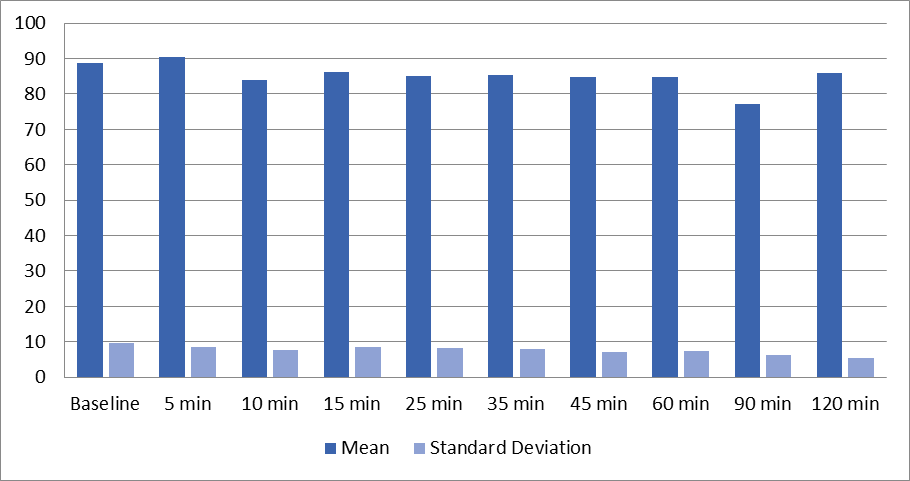
Furthermore, the mean arterial pressure in mm of Hg was 91.57 at the baseline which further decreased to 89.7 mm Hg, 5 minutes after the induction of anaesthesia. The Mean arterial pressure decreased to 82.1 after 10 minutes, was 90.37 after 15 minutes, 89.30 after 25 minutes, 87 after 45 minutes and 94.4 after 2 hours (Figure 1).


Table 1: Mean Heart Rate (In Beats per Minute) Of the Study Participants during the Intraoperative Period (N=30)

Time Interval

Mean

Standard Deviation

Baseline 

82.17

10.68

5 min 

81.23

10.08

10 min 

81.13

9.52

15 min 

80.10

8.98

25 min 

78.73

8.92

35 min 

78.73

8.80

45 min 

77.19

8.66

60 min 

78.70

9.22

90 min 

79.82

10.49

120 min 

80.00

9.41                 


Figure 1: Arterial Pressure of the study participants (n=30)

DISCUSSION

In our study, time from completing block to the time to first rescue analgesia demanded (VAS>3) was taken as total duration of analgesia. In our study, median duration of analgesia was 567.00 minutes. In a study by Pani et al. [5], duration of analgesia in patients who received 0.25% levobupivacaine and 4mg dexamethasone was 695 minutes. However, they administered analgesia only if VAS was more than 5 as compared to more than 3 as in our study. In a study by Mankad et al. [6], duration of analgesia was 12.56 hours in the patients who received 30 mL of 0.5% levobupivacaine. In our study, median dose of total doses of rescue analgesia was 150 mg. In the study by Hashim and Hassan, mean total dose of rescue analgesia was 84.1 mg, 110.5 mg and 170 mg in group DB (dexmedetomidine and bupivacaine), KB (ketamine and bupivacaine) and FB (fentanyl and bupivacaine). In their study, they have used VAS more than 4 for administration of rescue analgesia [7]. We observed that with levobupivacaine 0.25% in USG guided supraclavicular block with 4 mg dexamethasone as perineural adjuvant, patients started complaining discomfort at the site of tourniquet application after 30 minutes approximately. Therefore, we used 0.25% levobupivacaine in superficial surgeries with duration lasting less than 60 minutes and in surgeries where tourniquet application was not required.


In another study [8], when patients were administered with bupivacaine 0.5%, duration was 1053 min (802–1304 min); in levobupivacaine 0.5% group, duration was 1001 min (844–1158 min); and levobupivacaine 0.25% group had duration of 707 min (551–863 min) [P=0.01]. The authors recommended levobupivacaine 0.5% instead of bupivacaine 0.5% for the three-in-one block as supplement to spinal or general anaesthesia. 


Similarly, Raj et al. [9] evaluated the efficacy of tramadol or dexamethasone as an adjuvant to levobupivacaine in low volume ultrasound-guided supraclavicular brachial plexus block. The mean duration of analgesia was 1300.83±336 min and 820.47±239 min in patients administered with 0.25% of levobupivacaine with Tramadol and Dexamethasone, respectively.

CONCLUSION

In conclusion, the use of 0.25% levobupivacaine with dexamethasone (4 mg) as adjuvant in USG guided 
supraclavicular brachial plexus block resulted in smooth induction of analgesia, with a pain free period of nearly 4hours. The requirement for rescue analgesia is delayed. This anaesthetic has also been found to maintain cardiovascular stability. Further studies are required to assess the relative efficacy of this anaesthetic.

REFERENCES
  1. Bruce, B.G., et al. "Brachial plexus blocks for upper extremity orthopaedic surgery." Journal of the American Academy of Orthopaedic Surgeons, vol. 20, no. 1, 2012, pp. 38–47.

  2. Santorsola, R., et al. "Levobupivacaine for peripheral blocks of the lower limb: A clinical comparison with bupivacaine and ropivacaine." Minerva Anestesiologica, vol. 67, no. 9 Suppl 1, 2001, pp. 33–36.

  3. Marban, E., et al. "Structure and function of voltage‐gated sodium channels." The Journal of Physiology, vol. 508, no. 3, 1998, pp. 647–57.

  4. Gupta, P.K. and P.M. Hopkins. "Effect of concentration of local Anaesthetic solution on the ED50 of bupivacaine for supraclavicular brachial plexus block." British Journal of Anaesthesia, vol. 111, no. 2, 2013, pp. 293–96.

  5. Pani, N., et al. "A clinical comparison between 0.5% levobupivacaine and 0.5% levobupivacaine with dexamethasone 8 mg combination in brachial plexus block by the supraclavicular approach." Indian Journal of Anaesthesia, vol. 61, no. 4, 2017, pp. 302.

  6. Mankad, P.P., et al. "A comparative study of 0.5% ropivacaine and 0.5% levobupivacaine in supraclavicular brachial plexus block." International Journal of Medical Science and Public Health, vol. 5, 2016, pp. 74–79.

  7. Hashim, R.M. and R.M. Hassan. "The efficacy of adjuvants to bupivacaine in ultrasound-guided supraclavicular block: A Comparative study between dexmedetomidine, ketamine and fentanyl." Ain-Shams Journal of Anesthesiology, vol. 11, no. 1, 2019, pp. 1–8.

  8. Urbanek, B., et al. "Onset time, quality of blockade and duration of three-in-one blocks with levobupivacaine and bupivacaine." Anesthesia & Analgesia, vol. 97, no. 3, 2003, pp. 888–92.

  9. Raj, S.A., et al. "Efficacy of tramadol or dexamethasone as an adjuvant to levobupivacaine in ultrasound-guided supraclavicular plexus block for upper limb surgery: A randomized double-blinded controlled study." Anesthesia, Essays and Researches, vol. 11, no. 3, 2017, pp. 567.

License
CC BY-NC-ND
Creative Commons Attribution-NonCommercial-NoDerivatives 4.0 International License
Estimation of Duration of Analgesia in Patients Being Administered With 0.25% Levobupivacaine: A Cross Sectional Observational Study in a Medical College Of Trans-Himalayan Region © 2026 by A.K. Verma, Rahul Gupta licensed under CC BY-NC-ND 4.0
All papers should be submitted electronically. All submitted manuscripts must be original work that is not under submission at another journal or under consideration for publication in another form, such as a monograph or chapter of a book. Authors of submitted papers are obligated not to submit their paper for publication elsewhere until an editorial decision is rendered on their submission. Further, authors of accepted papers are prohibited from publishing the results in other publications that appear before the paper is published in the Journal unless they receive approval for doing so from the Editor-In-Chief.
Himalayan Journal of Community Medicine and Public Health open access articles are licensed under a Creative Commons Attribution-Share A like 4.0 International License. This license lets the audience to give appropriate credit, provide a link to the license, and indicate if changes were made and if they remix, transform, or build upon the material, they must distribute contributions under the same license as the original.
Recommended Articles
Research Article
Curves of Concern: Public Awareness of Scoliosis and Its Impact on Childhood Development in Hamirpur
Published: 10/12/2024
Download PDF
Research Article
Etiological Analysis of the Incident of Computer Vision Syndrome (Cvs) in Students of the Faculty of Medical Muhammadiyah University Semarang
...
Published: 20/01/2026
Download PDF
Research Article
Silent Threats Unveiled: Gauging Public Awareness and Understanding of Blood Clotting Disorders in Ambala, Haryana
...
Published: 30/07/2024
Download PDF
Research Article
Knowledge About HBV Infection and Its Association with HBSAG Positivity among Residents of Kaza Sub- Division Of District Lahaul & Spiti In Himachal Pradesh
...
Published: 30/07/2024
Download PDF
Flowbite Logo
Najmal Complex,
Opposite Farwaniya,
Kuwait.
Email: support@himjournals.com

Useful Links
Order Hard Copy
Privacy policy
Terms and Conditions
Refund Policy
Others
About Us
Team Members
Contact Us
Online Payments
Join as Editor
Join as Reviewer
Subscribe to our Newsletter
Follow us
MOST SEARCHED KEYWORDS
scientific journal
 | 
business journal
 | 
medical journals
 | 
Scientific Journals
 | 
Academic Publisher
 | 
Peer-reviewed Journals
 | 
Open Access Journals
 | 
Impact Factor
 | 
Indexing Services
 | 
Journal Citation Reports
 | 
Publication Process
 | 
Impact factor of journals
 | 
Finding reputable journals for publication
 | 
Submitting a manuscript for publication
 | 
Copyright and licensing of published papers
 | 
Writing an abstract for a research paper
 | 
Manuscript formatting guidelines
 | 
Promoting published research
 | 
Publication in high-impact journals
Copyright © Himalayan Journals . All Rights Reserved.