Contents
Download PDF
pdf Download XML
1269 Views
218 Downloads
Share this article
Research Article | Volume 4 Issue 2 (July-Dec, 2023) | Pages 1 - 3
Shattering the Silence: Investigating Polycystic Ovarian Syndrome (PCOS) Awareness among Women at Civil Hospital Theog, Himachal Pradesh
 ,
 ,
1
Dr Isha Chauhan, MS OBG, MO at CH Theog, India
2
Dr Supriya Chauhan, MD Anaesthesiology and critical care, SR at IGMC Shimla, India
3
Dr Priya Dogra, MD Radiodiagnosis, Radiologist at Chauhan Medicity, Pathankot, India
Under a Creative Commons license
Open Access
Received
May 18, 2023
Revised
June 30, 2023
Accepted
July 23, 2023
Published
Aug. 2, 2023
Abstract

Background: Polycystic ovarian syndrome (PCOS) is a common endocrine disorder among women of reproductive age, characterized by hormonal imbalances and ovarian cysts. Despite its high prevalence, there is limited information on the level of awareness and knowledge about PCOS among women attending outpatient departments. Methods: A descriptive, hospital-based cross-sectional survey was conducted in the outpatient department of Civil Hospital Theog, Himachal Pradesh. A sample size of 400 women aged above 18 years was selected using convenience sampling. A structured questionnaire consisting of 20 knowledge-related questions was used to assess awareness about PCOS. Data were analyzed using appropriate statistical tests. Results: The study revealed that 24.75% of participants had very good knowledge, 36.5% had good knowledge, 28% had fair knowledge, and 10.75% had poor knowledge regarding PCOS. While participants demonstrated awareness of PCOS definition, signs and symptoms, there were gaps in knowledge related to risk factors, long-term consequences, and dietary guidelines. Conclusion: The findings highlight the need for targeted educational interventions to improve knowledge and understanding about PCOS. Healthcare providers and policymakers should emphasize accurate information on risk factors, long-term consequences, and lifestyle management. Addressing emotional and psychological aspects and providing specialized care and resources for women with PCOS can enhance overall well-being.

Keywords
INTRODUCTION

Polycystic ovarian syndrome (PCOS) is a common endocrine disorder that affects women of reproductive age, characterized by hormonal imbalances and the presence of cysts in the ovaries. The prevalence of PCOS varies across different populations, but it is estimated to affect between 5% and 10% of women worldwide. In India, the prevalence of PCOS is thought to be even higher, at around 15%. It is characterized by a combination of symptoms, including irregular menstrual cycles, excess hair growth and acne. PCOS can have significant implications for a woman's reproductive health, including irregular menstrual cycles, infertility, and increased risk of metabolic disorders such as insulin resistance, obesity, and cardiovascular disease [1-3].


Despite its high prevalence, PCOS is often not well-recognized or understood by women and healthcare providers. The awareness and knowledge about PCOS among women are crucial for early detection, diagnosis, and management of this condition. Adequate awareness empowers women to recognize the signs and symptoms of PCOS, seek timely medical advice, and make informed decisions regarding their reproductive health. Moreover, awareness about the potential complications and long-term effects of PCOS can lead to better health outcomes and improved quality of life [4-5].


Himachal Pradesh, a northern state of India, has witnessed an increasing prevalence of PCOS in recent years. The Outpatient Department (OPD) of Civil Hospital Theog serves as an important healthcare facility catering to a large population in the region. However, there is limited information available regarding the level of awareness and knowledge about PCOS among women attending this specific healthcare setting.


Assessing the awareness and knowledge of women regarding PCOS is essential for healthcare providers to identify gaps in knowledge and develop targeted educational interventions. It can also guide policymakers in implementing public health strategies to improve awareness, prevention, and early detection of PCOS.


Therefore, this study aims to assess the awareness and knowledge about PCOS among women of reproductive age group attending the Outpatient Department of Civil Hospital Theog, Himachal Pradesh. By evaluating the level of awareness, sources of information, and misconceptions related to PCOS, this study aims to provide valuable insights into the educational needs of women in the region and contribute to improved healthcare outcomes.


Objectives of the Study

The objective of this study is to assess the level of knowledge about Polycystic Ovarian Syndrome (PCOS) among women of reproductive age attending the outpatient department of Civil Hospital Theog, Himachal Pradesh.

MATERIALS AND METHODS

Research Methodology

This is a descriptive, hospital-based cross-sectional survey conducted in the outpatient department of Civil Hospital Theog, Himachal Pradesh. The study duration was from March 2023 to June 2023. The study population consisted of women aged above 18 years who visited the outpatient department. A sample size of 400 women was determined, assuming a 50% knowledge rate about PCOS, with a 5% absolute error, 95% confidence level, and 5% non-response rate.


Convenience sampling technique was used, where the first five female patients visiting the outpatient department each day were selected until the desired sample size was reached. Informed consent was obtained from the participants, and their confidentiality was ensured.


The research tool included a demographic data survey instrument to collect background information, such as age, marital status, religion, employment, education, and family's monthly income. A questionnaire with 20 structured knowledge-related questions was used to assess participants' knowledge about PCOS. Scoring was done based on correct answers, with one mark  given  for  each  correct  response  and  zero for incorrect responses. The maximum score was 20, and the minimum score was zero. The scores were categorized as>80% (16-20) for very good, 60-79% (12-15) for good, 41-59% (8-11) for fair, and<40% (<8) for poor knowledge levels.


The validity of the research tool was ensured by experts in the field. Data collection was conducted under the guidance of supervisors, and participants were given 30 minutes to complete the questionnaire. The collected data were analyzed using Epi Info V7 Software, applying appropriate statistical tests in terms of frequencies and percentages.

RESULTS

The goal of the current study was to evaluate the level of knowledge about PCOS among women of reproductive age attending the outpatient department of Civil Hospital, Theog, Himachal Pradesh.


A total of 400 respondents including 112 (28%) were from urban area and 288(72%) were from rural area were participated in the study.


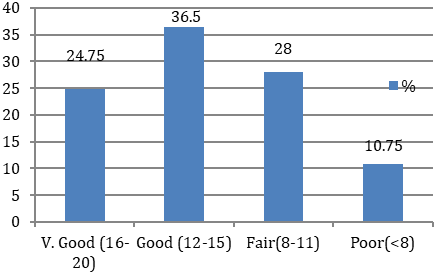
In the present study 24.75% (99) participants had very good knowledge (16-20 marks) towards Polycystic Ovarian Syndrome (PCOS), 36.5% (146) had good knowledge (12-15 marks), 28% (112) had fair knowledge  (8-11 marks) and 10.75 (43)  having poor knowledge (<8 marks).


Figure 1: Knowledge Score Regarding Polycystic Ovarian Syndrome (PCOS) Among Study Participants


Table 1: Knowledge Regarding Polycystic Ovarian Syndrome (PCOS) Among Study Participants

S.No.

Statements

Frequency of Correct Responses

Percent

  1.  

What does Polycystic Ovarian Disease (PCOD) refer to?

276

69

  1.  

What are some common signs and symptoms associated with PCOD?

268

67

  1.  

How does PCOD affect the menstrual cycle?

267

66.75

  1.  

What are some possible factors or risks linked to the development of PCOD?

201

50.25

  1.  

Can PCOD impact a woman's fertility and her ability to conceive?

189

47.25

  1.  

Are there specific medical tests or criteria used for diagnosing PCOD?

178

44.5

  1.  

Is PCOD a lifelong condition or is it curable?

221

55.25

  1.  

What are the potential long-term health consequences of having PCOD?

187

46.75

  1.  

Can lifestyle modifications, such as exercise and diet changes, help manage PCOD symptoms?

198

49.5

  1.  

What treatment options are available for PCOD?

202

50.5

  1.  

Can medications be prescribed to regulate hormone levels and menstrual cycles in women with PCOD?

199

49.75

  1.  

Are there any natural or alternative approaches that can be effective in managing PCOD?

167

41.75

  1.  

Does PCOD increase the risk of developing other conditions like diabetes or heart disease?

186

46.5

  1.  

Is it possible to prevent PCOD? Are there any preventive measures or strategies?

164

41

  1.  

Can stress or emotional factors contribute to the development or worsening of PCOD?

186

46.5

  1.  

Are there specific dietary guidelines for women with PCOD?

126

31.5

  1.  

Can surgical procedures like ovarian drilling or cyst removal cure PCOD?

113

28.25

  1.  

Are there support groups or resources available for women dealing with PCOD?

108

27

  1.  

Can weight management have an impact on improving PCOD symptoms?

193

48.25

  1.  

What are the potential complications associated with untreated or poorly managed PCOD?

156

39


DISCUSSION

Polycystic ovarian syndrome (PCOS) is a prevalent endocrine disorder among women of reproductive age, characterized by hormonal imbalances and the presence of cysts in the ovaries. The findings of this study indicate the level of knowledge and awareness about PCOS among women attending the outpatient department of Civil Hospital Theog, Himachal Pradesh.


The study revealed that there is still room for improvement in terms of knowledge about PCOS among the participants. While a majority of the respondents had some level of awareness regarding PCOS, there were specific areas where misconceptions and gaps in knowledge were evident. For instance, a significant number of participants correctly identified the definition of PCOS, its common signs and symptoms, and its impact on the menstrual cycle. However, there were lower levels of knowledge regarding the factors contributing to the development of PCOS, the potential long-term health consequences, and the specific dietary guidelines for women with PCOS.


These findings are consistent with previous studies conducted in different regions, indicating that the level of awareness about PCOS remains suboptimal among women of reproductive age.6-8. This highlights the need for targeted educational interventions and awareness campaigns to improve knowledge and understanding about PCOS.


Educational initiatives should focus on providing accurate information about PCOS risk factors, potential long-term health consequences, and the importance of lifestyle modifications in managing symptoms. Healthcare providers and policymakers should play an active role in disseminating information about PCOS through various channels, including health clinics, community programs, and online resources.


Additionally, it is important to address the emotional and psychological aspects related to PCOS. The study revealed misconceptions regarding stress and emotional factors contributing to the development or worsening of PCOS. Providing comprehensive support through counseling, support groups, and mental health services can significantly improve the overall well-being of women with PCOS.9


Furthermore, the study highlighted the need for specialized care and resources for women with PCOS. This includes the availability of support groups, dedicated healthcare professionals, and resources to address the unique challenges faced by women with PCOS in terms of fertility, weight management, and emotional well-being. The development of multidisciplinary clinics and collaboration between healthcare providers can enhance the quality of care and improve outcomes for women with PCOS.10


Limitations

It is important to acknowledge the limitations of this study. The sample size was limited to women attending the outpatient department of Civil Hospital Theog, Himachal Pradesh, which may limit the generalizability of the findings. Additionally, the study did not explore the sources of information or assess the impact of sociodemographic factors on knowledge levels, which could be considered in future research.

CONCLUSION

In conclusion, this study highlights the need for increased awareness and knowledge about PCOS among women of reproductive age. Targeted educational interventions and awareness campaigns are essential to address misconceptions and improve understanding about PCOS risk factors, potential complications, and lifestyle management. By enhancing knowledge and promoting early detection and management, healthcare providers and policymakers can contribute to improved healthcare outcomes and the overall well-being of women affected by PCOS.

REFERENCE
  1. Diamanti-Kandarakis, E. et al. "Pathophysiology and types of dyslipidemia in PCOS." Trends in Endocrinology & Metabolism, vol. 29, no. 7, 2018, pp. 479-489.

  2. Teede, H. et al. "Recommendations from the international evidence-based guideline for the assessment and management of polycystic ovary syndrome." Human Reproduction, vol. 33, no. 9, 2018, pp. 1602-1618.

  3. Unar, Fozia. et al. "To determine phenotype of polycystic ovary syndrome in women attending outpatient department of tertiary care hospital of KMC Civil Hospital Khairpur." Journal of Peoples University of Medical & Health Sciences Nawabshah (JPUMHS), vol. 10, no. 4, 2020, pp. 13-17.

  4. Mayo Clinic. "Polycystic ovary syndrome (PCOS)." Mayo Clinic, https://www.mayoclinic.org/diseases-conditions/ pcos/symptoms-causes/syc-20353439. Accessed 11 July 2023.

  5. URMC. "Polycystic ovary syndrome (PCOS)." University of Rochester Medical Center, https://www.urmc.rochester. edu/encyclopedia/content.aspx?ContentTypeID=85&ContentID=p08334. Accessed 12 July 2023.

  6. Asuncion, M. et al. "A prospective study of the prevalence of the polycystic ovary syndrome in unselected Caucasian women from Spain." Journal of Clinical Endocrinology & Metabolism, vol. 85, no. 7, 2000, pp. 2434-2438.

  7. Diamanti-Kandarakis, E. et al. "The role of genes and environment in the etiology of PCOS." Endocrine, vol. 61, no. 3, 2018, pp. 439-448.

  8. Veltman-Verhulst, S.M. et al. "Emotional distress is a common risk in women with polycystic ovary syndrome: a systematic review and meta-analysis of 28 studies." Human Reproduction Update, vol. 22, no. 6, 2016, pp. 766-775.

  9. Laganà, A.S. et al. "Analysis of psychopathological comorbidity behind the common symptoms and signs of polycystic ovary syndrome (PCOS)." Journal of Psychosomatic Obstetrics & Gynecology, vol. 38, no. 4, 2017, pp. 273-277.

  10. Teede, H.J. et al. "Recommendations from the international evidence-based guideline for the assessment and management of polycystic ovary syndrome." Fertility and Sterility, vol. 110, no. 3, 2018, pp. 364-379.

License
CC BY-NC-ND
Creative Commons Attribution-NonCommercial-NoDerivatives 4.0 International License
Shattering the Silence: Investigating Polycystic Ovarian Syndrome (PCOS) Awareness among Women at Civil Hospital Theog, Himachal Pradesh © 2026 by Isha Chauhan, Supriya Chauhan, Priya Dogra licensed under CC BY-NC-ND 4.0
All papers should be submitted electronically. All submitted manuscripts must be original work that is not under submission at another journal or under consideration for publication in another form, such as a monograph or chapter of a book. Authors of submitted papers are obligated not to submit their paper for publication elsewhere until an editorial decision is rendered on their submission. Further, authors of accepted papers are prohibited from publishing the results in other publications that appear before the paper is published in the Journal unless they receive approval for doing so from the Editor-In-Chief.
Himalayan Journal of Community Medicine and Public Health open access articles are licensed under a Creative Commons Attribution-Share A like 4.0 International License. This license lets the audience to give appropriate credit, provide a link to the license, and indicate if changes were made and if they remix, transform, or build upon the material, they must distribute contributions under the same license as the original.
Recommended Articles
Research Article
Curves of Concern: Public Awareness of Scoliosis and Its Impact on Childhood Development in Hamirpur
Published: 10/12/2024
Download PDF
Research Article
Etiological Analysis of the Incident of Computer Vision Syndrome (Cvs) in Students of the Faculty of Medical Muhammadiyah University Semarang
...
Published: 20/01/2026
Download PDF
Research Article
Silent Threats Unveiled: Gauging Public Awareness and Understanding of Blood Clotting Disorders in Ambala, Haryana
...
Published: 30/07/2024
Download PDF
Research Article
Knowledge About HBV Infection and Its Association with HBSAG Positivity among Residents of Kaza Sub- Division Of District Lahaul & Spiti In Himachal Pradesh
...
Published: 30/07/2024
Download PDF
Flowbite Logo
Najmal Complex,
Opposite Farwaniya,
Kuwait.
Email: support@himjournals.com

Useful Links
Order Hard Copy
Privacy policy
Terms and Conditions
Refund Policy
Others
About Us
Team Members
Contact Us
Online Payments
Join as Editor
Join as Reviewer
Subscribe to our Newsletter
Follow us
MOST SEARCHED KEYWORDS
scientific journal
 | 
business journal
 | 
medical journals
 | 
Scientific Journals
 | 
Academic Publisher
 | 
Peer-reviewed Journals
 | 
Open Access Journals
 | 
Impact Factor
 | 
Indexing Services
 | 
Journal Citation Reports
 | 
Publication Process
 | 
Impact factor of journals
 | 
Finding reputable journals for publication
 | 
Submitting a manuscript for publication
 | 
Copyright and licensing of published papers
 | 
Writing an abstract for a research paper
 | 
Manuscript formatting guidelines
 | 
Promoting published research
 | 
Publication in high-impact journals
Copyright © Himalayan Journals . All Rights Reserved.