This program is based on a problem related to the role and position of women in the family and society. In fact, femaleness is more physically viewed which then in patriarchal culture places it as a second-class human being. This understanding is contrary to the instructions of the Qur’an. This writing seeks to give understanding to the members of the women’s orphanage of Aisyiyah Malang Indonesia about the status of women from an Islamic perspective. The method of implementation of the program uses the lectures and discussions that are carried out face-to-face. This activity is divided into three stages; approach to partners, partner participation and evaluation. The result of this activity is the increase in knowledge of the members of the women’s orphanage of Aisyiyah after the evaluation of activities. In addition, the participants realized the importance of correct understanding with regard to the role and position of women that need to be applied in their daily life.
Keywords
The Role and Position of Women
Women’s Orphanage of Aisyiyah
Patriarchal Culture
INTRODUCTION
Studies of the role and position of women in Islam have been widely conducted, including Agustin Hanapi [1]. In his research entitled “The Role of Women in Islam” Agustin concluded that there are no verses of the Quran that indicate a person's priority due to gender or because of the ancestry of a particular ethnic group. Islam as rahmatan lil ‘alamin positions women in a noble place. There is no dichotomy and role discrimination between men and women. Furthermore, Indah Ahdiah [2], wrote a study entitled “The Roles of Women in Society” which concluded that women in carrying out their role in society still rely on the culture in which the society she lives. Although the role between men and women is equally carried out roles in the domestic, public and social spheres, but in reality, domestic roles are more charged to women.
Other researchers are Siti Zahrok and Ni Wayan Suarmini [3], who wrote “The Role of Women in the Family” with the conclusion that women as servants of God, have a very large role in community and state life. Without women, life would not have gone as well as it should have. Because women who gave birth the new generation. So, women are not ignored, because behind all the continuity of life there is the role of women. The role and position of women in the family is very important. Even women are the main role in the family. There is also another researcher, Achmad Syarifudin who wrote “The Strategic Role of Women in Realizing Religious Society”. From this research it can be concluded that women actually have an extraordinary strategic role. The good condition of this nation can be said to depend on the role of women in their households.
The study of the role and position of women that the author did departs from the patriarchal culture that is still strengthening in society. In the past, what women questioned was the opportunity to pursue higher education and roles in the public sphere. In accordance with the spirit of changing times, the culture of society is shifting. Instead of women getting their rights fairly, it is now the issue that buys women more complex. The capitalism, which is also allied with patriarchal ideology, feeds various forms of discrimination against women.
There are cases of human trafficking that make women as victims. Women, whether young or old, whether from a village or a city, are vulnerable to human trafficking that begins with fraud. They are made unpaid maids and are more often sexually employed.
The capitalism also makes women entangled in the commercial sexual industry and pornography. More and more girls are being destroyed. Not to mention cases of violence against women incarnated in various forms ranging from domestic violence, exploitation of Indonesian female migrant workers in neighboring countries, marriage of minors and so on. Consequently, it is rare for patriarchy to make out with capitalism to dictate the image of ideal women as capitalistically desired. Various beauty centers were established and many women unknowingly followed the media's image of the ideal female image. A slim body, a plunging neck, long black hair, smooth white skin is a set of criteria for women dictated by capitalism [4].
Soap operas on television also reinforce stereotypes of how to be an 'ideal woman'. One series on television in Indonesia (Husbands Are Afraid of Wives), for example, has upended the image of women into a figure who is fierce, selfish, willing to win alone, jealous and shallow-brained. This kind of impression may be funny material but it actually confirms the status of women as human beings dictated by patriarchal. In advance, President Sukarno once hinted, “Your struggle will be more difficult because it is against your own people". This proves that women's independence is still on the way. The song “Sabda Alam” by Ismail Marzuki released in 1956 interprets the form of injustice against women.
At the time of Dutch colonialism, women were only made “konco wingking” or friends who were behind. This means that women only have the task of cooking in the kitchen, washing clothes in the well and serving their husbands on the bed. Women tend to “master the kitchen” especially before the enactment of ethical politics women are forced to practice early marriage, polygamous mating with colonial soldiers. In Indonesian culture, mothers generally accept domestic roles without bidding. All matters and duties of home affairs are fully delegated to a mother. The role of the mother in the domestic territory (kitchen, well and mattress) seems to be the destiny that has been determined by the Almighty. It's ironic, as if women are being pulled back and held into the domestic space.
Pushing women's positions continuously into the public domain is indeed an inevitability. The socialization of a comprehensive understanding of the role and position in the Islamic perspective of women can revive the empowerment of women. The collective spirit of the pirates must be empowered so as not to continue to get discriminatory treatment. Of course, the rise of female existence is still adjusted to its nature so as not to worsen the image of women themselves.
There are at least two strategic roles to improve women’s quality of life. First, the need to restore the role of women in the family. For the house is a kingdom for a woman and she is the queen. The Prophet said, “A woman is the leader in her husband’s house and will be held accountable about him.” Second, develop social roles through training, advocacy and improvement of life skills. Lately there are many growing movement organizations that care about the world of women. The existence of this facility should be used to increase women's confidence and productivity ability so that they can occupy a more respectable position in community life. Therefore, the empowerment of the role and public participation of dispossession should continue to be encouraged. The generation of Women must be able to answer the challenges of modernity by playing an active role and career in various aspects of life both in the social, political, cultural and so on without forgetting the role of the domestic as a great household queen.
With regard to the restriction of the roles of women in public spaces, usually Islam is among those immediately accused of having made a major "contribution" in the retreat of women. Islamic teachings that are said to be very masculine or male biased, are not accommodative to feminine aspirations. The phenomenon of hijab, slavery, polygamy, talaq rights to husbands, inheritance rights and the testimony of women who are only half male, the emphasis on the domestic role of women and so on is always appointed as evidence of the truth of the accusations. Especially in the field of politics and society, Islam is accused of not respecting the role of women at all. The Prophet’s hadith narrates from Imam al-Bukhari: “It will never be fortunate for a people to leave their affairs to women” for example, he said as the culprit. The hadith, even by Muslim feminist thinkers, is false, inauthentic and loses its relevance in the reality of today's modern political world.
Therefore, it is considered necessary to socialize the correct understanding of the Islamic view of the role and position of women in every line of life. In the Islamic view, men and women in essence have the same rights and positions in the realm of education, worship and in employment. God has bestowed upon women as he has bestowed upon men sufficient potential and ability to assume responsibility and make these two sexes able to carry out activities of a general or special nature. Therefore, the laws of sharia also put both in one degree of glory.
MATERIALS AND METHODS
The method of socialization about the role and position of women in the Islamic perspective is carried out face-to-face (offline) with lecture and discussion methods. In this activity there are several stages. First, the preparation stage. In this stage, the author submitted an application to carry out activities to the managers and members of the women’s orphanage of Aisyiyah Malang Indonesia. Based on the analysis of the problem, the proposed activity proposal was made in order to strengthen the understanding of participants about Islamic views on the role and position of women. After obtaining approval, then continue by asking for the willingness of time and place to carry out activities. The next stage, the author prepares related materials. For this reason, the author conducts a literature review to formulate the material program.
Implementation of Program
The time of the activities was carried out on Monday, January 10, 2022, starting at 15.00 - 15.30 WIB at the women’s orphanage of Aisyiyah. Participants who participated in this program were all residents and administrators of a women’s orphanage numbering 20 people. The women’s orphanage of Aisyiyah, located in Mulyoagung Village, Dau Subdistrict, Malang Regency was established in 2013 on the initiative of Mr. Abdullah Hasyim, one of Muhammadiyah leaders in Malang regency at the time. Currently, the members of women’s orphanage Aisyiyah Malang Indonesia consist of 7 students, who act as well as dormitory administrators, 13 high school children and 11 junior high school children, so that the total number of residents is 31 people.
The method of activity uses an adult education approach (andragogy), with steps:
Pre-research
Recruitment process of participants (data collection)
Socialization of understanding the role and position of women according to the Qur'an
Discussion
Evaluation
Pre-reasearch
This study is intended to improve the understanding of the residents of the women’s orphanage of Aisyiyah regarding Islamic views on the role and position of women. In this initial study, the team conducted an analysis of the needs of the home on the activities to be carried out during socialization, so that the right material was obtained.
The step taken in this stage is to ask for the help of the manager of the women’s orphanage of Aisyiyah empathically and persuasively, so that they can participate and actively participate in socialization activities to add insight and knowledge about the role and position of women according to the Qur’an.
The things we learned from this initial study are:
Get an in-depth and detailed overview of everything needed for efforts to empower the members of the women’s orphanage of Aisyiyah Malang Indonesia
Discover the potential of individuals among participants who will play an active role in the family and society
Written reports in the form of field records and analysis as a starting point for empowerment efforts
Recruitment Process (Data Collection)
The recruitment process was taken from the data of the women’s orphanage of Aisyiyah. Recruitment is carried out the screening process identifies participants who have seriousness and commitment to follow the activity. The recruitment process is carried out within 1 month and ensures the number of trainees. Recruitment process in collaboration with the manager of the women’s orphanage of Aisyiyah Malang Indonesia.
Socialization Activities
This socialization was carried out in the hall of the women’s orphanage of Aisyiyah Malang Indonesia. Socialization activities aim to increase understanding for the members of the women’s orphanage of Aisyiyah about the role and position of women in Islam. This socialization encourages and gives participants more interactive discussion.
This socialization is carried out by the interactive dialogue and discussions. The process of socialization is carried out in the form of:
Concept, as a form of strengthening understanding and basic knowledge of the role and position according to the Qur’an. In the presentation of the concept is done by the method of lectures, questions and dialogue
Interactive discussion, as an effort to support participants’ understanding of Quranic verses related to the role and position of women. Each participant is given the opportunity to convey various problems about the world of women. At this stage, participants were asked to submit several examples of cases in terms of women, including cases that occurred in their families
Evaluation
Evaluation is conducted to assess the achievement of success. The assessment was conducted with tests and participants answered case examples about the women and how Islam views it. Based on the value data obtained an increase in the understanding of participants in related matters.
Reporting
After the process has all been passed and the implementation of the program has completed the entire series of activities as planned, starting from the initial study, implementation and evaluation.
RESULTS
Socialization activities about the role and position in the Islamic perspective for the members of the women’s orphanage of Aisyiyah can be explained as follows:
The process of socialization of the activity program is carried out through the information to the manager and members of the women’s orphanage of Aisyiyah. Recruitment of participants was carried out openly to the manager and members of the women’s orphanage of Aisyiyah. At the beginning of information is done through the administrator of the women’s orphanage of Aisyiyah that the participants of this program will be followed by all members of the women’s orphanage of Aisyiyah.
Strategy and Participants
The strategies chosen in this activity use a combination of lecture methods, discussions and dialogue. The presentation used is PowerPoint or PPT about the concept of the role and position of women in the Islamic view, equipped with white boards and LCDs that have been prepared by the author. Participants in “Socialization of Understanding the Role and Position of Women in Islam for the Women’s Orphanage of Aisyiyah Malang Indonesia” as many as 31 people consisting of 7 students, who acted at once as managers, 13 high school children and 11 junior high school children. Information on the implementation of socialization is conveyed to the administrator of of the women’s orphanage Aisyiyah and then followed up to all members.
Presentation
The process of socializing the role and position of women in the Islamic view uses an adult learning system. In this case socialization is done by the method of lectures, discussions and direct discussions. The lecture method is delivered in an effort to provide in-depth knowledge to participants about matters related to Islamic concepts in terms of women. With a deep explanation, they are expected to understand deeply about the role and position of women in life and life. All participants are also equipped with materials concept in the form of PowerPoint, so that they can read and learn it. The Method is more dominant in the socialization because various problems and realities that occur in the participant's environment become the subject of discussion. In dialogue session, participants are asked to submit questions and various cases of the world of women in the community.
The materials program is containing of 60% theory and 40% dialogue and discussion. Matter in form concept arranged in the form PowerPoint. Submission of material concept containing verses of the Qur'an. In the presentation accompanied by the delivery of some cases that are commonly faced woman in society. In addition, there are also participants who bring up cases based on events in their families.
Socialization of Materials Concept Include:
The role and position of women in society. This material contains an explanation of the role and position of women in the Islamic view. Then the author tries to trace various cases that occur in the tradition and life of the riel community. The reality on the ground, women as human resources do not have equal access with men so that their quality of life is still left in some ways, including the weak ability to meet the needs of women's rights in the fields of education, health, economy, employment, politics and management of natural resources and the environment. The quality of women’s resources is an important issue to discuss because it determines the quality of life of future generations. Based on the history of tradition and culture in Indonesia, the position of women is very limited, it has been forged in such a way around the environment with the dominance of the patriarchal system that makes it a second-class human being
The Qur'an's view of the role and position of women. This study contains an explanation of quranic verses that discuss the role and position of women, including Surah An-Nisa, Surah Ali 'Imran, Surah Al-Mujadalah, Surah An-Nahl and Surah Al-Ahzab. In the explanation of this verses refers to the translation interpretation of the Ministry of Religious Affairs. In more detail this study is detailed as follows
The Position of Women in Worship
“Verily I have not wasted the deeds of those who do good among you, either male or female, (because) some of you are descended from others.” Ali 'Imran: 195)
It is explained that God will not waste the deeds of a devout person and will not discriminate between men and women in reward and reward, because these two types of each other descend, women come from men and vice versa.
The Position of Women in Demanding Knowledge
Islam commands its people to study both men and women. The position of women in terms of education or demanding knowledge is the same as that of men. With knowledge, God will exalt his servants. This is as Allah almighty says in Surah Al-Mujadalah: 11.
"Allah will lift up those who believe among you and those who are given some degree of knowledge. And Allah is all-knowing what you do. "(QS. Al-Mujadalah: 11)
From this verse it is understood that those who have the highest degree in the sight of Allah are believers and knowledgeable. His knowledge was practiced according to what Allah and His Messenger commanded him to do. Then Allah affirmed that He is All-Knowing of all that man does, there is nothing hidden from Him. He will give a fair reward according to what he has done. Good deeds will be rewarded with paradise and evil and forbidden deeds will be rewarded with the punishment of hell.
For women, science is also very important for both herself and her children. Because, without the provision of knowledge it is impossible for women to serve their husbands and educate their children well.
The Position of Women in Work
In addition to education, Islam also allows women's position in work or career. With a note, do not forget her nature as a woman that is to serve her husband and educate her children. In addition, women who have a family must get permission from their husbands if working outside the home.
In fact, women are encouraged to stay at home as in the following Qur'anic verse.
“And let you remain in your house and do not be ornate and behave like the jahiliyah of old.” Al-Ahzab: 33).
Some scholars explain, in theory of the reason down, this verse is basically down intended specifically for the wives of the prophet Muhammad (peace be upon him). In this case it is true that many scholars use the rule more: al-ibratu bi-umum al-lafzhi la bi-khusus as-sabab; that the generality of lafazh that must be taken is not a special cause.
In its application, this verse must be viewed from the generality of lafazh only, namely the command to remain in the house and this also applies to other women, not only it is considered that this verse comes down to the prophet's wife and does not apply to other women.
But still that the above rules have not become the complete agreement of all scholars, because it is precisely some other scholars in this case more stick to the opposite rule; al-ibratu bi-khusus as-sabab la bi-umum al-lafzh; That particular cause should be taken more than the generality of lafazh. But beyond that all the scholars agreed that the order to stay in the house was not the price of death without exceptions.
The Position of Women in Inheritance
Islam gives women the right to inherited property. They still get their share as men.
The Qur'anic verse on the position of women in the issue of inheritance is contained in Surah An-Nisa verse 11. Allah said:
“Allah tells you about the division of inheritance for your children, the part of a son is equal to the part of two daughters. And if the child were all more than two women, then their share was two-thirds of the property left behind.” (QS. An-Nisa: 11).
In this verse Allah delivers a will that obliges the Muslims who have been recluse to complete the inheritance for the child left behind by his parents, whether they are men or women. If the heirs are made up of sons and women, give to the male two parts and to the female one part. The wisdom of the son gets two parts, because the man needs the property to meet the needs of himself and the livelihood of his wife and child, while the woman only needs a fee for herself.
The Position of Women as Male Support
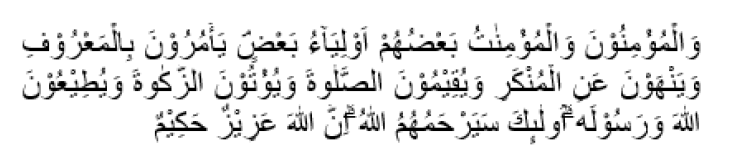
“And those who believe, men and women, some of them are helpers to others. They commanded (to do) the makruf and prevented from the mungkar, perform prayers, fulfill zakat and obey Allah and His Messenger. They will be blessed by God. Indeed, Allah is all-powerful, all-wise.” (QS. At-Taubah: 71).
This verse explains that believers, men and women are defenders of each other among them. As a believer he defended other believers because of religious relations. Women as believers also defend their brothers from among the male believers because of the relationship in accordance with the nature of their womanhood.
The wives of the Prophet and the wives of companions went to the battlefield with the Islamic army to provide drinking water and prepare food because the believers were bound by a rope of faith that evoked a sense of brotherhood, unity, mutual love and mutual help. All of them are driven by the faithful spirit of friends who make them as a body or a building that strengthens each other in upholding justice and exalting the grace of God.
The Position of Women in the Family
The Qur'anic verse on the next position of women regarding equality of women and men in the family. In Islam, you cannot distinguish a boy from a girl. Allah said:
“So when she gave birth, she said, "My Lord, I have given birth to a daughter." God knows best what he gives birth to and men are not the same as women.” (QS. Ali 'Imran: 36)
This verse affirms the glory of the daughter born and rejects the suggestion that the baby girl born is inferior to the baby boy as Imran's wife had hoped.
After Imran’s wife realized that her son was a woman and believed there was wisdom and secret behind this fact, she declared that the baby would be named Maryam. He will not retract what has been served to give up his son to serve in Baitul Maqdis, even though the baby is a girl and according to his assumptions it is not appropriate to guard Baitul Maqdis, but he will be a solemn servant of God.
Imran’s wife begged God to guard and protect her baby from satanic temptations that might keep him from virtue. Regarding this, the Prophet said: “Every posterity of Adam who was born was touched by satan at the time of his birth except Mary and his son.” (Al-Bukhari and Muslim).
The Position of Women in the Hereafter
The position of women in the Hereafter will be the same as that of men if they believe in Allah (SWT) by doing all His commandments and staying away from His prohibition. This is confirmed in the Qur'an, Surah An-Nahl: 97.
“Whoever does good, both men and women, in a state of faith, we will surely give him a good life and We will reward him with a reward that is better than what they have done.” (QS. An Nahl: 97)
In this verse it promises that Allah will truly give a happy and prosperous life in the world to His servants, both men and women, who do righteous deeds that are all deeds according to the guidance of the Qur'an and sunnah of the Messenger, while their hearts are full of faith. Thus the explanation of the Qur’anic verse about the position of women in the Islamic point of view. By understanding the position of women, it is expected to be a guideline, especially for women in everyday life.
Evaluation of Activities
Evaluation is conducted to assess the achievement of success. All activities that have been carried out in the stages of action are assessed, evaluated and analyzed. Assessment of the success of this program is carried out by conducting competency tests both conceptually and practically by answering the roles given to participants. Before the evaluation, the initial data collection was carried out to find out the level of the participants’ knowledge and experience about the role and position of women according to Islamic views. In general, the participants understood at a glance about the role and position of women according to Islam.
However, most of them have not understood directly, especially through the proposition of Qur'anic verses so that following socialization events as a form of strengthening the understanding of Islamic concepts about the role and position of women. The participants 80% had an understanding that women and men had equal roles and positions in the view of Islam. In the Islamic view, men and women in essence have the same rights and positions ranging from education, worship, work and so on. Therefore, the understanding that considers women as second-class humans certainly needs to be straightened out so that there is no misperception that causes discriminatory attitudes towards women.
CONCLUSION
The conclusion of socializing the understanding of the role and position of women in the Islamic perspective for the members of women’s orphanage of Aisyiyah shows an increase based on the results of the evaluation.
REFERENCES
Hanapi, Agustin. "Vol. 1, No. 1, March 2015 | 15." Gender Equality: International Journal of Child and Gender Studies, vol. 1, no. 1, 2015, p. 21.
Ahdiah, I. "Peran-Peran Perempuan dalam Masyarakat." Jurnal Academica, vol. 5, no. 2, 2013, pp. 1085-1092.
Zahrok, S. and Ni Wayan Suarmini. "Peran Perempuan dalam Keluarga." IPTEK Journal of Proceedings Series, no. 5, 2018, p. 61. https://doi.org/10.12962/j23546026.y2018i5.4422.
Ahmad, F. "Membebaskan Perempuan dari Kapitalisme dan Patriarki." New Malang Pos, December 2021, p. 2.
Achmad, S. "Peran Strategis Kaum Perempuan dalam Mewujudkan Masyarakat Religi." An Nisa’a, vol. 12, no. 1, 2017, pp. 21-32.
License
Creative Commons Attribution-NonCommercial-NoDerivatives 4.0 International License
All papers should be submitted electronically. All submitted manuscripts must be original work that is not under submission at another journal or under consideration for publication in another form, such as a monograph or chapter of a book. Authors of submitted papers are obligated not to submit their paper for publication elsewhere until an editorial decision is rendered on their submission. Further, authors of accepted papers are prohibited from publishing the results in other publications that appear before the paper is published in the Journal unless they receive approval for doing so from the Editor-In-Chief.
Himalayan Journal of Humanities and Cultural Studies open access articles are licensed under a Creative Commons Attribution-Share A like 4.0 International License. This license lets the audience to give appropriate credit, provide a link to the license, and indicate if changes were made and if they remix, transform, or build upon the material, they must distribute contributions under the same license as the original.
Recommended Articles
Research Article
Development of a Blended Learning Model to Increase Learning Effectiveness at University
Hairul ,
...
Darman Manda
Published: 10/12/2022
Download PDF
Cite
x
APA
None, H., Tolla, I. & Manda, D. (2022). Development of a Blended Learning Model to Increase Learning Effectiveness at University. Himalayan Journal of Humanities and Cultural Studies, 3(2), None-None.
MLA
None, Hairul, Ismail Tolla and Darman Manda. "Development of a Blended Learning Model to Increase Learning Effectiveness at University." Himalayan Journal of Humanities and Cultural Studies 3.2 (2022): None-None.
Chicago
None, Hairul, Ismail Tolla and Darman Manda. "Development of a Blended Learning Model to Increase Learning Effectiveness at University." Himalayan Journal of Humanities and Cultural Studies 3, no. 2 (2022): None-None.
Harvard
None, H., Tolla, I. and Manda, D. (2022) 'Development of a Blended Learning Model to Increase Learning Effectiveness at University' Himalayan Journal of Humanities and Cultural Studies 3(2), pp. None-None.
Vancouver
Hairul H, Tolla I, Manda D. Development of a Blended Learning Model to Increase Learning Effectiveness at University. Himalayan Journal of Humanities and Cultural Studies. 2022 Jul;3(2):None-None.
Download PDF
Research Article
A Study on the Current Situation and Innovation Strategies of Museum Cultural and Creative Product Development: taking Shanghai Museum as an Example
Shuyou Shi
Published: 30/04/2024
Download PDF
Cite
x
APA
Shi, S. (2024). A Study on the Current Situation and Innovation Strategies of Museum Cultural and Creative Product Development: taking Shanghai Museum as an Example. Himalayan Journal of Humanities and Cultural Studies, 5(1), 1-8.
MLA
Shi, Shuyou. "A Study on the Current Situation and Innovation Strategies of Museum Cultural and Creative Product Development: taking Shanghai Museum as an Example." Himalayan Journal of Humanities and Cultural Studies 5.1 (2024): 1-8.
Chicago
Shi, Shuyou. "A Study on the Current Situation and Innovation Strategies of Museum Cultural and Creative Product Development: taking Shanghai Museum as an Example." Himalayan Journal of Humanities and Cultural Studies 5, no. 1 (2024): 1-8.
Harvard
Shi, S. (2024) 'A Study on the Current Situation and Innovation Strategies of Museum Cultural and Creative Product Development: taking Shanghai Museum as an Example' Himalayan Journal of Humanities and Cultural Studies 5(1), pp. 1-8.
Vancouver
Shi S. A Study on the Current Situation and Innovation Strategies of Museum Cultural and Creative Product Development: taking Shanghai Museum as an Example. Himalayan Journal of Humanities and Cultural Studies. 2024 Jan;5(1):1-8.
Download PDF
Research Article
The Role of SEAMEO CECCEP in Creating Accessibility to Early Childhood Education in Indonesia
Ratna Wulan,
Elisabeth A. Satya Dewi
Published: 01/08/2024
Download PDF
Cite
x
APA
Wulan, R. & Dewi, E. A. S. (2024). The Role of SEAMEO CECCEP in Creating Accessibility to Early Childhood Education in Indonesia. Himalayan Journal of Humanities and Cultural Studies, 5(2), 1-8.
MLA
Wulan, Ratna and Elisabeth A. S. Dewi. "The Role of SEAMEO CECCEP in Creating Accessibility to Early Childhood Education in Indonesia." Himalayan Journal of Humanities and Cultural Studies 5.2 (2024): 1-8.
Chicago
Wulan, Ratna and Elisabeth A. S. Dewi. "The Role of SEAMEO CECCEP in Creating Accessibility to Early Childhood Education in Indonesia." Himalayan Journal of Humanities and Cultural Studies 5, no. 2 (2024): 1-8.
Harvard
Wulan, R. and Dewi, E. A. S. (2024) 'The Role of SEAMEO CECCEP in Creating Accessibility to Early Childhood Education in Indonesia' Himalayan Journal of Humanities and Cultural Studies 5(2), pp. 1-8.
Vancouver
Wulan R, Dewi EAS. The Role of SEAMEO CECCEP in Creating Accessibility to Early Childhood Education in Indonesia. Himalayan Journal of Humanities and Cultural Studies. 2024 Apr;5(2):1-8.
Download PDF
Research Article
Stamp Game Intervention to Overcome Numeracy Difficulties in Slow Learner Children
Florentina Nining Hastiani,
Adnani Budi Utami
Published: 30/05/2024
Download PDF
Cite
x
APA
Hastiani, F. N. & Utami, A. B. (2024). Stamp Game Intervention to Overcome Numeracy Difficulties in Slow Learner Children. Himalayan Journal of Humanities and Cultural Studies, 5(1), 1-4.
MLA
Hastiani, Florentina N. and Adnani B. Utami. "Stamp Game Intervention to Overcome Numeracy Difficulties in Slow Learner Children." Himalayan Journal of Humanities and Cultural Studies 5.1 (2024): 1-4.
Chicago
Hastiani, Florentina N. and Adnani B. Utami. "Stamp Game Intervention to Overcome Numeracy Difficulties in Slow Learner Children." Himalayan Journal of Humanities and Cultural Studies 5, no. 1 (2024): 1-4.
Harvard
Hastiani, F. N. and Utami, A. B. (2024) 'Stamp Game Intervention to Overcome Numeracy Difficulties in Slow Learner Children' Himalayan Journal of Humanities and Cultural Studies 5(1), pp. 1-4.
Vancouver
Hastiani FN, Utami AB. Stamp Game Intervention to Overcome Numeracy Difficulties in Slow Learner Children. Himalayan Journal of Humanities and Cultural Studies. 2024 Jan;5(1):1-4.
Fatoni, A. (2022). Socialization of Understanding the Role and Position of Women in Islam for the Members of the Women’s Orphanage of Aisyiyah Malang Indonesia. Himalayan Journal of Humanities and Cultural Studies, 3(1), 1-6.
MLA
Fatoni, Ahmad. "Socialization of Understanding the Role and Position of Women in Islam for the Members of the Women’s Orphanage of Aisyiyah Malang Indonesia." Himalayan Journal of Humanities and Cultural Studies 3.1 (2022): 1-6.
Chicago
Fatoni, Ahmad. "Socialization of Understanding the Role and Position of Women in Islam for the Members of the Women’s Orphanage of Aisyiyah Malang Indonesia." Himalayan Journal of Humanities and Cultural Studies 3, no. 1 (2022): 1-6.
Harvard
Fatoni, A. (2022) 'Socialization of Understanding the Role and Position of Women in Islam for the Members of the Women’s Orphanage of Aisyiyah Malang Indonesia' Himalayan Journal of Humanities and Cultural Studies 3(1), pp. 1-6.
Vancouver
Fatoni A. Socialization of Understanding the Role and Position of Women in Islam for the Members of the Women’s Orphanage of Aisyiyah Malang Indonesia. Himalayan Journal of Humanities and Cultural Studies. 2022 Jan;3(1):1-6.


 Download PDF
 Download XML