International migration and remittances are the most important factors affecting economic development and poverty reduction because remittances to hometowns become the main source of capital for local economic activities, in order to generate income and smooth consumption. On the other hand, this capital is also for the household’s direct consumption, improving the living conditions of families, as well as favourably impacting on poverty reduction in the least developed countries. This study of the impact of migration from Champasak province, Lao PDR to the Kingdom of Thailand aims to 1) identify and investigate the causes of worker migration to the Kingdom of Thailand, and 2) consider the impact of such worker migration on Lao household income and expenditure in households where migrant workers remit monies to families in Champasak and Phonthong Districts. This study consisted of 366 households including 248 migration households and 118 non-migration households, selected through stratified random sampling. Household heads responded to questionnaires November to December, 2014. The result shows the reasons for Lao migration worker to the Kingdom of Thailand were: unemployment, higher wage in Thailand, seeking new experiences and household’s lack of basic need. Migration to the Kingdom of Thailand had positive effects on the house hold incomes. This research found that Lao worker migration to the Kingdom of Thailand resulted in positive effect on household incomes in Champasak District with remittances causing incomes to increase 59.12 percent: however, expenditure was negatively impacted with level of significance at 0.05. The effect on expenditure in Phonthong District was positive. It takes 33.88 percentages with level of significance at 0.1. In summary, research results indicate that international worker migration and consequent remittances can increase household incomes while reducing poverty in rural areas. Hence it seems that, under Lao labour laws, a public sector policy should promote the practical skills and legal worker migration should be a taken into consideration.
Keywords
Migrant Workers
Income and Expenditure
INTRODUCTION
As we know, poverty is the main issue of most developing countries throughout the world. Topics on hunger, threat, lack of basic need (clothes, televisions, motorbikes), and lack of permanent housing are being discussed across the world. Nowadays nearly 1.8 billion people in Asia’s citizens live on less than 2$ a day [1].
International migration is one of the most important factors affecting economic relations between developed and developing countries in the 21st century. At the start of the century, it was estimated that about 175 million people roughly 3% of the world population lived and worked outside the country of their birth [2-3].
The impact of international migration and remittances on poverty in the developing world constructing and analyzing a new data set on international migration, remittances, inequality, and poverty from 71 developing countries. The results show that both international migration and remittances significantly reduce the level, depth, and severity of poverty in the developing world [2].
According to the report from the department of Labour and Social Welfare in Champasak province, [4] found that the labour migration trend to increase. Especially in Kingdom of Thailand from 27,116 people year 2009 to 33,691 people year 2012.
Table 1: Migration worker in Champasak province, 2011 - 2012
No
District
Number of migration worker
Total
Woman
1
Phonethong
7,046
3,555
2
Champasak
6,422
3,628
3
Soukhuma
3,728
2,255
4
Khong
3,720
1,887
5
Mounlapamok
4,105
2,103
6
Sanasomboun
3,566
2,052
7
Pakse
2,903
1,210
8
Pathumphone
1,671
852
9
Paksong
530
118
10
Bachiang
675
322
Total
33,691
17,660
Source: Department of Labour and Social Welfare in Champasak province [4]
Table 1 shows the data of migration worker in ten districts of Champasak province who work in the Kingdom of Thailand, Phonethong district is higher than other districts with the number of 7,046 people and Champasak district with the number of 6,422 people.
This study selected two districts Phonethong and Champasak district with ten villages. In Phonethong district there are Donsat, Nongtenoi, Dontabeng, Phon, and Dongnachan, in Champasak district there are Dontalat, Houaynganua, Houayngantay, Donhe, and Thangkhop. This two districts show the higher number of migration than other district. This study aims to 1) Identify and investigate the causes of worker migration to the Kingdom of Thailand; 2) Consider the impact of such worker migration on Lao household income and expenditure in households where migrant workers remit monies to families in Champasak and Phonthong Districts.
Literature Reviews
Richmond Tiemoko, 2003 argues that families play an important role in return migration, remittances, and aspects of human, social and financial capital acquisition and investment. Using Cerases typology of return migration, the analysis seeks to discriminate between migrants whose return decisions were affected by their families considered as ‘return of conservatism’, and those who made individual return decisions considered as ‘return of innovation’. The findings reveal that the relationship between the type of return (and extent of family involvement in this decision), and the extent of financial, human and social capital transfers, varies between countries and across groups of migrants.
The migrant’s currency against the Philippine peso leads to increases in household remittance receipts, and reductions in poverty in migrants’ origin households [5].
Albert Park and Dewen Wang, [6]examines how migration influences measurements of urban poverty and inequality in China, and also compares how other indicators of well-being differ for migrants and local residents. The research found that the income poverty rate of migrant households is 1.5 times that of local resident households, we find relatively small differences in the poverty rates of migrants and local residents.
Migration and return can be seen as a mechanism for providing capital for the development of small enterprises, particularly amongst poorer and less-skilled migrants. This paper uses results from a survey of international return migrants to Ghana undertaken in 2001 to explore the extent to which the processes of migration and return have contributed to development and poverty alleviation through the promotion of small businesses and examines the role of acquisition of financial, human and social capital whilst abroad in contributing to enterprise development and it also considers the extent to which public policy incentives and constraints have affected the promotion of small enterprises amongst returning migrants, and suggests measures that could enhance this process [7].
From literature reviews, the migration worker and remittance can be increasing income and smooth consumption for the poor people living in least developing country. In Lao lack of research in migration and remittance, especially in Champasak province that shares the border with Kingdom of Thailand
MATERIALS AND METHODS
Champasak Province is located in the South-West of Lao PDR bordering Thailand and Cambodia. The Province benefits from the newly established East-West Corridor between Myanmar, Thailand, Laos and Vietnam in respect to transport linkages to growing markets. The Mekong River stretches from the north to the south of the Province and contributes strongly to the potentials of economic development particularly in agri-business and tour-ism (Investment opportunity in Lao, Champasak province, 2011).
Sampling Size
According to the source of data from the Department of Labour and Social Welfare 2013 found that the migration workers from Phonethong and Champasak district are higher than other districts, in 3,416 households include migration worker 2,362 households and non-migration worker 1,054 households.
The sample size for this study is 366 households with 248 migration worker and 118 households non-migration. Calculated by Taro Yamane.
N: sampling size
N: total households
E: error term, e=0.05
Using stratified random sampling method and divided in two groups: the first group is migration worker households and second group is non-migration worker households that shows in Table 2.
The model
Using Multiple-regression model and Ordinary Least Squares: OLS, the impact model of Park and Wang [6]:
(1)
Table 2: The Sample Size
Name of district
Name of village
Population
Sample size
Migration worker households
Non-migration worker households
Total
Migration worker households
Non-migration worker households
Total
Champasak
Dontalat
450
267
717
46
29
75
Houaynganua
358
242
600
39
25
64
Houayngantay
287
196
483
30
22
52
Donhe
118
199
317
12
21
33
Thangkhop
282
48
330
30
6
36
Phonethong
Donsat
232
10
242
24
2
26
Nongtenoi
234
4
238
25
2
27
Dontabeng
192
0
192
20
2
22
Phon
105
76
181
11
7
18
Dongnachan
104
12
116
11
2
13
Total
2,362
1,054
3,416
248
118
366
Table 3: Variable and Definition
Variable
Definition
Impact Target
Independent variable
-
Ln(Income)
Logarithm households income per year
Ln(Expense)
Logarithm households expense per year
Dependent Variable
-
Characteristic of households (CH)
-
Gender: Gender of households head
1 = woman, 0 = other
-
Age: Age of households head
year
+
Educ: Education level of households head
year
+
OCCG: Households head are government staff
1 = yes, 0 = other
+
OCCR: Households head are business
1 = yes, 0 = other
+
OCCF: Households head are farmer
1 = yes, 0 = other
+
Status: Status of households head
1 = married, 0 = other
+
NDR: Number of people depending on households
person
-
Literature: No of households member go to school
person
+
Characteristic of village
-
Road: Road to village can use two season
1 = yes, o = other
+
DM: The distance of village to market
Km
-
HLW: Households member migration to Thailand
1 = yes, o = other
+
: Income and expense households per year
: Characteristic of households,
: Characteristic of village,
: Households Migration worker is call Dummy variable and 1 migration worker households and other 0.
: Measure impact income and expense of migration worker
: Constant
and parameter of and
: error term.
With highly skewed so the function (1) substitution by Semi-log form
(2)
Log of household’s income and expenditure per yea
Collection Data
Using questionnaire to interviews face to face on the household’s head in two group: migration worker households and non-migration worker households in 10 villages, villager for collecting data at the village level.
Data analysis
Analyze the reason of migration worker from Champasak and Phone thong districts to Kingdom of Thailand, descriptive analysis and calculate in percentage and bar chart.
The impact of migration worker with income and expenditure of migration worker households, using multiple regressions. The dependent variable in form of Logarithm using OLS method.
RESULTS
The General Characteristic
The result shows that poverty rate in Champasak district 27.3% higher than Phonethong district 19.8%, because people living in two districts are farmer 71.3%. Education level of households head graduate from primary school 23%, households size in average is 6 people, number of depending on households is 4 people. So the income in two districts are not difference that shows in Table 4.
The Causes of Worker Migration to The Kingdom of Thailand
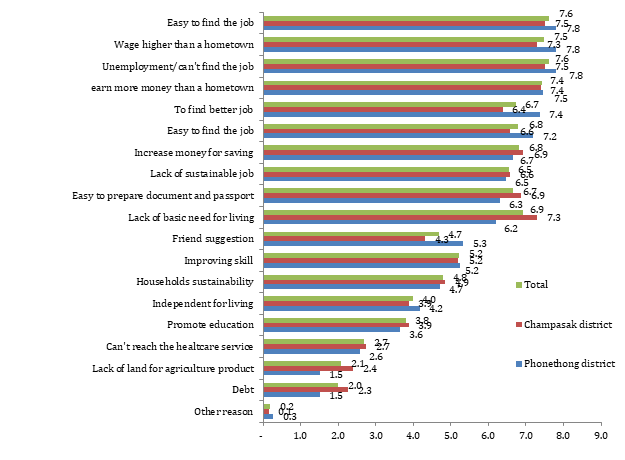
The research result found that, the main reason of worker migration to the Kingdom of Thailand is unemployment that mean they can’t find the job after harvest season. The second reason is the wage in Thailand higher than in hometown, so they can remittances money to family for consumption, business and buy the basic need in the households. The migration worker to Kingdom of Thailand easy than go to other country because easy to prepare document and passport, near their hometown. Easy to find the job and easy to understand Thai language.
Table 4: The general characteristic
Characteristic
Total
Champasak district
Phonethong district
Migration
Worker
Households
Non-Migration
Worker
Households
Total
Migration
Worker
Households
Non-Migration
Worker
Households
Total
Migration
Worker
Households
Non-Migration
Worker
Households
Total
Gender (%)
Man
Woman
33.5
66.5
27.1
72.9
31.4
68.6
29.1
70.9
34.4
65.6
32.3
67.7
31.9
68.1
13.3
86.7
29.2
70.8
Age (year)
54
49
52
54
50
52
55
49
54
Status (%)
Married
Single
Divorced
85.1
1.2
13.7
85.6
1.7
12.7
85.2
1.4
13.4
85.4
1.9
12.6
86.0
0.6
13.4
85.8
1.2
13.1
83.5
2.2
14.3
86.7
0.0
13.3
84.0
1.9
14.2
Occupation (%)
Farmer
Government staff
Business
Worker
Unemployment
Other
73.0
4.0
5.6
3.6
9.7
4.0
67.8
4.2
11.9
4.2
5.9
5.9
71.3
4.1
7.7
3.8
8.5
4.6
65.0
3.9
12.6
4.9
6.8
6.8
66.9
4.5
7.6
5.1
12.1
3.8
66.2
4.2
9.6
5.0
10.0
5.0
83.5
3.3
2.2
1.1
5.5
4.4
86.7
6.7
6.7
0.0
0.0
0.0
84.0
3.8
2.8
0.9
4.7
3.8
Education Level (%)
Non-go to school
Primary school
Secondary school
High school
Vocational
Bachelor degree
44.4
36.3
13.3
2.0
4.0
0.0
39.8
28.0
16.1
8.5
6.8
0.8
42.9
33.6
14.2
4.1
4.9
0.3
41.7
27.2
15.5
7.8
6.8
1.0
47.8
31.2
15.9
1.3
3.8
0.0
45.4
29.6
15.8
3.8
5.0
0.4
26.7
33.3
20.0
13.3
6.7
0.0
38.5
45.1
8.8
3.3
4.4
0.0
36.8
43.4
10.4
4.7
4.7
0.0
Households Size (Person)
7
6
6
7
5
6
7
5
7
No of people depend on households (person)
4
3
4
4
3
4
4
3
4
No of worker (person)
5
3
4
5
3
4
5
3
4
No of literature (person)
5
4
5
6
4
5
5
4
5
Household income 1,000(kip)
3,868
2,552
3,444
3,636
2,607
3,228
4,267
2,176
3,972
Household expenditure 1000kip
2,232
2,607
2,333
2,071
2,690
2,316
2,510
2,038
2,443
Source: Data survey on 27.11.2013
Figure 1: The Causes of Worker Migration to The Kingdom of Thailand
Source: Data survey on 27.11.2013
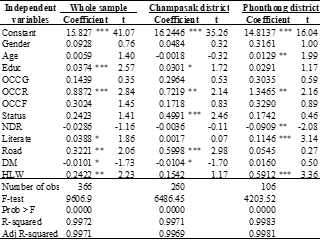
Table 5: The Impact of Such Worker Migration on Household Income
Source: Data survey on 27.11.2013
Note: *, **, and *** level of significant 90%, 95% ແລະ 99%
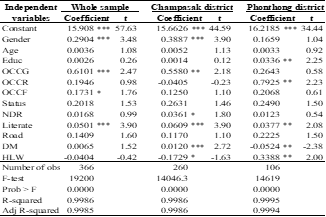
Table 6: Impact of Such Workers Migration on Household’s Expenditure
Source: Data survey on 27.11.2013
Note: *, **, and *** level of significant 90%, 95% ແລະ 99%.
The impact of such worker migration on household income expenditure in households
The main factor impact on household’s income is age of household’s head and positive with income, it means that the households head older and income increasing 1.29%. It’s positive with hypothesis of this study and level significant is 0.05. If the households head are business income increasing 88.72%. The households head are married also positive impact with household’s income. The households with migration workers to Kingdom of Thailand can increasing income 59.12%.
The Impact of Such Worker Migration on Household’s Expenditure
The research result found that, the main factor impact to household’s expenditure is Government staff 55.80%. Gender of household’s head (households head are woman) the percentage of expenditure is 38.87% with level of significant is 0.01. The households with migration workers to Kingdom of Thailand can increase expenditure 33.88%. with level of significant is 0.05.
CONCLUSION
With high percentage poverty incidence in Lao is 24% year 2013, affected to living standard and people find another way to poverty reduction. The migration worker and remittance is the way to find the income to spend for household’s consumption, business and basic needs.
Champasak province shares the border with Thailand and easy to cross the border to for find the job with high wage. The impact of migration from Champasak province, Lao PDR to the Kingdom of Thailand
Identify and investigate the causes of worker migration to the Kingdom of Thailand
Consider the impact of such worker migration on Lao household income and expenditure in households where migrant workers remit monies to families in Champasak and Phonthong Districts
This study consisted of 366 households. The result shows the reasons for Lao migration worker to the Kingdom of Thailand were: unemployment, higher wage in Thailand, seeking new experiences and household’s lack of basic needs. Migration to the Kingdom of Thailand had positive effects on the house hold incomes. This research found that Lao worker migration to the Kingdom of Thailand resulted in positive effect on household incomes in Champasak District with remittances causing incomes to increase 59.12 percent: however, expenditure was negatively impacted with level of significance at 0.05. The effect on expenditure in Phonthong District was positive. It takes 33.88 percentages with level of significance at 0.1.
In summary, the research results indicate that international worker migration and consequent remittances can increase household incomes that help reducing poverty in rural areas.
Hence it seems that, under Lao labour laws, a public sector policy should try to promote the professional practice legal worker migration should be considered as the responsibility under the sector.
REFERENCE
Asian Development Bank. "The ADB annual report 2011 comprises two separate."
Richard H., Adams J.R. and John P. "Do international migration and remittances reduce poverty in developing countries?"World Development, vol. 33, no. 10, 2005, pp. 1645–1669.
United Nations Department of Economic and Social Affairs Population Division. "International migration report 2002." New York: United Nations.
Department of Labour and Social Welfare. "The annual report 2013." Department of Labour and Social Welfare in Champasak Province, 2013.
Yang D. and Martinez C. "Remittances and poverty in migrants’ home areas: evidence from the Philippines." JEL Codes: D81, F22, F32, O12, O15, 2005.
Park A. and Wang D. "Migration and urban poverty and inequality in China." Discussion Paper no. 4877, April 2010.
Black R. et al."Migration, return and small enterprise development in Ghana: a route out of poverty?" International Workshop on Migration and Poverty in West Africa, March 13–14, 2003, University of Sussex.
Tiemoko R. "Migration, return and socio-economic change in West Africa: the role of family."Sussex Migration Working Paper no. 15, 2003.
License
Creative Commons Attribution-NonCommercial-NoDerivatives 4.0 International License
All papers should be submitted electronically. All submitted manuscripts must be original work that is not under submission at another journal or under consideration for publication in another form, such as a monograph or chapter of a book. Authors of submitted papers are obligated not to submit their paper for publication elsewhere until an editorial decision is rendered on their submission. Further, authors of accepted papers are prohibited from publishing the results in other publications that appear before the paper is published in the Journal unless they receive approval for doing so from the Editor-In-Chief.
Himalayan Journal of Humanities and Cultural Studies open access articles are licensed under a Creative Commons Attribution-Share A like 4.0 International License. This license lets the audience to give appropriate credit, provide a link to the license, and indicate if changes were made and if they remix, transform, or build upon the material, they must distribute contributions under the same license as the original.
Recommended Articles
Research Article
Development of a Blended Learning Model to Increase Learning Effectiveness at University
Hairul ,
...
Darman Manda
Published: 10/12/2022
Download PDF
Cite
x
APA
None, H., Tolla, I. & Manda, D. (2022). Development of a Blended Learning Model to Increase Learning Effectiveness at University. Himalayan Journal of Humanities and Cultural Studies, 3(2), None-None.
MLA
None, Hairul, Ismail Tolla and Darman Manda. "Development of a Blended Learning Model to Increase Learning Effectiveness at University." Himalayan Journal of Humanities and Cultural Studies 3.2 (2022): None-None.
Chicago
None, Hairul, Ismail Tolla and Darman Manda. "Development of a Blended Learning Model to Increase Learning Effectiveness at University." Himalayan Journal of Humanities and Cultural Studies 3, no. 2 (2022): None-None.
Harvard
None, H., Tolla, I. and Manda, D. (2022) 'Development of a Blended Learning Model to Increase Learning Effectiveness at University' Himalayan Journal of Humanities and Cultural Studies 3(2), pp. None-None.
Vancouver
Hairul H, Tolla I, Manda D. Development of a Blended Learning Model to Increase Learning Effectiveness at University. Himalayan Journal of Humanities and Cultural Studies. 2022 Jul;3(2):None-None.
Download PDF
Research Article
A Study on the Current Situation and Innovation Strategies of Museum Cultural and Creative Product Development: taking Shanghai Museum as an Example
Shuyou Shi
Published: 30/04/2024
Download PDF
Cite
x
APA
Shi, S. (2024). A Study on the Current Situation and Innovation Strategies of Museum Cultural and Creative Product Development: taking Shanghai Museum as an Example. Himalayan Journal of Humanities and Cultural Studies, 5(1), 1-8.
MLA
Shi, Shuyou. "A Study on the Current Situation and Innovation Strategies of Museum Cultural and Creative Product Development: taking Shanghai Museum as an Example." Himalayan Journal of Humanities and Cultural Studies 5.1 (2024): 1-8.
Chicago
Shi, Shuyou. "A Study on the Current Situation and Innovation Strategies of Museum Cultural and Creative Product Development: taking Shanghai Museum as an Example." Himalayan Journal of Humanities and Cultural Studies 5, no. 1 (2024): 1-8.
Harvard
Shi, S. (2024) 'A Study on the Current Situation and Innovation Strategies of Museum Cultural and Creative Product Development: taking Shanghai Museum as an Example' Himalayan Journal of Humanities and Cultural Studies 5(1), pp. 1-8.
Vancouver
Shi S. A Study on the Current Situation and Innovation Strategies of Museum Cultural and Creative Product Development: taking Shanghai Museum as an Example. Himalayan Journal of Humanities and Cultural Studies. 2024 Jan;5(1):1-8.
Download PDF
Research Article
The Role of SEAMEO CECCEP in Creating Accessibility to Early Childhood Education in Indonesia
Ratna Wulan,
Elisabeth A. Satya Dewi
Published: 01/08/2024
Download PDF
Cite
x
APA
Wulan, R. & Dewi, E. A. S. (2024). The Role of SEAMEO CECCEP in Creating Accessibility to Early Childhood Education in Indonesia. Himalayan Journal of Humanities and Cultural Studies, 5(2), 1-8.
MLA
Wulan, Ratna and Elisabeth A. S. Dewi. "The Role of SEAMEO CECCEP in Creating Accessibility to Early Childhood Education in Indonesia." Himalayan Journal of Humanities and Cultural Studies 5.2 (2024): 1-8.
Chicago
Wulan, Ratna and Elisabeth A. S. Dewi. "The Role of SEAMEO CECCEP in Creating Accessibility to Early Childhood Education in Indonesia." Himalayan Journal of Humanities and Cultural Studies 5, no. 2 (2024): 1-8.
Harvard
Wulan, R. and Dewi, E. A. S. (2024) 'The Role of SEAMEO CECCEP in Creating Accessibility to Early Childhood Education in Indonesia' Himalayan Journal of Humanities and Cultural Studies 5(2), pp. 1-8.
Vancouver
Wulan R, Dewi EAS. The Role of SEAMEO CECCEP in Creating Accessibility to Early Childhood Education in Indonesia. Himalayan Journal of Humanities and Cultural Studies. 2024 Apr;5(2):1-8.
Download PDF
Research Article
Stamp Game Intervention to Overcome Numeracy Difficulties in Slow Learner Children
Florentina Nining Hastiani,
Adnani Budi Utami
Published: 30/05/2024
Download PDF
Cite
x
APA
Hastiani, F. N. & Utami, A. B. (2024). Stamp Game Intervention to Overcome Numeracy Difficulties in Slow Learner Children. Himalayan Journal of Humanities and Cultural Studies, 5(1), 1-4.
MLA
Hastiani, Florentina N. and Adnani B. Utami. "Stamp Game Intervention to Overcome Numeracy Difficulties in Slow Learner Children." Himalayan Journal of Humanities and Cultural Studies 5.1 (2024): 1-4.
Chicago
Hastiani, Florentina N. and Adnani B. Utami. "Stamp Game Intervention to Overcome Numeracy Difficulties in Slow Learner Children." Himalayan Journal of Humanities and Cultural Studies 5, no. 1 (2024): 1-4.
Harvard
Hastiani, F. N. and Utami, A. B. (2024) 'Stamp Game Intervention to Overcome Numeracy Difficulties in Slow Learner Children' Himalayan Journal of Humanities and Cultural Studies 5(1), pp. 1-4.
Vancouver
Hastiani FN, Utami AB. Stamp Game Intervention to Overcome Numeracy Difficulties in Slow Learner Children. Himalayan Journal of Humanities and Cultural Studies. 2024 Jan;5(1):1-4.
SISOUMANG, B., HOMSOMBAT, K., SAYVAYA, I., KHOUN-APHAY, S., KHAMPHOUVANH, S. & BOUPHANOUVONG, A. (2022). The Impact of International Migrant Workers on Household Income and Expenditure. Himalayan Journal of Humanities and Cultural Studies, 3(2), 1-6.
MLA
SISOUMANG, Bounthom, et al. "The Impact of International Migrant Workers on Household Income and Expenditure." Himalayan Journal of Humanities and Cultural Studies 3.2 (2022): 1-6.
Chicago
SISOUMANG, Bounthom, Khampha HOMSOMBAT, Inpaeng SAYVAYA, Saengchanh KHOUN-APHAY, Sovat KHAMPHOUVANH and Athikone BOUPHANOUVONG. "The Impact of International Migrant Workers on Household Income and Expenditure." Himalayan Journal of Humanities and Cultural Studies 3, no. 2 (2022): 1-6.
Harvard
SISOUMANG, B., HOMSOMBAT, K., SAYVAYA, I., KHOUN-APHAY, S., KHAMPHOUVANH, S. and BOUPHANOUVONG, A. (2022) 'The Impact of International Migrant Workers on Household Income and Expenditure' Himalayan Journal of Humanities and Cultural Studies 3(2), pp. 1-6.
Vancouver
SISOUMANG B, HOMSOMBAT K, SAYVAYA I, KHOUN-APHAY S, KHAMPHOUVANH S, BOUPHANOUVONG A. The Impact of International Migrant Workers on Household Income and Expenditure. Himalayan Journal of Humanities and Cultural Studies. 2022 Jul;3(2):1-6.


 Download PDF
 Download XML






 : Income and expense households per year
  : Characteristic of households,
  : Characteristic of village,
  : Households Migration worker is call Dummy variable and 1 migration worker households and other 0.
  : Measure impact income and expense of migration worker
 : Constant
 and
and  parameter of
  and
and 
 : error term.
 Log of household’s income and expenditure per yea