The objectives of the study to find out the types of feedback are often used by the EFL Teachers on their students’ writing. The method used in this research was descriptive qualitative method. The data were collected by questionnaire. The result of the study found that six types of feedback often used by the EFL teachers in their students’ writing, they are:
Explicit correction
Recasts
Clarification requests
Metalinguistic feedback
Elicitation
Repetition
Most types of feedback are used but not as often as both types of feedback, namely explicit correction and recast.
Keywords
EFL Teachers
Feedback
Writing
INTRODUCTION
Language proficiency in English is one of the mandatory courses in the Indonesian educational system and teachers should be well-versed in the subject. As a result, English was one of the foreign languages that was taught in public schools. English is a subject that is taught to students at all levels, from elementary school to university. The Indonesian government must be created and taught as a priority in English, as well as other foreign languages. They determine the goal of learning English in accordance with the students' current proficiency level. Unlike in other countries, English is regarded a foreign language in Indonesia, affecting EFL teachers' ideas and practices [1].
English language competency is discussed by concentrating on the amount and type of proficiency required of English language teachers to facilitate classroom teaching. We first define competency and then give data on instructors' and students' English language proficiency in Indonesia and Asia. The next section provides research that explains why successful teaching requires a competency criterion. We then explore fundamental theoretical elements from SLA that might be utilized as a basis for building a training course to assist enhance teachers' proficiency. They concluded by urging all stakeholders (policymakers, language education providers and professional groups) to collaborate in order to help teachers improve their English competence. [2].
Junior high students must therefore achieve functional literacy, which implies they can successfully communicate in both written and spoken language to solve daily difficulties. Listening, speaking, reading and writing are four separate linguistic abilities that should be cultivated. These four skills are used to reply to or initiate communication in society. Listening and speaking are two of the four related language abilities. Life success requires mastering all four of these skills. Because everything is interconnected, it all helps each other learn new skills.
Listening, speaking, reading and writing capabilities are the four domains of language ability. Writing is one of the skills required for Language proficiency. After mastering hearing, talking and reading, students must learn to write. Having a second active talent in English is important and strongly related to speaking skills, as both are active abilities in the language. The more you write, the more "familiar" your mind grows with the English language and its grammar. Communication will be easier as a result.
Writing is one of the most difficult skills to acquire because it encompasses so many aspects of research such as topic, language use, organization, vocabulary, orthographic, punctuation and mechanics, among others. To conclude that writing is tough, we must also be able to organize ideas for written communication into a coherent form. Learning to write is difficult for everyone, especially when there are several components. Writing can help kids comprehend their own mental processes. It has the potential to be amazing. To summarize, writing is a dynamic ability that can be learned. However, it was discovered that the process approach to writing had a substantial impact on both writing performance and anxiety [3].
Writing anxiety is a crucial factor in language learning. Studying sentence structure will assist two classes of adult EFL learners lessen writing anxiety (HI learners). A semi-structured interview and a questionnaire were administered to two classes two weeks before to the study. Both classes' mean ratings are below 3, suggesting low to moderate anxiety. Moreover, the HI class outperforms the LI class in all four dimensions (classroom, writing, feedback and other effects), save the third (feedback experience). Both quantitative and qualitative data show that students in two classrooms have less writing anxiety following sentence-making exercise and this teaching style has also benefited students [4]. It is indicated that feedback has important role in teaching writing and give more impact to students’ writing improvement.
The same goes for writing anxiousness. Both low-intermediate and high-intermediate adult EFL students will benefit from studying sentence structure (HI learners). A semi-structured interview and a questionnaire were administered to two classes two weeks before the trial. Anxiety levels in both classrooms are low to moderate, according to descriptive statistics and independent t-tests. On the other hand, the HI class outperforms the LI class in all four dimensions except the third (feedback experience). EFL students can write about the same things over and over again to improve their writing and make good texts instead of relying on correct grammar and orthography [5]. Implications of the study were clearly shown. Students who do not have a master's degree in speech and grammar, as well as students who do not have a text or paragraphs produced that is consistent or intelligible.
Teachers put up a variety of efforts to teach students in order for them to gain information and extra knowledge in a specific amount of time. Teachers may become distracted from the significance of instructing students about the learning process itself as a result of this. As a result, opportunities to increase the quality of learning in order to make it more effective are missed out on. Sometimes, the instructional activities did not adhere strictly to the lesson plan that the teachers had created [6].
Teachers and students are vital components of higher education. No school can exist without teachers and students. Both must be there. The instructor is mostly responsible for instructing, whereas the student is primarily responsible for learning or offering suggestions. Writing takes a lengthy time, which is in line with the current regulations. As a result, perseverance and patience are required. The quality of students' writing improves when lecturers provide helpful criticism. Feedback would also improve students' general learning and inspire them to write more often. Students will benefit if they continue to correct errors in writing.
Hattie and Timperly speculated that this could be attributed to the positive feedback effect, which could be attributed to the use of motivational, emotional and cognitive theories in the educational process. In contrast to a ranking or a grade for the final project, good feedback offers teachers and students with more understanding about what they are doing or what they have done based on their learning objectives than simply a ranking or a grade for the final project. It is a type of dialog and constructive contact between professors and students in order to gain a better understanding of the learning objective. It encompasses not only the achievement of students in terms of the learning objectives themselves, but also strategies for bridging the gap between their current status and their desired status in the educational process [7].
Writing was first introduced in the 1970s [8], the issue of how teachers should respond to student writing became increasingly relevant. This is primarily due to the fact that the writing process is seen to be just as important as the final product in this method. Feedback is critical in assisting students in developing their writing skills at various phases of the writing process. First and foremost, the purposes of writing evaluation are to assist readers in analyzing their writings, secondly, to direct students in improving the quality of their texts and thirdly, to motivate students to become better authors. It is possible to judge writing for a variety of purposes, including, among others, to clarify what is thought when reading, to explain its meaning to others and to offer some care to the writing.
Many studies investigate how teachers innovate with feedback after receiving training may add new information to the field of teacher education as well as the field of feedback literature. Such specifics will draw attention to the gap between practice and the difficulties that instructors have in innovating their feedback, which will have direct implications for teacher education and for the continuous professional development of teachers in the area of written feedback.
Over the last few years, written corrective feedback given via Google Docs has been used successfully in a variety of instructional contexts. The goal of this study was to compare the effects of teacher feedback using Google Docs against peer feedback plus teacher feedback using Google Docs on EFL high school students' performance when writing paragraphs in the target language. The researchers used Google Docs to ask students questions about the impact of peer and teacher feedback on their paragraph writing. This study employed a mixed research technique to collect both quantitative and qualitative data. The study included 22 grade 11 students from a Mekong Delta high school. They were split into two groups: the experimental group received both peer and teacher comments through Google Docs and the control group received only teacher feedback. Participants wrote two projects, each with a first draft, second draft and final draft. Before the trial began, the experimental group's students got peer feedback training in person. Six drafts of two writing tasks, three drafts of one writing assignment and interviews were used to obtain data. Those who got teacher feedback in the control group performed much better than those who received both peer and instructor feedback via Google Docs in the experimental group. Both groups' participants improved their writing skills in their revised papers. The study's interviews revealed participants' positive perspectives on the impact of peer and teacher feedback utilizing Google Docs on their paragraph writing [9].
Teacher in Islamic School choose the feedback methods that they provide to students based on their belief that these ways will help students learn more successfully. It is also important to note that how teachers analyze learning and deliver feedback to their students has a direct relationship on how the students themselves receive the input. Teachers' knowledge of feedback, how to remark on teaching and how to offer instructors feedback, as well as how to provide teachers feedback in writing, would all be investigated in this study. This study increases and increases EFL teachers' understanding of the importance of feedback in the field of writing skills instruction, particularly in contexts in which teachers and students can develop their learning skills and in particular to assist students in generating information through writing, as a result of the results of this study.
Literature Review
Types of Feedback
There have been several studies on learning and teaching; however, only a few recent studies have looked into the significance of feedback in classrooms. Feedback, as a specific phrase, is not a novel paradigm in the field of scientific investigation. In the 1950s and 1960s, behaviorist researchers were more concerned with error prevention than with error therapy, believing that errors should not be allowed and that they could be avoided at all times if they were detected early. Lee claimed that various topics of literature on error repair were highlighted specifically to teachers while they were working on the errors of their students [10]. Teachers should be able to make decisions on whether or not to correct errors in students' work. Errors have the potential to become habit-forming and if they are allowed to persist, they will interfere with other beneficial habits. If students provided inaccurate responses, they should be provided with corrected feedback.
There are a variety of viewpoints on the pros and downsides of receiving peer criticism on writing assignments [11]. It contends that there may be some legitimate problems, such as faith in the ability of the peer to do the job. In a similar vein, he asserts that some students found their friends' feedback to be less beneficial [12]. However, it appears that some advantages are being overlooked while assessing the situation. The benefits of peer feedback in written classes is that students perceive themselves as being more intimate and friendly as a result [13].
Researchers, on the other hand, maintain the disadvantages, citing time restrictions, student properties and teacher roles as the primary reasons [14]. Aside from drafting, teaching students how to provide criticism takes time since they need to be trained, as does teaching them what makes a written piece. Because not everyone is at ease, students' traits can come into play. Students must be encouraged to solve problems. It may be difficult for teachers to accept such commitments and teaching students to submit feedback may be difficult. Given the time commitment, both students and teachers will gain from the process. Both groups will be properly trained if required. the advantages and disadvantages of peer feedback.
With the information and debates shown above, we came to the conclusion that there is a distinction between feedback from peers and feedback from teachers. Through highlighting which components of language are more significant throughout the correction process, the research team hopes to detect disparities in feedback received from students and teachers in the future.
There are numerous early researchers on feedback [12], who claimed in his studies that he had discovered favorable evidence for the efficiency of written corrective feedback in improving student performance. He asserted that providing indirect feedback to students will result in greater benefits for students' long-term writing progress than providing direct input to students. On the Contrary, Ferris [8], agreed that indirect feedback is generally more appropriate and effective than direct input in most situations.
Concerning those results, the researcher went on to discuss direct and indirect feedback on form, which resulted in the major explosion–which occurred as a response to [15], argument that error correction should be avoided at all costs and may even be harmful–and led to more recent study. Many professors and scholars, on the other hand, believed that Truscott's claim was premature and completely incorrect [16]. She dismisses Truscout's argument against grammatical correction in L2 writing classrooms and strives to construct her own argument in support of the practice. In terms of error correction, she has emphasized the significance of error treatment that goes beyond instructor error correction in order to be effective. It is also noteworthy when professors employ error feedback in conjunction with other tactics to assist pupils in resolving their own problems. Regarding to feedback, Hattie and Timperly in his article entitled the “Power of Feedback” stated that feedback is conceptualized as information provided by an agent for instance teacher, peer, book, parent, self, experience concerning on the aspects of student’s performance or understanding in the learning and teaching. The role of teachers or parent can give and provide corrective information. A peer can also provide an alternative strategy. Moreover, in another word, feedback is an effect of performance.
Feedback is a complicated construct having at least three unique components: feed-up, feed-back and feed-forward. It is necessary for teachers to employ them in order to avoid misunderstandings.
Feed Up: Clarify the Goal
Setting a purpose is also important for a feedback system because it allows teachers to align their assessments with the overarching goal of the unit's content. The teacher can then plan readings, collaborative projects, investigations and assessments to ensure students are concentrating on content related to the task at hand.
Feed Back: Respond to Student Work
Teachers' individual responses to students' work are the second component of an effective feedback system. It is important that these replies are directly related to the learning objective. Teachers should provide feedback as students complete discrete tasks that are part of a bigger project, so that students can use their advice to enhance their performance.
Feed Forward: Modify Instruction
Teachers use evaluation data to organize future education in an effective feedback system, which is why the term "feed forward" was coined. The need for greater flexibility in lesson preparation is necessitated by the fact that teachers can no longer simply implement a predetermined sequence of lessons.
Types of Feedback are the way teachers give feedback to students. Direct feedback provides the student with the correct form and indirect feedback that indicates students an error. Both of the types have different form and function based on how teachers provided feedback to the students. Teacher can present students with various of forms of assessment.
Type of evaluation is negative feedback, used to remind students of their mistakes. This form of feedback shows that the communication was received and comprehended. In this scenario, the teacher should request that the information be repeated in order to further understand what is being stated in the lesson.
Feedback is critical in the learning process because it leads, stimulates and reinforces productive behaviors while simultaneously reducing or stopping ineffective behaviors. It refers to the precise information that teachers deliver to their pupils dependent on the activity or learning process that they are completing. Providing pupils with feedback is an essential component of effective teaching. Specifically, the aims are to close the gap between what pupils comprehend at the time and what the objectives are to be grasped entirely.
Students must be active and engaged in the process of responding to criticism from teachers. They must consider the input they receive in terms of their personal development. Formative evaluation can be enhanced by the provision of feedback, which is one way of enhancing teacher's assessments. If feedback has no formative influence on learning, according to [7], it is not considered to be genuine feedback. It signifies that by formative assessment in this context, it is meant that the students' learning techniques or understanding are developed to a more developed stage than they were before to the specific assessment being conducted.
Tunstal and Gipps conducted a study on feedback in primary education. They devised a feedback typology that was based on classroom practice and they divided feedback into two basic types: descriptive feedback and evaluative feedback, respectively. According to the Tunstall and Gipps' typology, feedback may be evaluative (judgemental) or descriptive (descriptive) It can contain specific references to students' actual achievement or competence. Even criticism, if it is not judgemental, has the intention of being helpful in nature.
For example, a student may compose a sentence with an irregular word order because English is not their first language. If teachers notice this and bring it up with students, it will demonstrate to them that they understand why the statement makes sense.
It is critical feedback to the student's level of proficiency to the greatest extent possible. Feedback is only beneficial if the student comprehends what has been said. Mo (2007:41) offers five areas for classroom teachers to observe that will assist them in determining the communication proficiency of English language learners.
Development of a second language comes in stages, starting with silent and receptive learning, when the student understands some words but is not comfortable speaking, progressing to early language production and the emergence of speech and finally to intermediate and advanced proficiency. Teachers' feedback on students' development must be coordinated with the educational program or model used to serve English language learners. Programs differ significantly in terms of how feedback is provided and this is reflected in the results. Understanding where a student's development falls on a continuum will aid the teacher in providing appropriate feedback.
Table 1: Types of Corrective Feedback
Types of CF
Description
Explicit correction
Clearly indicating that the student's utterance was incorrect, the teacher provides the correct form
Types of CF
Description
Recast
Without directly indicating that the student's utterance was incorrect, the teacher implicitly reformulates the student's error, or provides the correction
Clarification request
By using phrases like "Excuse me?" or "I don't understand," the teacher indicates that the message has not been understood or that the student's utterance contained some kind of mistake and that a repetition or a reformulation is required
Metalinguistic clues.
Without providing the correct form, the teacher poses questions or provides comments or information related to the formation of the student's utterance (for example, "Do we say it like that?" "That's not how you say it in French," and "Is it feminine?").
Elicitation
The teacher directly elicits the correct form from the student by asking questions (e.g., "How do we say that in French?"), by pausing to allow the student to complete the teacher's utterance (e.g., "It's a....") or by asking students to reformulate the utterance (e.g., "Say that again."). Elicitation questions differ from questions that are defined as metalinguistic clues in that they require more than a yes/no response.
Repetition
The teacher repeats the student's error and adjusts intonation to draw student's attention to it
Table 2: Tunstal and Gipps’ Typology
Evaluative Feedback Strategies
Descriptive Feedback Strategies
Giving rewards and punishments
Telling children, they are right or wrong,
Expressing approval and disapproval.
Describing why an answer is correct,
Telling children what they have and have not achieved,
Specifying or implying a better way of doing something and
Getting children to suggest ways they can improve.
Tunstal and Gipps (1996)
Table 3: Feedback Choices for English Language Learners
Feedback Strategies
Timing and Amount
Talk frequently with the student about the work.
Allow plenty of time for interaction and student talk.
Mode
Oral—Have a conversation with the student about the work
Visual—Use nonverbals (pictures, diagrams, gestures) when possible.
Modeling of English—Provide feedback on a student’s English usage or pronunciation errors by modeling correct English (not by “correcting” the student) and do this in feedback for all content areas.
Audience
Give feedback to the individual student (as opposed to public feedback)
Respect student’s preferences for speaking style (which may not match yours), considering such things as the amount of wait time or eye contact or expectations for turn taking. For example, some students may perceive questioning as “grilling” or criticism. Have a conversation; listen as well as talk.
Feedback Content
Focus
Focus on “joint productive activity” (Dalton, 1998)—work is done collaboratively with other students (fosters language development as well as learning) that leads to a product, so there is some concrete work to discuss.
Focus on the product and the activity that produced it.
Comparison
Make comparisons criterion-referenced (compare student work to standards).
Make comparisons self-referenced as appropriate (point out improvement).
Function and Valence
Be descriptive.
Clarity
Use student’s first language as well as English for feedback, if possible.
Repeat
Speak slowly.
Use simple vocabulary; explain important terms.
Use routines.
Specificity
Connect feedback to knowledge and skills the student already has.
Connect feedback to real life (home, community) contexts.
Ask students to explain their reasoning.
Ask students to paraphrase feedback.
Tone
Be responsive and supportive.
Listen to students and respond immediately to lesson adjustments related to feedback conversations.
Brookhart (2008:104)
The guidelines in Table 2 above are intended to help you provide good feedback to your English language learners. Dalton, Hill and Flynn, Mo, Reed and Railsback and Reed and Railsback present information that may be found in publicly available resources for mainstream teachers. Suggestions are arranged according to the feedback style used and the material chosen. The most important element to remember is that feedback for English Language Learners students should be in the form of discussion. This method aids in the development of the student's language skills while also providing an opportunity to check for understanding.
Teaching Writing
Writing is an activity to convey ideas or ideas about the use of letters, numbers, hands and hands, markers in the form of stone, paper, books, or social networks, which are the most popular of today. Writing is the primary way of transmitting information, ideas, beliefs and impressions to others. Writing is often useful as preparation for some other activity, especially in writing sentences for discussion. Students write sentences.
Writing is a recursive process, which means students revise throughout the process, frequently moving back and forth among the stages. (Urquhart and Mclver, 2005:5-6). Writing is an intellectual activity of finding the ideas and thinking about the way to express and arrange them into a statement and paragraph that is clear to be understood by the people. (Nunan, 2003:88). Writing is the written products of thinking, drafting and revising that require specialized skills on how to generate ideas, organie them coherently, use discourse markers and rhetorical conventions coherently into a written text. How to revise text for clearer meaning and how to edit text appropriate grammar.
Teaching between teachers and students is what is happening in class, but it is also an event that can take place in different environments with distinctly different groups of students. Graham Hitchcocks and David Hughes (1995:4) stated that the use of technical, professional and knowledge to address a certain situation is a part of teaching. In light of these skills and knowledge, teachers must be required to make their judgments.
Writing has always been part of the curriculum in English teaching as one of four skills in listening, speaking, reading and writing. Jeremy Harmer points out that the important factors of writing vary from the pupil to the pupil. Most students can write but do not know where to start, or what to write. When directed to write what had been thought out immediately disappeared.
Students have more time to think when writing than when writing orally. You can go through what you know and even view dictionaries, grammar books or other reference material. Writing encourages students to focus on the exact use of language. This is quite different from the issues of writing and genre.
Procedure of Collecting Data
The participants of the study were from several student cohorts and EFL teachers who teach at Islamic School in Polewali Mandar district that is spread on 16 sub-districts, in a province on the western part of Sulawesi Island, Indonesia. Based on the objectives of the study, the data were collected Questionnaire. Questionnaire functions to find out the types of the teacher’ feedback in students’ Writing. Both of the instruments strengthen each other. The technique of data collection technique is a questionnaire that spread by google form and. The questionnaire is a written list of questions, the answer which was recorded by research during the teaching and learning activity. The result of the questionnaire functions to determine the types of Types EFL Teachers’ Feedback in their students’ writing.
Technique for Analyzing and Interpreting Data
The method used in this research was descriptive qualitative method. It is research aimed at describing a particular condition or phenomenon, not sorting out or looking for factors or certain variables. Research that is this exposure is intended to describe the things asked in research, such as: who, which, when, where and why. This descriptive research design can generally use case study methods, follow-up, content analysis, tendencies or correlational. Based on the purpose of the study, the researcher found out types of EFL teachers’s feedback on students’ writing. Those are the main reason why the researcher decided to conduct case study to answer the focus of the study.
Findings
In a classroom learning process the teacher can neither directly nor after a pause in the course of the learning process can separate himself from a feedback action. But as a teacher we need to know the kind of feedback that is used to improve or streamline student learning. The feedback types often used in the field by the teachers is the corrective feedback type, divided in six different types based on the data obtained by students from this study, they are:
Explicit correction
Recasts
Clarification requests
Metalinguistic feedback
Elicitation
Repetition
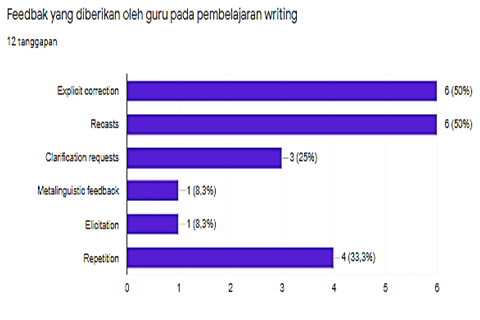
The results of the analysis were obtained as in Figure 1 after completing the questionnaire by a responding respondent. The table shows the different types of teacher feedback about the students’ writing of activities.
Explicit Correction
The survey results shown in figure 1 with 6 in 12 respondents sampled in this study, contains two types of feedback most commonly used by teachers, including explicit corrections. The researcher waited until the student's attempt to rebuild the text had ended, when the students made an error. Explicit correction was made explicitly with explicit corrective measures. In the explicit correction, the teacher provides the correct form clearly indicating that the utterance of the student was incorrect.
Recasts
The second type of feedback most often used by teachers is recasts on the basis of figure 1 Recasts have happened as we know without saying that the utterance of the student was wrong, the teacher implicitly reproduces or corrects the student's error. The major constraints of recasts are whether they are perceptible or not and their ambiguity. Nevertheless, there was a very low level of uptake after these recasts in a series of studies carried out.
Clarification Requests
The clarification requests used in this study were also employed in teachers' feedback. By using sentences like "About me?" or "I don't understand," the teacher notes that the message was not understood or that there is an error in the student's speech and that it is necessary to repeat it or rephrase.
Clarification requests are similar to recasts in that they prompt students to restate their own words. Like recasts, requests for clarification include implied types of remedial feedback. On the other hand, inspiring students to correct themselves might require deeper language processing, which results in better learning.
Metalinguistic feedback
In this research, the researcher also finds some metalinguistic feedback in the teaching learning process. The teacher provides comments or questions related to the well-formedness of the students’ utterances. This is an effective way to build students skill in English language and grammar.
Elicitation
Elicitation is a technique assumed as long as the learner has retained the necessary declarative knowledge. It involves asking questions. The teacher then asks the students to rework the utterance in the right form.
Figure 1: Types of Feedback Given by the Teacher of Writing Activity
Repetition
Repetition is a form of feedback that repeats the teacher's incorrect words with stress or intonation. The study aims to explore whether it leads to successful adoption and if it contributes positively to the acquisition as defined in this thesis and the effective perceptions of repeat learners and teachers. However, repetition was not studied separately as a technique of correction, although in some studies it was shown that this was one of the most effective methods for the self-repair of students. However, there was no study to see how effective repetition is as a specific type of feedback.
DISCUSSION
The conclusions of this study reveal that there are numerous ways to finish the research: students who use Google Forms are filling questionnaires and teachers who use WhatsApp are conducting interviews. Several types of information were gathered during the course of this investigation. This was determined through interviews with teachers and data collected from questioners who supplied students with their comments on the learning and teaching process by teachers of English topics, especially in writing. The information gathered must be described in accordance with the classification scheme that has been predetermined.
In this section, the researcher discusses the result of finding the data on the field compare with some theories related to the research of the problem. In the field, the researcher finds six types of corrective feedback often used by the EFL teachers in Islamic School give feedback on their students’ writing, they are:
Explicit correction
Recasts
Clarification requests
Metalinguistic feedback
Elicitation
Repetition
It showed that students had to receive corrective feedback to increase their speech skills. Corrective feedback also retains its drive to learn because many thought of correcting their error when they received corrective feedback. Most students had no negative response when corrective feedback was received.
No student preferred recast strategy to correct their error in speaking but no teacher preferred that strategy. Students preferred explicit correction because they thought it was helpful for them to know part of their error, so they can avoid the same error in the next performance and it does not consume too much time.
Explicit Correction
In the explicit correction, the teacher provides the correct form clearly indicating that the student's utterance of an important word was incorrect. Explicit correction includes metalinguistic feedback and the correct forming of the system, but only the right form is implicitly corrected. Considering the important role of attention in learning, awareness can be the main cause of explicit correctional groups' better performance. Schmidt thought it was impossible for students to learn sub-luminally and that it was this intake that cared. He also believes that attention controls access to awareness, enabling new features to be learned.
Explicit correcting errors in students can have led students to notice gaps between their target form and their existing interlanguage forms and this has led to their language restructuring. Moreover, as claimed by Ellis, students should be attentive, comparative and integrate feedback in order to make the acquisition happen. Students are more likely to view explicit corrections as remedies for correcting errors. The nature of the feedback is the reason. This study seems to have given more attention to the corrected features and the apparent nature of feedback in explicit corrections and to the gap between their existing knowledge and target knowledge.
Recasts
Recasts have happened as we know without saying that the utterance of the student was wrong. Nevertheless, there was a very low level of uptake after these recasts. Results from this study suggest that the recasts has significant repercussions on language learners' writing performance. It appears to be an effective tool to encourage pupils to identify and correct their mistakes in writing. The recasts had a significant statistical impact on their students’ writing skills in Polewali Mandar Islamic School. It should be emphasized that the effectiveness of recasts in speech performance was investigated in these trials.
Revising as an indirect response takes less time and can help scientists get a clearer insight into the effectiveness of these. This could play a decisive role in current pedagogy and education. The way in which this study has been revised provides students with feedback over and over again. Many researchers focused on the impact of recasts on spoken student performance especially in adults, while this study focused on the writing performance of secondary school students.
Clarification Requests
Clarification requests are a third way a teacher can make mistakes by students. The teacher uses clarification as corrective feedback when speaking in teaching. Requests for clarification tell students whether or not their pronunciations are misunderstood or in some way incorrect and whether a repetition or rework is necessary.
These sentences tell the students either that they have misinterpreted their utterances by the teacher or that the pronunciation is misformed in some manner and a repeat or a reformulation is needed, according to Spada and Frohlich cited by [17]. Clarification requests are a third way a teacher can make mistakes by students. The teacher uses clarification as corrective feedback when speaking in teaching. Requests for clarification tell students whether or not their pronunciations are misunderstood or in some way incorrect and whether a repetition or rework is necessary.
Metalinguistic Feedback
The metalinguistic is an effective way to build students skill in grammar. The teacher provides comments or questions related to the well-formedness of the students’ utterances. This can be seen when the students answer correctly or when they are missing a key word.
Metalinguistic feedbacks were directly superior to all other types of corrections in Carroll and Swain and Carroll. Formal grammatical explanations in Muranoi research are more effective than meaning-oriented briefings. The revisions were the most ineffective type of correction to Havranek and Cesnik. Lyster reported that prompts are more effective than recast, including metalinguistic comments. There is also some evidence that detailed metalinguistic feedback works better than less detailed metalinguistic feedback.
Corrective feedback includes information that makes students aware of the wrong words, without providing the teacher with an explicit form. Grammar or paraphrases are typical of metalinguistic feedback. The correct forms of ungraphic utterances of participants were also pointed out, in addition to providing grammatical explanation.
Elicitation
Eliciting is the term that describes a variety of techniques that enable the teacher to obtain information from students instead of it. Eliciting also encourages teachers to be flexible and take advantage of information already known rather than dedicated to it. The teachers can generate ideas, feelings, meaning, situations, groups and memories.
There are some tips that can be used to elicit, they are:
Eliciting is a basic technique and should be used regularly, not just at the start of a lesson; it should be used where appropriate and necessary.
Do not attempt to pull the teeth. Long silence or incorrect responses suggest that the teacher needs input.
Don't ask students to repeat incorrect responses, but ask students to repeat a good response to them.
Recognize or provide feedback with gestures or short remarks for each answer.
Provide adequate information or context. Socratic questioning differs because what the students know is to be found rather than to be brought to a conclusion only the teacher knows.
The idea of an information exchange is promoted; traditional teacher centering is broken down and a number of interaction patterns begin to be established. It is an inductive approach to language teaching and learning via work and self-discovery.
Repetition
Repetition is feedback that repeats the teacher's incorrect words with stress or intonation. The results of the grammar test showed that students in the experimental class who were repeatedly exposed to the correction of errors obtained higher scores than those in the control group who received the normal teacher's answers.The Six types above, are important to do during the lesson. But, in the field, the research finds out, the most the students needed are Explicit correction and Recasts. It’s have been shoewed in Figure 1 about Types of Feedback Given by the Teacher of Writing Activity. In the figure 1, Explicit correction and Recasts have same result of the students responding they are, 6 respondent or 50% from six types of feedback.
It can be concluded that the feedback was provided by English subjects' teachers is based more on the learning situation in the classroom. The teachers’ correction did not make the students doubt themselves either, so it did not lead to a loss of their self-confidence by the correction. But most students didn't resent being corrected in the classroom by their teachers, they had to have a clear correction because they realized that they felt confused when they didn't know what their teachers are doing. Moreover, most students did not fear correction because they were most satisfied that they accepted the correction. The reaction of the students is supported by the fact that most were motivated to correct their mistake. Most teachers, for example, use explicit correction and refurbishment when learning materials. The reason for this is that students need a spoken and written language. Most feedback types are used, but not as often as both explicit correction and recast.
CONCLUSION
The study found six types of feedback often used by the EFL teachers in their students’ writing, they are
Explicit correction
Recasts
Clarification requests
Metalinguistic feedback
Elicitation
Repetition
Giving feedback to teachers in English subjects is more based on the learning situation in the classroom. In learning writing materials for example, most teachers use explicit correction and recast. This is because students use both written and spoken languages. Most types of feedback are used but not as often as both types of feedback, namely explicit correction and recast.
Suggestion
For the Teacher: Regarding the results of this study, teachers who do feedback in their class will not worry about overcoming this problem by taking the right strategy based on the type of feedback that will be used
For the Students: Students must understand different types of feedback and know how to win feedback in order to improve student ability
For the Further Research: For result finding of the research can be used as consideration for other research who plan to research the teacher feedback in students writing. The further researchers can follow the research by different aspect of this research
REFERENCES
Sinwongsuwat, K. and Nicoletti, K. (2020). Implementing CA-T model lessons in schools: A preliminary study in southern border provinces of Thailand. English Language Teaching, 13(11). https://doi.org/10.5539/elt.v13n11p15
Renandya, W. A. et al. (2018). English language proficiency in Indonesia: Issues and prospects. Journal of Asia TEFL, 15(3), 618–629. https://doi.org/10.18823/asiatefl.2018.15.3.4.618
Hassan, A. et al. (2020). The impact of process writing on the language and attitude of Pakistani English learners. Asian EFL Journal, 27(43).
Liu, Y. (2020). The effect of sentence-making practice on adult EFL learners’ writing anxiety: A comparative study. English Language Teaching, 13(6). https://doi.org/10.5539/elt.v13n6p34
Alqasham, F.H. et al. (2021). Coherence and cohesion in Saudi EFL learners’ essay writing: A study at a tertiary-level institution. Asian EFL Journal, 28(11).
Suprayitno, E. et al. (2019). Character value: The neglected hidden curriculum in Indonesian EFL context. Asian EFL Journal, 23(3).
Sadler, D.R. (2010). Beyond feedback: Developing student capability in complex appraisal. Assessment and Evaluation in Higher Education, 35(5), 535–550. https://doi.org/10.1080/02602930903541015
Ferris, D.R. (2003). Response to student writing: Implications for second language students. https://doi.org/10.4324/9781410607201
Hoa, N. T. N. and Lap, T. Q. (2021). Investigating the impact of peer feedback and teacher feedback using Google Docs on EFL students’ writing performance. European Journal of Education Studies, 8(10). https://doi.org/10.46827/ejes.v8i10.3926
Lee, I. (2008). Student reactions to teacher feedback in two Hong Kong secondary classrooms. Journal of Second Language Writing, 17(3), 144–164. https://doi.org/10.1016/j.jslw.2007.12.001
Gong, T. et al. (2021). Association of keyboarding fluency and writing performance in online-delivered assessment. Assessing Writing. https://doi.org/10.1016/j.asw.2021.100575
Thirakunkovit, S. and Chamcharatsri, B. (2019). A meta-analysis of effectiveness of teacher and peer feedback: Implications for writing instructions and research. Asian EFL Journal, 21(1).
Ćeman, A. and Dubravac, V. (2019). Corrective feedback in second language acquisition. Journal of Education and Humanities, 2(1). https://doi.org/10.14706/jeh2019213
Bennett, S. et al. (2008). The “digital natives” debate: A critical review of the evidence. British Journal of Educational Technology, 39(5), 775–786.
Lee, G. and Schallert, D.L. (2008). Constructing trust between teacher and students through feedback and revision cycles in an EFL writing classroom. Written Communication, 25(4), 506–537. https://doi.org/10.1177/0741088308322301
Bitchener, J. and Ferris, D.R. (2012). Feedback in second language acquisition. In Adult Language Acquisition: Cross Linguistic Perspectives (Vol. 2, pp. 196–235).
Lyster, R. and Ranta, L. (2013). Counterpoint piece: The case for variety in corrective feedback research. Studies in Second Language Acquisition, 35(1). https://doi.org/10.1017/S027226311200071X.
License
Creative Commons Attribution-NonCommercial-NoDerivatives 4.0 International License
All papers should be submitted electronically. All submitted manuscripts must be original work that is not under submission at another journal or under consideration for publication in another form, such as a monograph or chapter of a book. Authors of submitted papers are obligated not to submit their paper for publication elsewhere until an editorial decision is rendered on their submission. Further, authors of accepted papers are prohibited from publishing the results in other publications that appear before the paper is published in the Journal unless they receive approval for doing so from the Editor-In-Chief.
Himalayan Journal of Humanities and Cultural Studies open access articles are licensed under a Creative Commons Attribution-Share A like 4.0 International License. This license lets the audience to give appropriate credit, provide a link to the license, and indicate if changes were made and if they remix, transform, or build upon the material, they must distribute contributions under the same license as the original.
Recommended Articles
Research Article
Development of a Blended Learning Model to Increase Learning Effectiveness at University
Hairul ,
...
Darman Manda
Published: 10/12/2022
Download PDF
Cite
x
APA
None, H., Tolla, I. & Manda, D. (2022). Development of a Blended Learning Model to Increase Learning Effectiveness at University. Himalayan Journal of Humanities and Cultural Studies, 3(2), None-None.
MLA
None, Hairul, Ismail Tolla and Darman Manda. "Development of a Blended Learning Model to Increase Learning Effectiveness at University." Himalayan Journal of Humanities and Cultural Studies 3.2 (2022): None-None.
Chicago
None, Hairul, Ismail Tolla and Darman Manda. "Development of a Blended Learning Model to Increase Learning Effectiveness at University." Himalayan Journal of Humanities and Cultural Studies 3, no. 2 (2022): None-None.
Harvard
None, H., Tolla, I. and Manda, D. (2022) 'Development of a Blended Learning Model to Increase Learning Effectiveness at University' Himalayan Journal of Humanities and Cultural Studies 3(2), pp. None-None.
Vancouver
Hairul H, Tolla I, Manda D. Development of a Blended Learning Model to Increase Learning Effectiveness at University. Himalayan Journal of Humanities and Cultural Studies. 2022 Jul;3(2):None-None.
Download PDF
Research Article
A Study on the Current Situation and Innovation Strategies of Museum Cultural and Creative Product Development: taking Shanghai Museum as an Example
Shuyou Shi
Published: 30/04/2024
Download PDF
Cite
x
APA
Shi, S. (2024). A Study on the Current Situation and Innovation Strategies of Museum Cultural and Creative Product Development: taking Shanghai Museum as an Example. Himalayan Journal of Humanities and Cultural Studies, 5(1), 1-8.
MLA
Shi, Shuyou. "A Study on the Current Situation and Innovation Strategies of Museum Cultural and Creative Product Development: taking Shanghai Museum as an Example." Himalayan Journal of Humanities and Cultural Studies 5.1 (2024): 1-8.
Chicago
Shi, Shuyou. "A Study on the Current Situation and Innovation Strategies of Museum Cultural and Creative Product Development: taking Shanghai Museum as an Example." Himalayan Journal of Humanities and Cultural Studies 5, no. 1 (2024): 1-8.
Harvard
Shi, S. (2024) 'A Study on the Current Situation and Innovation Strategies of Museum Cultural and Creative Product Development: taking Shanghai Museum as an Example' Himalayan Journal of Humanities and Cultural Studies 5(1), pp. 1-8.
Vancouver
Shi S. A Study on the Current Situation and Innovation Strategies of Museum Cultural and Creative Product Development: taking Shanghai Museum as an Example. Himalayan Journal of Humanities and Cultural Studies. 2024 Jan;5(1):1-8.
Download PDF
Research Article
The Role of SEAMEO CECCEP in Creating Accessibility to Early Childhood Education in Indonesia
Ratna Wulan,
Elisabeth A. Satya Dewi
Published: 01/08/2024
Download PDF
Cite
x
APA
Wulan, R. & Dewi, E. A. S. (2024). The Role of SEAMEO CECCEP in Creating Accessibility to Early Childhood Education in Indonesia. Himalayan Journal of Humanities and Cultural Studies, 5(2), 1-8.
MLA
Wulan, Ratna and Elisabeth A. S. Dewi. "The Role of SEAMEO CECCEP in Creating Accessibility to Early Childhood Education in Indonesia." Himalayan Journal of Humanities and Cultural Studies 5.2 (2024): 1-8.
Chicago
Wulan, Ratna and Elisabeth A. S. Dewi. "The Role of SEAMEO CECCEP in Creating Accessibility to Early Childhood Education in Indonesia." Himalayan Journal of Humanities and Cultural Studies 5, no. 2 (2024): 1-8.
Harvard
Wulan, R. and Dewi, E. A. S. (2024) 'The Role of SEAMEO CECCEP in Creating Accessibility to Early Childhood Education in Indonesia' Himalayan Journal of Humanities and Cultural Studies 5(2), pp. 1-8.
Vancouver
Wulan R, Dewi EAS. The Role of SEAMEO CECCEP in Creating Accessibility to Early Childhood Education in Indonesia. Himalayan Journal of Humanities and Cultural Studies. 2024 Apr;5(2):1-8.
Download PDF
Research Article
Stamp Game Intervention to Overcome Numeracy Difficulties in Slow Learner Children
Florentina Nining Hastiani,
Adnani Budi Utami
Published: 30/05/2024
Download PDF
Cite
x
APA
Hastiani, F. N. & Utami, A. B. (2024). Stamp Game Intervention to Overcome Numeracy Difficulties in Slow Learner Children. Himalayan Journal of Humanities and Cultural Studies, 5(1), 1-4.
MLA
Hastiani, Florentina N. and Adnani B. Utami. "Stamp Game Intervention to Overcome Numeracy Difficulties in Slow Learner Children." Himalayan Journal of Humanities and Cultural Studies 5.1 (2024): 1-4.
Chicago
Hastiani, Florentina N. and Adnani B. Utami. "Stamp Game Intervention to Overcome Numeracy Difficulties in Slow Learner Children." Himalayan Journal of Humanities and Cultural Studies 5, no. 1 (2024): 1-4.
Harvard
Hastiani, F. N. and Utami, A. B. (2024) 'Stamp Game Intervention to Overcome Numeracy Difficulties in Slow Learner Children' Himalayan Journal of Humanities and Cultural Studies 5(1), pp. 1-4.
Vancouver
Hastiani FN, Utami AB. Stamp Game Intervention to Overcome Numeracy Difficulties in Slow Learner Children. Himalayan Journal of Humanities and Cultural Studies. 2024 Jan;5(1):1-4.
Afiah, N., Jabu, B. & Salija, K. (2022). Types of EFL Teachers' Feedback on Students’ Writing. Himalayan Journal of Humanities and Cultural Studies, 3(2), 1-9.
MLA
Afiah, Nur, Baso Jabu and Kisman Salija. "Types of EFL Teachers' Feedback on Students’ Writing." Himalayan Journal of Humanities and Cultural Studies 3.2 (2022): 1-9.
Chicago
Afiah, Nur, Baso Jabu and Kisman Salija. "Types of EFL Teachers' Feedback on Students’ Writing." Himalayan Journal of Humanities and Cultural Studies 3, no. 2 (2022): 1-9.
Harvard
Afiah, N., Jabu, B. and Salija, K. (2022) 'Types of EFL Teachers' Feedback on Students’ Writing' Himalayan Journal of Humanities and Cultural Studies 3(2), pp. 1-9.
Vancouver
Afiah N, Jabu B, Salija K. Types of EFL Teachers' Feedback on Students’ Writing. Himalayan Journal of Humanities and Cultural Studies. 2022 Jul;3(2):1-9.


 Download PDF
 Download XML