Financial inclusion, a crucial component of the sustainable development goals, aims to deliver cost-effective and easily accessible financial services to marginalized populations. In Southeast Asia, where a considerable portion of the population lacks access to banking services, Bank Selaras Syariah has played a significant role by catering to these communities for more than ten years through community-based loans known as Pembiayaan Masa Depan (PMD) group financing. Recognizing the potential of providing their customers with the Individual Financing (IF) product for its efficiency and flexibility, the bank has faced challenges with consistently low repayment rates associated with this offering. To address this issue, the bank intends to conduct qualitative research methods, gathering insights from both current users of the IF product and potential customers. The analysis of customer feedback and experiences aims to shed light on the alignment (or misalignment) between the IF product features and customer needs. The study's findings will play a crucial role in formulating proactive strategies to improve the persistently low repayment rates associated with the IF product. This research underscores the importance of comprehending customer needs as an essential initial step in designing financial products for the underbanked segment.
Keywords
Financial Inclusion
Individual Financing
Customer Perceptions
Customer Expectations
Needs Analysis
Sharia Bank
Introduction
Financial Inclusion is defined by the Consultative Group to Assist the Poor (CGAP) as the availability of access for people and businesses with also empowered to use affordable and responsible financial services that meet their needs. Financial inclusion is a vital aspect of population development, reflecting the UN's sustainable development goals [1]. It acts as a crucial step toward broader financial access, empowering individuals to manage money effectively [2]. This emphasis on inclusion gained traction after the 2008 crisis, especially impacting the unbanked in low-income, irregularly employed, disabled and marginalized communities, predominantly found in developing countries.
The high population of the unbanked and underbanked population in Indonesia has the potential to provide services to the population. The government of Indonesia has announced a regulation on a national strategy for financial inclusion (NSFI) to achieve 90% of financial inclusion in 2024 [3]. In supporting that, Otoritas Jasa Keuangan (OJK) published Peraturan OJK (POJK) Nomor 3 Tahun related to increasing financial literacy and financial literation in the financial service sector for customers. This POJK consists of emphasizes the collaboration between the government and Pelaku Usaha Jasa Keuangan (PUJK) in the activity to increase financial literacy and financial inclusion. This can be seen as a green light and total support from the government for banks and other financial institutions to provide service to the unbanked and underbanked population in Indonesia.
Bank Selaras Syariah is one of the players in that segment that has been providing service for the unbankd population for over a decade. Bank Selaras Syariah provide financing product with a unique mechanism that comprises forming community-based loan for customers called Pembiayaan Masa Depan (PMD). Bank Selaras Syariah PMD products require customers to form a group called Sentra consisting of a minimum of 5 customers as the main touchpoints for the customers and the bank officer for banking processes. The so-called Sentra meets with the bank officer on a bi-weekly basis where banking transactions can be conducted such as disbursement, withdrawal/deposit of money, installment payment, etc.
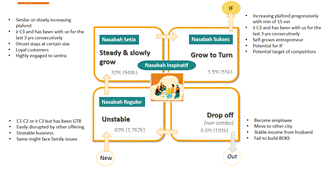
Figure 1: Customer sub-segment characteristics of Bank Selaras Syariah
(source: Bank Selaras internal report)
Bank Selaras Syariah itself already gained 4 million customers in its portfolio and segregated those customers into four sub-segments based on the size of their financing and characteristics. Those sub-segments are Nasabah Reguler, Nasabah Setia, Nasabah Sukses and Nasabah Inspiratif, which reflect the maturity of the customer, based on their length of relationship with Bank Selaras Syariah.
Bank Selaras Syariah classifies customers into distinct segments, including Nasabah Regular, Nasabah Setia, Nasabah Sukses and Nasabah Inspiratif, based on financing amounts and loyalty. Nasabah Sukses and Nasabah Inspiratif, esteemed for their influence, undergo significant personal and business growth. While their loyalty is paramount, the bank acknowledges the risk of their susceptibility to competitors with offerings exceeding 100 million rupiah in financing. To address this, Bank Selaras Syariah is developing a tailored individual financing product exclusively for Nasabah Sukses and Nasabah Inspiratif. Diverging from the typical group financing model, this new product aims to provide flexibility, meeting the evolving financial needs of these influential segments and ensuring their sustained loyalty.
Recognizing the crucial role Nasabah Sukses and Nasabah Inspiratif play in maintaining the bank's value, Bank Selaras Syariah aims to enhance engagement and retain their loyalty. These segments, although smaller in size, wield considerable influence and are susceptible to shifts in behavior and attitude toward the bank's main product. The proposed individual financing product is designed to address these shifts by offering a personalized approach that aligns with the unique requirements of Nasabah Sukses and Nasabah Inspiratif, reinforcing their connection with the bank and securing their continued loyalty.
Bank Selaras Syariah has attempted several times to provide tailored products for the Nasabah Sukses segment by releasing a product that focuses on individual service to cater to those segments that have already grown and become loyal customers of PMD group financing products. In the first attempt in 2017, Bank Selaras Syariah released a product called PMD Individual. After that, Bank Selaras Syariah made several adjustments and improvements to the product and in 2018 re-launched it with the name of Mapan Syariah (Figure 1 and 2).
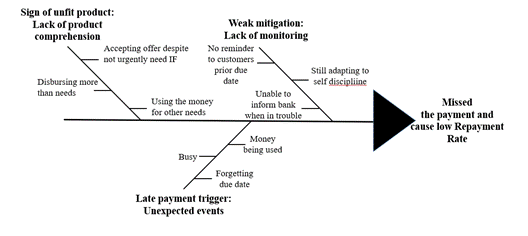
Figure 2: Fishbone analysis: drivers of late payment behavior towards individual financing products
Both projects were launched to capture the needs of the existing Nasabah Sukses segment that needs bigger financing and also a flexible mechanism that is more suitable for their business compared to PMD group financing. The product is offered with larger ticket sizes than regular PMD. It has also been offered in monthly payment since 2018 after improvement from PMD Individual 2017. Moreover, the key proposition for both products is the flexibility where the finances can be disbursed with a survey at any time, a faster process compared to regular PMD, in 2018 Bank Selaras Syariah also added more flexibility by providing ATM disbursement. The detailed product proposition can be seen in Table 1.
Table 1: Product Information on Individual Financing Products Released in 2017 & 2018 by Bank Selaras Syariah
Product Criteria
PMD Individual 2017
Mapan Syariah 2018
Ticket Size (IDR)
IDR 10 Mn – 50 Mn + Top Up
IDR 10 Mn – 50 Mn + Top Up
Financing Tenor (Months)
12, 18 or 24
12, 18 or 24
Margin Rate
25% p.a. or 30% p.a. for YOR <5 years
25% p.a
Collateral
No Collateral
No Collateral
Installment Frequency & Model
Bi-Weekly
Cash in PRS
Monthly auto debit from the T24 account
Customer Target
Existing PMD customers that meet the requirements of cycle 2+, never dropped out, never delivered/using solidarity funds
Existing PMD customers that meet the requirement of cycle 2+, never dropped out, never delivered/using solidarity funds
Own a non-Bank Selaras Syariah account and own access to a cell phone
Value Propositions
Can be disbursed at any time without a survey
Fast process (2 days TAT to disbursement)
Lower margin rate of 25% p.a.
Top-up facility (1 Mn) that can be disbursed at any time)
Opportunity to get a reward (5% of ticket size)
Monthly basis installment
Flex disbursement and installment (can be disbursed to non-BTPNS acc. and installment via transfer)
Lower margin rate of 25% p.a.
Reminder of installment schedule via SMS
Source: Bank Selaras Syariah internal data
Post the release of the product in previous years, the product faces significant issues after being implemented in the target customers. The repayment rate (RR) or the rate of customers paying back towards their financing is consistently below the regular PMD, except for the anomaly period of August 2020 where all PMD RR dropped before bouncing back (see Table 2).
Table 2: Repayment rate performance of Individual Financing vs PMD regular April – September 2020
Period/Product
Repayment Rate*
Apr 20
May 20
Jun 20
Jul 20
Aug 20
Sep 20
YTD
PMD Cycle 1
99.50%
99.60%
99.20%
99.00%
98.20%
98.40%
98.40%
PMD Cycle 2
98.40%
98.60%
98.20%
97.70%
92.30%
97.20%
97.20%
PMD Cycle 3
98.70%
99.10%
98.40%
98.10%
93.90%
97.40%
97.40%
PMD Cycle 4
98.90%
99.40%
98.70%
98.30%
96.20%
97.70%
97.70%
PMD Cycle >5
99.30%
99.80%
99.30%
98.80%
95.70%
98.30%
98.30%
Individual Loan
97.80%
98.10%
97.10%
96.10%
95.60%
94.50%
94.50%
Source: Bank Selaras Syariah internal reporting, 2020
* Numbers are masked for confidentiality purpose
The repayment rate is alarming for the development of Individual Financing products. This is due to the observation from the data that the target customers who exhibit good payment rates in cycle 2+ did not manifest the same behavior when they used the Individual Financing product. It is shown that the RR of Individual Loans is notably lower compared to customers in all cycles of PMD regular.
Considering the performance of the repayment rate of the Individual Financing, Bank Selaras Syariah decided to stop disbursement and acquisition of Individual Financing products at the end of Q3 2020 since the RR was already below the acceptable level. Bank Selaras Syariah also decided to write off more than 85% of the bad debt in that product.
Despite two unsuccessful attempts at launching an Individual Financing Product. Bank Selaras Syariah still strongly believes that Nasabah Sukses is the key to the sustainability of the business. Hence, Bank Selaras Syariah will make another attempt to re-launch another piloting project of Individual Financing products for the segment at the end of 2022. The pilot project was conducted on 30 selected customers with a set of criteria on top of their loan size.
To prevent the same issue from occurring in the product, the author conducted preliminary research by in-depth interviewing on customers of IF and a deep dive into their experience in using the products to understand the potential cause of late payment. The preliminary research included 3 groups of people, which are customers who have made late payments towards the product, customers who paid on time and potential customers that eligible for the product.
The preliminary research identifies three interconnected factors contributing to potential late payments. Firstly, the lack of clarity in the product proposition results in customers accepting offers that don't align with their needs. This initial ambiguity leads to acceptance based more on relationships than actual product suitability. The second factor involves personal incidents, prompting customers to allocate funds to emergency expenses, affecting timely payments. Lastly, the transition from group financing to individual financing creates a gap in monitoring, reducing the mitigation mechanism for late payments. The fishbone analysis illustrates these three factors influencing late payment behavior.
This study will focus on an in-depth investigation of the initial factor highlighted, which is the alignment of the IF product proposition with the needs and preferences of the customers. This will require a thorough investigation into the customer journey on how well the products resonate with the actual requirements of the customers throughout the journey of interacting with the product.
This research was conducted to provide valuable insights to Bank Selaras Syariah regarding its current target customer segment. The primary objective is to develop a comprehensive understanding of specific product requirements within the individual financing mechanisms, addressing the identified issue of product fitment contributing to late payment behavior. The research seeks to answer essential questions influencing customer behavior related to payments, such as the needs of customers concerning Individual Financing products, how customers perceive the Individual Financing proposition in meeting their needs throughout their product interaction journey and how these needs and perceptions influence customers' repayment behavior. Consequently, the research aims to identify key customer needs related to Individual Financing products, assess customer perceptions during their interaction journey and propose improvements to the Individual Financing product proposition that align with customer needs and perceptions, ultimately enhancing repayment behavior.
In understanding the behavior of the customers of IF, this research would need to deep dive into the product perception from the customers’ point of view. It is crucial to evaluate first the customers’ understanding of the product proposition. Perception itself is produced when humans consolidate sensory information during their interaction with products, services or businesses [4].
Moreover, Kenyon and Sen [5] explain that different people tend to have different perceptions of the events surrounding them when perceiving events. In general terms, people have three steps in building up a perception which are noticing the stimulus, connecting the stimulus to our familiar pattern and interpreting the pattern based on our attitudes, needs, experiences, expectations, goals, values and physical conditions which form perceptions. Our mind always processes stimuli into precepts where percepts itself may be utilized from multiple stimuli or in other words ambiguous stimuli may create multiple percepts. Furthermore, our interpretation of surroundings may also be influenced by subconscious blinders, lack of awareness and perceived similarities and cause errors in judgment which in the end will affect the outcome or actions as our body processes the perception [5].
In Bank Selaras Syariah's case, in initial findings, there is an unclear message on product proposition and low comprehension of the product from the customer's point of view. The customers may perceive the product significantly differently as Bank Selaras Syariah tried to convey in the early phase of the acquisitions. As explained in the previous passage, this misperception may affect how the customers behave and therefore it is important to understand how the customers perceive the Individual Financing product to understand the behavior of the customers later on.
Customer Needs
Understanding customer needs is a crucial task in creating a product, as it forms the heart of the business’s efforts to maintain its sustainability. The connection between what customers want and what the company offers is the key to staying in business and staying ahead in the market. To establish context, it is imperative to consider both the “customer” and the “needs”. In the business context, according to Smith [6], a customer is defined as an individual or group to whom a firm supplies one or more products or services and in return, the customer will provide compensation in the form of payment, goods or services. Purely in economic terms, each transaction needs to contain sufficient desired benefit to each party and this can be referred to as the Needs [6].
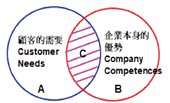
However, as Smith [6] mentioned, there are two parties involved in transactions and both need to align their interest to satisfy each other. In another framework (see Figure 3) by Chi-fai Chan et al. [7], customer needs and business and company competencies can be visualized as two circles with the left one representing customer needs and the right one representing company competencies.
Figure 3: Left-right theory diagram [7]
Chi-Fai Chan et al. [7] mentioned that for the company’s competencies to be relevant, it needs to understand the needs of its customers since customers have complex and layered needs both implicitly and explicitly [7].
In this research case, Bank Selaras Syariah tried to fulfill the needs of the Nasabah Sukses segment by providing flexibility and privacy to the customers by offering Individual Financing. However, as mentioned earlier, Bank Selaras Syariah also needs to have attention to other needs that come along with the new product such as the tenure, the plafond, the use purpose of the financing, the customer experience in the service and other needs that are relevant to the product. This will be required to match the Individual Financing products as Bank Selaras Syariah's capability with the customer needs.
Customer Behavior
Individual Financing is a relatively new product from Bank Selaras Syariah that is provided to existing loyal customers. Bank Selaras Syariah offered this exclusively to users with a good payment history with existing PMD products. The selected customers already formed a certain behavior towards the product. One definition regarding customer behavior is the study of how individuals spend their available resources (money, time, effort) on products or services [8]. It is closely related to the decision-making process that the customers make in analyzing, obtaining, consuming or discarding goods or services [9]. Customer behavior drives the decision-making throughout the journey of customers and most importantly how they spend their resources in repaying the financing.
Behavior is mentioned as translated to habit when it is done with little or no conscious thought [10]. Moreover, they mention that a product integrated into one’s life might drive the habit of the customer itself and it is not created, but rather built upon. Moreover, the concept of the habit-forming product also discusses how the habit is formed by a chain reaction that is caused by triggers that come externally and internally [10].
There are 4 types of external triggers mentioned by Eyal & Hoover [10] regarding building a habit. The first one is Paid Triggers which involves products or services to use incentives to encourage users to form habits. The second type is Earned Triggers where habits are built through the product's continuous visibility and positive word of mouth. The third one is Relationship Trigger, which focuses on how products build connections between users that lead to referral and habitual use. Lastly, Owned Triggers refer to products that actively integrate into the user’s ecosystem and gradually establish habits.
Additionally, Seiden [11] highlighted the significance of understanding customer behavior as a pivotal concept in delivering product value. Companies need to focus on the needs of their customers rather than focusing on what they intend to make. This implies that any feature or proposition a product offers should serve the purpose of facilitating a change, making it easier for the customer to complete a task or achieve a goal [11]. Moreover, Seiden argues that this principle also extends beyond product feature development such as changing policy, pricing, copy, positioning or employee behavior.
Bank Selaras Syariah faces a notable challenge in transitioning from the PMD product to the new Individual Financing product, marked by a low repayment rate. The PMD product deeply integrates with loyal customers, influencing their thoughts, emotions and daily routines. The shift to Individual Financing requires unique strategies for external triggers, including incentivization, relationship-building and feedback mechanisms. By understanding and prioritizing customer behavior, Bank Selaras Syariah aims to deliver product value and enhance the adoption of Individual Financing among its loyal customers.
Customer Journey
This research will explore and investigate the customer journey to dissect the product performance from the customers’ point of view. It is the process itself of purchasing and experiencing products or services from the customer’s perspective and can be thought of as walking “in the customer’s shoes” [12].
The analysis of the customer journey is critical in evaluating customer behavior, as it shows how customers navigate the system and enables us to highlight behaviors that require encouragement, those that are missing or those that need elimination [11]. It is the journey of the customers interacting with a firm over time during the purchase cycle across multiple touch points [13].
The definition of the customer journey implies that customer behavior becomes very dynamic and complex since it involves various channels and touchpoints and occurs in a certain period. The customer journey itself is usually mapped to create a visual depiction of the customer’s interaction with the organization [14].
In comprehending the Bank Selaras Syariah case, the customer journey serves as a tool to visualize behavior shaped by customer perception and needs. This analysis is crucial for identifying areas of improvement at each stage, fostering behavior change that drives business results for Bank Selaras Syariah.
The research questions and objective of this study are to understand bigger issues that occur in a product. It is aimed to gain understanding to develop an approach to solve the problem. The mentioned approach for this research can be categorized as exploratory research as it is aimed at understanding the problem confronting the researcher or in this case the product [15].
MATERIALS AND METHODS
The methodology focused in this research is the qualitative method which is seen as a method that involves the researchers’ interpretation and natural approach toward the subject of the issue [16]. There are some reasons that the author chose the qualitative methodology that will be deployed in the research. Firstly, this research will focus on deep diving into customer journeys in Individual Financing products. This method is focused on answering the research objective of identifying the perception and need of the customers toward the product. Since this research will focus on how needs and perception shape behavior, qualitative research is seen as more relevant to providing an understanding of the underlying behavior of customers in reaction to product stimuli [15].
Secondly, the methodology is also able to evaluate the experience of the customers in each touchpoint with detailed remarks. In the customer journey, qualitative research is suitable to focus on the emotions of the customers. The third reason is the limitation on the number of existing customers of the product. Currently, there are 30 customers of Individual Financing in Bank Selaras Syariah. The limitation of the participants available would suit and be more informative with qualitative research [17].
The main data collection for this research is through in-depth interviews. The writer will be going deeper into each customer by conducting in-depth interviews. This method is purposed to seek detailed information from key individual perspectives, feelings or experiences [18]. The key reason for the in-depth interview method in data collection is due to the sensitivity of the topic which consists of personal finance that may include their profile, income, financial motivation and other topics that may cause uncomfortable feelings if discussed among the group.
The discussion on the interview will follow a rough guideline in which the questioning will be based on the participant’s replies and the author will follow up with necessary probing to uncover relevant information for the research questions. This method of data depth interview approach is crucial as it is useful to obtain meaningful responses and uncover hidden issues [15].
In determining the sample size in this research, the writer will use the concept of saturation as a common guiding principle for assessing the adequacy of purposive samples in qualitative research where it’s defined as data adequacy [19] or can be also understood as where the researcher reaches the point when gathering fresh data no longer sparks new insights or reveal new properties [20]. Hence, the author will stop gathering participants in this research when the findings reach a plateau or no significant new insights.
The selection of the sample for qualitative research will be using purposive sampling. In qualitative research, sampling participants should be purposely selected to help best the researcher understand the problem and the research questions instead of selecting random sampling in a larger number of participants [21]. Purposive sampling itself is a sampling method where the researcher purposely selects the participant with particular criteria which are able to enrich the insights [22]. In this study, the writer would like to dive into the customers with four groups of main criteria:
Active customer of Individual Financing in Bank Selaras Syariah who already using the product for the last 3 month
Customers who have made late payments in the product
Potential customers of IF
Stakeholder of IF (Product Owner)
The similar character of the first group is based on the data clustering managed by internal data of Bank Berdaya Syairah. They are grouped based on these characteristics:
Being customer of Bank Berdaya Syariah for at least 3 years
Have last financing cycle of minimum 15 million rupiah
Similarly leading their own group financing (registered as ketua sentra)
Similar level of tech savviness (assessed internally to decide eligibility to IF product)
Have already disbursed their financing limit for the last 3 months
Second group has similar characteristics mentioned in the first group as the second group is also active customers. However, the second group have additional particular experience which is able to explain the late payment phenomenon since they all have made late payment during their repayment period for Individual Financing products. The third group also have similarities since they all have been filtered by several characteristics by Bank Berdaya Syariah. The characteristics are as below:
All potential customers categorized as Nasabah Sukses and being Bank Berdaya Syariah customer for at least 3 years
Have minimum financing of 15 million rupiah
Similar business scale with revenue of 30 – 50 million rupiah per month and have at least 3 employees
Have never made late payment in previous financing
Have adequate income to installment ratio of <30%
Approved eligible by the sales team by observing discipline, willingness to learn and business activity
In analyzing the qualitative data, the writer will use content analysis methodology. Qualitative content analysis has several definitions which are defined by Patton [23] as qualitative data reduction and the effort of making sense which takes the volume of qualitative material and identifying core meaning [23]. In this context, the author will take note of all the data from interviews conducted with all the respondents. The writer will identify categories among written, oral, explicit or inferred data with similar meanings into classification.
RESULTS AND DISCUSSION
The Customer Journey
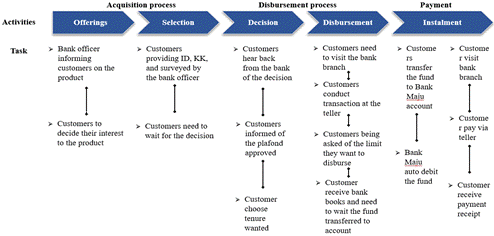
In the Individual Financing product, there are three major journeys that the customers experienced in interacting with the product that shown in figure 4 below. The first is the acquisition process, the second one is the disbursement process and the last one is the payment process. Each journey will be dissected in a journey that the customer needs to go through and experience which will be explained in the next part.
The acquisition stage comprises two essential processes that customers are required to undergo: the socialization and offering process and the survey and administration process. In the first phase, the bank officer provides customers with information and offers related to Individual Financing products. At the same time, the bank officer will survey the customers’ business using pre-set requirements. If the customers pass the requirement criteria, the bank officer will inform the limit facility that the customers receive. After that customers may choose the disbursement method whether physically through a bank branch or via mobile banking. All of the customers interviewed chose to come to the bank office since they don’t have mobile banking.
The next journey is the disbursement process which consists of document administration and the disbursement itself (receiving the fund). After they were surveyed and approved for the financing, they were invited to the nearest bank branch and required to bring eight duty stamps that they bought themselves, their documentation such as ID and family registration and also required to fill out forms and other personal data. After that, they would need to wait for 1 hour before they will receive their new bank account book for the financing. Subsequently, the teller will ask the amount of money they would like to disburse out of their facility limit. Subsequently, they will go to the nearest ATM to withdraw the funds and use the financing for their needs.
Within the payment process, customers are presented with two alternative procedures. The first option involves payment through a bank branch, necessitating customers to physically visit the nearest bank branch and submit their installment payment in cash to a teller. Customers who prefer this option usually have low-tech savviness and have less capability to use mobile banking.
The second alternative, referred to as auto-debit, requires customers to ensure that they have an adequate balance in their Bank Selaras Syariah account before the due date. The customers use this method to transfer the money from their daily-used bank account to the Bank Selaras Syariah account D-1 of the due date. Subsequently, Bank Selaras Syariah automates the payment process by debiting the required installment amount from the customer's account balance. These two distinct payment methods offer customers flexibility and convenience in meeting their financial obligations.
Customer Needs in Individual Financing Product
In understanding the evaluation of customers towards the product, the author interviewed the respondents regarding their needs towards financing the product overall and specifically towards Individual Financing product itself. As mentioned in the literature review, according to Kenyon and Sen [5], in understanding the needs of customers we have to understand that the purchase of one product comprises multiple attributes that become the judging parameter for the customers to categorize the product as a good performing product. In analyzing the performance of the product in fulfilling the needs, Chi-Fai Chan et al. [7] explains that it should be seen how the required needs of the customers and compared to the supplier's capability in fulfilling the needs. Hence in this section, the analysis will delve into customer needs by looking at what are the needs mentioned by customers and what expectations associated with each need.
In the acquisition/application process of financing, participants express a need for clear product information, emphasizing a streamlined survey process completed in a day with minimal back-and-forth communication and simple data requirements. Regarding the financing duration, opinions among participants vary, ranging from 18 to 36 months. Notably, many participants highlight that a larger disbursement may necessitate an extended financing period due to the additional time required for the money to circulate.
In terms of the margin, participants indicate that their consideration varies. Some emphasize the significance of the margin, stating that its acceptability depends on the ease of the acquisition process and collateral requirements. Participants note that a high margin is acceptable when the acquisition process is straightforward and collateral is not needed. Conversely, they expect a lower margin when collateral is required and the financing application process is lengthy. This nuanced perspective underscores the importance of considering both process efficiency and collateral demands in determining the acceptability of financing margins.
In the disbursement stage, participants highlight that the disbursed amount should be substantial enough to justify the effort invested in the financing application. For them, the process becomes worthwhile only if the desired disbursement amount is achieved. Additionally, participants express the expectation of same-day disbursement and emphasize the importance of a disbursement channel that offers easy access and privacy. Flexibility in disbursement methods is also deemed essential, with participants emphasizing the need for immediate capital during specific business periods, such as high seasons or opportune moments.
Transitioning to the payment method, participants express a preference for a simple payment process that is convenient for them. They stress the importance of a payment method that allows them to focus on their business instead of spending considerable time managing payments on each due date. Moving to the collection method during late payment, participants commonly expect a reminder-based approach. They anticipate the bank to remind them through calls or SMS after the due date. Based on past experiences with other banks, some participants are cautious and prioritize a comfortable collection method to avoid discomfort when making late payments or considering future financing or loans.
Customer Perception of Individual Financing Product Proposition
In explaining customer perceptions, the author will analyze three key components as outlined by Kenyon and Sen [5]: noticing the stimulus, connecting the stimulus to familiar patterns and interpreting the pattern based on attitudes, needs, experiences, expectations, goals, values and physical conditions, ultimately forming percepts [5].
In this section, the author will explore two main aspects of customer perception. The first concerns the comprehension or understanding of the product itself, considering that customers with diverse backgrounds may interpret the product proposition differently. The second topic revolves around customers' perceptions of product performance, anchored in their needs as explained in the preceding section. The author will assess whether customers perceive their needs as being fulfilled by the product proposition. To identify participants' perceptions of the product, the author will reference the product proposition defined by stakeholders, as outlined in Table 3.
Table 3. Repayment rate performance of Individual Financing vs PMD regular April – September 2020
Stage in Customer Journey
Product Proposition
Explanation
Acquisition
Pre-Approved Process
The customer assessment process is conducted only once at the beginning, so there is no need to undergo the assessment process for each new financing application or top-up.
Disbursement
Disbursement via Transfer
Disbursement is done by transferring funds to the customer's account, so customers do not have to wait for disbursement from officers at the PRS.
Line Facility
Customers have a flexible financing limit that can be used according to their needs. Customers also can freely choose available tenors.
Payment
Monthly Installment
The installment schedule, previously done every two weeks, is now done every month.
Auto-debit Installment
Installments are automatically debited from the customer's bank account.
Non-mandatory PRS
Customers are not required to attend PRS every two weeks, allowing them to focus on running their businesses.
Lower Margin
The financing margin is lower compared to regular financing products.
Source: Bank Selaras Syariah internal reporting, 2020
In terms of the Acquisition/Pre-Approved Process, there is a notable discrepancy in comprehension between active and potential customers. Active customers often assume they must undergo a similar acquisition process for new financing or top-ups, drawing from their experience with PMD products. In contrast, potential customers have a higher comprehension, perceiving this proposition positively as a simplification of the acquisition process.
Addressing the Needs in Application and Acquisition Process, the initial phase demands clear product information and a streamlined survey with minimal data requirements. While the Individual Financing product is designed to cater to this in the pre-approved feature, active customers find the process complex initially, akin to PMD product experiences.
Regarding Disbursement via Transfer, both active and potential customers exhibit clear comprehension, being familiar with bank transfers. However, participants expressed some concerns regarding the speed and accessibility of the disbursement point, despite their familiarity with the process.
The Line Facility feature encounters low comprehension among active customers, with only a few being aware and having a clear understanding. This lack of understanding stems from minimal explanation during acquisition. Conversely, potential customers comprehend this feature better, viewing it as a faster top-up program for additional financing during ongoing financing.
Monthly Installment considered helpful by customers, garners high attention from both active and potential participants. Active customers, having undergone payments, find it to be a significant differentiation from the PMD product they were accustomed to.
Auto Debit Installment is well understood by most customers, although concerns arise regarding the method's ease and convenience. Active customers, lacking easy access to mobile banking or ATMs, express concerns about learning the method and remain unfamiliar with the mechanism. Conversely, potential customers are already familiar with the feature.
The Non-Mandatory PRS offering, a departure from the previous PMD product's mandatory bi-weekly meetings, is clearly understood and perceived as highly beneficial. Participants appreciate the reduction in physical meetings, allowing for more flexibility and privacy.
Regarding the Lower Margin, most participants find the margin acceptable due to the absence of collateral and the bank's direct field visits. However, it is not considered lower than competitors, leading some customers to contemplate moving to a competitor due to perceived margin differences.
Customer Assessment of Individual Financing Product Proposition in Catering Their Needs
In the Application and Acquisition Process, the initial phase demands clear product information and a streamlined survey with minimal data requirements. Despite the Individual Financing product being designed to fulfill this requirement through the pre-approved feature, its impact primarily becomes apparent in subsequent financing cycles. Surprisingly, upon onboarding the Individual Financing product for the first time, customers still encounter several acquisition steps, reminiscent of those in the PMD product.
For the Financing Duration, where flexibility is key, the Line Facility product feature aims to meet these requirements. However, it falls short as the perceived strictness of financing duration leaves some participants with limited options. Instances were reported where customers were automatically given a set length of installment, potentially leading to monthly payments exceeding their budget.
Delving into Disbursement-related needs, several aspects come into play, including comparing the amount to the effort required, the speed of disbursement and the channel's flexibility. The pre-approved process, Line Facility and Disbursement via Transfer are product propositions catering to these needs. While the disbursement amount linked to the pre-approved process generally satisfies active customers, complexities arise in the first cycle of Individual Financing. Despite these challenges, the speed of disbursement meets customer expectations, especially when compared to the regular PMD process.
Regarding the flexibility of disbursement, intricacies emerge from the pre-approved process and Line Facility features. Some customers misunderstand these features, leading to a perception of less flexibility. For instance, a customer's attempt to disburse their entire limit was met with the bank advising a partial withdrawal, causing confusion and potentially limiting the perceived flexibility.
On the Payment Method, customers expect simplicity and convenience. The product proposition introduces an Auto Debit feature and Non-Mandatory PRS attendance to address these expectations. Non-mandatory PRS attendance garners positive feedback for its alignment with customers' busy schedules. However, the Auto Debit method faces challenges, especially concerning customers lacking easy access to mobile banking. The complexity intensifies with the payment due date being based on the disbursement date, resulting in concerns about managing multiple payments, particularly when there are various due dates in a single month.
Shifting focus to the Collection Method, although not explicitly addressed in the product proposition, customers find their needs met with the bank's persuasive collection efforts. However, customers advocate for reminders before the due date to enhance payment awareness. Lastly, in terms of Collateral, customers appreciate the absence of collateral, coupled with a higher margin compared to competitors. Nevertheless, some express openness to collateral requirements in the future if accompanied by adjusted margins and increased financing limits.
Customer Behavior Observed and Potential to Late Payment
In the acquisition stage, customers relying on the bank's familiarity with previous PMD products might accept Individual Financing without fully comprehending its terms. This habitual acceptance, coupled with low awareness, could lead to an unintentional commitment to repayment terms. The lack of understanding may result in customers facing challenges in meeting payment deadlines, contributing to potential late payments.
In selecting tenor options, some customers experienced strictness and inflexibility which might drive the customers to accept repayment terms misaligned with their business performance. During financial difficulties, adhering to installment schedules could become burdensome, impacting timely repayments. The unmet needs in tenor options may prompt customers to reassess resource allocation, potentially causing delays in meeting payment deadlines.
A lack of understanding about product propositions, particularly in flexible disbursement with a limit facility, may drive customers to withdraw the entire limit instead of utilizing what's necessary. This unintended behavior can lead to financial strain during repayment, obligating customers to repay the total disbursed amount, even when not immediately required. Moreover, customers deviating from the intended use of the Line Facility feature by keeping the full disbursed amount for personal purposes may strain finances during repayment. If not managed carefully, this behavior could result in suboptimal financing usage for business purposes, potentially impacting business growth and causing delays in repayment.
In the payment system, the customers face challenges in several areas which causes them to depend on other people to conduct the payment. This behavior for financing payments introduces a potential point of failure. Reliance on friends or family for payments can lead to delays if intermediaries face challenges or are unable to make timely payments. This dependency increases the risk of late payments.
Another behavior that appears in using mobile banking is the tendency of customers to pay close to the due date and might face unreliable digital transactions in the mobile banking platform. Reliance on mobile banking becomes a potential source of delays when faced with technological challenges. Difficulty using the platform or experiencing network errors may hinder customers from making timely payments.
Participants also mention potential late payment that might arise from the product proposition itself. The product features flexible withdrawal of financing may cause multiple due dates in one month. Potential customers see this as a problem where they perceive the condition will cause complexity in payment and also make it difficult for them to focus on turning around the money in business since they are being chased with due dates. In addition, the lack of a reminder system may lead to oversight and unintentional delays in making payments. Participants not setting reminders for payment due dates and relying solely on memory introduce a potential risk of forgetfulness, especially as the number of financing arrangements increases. This lack of automatic reminders could contribute to late payments, particularly when payment due dates fall on holidays, causing potential confusion and delays.
CONCLUSION
The findings of the research have led to significant conclusions, aligning with the research objectives of identifying key customer needs, evaluating customer perceptions across the Individual Financing (IF) product journey and proposing targeted improvements to meet customer requirements.
In the acquisition stage, customers express a need for comprehensive product information, a streamlined survey process, straightforward data requirements, an appropriate financing duration and an acceptable margin. However, during interviews, customers encountered challenges in grasping product details and the pre-approved acquisition process, leading to perceptions of low product clarity and a complex acquisition procedure.
Moving to the disbursement stage, customers exhibit varied understanding of the mechanism, resulting in ineffective utilization of the disbursement limit. Additionally, those who comprehend the flexible disbursement mechanism express concerns about managing multiple due dates, indicating a need for clearer communication and guidance.
In the payment/collection stage, customers demonstrate a solid understanding of the payment mechanism but struggle with real-life execution, emphasizing a perceived lack of simplicity and convenience. The absence of reminders raises apprehensions about potential missed payments, especially with multiple due dates.
Recommendations
To address these issues and enhance the IF product, the proposed improvement plan focuses on several key areas. In the acquisition stage, emphasis should be placed on enhancing product information, particularly regarding Line Facility features. Clear communication, a user-friendly process and proactive customer support are crucial for ensuring a complete understanding of the product proposition.
For the payment/collection stage, the addition of a reminder mechanism is recommended to facilitate better communication and prevent customers from forgetting due dates. Exploring options to consolidate bills into a single due date is suggested to simplify the payment mechanism, especially for customers with multiple disbursements.
In terms of adjustments to the business model canvas, the following modifications are proposed: the addition of a singular billing mechanism under Value Proposition, inclusion of a digital app in Channels for improved accessibility, introduction of an additional revenue stream from fee-based transactions, incorporation of key resources such as IT, HR and partnerships, addition of key activities like transitioning PRS, digital app development and monthly visits, establishment of key partnerships with external parties, such as PT PS and adjustments in the cost structure to include training costs, new team development (if required) and digital app investments.
These proposed changes aim to address customer needs, improve product clarity and ultimately enhance the overall customer experience with the IF product.
REFERENCE
UNCDF. The UN Capital Development Fund. 2023. United Nations, https://www.uncdf.org/sdgs.
World Bank. The World Bank. 29 March 2022. World Bank, https://www.worldbank.org/en/topic/financialinclusion/overview.
The Asian Banker. The Asian Banker. 16 November 2022. The Asian Banker, https://theasianbanker.com/finance-indonesia-2022/.
Carbone, L.P. and S.H. Haeckel. Engineering Customer Experience. American Marketing Association, 1994.
Kenyon, G.N. and K.C. Sen. The Perception of Quality: Mapping Product and Service Quality to Consumer Perception. Springer-Verlag, 2015.
Smith, I. Meeting Customer Needs. Elsevier Science Ltd., 2003.
Chi-fai Chan, A. et al. Customer Needs and Strategic Management. World Scientific Publishing Co. Ptc. Ltd., 2022.
Schiffman, L.G. et al. Consumer Behavior. Pearson Australia Group Pty Ltd., 2014.
P., T.L. Consumer Behavior: Understanding Consumer Behavior to Convert More Customers. Nestfame Creations Pvt. Ltd., 2022.
Eyal, N. and R. Hoover. Hooked: How to Build Habit-Forming Products. Penguin Random House LLC, 2014.
Seiden, J. Outcomes Over Output: Why Customer Behavior Is the Key Metric for Business Success. Sense & Respond Press, 2022.
Harris, P. et al. "Customer journey." The Routledge Companion to Strategic Marketing, Routledge, 2020, p. 67.
Lemon, K.N. and P.C. Verhoef. "Understanding customer experience throughout the customer journey." Journal of Marketing, 2016, pp. 69–96.
Schlegelmilch, B.B. and R.S. Winer. "Customer journey." The Routledge Companion to Strategic Marketing, Routledge, 2020.
Denzin, N.K. and S.Y. Lincoln. Handbook of Qualitative Research. SAGE Publications, 1994.
Nunnally, B. and D. Farkas. UX Research: Practical Techniques for Designing Better Products. O’Reilly Media, Inc., 2016.
Rutledge, P. and J.L. Hogg. "In-depth interviews." International Encyclopedia of Media Psychology, draft version, 2020.
Morse, J.M. "The significance of saturation." Qualitative Health Research, May 1995, SAGE Publications, Inc.
Charmaz, K. Constructing Grounded Theory. SAGE Publications, 2006.
Creswell, J.W. and J.D. Creswell. Research Design: Qualitative, Quantitative and Mixed Methods Approach. SAGE Publications, 2018.
Irawan, P. Penelitian Kualitatif dan Kuantitatif Untuk Ilmu-Ilmu Sosial. Departemen Ilmu Administrasi, Fakultas Ilmu Sosial dan Ilmu Politik, Universitas Indonesia, 2006.
Patton, M.Q. Qualitative Research and Evaluation Methods. SAGE Publishers, 2002.
License
Creative Commons Attribution-NonCommercial-NoDerivatives 4.0 International License
All papers should be submitted electronically. All submitted manuscripts must be original work that is not under submission at another journal or under consideration for publication in another form, such as a monograph or chapter of a book. Authors of submitted papers are obligated not to submit their paper for publication elsewhere until an editorial decision is rendered on their submission. Further, authors of accepted papers are prohibited from publishing the results in other publications that appear before the paper is published in the Journal unless they receive approval for doing so from the Editor-In-Chief.
Himalayan Journal of Economics and Business Management open access articles are licensed under a Creative Commons Attribution-Share A like 4.0 International License. This license lets the audience to give appropriate credit, provide a link to the license, and indicate if changes were made and if they remix, transform, or build upon the material, they must distribute contributions under the same license as the original.
Recommended Articles
Research Article
Influence of Leadership on Poverty Reduction in the Devolved Government in Trans-Nzoia County, Kenya
Kinisu Sifuna,
...
Peter Simotwo
Published: 30/06/2021
Download PDF
Cite
x
APA
Sifuna, K., Lwangale, D. W., Simotwo, P., Sifuna, K., Lwangale, D. W. & Simotwo, P. (2021). Influence of Leadership on Poverty Reduction in the Devolved Government in Trans-Nzoia County, Kenya. Himalayan Journal of Economics and Business Management, 2(1), None-None.
MLA
Sifuna, Kinisu, et al. "Influence of Leadership on Poverty Reduction in the Devolved Government in Trans-Nzoia County, Kenya." Himalayan Journal of Economics and Business Management 2.1 (2021): None-None.
Chicago
Sifuna, Kinisu, David W. Lwangale, Peter Simotwo, Kinisu Sifuna, David W. Lwangale and Peter Simotwo. "Influence of Leadership on Poverty Reduction in the Devolved Government in Trans-Nzoia County, Kenya." Himalayan Journal of Economics and Business Management 2, no. 1 (2021): None-None.
Harvard
Sifuna, K., Lwangale, D. W., Simotwo, P., Sifuna, K., Lwangale, D. W. and Simotwo, P. (2021) 'Influence of Leadership on Poverty Reduction in the Devolved Government in Trans-Nzoia County, Kenya' Himalayan Journal of Economics and Business Management 2(1), pp. None-None.
Vancouver
Sifuna K, Lwangale DW, Simotwo P, Sifuna K, Lwangale DW, Simotwo P. Influence of Leadership on Poverty Reduction in the Devolved Government in Trans-Nzoia County, Kenya. Himalayan Journal of Economics and Business Management. 2021 Jan;2(1):None-None.
Download PDF
Research Article
Modelling Structure Job Quality, Job Design and Job Satisfaction
Moch Nurhadi,
...
Avi Sunani
Published: 30/08/2022
Download PDF
Cite
x
APA
Nurhadi, M., Bisyri Effendi, M., Saiful Ulum, A. & Sunani, A. (2022). Modelling Structure Job Quality, Job Design and Job Satisfaction. Himalayan Journal of Economics and Business Management, 3(2), 1-4.
MLA
Nurhadi, Moch, et al. "Modelling Structure Job Quality, Job Design and Job Satisfaction." Himalayan Journal of Economics and Business Management 3.2 (2022): 1-4.
Chicago
Nurhadi, Moch, Moch Bisyri Effendi, Achmad Saiful Ulum and Avi Sunani. "Modelling Structure Job Quality, Job Design and Job Satisfaction." Himalayan Journal of Economics and Business Management 3, no. 2 (2022): 1-4.
Harvard
Nurhadi, M., Bisyri Effendi, M., Saiful Ulum, A. and Sunani, A. (2022) 'Modelling Structure Job Quality, Job Design and Job Satisfaction' Himalayan Journal of Economics and Business Management 3(2), pp. 1-4.
Vancouver
Nurhadi M, Bisyri Effendi M, Saiful Ulum A, Sunani A. Modelling Structure Job Quality, Job Design and Job Satisfaction. Himalayan Journal of Economics and Business Management. 2022 Jul;3(2):1-4.
Download PDF
Research Article
The Constitutional and Legislative Basis for Considering the Taxable Capacity of Taxpayers in Iraqi Tax Legislation
Hussein Kamel Wadaa
Published: 05/05/2025
Download PDF
Cite
x
APA
Wadaa, H. K. (2025). The Constitutional and Legislative Basis for Considering the Taxable Capacity of Taxpayers in Iraqi Tax Legislation. Himalayan Journal of Economics and Business Management, 6(1), 1-10.
MLA
Wadaa, Hussein Kamel. "The Constitutional and Legislative Basis for Considering the Taxable Capacity of Taxpayers in Iraqi Tax Legislation." Himalayan Journal of Economics and Business Management 6.1 (2025): 1-10.
Chicago
Wadaa, Hussein Kamel. "The Constitutional and Legislative Basis for Considering the Taxable Capacity of Taxpayers in Iraqi Tax Legislation." Himalayan Journal of Economics and Business Management 6, no. 1 (2025): 1-10.
Harvard
Wadaa, H. K. (2025) 'The Constitutional and Legislative Basis for Considering the Taxable Capacity of Taxpayers in Iraqi Tax Legislation' Himalayan Journal of Economics and Business Management 6(1), pp. 1-10.
Vancouver
Wadaa HK. The Constitutional and Legislative Basis for Considering the Taxable Capacity of Taxpayers in Iraqi Tax Legislation. Himalayan Journal of Economics and Business Management. 2025 Jan;6(1):1-10.
Download PDF
Research Article
Proposed Digital Marketing Strategy to Enhance Engineering Consultancy Company Revenue
Alfarisy, K. A.,
Wandebori, H.
Published: 30/04/2024
Download PDF
Cite
x
APA
K. A., A. & H., W. (2024). Proposed Digital Marketing Strategy to Enhance Engineering Consultancy Company Revenue. Himalayan Journal of Economics and Business Management, 5(1), 1-18.
MLA
K. A., Alfarisy, and Wandebori, H.. "Proposed Digital Marketing Strategy to Enhance Engineering Consultancy Company Revenue." Himalayan Journal of Economics and Business Management 5.1 (2024): 1-18.
Chicago
K. A., Alfarisy, and Wandebori, H.. "Proposed Digital Marketing Strategy to Enhance Engineering Consultancy Company Revenue." Himalayan Journal of Economics and Business Management 5, no. 1 (2024): 1-18.
Harvard
K. A., A. and H., W. (2024) 'Proposed Digital Marketing Strategy to Enhance Engineering Consultancy Company Revenue' Himalayan Journal of Economics and Business Management 5(1), pp. 1-18.
Vancouver
K. A. A, H. W. Proposed Digital Marketing Strategy to Enhance Engineering Consultancy Company Revenue. Himalayan Journal of Economics and Business Management. 2024 Jan;5(1):1-18.
Tauhid, K. & Belgiawan, P. F. (2024). Proposed Plan to Enhance Payment Behavior through Customer Needs Analysis of Individual Financing Product. Himalayan Journal of Economics and Business Management, 5(1), 1-10.
MLA
Tauhid, Kharisma and P. Fajarindra Belgiawan. "Proposed Plan to Enhance Payment Behavior through Customer Needs Analysis of Individual Financing Product." Himalayan Journal of Economics and Business Management 5.1 (2024): 1-10.
Chicago
Tauhid, Kharisma and P. Fajarindra Belgiawan. "Proposed Plan to Enhance Payment Behavior through Customer Needs Analysis of Individual Financing Product." Himalayan Journal of Economics and Business Management 5, no. 1 (2024): 1-10.
Harvard
Tauhid, K. and Belgiawan, P. F. (2024) 'Proposed Plan to Enhance Payment Behavior through Customer Needs Analysis of Individual Financing Product' Himalayan Journal of Economics and Business Management 5(1), pp. 1-10.
Vancouver
Tauhid K, Belgiawan PF. Proposed Plan to Enhance Payment Behavior through Customer Needs Analysis of Individual Financing Product. Himalayan Journal of Economics and Business Management. 2024 Jan;5(1):1-10.


 Download PDF
 Download XML